




Abstract
When properly understood in the context of entrepreneurship, entanglement explains the complex ingredients in the tangled relations required for entrepreneurial success. However, in examining entrepreneurial success, many scholars overlook a critical consideration—are the right resources (people and materials) in the right place at the right time? How do entanglement and convergence come about? This occurs when a microsystem is entangled with many fine-grained structures with different degrees of freedom, converging to generate emergence. These fine-grained structures are the heterogeneous agents with correlated histories (co-founders, financiers, suppliers, competitors, customers, employees, etc.) that are entangled with the entrepreneurs. This article explains the complex causes in the emergent order arising from several entangled dynamics among the heterogeneous agents and resources. The challenge is understanding what complex ingredients and combinations are necessary for a new emergent order that gives rise to such possibilities. Finally, such emergence arising from entanglement is discussed to explain collaboration and coevolution effects, and suggestions for future research that utilises the intended theorisations of practice are offered.
‘Entrepreneurship is a process’ (Mcmullen & Dimov, 2013, p. 1481), but what is involved in that process? This article introduces a novel approach to describe the process using entanglement, opportunity and collaborative entrepreneurship in terms of complexity and quantum science. It explores the origins and emergence of order from self-organisation in the disorderliness and messiness of entrepreneurial venturing. Entrepreneurs are treated as complex and connected entities in a tangled pool of relationships—intermingling, interfering and interacting. However, this article argues that entrepreneurial emergence arises not among entities existing in the entangled pool but rather in the connections (entangled fates) among them at the right time to form an efficacious entrepreneurial organisation.
There is a certain sense of disorderliness in the entangled affairs between entrepreneurs and the heterogeneous agents. ‘Disorder, to natural scientists, means the second law of thermodynamics, namely, inexorable dissipation toward entropy and randomness’ (McKelvey, 2001b, p. 137). In the search for the hidden order amid the chaos, entrepreneurial venturing involves identifying complex interdependencies (between heterogeneous agents and resources) to find the best profitable yields through self-organisation and the conceptualisation of exploitation strategies. Whether conceptualised as the creation of new products, services or processes (Schumpeter, 1934); the creation of new ventures through co-creating, organising and performing (Shepherd et al., 2020); or through the ‘creation of new and emerging markets through discovery and exploitation of profitable opportunities’ (Shane & Venkataraman, 2000, p. 217), the creation of order from disorder in a particular space and time must be considered. The complex components arising from the disorder—appearing at a different time in space (or a different space in time)—may not create the same outcome. Here, the argument features a time perspective in the convergence of heterogeneous agents and resources, bringing about an emergence with exploitable opportunities. This article initiates a deeper dialogue on entanglement and the emergence of order in relation to timeliness in entrepreneurship. It illustrates the criticality of timing and entangled effects by applying quantum formalism and complexity science concepts.
This article explicitly uses quantum references and complexity science to clarify entrepreneurship. The theories and methodologies of the quantum sciences can offer both constructive theoretical advancements and practical insights to help address contemporary societal challenges and investigate problems relating to finance, economics, psychology, sociology or other domains of inquiry (Haven et al., 2013). Quantum mechanical principles are counterintuitive on the Planck (quantum) scale, and the social science aspects of the investigation involve research on a macroscopic scale. Specifically, this article uses quantum formalism in a social science environment to provide novel insights, such as entanglement in an entrepreneurial setting. Any suggestions, at best, are quantum-like. The basic premise is that the social entrepreneurial system is highly complex, with many hierarchically nested relationships that interfere and interact, generating highly probabilistic outcomes. Entrepreneurial emergence and its consequences are fundamentally unpredictable and probabilistic. In these cases, quantum theorisations can provide a framework for approaching the entanglement and the emergent order of entrepreneurship at a level that can offer constructive theoretical advancements and practical insights to better address the highly probabilistic entrepreneurial phenomena.
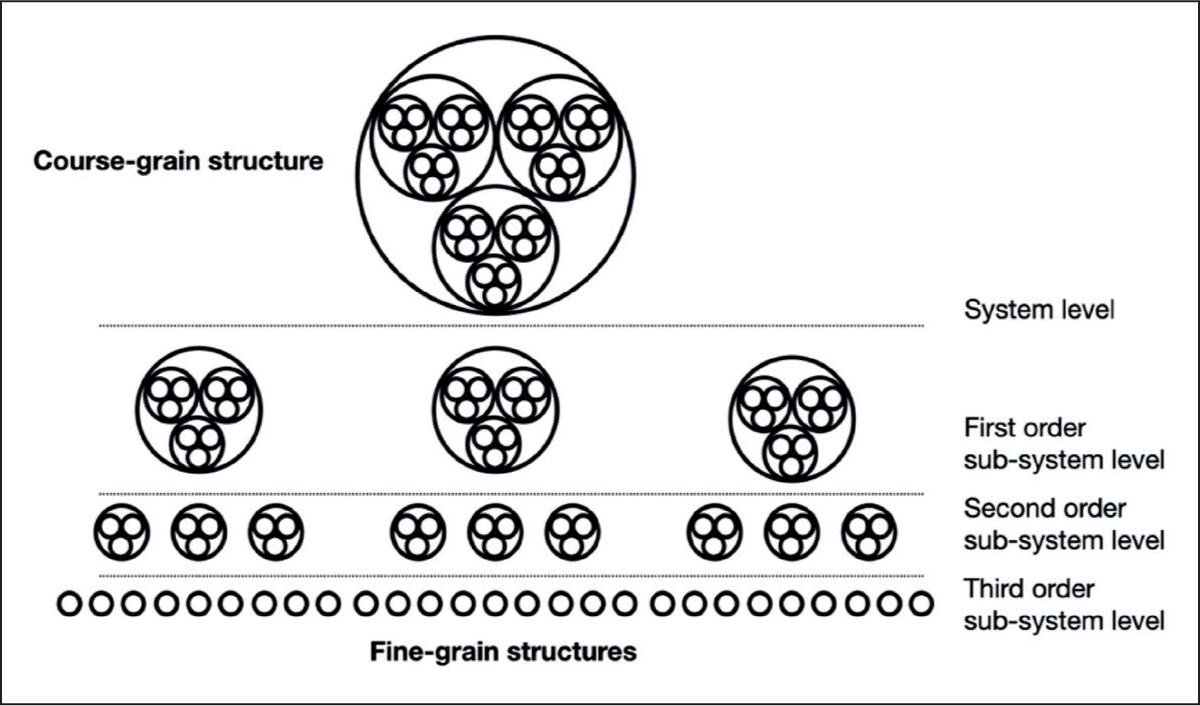
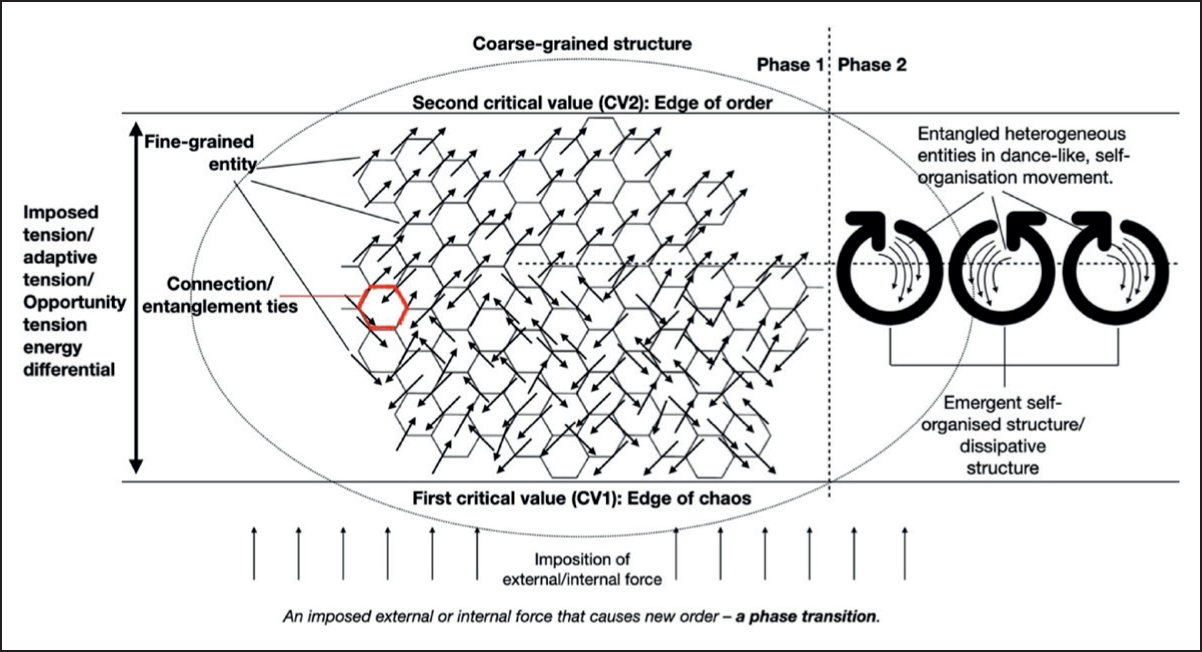
The article is organised as follows. The literature review section enumerates the problems and gaps in entrepreneurial studies featuring the actions of entrepreneurs and their central role in entrepreneurship. The systematic literature review discusses the challenges, problems and impacts of relational effects on entrepreneurship. The review clarifies the hierarchical and relational nested structure based on the generalisation of existing theories and approaches (Figure 1). The discussion analyses and generalises the determinants of entanglement and proposes an agent-based model of entrepreneurial dynamics describing the entangled synchronicity in action due to self-organisation (Figure 2).
Peer-Level Horizontal Relationships and Hierarchically Nested Vertical Relationships.
Entangled Synchronicity in Action Due to Self-Organisation from Imposed Tension.
This article concludes that entangled fates, synchronicity in action and butterfly effects open novel ways to explore the dynamics of entrepreneurial emergence and the generation of possibilities.
Literature Review
This article addresses agentic relations and discusses the entangled effect of these relationships and their impacts on entrepreneurship. The systematic review searches Scopus, Web of Science Core Collection, Google Scholar and forward and backward citations for studies up to 2022. To gain meaningful insights into the relational effects on entrepreneurship, the comprehensive systematic literature review analyses existing approaches to entrepreneurship on relationships, ties and interrelatedness of stakeholders in the venturing process. The following research questions are posed: (a) What are the critical processes for entanglement in business venturing? (b) How entanglement implicates agents, particularly concerning involved agents, opportunities and risks, resources, processes and other factors to give rise to an emergent order? This article defines and clarifies the critical determinants of entanglement and analyses their interconnections and support systems in the entrepreneurial process.
The justifications of studies in entanglement and the emergent order are explained in these clarifications. Bergman and McMullen (2022) described these support systems as entrepreneurial support organisations (ESOs such as incubators, co-working spaces and accelerators) and despite ‘this proliferation, their impact on entrepreneurs, ventures, and communities remains unclear, while academic research remains disjointed and largely descriptive, limiting understanding of the entrepreneurial support process and the influence of ESOs on it’ (p. 688). These support systems interact with the entrepreneurs in a processual and relational manner. Similarly, McKelvey (2002) suggested the concept of fine-grained entanglement in a discussion about emergent order in firms and how the fine interactions at the organisational level impact order creation. McKelvey (2002) explained entanglement as the interdependence of two entities such that neither one’s behaviour can be understood independently as they have correlated interdependence. Entrepreneurial activities are situated within communities (in incubators, accelerators, co-working spaces, etc.) in a range of structures with strong and weak ties. Fuller and Warren’s (2006) complex social network perspective provided insights into the layers constituted in the multi-level social network model characterising emergent structure relationships. The entanglement ties discussed in this article are proposed as alternatives to sociologists’ weak and strong ties (Granovetter, 1983; Henning & Lieberg, 1996). The systematisation of the extant literature is highly relevant for future research to understand the interrelations between agents within the entrepreneurial structures and the socioeconomic system in general. This understanding necessitates further exploration and research in entrepreneurship related to content, method and theory.
The discussion of entanglement, decoherence, coarse-graining and fine-graining in the context of entrepreneurship begins with a review of how order from coarse-graining emerges from the fine-grained structure of entanglement pools of entrepreneurial phenomena. Next, these terms are discussed concerning business venturing—all to understand the concept of unknown correlations, coevolving causalities and entangled effects that often generate unexpected and unanticipated entrepreneurial outcomes that change the fortunes of entrepreneurs. This study, therefore, unravels the entangled entrepreneurial dynamics to explain the causal forces at play, at a specific time, in entrepreneurship and the power of the intertwined causal forces, at the right time that generate potentially path-changing business trajectories.
Problematisation and Gaps in Literature
Time sensitivity and timeliness (i.e., achieving something at the right time) are not typically addressed in entrepreneurial research. Levesque and Stephan (2020) argued that the study of time in entrepreneurship is largely neglected, with two exceptions. First, there has been a call to view entrepreneurship as a nonlinear process (Joglekar & Lévesque, 2013; Levie & Lichtenstein, 2010; Lichtenstein et al., 2007; Mcmullen & Dimov, 2013). Mcmullen and Dimov (2013) proposed a fundamental inquiry shift from entrepreneurship as an act to a journey, studying when it starts and ends (relative to time). They further discussed the subdivision of the journey into episodes and events for a clearer understanding of the entrepreneurial journey concerning time, ‘where a process orientation has been conspicuously absent’ (Mcmullen & Dimov, 2013, p. 1481). Second, there has been an emphasis on the time perspective, taking a long-term orientation prevalent in family businesses (Lumpkin & Brigham, 2011). While these views of time are critical, they do not address the issue of what is the right time to take action. They discussed the flow and measurement of time but stopped short of discussing this question of timeliness. This article suggests a clearer understanding of entanglement and the emergent order in entrepreneurship by adopting a time-based lens to explain the trigger of the emergence and the timeliness imperative.
Traditionally, economists treat all agents and economic actors as rational (Friedman, 1953). However, they also attribute to them a particular entrepreneurial orientation (with a degree of freedom to self-organise) rationally, under uncertainty, for optimal results (Mason, 2006). Furthermore, economists and organisation scientists tend to develop theories using idealised models whose uniformity and linearity assumptions provide ‘instrumental conveniences’ (McKelvey, 1997):
We are not good at thinking about movement. Our instinctive skills favour the fixed and static, the separate and the self-contained. Taxonomies, hierarchies, systems and structure represent the instinctive vocabulary of institutionalised thought in its determined subordinating of flux, movement, change and transformation. (Chia, 1999, p. 128)
Idealised models with linearity and equilibrium at the centre of the theorisations do not reflect the uncertainty pervasive in entrepreneurial venturing. Instead, organisations and scientists increasingly explore uncertainties in field-wide flux, emergence and convergence, and they investigate complexities and nonlinearities in far-from-equilibrium situations (Meyer et al., 2005).
Entrepreneurship requires theories based not on the singular actions of agents or the characteristics of agents but on the co-evolutionary interdependencies of other significant heterogeneous agents involved and entangled in their entrepreneurial journeys. The literature extensively covers entrepreneurs’ traits, behaviours and characteristics (Bruyat & Julien, 2001; Gartner, 1989; Kuratko et al., 2015; Landstrom, 1999) and examines them from the perspective of the internal locus of control (Karabulut, 2016), orientation (George & Marino, 2011; Lyon et al., 2000; Wales, 2016), need for achievement (Wu et al., 2007) and propensity to take risks (Alshebami & Seraj, 2022; Palich & Ray Bagby, 1995); however, the singular descriptions of the entrepreneurs, devoid of other involved stakeholders, cannot wholly describe entrepreneurship. Entrepreneurship must include descriptions of a supportive environment (Bull & Willard, 1993) and support agencies (Chell & Baines, 2000). Networks, relationships and connections are instrumental, as entrepreneurs rely on them to access resources.
Witt (2004) advanced the network success hypothesis underpinned ‘by the theory of socially embedded ties that allow entrepreneurs to get resources cheaper than they could be obtained on markets and to secure resources that would not be available on markets at all, for example, reputation, customer contacts, etc.’ (p. 391). The coalesced web of relationships comprises tightly and loosely interdependent and mutually supportive agents. Miller and Friesen (1984) described such configurations as ‘constellations of conceptually distinct variables or elements that cluster together to characterise many aspects of organisational states and processes’ (p. 4). What is crucial is that the constellations of conceptually distinct variables/agents exist interdependently and are simultaneously connected to the structure/entrepreneur. ‘Entanglement is about what exists before order emerges in the physical world’ (McKelvey, 2002, p. 1). Here, this study argues that the entangled fates of these interdependent and mutually supportive agents drive the formation of an entrepreneurial order. The entangled fates should be examined in relation to time—the timeliness of the association and connection. This research advances a model illustrating the entangled synchronicity from which self-organisation emerges from the imposed tension, presupposing the entrepreneur as a complex adaptive agent working in concert with other stakeholders—at the right time and in the right space.
Entrepreneurship is not a singular effort of an entrepreneur who merely recognises, evaluates and exploits opportunities (Chiles et al., 2007) but one that occurs through the actions of multiple agents (co-founders, competitors, financiers, investors and suppliers). The many agents involved have diverse agendas enjoined in various interdependencies and interact in dynamic ways. Significant actors and agents with resources converge in complex interdependencies in their entangled fates and web of relationships. With the entrepreneur as the main actor and the heterogeneous agents as a constellation of interdependent and mutually supportive agents situated in specific historical conditions and entanglement (Thompson et al., 2020), many plausible outcomes may arise. Hence, ‘entrepreneurship is not a unique individual behaviour, substance, state or event that can be a priori fully specified, uniformly observed and homogenously theorised’ (Thompson et al., 2020, p. 248). Entrepreneurship involves entangled heterogeneous agents acting out, each in their own way, and contributing to the emergent event. Such emergent events resulting from the combinatorial effects of heterogeneous agents’ interactions can produce a disproportionate outcome. Each of these agents moves along a particular trajectory; in an entrepreneurial event, they converge, interfere and are entangled in a specific spacetime to produce an outcome. Small inputs from heterogeneous agents can generate significant effects known in the chaos metaphor as the ‘butterfly effect’ (Bygrave, 1993; Gleick, 2008). Such significant effects generally lead to epic breakthroughs or failures in business venturing. Hence, entrepreneurship should be studied in a larger context, including the actions of other heterogeneous actors and the environment. For example, this approach should consider Davidsson et al.’s (2020) external enablers (new technologies, demographic and regulatory shifts or changes in the natural, economic or political environment) that exist at the right time and in the right place. The convergence, association and entanglement effects, occurring in a timely way, are the reasons for epic successes or failures. Here, this research draws on Gell-Mann’s (1995) decoherence to explain entanglement, coarse-grained histories (the larger picture), fine-grained entities (the smaller interacting layers) and interferences.
No matter how successful entrepreneurs may be, they do not achieve this result independently. For example, Steve Jobs had Steve Wozniak as a co-founder (La Bella, 2015). Likewise, the lives and careers of the two founders of Apple, Inc. were entangled from humble beginnings. Their entwined lives as individuals contributed to their joint venture and helped them bring the maverick company to the public as a team. Likewise, Larry Page had Sergey Brin as a co-founder when they started Google (McPherson, 2010). Immediately, with their entangled fates, Google mushroomed into an astounding phenomenon, confounding financial experts (McPherson, 2010, p. 5).
Alibaba Group was established in 1999 by 18 people, led by Jack Ma, who initially chose to work alone despite not understanding his complex path to success. Ma’s Alibaba was not an apparent success in 1999. In its early stages, Ma sought venture capital funding and faced constant rejection. Alibaba finally garnered $20 million in investments from the venture capital giant Softbank. Five years later, in 2005, it received an investment from Yahoo! that catapulted the company to become a tech giant (Wulf, 2010). These heterogeneous agents—the 18 people, Masayoshi Son from Softbank, and Yahoo!—are entangled at different points in spacetime that led to the creation and the evolution of Alibaba to become what it is today.
While successes stand for themselves, they are contributed to or interfered with by entangled heterogeneous entities with correlated histories. These histories become essential to the entrepreneurial venture because of the particular time and place where they interfere and become entangled with the entrepreneur. Their trajectories are conjoined; otherwise, these heterogeneous agents would not be in the same place at the same time in an entangled dance towards the emergence of order.
The scholarly discussion of the concept of entanglement has to deal with the contextually imposed tensions induced by the energy differentials provided by the changing environment. This article draws on extant studies of quantum entanglement and theorises the significance of the entanglement construct in relation to entrepreneurship. It highlights the importance of entanglement, which cannot be determined a priori, focusing on seemingly uncontrollable randomness and assemblages of the people and resources involved. Moreover, the research offers insights into entanglement, its operationalisation in order creation, and its relationship with ventures’ outcomes. Studying these phenomena implies a focus on order creation where various possibilities can result throughout space and time from the entangled pool. Still, only one state materialises, unpredictably, at a particular spacetime as the outcome of the entanglement. Schumpeter’s creative destruction of an existing order is discussed in the model. Here, the article shows how a Schumpeterian process of creative destruction induces behaviours among the heterogeneous agents in an entangled whirlpool that are energised by contextually imposed tensions induced by energy differentials. Essentially, the goal is to find opportunities through a structured pattern in chaos presented by the energy differentials. In Stewart and Cohen’s (2000) expression, the structured patterns collapse in an underlying sea of chaos conditioned and created by contexts.
This purpose of this article is threefold. First, it demonstrates that neither the characteristics nor the singular action of entrepreneurs contribute to entrepreneurship. Still, this should also be contemplated from the perspective of the joint actions of significant others in a timely way. The second purpose is to theorise and model an action framework that examines enjoined actions by the entrepreneur and the entangled agents regarding timeliness (at the right time, in the right place and with the right people). Finally, this article discusses the entrepreneurial process, the implications of entanglement and how this perspective of entangled fates affects entrepreneurship theory, research and practice.
Defining Entanglement
Entanglement is a quantum phenomenon that occurs when two or more heterogeneous entities interact in spacetime. There is a sense of temporality in each of these interactions across spacetime as the coalescing of particles, electrons or agents is entangled and emerges as a higher-level structure. Each coalescing, collision or meeting brings about a configuration or reconfiguration that implicates prior histories of encounters. Barad (2010) described it as ‘(re)configurings that are more akin to how electrons experience the world than any journey narrated through rhetorical forms that presume actors move along trajectories across a stage of spacetime (often called history)’ (p. 240).
It is a way of thinking with and through dis/continuity—a dis/orienting experience of the dis/jointedness of time and space, entanglements of here and there, now and then, that is, a ghostly sense of dis/continuity, a quantum dis/continuity. There is no overarching sense of temporality, of continuity, in place. Each scene diffracts various temporalities within and across the field of spacetime mattering. Scenes never rest, but are reconfigured within, dispersed across and threaded through one another (Barad, 2010, p. 240). The entanglement occurrences across spacetime are innumerable for every particle or electron where their trajectories crisscrossed at one time or another. ‘The only possible description is in terms of a “global state” which encodes the properties of all the entangled entities as a whole, as if forming a bigger interconnected single entity’ (Aerts et al., 2020, p. 1). Such wholeness—entangled entities as a whole—is not understandable to an observer; Bohm (1980) described it as ‘the undefinable totality of flux that is the ground of all things’ (p. 77). Bohm (1980) concluded that in quantum descriptions, ‘everything implicates everything … in an order of undivided wholeness’ (p. 197). Thus, entanglement entails a notion of wholeness, of decomposable parts with implicated knowledge and information (Aerts et al., 2020) or history. Bohm’s (1980) idea that ‘all implicates all’ explained that whatever decomposes into parts, these parts are connected somehow—in a way unknown to the observer—and still influence each other.
In quantum theory, decoherence and correlated histories explain the emergence of coarse-grained structures (wholeness) made out of fine-grained (decomposed parts) entanglement (Gell-Mann, 1995; McKelvey, 2002). In entanglement, these fine-grained structures/entities, each with their unique history, interfere and interact with the transference of energy. Gell-Mann (1995) used the analogy of horses and jockeys in races to explain entanglement, coarse-grained histories and fine-grained entities and interference:
The horses and jockeys in the races are in contact with air molecules, bits of sand and horse dung on the track, photons from the sun, and horse flies, all of them summed over in the coarse-grained histories of the races. The different possible outcomes of the races are correlated with different fates for everything ignored in the coarse-grained histories. But those fates are summed over, and quantum mechanics tells us that in the summation, under suitable conditions, interference terms vanish between histories involving different fates for what is ignored. Because of the entanglement, the interference terms between different results of the races also give zero. (p. 147)
Entanglement expresses the interdependence of fine-grained entities, each with its unique history, enmeshed into a coarse-grained structure that is summed over where the ‘interference terms vanish between histories involving different fates’ (Gell-Mann, 1995, p. 147). All the race-relevant contexts and correlations among the fine-grained effects on becoming the coarse-grained reality are summed over. Their interference is made irrelevant on observation.
Entanglement and coarse-graining precede order creation; order ‘from coarse-graining emerges from the fine-grained structure of entanglement pools of quantum phenomena—all for the purpose of understanding the concept of correlated histories over time between pairs of electrons and how these affect emergence of higher-level structures’ (McKelvey, 2002, p. 1).
Electrons interact with one another such that the quantum state of the one is affected by the other. Thus, their quantum states are correlated over a series of time intervals. The correlation of each quantum with all the others is referred to as entanglement. The quantum state of a given electron at a given time is, thus, a function of its entanglement with all the other electrons it is correlated with, possibly a virtually infinite number. Presumably, correlations with nearer electrons dominate correlations with electrons, say on the other side of the galaxy but, still, correlations from the farther electrons presumably filter through intervening neighbours to affect the neighbourhood of the nearer electrons (McKelvey, 2002, pp. 2–3).
The entanglement effect is not only in the neighbourhood of the nearer entities but can also impact entities with correlated histories farther away. ‘If the individual histories are correlated, they are said to interfere with each other’ (McKelvey, 2002, p. 3). For example, the war between Ukraine and Russia impacted distant, unrelated countries (with correlated trade histories) in Asia-Pacific. It has socioeconomic implications, disrupting commodity and food prices and causing surges in energy prices. The war in Ukraine implicated and entangled Asia-Pacific economies, affecting their economic structures and exposing them to higher prices and financing costs (ESCAP, 2022). The war is an emergent, coarse-grained reality and the interferences (from logistics disruptions to soaring inflation causing escalating interest rates) posit the entanglement with probabilistic outcomes. ‘The emergent coarse-graining process overcomes the interference-term effect by translating entanglement into probability’ (McKelvey, 2002, p. 3), or what Gell-Mann (1995) termed decoherence (p. 146). ‘The mechanism responsible for that decoherence is again frequent interaction with objects the fates of which are being summed over’ (Gell-Mann, 1995, p. 148).
So, fate and entanglement are closely integrated, as in the discussions of the fate of Schrödinger’s cat. In quantum mechanics, Schrödinger’s cat is a thought experiment demonstrating quantum superposition’s paradoxical nature. The cat’s fate in mixed states (simultaneously alive or dead) is presented. The simple thought experiment involves a flask of poison and a radioactive source placed in a sealed box with an internal Geiger counter monitoring the radioactivity (i.e., a single atom decaying). On detecting the radioactivity, the flask is shattered, releasing the poison, which kills the cat. ‘The quantum mechanics allows the preparation of physical systems in superposition states, or states that are “smeared” between two or more distinct values’ (Monroe et al., 1996, p. 1131), and in this case simultaneously in a state of both dead or alive. This unfortunate Schrödinger’s cat is placed in a quantum superposition of being dead and alive, correlated with a single radioactive atom that has and has not decayed. This entangled fate depends on a correlated event—the decay of the radioactive atom. Entrepreneurs’ fates are tied to fine-grained interactions. Whether in the neighbourhood of nearer heterogeneous entities or with parties further away, it depends on the heterogenous agents’ correlated actions (colleagues, subordinates, vendors, suppliers, shareholders, bankers, collaborators, etc.). The entanglement produces the emergent order for success or otherwise.
Complexity Science
The concept of Bénard cells energising order creation networks through energy differentials (as control parameters) that cause emergence ‘at the edge of chaos’ and ‘at the edge of order’ is at the heart of complexity science (McKelvey, 2001a, 2002). The nature of the entanglement pool broadly presents a set of network connections among particles, molecules and, in this entrepreneurial research case, agents/actors. Chaotic theories, in particular complexity theory, are concerned with systems that are generally unstable and in a state of disequilibrium. Complexity theory studies complex systems that involve phenomena contributing to changes at the edge of chaos and the butterfly effect. Small inputs or changes in the initial conditions can have profound implications for the outcomes. Such inputs and changes arising from the influence of agents lead to the emergence of a chaotic situation. These phenomena can positively or negatively affect the entrepreneur’s trajectory, which is unpredictable in the initial conditions.
Entrepreneurs operate at the edge of chaos, so entrepreneurial venturing is situated in a complex environment complicated by nonlinear interactions with other heterogeneous agents. This article illustrates a model mirroring the convection of a Bénard cell to illuminate the dynamism and the complexities of entrepreneurship, responding to changes at the boundary of chaos and order.
Butterfly Effect
Chaos refers to the phenomenon where there are freely interdependent and interrelated parts, with a high degree of freedom, interacting and generating inherently nonlinear and intractably unpredictable outcomes. With the nonlinearities of the interactions and feedback effects, tiny input changes can cause enormous, disproportionate output differences. Such sensitive dependence on initial conditions is called the butterfly effect, ‘in which, for example, the proverbial moth flapping its wings in Brazil can cause a tornado in Texas’ (Holbrook, 2003, p. 1). The term butterfly effect was closely associated with Edward Lorenz, who was a mathematician and meteorologist at the Massachusetts Institute of Technology. He studied the feasibility of very long-range weather prediction. This article draws similarities between the chaotic environment of business venturing and the weather. It assumes that entrepreneurs bet on a butterfly-effect event to have a breakthrough while immersed in chaos. In chaos, an entanglement of parts (with a high degree of freedom) where a small trigger or input (actions of others, through cooperation, rendered assistance, financing) can generate a disproportionate outcome. The non-proportionality occurs when the entrepreneurs are pushed to the limits of their capacity, exhibiting extremely dynamic behaviour in phase space. Lorenz stated that ‘for those systems with bounded solutions, it is found that nonperiodic solutions are ordinarily unstable with respect to small modifications, so that slightly differing initial states can evolve into considerably different states’ (Lorenz, 1963, p. 130). Regarding the feasibility of very long-range weather prediction under conditions of instability with the nonperiodic flow, ‘the prediction of the sufficiently distant future is impossible by any method, unless the present conditions are known exactly. In view of the inevitable inaccuracy and incompleteness of weather observations, precise very-long-range forecasting would seem to be non-existent’ (Lorenz, 1963, p. 141). In the same vein, entrepreneurs face indeterminate conditions with many fine-grained variables, nonlinear actions and interactions culminating in uncertainty. The uncertainty primarily stems from incompleteness or information inaccuracies, thus making long-range forecasting equally daunting. While exerting efforts and perseverance for their ventures, entrepreneurs have one goal in mind—that they can break through with a butterfly-effect event that can change the course of their fortune. A small change or action by other heterogeneous agents can lead to large-scale and unpredictable variations in their fortune.
Discussion
Uncertainty, risk and rationality are integral and closely intertwined and connected concepts in entrepreneurship (Miller, 2007). Extant literature on entrepreneurial action theory assumes that rational intentionality guides entrepreneurial action (Hunt et al., 2022). What are the implications for uncertainty and risk assessments through the lens of rationality? Hunt et al. (2022) argued for the inclusion of ‘less-deliberative and even impulsive drivers of business venturing’ (p. 1) that challenge the ‘core assumptions regarding rationality, particularly the presence, role, and function of rational intentionality’ (p. 1). This article argues that (degrees of) uncertainty is present in every phase of the entrepreneurial journey and entrepreneurs are guided by intentionality (whether rational or not). Intentionality is ascribed to mental states, such as beliefs and desires, which drive entrepreneurial action. Here, the article further argues that intentionality may sometimes not be rational. Intentionality is driven by the power of the mind to focus on something that is believed to be worth pursuing. Elon Musk’s SpaceX and Tesla projects exemplify how his irrationality shapes the future of electric cars and space travel (Vance, 2015). Entrepreneurial outcomes, therefore, depend on the entrepreneur’s mental state (belief and intentionality), which intersects with the fine-grained activities in the complex environment. The favourable externalities result from the fine-grained interactions that generate the favourable coarse-grained externalities (reality). Determined actions follow when this intersects with a strong entrepreneur’s belief and intentionality (power of the mind). Therefore, the complex method of order creation involves and implicates the entrepreneur’s mental state.
With all the entangled fine-grained structures, coarse-graining emerges in a complex way in order creation. Here, the discussion of entanglement related to decoherence and network dynamics offers insights into entrepreneurship within a metaphorical discussion.
Entangled Fate and Emergent Order
Entrepreneurship is embedded in complex relationships and connections in an entangled pool.
For complexity science to work, the entanglement pool must not only contain a rich set of fine-grained entanglements, but there also must be enough more highly correlated histories that coarse-graining produces structures that emerge as probabilities relative to the fine-grained interference terms (correlation histories) among agents (McKelvey, 2002, p. 8).
There are particular difficulties in modelling an entrepreneurial system with its constituting system elements/components, such as friends, relatives, supporters, financiers, competitors, mentors, individuals, groups or companies that are heterogeneous agents with correlated histories with the entrepreneurs. Apart from the constitution at the horizontal plane with peers, most of these relationships are nestled in vertical hierarchical relationships (Figure 1). The interlacing of the different layers of relations and the exchanges within the same relationship is termed multiplexity in network parlance. For example, the network ties to investors, distributors, suppliers, competitors or customer organisations can be important as conduits of information and know-how (Hoang & Antoncic, 2003). To thrive, entrepreneurs need to work with their purposes with those ‘whom they associate in a spirit of sympathy and harmony’ (Hill, 2011, p. 178) with their purposes.
The effect of the network through interpersonal and inter-organisational relationships is that entrepreneurs can gain access to various resources, including information, financing and other supports, held by different actors.
A key benefit of networks for the entrepreneurial process is the access they provide to information and advice. The reliance on networks is not constrained to the start-up stage. Entrepreneurs continue to rely on networks for business information, advice and problem-solving, with some contacts providing multiple resources (Hoang & Antoncic, 2003, p. 166).
In business venturing, uncertainty abounds at every phase, and ‘entrepreneurs seek legitimacy to reduce this perceived risk by associating with, or by gaining explicit certification from, well-regarded individuals and organisations. Positive perceptions based on a firm’s network linkages may in turn lead to subsequent beneficial resource exchanges’ (Hoang & Antoncic, 2003, p. 166). When the different heterogeneous agents become entangled in a network, there is a distinct mechanism at work. They are interrelated and bounded at some levels with ‘distinctive governance mechanisms that are thought to undergird and coordinate network exchange’ (Hoang & Antoncic, 2003, p. 166). The network structure created by the fine-grained relationships between agents, both interpersonally and inter-organisationally, can impact venture performance. Measures include the size of the network, centrality, density (including the hierarchically nested relationships), and strong/weak ties (Hoang & Antoncic, 2003). The entrepreneur’s ‘embeddedness in a network of ties is an important source of variation in the acquisition of competitive capabilities’ (McEvily & Zaheer, 1999, p. 1133). In a way, entrepreneurial ventures that maintain dense networks in bridging and sustaining strong ties are well-positioned and differentially exposed to access opportunities, information and resources (McEvily & Zaheer, 1999).
McKelvey (2002) used Granovetter’s (1973) ‘strength of weak ties’ concept to emphasise the crucial role of ties in entanglement and that these ties encompass a broad set of correlated substantive interests across agents within a firm. Weak ties parallel quantum entanglements in two ways: (1) the weak ties that an agent has with many other agents can ‘interfere’ with the level of effort they put into a particular tie and whether the particular tie will grow to possess the probability of meaningful action; and (2) coarse-graining will not occur if: (a) there are not enough weak ties of randomly varying substantive contents to allow summing over to reduce the effects of the fine-grained structure to zero—that is, get rid of the interferences, and (b) there are not enough weak ties having similar substantive contents for coarse-graining to cause the entanglement to decohere into a coarse-grained structure (McKelvey, 2002, p. 8).
The pool of entangled ties (strong and weak ties, inclusive) provides the necessary and requisite varieties for emergence.
Entrepreneurship is not individualistic, as it involves multipartite, organised participation. Schatzki (2006) examined what organisations are as they happen and argued that ‘the performance of its constituent actions and practices and the occurrence of events whereby its material arrangements causally support these activities’ (p. 1863). Through the constituent actions and practices of the heterogeneous agents, the entrepreneurial self-organisation results in the occurrence of events (emergent events) that are the material arrangements causally supported by the entrepreneurs and other agents. This is not the entrepreneur’s actions alone but a social phenomenon involving the entrepreneur as the primary agent and their relations with others. The activism of others results in agent self-organised structures, as seen in phase 2 of Figure 2. The mainstream entrepreneurial theories, such as bricolage, effectuation and causation (Alvarez et al., 2016; Fisher, 2012; Welter et al., 2016), and many other social-psychological frameworks typically feature the antecedent behaviours, cognition and traits such that they are the main causative reasons for entrepreneurial success. This article argues that such behaviours, cognitions, motivations, knowledge and traits explain part of this process, as they are central components of social reality, such as the collective structure that moves in a dance-like pattern in dissipative actions (as observed in phase 2 in Figure 2). The entrepreneur, as the primary cast/agent, through weak and strong ties with the heterogeneous agents and material arrangements, forms the emergent structure that works towards the entrepreneurial cause (to reduce the imposed tension) to finally derive a profit/benefit or accomplish a goal. An organised structure emerges when the fine-grained structures (heterogeneous agents) interact with the primary agent (entrepreneur) through their interferences, correlations, ties and entanglements.
In his book The Quark and the Jaguar, Gell-Mann (1995) explained correlations, ties and entanglements with quantum descriptions. He described how electrons interact with one another so that the quantum state of one is affected by the other. Thus, over time, their quantum states are correlated. Such a correlation, according to Gell-Mann, is entanglement. As in ties, the interactions between electrons produce a joint quantum state where the states of the interacted electrons are entangled/correlated.
At the decoherence level, Gell-Mann further explained: If you are interested in just one of the electrons, you can ‘sum over’ all the positions (or momenta or values of any other attribute) of the other electron, and then the limited information available about your electron is described as follows. Your electron is not in a definite (‘pure’) quantum state, but instead has a set of probabilities for being in a variety of such states (Gell-Mann, 1995, p. 140). Such a state is known as the mixed quantum state—a statistical ensemble of pure states where the mixed states arise from the pure states in entanglement.
Schrödinger (2003) similarly explained that in superposition, when two waves of the same frequency and amplitude are superimposed (or, in a less technical sense, stacked upon each other), their effect is magnified through the combination of both waves when they coincide; if the peak of one wave occurs at the same time as the trough of the other wave, there is a cancellation effect. Hence, in Schrödinger’s wave formulation, where the waves are superimposed, their individual pure states cannot be separated and are entangled in a single wave packet. The quantum state of any given electron at any given time is, therefore, a function of its entanglement with all other electrons it is correlated with and with which it has a history of effects with all the other electrons it has interacted and interfered with (McKelvey, 2002). Whether Schrödinger described it as an entangled wave packet (in superposition states) or as Gell-Mann’s coarse-grained structure emerging from entangled fine-grained structures, the interpretation metaphorically implies that the criticality of the correlated actions of related entities (as in Figure 1) leads to an inevitable emergence. In other words, a coarse-grained history comprises equivalent fine-grained actions.
According to Gell-Mann (1995), the decoherence of coarse-grained histories produces true probabilities. This is because the interferences between coarse-grained histories are the sum total of all the interferences between the pairs of fine-grained histories of the interacting coarse-grained ones. ‘If the interference term between each pair of coarse-grained histories is zero, either exactly or to an exceedingly good approximation, then all the coarse-grained histories are said to decohere’ (Gell-Mann, 1995, p. 146).
‘In practice, quantum mechanics is always applied to sets of decohering coarse-grained histories, and that is why it is able to predict probabilities’ (Gell-Mann, 1995, p. 146). According to Gell-Mann (1995), ‘the resulting coarse-grained histories decohere and have true probabilities’ (p. 147). The different possible outcomes of the correlated fine-grained interferences and fated entanglement are ignored (where the interference terms are summed to zero to permit the assignment of probabilities) in the coarse-grained histories. Instead, their entangled fates are summed over, ‘and quantum mechanics tells us that in the summation, under suitable conditions, interference terms vanish between histories involving different fates for what is ignored’ (Gell-Mann, 1995, p. 147). The interference terms between different fine-grained interactions vanish with the entanglement, thus explaining the uncertainty surrounding events and occurrences.
Constructing an Agent-Based Model of Entrepreneurial Dynamics
To illustrate the generality of decoherence and entanglement, Figure 2 shows the entangled synchronicity of fine-grained structures in action resulting from self-organisation under tension. When the entangled heterogeneous entities self-organised to form dissipative structures under tension (opportunity tension arising from the differential in market supply or demand or trade imbalances), Schumpeter’s (1942) creative destruction is induced by the phase transition.
This article conceptualises a model to show the entangled synchronicity where self-organisation emerges from the imposed tension, presupposing the entrepreneur as a complex adaptive agent. The adaptive tension/opportunity tension (energy differential between CV1 and CV2) induces the requisite criticalities that co-produce entanglement in the emergent structures under the following conditions:
The entangled synchronicity is a later event formed by self-organisation that must be preceded by the presence of an adaptive/opportunity tension with an energy differential; The tension creates boundary conditions defined as the edge of chaos ‘CV1’ and edge of order ‘CV2’; A phase space arises between the two critical values, CV1 and CV2, where there is a phase of convection flow; The heterogeneous agents with some level of correlation between their histories begin a dance-like movement; The agents’ relationships, interactivities and entanglements where each agent interferes, coheres and entangles with all the others, and the probabilities of how one agent influences another cannot be deterministically ascertained. Thus, their destinies are entangled in interactions; the causative relationships are nonlinear, and the actions of some agents affect those of others. Consequently, the emergent properties cannot be understood by referring to individual behaviour (Kauffman, 1995; Nair et al., 2022; Waldrop, 1993).
The model in Figure 2 demonstrates the entangled synchronicity in an emergent process initiated with an increase in energy flux (an imposed external or internal force). ‘Innovations and new technologies create energy and resource disparities in economies—Bénard thresholds—with the result that firms, as order creations, emerge to dissipate the energy/resource differentials’ (McKelvey, 2001b, p. 149). The emergence of coronavirus disease-2019 (COVID-19) and an unprecedented pandemic in 2020 led countries to take drastic steps to stem the circulation of the virus. Businesses were impacted, and logistic supply chains were dislocated. The lockdown of national borders and economic life has been an exogenous shock; it created massive turbulence for many economic actors, not least innovative start-ups (Kuckertz et al., 2020). The pandemic resets the energy/resource differentials; to survive, entrepreneurs need to construct new dissipative structures to build order out of the chaos. Entrepreneurs must evolve and adapt to the changes and operate within the fluctuation force existing in a far-from-equilibrium condition that threatens its previous stability state, as COVID-19 forces them to approach a critical moment or bifurcation point. According to Prigogine and Stengers (2018), at this point, it is inherently impossible to determine in advance the next state of the system. Instead, chance nudges what remains of the system down a new path of development. And once that path is chosen (from among many), determinism takes over again until the next bifurcation point is reached (Prigogine & Stengers, 2018, p. xxii).
The instability and tension are necessary conditions. This instigating force starts the self-organisation process that develops momentum, fed by positive feedback. The self-organisation sequences that arise from an external force resulting in an energy differential are best described by Bénard convection. The ‘Benard instability’ is another striking example of the instability of a stationary state giving rise to a phenomenon of spontaneous self-organisation. The instability is due to a vertical temperature gradient set up in a horizontal liquid layer. The lower surface of the latter is heated to a given temperature, which is higher than that of the upper surface. As a result of these boundary conditions, permanent heat flux is set up, moving from the bottom to the top (Prigogine & Stengers, 2018, p. 142).
As the applied heat increases (situational/environmental changes), the unstable fluid molecules at the bottom plane become agitated. As a result, they begin to influence and enslave the stable molecules at the top plane, thus eliminating the latter.
Consequently, degrees of freedom are reduced with increased fluid interactivity, resulting in interference and entanglement. Likewise, coarse-graining is similarly reduced with fine-grained structures (individual molecules) interacting, interfering and entangling until a trigger/tilting point where Bénard convection assumes order. ‘A convection corresponding to the coherent motion of ensembles of molecules is produced, increasing the rate of heat transfer. Therefore, for given values of the constraints (the gradient of temperature), the entropy production of the system is increased’ (Prigogine & Stengers, 2018, p. 142). Entrepreneurs embark on their business ventures through a process in which they continually search for profits from the mildly agitated to the turbulent external environment.
The imposed gradient is a necessary condition for entrepreneurial self-organisation. It is within this imposed gradient that pockets of opportunities are found. Lichtenstein et al. (2007) defined these pockets of opportunities as arising out of opportunity tension. He described ‘opportunity tension’ as the driver of emergent order, drawing on the concept of McKelvey’s (2004) adaptive tension. Entrepreneurs thrive in a mild to turbulent external (exogenous) environment while at the same time maintaining a thermodynamically stable internal (endogenous) structure through energy transfers and exchanges under tension. McKelvey asserted that this tension results from energy differentials. An imposed energy differential can cause disruption and alter the initial pool of entangled fine-grained structures (initial molecules) to have a new reconfiguration and emergent outcome. McKelvey (2001b) described them as such: ‘Given an initially “pure,” uncorrupted, or untampered-with pool of entanglements, the first coarse-graining resulting from an imposed energy differential could irrevocably alter entanglement—whether in physical, biological, or social entanglement pools’ (p. 151). Entrepreneurs interact within the complex, dynamic environment to maintain a thermodynamically balanced internal structure, thus in a way creating ‘order out of chaos’—a phrase used by Prigogine and Stengers (2018) to describe order creation in terms of fluctuations, feedback, amplification, dissipative structures and bifurcations. Prigogine and Stengers (2018) asserted that irreversible processes are the source of order with the reinterpretation of the second law of thermodynamics. According to Alvin Toffler, ‘entropy is not merely a downward slide toward disorganisation. Under certain conditions, entropy itself becomes the progenitor of order.… It is the processes associated with randomness, and openness, that lead to higher levels of organisation, such as dissipative structures’ (Prigogine & Stengers, 2018, p. xxi).
Kearney and Lichtenstein (2022) identified eight dynamics entrenched in complexity explanations of emergence: instability, tension, nonlinear change, unpredictability, surprise, emergent structures, the ongoing creation of new knowledge and enhanced capabilities. The model in Figure 2 provides realistic illustrative descriptions and interpretations of the contexts, relationships and processes, particularly the unanticipated ‘surprise’ phenomena in complex systems.
Finally, another profound synthesis is implied: a new relationship among chance/surprise, entanglement and emergence, producing a proportionate pay-off or disproportionate and handsome returns from a butterfly effect. Entrepreneurs bet that a butterfly-effect event will have a breakthrough in which a small trigger or input (e.g., actions of others, a superstar team member joining the management, additional financing round or an unknown product captures global attention) can generate a disproportionate outcome. The nonproportional returns occur when entrepreneurial efforts are exerted and pushed to the limits of their capacity, exhibiting extremely dynamic behaviour, tilting the point where Bénard convection assumes order (Figure 2). Such convection is, therefore, a synchronicity dance corresponding to the coherent motion of all the involved stakeholders and agents, increasing the rate of exchanges and profitable gains. The synchronicity happens in space (under an opportunity tension) at the right time, entangling the right people and resources to produce the outsized returns only when a tilting entrepreneurial action (effort) is exerted. The agent-based model of entrepreneurial dynamics advances the notion of timeliness at the right place with the right people and resources. A creative application of effort by pushing the limits can activate the entanglement effect.
Contribution to Theory and Practice
This article draws on epistemological suppositions from quantum physics and complexity science. It uses them to construct a philosophical framework to interrogate entrepreneurship, uncertainty, entanglement and chaos and to clarify social phenomena. Physics deals with the elementary constituents of reality, of which the macroscopic phenomena are composed, everything in nature is ultimately just physics. This gives physics a foundational role with respect to other sciences … no entities, relationships, or processes posited in their inquiries should be inconsistent with the law of physics (Wendt, 2015, p. 7).
Entrepreneurship is framed as a complex system involving the interaction of the components (resources) and agents, and from their interactivity, this article clarifies the entanglement and butterfly effect. The interactions and dynamic processes capture the immense uncertainty in business ventures. This entanglement problematises the agentic role and enlarges the boundary to include other heterogeneous agents. It also emphasises the interactivities effect by teasing out the lower-level, (sub-)microscopic quantum effects (the interaction of the heterogeneous components at the fine-grained level) and rationalising it in a macroscopic way (coarse-grained level) to clarify the higher-order macroscopic outcomes. The entanglement pool must not only be constituted with a rich set of fine-grained entanglements (i.e., valuable connections and resources) but also adequate highly correlated histories (deep experience) so that the coarse-graining produces emergence that has high probabilities for fine-grained interference (entanglements) among agents (McKelvey, 2002).
Going further, fostering entrepreneurship needs a supportive funding environment. Hellmann and Thiele (2019) developed ‘a theory about the equilibrium consequences of two canonical types of entrepreneurship policies: policies that encourage entrepreneurs to found new ventures, and policies that encourage investors to fund new ventures’ (p. 2502). The key novelty in their analysis is the intergenerational linkage in which younger entrepreneurs benefit from the experience of previous entrepreneurs; over a cycle or more, the roles switch from being key promoter (the entrepreneur) to being a key input provider (the investor). Such circular movement is evident in phase 2 of Figure 2. In fostering an entrepreneurial ecosystem, the entanglement pool must contain sufficient angel investors and venture capitalists in an environment to engender entanglement with the butterfly effect. The butterfly effect is a phenomenon wherein an inconsequential initial action sets a disproportionate, nonlinear, impactful trajectory in motion. Venture funding impacts start-ups and their subsequent scale-ups differently (Cavallo et al., 2019). The initial small angel funding may catapult start-ups to scale up phenomenally. Kerr et al.’s (2014) research found consistent evidence that angel funding improves the likelihood of survival for four or more years, and they suggested that it is likely that angels’ mentoring and business contacts help new ventures the most. Herck Giaquinto and Bortoluzzo (2020) showed a positive correlation between receiving an angel or seed round with follow-up financing and a negative relationship with having a single founder (p. 276).
The engagement and entanglement bring about active interaction and participation by these investors with the experience to provide advice and direction. This dynamic aspect of engagements and interactions in the ecosystems is built over time. The ‘entrepreneurs, different types of investors, universities and research labs, established corporations, stock markets, supply chains, service providers and so on’ (Hellmann & Thiele, 2019, p. 20) are the heterogeneous agents with correlated histories interfering, interacting, and entangling in a specific spacetime to produce an outcome. The outcome emerges from multiple equilibria between every interaction, and there is no constancy in any period of interaction. To be precise, there is a unique equilibrium in every period of interaction. Hellmann and Thiele (2019) concluded that the challenge is not to bring the heterogeneous agents to coordinate; instead, it creates sufficient expertise for the ecosystem to be dynamically self-sustaining. As illustrated in Figure 2, under an opportunity tension, the heterogeneous agents between the edge of chaos and the edge of order become locked into a self-sustaining motion (through self-organisation) to dissipate the energy until the tension is relieved.
The model developed in this article aims to help entrepreneurs understand entangled fates and butterfly effects and how a small input can deliver enormous impacts, stressing the importance of engagement that may lead to entanglement with unexpected and meaningful outcomes. With this understanding, the entrepreneur needs an entrepreneurial frame of mind that entertains changes in the phase transition (see Figure 2), to freely explore engagements that can lead to entanglement for positive effects, and the ability to tolerate risks of failure and the unsettling feeling of what is to come. Barad (2010) described ‘the “past” repeatedly reconfigured … the continual reopening and unsettling of what might yet be, of what was, and what comes to be?’ (p. 264). Therefore, entrepreneurship must embrace potentiality and probability, tolerate risks, accept failures and not be fixated on predictability with a certain determinism. Operating under such an entrepreneurial frame of mind, under conditions of nonequilibrium, nonlinearity and nondeterminism, enables the entrepreneur to relate to the ‘highly non-classical causality, breaking open the binary of stale choices between determinism and free will, past and future’ (Barad, 2010, p. 254).
Nonlinearity, uncertainty and nondeterminism complicate the entrepreneurial process since the fine-grained entanglement over time changes, and the coarse-grained reality makes any prediction difficult. This is similar to weather forecasting; Lorenz (1963) asserted that any weather prediction is impossible since there are many interacting variables, and incomplete information renders any long-range forecast improbable. This article identifies considerable similarities between Lorenz’s long-range weather prediction under conditions of instability and business venturing based on instability (uncertain environment) and incomplete information. The unpredictable fine-grained interactions in business venturing, as well as weather forecasting, potentially amplify the permutation of possible changes. Business environments are unpredictable. The Russia–Ukraine war (Boubaker et al., 2022; Mbah & Wasum, 2022), the US–China trade war (Ding et al., 2022; Itakura, 2020), the COVID-19 pandemic (Sharma et al., 2022) and tension around the Taiwan strait (US–China–Taiwan relations; Abidde, 2022) contribute independently to exert influences at the fine-grained level, creating a turbulent environment for businesses.
First, the analysis presented here shows that the actions of the heterogeneous agents or events implicate and impact the emergence at the fine-grained level. The entanglement can generate a butterfly effect that can shift the entrepreneurial trajectory for better or worse. Future research can explore such fine-grained interactivities that generate multiple equilibria. Second, the eventual emergence is a result of the multiple equilibria. How do these insights change entrepreneurship thinking and behaviours? The emergence framework assumes a highly dynamic world of social agents. Agents are constantly organising themselves and continuously learning and adapting; new agents emerge and re-emerge over time. Emergence is driven by entrepreneurial behaviour: someone sees a potential, an opportunity, a chance to generate value and they put their passionate agency into making it real. Ultimately, entrepreneurial behaviour aims to generate emergence by creating new value, solving a problem, capitalising on an opportunity, improving a situation and generating more capacity (Lichtenstein, 2016).
Lichtenstein (2016) pivoted emergence on the entrepreneurial behaviour of a single agency. Still, this article sets the tone for entangled interactions that consider the actions of other heterogeneous agents in an emergent order immersed in complexity. Entanglement in the emergent order is essential in business venturing as it involves heterogeneous actors’ participation and joint independent action. Therefore, entrepreneurs need to be aware of their interactions in all kinds of environments. The practical implication is that when two or more agents with distinct identities converge in a way that a synergistic effect ensues, the entangled fates can change the course of a venture. For example, Masayoshi Son was an early investor in Alibaba in 1999. His initial investment of $20 million (a small input) in 2000 generated a disproportionate worth of around $108.7 billion as of 23 October 2018 (Schumpeter, 2017; Sender & Ling, 2000). Both their entangled fates escalated Alibaba’s growth. During a speech at Stanford University, Ma stated, ‘We are a very lucky company.… There was no chance that we would survive. I don’t have any background, rich father, or strong uncles.’ Ma’s success seems to be the outcome of his innovative vision and aggressive business savvy (Nazir et al., 2020, p. 60).
As with entanglement, focusing on Jack Ma as an entrepreneur with his innovative vision and aggressive business savviness misses the point with the more significant effect lost. His personality archetype, flamboyance and forwardly opinionated characteristics are fine-grained descriptions of a single agency, with all of them summed over in the coarse-grained histories of Alibaba’s phenomenal growth; this is similar to Gell-Mann’s use of horses and jockeys in races as an analogy to explain entanglement, coarse-grained histories and fine-grained entities and interference. Any change in those initial conditions, such as the early investments by Softbank and Goldman Sachs and Fidelity, who were the earliest investors in Alibaba (Nazir et al., 2020), may have other emergent orders and possibilities. Studying these phenomena, with the various changes to the initial conditions, implies a focus on order creation in which different possibilities can result throughout space and time from the entangled pool. Only one state materialises at a particular spacetime as the outcome. This state is Masayoshi Son’s entanglement with Jack Ma at the time the butterfly effect was created for Alibaba. ‘In 2001, the company surpassed one million users and operated with positive cash flow; this was Ma’s first encounter with profitability’ (Nazir et al., 2020, p. 61); this outcome became its emerging order. Jack Ma is not the single agency creating the butterfly effect; instead, the small trigger (the investment sum of $20 million by Masayoshi Son) caused an enormous breakthrough that shifted Alibaba’s trajectory.
Understanding the butterfly effect can give a new lens to view entrepreneurship, entangled fate and emergent outcomes that can change entrepreneurial fortunes. The butterfly effect is the idea that small things can have nonlinear impacts on a complex system with bountiful, fine-grained, interdependent and interrelated entities’ interactions and actions. However, small events or actions by benefactors can serve as catalysts that act on starting conditions that generate consequential outcomes. Such actions can change the fortunes of entrepreneurs.
Future Research Directions
It is difficult to empirically determine the implicated relationships and networks because they involve complex interactions. The concerned entrepreneurs can only identify the usefulness of ties and connections in hindsight. Nonetheless, empirical investigation into how and when entanglement happens has relevance. Entrepreneurship is not an event but a series of entangled events in a journey that sometimes produces a butterfly effect with epic successes or, most often, failures. This article concludes that the entrepreneurial journey comprises such entangled events, which should be explained concerning the interactions between artefacts and agents. As illustrated in Figure 1, the conceptualisation of entanglement and emergent order arises from the interaction and interference of emergent hierarchical relationships. The concept explains the endogenous dynamism in the entanglement that creates the unpredictable emergent event. Empirical case studies should therefore investigate such outcomes regarding time (timeliness and time sensitivity), multiple contexts and levels of analysis. This research acknowledges that this approach using the concept of entanglement to explain emergence is at an early stage of development. It is hoped that other researchers will build on the dialogue and suggest new frameworks and models to explain entanglements and entangled fates in entrepreneurship.
Conclusion
Finally, entrepreneurship embraces possibilities and potential, adopting an adaptive response and attitude towards changes and transformations. Utilising complexity science as a theoretical lens and Gell-Mann’s coarse-grained histories decohering to fine-grained interactivities to produce true probabilities to discuss the emergence and entangled fates, butterfly effects open unique ways to explore the dynamics of emergence. The entrepreneurial journey is full of possibilities. Business venturing, like very long-range weather forecasting, is unpredictable and uncertain. The possibilities are generated from the highly implicated fine-grained interactions. To weather the wide range of unpredictable events, entrepreneurial behaviour, passion and mental states (intentionality and beliefs) are critical moderators that ensure that entrepreneurs can stay in the game long enough to be entangled with favourable and enabling conditions for success.
The core theme of this article is that a single event does not define business venturing. Instead, the entrepreneurial journey comprises a series of events, with some butterfly-effect breakthroughs and some epic failures; otherwise, it involves attempts to stay alive in a turbulent environment marked by the financial crisis, pandemic and wars.
While entrepreneurs roll the dice at every bifurcated intersection, their fates are not determined solely by their efforts, determination and innovation but by the entanglement of others’ actions. Entrepreneurs ‘commonly experience instability, tension, nonlinear change, unpredictability and surprise’ (Kearney & Lichtenstein, 2022, p. 1). They are concerned about ‘to what extent we as actors have the ability to shape our destiny as against the extent to which our fate is determined by external forces’ (McAnulla, 2002, p. 271). This article concludes that external forces determine entangled fate. Thus, unpredictability and the element of surprise are common, consistent themes in the entrepreneurial journey. Only successful entrepreneurs can live to tell the tale of their good fortune.
Case Study/Box Story
The Entanglement Story of Bill Gates Sr and Howard Schultz. How Gates Helped Schultz Acquire Starbucks?
‘The Italians had created the theatre, romance, art and magic of experiencing espresso,’ Schultz recalled. ‘I was overwhelmed with a gut instinct that this is what we should be doing’ (Schultz, 2016).
The rapid emergence and growth of Starbucks generated a lot of interest from scholars and practitioners. However, the company’s rise was aided by various external factors. These include the increasing number of people who are passionate about coffee and the changing consumer habits.
When Starbucks gained widespread popularity in the USA, various factors, such as the rise of subculture brands and the homogenisation of the industry, also contributed to its rapid growth. These external factors and the company’s established environment were instrumental in its continued success.
This study uses the rags-to-riches narratives of Howard Schultz by Erik Sherman of Inc.com (Sherman, 2017) and Kathleen Elkins of CNBC (Elkins, 2017) to construct the case study. This study explores the various stories of Howard Schultz, focusing on the intertwined and entangled fates of the entrepreneur (the meeting of Bill Gate Sr through Scott Greenberg). This case study provides a deeper understanding of the company’s rapid growth and how the entanglement of factors influenced its success.
It would have been impossible for Starbucks to survive without the help of Bill Gates Sr, the father of Microsoft’s Bill Gates. He played a crucial role in helping Howard Schultz buy the company in 1987. Schultz fell in love with the company after he came across it while on a business trip in Seattle in 1982. He immediately started working at the company.
During his time in Milan, he came across the Italian coffeehouse tradition. He wanted to bring this culture to the USA. Unfortunately, the original owners of Starbucks did not think that the chain of Italian-style shops was worth the money. So, in 1983, he left the company to start his own company, Il Giornale.
In 1987, Jerry Baldwin, the founder of Starbucks, wanted the company to be sold for around $3.8 million. Schultz, the first person to approach him, was given an exclusive 90-day window to raise the money. However, a prominent Seattle businessman and Starbucks board member tried to prevent him from participating in the deal.
Scott Greenberg, Schultz’s lawyer, informed Gates that he could help. He then agreed to meet with one of the partners of his law firm the following day. Gates then demanded the entire story. After they met with Gates, both of them walked across the street to meet the prominent businessman.
In five minutes, Gates told the prominent Seattle businessman that he should be ashamed of himself for stealing Schultz’s idea. Then, Gates agreed to help Schultz raise the necessary funds to purchase the company. He also noted that he would be willing to invest in the company. In August 1987, Schultz acquired the company for $3.8 million.
The various entangled fates that occurred during the time that led to the buyout of Starbucks were instrumental in shaping his future. First, Baldwin’s decision to allow Shultz to enter the coffee industry (the first entanglement in this case) was a critical factor that helped him develop his more adventurous and extensive business idea for Starbucks. The second significant entangled fate during this time was the relationship between Schultz and Scott Greenberg, his lawyer who was relationally connected to Gates Sr as his firm’s senior partner.
The events that occurred during this period significantly changed the fortune of Schultz. During that period, various trends emerged, such as the emergence of subculture brands and the poor quality of coffee in supermarkets. These factors helped Schultz develop his business idea and significantly increase his company’s potential.
The various entanglements during this period can be recreated to show how the opportunities available to Schultz were greatly influenced by the interactions between him, Bill Gates, and Scott Greenberg.
Without the unexpected entanglement between Gates and Schultz, Schultz’s fortune might have been different.
Footnotes
Declaration of Conflicting Interests
The author declared no potential conflicts of interest with respect to the research, authorship and/or publication of this article.
Funding
The author received no financial support for the research, authorship and/or publication of this article.