



Abstract
Purpose:
The Career EDGE Model was introduced as the ‘key’ to employability in 2007, but it does not explain how graduates manage in multicultural environments or cope with failure. This study aims to present an updated and enhanced version of the Career EDGE Model by adding the constructs of cultural intelligence and grit as an answer.
Design/Methodology/Approach:
This article follows an integrative literature review approach where papers pertaining to the Career EDGE model are evaluated to create an enhanced framework of employability by including cultural intelligence and grit in the original model. A total of 85 papers were considered for the study, majorly within the time frame 2017–2024, with a few seminal papers dating as far as 1998.
Findings:
The research shows cultural intelligence and grit address Career EDGE’s gaps in explaining the external environment and multicultural settings. Cultural intelligence helps graduates perform efficiently even in an environment that is culturally different from their own, thus promoting adaptability. Grit helps graduates face adversity in terms of labour market or rejections in career while not losing hope and continuing their pursuit of continuous learning and excellence.
Conclusion:
The enhanced Career EDGE model advances employability research by incorporating Grit and Cultural Intelligence thereby addressing the lacunae pertaining to multicultural complexity and general career-related adversity. By embedding perseverance and adaptability, the enhanced model extends theoretical knowledge of graduate employability while providing practical insights to academicians, higher educational institutions and employers on how to produce globally competent and resilient graduates.
Introduction
Employability has been a subject of extensive academic discussion over the past two decades. However, there remains a lack of clarity and consensus on its definition and measurement (Dacre-Pool & Qualter, 2012; Pegg et al., 2012). Yorke (2006) provided a widely accepted definition, describing employability as ‘a set of achievements, skills, understandings and personal attributes that make graduates more likely to gain employment and be successful in their chosen careers, and make a positive contribution to the economy’ (p. 2). This definition was further refined by Dacre-Pool and Sewell (2007) and Dacre-Pool and Qualter (2012), incorporating the factors of choice, security, satisfaction and success for employed individuals. Subsequent research has expanded the definition to include not only obtaining a job but also sustaining and thriving within it (Sulistiobudi & Kadiyono, 2023). The definitions here speak of an individual’s understanding of the knowledge and skills needed to get in and sustain a job of their choice that would fulfil their requirements of security and satisfaction, which is brought by success in the job.
The concept of employability varies depending on stakeholder perspectives, as the required skills and attributes differ for respective stakeholders (Clarke, 2018). The most prominent stakeholder in the question of employability is the graduate looking for employment. Thus, employability as a concept is generally based on the graduate’s perception of their ability to hold or sustain a job (Riley et al., 2020). This is also referred to as output-based or self-perceived employability, as it speaks of an individual’s self-assessment of their own ability to obtain and sustain employment (Lo Presti & Rosa, 2024). The concept is simply referred to as employability in this article.
Although prior studies have examined employability skills and placements (Singh & Singh, 2021), indices (Chowdhury & Khasro, 2019), school-level skills (Sustiliobudi & Kadiyono, 2023), higher education skill gaps (Healy, 2023), policy approaches (Corradini et al., 2023) and life skills (Scheuring & Thompson, 2024), few studies integrate micro, macro and cognitive factors holistically. Extant models are criticized for omitting personal attributes (Bennett et al., 1999; Cotton, 1993), overlooking contextual influences (Hillage & Pollard, 1998), being mechanistic (DOTS, 2003), lacking empirical grounding (Knight & Yorke, 2004), being overly complex (McQuaid & Lindsay, 2005) or ignoring diversity and adversity-coping mechanisms (Dacre-Pool, 2020). This conceptual ambiguity (Akkermans et al., 2023) complicates graduates’ self-assessment of their employability (Gunawan et al., 2021). To address these challenges, this study proposes an enhanced framework for employability, specifically for management school graduates. The framework will include the following objectives:
To understand the concept of employability with respect to the perception of management school graduates and present a definition of employability To analyse the existing models/frameworks of employability and examine their limitations To propose a framework of employability for management graduates that mitigates the above limitations
The Career EDGE model is chosen because it synthesizes major employability frameworks and offers a multifaceted representation of the construct (Knight & Yorke, 2004). It remains one of the most popular models globally, cited 2,431 times, downloaded over 12,000 times, referred to in policy documents and consistently used in employability research. Yet, after 18 years, it requires updating (Dacre-Pool, 2020), particularly regarding diversity and coping mechanisms (Costello et al., 2022). To address these gaps, this study incorporates the following into the model:
Cultural intelligence (CQ): to address the cultural impact of globalization (Ljubica & Dulcic, 2012) Grit: to acknowledge graduates’ perseverance and passion for success
This article has been structured as follows. The ‘Introduction’ section is followed by the ‘Methodology’ section, speaking on the selection criteria of papers used in this review. Then comes the ‘Literature Review’ section, where the conceptualization of employability as a construct and its different frameworks are presented. This is followed by a brief overview of the two new constructs of cultural intelligence and grit and their placement in the existing Career EDGE model, with an explanation of the entire model. This section is followed by ‘Proposition Development’, where we develop relationships among the different constructs, which leads us to the enhanced Career EDGE model. Next is the ‘Discussion’ section, followed by ‘Implications’ (theoretical and practical) and finally the ‘Conclusion, Limitations and Future Scope’ of research.
Methodology
The papers reviewed to lead up to the enhanced model were selected using a twofold method. First, we traced the most important and relevant works done over the years contributing towards employability frameworks and models, namely Hillage and Pollard (1998), Knight and Yorke (2004) and others along with the original Career EDGE paper itself (Dacre-Pool & Sewell, 2007). A similar approach was taken for grit (Duckworth et al., 2007) and for cultural intelligence (Ang & Van Dyne, 2009). The Career EDGE model was selected based on its immense popularity (Dacre-Pool, 2020) and citations generated over the years.
For the second part, papers were identified through databases such as Scopus, Science Direct, Web of Science and Google Scholar. As the purpose of an integrative review is reviewing, reshaping and enriching the understanding of a topic (Snyder, 2019), we extended the search beyond the last 5 years; however, the major concentration of the papers is from 2017 to 2025. The search was conducted with the keywords ‘Employability’, ‘Career EDGE’, ‘Models of Employability’, ‘Cultural Intelligence’ and ‘Employability’ and, lastly, ‘Grit’ and ‘Employability’. We selected peer-reviewed journals for their stringent screening and academic credibility (Chaudhary et al., 2021). Also, we discarded conference and working papers (Pereira et al., 2023), and as these papers usually do not undergo rigorous screening (Aggarwal & Singh, 2024), we chose papers only in the English language.
The entire exercise yielded a repository of 94 papers, which were then individually sorted by the authors to check for relevance to the topic being explored, and finally, 85 papers were chosen after removing all duplicities and satisfying the set criteria.
Literature Review
Conceptualizing Employability
As stated earlier, multiple definitions of employability exist, all highlighting different perspectives and issues. These definitions are either overlapping (Malhotra et al., 2022) or extensions of each other (Knight & Yorke, 2004; McQuaid & Lindsey, 2005), but consensus is lacking in the case of the definition of employability (Pegg et al., 2012). In this context, the definition offered by Dacre-Pool and Sewell (2007) and Dacre-Pool and Qualter (2012) is more acceptable as an improvement to Knight and Yorke (2004) as it attempts to clarify the concept by restricting it to an individual by making it measurable and attributable (Yawson & Yamoah, 2023). A few definitions of employability over the years have been provided in Table 1.
Employability: Table of Definitions.

The definition of employability has, thus, evolved over time; earlier notions focused on job acquisition and long-term work (Hillage & Pollard, 1998), later shifting to fulfilling employment (Harvey, 2001) and skill-building for job-readiness (Moore & Morton, 2017). It was identified as human capital, a component of graduate capital (Fugate et al., 2004) and linked to personal potential and happiness (Dacre-Pool & Sewell, 2007). However, the understanding of employability has matured beyond mere job acquisition (Pilz & Zenner-Höffkes, 2023) and now encompasses self-awareness and the utilization of competencies efficiently (Lo Presti et al., 2022).
The dynamic nature of work also necessitates continuous growth and adaptation (Riley et al., 2020) and updating and adjusting skills as per the environment (AlMemari et al., 2025). This means being open to new learning opportunities, acquiring new skills and staying up to date on industry trends (Römgens et al., 2020).
In essence, the definition of employability has moved from a simple job-centric view to a multifaceted concept encompassing skills, self-awareness, adaptability and lifelong learning (Römgens et al., 2020), acknowledging the interplay of individual agency and external factors. Thus, in keeping with the above, for this study, we define employability as follows:
A dynamic blend of skills, knowledge, and abilities, nurtured by education, empowering graduates to navigate the ever-changing job market, secure fulfilling employment, and continuously evolve in their chosen career paths, under ideal conditions.
This definition improves earlier conceptualizations by placing employability as a dynamic, capacity-driven process (Moore & Morton, 2017) attuned to evolving labour-market conditions (Kornelakis & Petrakaki, 2020), extending beyond mere job acquisition (Pilz & Zenner-Höffkes, 2023) to sustained fulfilling employment (Harvey, 2001; Malhotra et al., 2022; Rothwell & Arnold, 2007) while incorporating essential external conditions (Kornelakis & Petrakaki, 2020).
Employability Frameworks/Models
There are several frameworks of employability in the extant literature. These have been presented in Table 2.
Frameworks/Models of Employability.
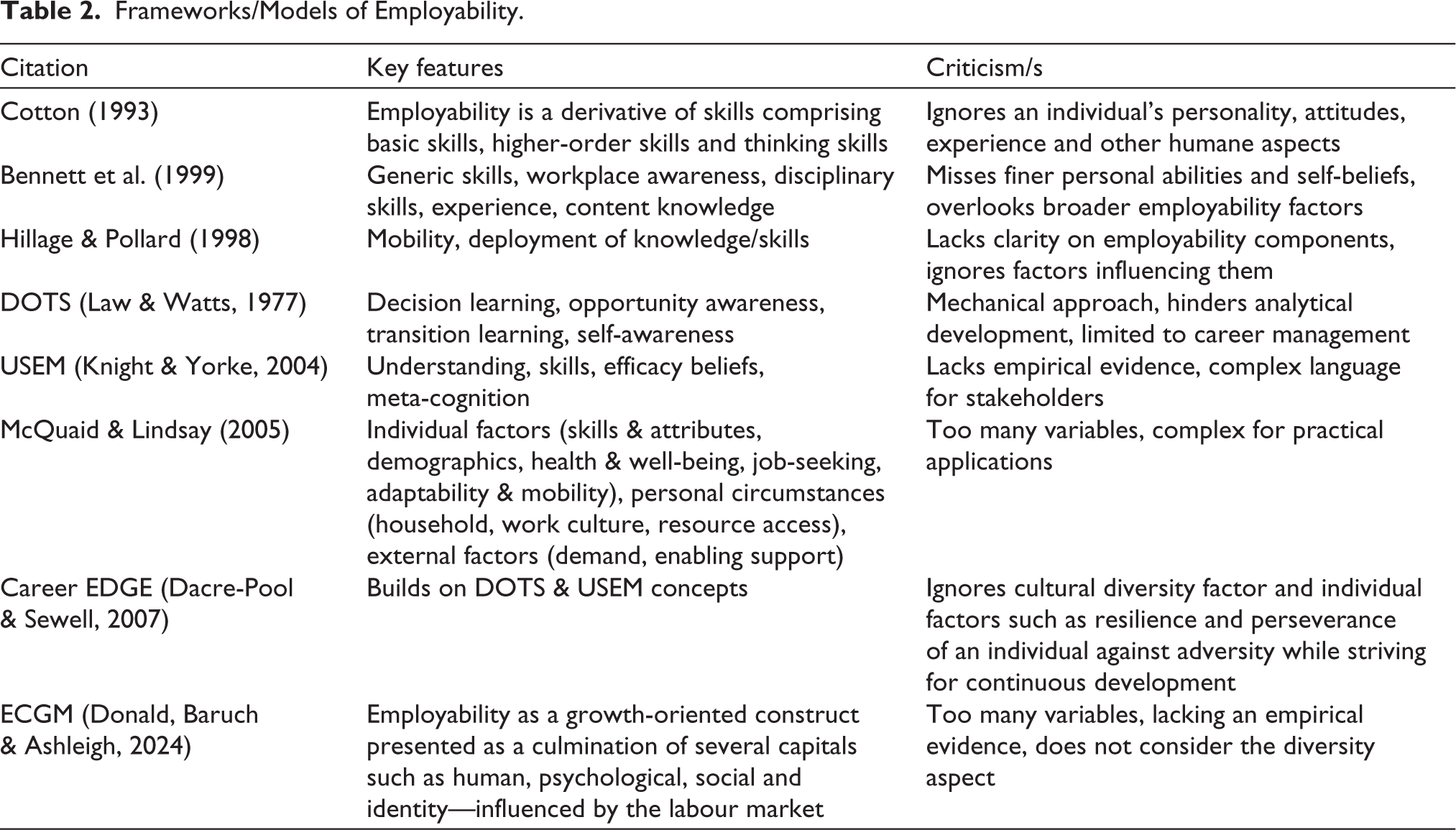
The Career EDGE model was introduced in 2007 by Dacre-Pool and Sewell (2007) as the key to employability, using concepts from DOTS and USEM models. The model expresses employability considering the factors of career development learning (CDL) activities, experience in work, degree and knowledge, generic skills and emotional intelligence.
CDL helps a graduate know how to present themselves to potential employers; that is, graduates should be aware of their own skills and when and how to present or use them (Hillage & Pollard, 1998). This refers to the simplest of skills like developing a proper CV by understanding the employer’s demand (Anas & Hamzah, 2017) and even the market conditions (Ma et al., 2024) or the relevant skills (Tomlinson, 2012).
It is usually seen that graduates who have prior work experiences usually secure jobs faster than graduates who are freshers (Pegg et al., 2012); consequently, graduates are frequently seen opting for part-time work or internships (Dacre-Pool, 2007) to help them increase their work experiences.
In the absence of other criteria, a graduate’s knowledge and understanding of the degree subject is the first check box ticked by any potential employer (Brown et al., 2003). The pedagogy of employability showcases an exhaustive list of skills that has been considered as a base for the Career EDGE model. Emotional intelligence is conceptualized as the cognitive ability that helps one to observe, understand, apply and manage emotions and thus tends to have a higher employability (Dacre-Pool & Qualter, 2012). Next, the learning experiences from all these factors are reflected upon by the graduates, which leads them to gain deep and effective learning (Artess et al., 2017). The reflection and evaluation of the learning experiences help develop cognitive factors such as self-efficacy, self-confidence and self-esteem (3Ss) of the graduates, which comprise the third and final level of the model leading to employability.
CQ and Employability
CQ is most popularly defined as the ability to perform effectively in culturally diverse surroundings (Ang & Van Dyne, 2009). CQ’s four dimensions (Earley & Ang, 2003)—metacognitive (cultural awareness/planning), cognitive (cultural knowledge), motivational (drive/interest to change) and behavioural (adaptive actions)—enhance Career EDGE’s base factors and employability by enabling cross-cultural adaptation of skills, knowledge and self-efficacy for global workforce success (Van Dyne et al., 2012). CQ earns its position as a base factor in the Career EDGE framework by playing dual roles of an essential moderator and a multiplicative amplifier of the existing components. In its current form, Career EDGE components remain theoretically valuable but practically inert in a globalized context. Through metacognitive cultural assumptions, CQ transforms CDL from culturally bounded self-awareness into globally adaptive career planning, leading to the strategic preparation for diverse organizational contexts and developing the ability to translate self-knowledge into culturally appropriate professional narratives and job-seeking strategies (Earley & Ang, 2003). CQ also helps in converting the work and life experience into intercultural competence, with high-CQ workers demonstrating significantly higher performance outcomes than low-CQ counterparts (Yao & Charoensukmongkol, 2025). CQ elevates degree subject knowledge by facilitating technical expertise application across cultural boundaries (Liu et al., 2022); domain-specific competencies remain geographically constrained without CQ to enable contextual adaptation. Generic skills achieve cross-cultural functionality only through CQ moderations as CQ’s metacognitive facets strengthen cognitive engagement in intercultural group work (Poort et al., 2021). CQ creates synergistic effects with emotional intelligence, moderating supervisor support—career success relationships and organizational support—social exchange dynamics to produce exponential outcomes (Bal et al., 2022).
Positioning CQ as a base factor is justified owing to mounting empirical evidence highlighting its importance in contemporary employability studies. Quantitative research has established a significant predictive relationship between CQ and employability (Silvallana & Suppiah, 2023), while systematic reviews confirm CQ as an antecedent to career adaptability outcomes (Asok Kumar et al., 2024). CQ has been seen to function both as a selection mechanism and a competence catalyst for employability enhancement (Butković et al., 2024), with meta-analytic evidence showing CQ as a critical moderator when career adaptability’s workplace effectiveness remains contingent on CQ levels (Ocampo et al., 2022). Numerous studies have focused their attention on the impact of the cultural intelligence of employability: calling it a core competence for employability (Lin et al., 2012), demonstrating how intercultural experiences and transnational education shape generic skills (Jones, 2013) and boost employability (Schueller, 2023) by developing cultural capital; calling cultural intelligence as the main ingredient for managerial success (Ljubica & Dulcic, 2012); proving its effects on job performance (Nam & Park, 2019); and finding out a positive correlation between employability and cultural intelligence among students (Chen, 2015) also point towards cultural intelligence as a way to increase employability. This validation across methodologies and contexts establishes CQ as a structural prerequisite to Career EDGE, making it more conducive towards employability.
Grit and Employability
Grit, as a concept, was introduced by Duckworth and colleagues in 2007, who defined it as ‘perseverance and passion for long-term goals’. Grit, a positive psychological trait, enhances success in overcoming challenges (Duckworth et al., 2007). Unlike resilience, which focuses on overcoming adversity, grit involves sustained effort and interest over time, despite repeated failures. Grit thus builds an optimistic outlook, which helps graduates cope with periods of hardship that might lead to emotional exhaustion (Sharma & Kumar, 2024) and high stress.
Grit also functions as a critical mediator with the Career EDGE model, transforming the base factors through reflection and evaluation into enhanced employability outcomes (Çarkıt, 2024; Jiang et al., 2024). Research has shown grit mediates degree subject knowledge and generic skills to employability by ensuring academic learning is persistently translated to workplace application (Duckworth et al., 2007); individuals with high grit consistently upgrade their skills and competencies despite obstacles (Duckworth et al., 2007; Jiang et al., 2024). Grit also converts diverse experiences into meaningful career learnings by extracting developmental insights, transforming fleeting exposure into consolidated expertise (Gregor et al., 2021).
Furthermore, grit mediates between emotional intelligence and employability; individuals with high grit consistently utilize emotional awareness to build relationships and navigate workplace challenges, converting momentary insights into professional leverage (Liu et al., 2022). Critically, grit augments self-efficacy, self-confidence and self-esteem through accumulated successful experiences of overcoming obstacles (Zhao et al., 2023). Grit enhances employability by strengthening how self-regulatory attributes—such as career agility and resilience—translate into employer-valued competencies, partially mediating this relationship (Ismail et al., 2023).
Grit has figured in numerous employability literature: as a positive force for increasing employability (Mashod & Kura, 2023), as a direct influence on organizational commitment, (Widodoa & Chandrawaty, 2020), as a predictor of success (Bowman et al., 2015), as a factor boosting career-related attitudes in students (Lee & Sohn, 2017), as an indicator of employee mobility in a job and frequency of career change (McGinley et al., 2020), as a trait judged for candidate assessment in hiring (Butz et al., 2019) and also as having a positive correlation to perceived employability in fresher students (Kasler et al., 2017). Grit drives individuals to grow during good times while seizing every opportunity to overcome bad times.Thus, the addition of Grit can be justified, and based on all the literature and the gaps discussed above, we propose the updated model of employability in Figure 1.
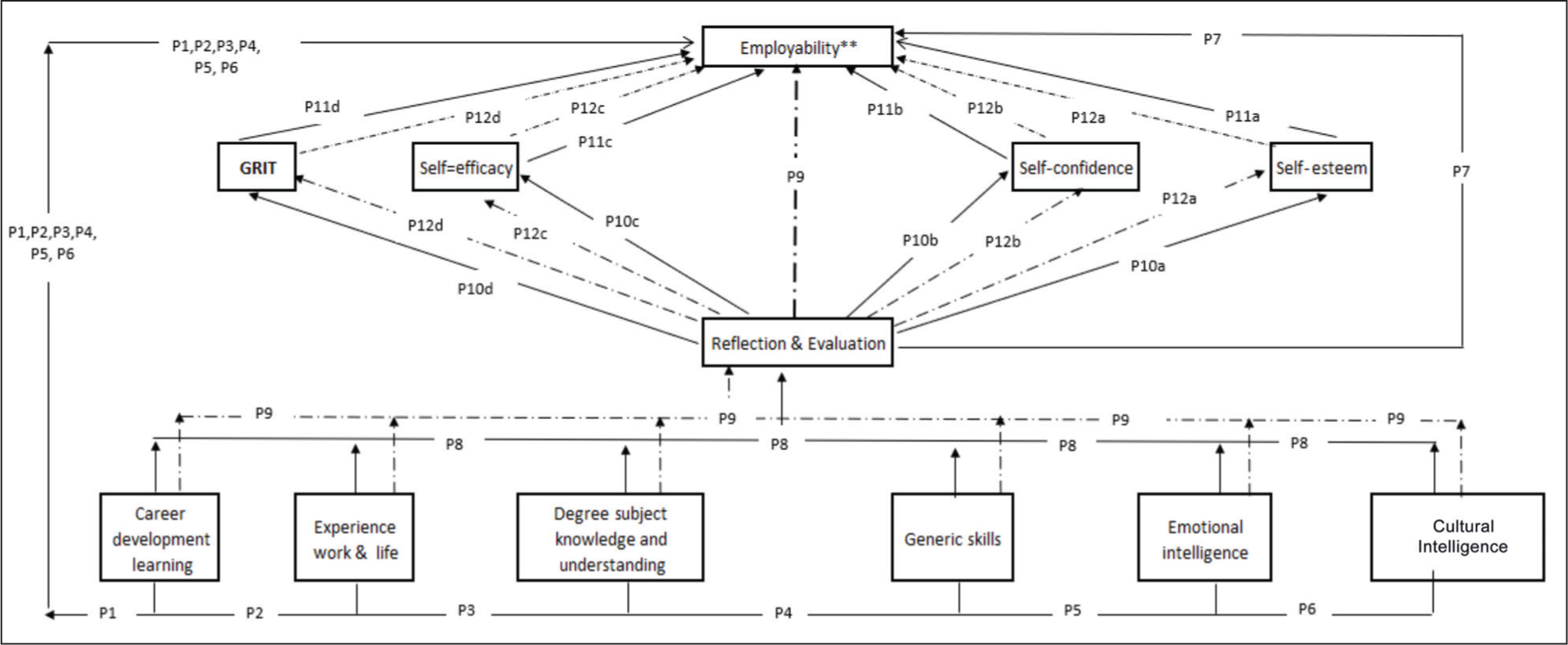
In the proposed model, CDL, degree and subject knowledge and generic skills, and emotional intelligence were further strengthened through reflection. Cultural intelligence helps a graduate manage diversity, and paired with the 3Ss, a graduate has a clear idea about their abilities and demonstrate employability skills. Grit supports continuous growth and learning how to navigate adversity. This enhanced model also lays out areas that can be worked upon and improved through training or by modifying curriculum, thus creating adaptable and holistically competent management graduates to join the workforce.
Proposition Development
Career Development Learning and Employability
CDL equips individuals with knowledge, skills and strategies for effective career navigation, thus enhancing employability (Watts, 2006). Structured CDL programmes such as work-integrated learning, employability workshops, pre-placement trainings, mentoring and career guidance consistently boost confidence and adaptability, positively impacting employability (Dacre-Pool & Sewell, 2007; Hillage & Pollard, 1998; Padgett & Donald, 2023). Research has also shown CDL to improve job-readiness (Moore & Morton, 2017) and align individuals better to labour-market requirements (Atitsogbe et al., 2019). CDL also promotes career adaptability and self-efficacy, which strongly predict employability, substantiating the proposition that CDL leads to higher employability (Gunawan et al., 2021; Healy, 2023). Thus, we propose:
P1: Career development learning has a significant positive impact on employability.
Experience and Employability
Experience enhances employability by equipping graduates with practical skills, maturity and adaptability that employers value (Dacre-Pool & Sewell, 2007). Internships, simulations and other work-integrated learning opportunities bridge the gap between academic knowledge and workplace demands (Lo Presti et al., 2023), increasing job-readiness (Moore & Morton, 2017). Graduates with relevant work experience are more likely to secure jobs and adapt to workplace challenges better (Lo Presti et al., 2023). Experience nurtures attributes such as resilience and problem-solving skills, which are strong predictors of employability (Tomlinson, 2017), thus substantiating the proposition that experience leads to higher employability. Therefore, we place our second proposition:
P2: Experience has a significant positive impact on employability.
Degree, Subject Knowledge and Understanding and Employability
Degree and subject knowledge foster employability by signalling technical competence and the ability to fulfil job requirements (García-Álvarez et al., 2022). Higher academic achievements and specialized knowledge are linked to better job prospects and career advancements (Dacre-Pool & Sewell, 2007). Employers still use academic scores as a primary criterion for selection of graduates in the absence of better tools (Brown et al., 2003). Depth of knowledge in a subject increases analytical ability and indicates the discipline for having attained knowledge, both of which combine to predict higher employability outcomes (Raut et al., 2024). Thus, we propose:
P3: Degree, subject knowledge and understanding have a significant positive impact on employability.
Generic Skills and Employability
Generic skills enhance employability by enabling graduates to adapt to diverse workplace demands. Skills such as communication, teamwork and problem solving are essential for employability in varied contexts (Chowdhury & Khasro, 2019). Employers seek these transferable skills to address evolving workforce needs (Riebe & Jackson, 2013). Generic skills outline the most important aspects of acquiring and sustaining any job—skills such as teamwork, communication, critical thinking, organizing, planning and leadership are key contributors towards building employability (Tushar & Sooraksha, 2023), substantiating the proposition that generic skills have a significant positive impact on employability (Dacre-Pool & Sewell, 2007). Thus, we propose:
P4: Generic skills have a significant positive impact on employability.
Emotional Intelligence (EQ) and Employability
EQ enhances employability by improving career adaptability, decision-making and workplace relationships (Mohan et al., 2025). Graduates with a high EQ manage stress and collaborate effectively, thus having a greater chance of employability than their peers (Dacre-Pool & Sewell, 2007). Research confirms that EQ is a robust predictor of employability as it underpins empathy (Dacre-Pool & Qualter, 2012; Knight & Yorke, 2004). Employers increasingly recognize EQ as a critical factor for career success for its association with resilience, interpersonal effectiveness and adaptability to changing work environments (Mohan et al., 2025). Attributes such as self-regulation, empathy and emotional self-efficacy, known as key predictors of employability, are all positively influenced by EQ (Wong et al., 2024), thus substantiating the proposition that EQ has a significant positive impact on employability (Dacre-Pool & Sewell, 2007). This brings us to our fifth proposition:
P5: Emotional intelligence has a significant positive impact on employability.
Cultural Intelligence (CQ) and Employability
CQ enhances employability by enabling graduates to adapt to diverse cultural contexts. A high CQ improves communication and organizational effectiveness in globalized workplaces (Chen, 2015; Ang & Van Dyne, 2009). CQ is a key determinant of employability in multinational organizations (Chen, 2015). CQ advances key attributes such as cross-cultural adaptability and openness, which strongly predict employability (Ang & Van Dyne, 2009). These attributes push individuals to adapt to multicultural surroundings and work efficiently, thus boosting employability, which brings us to the sixth proposition:
P6: Cultural intelligence has a significant positive impact on employability.
Reflection and Evaluation and Employability
Reflection is a potent driver of deep learning, enabling graduates to assimilate knowledge from both experiences and education (Heymann et al., 2022). This process leads to the development of the 3Ss and helps students identify their capabilities and set achievable goals, thereby enhancing self-perceived employability (Van der Baan et al., 2024). Drawing from Kolb’s (1984) experiential learning theory, reflection is essential learning and acts as a mediating factor, allowing graduates to maximize their foundational knowledge and employability (Fearon et al., 2019). Empirical evidence further confirms that reflection supports self-awareness, critical thinking and identity formation, making it a critical tool for employability (Helyer, 2015). It has also been seen that reflection acts as a strong mediator between learning experiences gathered from curricular courses, extra-curricular activities, work or general interactions and leads them towards enhanced employability (Heymann et al., 2022). This can be achieved through reflective journaling, diary writing, note taking or reflective logs that may be used to reflect upon to assimilate the learning, leading to a state of deep learning (Dacre-Pool & Sewell, 2007). Thus, reflection is not only a facilitator of learning but also a key enabler of employability. Here, we place three propositions:
P7: Reflection and evaluation have a significant positive impact on employability. P8: The base factors of the new extended model of Career EDGE have a significant positive impact on reflection and evaluation P9: The base factors of the new extended model of Career EDGE have a significant positive impact on employability, via reflection and evaluation.
Self-efficacy, Self-confidence, Self-esteem (3Ss), and Grit and Employability
The 3Ss are core personal resources consistently linked to higher employability outcomes (Dacre et al., 2007). The Career EDGE model identifies these constructs as mediators, emphasizing that reflection and evaluation enable graduates to present, utilize and accurately represent their skills better, to employers (Dacre-Pool & Sewell, 2007). Empirical studies based on the Career EDGE model have also confirmed that higher levels of 3Ss are associated with graduates being more forthwith with job applications, more effective with skill utilization and balanced self-presentations, all contributing greatly to enhanced employability (Yawson & Yamoah, 2023).
Grit has always been considered as a robust predictor of employability owing to its qualities of perseverance and continuous learning (Ismail et al., 2023). Research has shown gritty individuals to be more successful with long-term career goals (Duckworth et al., 2007). Further evidence also suggests that practical learning through experiences and their reflections (Costello et al., 2022) inculcates more grit. The Career EDGE model integrates reflection and evaluation as key drivers of both grit and the 3Ss, reinforcing the importance of these personal resources for employability. Thus, we propose the following:
P10: Reflection and evaluation have a significant positive impact on grit and the 3Ss. P11: Grit and the 3Ss have a significant positive impact on employability. P12: Reflection and evaluation have a significant positive impact on employability via grit and the 3Ss.
Discussion
Dacre-Pool’s (2007) original model is still very popular despite being close to a decade-and-a-half old. It has already found its utility through implementation in several universities, as stated earlier. But the Dacre-Pool (2020) herself feels that it is time that a relook be given at the model to make it more relevant to current times. Thus, the authors of this study concluded on adding two new elements to the existing Career EDGE model, namely cultural intelligence and grit.
Cultural intelligence accounts for global connectivity, be it in the immediate workplace or in dealing with clients, and the construct is largely missing in the current model of Career EDGE. The global workforce of today calls for a much more culturally diverse aggregation of employees (Dacre-Pool, 2020), making CQ a more important concept as far as employability is concerned. Studies have depicted that employers today are also more inclined towards graduates who possess real-life multicultural experiences—are multilingual (at least bilingual) and comfortably adjust with different cultures, which have called for the introduction of cultural studies in curriculum. (Jones, 2013). One of the prominent definitions of employability points to knowledge, skills and mobility (Artess et al., 2017). Also, Dacre-Pool (2020) herself has spoken about the importance of cultural intelligence as conducive to employability and that it very much needs to be added to Career EDGE. Thus, we can conclude that cultural intelligence is a relevant and important addition to the Career EDGE model.
In 2007, Duckworth and team published their work on grit, defining it as ‘perseverance & passion for long-term goals’ (Duckworth et al., 2007). Several studies have since been conducted to compare the impact of grit in achieving higher goals (Sheldon et al., 2015), in showing persistence in overcoming or approaching challenging circumstances (Lucas et al., 2015); for academic excellence (Bowman et al., 2015); for academic achievements in diverse settings (Park & Cho, 2019); and for retaining long-term employment (Robertson-Kraft & Duckworth, 2014)—and all have yielded positive results, showing grit to be a positive influence. Grit also displays some similarities with constructs such as self-regulation and conscientiousness. Self-regulation is a short-term control exerted on the self on specific occasions like avoiding high-calorie food intake while dieting or not watching TV if exams are near. Conscientiousness addresses planning for a specific task or some deadline to be achieved. Grit, on the contrary, is planning coupled with consistent effort that an individual keeps repeating even after facing repeated failures (Duckworth et al., 2007; Lee & Sohn, 2017).
People tend to confuse grit with resilience, but while resilience is always associated with some or the other form of adversity, gritty people are not only resilient but also deeply committed to their goals and keep working steadily to achieve them (Duckworth et al., 2007). Gritty people stay their course despite hardships or even boredom (Duckworth et al., 2007). Graduates who are gritty have been seen to do better as they are intrinsically motivated to work hard for their goal. Also, gritty students, being more focused, rarely change courses or drop out (Kaufman & Duckworth, 2017)—and have much more clarity as to what they want or need (Yu et al., 2022). Thus, although Dacre-Pool (2020) suggested the addition of resilience as another addition for the original Career EDGE model, we can conclude that grit is a far more effective choice.
Implications
Theoretical Implications
The upgraded Career EDGE model holds significant theoretical implications for graduates and their stakeholders, including parents, teachers and potential employers. The novelty of this study is in the integration of grit and cultural intelligence into the discourse of employability, an aspect that has so far been greatly underestimated and overlooked in past research. It builds upon the original model by addressing the critical issue of multicultural adaptation and paves the way for a more inclusive and globally minded perspective on career development. Additionally, the model provides valuable guidance on overcoming obstacles, emphasizing the importance of fostering grit in students from an early age (Dacre-Pool & Sewell, 2007). The model also highlights the importance of self-reflection in learning and its influence towards developing crucial cognitive faculties such as grit, self-efficacy, self-confidence and self-esteem. The relation is more indicative of experiential learning, which can be concluded to be a culmination of the base factors of the model put together. Thus, the model acts as a bridge between the three different fields of personal psychology, career development and cross-cultural studies, which heighten employability from a transactional concept to encompass more transformational personal attributes.
Literature shows that students increase their self-perceived employability when their curriculum includes more industry-oriented topics (Padgett & Donald, 2023). This model affirms that CDL, degree, subject knowledge and experience, the three base factors, would be covered in industry-oriented learning, leading to an improvement in generic skills. Moreover, a culture of self-reflection should be introduced in educational curricula to ensure students are absorbing the maximum of what is being taught to them. Self-reflection, self-esteem and CDL make students assess their strengths, identify and close skill gaps, and continuously improve. Structured interventions such as mock interviews, simulations and internships practiced in CDL or experiential learning initiatives (Laverie et al., 2022) directly boost the 3Ss and help students build the strength to persevere through adversity. This is the groundbreaking aspect of the model as it places the concept of employability because of an interaction between intrinsic qualities of graduates and their extrinsic environment. Furthermore, this shows the model’s potential to serve as a powerful tool for knowledge sharing between institutions and corporations, showcasing the crucial role of higher education institutions in building employability and collaborating with the industry for optimal results.
Practical Implications
The extended Career EDGE model uses HRD strategies to translate its theoretical strengths into practical applications that benefit both individual learners and educational institutions. Educators can integrate targeted cultural sensitivity training into the curriculum. Introducing bilingual or multilingual lectures fosters inclusivity and caters to the needs of a global student body. Additionally, exploring the potential of internationalizing the curriculum equips students with a broader perspective and enhances their preparedness for international careers. Moreover, cultural sensitivity brings out instances of open communication and feedbackacceptability to open avenues for developing and strengthening emotional intelligence. Thus, introducing cross-cultural training programmes (Zhang, 2012), international case studies and industry exposure programmes would greatly prepare students to navigate through global environments.
The model also indicates the development of more experiential learning-based curriculum, like simulation training programmes or leadership challenges, which would help build more self-reflection and in turn help develop the faculties of grit, self-efficacy, self-confidence and self-esteem. Simple curriculum changes such as introducing simulations where students need to plan and strategize, assigning mentors for motivation and placing them on a self-reflective and feedback loop (Mirza et al., 2021) go a long way in inculcating grit among students. Cross-cultural adjustment trainings (Zhang, 2012) and upskilling or reskilling training programmes are a regular part of most organizations; thus, curriculum changes to introduce these as a part of regular courses would go a long way in creating a more potent workforce (Donald et al., 2024). Emotional intelligence can be inculcated more through a continuous cycle of feedback and mentoring, which would also strengthen the 3Ss. Padgett and Donald (2023) introduced certain modules such as CV development, knowledge of recruitment process and proactive career ownership, which boosted the self-perceived employability of students from 37.5% to 92.5%. This shows the importance of incorporating CDL in the curriculum.
Beyond curriculum development, the model equips individuals with a self-assessment tools to understand their current employability level. Graduates can self-assess their own prowess in the base factors through self-reflection. The 3Ss would make them exactly aware of where they stand and the aspect they need to improve on. And with every hurdle they cross,, their grit towards achieving their goal would increase along with their hard work, contributing to achieving the goal. This self-awareness would empower them to take charge of their career trajectories and navigate the ever-changing job market with confidence. This can be brought about by introducing mock interview sessions, industry live projects or consultancy internships and a proper structured feedback session. The self-assessment coupled with feedback loop would provide a holistic view to graduates regarding their lacunae and provide a path towards development and to be more industry ready.
Conclusion, Limitations and Future Scope
From Dacre-Pool’s own admission, the Career EDGE model of employability is outdated and needs to be upgraded (Dacre-Pool, 2020). To meet the demands of a multicultural workplaces, CQ and grit are introduced, enabling graduates to adapt, remain resilient and thrive amidst adversity (Shah et al., 2025; Zhang, 2012).
One limitation of this model is that its Western-oriented assumptions may not fully reflect collectivist or high-power distance cultures, requiring contextual calibrations of constructs such as emphasizing collaborative goal setting and peer feedback alongside individual skill development. CQ helps graduates navigate this situation, partially mitigating the limitation. However, this model is yet to be empirically tested to confirm the veracity of these constructs in the Asian context. Additionally, the large number of components in the model, though holistic, may challenge its implementation.
Future research could empirically test the enhanced model and assess its practical relevance across diverse cultural contexts or even consolidate the variables into broader constructs. Overall, the enhanced Career EDGE model remains accessible, interpretable and implementable, providing a culturally aware and resilient framework for graduate employability.
Footnotes
Authors’ Contribution
Abhinanda Bhattacharya: Conceptualization, methodology, writing—original draft preparation, model visualization. Ginni Chawla: Supervision, writing—reviewing and editing.