




Abstract
Advancements in big data analytics, IoT, and artificial intelligence (AI) have significantly transformed marketing practices and consumer behavior. AI offers promising opportunities for marketing practice and research. However, marketers need a holistic understanding of AI and its influence on consumers. Thus, this study aims to offer a review of AI applications in marketing and explore the role of AI in aiding marketing. This study carries out a review of AI and its applications in marketing by analysing the existing literature between 2000 and 2021. Only those papers were selected for this review, which are positioned around AI technology. Articles were drawn from Google Scholar and Scopus databases and were analysed using thematic analysis. A review of selected papers depicts that AI implementation in marketing is still in its nascent stage. The review proposed the following themes: (a) Prediction Analysis, (b) Relationships with AI, (c) Consumer Relationship Management, (d) AI in Strategic Marketing, (e) AI and Services, (f) Conversational Commerce, (g) Advertising and Artificial Intelligence, and (h) Consumer Brand Engagement.
Introduction
Artificial intelligence (AI) is doubtless one of the proactively talked-about technologies in marketing, providing numerous exciting opportunities for marketers and academicians. In the past few years, the technological advancement in AI has put industries on the move. In the present business scenario, AI finds applications across various contexts. Marketers are progressively relying on AI, with 72% of marketers stating AI as a benefit for their business (Rissland & Stillings, 1987; Huang & Rust, 2018; Rangaswamy et al., 2021; Russell & Norvig, 2021).
Nowadays, marketers and consumers use AI at every stage, whether retailing, strategic decision-making, personal engagement marketing, analysing customer satisfaction, etc. (Huang & Rust, 2021; Kumar et al., 2019b; Lucini et al., 2020; Weber & Schütte, 2019). Consumers also benefit from AI applications by dropping costs, utilizing various service channels, and providing opportunities for expanded individual creativity (Haenlein & Kaplan, 2019; PwC, 2017; Smart Insights, 2018). Furthermore, the global adoption of AI tools has increased enormously. The global market size of AI is predicted to increase from around 5 billion US dollars in 2015 to approximately 125 billion by 2025 (Statista, 2020). Regardless of this massive market penetration, there is a dearth of a proper understanding of how AI technologies have been practiced in marketing so far. To be precise, there is no exhaustive overview of what has been explored so far in artificial intelligence from the marketers’ side, that is, for what activities marketers are using AI, how they are using AI, human-AI interaction, etc. A literature review can draw attention to the significance of artificial intelligence in marketing and frame future research directions in this area. Therefore, in this study, we present a review that drafts themes of research conducted on AI in the field of marketing that could be relevant for marketers and academicians. We have inferred the critical topics that have been covered in the AI marketing literature, presenting eight major themes that could be significant for marketers. Our focal point was the literature of the last 21 years (2000–2021) because, throughout this period, AI has grown widely and is accepted by marketers and users. We highlight that the researchers studied how marketers manage consumer relationships and how AI technologies can enhance brand engagement. We also emphasize that the reviewed articles explored how anthropomorphism and interpersonal attraction may lead to users’ relationships with AI tools. The rapid increase in AI research has made the study of AI marketing increasingly significant. With the increasing intervention of AI, marketers need more information and understanding about AI, its tools, and its influence on consumers in a holistic way.
After introducing the study in the first section, we elucidate the literature review and methodology in the second section. Then, in the third section, the methodology and data analysis were described. The fourth section reviews the significant themes of research on artificial intelligence in the field of marketing, and future research directions are mentioned in the fifth section. Finally, the conclusion and limitations of the study were discussed in the sixth section.
Literature Review
The notion of AI was started by Alan Turing in the 1950s, and he proposed the Turing test for machine intelligence (Turing, 1950). This time period was not just a milestone turning point for computer science but for societies and industries as well. The term “artificial intelligence” was coined in the middle of the twentieth century by John McCarthy at the Dartmouth Conference to delineate efforts in computer science concentrating on the simulation of human learning. John called AI “the science and engineering of making intelligent machines” (Tech Nation, 2019). AI is described as a system synthesizing sophisticated hardware and software with large databases to carry out human-oriented functions, including decision-making, problem-solving, and reasoning, similar to human behavior. In 1961, the first robot was introduced at General Motors (Murray et al., 2017). In the second phase of AI development, from 1980 to 2000, the Japanese government issued 850 million US dollars, a large amount of money to boost AI development. During this time, plenty of work was done on building theoretical foundations and (ML) machine learning (Lu, 2019). Later in 1997, Deep Blue, a chess-playing computer, won the world chess championship by defeating chess grandmaster Garry Kasparov (Hsu, 1999). In two decades, AI has considerably revamped the fields of education and healthcare, and marketing is no exception (Huang & Rust, 2018).
In the early twenty-first century, the world was undergoing exponential growth in the Internet age (Lu, 2019). The organizations were generating a large volume of data, that is, big data, which is impossible to process through traditional data processing software (Dimitrieska et al., 2018). This big data issue gave birth to AI in marketing (de Bellis & Venkataramani Johar, 2020; Grewal et al., 2020). Because of this abundant data, marketers started making huge investments in AI and machine learning to strengthen their performance and capabilities (Ma & Sun, 2020). However at that time, marketers were reluctant to acknowledge AI for its functions, and only large tech companies such as Google and Amazon were utilizing it (Casillas & Lopez, 2010). In the next to no time, AI gained marketers’ trust and became an indispensable assistant for every brand out there (Karimova & Goby, 2021).
By the year 2017, an increasing number of brands have started using AI algorithms in their decision-making processes (Aflalo, 2020). A recent study has indicated that the number of businesses adopting AI in their marketing functions has increased by 270% during the past 4 years (Lin, 2022). Hence, with its widespread acceptance by industries, AI was not a novelty; rather, it became an integral part of decision-making and other functions.
These days, AI is being utilized by almost all organizations in various activities, such as product development, marketing, and customer support. Firms are utilizing AI techniques in personalized marketing techniques to observe the consumers’ preferences and behaviors, which aids the firms in enhancing the effectiveness of their marketing campaigns (Kumar et al., 2019b). In addition, marketers are using AI to improve demand forecasting (Carbonneau et al., 2008), optimize supply chains (Min, 2010), and manage inventories to increase and enhance efficiency and cost savings. Additionally, firms are using AI-powered chatbots to provide quick, personalized customer care, increasing the customer experience (Hoyer et al., 2020; Pelau et al., 2021). AI recommendation systems are playing a vital role in e-commerce. These recommendation systems suggest products by analysing the users’ preferences and their behavior (Marchand & Marx, 2020).
Consumers have extensively integrated AI into their everyday routines through virtual assistants, chatbots, smart homes, and smart products. Voice assistants such as Siri, Alexa, and Google Assistant employ AI algorithms to comprehend and address customer’s inquiries and perform tasks like booking reservations and setting reminders (Hoy, 2018). Individuals using smartphones equipped with AI can recognize faces, function as intelligent assistants, and take smart images (Kumar et al., 2019a). Additionally, online shopping platforms, streaming services, and social media platforms such as Amazon, Instagram, and Netflix are widely using AI-driven recommendation systems (Chung et al., 2016; Martínez-López et al., 2015). User engagement and satisfaction are improved by offering personalized content and product recommendations (Shen, 2014).
Methodology
In the current study, we have used the systematic approach to review the articles on AI in marketing, following PRISMA guidelines. A multi-stage filtration process was followed to extract the articles published throughout this time period.
Keyword Selection
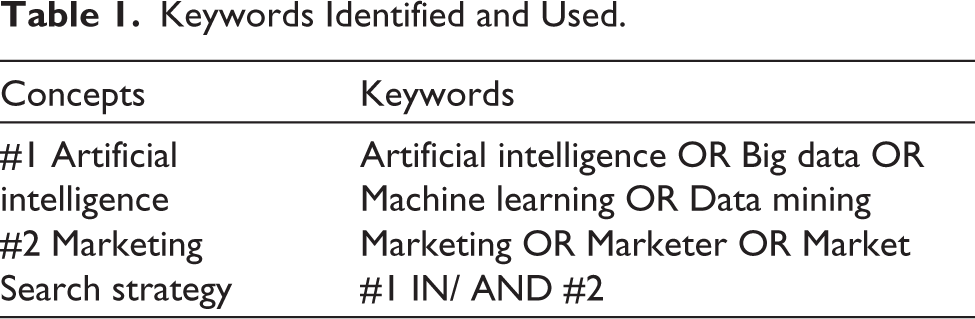
In the first stage, we decided on keywords related to artificial intelligence. Initially, we used the keyword “Artificial Intelligence in Marketing” in Google Scholar to identify all the terms associated with AI in marketing and downloaded 10 papers with the keyword “AI in Marketing” in their title and abstract. Then, an in-depth review of these articles was conducted to find out if there were any other keywords related to the term AI. In this process, we identified four keywords and searched those through Google Scholar and Scopus, two of the primarily accepted and popular databases and search engines (Buhalis & Law, 2008). Detailed keywords are provided in Table 1.
Keywords Identified and Used.
Inclusion and Exclusion Criteria
The time frame for paper collection ranged from 2000 to 2021 because, in this time frame, AI has developed to a great extent, and marketers have started exploiting AI in marketing functions. Only those articles were selected that are (a) positioned around AI technology and (b) in the marketing context.
Data Collection
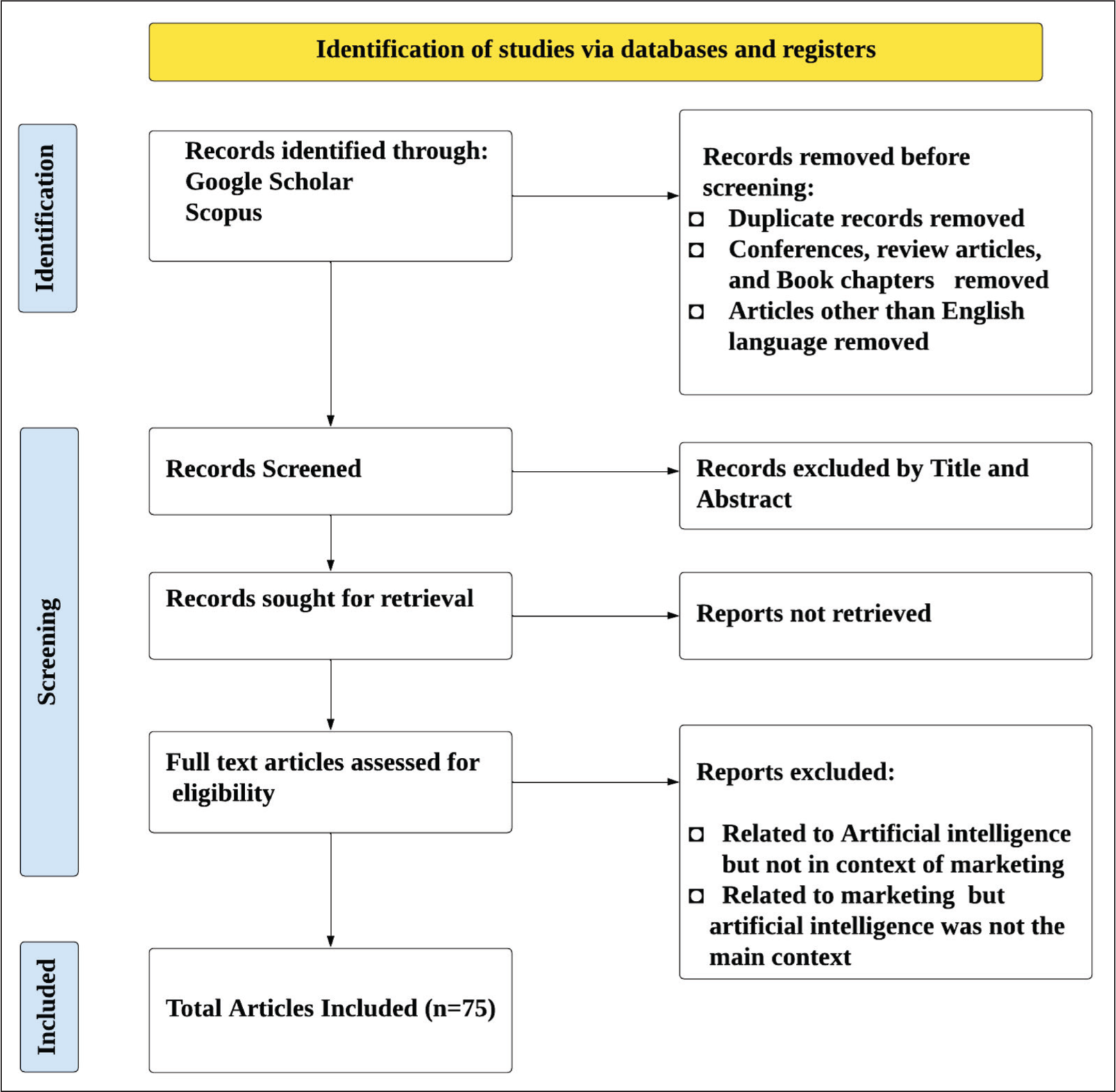
In this stage, the search returned with 580 articles. Initially, articles were excluded due to duplication, being conference proceedings, review articles or book chapters, and being published in languages other than English. Out of these, those articles were selected that had any of these keywords in the title or abstract. These initially selected articles were reviewed carefully to see if they were associated with artificial intelligence in the context of marketing. Only those articles were picked that mainly highlight AI applications in marketing. This filtration resulted in 75 papers. Figure 1 illustrates the visual representation of the selection and filtration processes. The selected articles were reviewed and analysed comprehensively using thematic analysis to extract the themes of AI in marketing.
PRISMA Flowchart.
Data Analysis
After article selection, we executed a thematic analysis on an aggregate of 75 papers to identify significant themes using Braun and Clarke’s (2006) procedure. Thematic analysis is a qualitative analytical approach generally used for systematic reviews. In broad terms, Braun and Clarke (2006) defined thematic analysis as “a method for identifying, analysing, and reporting patterns (themes) within data.” (p. 79). The first and foremost step is to familiarize yourself with the data. At this stage, all of the papers were reviewed, re-reviewed, and summarized using a standardized framework to get early ideas. Then, a comprehensive evaluation of these papers was performed, after which articles that were found to be comparable were grouped together, and codes were provided manually to indicate each article’s contribution to a theme. These codes are the terms that outline the significant areas of research. The articles were grouped on the basis of the application of AI in marketing described by the researchers. On that basis, the codes were collated into potential themes. Eight central themes were extracted, defined, and named, representing the research held in AI marketing literature.
Results and Themes Identified
This article presents a review of the application of AI in marketing. The authors have reviewed 75 papers. Thematic analysis has extracted various key domains from the existing studies.
Theme 1—Prediction Analysis
The research included in this theme focuses on understanding consumers’ sentiments and predicting their preference for a product, price, place, and promotion through AI. Online feedback, perception, or consumer attitudes are thoroughly investigated using big data and artificial neural networks (ANN) (Chong et al., 2016). Studies explore the idea that ANN and fuzzy logic are the solutions to the problems of market prediction, market segmentation, and sales forecasting (Tiwari et al., 2020). Marketers have a vast amount of consumer data that is unorganized and unstructured, such as audio, videos, images, and text, which standard analytical procedures cannot maintain. However, by utilizing AI, marketers can forecast sales, control market activities, identify structures, and design consumer-centric products and services (Kühl, 2019). In addition, marketers can predict consumers’ moods based on the commands of consumers in the process of conversational shopping through voice assistants (Halbauer & Klarmann, 2022).
Through AI, consumer needs can be fetched through social media prediction analysis. Huang and Rust (2021) show numerous AI intelligence from which a marketer can gain an advantage: Mechanical AI can be used to collect information related to the market, firm, environment, consumers, and competitors. Thinking AI is meant for market analysis. Feeling AI intends to know about consumers’ needs and wants, such as what they want and what price they want. Previous studies have also communicated several ways of utilizing feeling AI to understand customers.
Theme 2—Relationships with Artificial Intelligence
Studies categorized under this topic identified that users have started to build relationships with AI tools such as voice assistants and chatbots since they aid human–computer interaction naturally, which makes them identical to interpersonal interactions as they help in fulfilling users’ tasks, following a conversation, and answering questions (human–human interaction). After 2017, papers related to this theme came into existence. Studies are trying to find out the different relationships people build with these anthropomorphized devices, such as servant, friend, or master, and the impact of these relationships on their expected future usage (Schweitzer et al., 2019). The research on users’ relationships with these AI tools is in the developing stage. Hence, the researchers are investigating the antecedents of these relationships or what factors are leading to these relationships. The significant antecedents of these relationships in the existing literature are enjoyment, anthropomorphism, social presence, and interpersonal attraction (Han & Yang, 2018; Noor et al., 2021).
Research has also shown various outcomes of human-computer relations that benefit firms and users. Human AI relationships influence the attitude of users toward these AI tools and their brands and contribute to the users’ perceived well-being as well (Skjuve et al., 2021). These relationships also play a vital role in adopting and continuously using personal assistants and chatbots (Han & Yang, 2018; Ki et al., 2020).
Theme 3—Consumer Relationship Management or Relationship Marketing
This theme is associated with how AI technologies can be utilized to manage and amplify consumer relationships, as it has been found that AI plays a crucial role in managing customer relationships (Mishra & Mukherjee, 2019). These days, consumers are also becoming acquainted with the advantages and perks that AI delivers and how it entirely improves their user experience. These AI-based CRM systems have transformed marketers’ ways of analysing the huge volume of customer data. Studies related to customer relationship management found that with several sources of big data, marketers can establish a value-justified data infrastructure that allows quick implementation of leading consumer analytics, which promotes and maintains better customer relationships (Kitchens et al., 2018). Apart from that, Chatterjee et al. (2021) identified that organizational agility builds up the capabilities for the successful adoption of AI-blended customer service systems in the organization for long, successful customer relationships. Furthermore, studies have explored how combining Internet-of-Things and relationship marketing strategies improves the performance of a business and promotes successful relationships (Lo & Campos, 2018).
Theme 4—AI in Strategic Marketing
The studies in this theme explore how AI can contribute to the formulation of marketing strategies. The rapid growth of AI has already started to impact how decision-making takes place in organizations. The structure of an organization is influenced gradually by the productive use of AI in facilitating marketing strategy. It includes the strategic factors of corporate performance by transforming huge user-generated content into valuable information to develop a competitive landscape for firms (Lin & Kunnathur, 2019; Netzer et al., 2012). The structure of an organization is gradually influenced by the productive use of AI in facilitating marketing strategies. Research substantiates that AI can amplify, replace, or accompany the decision-making process of humans for marketing strategy formulation (Jarrahi, 2018). Till now, there has not been enough research on employing AI in strategic marketing decision-making. Studies have also explored that significant factors, such as consumers’ attitudes toward the product, firm, or service, for strategic marketing decisions can be tracked through big data by acquiring social media data (Fan et al., 2015).
Theme 5—AI and Services or Service AI
Studies under the AI and service theme have explored how AI can be utilized to deliver services and the adoption factors and barriers to customers and companies adopting AI services. Most of the studies talk about service robots, chatbots, and voice assistants in service delivery. For instance, in a study, YouTube comments were investigated to know the general public’s feelings or reactions toward robot workers as frontline service providers (Yu, 2020). Furthermore, considering different types of robots, voice assistants, and chatbots (Gursoy et al., 2019; van Pinxteren et al., 2019) investigated that social presence, or humanlike appearance, is more significant in encouraging AI service device adoption for service and customer trust toward these devices. Moreover, findings from the research show that for less complex functions, consumers will doubtlessly use AI service agents.
But in contrast to that, for highly complex processes, the consumer prefers a human consumer service provider. West et al. (2018) and Xu et al. (2020) have also identified a lack of internal resources, insufficient technology, and incorrect data as the topmost barriers to a company’s adoption of AI in service delivery. Studies have also found that AI has brought about a dramatic change in the service environment. As a result, service marketing has entered a stage where there is a need to develop new theories and new ideas considering the technology-centric nature of the service (Bock et al., 2020). This has made marketers focus on providing a highly personalized customer experience and solving customers’ problems through AI technology.
Theme 6—Conversational Commerce or AI in Retail
Studies categorized in this theme investigate how AI can impact retailing, how AI can be put to use throughout several retail value chain activities, and what influences the users’ purchase intention through these AI assistants. Guha et al. (2021) explored how AI can revamp retailing. It will enhance retailers’ online and in-store interactions with consumers as they guide them in their online shopping. Also, improve their supply chain operations, such as SAS provides supply chain optimization. Furthermore, Oosthuizen et al. (2021) identified the core functions of AI in the retail value chain, that is, stock management, knowledge and insight management, and operations optimization.
Increased usage of AI tools has given birth to a new type of shopping experience, that is, voice shopping or, as we can say, conversational commerce. It has changed consumer decision-making. Studies are still trying to determine what variables influence consumers to adopt AI tools in shopping (Araújo & Casais, 2020). Researchers have found that young shoppers have few intrinsic (habit or passion) and extrinsic (time constraint, convenience) motivations to use AI tools in their shopping decision-making (Chopra, 2019). Additionally, the results of Balakrishnan and Dwivedi’s (2021) study inferred that perceived anthropomorphism, intelligence, animacy, and users’ attitudes with respect to voice assistants positively enhance their purchase intention with these voice assistants.
Theme 7—Advertising and Artificial Intelligence
Studies related to this theme concentrate on applying AI in the advertising process. With the growth of the e-commerce market, the need for advertising cannot be fulfilled by traditional advertising models. Hence, marketers and advertisers use AI technologies in their advertising operations to enhance advertising efficacy and productivity and to meet the market’s demand. Furthermore, as AI is in its growing stage, authors are trying to find out how artificial intelligence can be applied in the advertising process to make advertisements more efficient (Qin & Jiang, 2019).
Emerging studies focus on a new form of interaction among consumers and brands, that is, voice assistants or smart speakers. Researchers are investigating what sort of marketing messages people find adequate on smart speakers. Smith (2018) explored that a cognitive message strategy is sufficient, and the message should contribute some value to the listeners. In contrast, when an advertisement is inappropriate or irrelative to the content (non-contextual adverts), the viewers hold a negative attitude toward them and treat them as noise or disturbance, which may cause irritation (Lee & Cho, 2020).
Theme 8—Consumer Brand Engagement
Finally, theme 8 pertains to how AI can be employed to engage consumers with brands. AI has provided various touchpoints for consumers to engage with brands. Studies are trying to discover major factors in consumer brand engagement through artificial intelligence, such as chatbots and voice assistants. The findings of McLean et al. (2021) research outline that voice assistants are key players in the engagement process, social presence, and perceived intelligence. The social attraction of these voice assistants and technology attributes such as perceived ease of use and perceived usefulness are the major drivers influencing consumer brand engagement, which further affects brand usage intention. Studies explored that high-quality AI speech recognition and synthesis encourage consumer engagement via human–computer interaction, leading to purchase intention from those brands (Sung et al., 2021).
Earlier, artificial intelligence and consumer brand engagement were investigated individually. However, in recent times, these two distinct topics have been integrated, and much attention has been given to consumer engagement with brands through rising technological platforms such as artificial intelligence (Perez-Vega et al., 2021). These consumers’ AI-facilitated brand engagement plays a crucial role in promoting their well-being as well (Hollebeek & Belk, 2021).
Discussion
The systematic literature review emphasizes the significant influence of AI on different aspects of marketing. Even though AI in marketing is still in its early stages, the study showcases that AI has been used across various marketing functions such as managing consumer relationships, consumer brand engagement, consumer experience management, retailing, voice commerce or voice-assisted e-commerce, social media marketing, service management, predictive analysis, strategic marketing planning, B2B marketing, e-WOM-based insights, and analysing customer satisfaction. The latest research has shown that there is ample opportunity for AI to be a progressively significant factor in marketing applications.
The themes identified highlight the increasing impact of AI in the field of marketing, assisting in strategic decision-making, and influencing consumer behavior and engagement. Utilizing AI algorithms for predictive analysis is becoming increasingly important for companies to anticipate market trends, sales patterns, and customer preferences. This analytical strength improves strategic marketing endeavors such as segmentation, targeting, and positioning of products. Furthermore, AI fosters consumer relationships through personalized recommendations, conversational interfaces (chatbots), and tailored brand experiences. The review highlighted unique AI applications like conversational commerce, showcasing how consumers can smoothly engage with AI assistants during the buying process. AI’s impact on advertising is quickly changing, enabling targeted campaigns, multimodal content creation, and real-time bid optimization.
Future Research Directions
Research on AI in the field of marketing is still evolving. The review of artificial intelligence in marketing literature emphasizes multiple research areas that are essential to examine or investigate in the immediate future to understand the influence and challenges of AI and to make customers and industries ready for the revamps and changes that will more or less come. Several areas are there in which the contribution will prove beneficial. First, it is highly important to identify the optimum balance between the tasks and functions that may be automated by AI technology and marketers. Resource allocation and marketing processes can both be enhanced by determining how AI and marketers should work together. When implementing AI-based marketing strategies, it is important to keep both efficiency and consumers’ happiness in mind. Researchers must concentrate on the application of AI in marketing in order to ensure the welfare of consumers. With AI increasingly integrated into marketing, it is more important than ever to ensure these tools are utilized effectively for the benefit of customers. Ensuring that AI technologies are utilized in marketing strategies in a manner that prioritizes consumer interests is of utmost importance.
Developing AI models to understand consumer thoughts in a better way through neuroscience-based methods is another crucial area of research. Marketers can better customize their strategies and meet the needs of their target audience if they have an in-depth understanding of consumer behavior, resulting in satisfied and more engaged consumers.
Researchers need to pay attention to the applications of AI in pricing decisions. By analysing how AI algorithms can improve pricing strategies in light of competition, consumer preferences, and demand, better pricing models that increase revenues and customer value can be developed.
As a result of AI, the decision-making process of consumers is changing, and it is important to understand this transformation. More research is needed to determine which consumer decisions can be delegated to Artificial Intelligence and which are not. This knowledge will help marketers better exploit AI’s capabilities and provide useful insights into how AI affects customer behavior. It will help marketers to use the capabilities of AI in full and give useful insights into how consumer behavior is affected by AI.
Further research is needed on the emotional and cognitive aspects of AI. The development of more sympathetic and user-friendly AI tools can be supported by research on the cognitive and emotional effects of engaging with AI technology. Another area to explore is the comparison of how interactions with VAs and social relationships are different. Valuable insights related to the advantages and constraints associated with AI-driven interactions can be gained by examining the way in which individuals perceive and interact with virtual agents, in contrast to human relationships. As it has been observed that users’ relationships with VAs or chatbots produce beneficial outcomes for marketers, researchers should attempt to identify additional factors that influence the users to build emotional connections or relationships with these AI tools.
Finally, it becomes necessary for the researchers to identify the factors that influence consumers to purchase products through voice assistants. The understanding of what factors motivate consumers to adopt conversation commerce or make purchases through chatbots or VAs can be enhanced by studying consumer attitudes toward perceived utility, trustworthiness, and convenience. For this, it is important for marketers to obtain insights into the preferences and habits of consumers, which results in engaging, voice-enabled experiences.
Conclusion
The key objective of this article is to offer a review of topics in the field of AI in marketing. This study uses thematic analysis to carry out a systematic and comprehensive review of AI research in the fields of marketing and consumer behavior. With the review of 75 articles published between 2000 and 2021, we extracted eight themes. (a) Prediction Analysis, (b) Relationships with AI, (c) Consumer Relationship Management or Relationship Marketing, (d) AI in Strategic Marketing, (e) AI and Services or Service AI, (f) Conversational Commerce, (g) Advertising and Artificial Intelligence, and (h) Consumer Brand Engagement. The number of papers on artificial intelligence in marketing has been amplified significantly since 2017. Recent research has shown that AI has great potential to become a crucial factor in enhancing customer relationship management and consumer brand engagement.
The main limitation of this study is the dependency on Google Scholar and the Scopus database for data (paper) collection to conduct this research. While Scopus covers a broad range of journals, all of the marketing journals are not listed under the Google Scholar and Scopus databases, and the papers published in the journals apart from the journals listed in Scopus would not be covered in our sample. Hence, the results of this study may not portray all of the work done up until now on AI in the marketing field. Furthermore, our findings are necessarily influenced by the selection of keywords. Thus, future research can provide additional insights into the same by collecting data from other databases later. Regardless of these limitations, this study aids in describing the applications and growth of AI research in the marketing field and provides future directions for research in this area.
Footnotes
Declaration of Conflicting Interests
The authors declared no potential conflicts of interest with respect to the research, authorship and/or publication of this article.
Funding
The authors received no financial support for the research, authorship and/or publication of this article.