




Abstract
Confusion among consumers is becoming more prevalent in the marketplace. The importance of consumer confusion to businesses is ultimately determined by its consequences and economic relevance; all consequences have a negative impact on the company’s profitability and sales. It is an issue for both customers and marketers. From the extant literature, three types of confusion are in superior position: similarity confusion, overload confusion, and ambiguity confusion. It represents the consumer confusion concept fully. Through the literature review process, this study develops a theoretical framework and provides a better understanding of consumer confusion and cognitive dissonance, as well as how they affect decision postponement. It provides new insight into consumer confusion.
Keywords
Introduction
Consumer confusion studies are highly relevant in today’s market as they address the complex challenges consumers face when making purchasing decisions. In an era of information overload, digital transformation, and market globalization, consumers are inundated with choices and information, leading to confusion about product features, pricing, and value propositions. Understanding the causes and consequences of consumer confusion is critical for marketers who want to improve the customer experience, increase brand loyalty, and drive business success. Businesses can achieve a competitive edge in a dynamic market by recognizing and resolving sources of confusion, enhancing communication efficiency, refining product offerings, and establishing trust with their intended audience.
Marketplace confusion increases as consumers encounter a rising amount of information from different products and promotional channels. Consumer confusion is a complex problem that affects numerous industries, such as acquasector (Kaimakoudi, 2024), e-hospitality (Sharma et al., 2023a, 2023b), social commerce platforms (Wang et al., 2023), healthcare decision-making (Chauhan & Sagar, 2023), tourism (Dharmasena & Jayathilaka, 2020), health claims (Fitzgerald et al., 2019), convenience stores (Chen & Chang, 2013; Friedman, 1966; Shiu, 2017; Shiu & Tzeng, 2018; Walsh et al., 2007), mobile phone markets (Leek & Chansawatkit, 2006; Turnbull et al., 2000), health sector (Chauhan & Sagar, 2021b), hotel booking (Matzler et al., 2011), tourism industry (Lu & Gursoy, 2015), and watch market (Mitchell & Papavassiliou, 1997). Despite this, somehow consumer confusion also creates marketing prospects and challenges for many companies. Consumer confusion is considered a prospect for many small companies, as they can use this confusion to trick them with similar products they frequently opt for. At the same time, it is considered to be the greatest challenge for established companies as it may harm their brand loyalty among consumers (Oliver, 1999). Every customer expects the best product with the best features and specifications to meet their needs. However, there are instances where consumers are overloaded with information, which in turn affects their cognitive ability to process adequate and inadequate information, sometimes leading to the wrong purchase (Mitchell & Papavassiliou, 1999). Moreover, excessive information regarding the products demands more time from consumers in arriving at a decision, ultimately creating stress in making a choice.
Recent information regarding Olaplex highlights consumer confusion in the hair care sector. The news highlights misleading information and false advertisements, which cause consumer confusion and lead to wrong purchases. After using the products, some customers are reporting issues. It affects the brand’s reputation and customer trust. Recent news reports have highlighted the need for regulation in the digital lending space. The number of apps and lack of clarity of information are creating confusion. So, the Reserve Bank of India is preparing a “white list” of approved digital lending apps that operate within its regulatory framework. The white-listing of digital lending apps will provide clarity to consumers and direct them to authentic apps, avoiding confusion. Recent news addressing the issue of the number of choices and un-clarity of information are creating confusion, and it negatively affects the company’s profitability and sales. When customers are presented with too many options, there is a chance that their satisfaction will decrease. Too many options can lead to tension, anxiety, stress, nervousness, indecision, and even dismay and despair (Anand, 2024). The news highlights the problems of consumer confusion such as misleading information and too many choices. Various studies on this ground prove that numerous factors cause a dilemma in consumers, and three of the major factors are similarity, overload, and ambiguity-related confusion.
Consumer confusion studies were not much popular among the business or marketing scenarios in the past, as there were only a few products, but over time, as the competition progressed, there was an enormous choice of products, which made consumers’ decisions standstill (Malhotra, 1982). Despite this, as there are too many choices, consumers need to invest an adequate amount of time in comparing products and processing and filtering the information they perceive.
This article reviews the extant literature related to consumer confusion. The initial identification of prior literature reveals a notable absence of a universally accepted definition that can effectively encompass the various divergent perspectives presented in previous studies. Confusion is defined as “a state of mind that affects information processing and decision-making. The consumer may therefore be aware or unaware of confusion” (Mitchell & Papavassiliou, 1999). Second, once identified, this area lacks conceptual work (Anninou, 2018). Review papers concerning consumer confusion are remarkably scarce. During the literature review process, only 3% of the articles were discovered (Chauhan & Sagar, 2021a). Third, cognitive dissonance is one of the important consequences of consumer confusion, but no studies empirically tested the relationship between these variables (Chauhan & Sagar, 2021a; Walsh et al., 2007; Walsh & Mitchell, 2010). Also, some authors reported that similarity, and overload and ambiguity, are the consumer confusion dimensions and future research might examine how the consumer confusion proneness operates on the cognitive dissonance concept (Kurtulmuşoğlu & Atalay, 2020; Tjiptono et al., 2014; Walsh & Mitchell, 2010). This article looks at how consumer confusion and cognitive dissonance are linked, as well as its influence on decision postponement, and proposes a conceptual model. It is essential for marketers and managers to comprehend the reasons and outcomes of consumer confusion in order to create successful strategies to tackle this problem and enhance consumer satisfaction and decision-making.
Objectives of the Study
To develop a conceptual framework based on the research gap
To identify the relationship between consumer confusion dimensions on cognitive dissonance
To find the relationship between cognitive dissonance and decision postponement
Research Methodology
This study employed a systematic literature review methodology and utilized Web of Science and Google Scholar, and Scopus data to conduct a thorough literature review on consumer confusion concepts. The conceptual framework was developed based on insights gained from the literature review.
The review commenced by establishing review protocols and inclusion/exclusion criteria. We did not impose any time constraints on the studies for inclusion.
We collected all studies related to consumer confusion and tracked the advancements in this field of literature. Furthermore, when examining the consumer confusion construct, the following inclusion criteria were applied: only peer-reviewed journal articles, studies from marketing or management journals, and studies published in English. The exclusion criteria were conference papers, working papers, book chapters, and dissertations. Only consumer confusion dimensions utilized in studies are considered in the literature review because the paper focused on three dimensions of confusion and their effects on cognitive dissonance, leading to decision postponement. It is also a significant research gap.
Literature Review
Consumer Confusion Theoretical Background
In today’s competitive environment, consumers may find it difficult to process information for certain tasks due to the abundance of options, increased marketing communications, and decreasing interbrand differences. Additionally, the complexity of information and its sources can increase search costs. Consumer confusion is become problematic for a variety of reasons. Such as the similarity of the alternatives, information overload, and ambiguous information from different sources.
The concept of consumer confusion has become an exciting area of study in consumer behavior research. It all began in 1966 when Friedman conducted a pioneering study on confusion in supermarket products, which was published in the psychology literature (Friedman, 1966). Since then, numerous authors delved into the exploration of confusion in various contexts (Chauhan & Sagar, 2021a). The early studies revealed that consumer confusion predominantly occurred during the pre-purchase stage of consumption (Foxman et al., 1990). Competitor-imitation strategies were found to confuse consumers, affecting a firm’s profit and reducing the number of loyal consumers (Wydajewski, 1994). A case study on Nike and Mike’s brand confusion showed that similarity in appearance and products can contribute to confusion (Rafiq & Collins, 1996). The amount of information and the similarity of packages were identified as factors that create confusion (Hayward, 1996), but it was also noted that people desire knowledge more than mere information (Balabanis & Craven, 1997). Stimulus similarity was found to lead to confusion, as well as low-priced products and impulsive buying by customers. In the watch market, confusion was observed due to the minor differences between different watch brands, weakening brand loyalty and causing consumers to postpone their decisions, resulting in lost sales for companies (Mitchell & Papavassiliou, 1997).
Although many studies have concentrated on stimulus similarity, they have not taken into account the complexity of consumer confusion. However, three dimensions conceptualize consumer confusion concept: similarity, overload, and ambiguity (Walsh et al., 2002). These dimensions were found to have important consequences, such as brand loyalty and decision postponement (Walsh et al., 2007).
Confusion can arise at any time, at the point of purchase, or even long after a purchase has been made, and there is no consistent method for proving consumer confusion (Mitchell & Papavassiliou, 1999). To address this Walsh et al. (2007) developed a consumer confusion proneness scale to measure consumer confusion in the marketplace. Nowadays many researchers are using this scale to demonstrate confusion in the market. Mitchell and Papavassiliou (1997) and Walsh et al. (2002) first dealt with marketing-related consumer confusion. Lomax et al. (1999) and Turnbull et al. (2000) identified the main sources of confusion as an abundance of options (i.e., goods and retailers), similarity between products, and inaccurate or insufficient information.
Consumer confusion has attracted considerable interest in consumer behavior research. Consumer confusion and cognitive dissonance appear to be relatively understudied areas based on the previous literature (Chauhan & Sagar, 2021a; Kurtulmuşoğlu & Atalay, 2020). A majority of the studies that come up in the search results are about what causes cognitive dissonance in buying decisions or how cognitive dissonance is related to satisfaction, loyalty, or complaint behavior (Bose & Sarker, 2012; Hasan, 2012). Nevertheless, there is a scarcity of research that delves into the impact of consumer confusion on cognitive dissonance and its consequences for buying choices.
Theoretical Foundation
The present study developed a conceptual framework based on cognitive dissonance theory and bounded rationality theory. Leon Festinger introduced the theory of cognitive dissonance in 1957. It is a social psychology theory that explains how individuals strive to maintain consistency among their beliefs, attitudes, and behaviors. Based on this theory, when individuals hold conflicting beliefs or attitudes, or when their beliefs and behaviors are inconsistent, they experience a state of psychological discomfort known as cognitive dissonance. Based on this theory, individuals are driven to lessen cognitive dissonance by altering their beliefs, attitudes, or behaviors to regain consistency or by justifying their decisions to support their actions.
Consumer confusion creates inconsistencies in consumer behavior, and it will lead to the feeling of dissonance. Based on the theory, individuals who experienced cognitive dissonance were motivated to reduce the dissonance by changing their behavior. According to previous literature, decision postponement emerged as a reduction strategy of cognitive dissonance (Hilton, 1962). Cognitive dissonance theory can be utilized to support the whole model.
Herbert Simon’s (1950) bounded rationality theory acknowledges that individuals have limited cognitive abilities, including limited processing capacity, memory, and attention. As a result, decision-makers cannot fully analyze all available information or consider all possible alternatives. So, they do not make perfectly rational decisions due to cognitive limits and social limits. Consumers facing confusion with products and services may encounter conflicting and ambiguous choices, leading to a decrease in their ability to make rational purchasing decisions (Walsh & Mitchell, 2010).
Conceptual Framework
Conceptual Model
This conceptual model was created using the cognitive dissonance theory and bounded rationality theory as well as based on the research gap in the consumer confusion domain. Consequently, the proposed model establishes a connection between the three dimensions of confusion pertaining to cognitive dissonance. Furthermore, the current study examines the effect of cognitive dissonance on the tendency to delay decision-making.
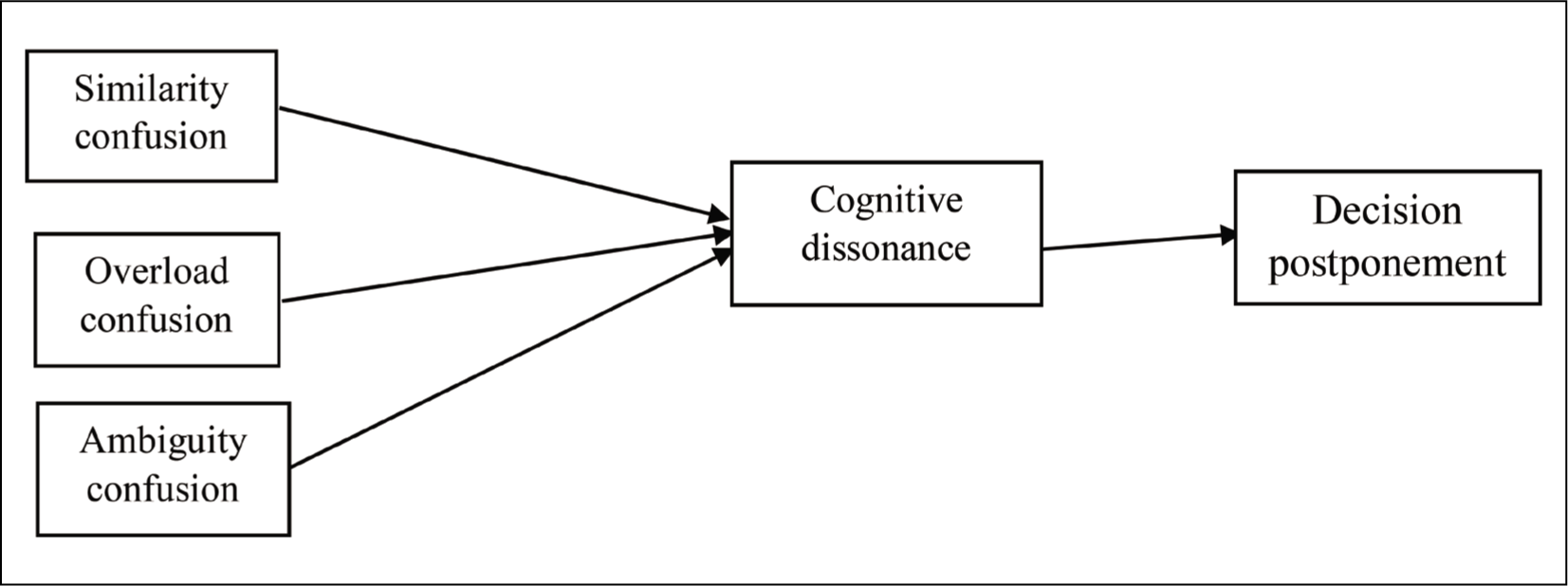
Similarity Confusion on Cognitive Dissonance
Confusion about the similarity of alternatives is more common, as there are several look-alike products challenging the mindset of consumers in making a choice and, hence, some of the retails took this as an opportunity to market their products with the same features and specifications (Moon et al., 2017). According to Walsh et al. (2007), “Similarity confusion means different products in a product category are visually and functionally similar.” The term “look-alike” refers to any aspect of the product, such as brand packaging, other characteristics of visual elements that can be considered include shape, size, color, lettering, or the presence of a logo (Balabanis & Craven, 1997). Consumers think that look-alike products are very similar to branded ones, and mistakenly purchasing the products will lead to similarity confusion. More confusion occurs as the degree of similarity between two stimuli increases (Balabanis & Craven, 1997). Consumers may encounter uncertainty and doubt when presented with similar market options. As the degree of similarity between the alternatives becomes greater, the level of dissonance experienced also intensifies (Ivy et al., 1978). One of the situations causing cognitive dissonance is when the alternatives are similar. When consumers encounter comparable alternatives during the decision-making process, which may result in cognitive dissonance, they may find themselves in a state of indecision (Barta et al., 2023). Therefore, we hypothesized that,
H1: Similarity confusion is positively related to cognitive dissonance.
Overload Confusion on Cognitive Dissonance
“Overload confusion means consumers are facing difficulty when confronted with more product information and alternatives than they can process in order to get to know, compare and comprehend alternatives” (Walsh et al., 2007). Increasing amount of information and products in the marketplace can overload and confuse consumers, resulting in stress and frustration and causing them to make suboptimal decisions. Overload confusion is largely related to the information consumer receives from different sources. Excess information affects the processing capacity of consumers, thereby causing them to commit mistakes (Chen & Chang, 2013). The current legal framework fails to address the issue of information overload as a consumer concern, thereby leaving consumers inadequately protected (Mitchell & Papavassiliou, 1999). Consumers are flooded with more information about various products. It can lead to confusion in the consumer’s mind, then leads to cognitive dissonance (Bolia et al., 2016). A greater number of alternatives are available to consumers but they fail to interpret the positive and negative attributes of the products, so the level of dissonance may increase (Oshikawa, 1970). Overload of information confuses consumers and can lead to cognitive dissonance. Based on this information, the next hypothesis is formulated.
H2: Overload confusion is positively related to cognitive dissonance.
Ambiguity Confusion on Cognitive Dissonance
Ambiguity confusion is connected with incomplete or misleading information causing trouble for customers while making decisions (Fitzgerald et al., 2019). Walsh (2007) defines “Ambiguity confusion is a consumer’s tolerance for processing misleading and unclear products and information about the products or advertisements.” Buyers often encounter a lack of clarity regarding products and their respective characteristics. Moreover, the presence of inconsistent information about the same product from various sources further contributes to the ambiguity and uncertainty experienced by buyers (Gan & Ting, n.d.). The phenomenon of overload confusion and similarity uncertainty has been found to have a positive impact on ambiguity uncertainty, which in turn has implications for cognitive dissonance (Gan & Ting, n.d.). Consumers experiencing more difficulty in alternative comparisons were more ambiguous, which is liable to cause cognitive dissonance (Dhar, 1997). We hypothesized that:
H3: Ambiguity confusion is positively related to cognitive dissonance.
Cognitive Dissonance and Decision Postponement
Due to the growing amount of information and products on the market, consumers may have trouble making decisions when making purchases. This may lead to discomfort in the purchasing process and cognitive dissonance, which can cause consumers to postpone or delay their purchasing decisions (Graff et al., 2012; Hasan, 2012; Hawkins, 1972). Cognitive dissonance is a psychological discomfort and uncertainty that arises when a person experiences conflicting thoughts or beliefs about their decisions and arousal in terms of purchase decision difficulty (Hawkins, 1972). Cognitive dissonance occurs both before purchase and after purchase (Graff et al., 2012; Koller & Salzberger, 2007; Soutar & Sweeney, 2003). So we hypothesized that:
H4: Cognitive dissonance is positively related to decision postponement.
Conclusion
This article generates a research question based on the model proposed. Does confusion among consumers cause cognitive dissonance? Consumers experiencing confusion in various product categories are prone to becoming frustrated, potentially leading to feelings of discomfort and tension. It will lead to cognitive dissonance. Previous studies argue that cognitive dissonance is an unexplored area and that dissonance is empirically an understudied area (Chauhan & Sagar, 2021a; Mitchell & Papavassiliou, 1999; Walsh et al., 2007). To address these gaps, the paper reviewed literature related to consumer confusion and cognitive dissonance and developed a conceptual model. This research aims to investigate how similarity, overload, and ambiguity confusion impact cognitive dissonance and their association with decision postponement.
Although all hypotheses are theoretically plausible and contribute to understanding the correlation between confusion and dissonance, H4 (cognitive dissonance is positively related to decision postponement) may have significant consequences due to its implication for consumer behavior beyond the immediate confusion stage. However, empirical evidence is needed to confirm the dominance and consequence of each hypothesis within the conceptual framework. Performing empirical research to test these hypotheses would offer valuable insights into their significance and consequences for theory and practice.
Evaluating the practical consequences of each hypothesis requires analyzing its potential influence on consumer behavior and marketing strategies. Identifying similarity, overload, and ambiguity confusion as significant factors contributing to cognitive dissonance, simplifying product information, or reducing choices could be effective marketing strategies to alleviate cognitive dissonance and promote decision-making.
Consumer confusion studies play a crucial role in guiding businesses’ marketing efforts, enhancing consumer decision-making processes, and contributing to a fair and well-functioning marketplace. By reducing confusion, companies can build stronger relationships with their customers and drive sustainable growth.
Future Research Scope and Study Limitations
Further research in this area could provide valuable insights into how consumer confusion influences cognitive dissonance and its effects on consumer behavior and decision-making. Cognitive dissonance may lead to decision delay if a person seeks more information to resolve the conflict. When a person feels the need to gather more information or evidence to support their beliefs or decisions, this information-seeking process may take time and delay the decision-making process. However, no studies empirically proved this concept. Cognitive dissonance and decision postponement are harmful to a company’s profitability and sales. It is a problem for both consumers and marketers.
The study has some limitations. One limitation is that the study developed a theoretical framework based on existing literature reviews and theories but did not validate the model through testing. The research cannot verify or refute the validity of those hypotheses without testing the model empirically. This proposed model offers fundamental concepts and guidelines for further research. Additional study is needed to validate the practical worth of this suggested model.
Several research gaps were identified during the literature review process. This study specifically addressed a particular research gap and developed a conceptual framework. Cognitive dissonance and consumer confusion are related concepts, as consumer confusion can contribute to cognitive dissonance in decision-making processes. Nevertheless, previous literature lacks a comprehensive exploration of the precise effects and ramifications of consumer confusion on cognitive dissonance.
Future studies should investigate the effect of consumer confusion dimensions on other consequences in different product categories. The research could incorporate additional mediators and moderators into this model. Future research in this area could help companies and consumers, academicians, and researchers in the marketing area.
Footnotes
Declaration of Conflicting Interests
The authors declared no potential conflicts of interest with respect to the research, authorship and/or publication of this article.
Funding
The authors received no financial support for the research, authorship and/or publication of this article.