




Abstract
Purpose:
The study is designed to check the impact of human brand image dimensions (other than performance related) on young customers’ psychological attachment toward athlete brands.
Design/Methodology/Approach:
The study was conducted among young athlete fans randomly selected from Kerala, India. The data were collected from 200 sample respondents using a questionnaire. The data were analyzed using the structural equation model.
Findings:
The findings reveal that variables such as relationship effort and life story of the athletes contribute to the creation of psychological attachment among the fans.
Practical Implications:
The result of the present study is a value addition for the marketing of human brands, especially for athlete brands. The results will be helpful in determining what factors should be concentrated on and how much weightage should be given to each factor for making a human brand successful in the market.
Originality/Value:
The study examines the influence of human brand image dimensions (other than performance-related dimensions) on young customers’ psychological attachment toward athlete brands. As the majority of the sports aspirants are from the young age group, the study variables are tested among young customers of athlete brands. Individual players, managers, and coaches can use the tested variables for analyzing, testing, and managing human brands (athlete brands).
Keywords
Introduction
Today’s globalized society has put pressure on people to ‘stand out’ from the crowd due to factors including increased competition in most areas of our everyday life. As a response to this pressure, personal branding is common among professionals (Tarnovskaya, 2017). Like normal products, humans can be considered as separate brands. In the context of marketing, we could say that people are generic products, and their names give them the distinctiveness of a brand. Human branding begins the moment a child is born. As a result of the parents giving their child a name, a human brand is created. There may be several people with the same name; nevertheless, their individual attributes and qualities may set them apart (Swati, 2014). Branding yourself is one of the factors for personal success. People can get a return in the form of reputation through personal branding, as personal branding can be considered as an investment in social relationships (Gandini, 2016), and in the case of professionals, such as athletes, personal branding is common nowadays. As brand management can optimize the commercial potential of those famous sportsmen, it is becoming increasingly important. In order to develop efficient marketing tactics, particularly for human brands, athlete branding studies make an effort to comprehend an athlete as a brand, and also athletes’ self-branding activities are aligned with endorsement procedures (Arai et al., 2013). Researches are emerging in the area of human branding, and many of them are in connection with athlete brands (Osorio et al., 2020).
According to Keller (1993), brand image means the consumer’s judgment about the brand, which is expressed by a collection of brand associations that are ingrained in the consumer’s memory, and is also one of the factors of brand equity. In the sports industry, individual athlete’s brand image has an impact on their customers. Different authors discussed the aftereffects of different dimensions of athlete brand image (Carlson & Donavan, 2013; Choi & Rifon, 2007; Franck & Nüesch, 2012; Hofmann et al., 2021; Rosen, 1981; Swati, 2014; Thomson, 2006; Wang & Scheinbaum, 2018; Yang & Shi, 2011). Keller (1993) classified brand attributes into certain product- and non- product-related characteristics that are noticeable during purchase or use. Based on this, the attributes of a human brand can be classified into two categories: performance-related attributes and attributes other than performance related (Arai et al., 2013).
The present study is designed to check the impact of human brand image dimensions (other than performance related) on young customers’ psychological attachment toward athlete brands. The research is conducted on young customers because, as per the study by Eime et al. (2016), the majority of sports stars and aspirants fall under the age group of less than 20 years. The study is based on the brand image scale developed by Arai et al. (2013), who developed the Scale of Athlete Brand Image (SABI). Based on the scale, attractive appearance (an athlete’s attractive external appearance) and marketable lifestyle (an athlete’s off-field marketable features) fall under attributes other than performance related. From these two dimensions, a total of four subdimensions are selected as independence variables, namely, attractive appearance, symbol, life story, and relationship efforts. The impact of these independent variables on the young customers’ psychological attachment is studied in this article.
Five research questions have been addressed in this article: First, how the human brand image dimensions other than performance related impact the young consumers’ psychological attachment toward human brands? Second, what is the relationship between the attractive appearance of an athlete and the young consumers’ psychological attachment toward the human brand? Third, what is the relationship between fashion/symbol of the athlete and the young consumers’ psychological attachment toward the human brand? Fourth, does the life story of the athlete create psychological attachment among young customers? Finally, is there any relationship between the relationship effort of the athlete and the young consumers’ psychological attachment toward the human brand?
Review of Literature and Hypothesis Development
Athlete as a Brand
Apart from product branding, branding activities are used in different areas. Different literatures have discussed the concept and aftereffects of employer branding (Muhammad & Shaikh, 2021), branding in politics (Omojola, 2008; Purwanti et al., 2023), personal branding in sports (Bauer et al., 2005; Geurin, 2017) and film industry (Mathys et al., 2016), etc. The concept of personal branding first appeared to be primarily relevant to famous people, public figures, and corporate executives. Over time, it became clear that it was significant for all managers, scientists, teachers, and other professionals, as well as for students who are about to enter the workforce and for all typical social media users, regardless of their line of work (Kucharska, 2018). According to Gorbatov et al. (2018), personal branding is the strategic process of developing, positioning, and upholding a positive self-image based on a special combination of individual traits that communicate a certain promise to the target audience through a distinct story and imagery. The branding of human beings is very similar to product branding, and the wide acceptance of social media brings a wide practice of personal branding (Tarnovskaya, 2017). Human brands, which include athletes, celebrities, politicians, academics, social media influencers, and business owners, can be thought of as one of various definitions of the larger brand concept, even if the phrase is typically used to refer to businesses, products, and services (Mogaji et al., 2022). An athlete’s brand is their public persona in the market, which may include their symbol, face, or other brand aspects (Arai et al., 2014). Geurin (2017) made a study on female athlete brands by incorporating the theory of self-representation and analyzed that athletes use new media for communication as well as branding purposes. From a marketing point of view, branding of sports stars is crucial nowadays (Pifer et al., 2015).
Customer’s Psychological Attachment
The concept of brand attachment has been extensively researched in the field of marketing (Saavedra Torres et al., 2020), and the concept is rooted in the ‘attachment theory’. Marketing research is increasingly using attachment theory and attachment style measures to explain how relationships affect consumer behavior. Because attachment theory can explain a wide range of psychological processes and behaviors, it has gained a great deal of traction. The basic principle of attachment theory is that individuals are compelled to remain close to people, or attachment figures, who provide both secure bases from which to explore the outside world and achieve personal objectives and safe havens in times of need (David et al., 2020). An increasing number of authors who contend that customers can and do develop emotional attachments to their brands have found inspiration in attachment theory (Belaid & Temessek Behi, 2010; Grisaffe & Nguyen, 2011; Vahdat et al., 2020). The psychological idea of ‘attachment’, which is characterized as a link of emotional charge between a person and an object, is based on brand attachment (Saavedra Torres et al., 2020). Jane Hemsley-Brown (2022) has discussed the antecedents as well as the consequences of customer attachment with a brand. He found that loyalty is an outcome of emotional ‘bonds’ with brands and argued that sentimentality, socialization, superior marketing characteristics, user-derived benefits, etc. are the antecedents of brand attachment (Grisaffe & Nguyen, 2011). A study conducted on product brands by Vlachos et al. (2010) states that firm trust, trust in employees, likeability of service personnel and likeability of co-consumers, shopping enjoyment, self-expressiveness, place dependence, and place identity lead to the customers’ emotional attachment with the brand.
Human Brand Image
The totality of the impressions a consumer gets from various sources constitutes their brand image (Lee et al., 2014). Brand image is the opinions about a brand as represented by the associations that consumers have with it in their memory (Keller, 1993). According to Lee et al. (2011), the personal symbolism that consumers identify with a brand is represented by its brand image, which is made up of all the descriptive and critical data connected to the brand. The impact of a brand’s messages is greater when consumers have a positive perception of them than when rival brands use similar messaging. A human brand with a high brand image helps to get the attention of customers. In comparison to low image appeal and no human brand situations, visual attention will be more successful in the high human brand image appeal condition (Seo et al., 2012). Various authors have discussed about different dimensions of human brand image and about various types of human brands, such as journalists (Klaß & Wellbrock, 2019), celebrities (Centeno & Wang, 2017), athletes (Arai et al., 2013), endorsers (Kunkel et al., 2019), etc.
Brand attributes can be categorized and analyzed by classifying them into product-related and non- product-related categories (Keller, 1993). Thus, human brand attributes can be classified into performance-related attributes and attributes other than performance related (Arai et al., 2013).
Performance-related Attributes
According to the study of Arai et al. (2013), the performance-related attributes of human brand image dimensions are athletic expertise, competition style, sportsmanship, and rivalry. Several researchers studied the positive relationship between performance-related brand image traits and customer behavior/market value. The athletes’ competency, quality, and tactics positively impact human brand image and promote their market value (Hofmann et al., 2021). Consumer awareness of a human brand rises as its performance-based traits reach higher levels (Yang & Shi, 2011). Further, the formation of a better human brand image is influenced by performance-based characteristics of a human brand (such as ability and knowledge), which justifies the positive impact of performance variables on the human brand (Rosen, 1981).
Attributes Other than Performance Based
As per the classification of Arai et al. (2013), the human brand image attributes other than performance based are physical attractiveness, symbol, life story, role model, and relationship effort. Traits other than performance also may influence customer perception and brand value. Choi and Rifon (2007) argued that in addition to their exceptional on-field performances, celebrities can improve their brand image through their distinctive lifestyles.
In the case of interaction, if the human brand is more interactive, then the consumers’ attachment to the brand will be high. By satisfying fans’ desire to connect with athletes, providing athletes with online places like blogs or chat rooms where they may interact with followers can aid in the growth of fan attachment (Thomson, 2006). Jun and Yi (2020) found that the interactive element of human brands creates authenticity and enhances their brand equity. Even press attention can increase the brand image (Franck & Nüesch, 2012).
The physical appearance of the human brand may also affect its image. Someone who is deemed attractive has a pleasing physical appearance, such as someone who is considered to be gorgeous, elegant, or refined. The attractiveness of the human brand positively influences the effectiveness of a communication message (Wang & Scheinbaum, 2018). Symbols indicate the fashion of the celebrity, which is also considered as a factor in brand image determination (Arai et al., 2014). Popularity-based variables, such as media effectiveness, temper, and eccentric appearance, may also lead to brand image building (Hofmann et al., 2021).
Life incidents with celebrity brands can be a factor that attracts fans. Life milestones, viral news, etc. may create curiosity among the fans and may lead them to follow the celebrities. Fans can be further categorized into different subgroups, which explains why a human brand can sometimes remain successful despite many scandals, such as love affairs and drug use, as their core products remain of high quality and most of their devoted fans are connoisseurs who only stick to the core products. For this reason, if we generalize all passionate fans as sharing the same loyal behaviors and willingness to make any sacrifices necessary to support the human brand, then possibly we will ignore their challenges and other causes that motivate them to remain in the fan kingdom or seek to drive them out (Huang & Huang, 2016). Apart from these, variables such as rarity and stability are also influencing factors in human brand image. According to Moulard et al. (2015), the variables’ rarity and stability positively influence the authenticity of human brands. Rarity means the extent to which a celebrity is regarded as unusual. The concept of rarity suggests that a celebrity has special qualities that cannot be imitated and set them apart from other stars. The degree to which a celebrity is viewed as consistent is characterized as stability. Those who are firm and steadfast in their speech, acts, principles, and mental and physical attributes are celebrities who display stability.
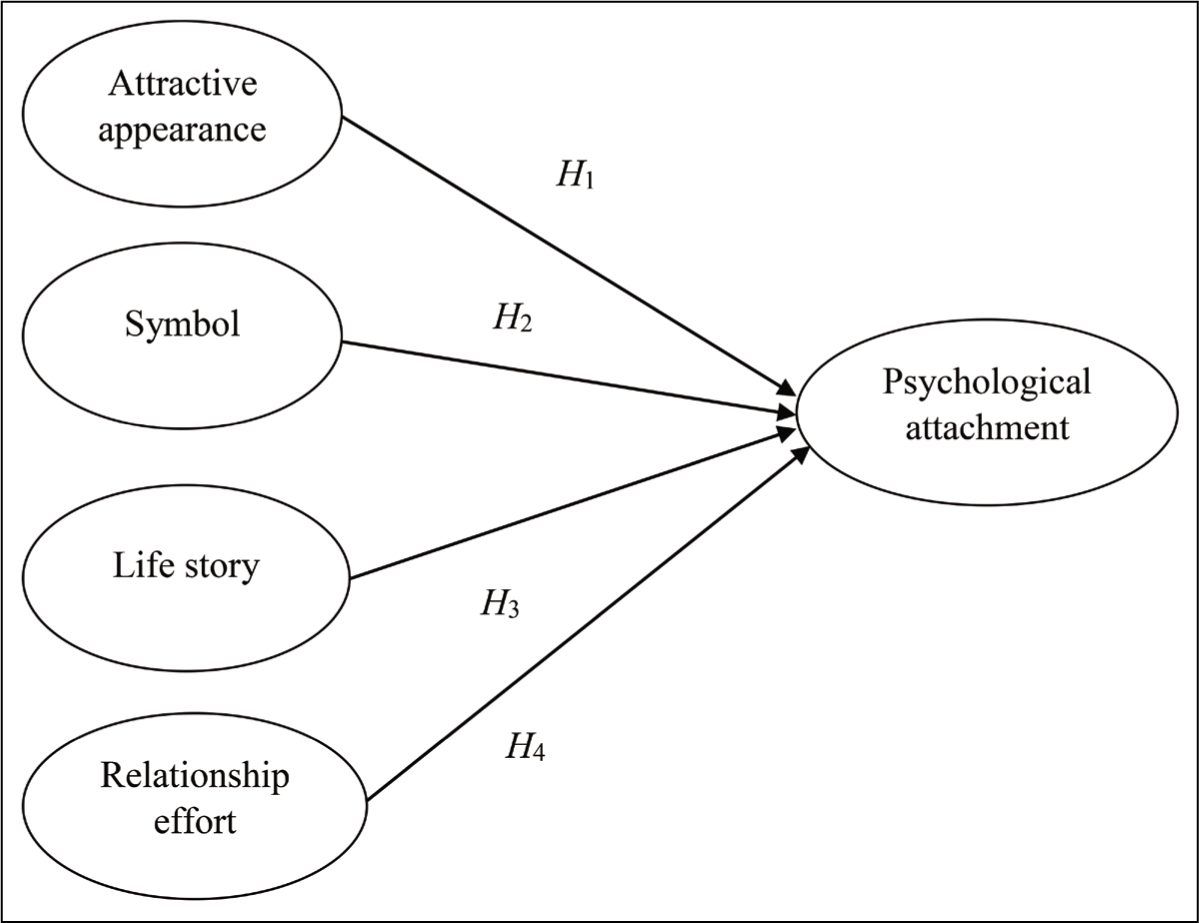
Based on the above literature, the study formed four hypotheses to check the impact of human brand image dimensions other than performance based on the young customers’ psychological attachment toward the human brand (here the selected human brand is an athlete). The human brand dimensions selected in the study are the human brand’s attractive appearance, fashion/symbol, life story, and relationship effort.
Hypothesis
H1: There is a relationship between the attractive appearance of the athlete and the young consumers’ psychological attachment towards the human brand.
H2: The fashion/symbol of an athlete contributes to the young consumers’ psychological attachment toward the human brand.
H3: There is a relationship between the life story of an athlete and the young consumers’ psychological attachment toward the human brand.
H4: There is a relationship between the relationship effort of an athlete and the young consumers’ psychological attachment toward the human brand.
Methodology
This research employed explanatory research with a quantitative approach using the structural equation model (SEM). The research seeks a deeper understanding of the dimensions of human brand elements and their impact on the psychological attachment of fans. The study focuses on the attributes of human brand image (other than performance related) and how it affects their customers’ attitudes toward them. So, the dependent variable of the study is the psychological attachment of fans, and the independent variables are the attributes (other than performance related) of athlete brand image. The independent variables considered in the study are attractive appearance, symbol, life story, and relationship efforts of the athlete. The relationship between independent and dependent variables under the study is explained in Figure 1. The variables are adopted from the Model of Athlete Brand Image (MABI) developed by Arai et al. (2013) in their study.
Conceptual Framework.
Respondents of the study are young customers (young fans of athletes) from Kerala, India. According to the World Health Organization, young people cover the age range of 10–24 years. So, the selected respondents are below the age of 24 years. The sampling technique used was stratified random sampling, and samples were collected from several regions of Kerala, India. Data were collected from 200 sample respondents using a structured questionnaire. For measuring customer variables, 15 statements with a 5-point Likert scale were used: strongly agree (5), agree (4), neutral (3), disagree (2), and strongly disagree (1). The questionnaire includes questions regarding the athletes, and the respondents were asked to fill out the same by keeping their favorite athlete in mind.
Result
Out of the total 200 respondents, 56% were male and 44% were female. The study considered young customers only, so all the respondents were under 25 years of age.
The goodness-of-fit criteria values were derived from the SEM of this study and calculated using the AMOS 23.0 software. Fit indices are listed in Table 1; the value of CMIN/DF is 1.737, and the model was considered as fit. The goodness-of-fit index (GFI) is 0.919; the model was also considered as fit due to the value of GFI ≥ 0.90; the comparative fit index (CFI) is 0.947, which is more than the standard value of ≥0.90; the model was considered as fit because GFI ≥ 0.90; here GFI is 0.919; the root mean square error of approximation (RMSEA) is 0.061; the model was considered as fit due to the RMSEA value ≤ 0.08. All model fit values fall within an acceptable range, according to the literature (Danarahmanto et al., 2020).
Model Fit Summary of the Structural Equation Model.

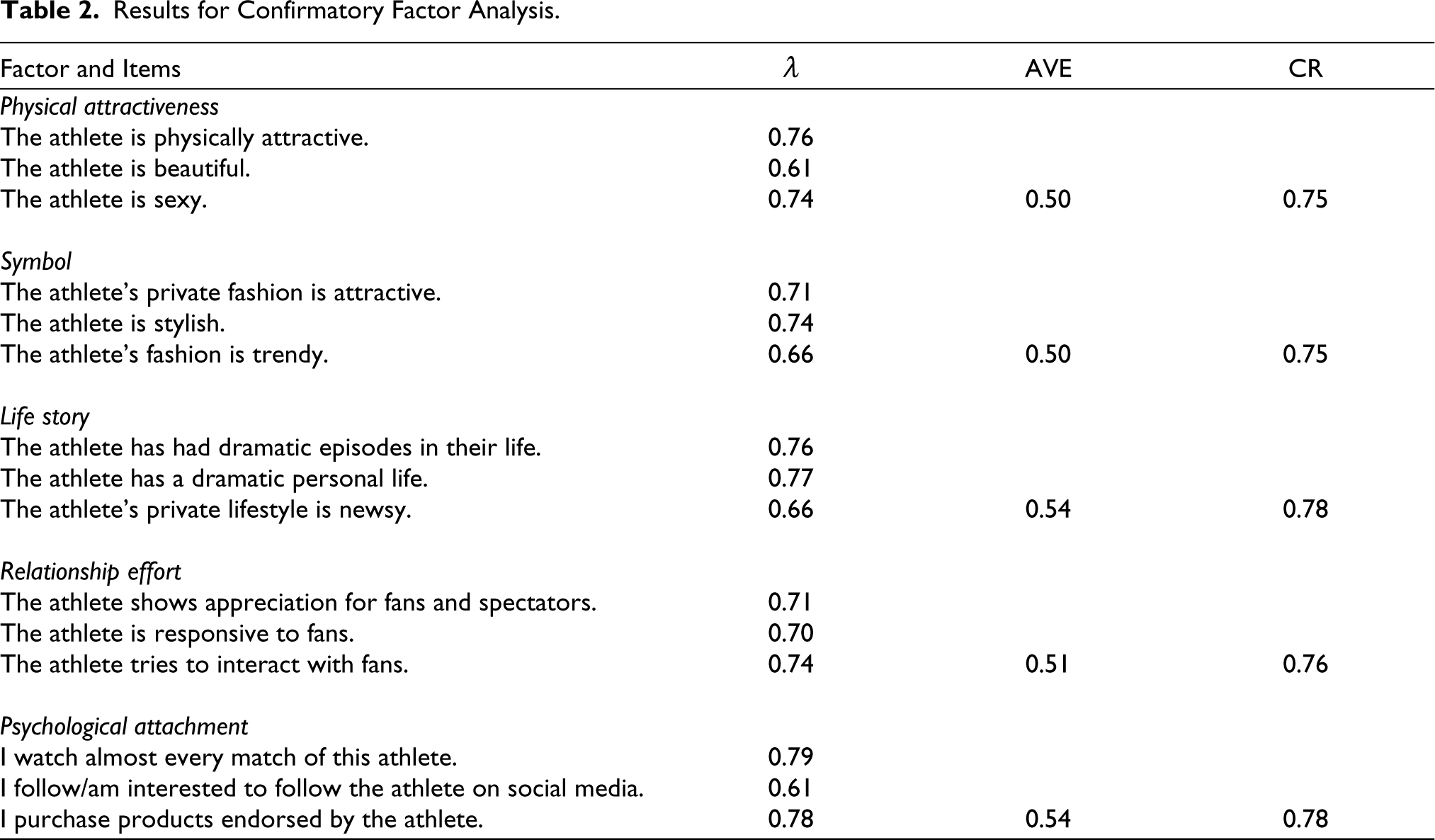
The values of AVE and CR are explained in Table 2. The values of AVE and CR for all constructs were also valid because all the values of CR > 0.70 and AVE > 0.50. All exogenous and endogenous constructs had acceptable construct validity and reliability because the computation revealed that the standardized loading, CR, and AVE requirements were met (Danarahmanto et al., 2020).
Results for Confirmatory Factor Analysis.
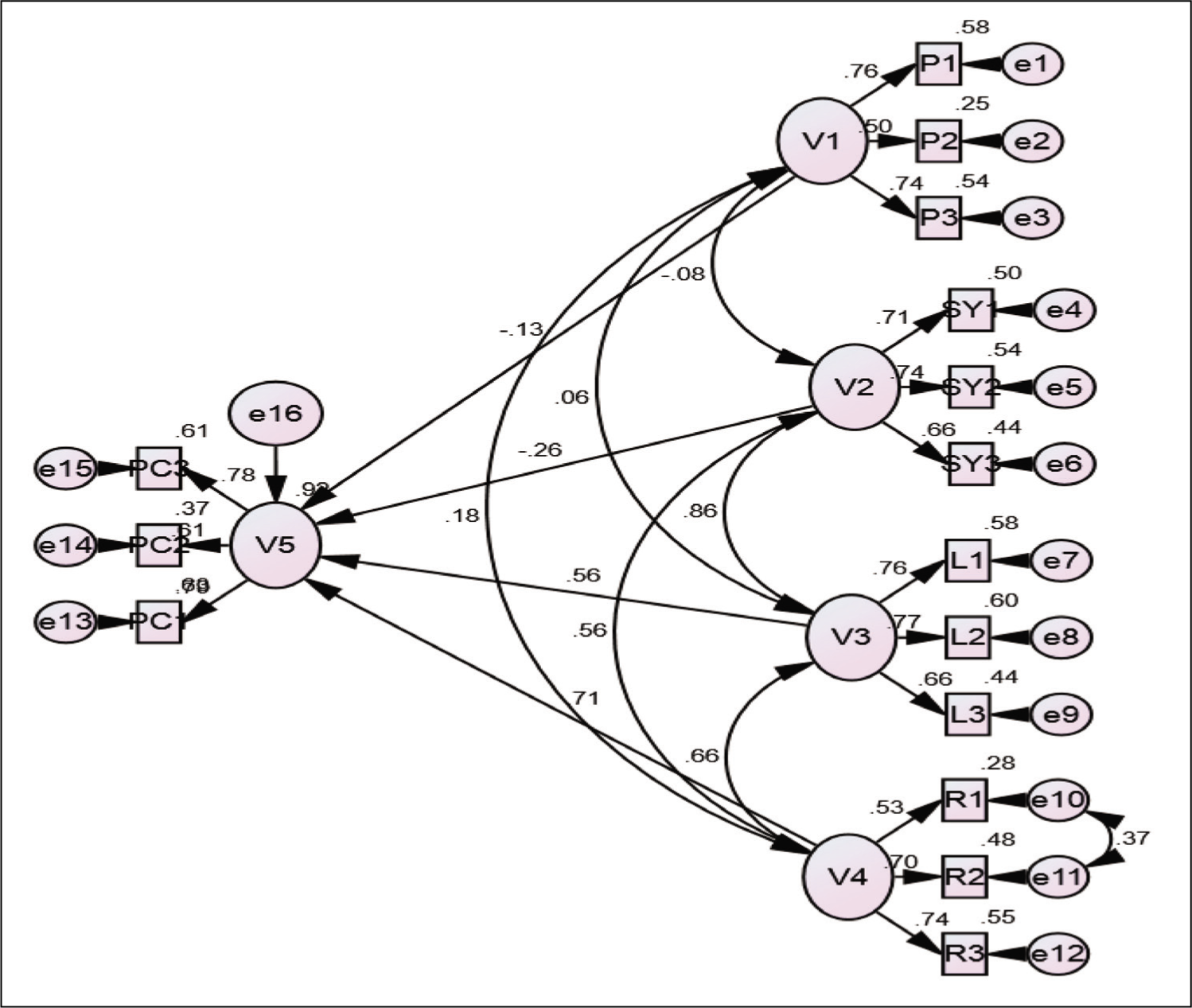
The article studied the impact of the physical attractiveness, symbol, life story, and relationship efforts of athletes on the psychological attachment of young fans (see Figure 2). The test values of the analysis are shown in Table 3.
Regression Weights.

The relationships among the variables are as follows:
The analysis finds that the variables’ physical attractiveness and symbol do not affect psychological attachment, as the computed p value is more than .05. In these cases, the null hypothesis is accepted (Hypotheses 1 and 2). The life story of the athlete brand influences the psychological attachment of the fans because the computed p value is .029, which is less than .05. Here also, the null hypothesis is rejected (Hypothesis 3). Analysis shows that the variable relationship effort strongly influences the variable psychological attachment; here, the p value is .001 (p < .05). Therefore, the null hypothesis is rejected (Hypothesis 4).
Discussion
Product branding (Kalro & Joshipura, 2023; Noorda, 2019; Yu Xie & Boggs, 2006), brand image, and brand equity dimensions of goods and services (Driesener & Romaniuk, 2006; Lee et al., 2011; Lee et al., 2014; Mikul, 2023) are widely discussed by prior research studies. Now researchers are focused on and discussing human branding and personal branding (Gorbatov et al., 2018; Osorio et al., 2020). Athletes have been treated as brands in marketing research, and it has been stressed how essential it is to build an athlete’s brand image (Arai et al., 2013). The main objective of the study was to examine the impact of human brand image attributes (other than performance related) on young customers’ psychological attachment. For this purpose, the study was conducted on athlete brands. The results of the study are analyzed through research hypotheses. To answer the hypotheses, the athlete brand image scale developed by Arai et al. (2013) was used. On this scale, variables such as physical attractiveness, symbol, life story, and relationship effort are taken as the dimensions of human brand image. These are the independent variables of this study, whereas the dependent variable is the consumers’ psychological attachment.
For the first research question, this investigation shows that some of the dimensions of human brand image (those that are mentioned in the solutions to the next research problems) have an impact on customers’ psychological attachment. The answer to the second and third research questions indicates that the physical appearance (both attractive appearance and style/symbol) of the athlete brand does not impact attachment among the young fans in Kerala, which was analyzed through the first two hypotheses. The result is in contradiction with the findings of Wang and Scheinbaum (2018) and Arai et al. (2013), who found that attractive appearances positively affect the brand image of human brands. They have found that the attractive appearance of human brands may lead to enhanced brand credibility. The first author conducted his study on celebrities, and the other author’s study was done on athletes. The variation in the results may be due to the reason that this study was conducted on young customers only. The perceptions of respondents may vary with changes in the age group. In the case of the fourth research question, it is examined that the newsy life and the dramatic episodes of the human brand also attract fans to follow them. This article found that the life story of an athlete makes the athlete popular and creates a positive image in the minds of fans through the evaluation of the third hypothesis. The last research question and the fourth hypothesis were formed to find out the impact of relationship effort on customer psychological attachment. In the case of relationship efforts, the findings show that it is a factor that creates attachment among the youth. The athlete’s response to the fans, interactions, appreciation, etc. may contribute to a favorable brand image in the minds of fans. These findings are in line with the conclusions of Thomson (2006) and Franck and Nüesch (2012). The positive effect of relationship effort and the life story of a human brand on psychological attachment may be because of the increased use of social media by public figures for interactions and to share news and life incidents.
In short, among the factors other than performance related, some have a positive impact on the fans’ psychological attachment. In the current study, out of the total four variables, two (relationship effort and life story) contribute to the fans’ psychological attachment. By determining an athlete’s strengths and shortcomings as a brand, athletes can construct (or rebuild) a successful brand based on the proposed dimensions.
Implications of the Study
The study has both practical and theoretical implications. The findings of the study extend the knowledge of human branding and are also helpful for the better management of human brands. In the present world, human brands can be mauled and marketed like marketers do for normal products. Similar to how a brand becomes a product’s identity, a person’s name also becomes that person’s identity, but the correct distinctions for any brand can only emerge from the right collection of traits. Love, trust, relationships, consistency, passion, uniqueness, emotional connect, and communication lead to the success of human brands. Persons who identify the best positioning strategy for themselves through their traits, values, and behaviors are able to become more successful (Swati, 2014). The result of the present study is a value addition for the marketing of human brands, especially for athlete brands. The results will be helpful in determining what factors should be concentrated on and how much weight should be given to each factor for making a human brand successful in the market. Individual players, managers, and coaches can use the tested variables for analyzing, testing, and managing human brands (athlete brands). As per the findings of Carlson and Donavan (2013), individual athletes have an impact on game viewership and retail spending of the fans. Both athlete and team identification have a beneficial impact on the number of games fans watch and the amount of money they spend on club-related merchandise. As the findings revealed that the interaction efforts and life stories of human brands lead to better results from the side of the customers or followers, these public figures can use the benefits of social media to interact with their followers, and also to share their stories, incidents, and personal as well as professional achievements in order to enhance their brand image and to attain followers’ attachments. The findings of Chung and Cho (2017) state that the wide acceptance of new media narrowed the gap between celebrities and their followers, and the followers started to consider them as ‘friends’.
The article goes through the theory of brand attachment and brand image and gives strong arguments in the area of human branding. It is an extended evaluation of human brand image dimensions developed by Arai et al. (2013). Although existing studies on human branding have established a wide range of theoretical bases, they have not analyzed the impact of human brand image dimensions on customers’ psychological attachment. The brand image of goods and services is widely discussed by researchers. Human brand image, its antecedents, and its outcomes are rarely touched upon by authors. Thus, this study extends the knowledge of human branding-related concepts.
Conclusion
From the data collected, analyzed, and discussed, we can conclude that some of the dimensions of athlete brand image influence the psychological attachment of youth customers. Out of the four dimensions of human brand image considered in this study, two dimensions, namely, relationship effort and life story, are influenced by the young customers’ psychological attachment, whereas the other two dimensions, attractive appearance and symbol, do not affect the psychological attachment of young customers. Athletes are selected as the human brand for this investigation. The data were collected from young customers of athlete human brands. The result shows the relationship examined among young customers. The young followers of an athlete brand feel more attached to the public figure because they make an effort to interact with their followers. A similar view was found by Dibble et al. (2016), where they stated that media characters and media users benefit from their parasocial relationships, which encourage intimacy and dependency. The emotions depict interpersonal relationships in the real world. Human brands can interact with the public through any mode. They can make use of digital media, social media, and even a press release, which may help to gain customer attachment. Another finding of the article is the positive relationship between the life story of the athlete and the customers’ psychological attachment. The athlete’s motivational stories, achievements, and public and private life incidents lead to the attachment of customers. In short, we can conclude that the efforts of athletes to establish a relationship with followers through interactive elements and the exhibition of their life stories may cause positive attachment and behavioral intentions among the followers. Followers may become more curious about their sports events, their endorsed products, and even their personal and public achievements. The result may be different in other categories of human brands and among other age groups of followers.
Limitations and Scope for Further Study
Along with the implications, the study also possesses some limitations. First, the study is conducted among the youth of Kerala only. The findings may be different for other age groups and among customers in other cities. Second, this study does not consider the factors related to the athletic performance of the athlete; only those dimensions of human brand image that are not related to athlete performance are connected with customer attachment. Third, the study is not based on a selected sample of athletes. The questionnaire is filled out by the respondents by keeping their favorite sports star in mind. Fourth, the results may vary for other human brand categories, such as film stars, politicians, and other professionals. Several studies are in support of the relationship between the attractive appearance of the athlete brand and the psychological attachment of fans. The present study is not able to find this relationship. It may be due to the above-mentioned limitations. In light of the present study, further studies can be done on select human brands by taking sample athletes from the selected sports area. Further, the same variables can be studied for human brands from other industries also. There is scope for adding several cities to the upcoming research in this area. An elaborate study can be conducted by incorporating both dimensions, such as performance-related and non-performance-related, with an age-wise comparison.
Footnotes
Declaration of Conflicting Interests
The authors declared no potential conflicts of interest with respect to the research, authorship, and/or publication of this article.
Funding
The authors received no financial support for the research, authorship, and/or publication of this article.