




Abstract
Purpose:
Past studies show that Machiavellianism, Organizational Cynicism, and Workplace Incivility can lead to adverse behavioral outcomes. For a munificent work climate and performance, managing these behaviors is essential. Which may hypothetically be difficult for leaders with positive behavioral orientation. Servant Leaders possess positive qualities like forgiveness, compassion, morality, and emotional healing. The study attempts to examine whether they are overwhelmed by or are able to manage the impact of behaviors like Machiavellianism, Organizational Cynicism and Workplace Incivility which are known to hamper trust and performance.
Method:
The study employs moderated mediation analysis using structural equation modeling (SEM) to model the moderating role of servant leadership over the relationship between Machiavellianism, Organizational Cynicism, and Organizational Incivility (independent variables) and performance (dependent variable) as mediated by trust climate.
Findings:
Results show that Servant Leadership plays a moderating role such that it significantly diminishes the negative effect of Machiavellianism, Organizational Cynicism and Organizational Incivility on Trust climate and (through that) on performance. Trust climate fully mediates the negative relationship between independent variables and dependent variables.
Practical Implications:
Present study suggests that the positive qualities of servant leaders are not overwhelmed by Machiavellianism, Organizational Cynicism, and Workplace Incivility. Instead, they are successfully able to maintain environment of trust leading to positive performance.
Originality/Value:
Since the impact of Servant Leadership style in presence of negative behaviors has not been examined yet; present study fills this gap and shows that qualities of servant leaders reduce the impact of negative behaviors like Machiavellianism, Organizational Cynicism and Workplace Incivility.
Keywords
Introduction
Servant Leadership style is characterized by a compelling desire to serve the highest priority needs of the followers (Coetzer et al., 2017). It has a spiritual inclination (Sendjaya & Cooper 2011; Williams et al., 2017) and also focuses on elements such as forgiveness (Gun, 2002; Ramsey, 2006), empathy (Spears, 2010) compassion (Jit et al., 2017) and morality (Lemoine et al., 2019; Sendjaya et al., 2008). The style also has a unique orientation towards healing the emotions of their followers; they empower them to grow (Jit et al., 2017; Wheeler, 2011). At the same time, it can also be observed that servant leadership style is efficient in enhancing organizational trust (Joseph & Winston 2005; Patterson, 2003; Sendjaya & Pekerti, 2010). In fact, trust has been found to be the building block of servant leadership style (Patterson, 2003; Russell, 2001). It has also been established that servant leadership style has a positive impact on performance of employees (Harwiki, 2016). Trust also mediates servant leadership’s effect on the performance of employees (Saleem et al., 2020). It also enhances the efficiency and effectiveness of the organization. Trust can lead to enhanced social interaction between the employees (Gould-Williams, 2003). It has been shown that servant leaders accomplish this by building an environment of trust among employees (Sendjaya & Pekerti 2010). It has also been found that there is an inverse relationship between stress and workplace performance; nevertheless, this relationship can be reduced by inducing servant leadership behavior among managers (Rasheed et al., 2023). However, there may be some employees whose behavior might be characterized by Machiavellianism, cynicism, and incivility. These employees may hypothetically at least, consider goodness of servant leaders as a weakness to be exploited to the advantage of the former. The challenge before servant leaders is; how to manage such behaviors so that an environment of trust is not dented. Despite the theoretical and empirical progress in the area of servant leadership, trust and its effect on performance of employees; there is a dearth of empirical work on how behaviors like Machiavellianism, cynicism and incivility affect the environment of trust created by servant leaders and how such behaviors are managed by servant leaders. Since Servant Leaders possess good human qualities like forgiveness (Gun, 2002; Ramsey, 2006), empathy (Spears, 2010) compassion (Jit et al., 2017) morality (Lemoine et al., 2019; Sendjaya et al., 2008) and emotional healing (Jit et al., 2017; Wheeler, 2011) the question arises that whether they are overwhelmed by the negative behaviors like Machiavellianism, Organizational Cynicism and Workplace Incivility or they manage it successfully. The present study attempts to fill the gap by examining the impact of Machiavellianism, Organizational Cynicism and Workplace Incivility on organizational trust and employee performance. This study examines the moderating role of servant leadership on the relationship between Machiavellianism, cynicism, incivility and trust. We also examine how trust climate mediates the relationship between Machiavellianism, Cynicism, Incivility and Job Performance with servant leadership as a moderator.
Hypotheses Development
Machiavellianism, Trust Climate, Servant Leadership, and Job Performance
Trust evolves from predictability. It involves confidence that the trusted person will respond to certain cues and situations as assumed and predicted. An act of trust is always beset with the risk of the expected behavior not materializing. It makes trusting individuals vulnerable to adverse consequences. Therefore, trusting someone requires building a disposition to assume risk and expose oneself to vulnerability. This disposition to assume risk does not develop overnight. Trust gets established when the behavioral pattern of individuals and groups in whom trust is reposted meets the criteria of predictability, reliability, and competence repeatedly over a sufficiently long period of time (Burke et al., 2007; Mayer et al., 1995). Trust is an essential element of an organization as it influences job performance significantly (Usikalu et al., 2015). Also, trust climate is an important predictor of job performance and satisfaction (Goris et al., 2003).
However, there are certain behaviors which damage the trust levels among the employees. For example, people high on Machiavellianism have feeling of distrust against the people they communicate with, and they avoid placing trust in others. This feeling of distrust encourages them to extract benefits from others by indulging in manipulative and exploitative behaviors (Gürer & Çiftçi, 2018; Jahanzeb et al., 2021). They also take advantage of those who trust them (Zagenczyk et al., 2014). They have a desire for control; they cheat on others by acting unethically and tend to manipulate others (Gürer & Çiftçi, 2018). Machiavellianism is positively linked with deceptive and manipulative behaviors and exploitative social tactics. People high on Machiavellianism are solely concerned about achieving their personal goals rather than organizational goals. People high on Machiavellianism do not trust the organization they work with (Koo & Lee, 2021). Machiavellianism is also associated with high level of cynicism, egocentricity and mistrust (LeBreton et al., 2018). Consequently, people who are high on Machiavellianism are unpredictable and unreliable. Machiavellianism may also prevent the creation of an environment of mutual trust in the workplace. However, studies also show that responsible leadership has a negative impact on Machiavellianism (Burcu & Seray, 2023).
Studies show that forgiveness and empathy are negatively related to Machiavellianism (Lee & Gibbons, 2017; Rebrov, 2022). The servant leadership style is also characterized by forgiveness (Gun, 2002; Ramsey, 2006) and empathy (Spears, 2010). It has been found that Machiavellianism can be handled by a group-focused transformational leadership style (Koo & Lee, 2021). Transformational leaders encourage and inspire their followers to perform beyond expectations; transformational leaders primarily focus on organizational goals. They rely on rewards and praise to encourage their followers to achieve desired outcome (Van Dierendonck et al., 2014). Studies show that servant leadership and transformational leadership styles have a common orientation as both these styles are people-orientated. Both these styles incorporate characteristics such as vision, influence, trust, and integrity, risk-sharing, listening and empowering followers (Stone et al., 2004). Also, servant leadership style is described to be the most moral form of charismatic leadership as it comprises elements such as humility, relational power and moral development of followers (Iyer, 2012). Since the existing literature shows that servant leadership style comprises behaviors such as forgiveness and empathy are negatively linked with Machiavellianism and leadership styles such as transformational leadership and charismatic leadership are capable of managing Machiavellianism at the workplace, therefore, servant leadership style may also be adequate enough to reduce its negative impact on trust and performance. It may, therefore, be hypothesized that:
H1: Servant Leadership moderates the relationship between Machiavellianism and Trust Climate H2: Trust Climate mediates the relationship between Machiavellianism and Job Performance with Servant Leadership as a moderator.
Organizational Cynicism, Trust Climate, Servant Leadership, and Job Performance
Cynical behavior is characterized by skepticism, distrust, incredulity, criticism, pessimism, and feeling of insecurity. Individuals who display cynical behavior are the ones who always find faults in others and have an extremely negative attitude towards the organization (Kökalan, 2019). Cynicism is described as an individual’s disbelieve on others (Soner, 2013). Existence of cynical behavior at workplace can reduce the efficiency and productivity of the organization and thus lead to material and spiritual losses. Cynical behavior can decrease job satisfaction and performance (Chiaburu et al., 2013; Kökalan, 2019).
Organizational cynicism may be caused by various factors. For example, when employees feel that their efforts are not valued by the organization, they are likely to feel betrayed; this leads to higher level of cynicism towards the organization. There are certain individuals who are characterized by cynical behavior, individuals who are high on it feel that others are selfish, dishonest, take advantage of others and cannot be trusted. Organizational cynicism can also be caused by emotional exhaustion (Chiaburu et al., 2013). Cynicism is also associated with stress, intentions to leave and organizational revenge (Özer, 2014). Employees who are high on cynical behavior are less likely to exhibit organizational citizenship behaviors even in the presence of ethical leadership (Nemr & Liu, 2021). Studies show that cynical employees have negative sentiments towards the organization and do not trust the organization and their leaders (Akin, 2015). Organizational cynicism arises as a result of employees’ lack of trust in the organizations they work with (Akin, 2015; Durrah et al., 2019). It has been found that cynical behavior is negatively associated with organizational trust perception; organizational trust is a significant predictor of organizational cynicism (Soner, 2013). Certain leadership styles can also give rise to organizational cynicism; for example, it has been found that despotic leadership has a positive impact on organizational cynicism (Ahtisham et al., 2023).
Empirical evidence shows that cynical behavior and its consequences may be reduced by being compassionate towards others as it fosters a sense of belongingness (Schabram & Heng, 2022). Also, it has been reported that transformational leadership is conducive to managing cynical behavior (Bommer et al., 2005; Demirçelik & Korkmaz, 2017). Transformational leaders inspire their subordinates to transcendent their self-interest for the sake of the organization they work with (Bass, 1985). They articulate the vision of the organization and also engage in supportive leader behavior. Transformational leader behavior is positively linked with employees’ trust in their managers (Bommer et al., 2005). Moreover, cynical behavior is prevalent when employees feel that their managers are incompetent and cannot be trusted. Since transformational leadership style does not fall under such a category of leadership; therefore, it is helpful in managing cynical behavior (Bommer et al., 2005). Transformational leaders help the employees in develop and exhibit positive attitudes and behavior towards the organization and therefore can reduce cynical behavior at workplace (Demirçelik & Korkmaz, 2017). It has been found that organizational spirituality is also negatively associated with cynical behavior at workplace (Kökalan, 2019).
It can be discerned from the above discussion that elements such as compassion, trust climate and spirituality can help organizations to combat cynical behavior. Since servant leadership style is also characterized by trust (Patterson, 2003; Russell, 2001), compassion (Jit et al., 2017) and spirituality (Sendjaya & Cooper 2011; Williams et al., 2017). It may be conjectured that servant leaders may also be able to manage cynical behavior at workplace. Based on this we have formulated following hypothesis.
H3: Servant Leadership moderates the relationship between Organizational Cynicism and Trust Climate
H4: Trust Climate mediates the relationship between Organizational Cynicism and Job Performance with Servant Leadership as a moderator.
Workplace Incivility, Trust Climate, Servant Leadership, and Job Performance
Another form of negative behavior that is the focus of the present study is workplace incivility. Incivility refers to a low-intensity deviant behavior that violates organizational norms and is intended to harm others (Lata & Chaudhary, 2021). Workplace incivility has a negative impact on job performance (Jiang et al., 2019; Rahim & Cosby, 2016). It is also negatively associated with organizational trust. When employees experience uncivil behavior at workplace, they lose trust in the organization. In the same way, when employees feel that their expectations are not met by the organization, they become more prone to demonstrate uncivil behavior (Cingöz & Kaplan, 2015). High trust level between leaders and subordinates leads to civil behavior at workplace (Rawat et al., 2019). Workplace incivility also has a negative impact on employee well-being (Kuriakose et al., 2023). Because of the above-mentioned negative consequences of uncivil behavior, leaders must create an environment in which employees are less likely to exhibit such behaviors.
Previous studies provide certain cues on how such an environment can be created. For example, it has been employees who are compassionate are less likely to engage in in-civil behavior a workplace. Being compassionate involves recognizing the suffering of others and acting in a manner to relieve the suffering. Since compassionate behavior involves understanding the suffering of other employees; it is also related to workplace incivility. When leaders express compassionate behavior towards their subordinates; employees feel that they are receiving genuine care from their leaders. This enhances the quality of relationship between the leader and subordinates, as a result, employees are less likely to indulge in uncivil behavior (Ko et al., 2021). Forgiving work environment tends to lessen the impact of incivility on job satisfaction and subjective well-being. Both of these are positively related to trust and performance (Christen et al., 2006; Goris et al., 2003; Salgado et al., 2019). Forgiving climate at the workplace provides employees with appropriate social signals in response to workplace offenses. This means that in a workplace characterized by forgiving environment, when employees experience offensive behavior from another organizational member, they express tolerance and kindness. In such work environment employees prefer to stop grudging and also restrain from blaming others while tolerating and accepting mistakes (Khan et al., 2021). According to previous empirical studies; workplace bullying (considered as uncivil behavior) can have a negative effect on organizational performance. However spiritual leadership has the capacity to fuel the growth of workplace spirituality, which in turn develops the spirits of employees; this reduces bullying and uncivil behavior (Ghaedi et al., 2021). Spiritual leadership with dimensions such as vision, hope, altruism, membership and meaning of work can reduce bullying behavior (Nafei, 2018). Workplace spirituality can also be one way to reduce deviant behavior at workplace (Chawla 2014; Astuti et al., 2020). The existence of workplace spirituality can provide employees with psychological resources; these resources help employees deal with workplace stressors because of which employees are less likely to perceive a workplace act as uncivil (Lata & Chaudhary, 2021; Naimon et al., 2013).
Servant leadership style is also spiritual in nature (Sendjaya & Cooper 2011; Williams et al., 2017). It is also characterized by compassion (Jit et al., 2017) and forgiveness (Gun, 2002; Ramsey, 2006). Since the attributes of servant leadership style such as compassion, forgiveness and spirituality are helpful in the management of uncivil behavior at workplace. Therefore, we hypothesize that:
H5: Servant Leadership moderates the relationship between Workplace Incivility and Trust Climate. H6: Trust Climate mediates the relationship between Workplace Incivility with Job Performance with Servant leadership as a moderator.
Method
Procedure
Employing moderation mediation analysis the data were collected through well tested scales and analyzed with the help of structural equation modeling (SEM) on AMOS.
Sample
The sampling technique for the present study was purposive sampling. Certain number of questionnaires were floated via emails, apart from that respondents were contacted personally to fill out the questionnaires. Our sample included people working in manufacturing and service industry with having minimum of 10 years of experience and an average age being 34 years. In order to reduce the common method bias, the respondents were ensured about the confidentiality of their responses (Bennett & Robinson, 2000). The sample size of the present study is 327, out of these 184 were males and 143 were females.
Measures
Independent Variables: Machiavellianism, Organizational Cynicism, and Workplace Incivility
To measure Machiavellianism 20 Item Machiavellianism IV scale was used, it is a seven-point Likert scale ranging from strongly disagrees to strongly agree (Mach IV; Christie & Geis, 1970a). In this scale, 10 items are designed to support Machiavellianism and 10 items are designed not to support Machiavellianism. In the original work of Christie and Geis (1970) Cronbach’s Alpha Coefficient of the scale is 0.79.
Workplace Incivility was measured with the help of Workplace Incivility Scale (WIS) by Cortina et al., 2013. This is a seven-item scale; it asks respondents to describe how often they experience uncivil behavior from their supervisor and colleague. It is a seven-item five-point Likert scale ranging from never to many times. The incivility measure showed good internal consistency of Cronbach’s Alpha 0.96.
Organizational Cynicism was measured with the help of Organizational Cynicism Scale by Dean et al., 1998. It is a 12-item five-point Likert scale ranging from strongly disagrees to strongly agree. This scale has three dimensions; namely affective cynicism, behavioral cynicism and cognitive cynicism. The value of Cronbach’s Alpha on this scale is 0.79.
Dependent Variable: Job Performance
Job Performance was measured with the help of short version of Self-Assessment Scale of Job Performance by de Azevedo Andrade et al. (2020). It is a 10 item Likert scale ranging from 1 (never) to 5 (always). The composite reliability for this scale was 0.91.
Mediating Variable: Trust Climate
Trust Climate was measured by Dwivedi’s Trust-Distrust Industrial Scale. Eight items were taken from group trust and two items from organizational trust. The measure for Trust climate showed a good internal consistency of Cronbach’s Alpha 0.828 (Sharma, 1989).
Moderating Variable: Servant Leadership
To measure servant leadership Barbuto and Wheeler (2006) scale was used. This scale consists of five dimensions namely: altruistic calling, wisdom, persuasive mapping, emotional healing, and organization stewardship. The value for Cronbach’s Alpha in each dimension has been mentioned separately. Altruistic calling Cronbach’s alpha = 0.82, Emotional Healing Cronbach’s alpha = 0.91, Wisdom Cronbach’s alpha = 0.92, Persuasive mapping Cronbach’s alpha = 0.87, Cronbach’s alpha organizational stewardship = 0.89. Since this scale did not have dimensions such as empathy and spirituality; five items of empathy from Servant Leadership Behaviors Scale and Evaluation of Servant Leadership Behaviors According to Teachers’ View by Ekinci (2015) and five items of spirituality from conceptualizing and measuring spiritual leadership in organizations by Sendjaya, S (2007). The Cronbach’s alpha for the dimension of spirituality was 0.72. The value of Cronbach’s alpha for the dimension of spirituality was 0.93. The items for empathy and spirituality were edited accordingly so as to maintain the flow of servant leadership scale by Barbuto AND Wheeler (2006).
Results
Confirmatory Factor Analysis
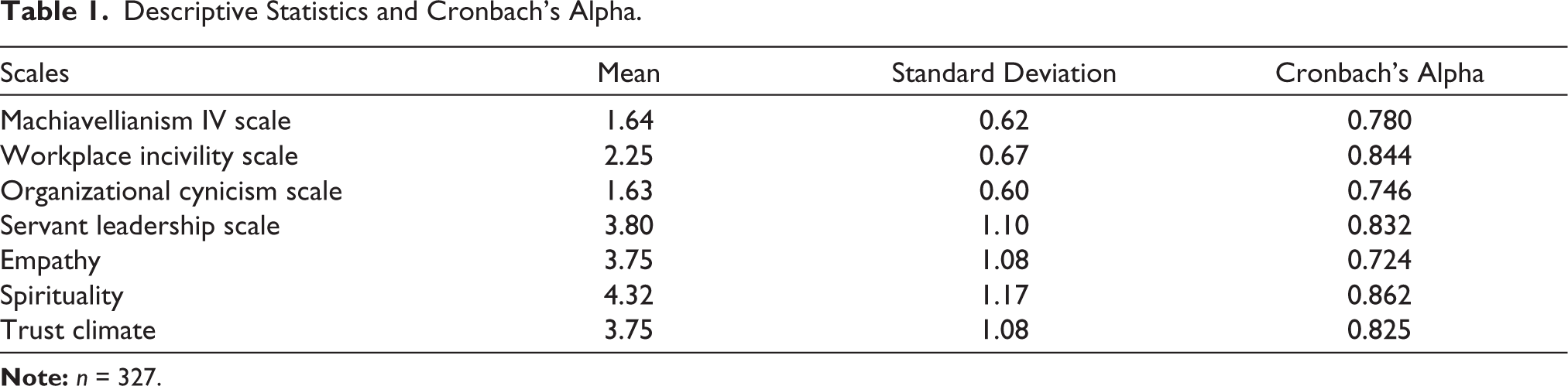
The descriptive statistics comprising of mean, standard deviation and Cronbach’s Alpha for each measure are given in Table 1. Cronbach’s alpha of all the scales was greater than 0.6 pointing towards internal consistency and reliability. The KMO value was 0.857, the value of Barlett’s test of sphericity was also significant. Both these value signifies appropriateness of sample adequacy.
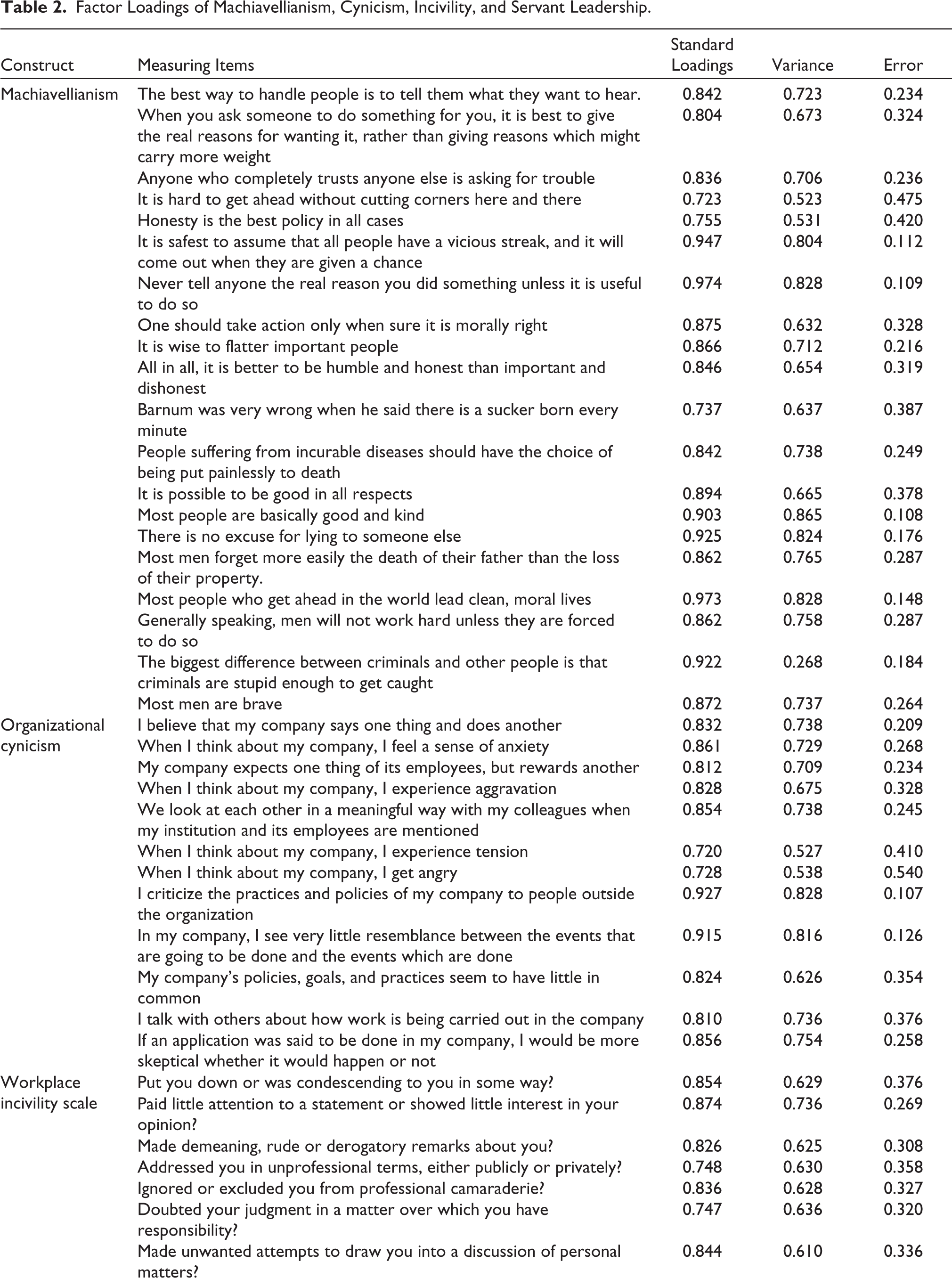
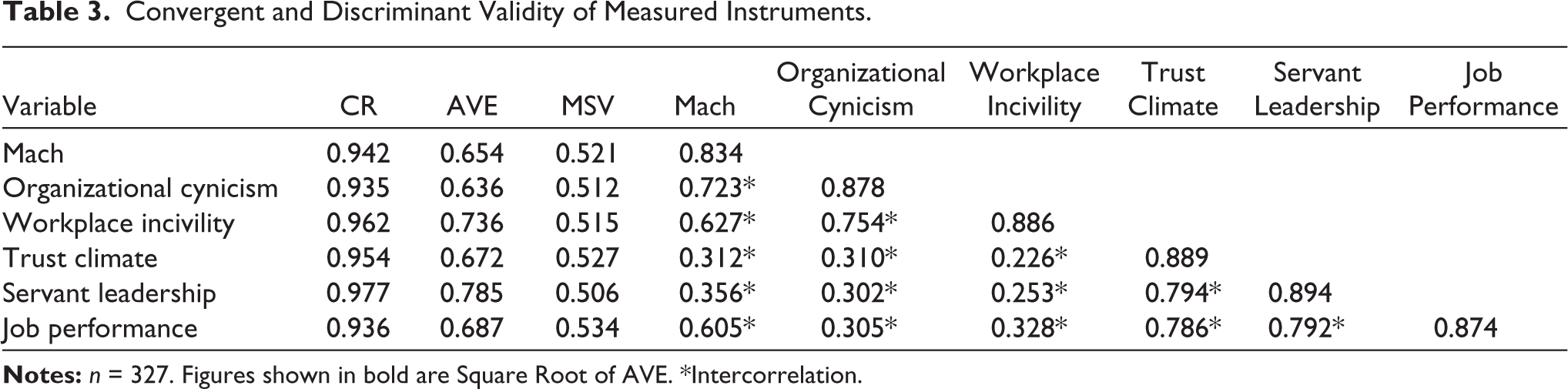
In order to investigate convergent and discriminant validity, Confirmatory Factor Analysis (CFA) was carried out employing Maximum Likelihood Estimation (MLE) method using AMOS. Since the factor loadings shown in Table 2 are above 0.7, this ensures the local usability of the scales. However, to get an adequate model fit, moderation indices were used. Goodness of fit is indicated if the value of CMIN/df is less than 3. However, to obtain conclusive evidence the Comparative Fit Index (CFI), Incremental Fit Index (IFI), and Root Mean Square Error of Approximation (RMSEA) were also calculated. Goodness of fit is established by CFI and IFI are above 0.90; RMSEA which shows badness of fit with the available data, should be below 0.010 Hu and Bentler (1999). In the present study, CMIN /df was found to be 2.827, Comparative Fit Index had a value of 0.964, Incremental Fit Index stood at 0.942 while Root Mean Square Error of Approximation (RMSEA) was 0.062. This shows that all the criterion statistics were acceptable range. The convergent and discriminant validity for the instrument were also calculated employing tool “excel tool package OLD” developed by David Kenny. This test is accessible at
Descriptive Statistics and Cronbach’s Alpha.
Factor Loadings of Machiavellianism, Cynicism, Incivility, and Servant Leadership.
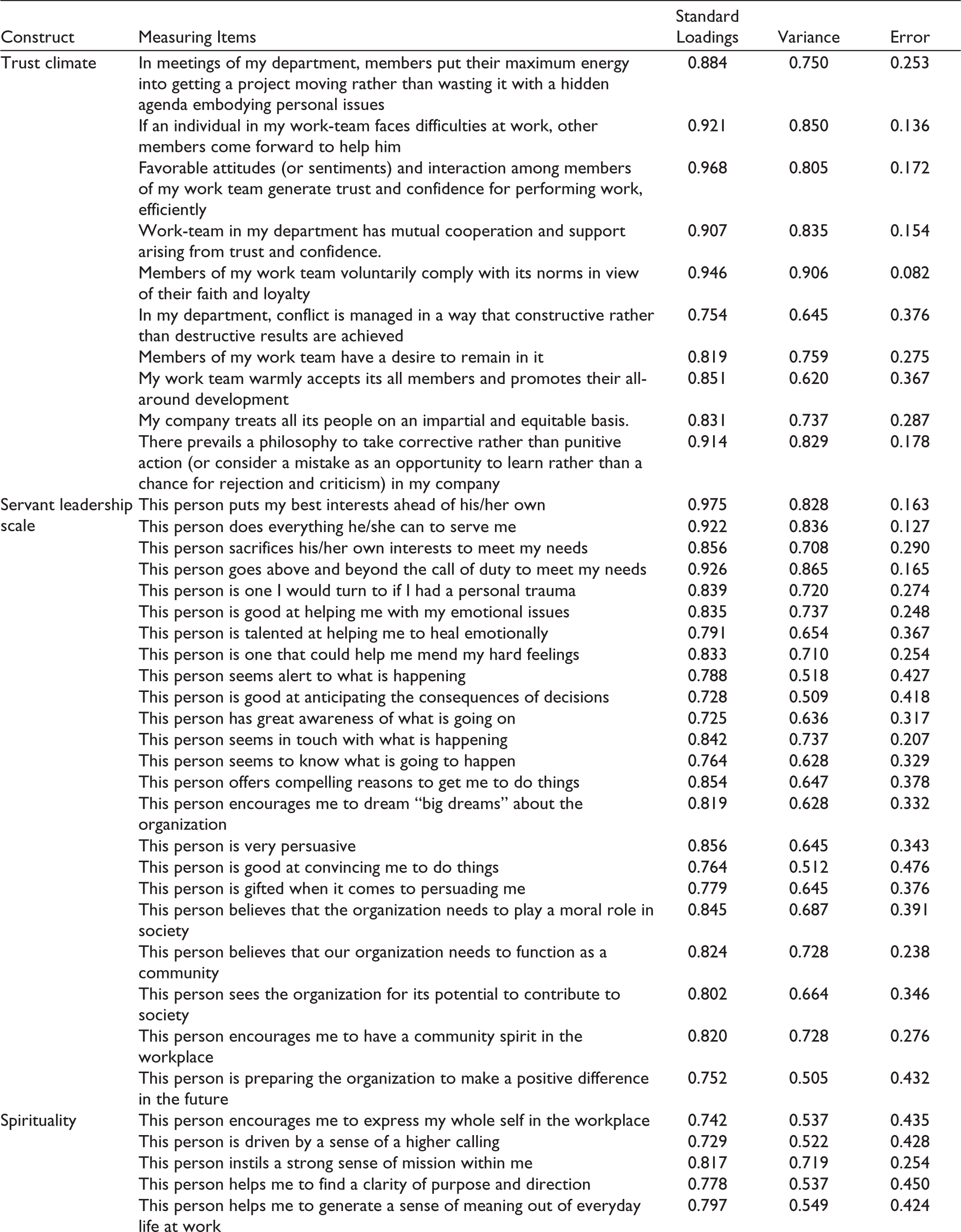
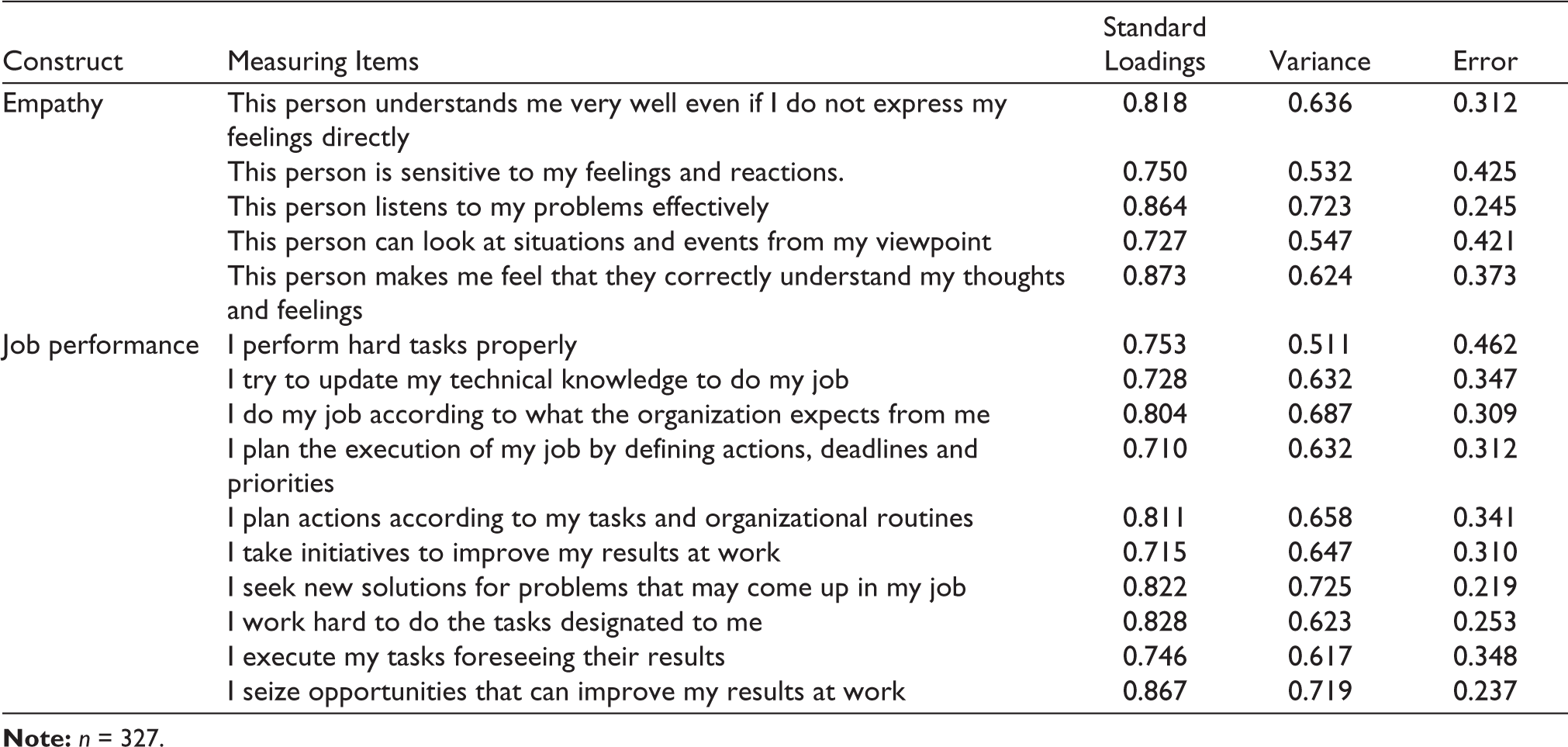
Convergent and Discriminant Validity of Measured Instruments.
Hypotheses Testing
In order to test the research hypotheses, the moderated mediation analysis was carried out with the help of AMOS software. To perform the moderated mediation analysis, the effect of interaction variable (interaction between independent variable and moderator variable) on mediator variable as well as dependent variable was evaluated. The moderated mediation analysis for each independent variable (Machiavellianism, Organizational Cynicism and Workplace Incivility) was carried out separately on AMOS software. The results are presented in Figure 1 and Table 4.
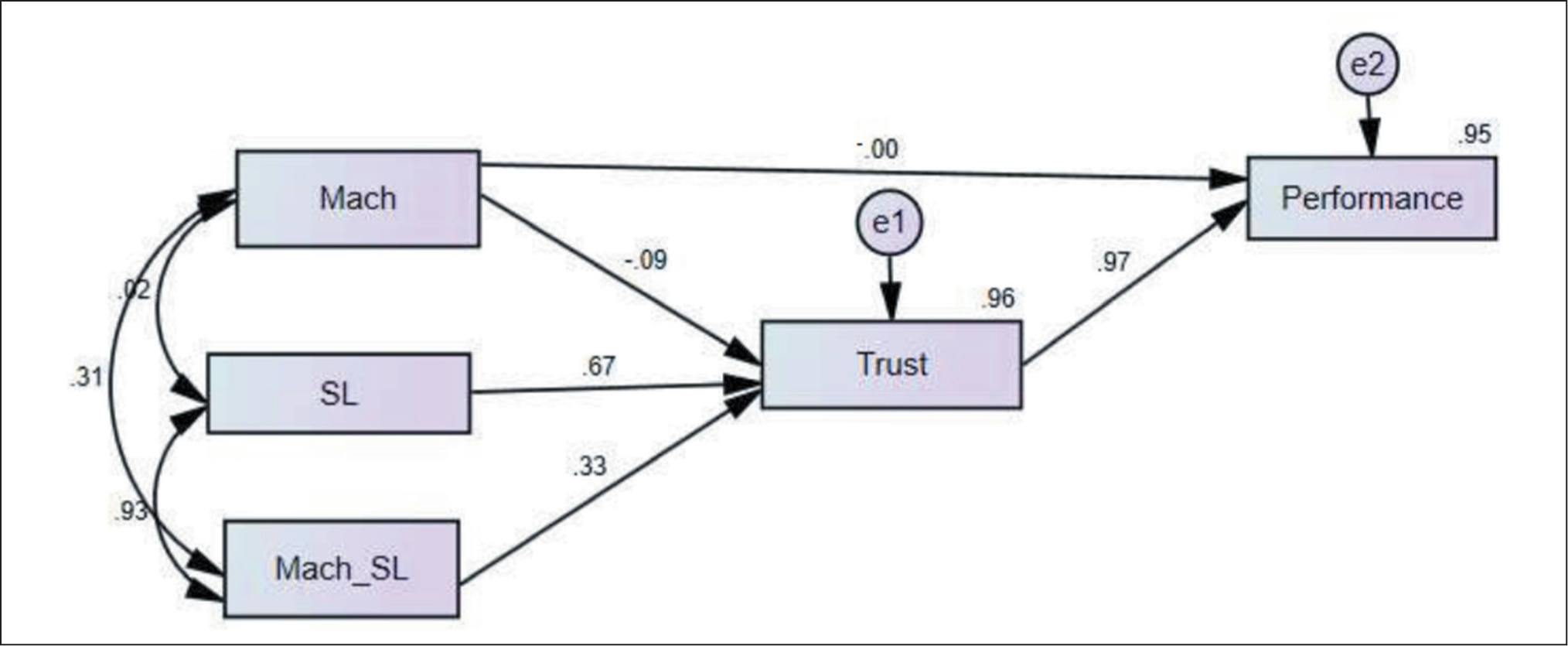
Mach_SL represents interaction effect between Servant Leadership and Machiavellianism.
Results for Moderated Mediation for Machiavellianism.
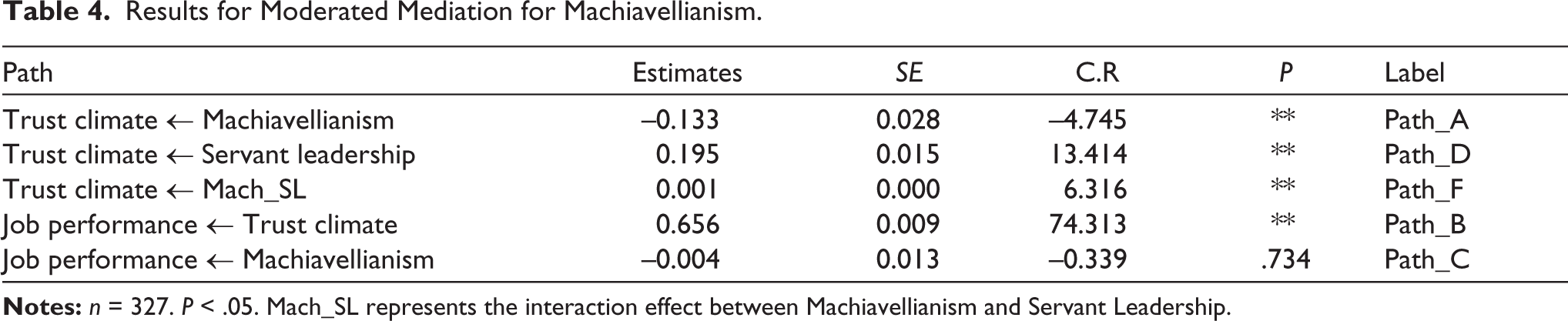
In Table 4, Path_A shows the effect of Machiavellianism on Trust Climate, the values for estimates and C.R (critical ratio) show that this effect is negative and significant. This means that Machiavellianism has a negative effect on Trust Climate. Similarly, Path_D Servant Leadership has a positive effect on Trust Climate. Path_B represents the effect of Trust Climate on Job Performance that is positive and significant, indicating that performance is enhanced by a high level of trust. However, the effect of Machiavellianism on Job Performance (Path_C) is negative but not significant. Since the effect of an independent variable (Machiavellianism) and dependent variable (Job Performance) is negative but not significant; this means that Trust Climate fully mediates the relationship between Machiavellianism and Job Performance. In other words, our findings show that when Machiavellianism is high, trust declines which in-term decreases the performance. However, this effect is being moderated by servant leadership indicated by Path_ F; this effect is also positive and significant. This means that Servant Leadership moderates the relationship between Machiavellianism and Trust Climate in such a way that Servant Leadership eliminates the negative effect of Machiavellianism on Trust Climate and Performance, thereby retaining the climate of trust that enhances performance.
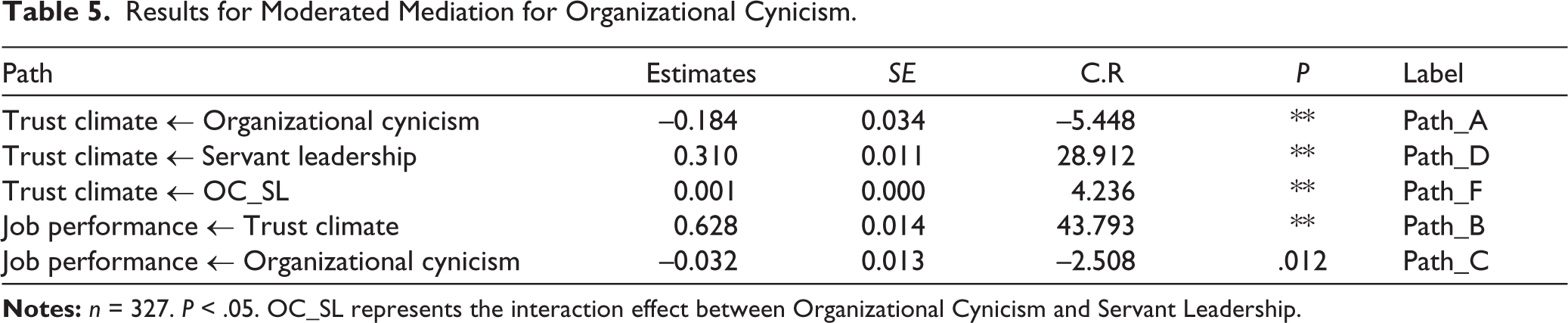
Figure 2 and Table 5 exhibits the moderated mediation analysis for organizational cynicism. Path_A shows the effect of Organizational Cynicism on Trust Climate. The values for estimates and C.R (critical ratio) show that this effect is negative and significant. This means that Organizational Cynicism has a negative impact on Trust Climate. Path_D represents the effect of Servant Leadership on Trust Climate; that is positive and significant. Path_B represents the effect of Trust Climate on Job Performance that is positive and significant. However, the effect of Organizational Cynicism on Job Performance (Path_C) is negative but not significant. Since the relationship between independent variable (Organizational Cynicism) dependent variable (Job Performance) is negative but not significant. This means that Trust Climate fully mediates the relationship between Organizational Cynicism and Job Performance. This indicates that when Organizational Cynicism is high, trust declines which deteriorates the performance. The above relationship is moderated by Servant Leadership as indicated by Path_ F; this effect is also positive and significant. This means that Servant Leadership moderated relationship between Organizational Cynicism and Trust Climate such that Servant Leadership omits the negative impact of Organizational Cynicism on Trust and Performance; thereby retaining the climate of trust that enhances performance.
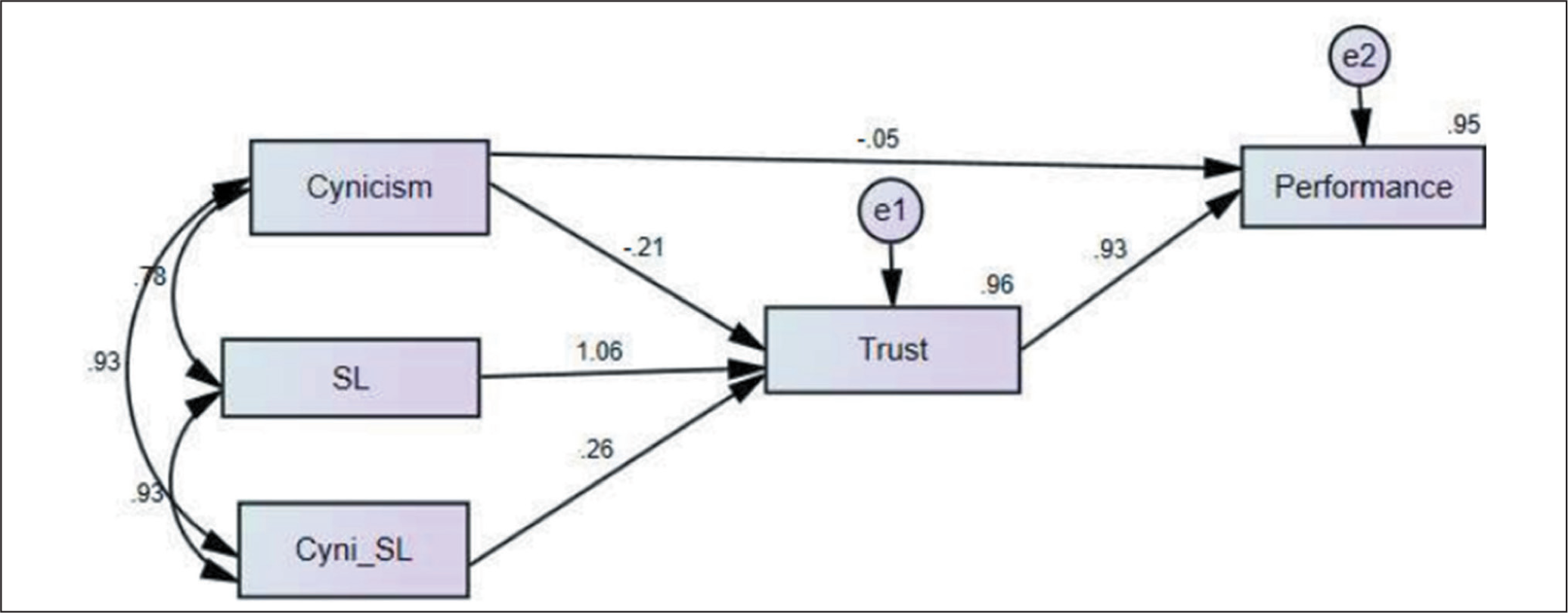
Results for Moderated Mediation for Organizational Cynicism.
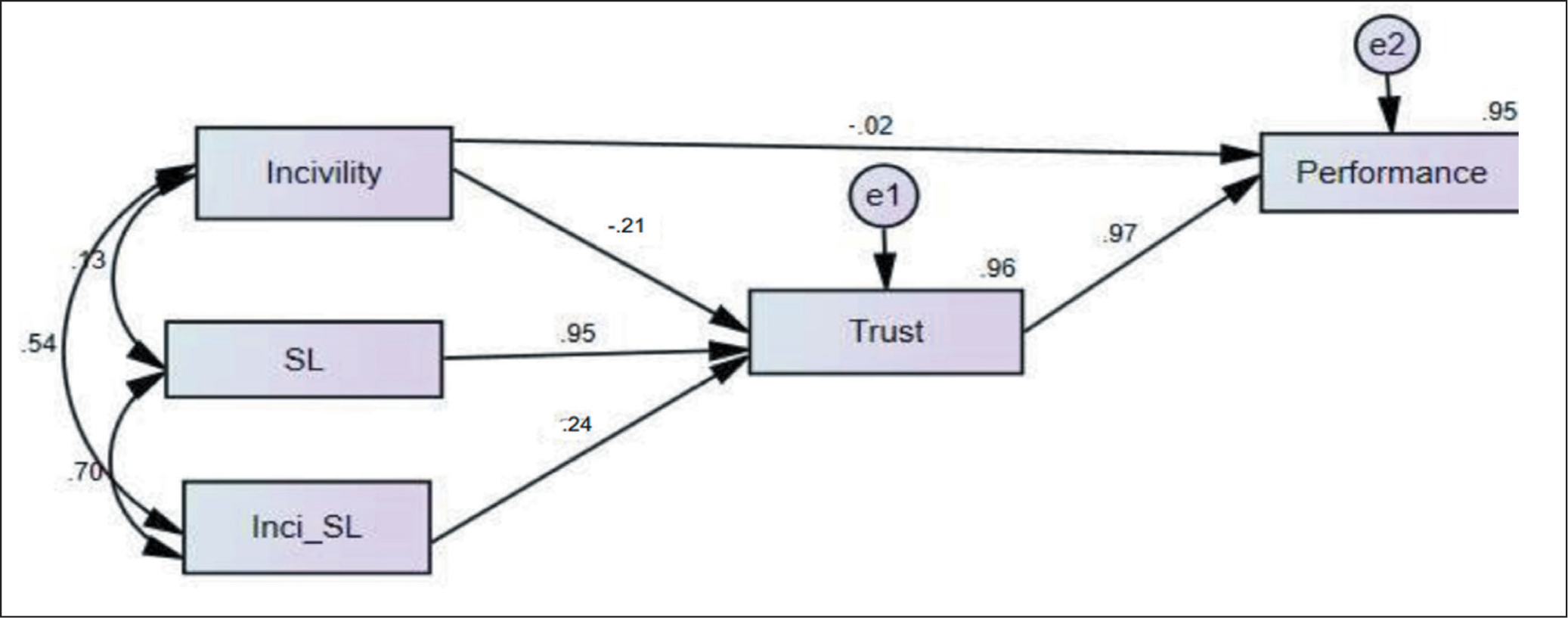
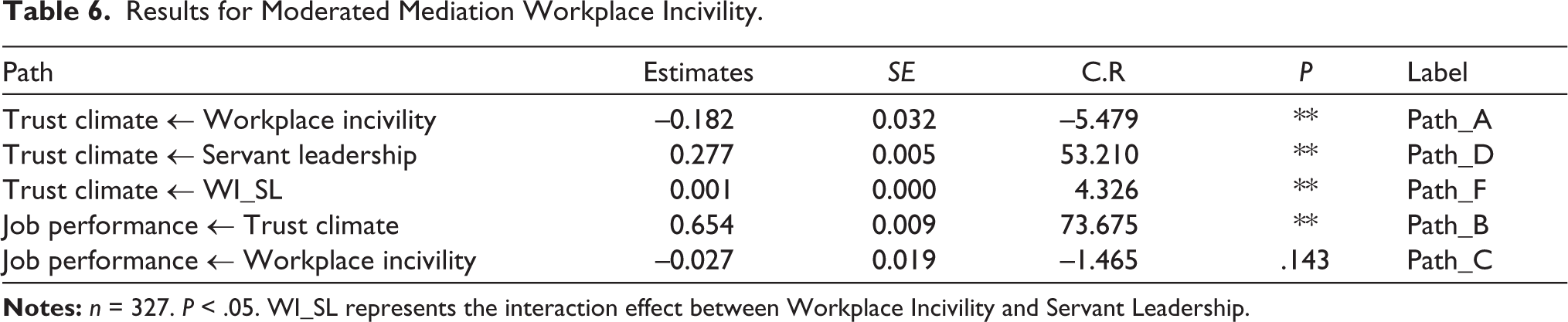
In Table 6 and Figure 3, Path_A shows the effect of Workplace Incivility on Trust Climate; this effect is negative and significant. Similarly, the effect of Servant Leadership on Trust Climate is positive and significant. Path_B represents the effect of Trust Climate on Job Performance that is positive and significant. However, the effect of Workplace Incivility on Job Performance (Path_C) is negative but not significant. This means that Trust Climate fully mediates the relationship between Workplace Incivility and Job Performance in a way that a high level of Workplace Incivility deteriorates trust and performance. The above relationship is moderated by Servant Leadership as indicated by Path_ F; this effect is positive and significant. This means that Servant Leadership moderated relationship between Workplace Incivility and Trust Climate such that Servant Leadership eliminates the negative impact of Workplace Incivility on Trust Climate in a way that trust is retained and performance is enhanced.
Results for Moderated Mediation Workplace Incivility.
The Table 7 shows the role of moderating variable (Servant Leadership) on the indirect effect of interaction terms through the mediator (Trust Climate) to the dependent variable (Job Performance). Since the P values for all the interaction terms are less than 0.05, therefore, it shows that this indirect effect is being moderated by servant leadership.
Index of Moderated Mediation (Indirect Effect of Interaction Terms Through the Mediator to the Dependent Variable).
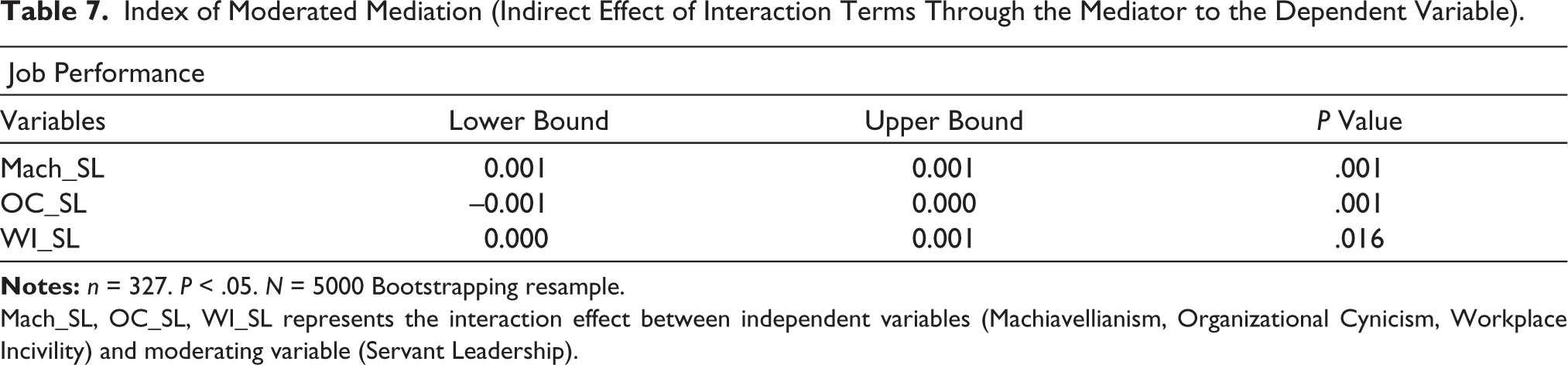
Mach_SL, OC_SL, WI_SL represents the interaction effect between independent variables (Machiavellianism, Organizational Cynicism, Workplace Incivility) and moderating variable (Servant Leadership).
Discussion
Present study develops and tests moderated mediation model, centering on whether servant leaders can handle elements such as Machiavellianism, Organizational Cynicism and Workplace Incivility. Since Servant Leaders possess good human qualities, the question arises that whether they are overwhelmed by negative behaviors like Machiavellianism, Organizational Cynicism and Workplace Incivility or they are successfully able to handle it; present study is an attempt to answer this question. Results of the present study show that goodness of Servant Leaders is not overwhelmed by behavioral elements like Machiavellianism, Organizational Cynicism; rather they (Servant Leaders) are successfully able to manage it by preserving the climate of trust leading to high level of performance. This is comparable to the attributes of servant leadership style as it is efficient in enhancing organizational trust (Joseph & Winston 2005; Patterson, 2003; Sendjaya & Pekerti, 2010). In fact, Servant Leadership Style operates by maintaining an environment of trust and cooperation (Patterson, 2003; Russell, 2001). This impact of Servant Leadership could be because they are forgiving and compassionate (Gun, 2002; Jit et al., 2017; Ramsey, 2006), they have spiritual inclination (Sendjaya & Cooper 2011; Williams et al., 2017) and have compelling desire to serve the highest priority needs of the followers (Coetzer et al., 2017).
Leadership styles having characteristics overlapping with servant leadership style for example ethical leaders (Lemoine et al., 2019) can reduce the expected damages of unpleasant behaviors such as organizational cynicism (Qian & Jian, 2020), Machiavellianism and counterproductive behaviors (Brown et al., 2005). It is because of these conceptual similarities that the present study shows that servant leadership plays a moderating role in the present study.
There is empirical evidence that shows that people who are high on Machiavellianism extract benefits from others by indulging in manipulative and exploitative behaviors (Gürer & Çiftçi, 2018; Jahanzeb et al., 2021). Many social psychologists strongly support the fact that selfishness is rooted in human behavior and that humans are inherently selfish (Dubois et al., 2015; Force, 2003; Yu, 2011). Therefore, Machiavellianism can be a commonly observed personality trait in the workplace. Similarly, employees in an organization may encounter unpleasant experiences that can lead to psychological distress and emotional turmoil/exhaustion (Jit et al., 2017). Employees may become cynical as a result of the stress and emotional exhaustion (Chiaburu et-al. 2013; Özer, 2014). Porath and Pearson (2013) predicted that around 98% of employees experience uncivil behaviors with 50% of employees experiencing such behaviors at least weekly. Since these negative forms of behaviors such as Machiavellianism, Organizational Cynicism and Workplace Incivility can be easily encountered; it becomes extremely essential to manage them. Therefore, the present study is an important contribution to the literature as it shows that the goodness of servant leaders is not overwhelmed with these negative forms of behaviors; rather they successfully manage it by preserving the climate of trust.
Implications
It is a well-established fact that Servant Leaders possess good human qualities such as forgiveness, compassion, empathy, morality, spirituality, and emotional healing. At the same time, there might exits some negative behavioral elements such as Machiavellianism, Organizational Cynicism and Workplace Incivility that hinders the overall growth of the organization. Since no studies have been done to explore the role of servant leadership styles in preserving the climate of trust even in the presence of negative behaviors like Machiavellianism, Organizational Cynicism and Workplace Incivility. Present study can help the researchers to understand that the goodness of servant leaders is not overwhelmed with these negative forms of behaviors; rather they successfully manage it by preserving the climate of trust and enhancing performance. People who display these negative behaviors cannot extract benefits out of the good qualities of Servant Leadership style. Present study can help the researches to explore other facets of the Servant Leadership style. Since these negative behaviors can be frequently encountered at the workplace and can lead to adverse organizational consequences, therefore, it is essential to manage them efficiently. The present study can be helpful for people holding managerial/leadership positions so that they are able to manage such negative behaviors. This study can help Human Resource professionals induce servant leadership behaviors among people holding managerial positions as well as employees who have the potential to hold a leadership position. This can not only stimulate an environment of trust but can also be helpful in managing such negative forms of behaviors.
Limitations
There are certain limitations of the present study. First, our present study has only included private sector employees as participants in the research; including public as well as private sectors could have the results more generalized. Second, the present research has incorporated quantitative techniques of data collection and analysis; a quantitative or mixed method could have yielded better results. Third, this study has only focused on the servant leadership style; a comparison with other leadership styles could have been done. Fourth, the present study has included only one personality trait of the dirty triads that is Machiavellianism; the other two traits, Narcissisms and Psychopath were not included.
Conclusion and Scope for Future Research
The present study has explored and analyzed the moderated mediation model. It can be concluded that Servant Leadership style moderates the relationship between independent variables (Machiavellianism, Organizational Cynicism, and Workplace Incivility) and Trust Climate (mediating variable) in a way that Servant Leadership style eliminates the negative impact of Machiavellianism, Organizational Cynicism and Workplace Incivility on Trust Climate. Good qualities of servant leaders are not overwhelmed by negative behaviors like Machiavellianism, Organizational Cynicism and Workplace Incivility. The study also concludes that Trust Climate fully mediates the relationship between independent variables (Machiavellianism, Organizational Cynicism and Workplace Incivility) and dependent variable (Job Performance). Certain aspects that could not be covered in the present research can be taken care of in future research. Therefore/future research can focus on public as well as private sector and can also do cross-sectional studies so as to explore and compare various sectors. Since the present study has used quantitative method, future studies may focus on qualitative methods or mixed methods that can bring out other issues and challenges. Third, this study has only focused on servant leadership style; future research can also do a comparative study by comparing other leadership styles.
Footnotes
Declaration of Conflicting Interests
The authors declared no potential conflicts of interest with respect to the research, authorship, and/or publication of this article.
Funding
The authors received no financial support for the research, authorship, and/or publication of this article.