




Abstract
The plastic particles measuring less than 5 mm known as Microplastics have emerged as pervasive environmental contaminants with increasing evidence of human exposure. Recent studies reporting their presence in human tissues have raised concerns regarding their potential role in carcinogenesis.
On this background this toxicology mini review was carried out which summarises current analytical techniques used to detect and characterise microplastics in human cancer tissues and to synthesize existing evidence on their potential role in tumor development and progression. A literature search was conducted in PubMed and Google Scholar for studies published between January 2010 and October 2025 using medical subject headings (MeSH) terms and keywords. Eligible studies were included and data extraction was done in focus of cancer type, analytical methods, polymer characterisation and proposed carcinogenic mechanism. At the end we found microplastics have been identified in multiple human tissues, including blood, placenta, lung, brain, and solid organs, as well as within tumor and metastatic tissues of colorectal, prostate, gastric, lung, and cervical cancers. Analytical approaches such as µ-FTIR, Raman spectroscopy, laser direct infrared imaging, and pyrolysis-GC-MS are commonly employed, each offering distinct advantages and limitations.
Emerging evidence indicates preferential accumulation of microplastics in cancerous tissues and supports their potential involvement in carcinogenesis through oxidative stress, chronic inflammation, immune modulation, and synergistic toxicity. However, standardized analytical protocols and large-scale epidemiological studies are essential to establish causality and clarify clinical significance.
Introduction
Since the start of modern conveniences, the utilization of plastics in daily human activities has increased significantly. This is primarily due to the fact that plastic is a synthetic polymer that is easily moldable and resistant to numerous chemicals. In daily use, plastic interacts with various environmental elements, both marine and terrestrial, owing to its non-biodegradable nature. Initially, the accumulation of non-biodegradable waste was a primary concern for environmental activists. However, the discovery of microplastic (MP) particles in animal tissues has increased concerns regarding their infiltration into living tissue. Routine exposure to MPs, defined as plastic fragments smaller than five mm, occurs as these particles accumulate in the environment through the degradation of larger plastic waste or direct discharge. 1 MPs can be generated intentionally as primary sources, such as glitter, microbids, and plastic pellets, or they can be produced during processing as secondary sources, including the breakdown of larger plastic items, plastic fibers, and plastic textiles. MPs are predominantly composed of materials such as polyethylene (PE), polypropylene (PP), polystyrene (PS), and polyethylene terephthalate (PET), which are commonly identified through analytical methods. 2
The detection of MPs in consumable animal tissues has raised significant concerns among scientists regarding their potential deleterious effects on human health. There has been a notable shift from merely detecting MP exposure in the environment to recognizing its direct infiltration into animal and human tissues. This process begins with the detection of MPs in the external environment and their pathways of human contact, such as air, 3 drinking water, 4 and food. 5 Subsequently, the focus shifts to their biological translocation, accumulation, and persistence within human tissues, as well as the evaluation of their cellular, molecular, and pathological consequences.
MPs have been detected in various human tissues, including circulating blood, 6 the human placenta, 7 lung tissue, 8 urine, 9 stool, breast milk, 10 semen, 11 and solid human organs such as the liver, kidney, 9 and brain. 12 Additionally, MPs have been detected in solid structures, such as tumors and metastatic tissues, in the prostate, 13 lung, and colorectal cancers (CRCs).14, 15
Methodology of Mini-review
This toxicology mini-review was done with the research question, “What analytical techniques are currently in use to detect MPs in human cancer tissues?” The mini-review was conducted with a literature search done with the English language in two databases, namely PubMed and Google Scholar, for studies published between January 2010 and October 2025. The search strategy was done by using medical subject headings (MeSH) terms and other words such as “MP,” “nanoplastic,” “human tissue,” “tumor tissue,” “cancer,” “malignancy,” and combining them by Boolean operator (AND/OR). The generated articles were manually screened and classified according to inclusion and exclusion criteria. Only those freely available full articles included that reported the detection of MPs in human cancer tissues. A few relevant review articles were also included. The other study, which includes animal studies and environmental studies were removed. After excluding all non-relevant articles the data were extracted, focusing on cancer type, analytical method used, such as micro–Fourier-transform infrared (µ-FTIR), Raman spectroscopy (RS), Py-GC-MS, and proposed mechanism of cancer cell generation. Out of a total of 112 records identified in the database, 16 were excluded due to duplication. Two independent reviewers screened titles, abstracts, and full texts. The remaining records underwent a screening process based on their titles and abstracts, leading to the exclusion of an additional 58 articles. Of the 38 articles that remained, 28 were deemed suitable for inclusion in the final study. A mini-review was conducted on these 28 articles, with a detailed discussion of eight particularly similar articles. The generated data were independently reviewed by two reviewers.
Discussion
Different Analysis Methods
Recent advancements in the detection methods for MPs vary depending on the tissue or sample utilized. Currently, there is no established gold standard for advanced techniques that ensure robust detection and quantitative analysis of MPs within cancerous tissues and solid organs. Moreover, there are limited methods available for detecting MPs in human tissues.
Laser direct infrared (LDIR) imaging has emerged as a reliable tool for detecting and analyzing the polymer composition of MPs in human tissue sections. It is particularly beneficial in colorectal and prostatic cancer tissues, as it facilitates simultaneous detection and chemical identification within histological tissue sections.
Another reliable tool is RS, which offers the advantage of higher spatial resolution and the ability to detect smaller particles, down to a size of one µm. It has been successfully employed in cervical cancer tissues. However, the challenge of fluorescence from biological matrices persists in MP quantification.
In contrast, pyrolysis–gas chromatography–mass spectrometry (Py-GC-MS) provides highly accurate quantitative data on polymer mass, enabling precise measurement of plastics such as PE, PS, and polyvinyl chloride (PVC) in tissue samples. The downside is the lack of particle morphology and spatial information due to its destructive nature.
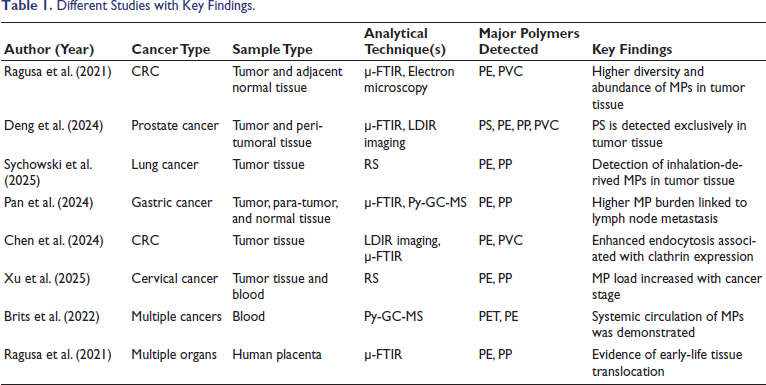
FTIR spectroscopy is currently the most popular approach for the identification and quantification of MPs. FTIR represents a powerful technique in the diagnostic analysis of plastic polymers by providing information on the specific bonds of plastics. 16 Plastic debris and visible MPs are usually identified by conventional FTIR, 17 whereas smaller particles require the use of µ-FTIR, which is equipped with a microscope to localize MPs on filters. 18 Notably, recent trends highlight the growing integration of artificial intelligence and machine-learning approaches, including deep-learning models such as PlasticNet, to automate high-throughput spectral analysis from FTIR and Raman datasets, thereby reducing human error, improving reproducibility, and enhancing analytical efficiency. 19 Below Table 1 shows the different methods used for MP detection in different cancer tissues.
Different Studies with Key Findings.
Key Findings in Cancer
Recent studies indicate that MPs are not only widespread environmental pollutants but may also accumulate differently in cancerous tissues, potentially affecting tumor biology and disease progression. In CRC, advanced techniques such as LDIR imaging and electron microscopy have revealed a wide range of MPs, such as PE and PVC, with a significantly greater variety and quantity in tumor tissues compared to nearby normal tissues. Additionally, increased levels of clathrin, a protein related to endocytosis, have been linked to enhanced MP uptake by CRC cells. 15 In prostate cancer, detailed tissue analysis has found that PS is exclusively present in tumor samples, while other polymers such as PE, PP, and PVC are found in both tumor and surrounding tissues, with higher overall MP concentrations in tumors. This suggests a possible preference for infiltration or retention within malignant glands. 20 Patients with gastric cancer also show a significantly higher MP load in tumor tissues compared to para-tumor and normal gastric tissues. This increased burden has been associated with lymph node metastasis and poor clinical outcomes, possibly reflecting the biological effects of MPs on oxidative stress and signaling pathways related to cancer aggressiveness. 21 Moreover, research on reproductive cancers suggests that MPs, including PE and PP, increase in abundance as cervical cancer advances. MPs have been detected in both cervical tumor tissue and blood, with links to lifestyle factors such as diet, highlighting the potential role of systemic exposure in tumor infiltration. 22 Overall, these findings support a model where MP presence is heightened in cancerous tissues, indicating a connection between exposure, cellular uptake mechanisms, and disease progression. However, mechanistic studies are necessary to determine whether MPs actively contribute to cancer development or reflect altered tissue properties in malignant states.
Mechanisms of Carcinogenesis
There is growing evidence indicating that MPs might play a role in the initiation and progression of tumors through various interconnected biological mechanisms. A significant pathway involves oxidative stress and deoxyribonucleic acid (DNA) damage: Exposure to MPs has been found to trigger the production of reactive oxygen species (ROS) within cells, which can overwhelm the body’s antioxidant defenses, resulting in DNA strand breaks, base alterations, and impaired repair processes. This sequence of ROS-induced damage fosters genomic instability, a critical event in the development and evolution of tumors. 23 Furthermore, MPs can persist as foreign bodies in tissues, causing chronic low-grade inflammation that alters the tumor immune microenvironment. Ongoing inflammatory signaling has been associated with the recruitment of immunosuppressive cell populations, continuous cytokine release, and changes in immune surveillance, thereby creating an environment that supports the survival and proliferation of malignant cells and may even hinder the effectiveness of immunotherapy. 24 Recent data from 2024 to 2025 further emphasize the potential of synergistic toxicity as a carcinogenic co-factor: MPs have been observed to worsen tissue damage in the presence of viral or bacterial infections, intensifying inflammatory responses, and activating oncogenic promoters such as spalt-like transcription factor 2 (SALL2), which has been linked to tumor promotion and progression under stress conditions. 20 These findings imply that MPs may not act alone but can interact with infectious and inflammatory processes to further disrupt cellular homeostasis and oncogenic signaling pathways.
Conclusion
Despite the rapidly increasing evidence of MP presence in human tissues, several significant knowledge gaps persist. Population-based studies are necessary to establish a causal link between long-term MP accumulation and cancer initiation or progression. The detection of MPs in human tissues, including tumors, may have future implications in forensic toxicology and environmental exposure reconstruction. Current research shows highly variable sampling strategies, digestion methods, and analytical techniques, which limit reproducibility and hinder comparisons across studies and geographic regions. Therefore, developing standard protocols and validated reference materials for biological materials is crucial.
Footnotes
Declaration of Conflicting Interests
The authors declare the following potential conflicts of interest with respect to the research, authorship, and/or publication of this article: Author Ravindra B. Deokar is Editor-in-Chief of the Journal of Indian Academy of Forensic Medicine. He did not take part in the peer review or decision-making process for this submission and has no further conflicts to declare. All other authors report no potential conflicts of interest.
Ethical Approval
Ethical approval was not required for this mini-review as it is based solely on publicly available data from previously published studies and does not involve human participants, animal subjects, or direct data collection.
Funding
The authors received no financial support for the research, authorship, and/or publication of this article.
Informed Consent
Since this study is a mini-review of existing literature and does not involve direct interaction with human participants, obtaining informed consent was not applicable.
