




Abstract
This case report presents a groundbreaking homicide investigation where forensic tattoology played a pivotal role in suspect identification and case resolution. The deceased, with extensive sharp weapon injuries, exhibited multiple tattoos including 22 names on bilateral thighs. Through systematic forensic examination, these tattoos were found to directly correlate with individuals known to have threatened the victim, leading to the rapid identification and subsequent confession of the primary suspect. This case demonstrates the evolving significance of tattoos in forensic medicine, particularly in gang-related crimes and personal conflict scenarios. This study discusses the multidisciplinary approach combining forensic examination, criminal psychology, and investigative techniques that made this breakthrough possible, while supporting standardized protocols in tattoo documentation and analysis in medicolegal investigations.
Keywords
Introduction
The tattooing art has evolved from symbolic cultural meaning to an essential forensic tool in the 21st century. Recent literature shows that nearly 38% of the world’s 18–35-year-old population has at least one tattoo, with its prevalence being as much as 52% in urban populations. 1 This demographic shift has provided new avenues for forensic identification, and forensic tattoology currently accounts for about 23% of unidentified body cases solved in metropolitan areas.2, 3 Tattoo prevalence among autopsy populations has also been shown to be significant in recent Indian studies, further reinforcing its forensic relevance.3, 4 The forensic value of tattoos is more than simply identification. Tattoos have recently been classified into six evidentiary categories: identification markers, affiliation symbols, memorial tattoos, threat indicators, psychological markers, and incidental artwork. 5 This case particularly illustrates the combined aspects of “threat tattoos” and “psychological markers,” where the tattoos served both as a warning and as symbolic cataloging of perceived foes.
Case Report
On July 24, 2024, at around 01:00 am, police responded to a reported murder at a spa involving multiple sharp force injuries. The scene suggested a targeted attack with evidence of premeditation. The victim had reportedly stayed overnight at the spa, and the assault occurred in the early morning hours.
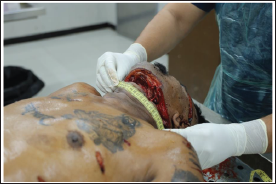
The body was taken to a tertiary care teaching hospital for postmortem examination. External examination revealed 23 sharp force injuries, including four deep stab wounds to the chest and abdomen, and two chop wounds to the neck and forehead. Defensive injuries were noted on the left palm, indicating an attempt to resist the attack. Numerous tattoos were also observed across the body, contributing to identification.
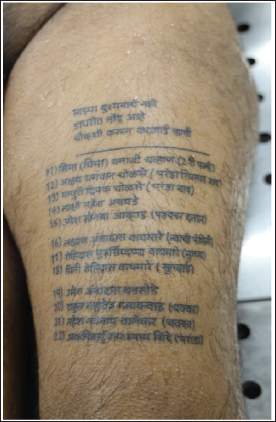
The victim had several distinctive tattoos across different regions of the body (Figure 1). Religious symbols were inscribed on the chest (Figure 2), while the back and left shoulder displayed blurred manuscripts and symbols (Figure 3). The tattoos on the bilateral thighs had forensic significance, where 22 names were inscribed in Devanagari script (font size 10–12 mm), including names of police officers, journalists, personal friends, and family members (Figures 4 and 5). These thigh tattoos were of particular importance as they listed names in a roll call format, accompanied by a note stating that these individuals had threatened the victim’s life.6, 7
Distribution Map of Victim’s Tattoos.
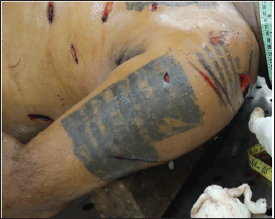
Distribution Map of Victim’s Tattoos.
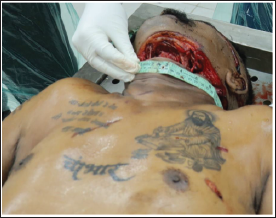
Distribution Map of Victim’s Tattoos.
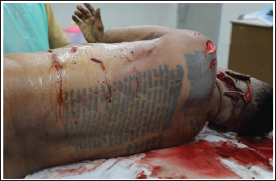
Close-up of Significant Thigh Tattoos.
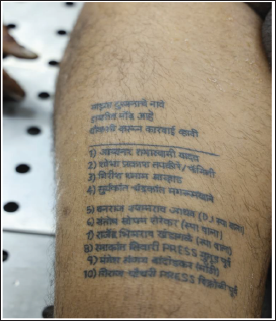
Close-up of Significant Thigh Tattoos.
The pattern of injuries indicated six potentially lethal wounds. Tool mark analysis suggested the use of a single-edged sharp object (Figures 6 and 7), while the presence of defensive wounds (Figure 7) confirmed an attempt by the victim to resist the assault.8, 9
Wound Pattern Analysis Diagram Showing Chop Wound Over the Neck.
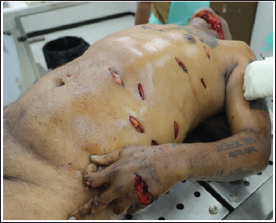
Wound Pattern Analysis Diagram Showing Multiple Stab Wounds Over the Chest and Abdomen and Defense Wound Over Ulnar Aspect of the Dorsum of the Left Hand.
Within 48 hours of the tattoo examination, all 22 individuals named were traced for questioning, which led to the arrest of the prime suspect, Santosh Sopan Sherkar, a spa owner. The recovery of the murder weapon substantiated the tool mark analysis, and a complete confession was obtained, wherein the suspect admitted to prior personal disputes and extortion threats involving the victim. Conventional suspect-development timelines can vary widely depending on the complexity of the case and the strength of the initial leads. In many domestic homicides, the primary suspect is identified and arrested within the same day, but in cases where there are no clear clues, witnesses, or immediate direction for the investigation, the process can extend for weeks or even months. In contrast, the present case achieved suspect identification and interrogation within just 48 hours, representing a significantly faster breakthrough than typically observed. 10
Discussion
This case illustrates the evolving role of tattoos in forensic investigation. Tattoos contributed to criminal profiling, as the victim’s designs reflected paranoid thoughts and hostile symbolism, resembling the “trophy mentality.”5, 8 They also had clear forensic value, serving both as identifying marks and as investigative clues. In this instance, the content of the tattoos helped the police to narrow the pool of suspects effectively. 11 This aligns with recent JIAFM homicide autopsy data showing the increasing relevance of individualizing features like tattoos in complex violent deaths. 12 Beyond this, the tattoos offered behavioral insights, as the victim inscribed his perceived enemies on his skin as well as in his diary, a pattern consistent with persecutory delusions sometimes observed in antisocial and narcissistic traits. 8
The case further demonstrates the legal potential of tattoo evidence, which expedited case resolution. Under the Bhartiya Sakshya Adhiniyam (BSA) 2023, tattoos naturally fall within the scope of relevant facts because they help establish who a person is and what circumstances may surround an offense. Section 7 allows the court to consider any fact that helps identify a person, making distinctive tattoos directly admissible. Similarly, Section 6 includes facts that point toward motive or related conduct, which becomes important when a tattoo contains names linked to prior threats or tension. In this way, tattoos in a homicide investigation not only confirm identity but also provide meaningful clues that help connect the victim with individuals who may be involved. Overall, it highlights the need for forensic experts to consider not only the physical but also the psychological, symbolic, and narrative dimensions of tattoos in their work.
Based on this case, several recommendations can be made to strengthen forensic practice. Standardized documentation of tattoos should be mandated in all medicolegal autopsies to ensure consistency and reliability.10, 13, 14 The development of a tattoo significance scoring system can provide structured assessment of forensic importance. 15 The establishment of forensic tattoology as a recognized subdiscipline within forensic medicine would further validate this emerging field.10, 16 Artificial intelligence-based tattoo registries could support the identification of patterns, associations, and repeat offenders. 6 Finally, training modules on forensic tattoology should be introduced into postgraduate medicolegal curriculum to prepare future experts. 10
Conclusion
This case reinforces the dual value of tattoos as identifiers and behavioral markers in homicide investigations. The convergence of psychological assessment, forensic tattoology, and evidence-based profiling was key to solving a complex case with multiple personal and criminal motives. Standardized tattoo documentation and interpretation should form a cornerstone of future forensic practice.
Footnotes
Declaration of Conflicting Interests
The authors declared no potential conflicts of interest with respect to the research, authorship, and/or publication of this article.
Ethical Approval
Not applicable.
Funding Disclosure
The authors received no financial support for the research, authorship, and/or publication of this article.
Informed Consent
Written informed consent has been obtained.
