




Abstract
Identification is the determination of the individuality of a person and plays a significant role in medico-legal cases. Among the various methods of identification, fingerprints, lip prints, and palatal rugae patterns hold special importance in establishing human identity in both living and deceased individuals.
The present study was conducted to analyze the lip-print patterns of 100 deceased Assamese individuals, comprising 50 males and 50 females, aged between 21 and 78 years, with the objective of studying the arrangement of different lip-print patterns. Cheiloscopy, the study of lip prints, has long been used as a method of identification; this study aims to explore the possible relationship between specific lip-print patterns and sex determination.
Lip prints were collected from the dead bodies and examined for uniqueness with the aid of a magnifying lens. The patterns were classified and analyzed statistically. In males, Type IV lip-print pattern was the most predominant (36%), followed by Type III (30%), Type II (16%), Type I′ (12%), and Type I (6%). In females, Type I′ was the most common pattern (46%), followed by Type I (24%), Type II (12%), Type IV (10%), and Type III (8%). Statistical analysis was carried out using mean standard deviation Chi Square test, Students Unpaired T test, and Cohen’s Kappa Test (Cohen’s Kappa = 0.48, p = < .001)
The study revealed that Type IV lip-print pattern predominated in males, whereas Type I′ was predominant in females. These findings suggest that lip-print analysis can be a useful tool in the sex determination of unknown individuals in medico-legal investigations.
Introduction
Identification is the determination of the individuality of a person based on certain physical characteristics.1, 2 The investigating officer is primarily concerned with the identification of individuals in both civil and criminal cases, as it plays a critical role in crime investigation. Personal identification is based on the fundamental principle that every individual possesses unique physical characteristics. 3
Identification is required in civil courts in cases of forgery to secure unlawful possession of property, fraudulent insurance claims, or extension of a lapsed pension. In criminal courts, identification is imperative for tracing absconding offenders or individuals accused of heinous crimes such as rape, assault, or murder. Various parameters such as age, sex, race, religion, and anthropometric measurements are used for identification; however, lip prints have proven to be competent in linking a criminal to a crime scene.4, 5
Lip-print patterns play a decisive role in personal identification, especially when other methods such as DNA analysis are costly, time-consuming, technically demanding, and not readily available in rural areas or developing countries.1–3
Cheiloscopy is the study of lip prints and is a noninvasive forensic examination method. Lip prints are individualistic in nature, except in identical twins, which makes cheiloscopy a valuable tool for personal identification. Lip prints consist of characteristic patterns of fissures in the form of ridges and grooves, known as sulci labiorum, present on the labial mucosa in the transition zone between the outer skin and the inner mucosa. The study of the patterns produced by these ridges and grooves and their application in forensic science is known as cheiloscopy or cheiloscopy (quilioscopy).6, 7
Lip prints were first described by R. Fischer in 1902, and their application in human identification was first suggested by Sir Edmond Locard. In 1960, Dr. Martins Santos proposed a systematic classification of lip prints for human identification. In 1950, Japanese scientists Yasuo Tsuchihashi and Kazuo Suzuki demonstrated that the arrangement of furrows on the lips is unique to each individual and proposed their own classification of lip-print patterns. Extensive research worldwide has since established the application of cheiloscopy in human identification. Studies have demonstrated that lip-print patterns can provide information regarding gender, racial origin, profession, customs, paternity, and blood group. Lip prints have been shown to be as precise as fingerprints for human identification, except in identical twins.
Lip-print patterns are identifiable as early as the sixth week of intrauterine life. The ridges and grooves on the lips are permanent and remain unchanged throughout an individual’s lifetime. Even when altered due to injury, inflammation, or pathological conditions such as herpes, lip prints tend to recover. 1 Cheiloscopy is an evolving scientific technique that aids in personal identification. Lip prints are considered extremely reliable when found in good condition, particularly at crime scenes where they are frequently encountered.1, 2
Although numerous studies on cheiloscopy have been conducted worldwide, very few correlative studies have been carried out in the northeastern states of India, especially in Assam. Therefore, the present study was designed to assess the distribution of lip-print patterns in the Assamese population and to evaluate their reliability in sex determination.
Aims and Objectives
To study the distribution of different lip-print patterns in the Assamese community.
To identify the predominant lip-print patterns among the study population.
To assess and compare the reliability of lip-print patterns in the determination of sex in the Assamese population.
Materials and Methods
The present study was conducted on 100 deceased Assamese individuals, comprising 50 males and 50 females, who were brought for medico-legal autopsy to a government medical institute in the state of Assam, India. The age of the individuals ranged from 21 to 78 years.
A sample size of 100 was chosen as it is sufficient to provide reliable statistical estimates while remaining practical in terms of time and resources. This size allows for meaningful analysis, reduces sampling error, and is consistent with sample sizes used in comparable studies.
Inclusion Criteria
Deceased individuals with good general health. Individuals who had completed permanent dentition.
Exclusion Criteria
Individuals with congenital deformities such as cleft lip. Presence of lip pathologies including inflammation, ulcers, trauma, or surgical scars. Decomposed bodies.
Method of Collection of Data
The study subjects were selected based on the predefined inclusion and exclusion criteria. Relevant demographic details such as name, age, sex, and gender were recorded in a specially designed pro forma, which also contained designated spaces for recording lip prints along with a serial number for identification. A unique identification number is assigned to each individual in the pro forma, and their lip print pattern is recorded. This pattern is then compared with existing records to determine the sex of the individual.
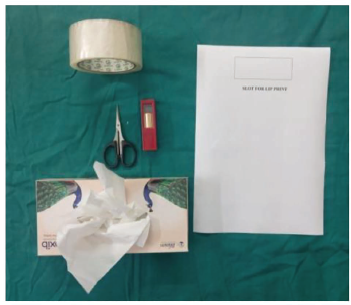
The equipment used for recording lip prints (Figure 1) included tissue paper, dark non-glossy lipstick, a lipstick application brush, transparent cellophane tape, scissors, and white bond paper.
Equipment for Recording Lip Print.
Methodology
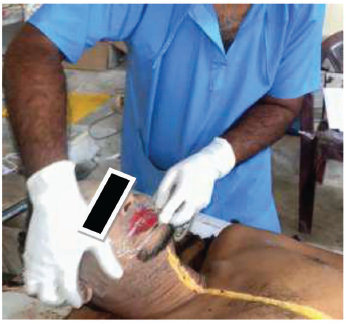
The lipstick method was used for recording lip prints. Both the upper and lower lips were first cleaned using tissue paper, ensuring that no tissue remnants were left behind. A lipstick application brush was then used to apply a dark, non-glossy lipstick evenly over both lips. The lipstick was allowed to dry for approximately two minutes.
Lip impressions were obtained by gently placing the adhesive side of a transparent cellophane tape over the surface of the lips. The tape was immediately transferred onto white bond paper by dabbing it evenly to obtain a clear impression (Figure 2). The characteristic fissures, namely the ridges and grooves of the lips (sulci labiorum), were examined to determine the lip-print pattern. 8 Each lip print was analyzed for its uniqueness using a magnifying lens (Figure 3).
Recording of Lip-print.
Comparative Prevalence of Lip Print Patterns (Types I–IV) Among Assamese Population.
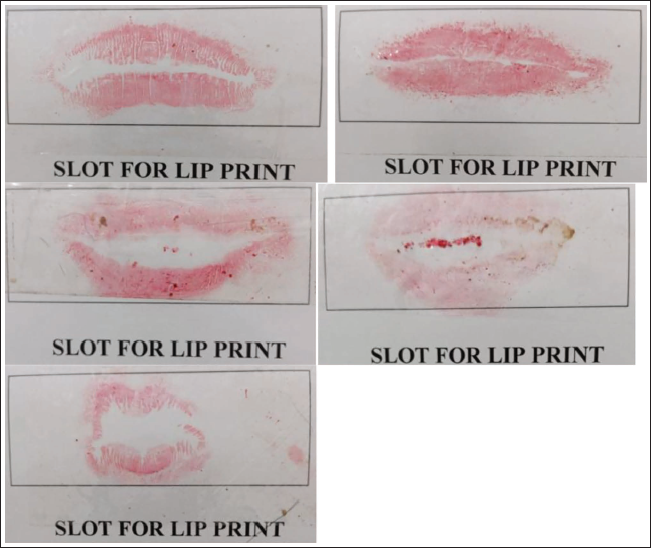
Classification of lip-print patterns was performed according to the system proposed by Suzuki and Tsuchihashi.9, 10 The patterns were categorized as follows:
Type I: Clear-cut vertical grooves running across the entire lip Type I′: Partial-length vertical grooves (variant of Type I) Type II: Branched grooves Type III: Intersected grooves Type IV: Reticular grooves Type V: Irregular or unclassified patterns
Sex determination was based on the characteristic lip-print pattern observed in the middle portion of the lower lip, as this region offers greater clarity and visibility. 1 Gender was assigned according to the dominant lip-print pattern as follows:
The results obtained from lip-print analysis were subsequently verified with the demographic data recorded in the pro forma using the corresponding serial number assigned at the time of data collection.
Results
The lip prints collected on bond paper from the study individuals were examined using a magnifying lens. The data were entered into Microsoft Excel 10 and analyzed using GraphPad Prism version 10. Relevant statistical tests were applied to interpret the results.
The mean age of the study population was 46.2 ± 13.89 years for males and 45.08 ± 14.34 years for females (SEM = 1.964). The Kolmogorov–Smirnov normality test (KS = 0.08139) indicated that the data followed a normal distribution (Table 1).
Age Wise Distribution of Study Population (Mean Age).

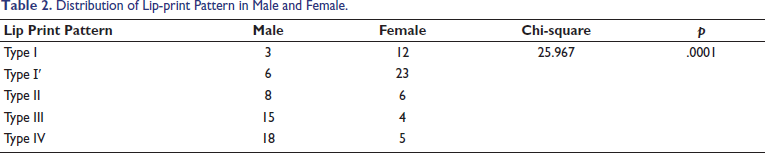
In males, Type IV was the most predominant lip-print pattern (36%), followed by Type III (30%), Type II (16%), Type I′ (12%), and Type I (6%). In females, Type I′ was the most common pattern (46%), followed by Type I (24%), Type II (12%), Type IV (10%), and Type III (8%). Type V patterns were not observed in any individual in this study (Table 2). Comparison of lip-print patterns between males and females using the Chi-square test showed a statistically significant difference (p < .0001).
Distribution of Lip-print Pattern in Male and Female.
Sex estimation based on lip-print patterns revealed that 66% of males were correctly identified as male, while 34% were misclassified as female. Among females, 82% were correctly identified, and 18% were misclassified as male (p < .001). Overall, the accuracy of sex determination using lip prints in the study population was 48%, with a Cohen’s Kappa value of 0.48, indicating moderate agreement between estimated and actual sex (Table 3).
Reliability of Sex Determination by Lip-print Using Cohen’s Kappa Test.

Discussion
Identification of a person is based on physical characteristics such as age, sex, race, stature, fingerprints, moles, scars, gait, teeth, lips, eyes, hair, intelligence, memory, or voice. With the increasing number of criminal cases, lip prints have become an important tool for investigating officers to link a crime to the perpetrator. Accurate determination of the gender of suspects through lip prints can significantly reduce the investigative burden. Identification is also crucial in managing deceased individuals during natural disasters or mass casualty events, including landslides, tsunamis, earthquakes, air crashes, train accidents, and terrorist attacks.
In this study, the reliability of lip prints in sex determination was assessed. Lip prints were recorded using dark, non-glossy lipstick to prevent smudging, and impressions were lifted using transparent cellophane tape, a method previously used by Gazge NM et al., 4 Patil D et al., 11 Prabhu RVet al., 8 Sivapathasundharam B et al., 12 and Augustine J et al., 13 Shrama P and Yadav R. 14 In the present study, a red lipstick was used for optimal visibility on white bond paper, and a lipstick brush ensured even application.
The most frequent lip-print pattern in this study was Type IV (36%) in males and Type I′ (46%) in females. Both genders exhibited distinct patterns, and Type V patterns were absent in all individuals. These findings are consistent with studies by Gazge NM et al., 4 Sharma P et al., 15 Verghese AJ and Mestri SC, 16 and Malik R and Goel S. 17 However, they contrast with studies by Mishra P et al., 3 Patil D et al., 11 Tsuchihashi Y, 9 Sivapathasundharam B et al., 12 Makesh Raj et al., 18 Sahu G et al., 19 Gopala T Krishnan et al., 20 Ravikumar R, and Darshan C, 21 which may reflect differences in geography, ethnicity, and study populations.
This study confirmed that lip prints are individualistic, in agreement with Prabhu RV et al., 7 Tsuchihashi Y., 9 Suzuki K and Tsuchihashi Y, 10 Sivapathasundharam B et al., 12 Bajpai M et al., 22 Nagrale N et al., 23 and Kulkarni Meena and Ashraf Muzamil. 24 Variations in lip prints across different regions of the lips contribute to their uniqueness, allowing ante-mortem and post-mortem comparisons for individual identification, either partially or as a whole.
In the present study, 66% of males were correctly identified, while 34% were misclassified as females. Among females, 82% were correctly identified, while 18% were misclassified as males (p < .001) (Table 3). These findings align with studies by Bajpai M et al., 22 Malik R and Goel S., 17 Kaul R et al., 25 Sharma S et al., 26 Kumar B et al., 27 however, reported much lower accuracy, with validity rates of 17.4% in males and 35.4% in females. The discrepancy may be attributed to differences in geography, ethnicity, age range, and methodology. The present study included individuals aged 21–78 years from the Assamese community, whereas Kaul et al.’s study focused on a narrower age group. Age-related changes in lip size and perioral skin may reduce the accuracy of sex determination in older individuals.
Similarly, Nandan SR et al., 28 reported a weak correlation between lip-print patterns and gender, which could be explained by differences in analytical techniques. Overall, very few comparative studies on lip prints for sex estimation exist, highlighting the need for further research with larger sample sizes to obtain more precise results.
Conclusion
This is the first study on cheiloscopy conducted in the Assamese community for sex determination, applicable to both living and deceased individuals. Lip prints exhibit lifelong stability comparable to fingerprints, persisting unchanged from formation in the 6th intrauterine week through adulthood, even postmortem or after trauma/aging.
Lip prints are unique to every individual and serve as a valuable tool for the identification of unknown persons. They can also assist in the determination of sex, providing important leads in forensic investigations when lip prints are found at a crime scene. To establish more accurate correlations between lip-print patterns and sex, further studies involving larger sample sizes across diverse racial and ethnic groups are recommended.
Footnotes
Declaration of Conflicting Interests
The authors declared no potential conflicts of interest with respect to the research, authorship, and/or publication of this article.
Ethical Approval
Prior to the commencement of the study, necessary approval was obtained from the Institutional Ethics Committee vide no MC/190/2007/Pt-II/Oct 2022/14, dated 23-12-2022.
Funding
The authors received no financial support for the research, authorship, and/or publication of this article.
Informed Consent
Formal written informed consent was obtained from the legal guardians of the deceased prior to data collection.