




Abstract
Background
Autopsy is conventionally performed prior to embalming, as preservation procedures may obscure or destroy vital medico-legal evidence. However, in exceptional circumstances such as international transportation delays, administrative constraints, or lack of facilities, autopsies may be conducted after embalming or prolonged preservation. Scientific documentation of such cases remains sparse. This case series highlights the various medical and legal challenges faced during autopsies of embalmed bodies.
There are various methods used to inhibit and retard decomposition changes over centuries. It includes mummification, thanatopraxis, and preservation of the body under low temperatures. Public transportation of the dead body to distant places, anticipating a delay in the funeral, absence of postmortem facilities, preservation of the body of important personalities for public viewing, and criminal intention in rare cases are some of the important indications for the preservation of bodies.
Case Presentation
We discuss a case series comprising three case reports wherein two cases (Case 1 and 3) embalming was done before autopsy, and in Case 2, the body was preserved at cold temperatures for a certain period before being transported for autopsy. The external and internal examination findings have been mentioned along with the cause of death that was concluded from a comprehensive analysis of postmortem findings and sample analysis.
Conclusions
In normal circumstances, embalming should not precede autopsy as it can destroy vital medico-legal evidence. As forensic experts, we need to acquire the skills to conduct autopsies on preserved bodies to gain comprehensive insights into postmortem changes and positive findings to establish the cause of death.
Background
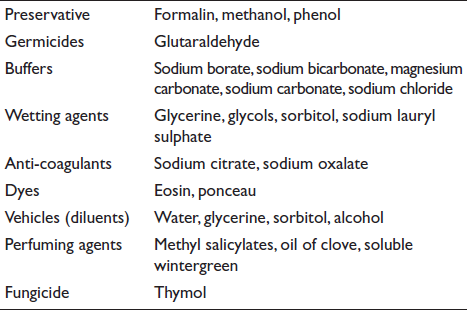
The various methods of embalming are classified into:
3
Vascular embalming: The embalming fluid is injected into the arteries, and the blood is drained from the veins. Cavity embalming: A trocar is used to aspirate the contents of the thoracic, abdominal and intestinal cavities, and then 1 L of embalming fluid is directly injected into each of the cavities. Hypodermic embalming: Subcuticular injection of the chemical directly into the tissues. Humectant embalming: Chemicals are added to dehydrated and emaciated bodies to help restore tissue to a more natural and hydrated appearance.
2
Typically, postmortem examinations are performed before embalming to determine the cause of death. However, in certain circumstances, a postmortem may be conducted afterwards to determine the cause of death. We will discuss three different unique case presentations of bodies preserved in natural and unnatural deaths, highlighting the unusual circumstances, and discuss the findings, merits, demerits, and medico-legal challenges faced by forensic experts in conducting an autopsy after preservation, which will provide valuable insights into forensic medicine practices.
Aims & Objectives of Study
To highlight the medico-legal challenges, autopsy findings, and forensic implications of conducting autopsies on embalmed and preserved bodies.
Methodology:
Study design: Prospective case series.
Study setting: Post mortem centre attached to the department of Forensic Medicine & Toxicology at a tertiary healthcare centre.
Study period: February 2022–April 2023.
Inclusion criteria: Bodies undergoing autopsy after embalming or prolonged preservation.
Procedure: Standard medico-legal autopsy with detailed external and internal examination.
Documentation: Photographic evidence, histopathology, toxicology.
Case Presentation
Case 1
A 42-year-old man, a native of India, was on board a crude oil tanker at sea near Al-Riqqa, Kuwait. On the morning of 2nd February 2022, the deceased complained of chest pain and was given an antacid. He returned to his cubicle. The colleagues on board then heard a loud noise and found the man lying unconscious on the floor. Despite available resuscitative measures, he was declared dead by the on-duty doctor on the ship and the body was kept under cold storage located in the basement of the ship. The body reached the nearest Singapore Port on 5 March 2022, where the body was examined by the doctors there. Arterial embalming was done on the same day, and the body was transported by ship. It reached our postmortem centre after 30 days.
Autopsy Findings
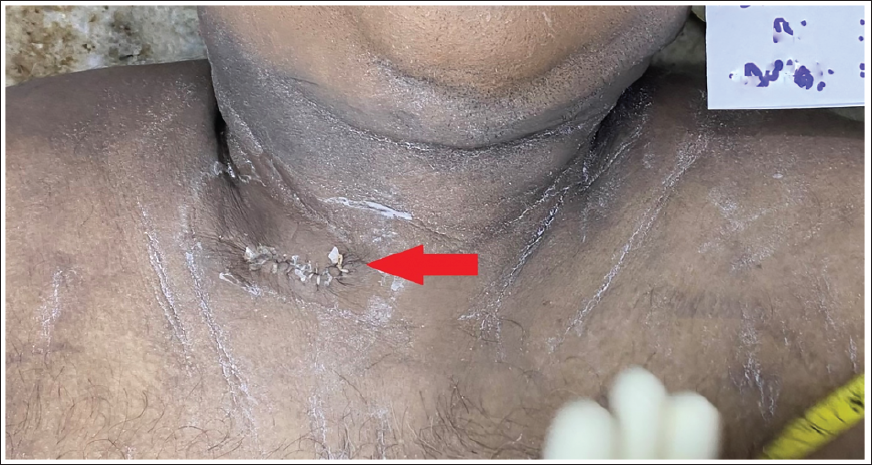
On external examination: The deceased was well-built and nourished. Rigor mortis had passed off. The skin was darkened, and the face showed evidence of cosmetic application. There was no evidence of external injuries except for a postmortem stitched wound of length 1 cm (centimetre) present over the right supraclavicular region, suggesting the incision (port) for arterial embalming (Figure 1).
Site of Trocar Insertion of Embalming, Sutured After the Procedure.
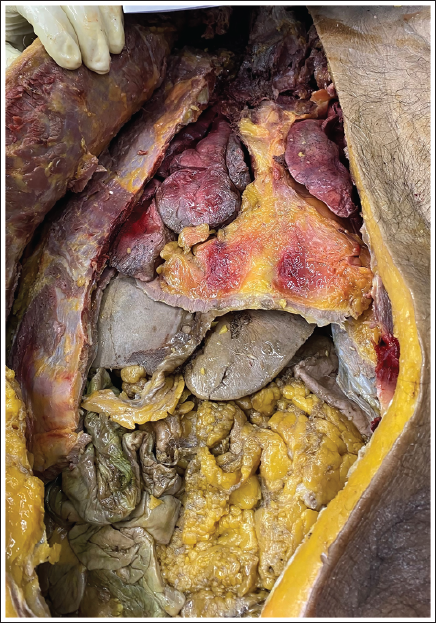
On internal examination: The anatomical structures were intact (Figure 2) and hardened with a strong formalin smell emanating from the body. On serial sectioning of the coronaries of the heart, there was a 100% eccentric block in the left anterior descending artery about 1 cm from its origin (Figure 3). The pieces of all organs were preserved for histopathological examination.
Intact Internal Organs Post Arterial Embalming.
Left Anterior Descending Coronary Artery Showing 100% Block.
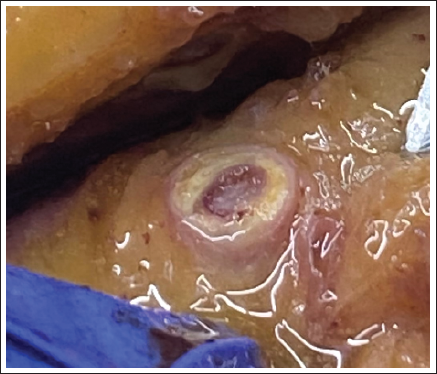
On histopathological examination, the left anterior descending artery corroborated the findings of gross examination. The findings of the rest of the organs were insignificant.
The final cause of death was given as ‘coronary artery disease (Natural)’.
Case 2
A 25-year-old woman, a native of a South American country, had come to an Island nation in the Indian Ocean for a tour along with her friend. In October 2022, at around 15:10 hours, her friend found her hanging in the washroom of the hotel room using the cord of the hairdryer and rushed her to the hospital, where she died during treatment 20 days later. The day before, the deceased had tried to commit suicide by attempting to jump from the balcony of the hotel room, but was rescued by the hotel staff. As the relatives were suspicious of her death, they had requested a postmortem. The body was kept under cold storage for around 4 months for all legal formalities to be completed before it could be transported by flight to the nearest country. The body then arrived at our postmortem centre in February 2023, and an autopsy was performed.
Autopsy Findings
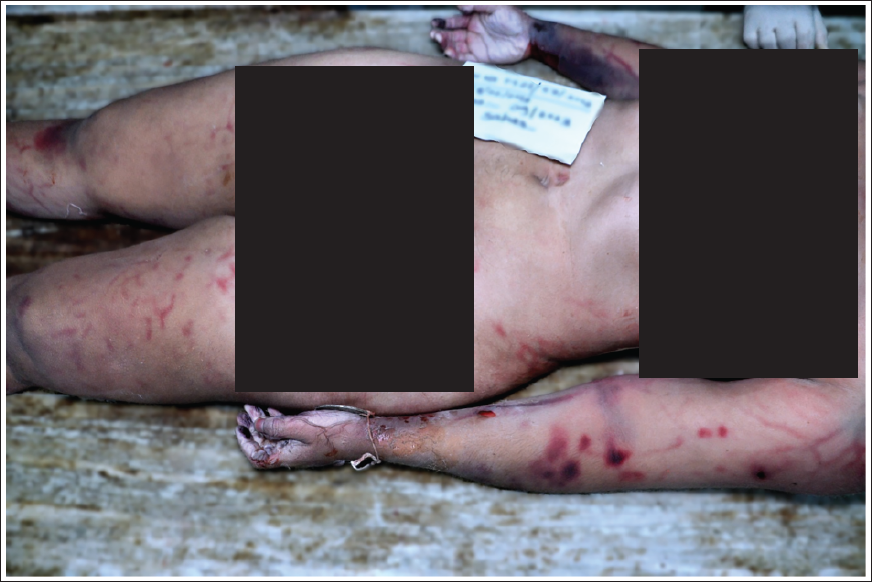
On external examination: Signs of decomposition were present in the form of brownish discolouration of the skin at places, along with peeling of skin and blister formation over the right foot and bilateral hands. Marbling was present around the anterior aspect of both shoulders, the groin region and the antero-medial aspect of bilateral thighs (Figure 4). Postmortem lividity was present over the back, except for pressure areas and was fixed. A faint ligature mark was seen in the form of pressure abrasion over the anterior aspect of the neck, at the level of thyroid cartilage running obliquely upwards and backwards towards the right side of the neck and absent over the left side of the neck and nape of the neck and having a uniform breadth of 0.4 cm. Over the anterior aspect of the neck, it was 6 cm below the chin and 9 cm above the suprasternal notch, while on the right side of the neck, it was situated 3 cm below the angle of the mandible, and there was no evidence of any other injuries over the body besides the pressure abrasion.
Decomposition Changes Over the Body Preserved at Cold Temperatures.
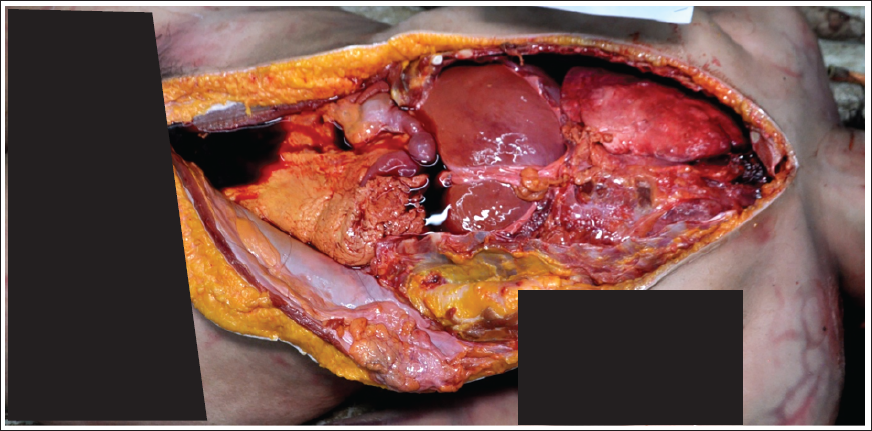
On internal examination: The anatomical structures were intact with very minimal signs of decomposition (Figure 5). No haemorrhages are present in the underlying tissues of the neck. The thyroid cartilage, cricoid cartilage, and hyoid bone were intact.
Intact Internal Organs of the Body Preserved in Cold Storage.
About 160 mL of foul-smelling, straw-coloured fluid was present in the bilateral pleural cavities. Petechial haemorrhages were present over the inter-lobar fissures of both the lungs with evidence of patchy consolidation present over the lower lobes of both the lungs. All necessary samples, including neck strapping, scalp hair, nail clippings from both hands and viscera, were preserved.
The chemical analyser reported that no poison was detected in any of the viscera, and other exhibits did not report anything of significance. The final cause of death was given as ‘Bilateral Lobar Pneumonia as a Complication in an Admitted Case of Hanging (Unnatural)’.
Case 3
An 82-year-old woman had travelled to North India in April 2023, along with her 81-year-old husband, for a holiday. At around 1:30 pm (post meridiem) on the 2nd of April 2023, the woman had complained of breathlessness and fell unconscious on the houseboat they were staying at. She was taken to the nearby hospital and was declared dead by the on-duty doctor. Since the husband of the deceased had no relatives and was unable to comprehend his wife’s death, the body was transported to their native place (Mumbai) for a postmortem. The husband seemed to be in a state of shock and was unable to narrate any past medical or surgical history of the patient. The body reached the postmortem centre 3 days after she was declared dead, along with an embalming certificate stating that cavity embalming was done.
Autopsy Findings
On external examination: Rigor mortis had passed off. Postmortem intervention was seen as a stitched wound of length 1 cm consisting of two continuous black sutures in situ and present over the right hypochondriac region, 11 cm below the right costal margin (suggestive of embalming procedure done). An old healed, pale and glistening smooth scar of length 7.5 cm placed horizontally was present over the left infraclavicular region, 3 cm below the left clavicle. There were no other external injuries.
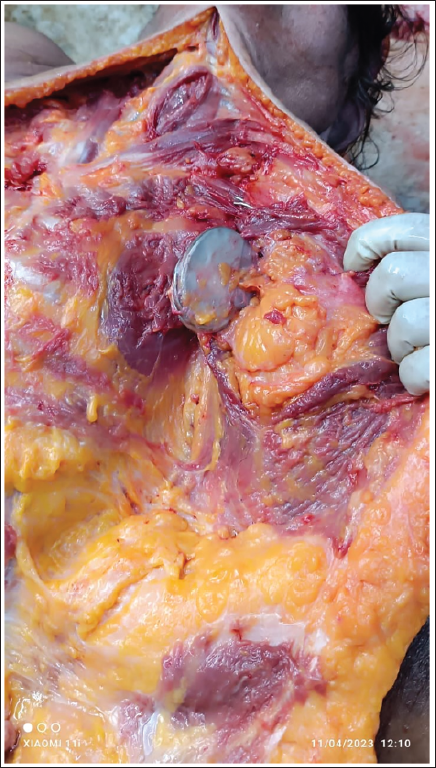
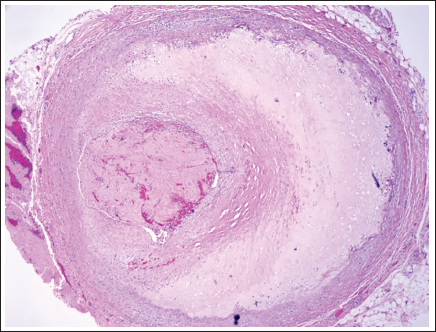
On internal examination: The anatomical structure of the organs was maintained. On incision parallel to the tissue around the scar, a pacemaker of size 4 cm × 5 cm × 0.6 cm, was seen implanted in the fascia of the left pectoralis major muscle with its two leads running through the left subclavian vein and the electrode at the end of the leads were seen attached to the right atrium and right ventricle respectively (Figure 6). Serial sectioning of the coronaries revealed a 70%–80% eccentric block of the left anterior descending artery 1 mm away from its origin. The left circumflex artery showed 50%–60% eccentric block 0.5 mm away from its origin. The right coronary artery showed a 30% block 0.3 mm away from its origin. The abdominal organs were intact and hardened, with a strong smell of formalin perceived. The liver was hardened and shrunken in size, weighing 1000 g, with multiple tan-coloured micronodules of size 0.2–0.3 cm present on the surface of the liver. Examination of the viscera and other internal organs was intact and normal. Tissues of every organ were, however, preserved for histopathological examination. Histopathological findings of the coronary artery corroborated with the findings on gross examination (Figure 7).
Pacemaker Present in Situ.
Histopathological Finding of Atherosclerosis of an Artery with 60% Eccentric Block (40×, H&E Staining).
The final cause of death was given as ‘coronary artery disease (Natural)’. All the cases have been summarised in Table 1.
The Summary of Important Findings of the Cases.

Discussion
Published literature on medico-legal autopsy of embalmed bodies remains limited, with most reports restricted to isolated case reports or small case series. Bodwal et al. described a medico-legal autopsy conducted on an embalmed body exhumed following allegations of foul play and emphasised the difficulty in interpreting soft-tissue injuries and toxicological findings after formalin fixation. 4 Similar interpretational challenges were encountered in the present series, particularly with respect to tissue consistency, accentuation of postmortem artefacts, and limitations of chemical analysis.
Tatiya et al. reported a rare case of autopsy performed on an embalmed body where, despite preservation-related artefacts, meaningful conclusions regarding the cause of death could still be drawn through meticulous gross and histopathological examination. 5 This observation closely parallels Cases 1 and 3 in the present series, where coronary artery disease was reliably identified despite arterial and cavity embalming, supporting the notion that natural causes of death—especially cardiovascular pathology—may still be diagnosed with reasonable confidence in preserved bodies.
More recent forensic studies have highlighted that refrigeration and cold storage may preserve anatomical integrity better than embalming with respect to soft-tissue evaluation and injury interpretation. A retrospective analysis by Saukko and Knight emphasised that prolonged cold preservation can significantly retard decomposition while preserving injury morphology, provided microbial putrefaction is adequately controlled. 6 This aligns with Case 2 of the present study, where, despite a four-month delay, ligature mark characteristics, internal neck structures, and pulmonary pathology were still appreciable, allowing determination of an unnatural cause of death.
A forensic pathologist rarely encounters cases in which he/she is asked to perform a postmortem examination on an embalmed body. The circumstances might occur when the body undergoes embalming prior to burial, and later exhumation, and a subsequent autopsy becomes necessary. Sometimes, both autopsy and embalming are conducted on a body, and later, there is an allegation of foul play in the autopsy. In this situation, the second autopsy may be conducted on the embalmed and autopsied body. 4 Nevertheless, instances of forensic autopsies conducted post-embalming are seldom documented in scientific literature. Embalming should not be done before a medico-legal autopsy because certain findings could be misinterpreted by the forensic pathologist and may destroy the medico-legal evidence. Embalming alters the colour and consistency of the body tissues and organs, sometimes making it difficult to differentiate any injury or disease. 1
During embalming, many chemicals are introduced to the body; if later toxicological analysis of viscera is conducted, there could be problems in differentiation and reporting of false positive cases. Detection of certain poisons, especially alkaloids and organic poisons, will pose a challenge. Analysing the viscera for heavy metal poisoning becomes extremely difficult. 1
In addition to the specific issues discussed above, it is strenuous performing the postmortem on an embalmed body because the formalin fumes make the autopsy room obnoxious. Also, there may be problems in DNA fingerprinting (Deoxyribonucleic acid) as the tissues are stained with formalin, which denatures the protein. Only small molecular weight genomic DNA (5 mg) can be recovered from formalin-fixed tissues. These fixed tissues cannot be utilised for DNA typing unless short sequences are amplified by the Polymerase Chain Reaction techniques. 7
We will be discussing the above case reports under the following headings:
Reason for delay in the postmortem. Pros and Cons of conducting an autopsy after preservation. Challenges faced by the forensic experts in such cases.
Reasons for Delay in the Postmortem
Case 1
In this case, the deceased had expired in the middle of the sea and therefore had to be embalmed before he could be handed over to the authorities for transportation of the body. In India, the Ministry of External Affairs is in charge of the transportation of mortal remains.
The various documents required for the transfer of the body include:
8
Power of attorney and consent from the legal heir Clinical death certificate Embalming certificate Non-communicable disease certificate Passport for cancellation No objection certificate from the Indian Embassy
In case no friends/relatives are present to transfer the mortal remains and to supervise the entire process, the Indian Embassy/ Consulate aids in expediting the process.
The entire paperwork takes at least a month and a half, in which case it is necessary for the body to be embalmed and postmortem delayed till the documentation is complete.
Case 2
In the second case, the deceased had expired due to an unnatural cause. Upon interrogation with the investigating officer, the reason for the postmortem examination to be deferred before transportation of the body remains unclear. The only documentation that was made available to us was the statements of the friend with whom she was residing during the vacation and the hospital summary. In most countries, an autopsy in cases of unnatural deaths is always performed before preservation of the body. However, in this case, although the body had been received 4 months after the time of death lapsed, it showed very minimal signs of decomposition, and the anatomy of the organs was well preserved.
Case 3
Though the deceased was declared dead in city in North India, the reason for the body to be embalmed without performing an autopsy could not be determined. One of the reasons that the investigating officer put forth was that the deceased’s husband was in a state of shock and was in no condition to comprehend the unexpected turn of events, no other relatives or children could be contacted, and therefore the body was transported to Mumbai after cavity embalming was performed.
Pros and Cons of Conducting an Autopsy After Preservation 9
Advantages
The body is well preserved, and most pathogenic organisms are killed.
The corpse is also devoid of a foul smell that develops with time after death.
The tissue is well preserved.
The anatomical relations are intact.
The lesions, like tumours, become more distinct.
During organ dissection, the findings are appreciated better than normal autopsy.
Disadvantages
Embalming interferes with the detection of poison (e.g., cyanide, formaldehyde, etc.)
The tissues get denatured.
There is difficulty in the recovery of DNA material.
The thrombus may get dislodged during the procedure. 10
Blood grouping may not be possible in cases of identification.
Chemical stiffening, similar to rigor mortis, which makes it difficult to estimate time since death. 11
Challenges faced by the medico-legal experts in the case of preserved bodies.
Dimensions of the wound (e.g., gunshot wounds) may be modified by the embalmer, or new wounds may be produced due to the use of a trocar for injecting embalming fluid. 12 Skin bruises may be markedly accentuated due to increased transparency of the overlying skin resulting from perfusion with fixative.
The fixation of the tissue by formalin makes it more resistant to the action of organic solvents used for the extraction of non-volatile organic compounds (most drugs); therefore, very low recoveries of such substances will result. 4 However, Alunni-Perret and co-workers have detected heroin from bile and liver in embalmed bodies. Steinhauer has devised a useful test for the detection of ketosis in cadavers. 5 For comprehensive toxicological analysis, the samples to be preserved are vitreous humour, synovial fluid, bile, psoas muscle and gluteus muscles, which may not be retained by inexperienced medical officers. In the case of already embalmed disinterred bodies, it is desirable to furnish the toxicologist with a sample of the embalming fluid used for burial as a control, should any positive chemical findings be obtained. 13
In medico-legal cases, conducting embalming before autopsy invites liability under the Bhartiya Nyaya Sanhita Section 238 (causing the disappearance of evidence of an offence or giving false information to screen the offender). 3 Any disrespect of the corpse invites applicability of Section 301 of the Bhartiya Nyaya Sanhita. The Anatomy Act provides for the collection of a dead body for teaching purposes only if death occurs in a State Hospital or a Public Place within the prescribed zone of a medical institution. It can be utilised for medical education or research purposes, including anatomical dissection and examination. 14
Conclusions
The above case reports enable us to identify the challenges faced while performing an autopsy after embalming. The regulations for transportation of mortal remains after completion of postmortem and furnishing the cause of death prior to any preservative procedure should be amended. As forensic experts, we need to acquire the skills to conduct autopsies on preserved bodies to gain comprehensive insights into postmortem changes and positive findings to establish the cause of death.
Footnotes
Abbreviations
cm = Centimetres
DNA = Deoxyribonucleic acid
e.g. = Exempli gratia
etc. = Et cetera
ml = Millilitres
pm = Post meridiem
Declaration of Conflict of Interests
The authors declared no potential conflicts of interest with respect to the research, authorship and/or publication of this article.
Ethical Approval and Informed Consent
As the deceased were brought for post mortem examination under Sec 194 BNSS, consent of relatives were not necessary for conducting post mortem as per law of land. Ethical approval and consent of relatives were taken for publishing.
Funding
The authors received no financial support for the research, authorship and/or publication of this article.