




Abstract
Railway track accidents constitute a significant cause of unnatural deaths in India due to extensive railway networks traversing densely populated areas. These incidents frequently result in severe polytrauma, posing important medicolegal challenges in determining the pattern of injuries, cause of death, and manner of death. A retrospective autopsy-based study was conducted on 61 fatal railway track accident cases at the Department of Forensic Medicine and Toxicology, Pt BD Sharma Post Graduate Institute of Medical Sciences (PGIMS), Rohtak, Haryana, over a two-year period from January 1, 2022 to December 31, 2023. Data regarding age, sex, manner of death, and pattern and distribution of injuries were analyzed from autopsy records and police inquest documents. The most affected age group was 21–40 years. Males predominated with 59 cases (96.72%), while females accounted for two cases (3.28%), with a male-to-female ratio of approximately 30:1. Accidental deaths constituted the majority (49 cases; 80.30%), followed by suicidal deaths (12 cases; 19.67%); no homicidal cases were observed. Crush injuries were most commonly observed in the lower limbs, followed by the upper limbs, face, and head. Railway track fatalities predominantly involve young adult males and are largely accidental in nature. The characteristic pattern of crush injuries, particularly involving the lower limbs, highlights the high-energy impact associated with train-related trauma. Understanding these injury patterns is essential for accurate medicolegal interpretation and for guiding preventive safety measures.
Introduction
Railway track accidents remain an important cause of unnatural deaths in India, contributing significantly to medicolegal caseloads involving traumatic injuries and fatalities. According to the Accidental Deaths and Suicides in India (ADSI) 2023 report by the National Crime Records Bureau (NCRB), India recorded 24,678 railway accidents resulting in 21,803 deaths in 2023, reflecting an increase over the previous year and highlighting the continued public health and safety challenge posed by railway-related incidents. 1
Fatal railway track injuries often involve extensive trauma to multiple body regions and demand meticulous medicolegal investigation to determine the pattern and distribution of injuries, cause of death, and manner of death. Studies on railway fatalities have documented a predominance of multiple injuries and blunt force trauma as common modes of fatality in such cases.2–4
Railway tracks are also used as sites for intentional self-harm in some cases, where individuals deliberately lie on tracks or deliberately position themselves in the path of trains. 3 In addition, there is potential for railway accidents to mask homicidal events when incidents are staged to appear accidental or suicidal, making forensic evaluation essential when circumstances are unclear. 5 The expertise of a forensic medicine specialist is therefore critical in differentiating between accidental, suicidal, and homicidal causes of death, particularly when direct eyewitness accounts are absent.
To provide a clearer understanding of the epidemiology and injury characteristics of railway track fatalities, the present two-year retrospective analytical study was undertaken at the Department of Forensic Medicine and Toxicology, Pt BD Sharma Post Graduate Institute of Medical Sciences (PGIMS), Rohtak, Haryana.
Material and Methods
Study Design and Setting
The present study was a retrospective autopsy-based observational study conducted in the Department of Forensic Medicine and Toxicology, Pt BD Sharma PGIMS, Rohtak, Haryana. The study included fatal cases of railway track accidents received for medicolegal autopsy over a period of two years, from January 1, 2022 to December 31, 2023.
Study Material and Data Collection
A total of 61 fatal cases in which death resulted from railway track-related injuries were included. Data were collected retrospectively from multiple sources, including police inquest papers, medico-legal autopsy reports, and relevant history obtained from relatives or accompanying persons. Information regarding age, sex, alleged manner of death, type of injuries, pattern and distribution of injuries, and cause of death was systematically recorded using a pre-designed proforma.
Autopsy Protocol
All autopsies were conducted as per standard medicolegal autopsy procedures followed at the institute. A thorough external examination was performed to document the nature, type, location, and extent of injuries, including abrasions, contusions, lacerations, amputations, fractures, and crush injuries. This was followed by a detailed internal examination of the cranial, thoracic, and abdominal cavities to assess internal organ damage, hemorrhage, and skeletal injuries. Special attention was paid to the pattern and distribution of crush injuries over different body parts to assist in determining the cause and manner of death.
Inclusion Criteria
All medicolegal autopsies in which death occurred due to injuries sustained in railway track accidents during the study period.
Exclusion Criteria
Cases in which railway track-related injuries were absent on postmortem examination.
Cases with advanced decomposition where reliable injury assessment was not possible.
Autopsies of individuals who died due to natural causes occurring in or near railway stations.
Statistical Analysis
The collected data were entered into Microsoft Excel and analyzed using the Statistical Package for Social Sciences (SPSS) software. Descriptive statistics were applied and results were expressed as frequencies, percentages, and ratios. The findings were compared with published national and international studies to interpret the results in a medicolegal context.
Observations and Results
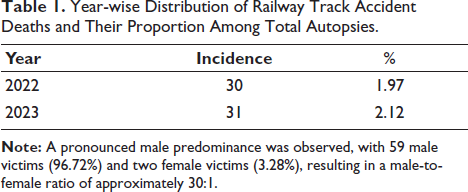
During the two-year study period (January 1, 2022 to December 31, 2023), a total of 2,983 medicolegal autopsies were conducted at the mortuary of the Department of Forensic Medicine, PGIMS, Rohtak. Of these, 61 cases (2.04%) were attributable to railway track accidents. The annual proportion of railway fatalities was comparable across both years, accounting for 1.97% in 2022 and 2.12% in 2023 of total autopsies conducted.
The proportion of railway-related deaths remained relatively consistent over the two years, accounting for 1.97% in 2022 and 2.12% in 2023 of all autopsies performed (Table 1).
Year-wise Distribution of Railway Track Accident Deaths and Their Proportion Among Total Autopsies.
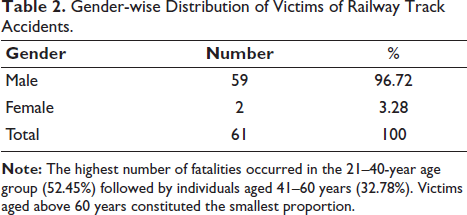
Gender-wise Distribution of Victims of Railway Track Accidents.
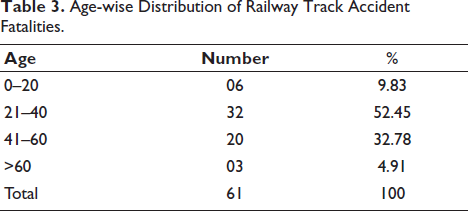
Age-wise Distribution of Railway Track Accident Fatalities.
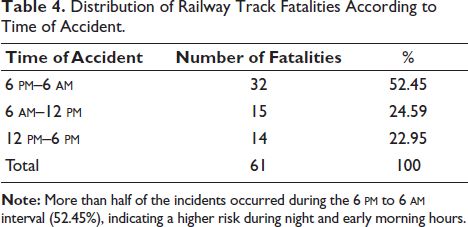
Distribution of Railway Track Fatalities According to Time of Accident.
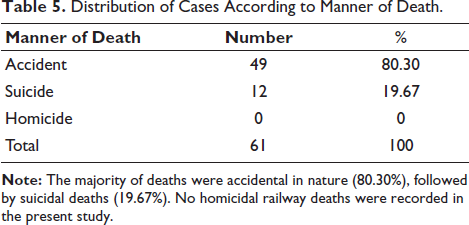
Distribution of Cases According to Manner of Death.
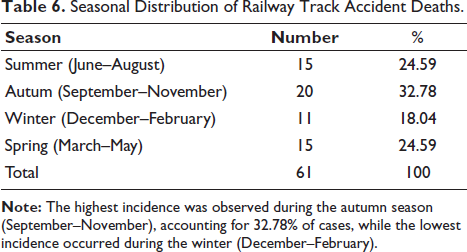
Seasonal Distribution of Railway Track Accident Deaths.
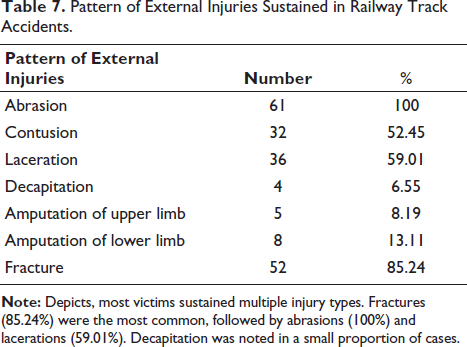
Pattern of External Injuries Sustained in Railway Track Accidents.
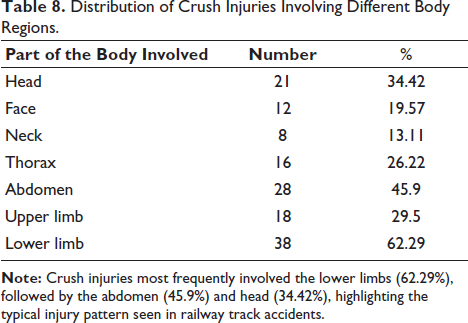
Distribution of Crush Injuries Involving Different Body Regions.
Discussion
Out of the 2,983 medicolegal autopsies conducted during the study period, 61 cases (2.04%) were attributed to railway track-related deaths. This proportion is comparable to findings reported by Khilji et al. 5 (2.45%) and Kumar et al. 6 (2.16%), both from North Indian regions with similar railway density and population distribution. However, the incidence observed in the present study is lower than that reported by Wasnik 7 (5.99%) from Central India and Kumar A 8 (6.7%) from Eastern Uttar Pradesh. Such regional variations may be explained by differences in railway traffic volume, urbanization, enforcement of safety measures, accessibility to railway tracks, and public awareness regarding railway safety norms.
The present study demonstrates a marked male predominance (96.72%), which is consistent with several Indian studies, including those by Khilji et al., 5 Das et al., 9 Tyagi et al., 10 and Wasnik. 7 Similar trends are also reflected in the NCRB national statistics, where males constitute the majority of victims in railway-related accidental deaths. This predominance may be attributed to greater male exposure to railways due to occupational mobility, travel frequency, and higher involvement in high-risk behaviors such as crossing tracks at unauthorized locations or boarding moving trains (Table 2).
Age-wise analysis revealed that the 21–40-year age group constituted the largest proportion of victims (52.45%), aligning with observations by Ahamed et al., 11 Pelletier, 12 Wasnik et al., 7 and Das et al. 9 This age group represents the most economically productive segment of the population and is more frequently exposed to railway environments due to employment-related travel. International studies, including those from the United States and Europe, similarly report a higher incidence of railway fatalities among young and middle-aged adults, emphasizing the universal vulnerability of this demographic group (Table 3).
More than half of the fatalities occurred during the 6 pm to 6 am period. This finding corroborates the observations of Moses et al., 13 who reported a higher incidence of railway deaths during night hours. Reduced visibility, fatigue, alcohol consumption, and delayed reporting of incidents during nighttime may contribute to this trend. Many nocturnal railway accidents are discovered only during early morning hours, leading to the clustering of reported fatalities within this time interval (Table 4).
Regarding the manner of death, the majority of cases were accidental (80.30%), followed by suicidal deaths (19.67%), with no homicidal cases identified. These findings are consistent with those reported by Sheikh et al., 2 Sabale et al., 14 and Davis et al. 15 NCRB data also indicate that accidental railway deaths substantially outnumber suicides nationwide. Accidental fatalities commonly result from falls from moving trains, attempts to board or alight from running trains, walking or crossing tracks at unauthorized points, and train derailments (Table 5).
Seasonal analysis showed a higher incidence of railway fatalities during the autumn months (September–November), which contrasts with the findings of Chatterjee et al., 16 who reported a peak during summer. The autumn peak in the present study may be attributed to increased travel during festive seasons in North India, particularly in Haryana, where migrant workers frequently use trains to travel to their native places (Table 6).
Analysis of injury patterns revealed that abrasions, fractures, and lacerations were the most commonly observed external injuries, a finding consistent with studies by Thakuria and Baruah, 16 Ahamed et al., 11 and Khilji et al. 5 These injuries are typically caused by blunt force impact and frictional contact with railway tracks and rolling stock (Table 7).
Crush injuries were predominantly observed in the lower limbs, followed by the upper limbs, abdomen, face, and head. Similar injury distributions have been documented in studies by Wasnik et al. 7 and Kumar A et al. 8 both from North India. International forensic literature also describes lower limb involvement as a characteristic feature of railway fatalities, reflecting the mechanics of impact when individuals are struck or run over by trains (Table 8).
Conclusion
Railway track fatalities predominantly involved young adult males, with the highest incidence observed in the 21–40-year age group and during night and early morning hours (6 pm–6 am). Most deaths were accidental in nature and characterized by multiple injuries, particularly crush injuries involving the lower limbs, reflecting high-energy train impacts. These findings highlight persistent safety gaps related to overcrowding, unsafe passenger behavior, and inadequate adherence to railway safety norms. Strengthening public awareness, discouraging risky practices such as boarding or alighting from moving trains, and improving track access control are essential preventive measures. Enhanced surveillance, infrastructural safeguards, and strict enforcement of safety regulations are crucial to reducing railway-related fatalities.
Footnotes
Declaration of Conflict of Interests
The authors declared no potential conflicts of interest with respect to the research, authorship, and/or publication of this article.
Ethical Approval
Ethical approval for this study was obtained from the Biomedical Research Ethics Committee, Pt BD Sharma PGIMS, Rohtak, Haryana, vide letter number BREC/25/290 dated October 6, 2025.
Funding
The authors received no financial support for the research, authorship, and/or publication of this article.
Informed Consent
As this was a retrospective autopsy-based study using existing medicolegal records of deceased individuals, informed consent from subjects was not applicable. Confidentiality and anonymity of all personal data were strictly maintained.