




Abstract
Poisoning is a significant public health and medicolegal problem in developing countries including India. A retrospective observational study was conducted on fatal poisoning cases subjected to medicolegal autopsy between 1 January 2023 and 31 December 2023 at a tertiary care center in Haryana. Demographic profile, manner of poisoning, seasonal and diurnal variation, and toxicological (FSL) findings were analyzed from police inquest papers, hospital records, post-mortem findings, and FSL reports. Of 1,461 autopsies performed during the study period, 216 deaths were attributed to poisoning. Males constituted 164 (76.27%) cases. Most victims belonged to joint families (168; 77.77%). Maximum deaths occurred in the 30–39 years age group (57; 26.39%) and 118 (54.42%) cases were from rural areas. Suicidal poisoning was predominant (174; 80.93%), followed by accidental (41; 18.60%) and homicidal (1; 0.45%). Monsoon season recorded the highest burden (94; 43.52%) and night-time was the commonest period (62; 37.80%). Organophosphorus compounds were the most frequently detected poisons (168; 77.77%), followed by others (34; 15.74%) and aluminum phosphide (8; 3.70%). Fatal poisoning deaths in Haryana predominantly involved young adult males from rural backgrounds with suicidal ingestion of agricultural pesticides. Strengthening toxicology services and preventive strategies is recommended.
Introduction
The magnitude of the burden of poisoning is very large and exists all over the world. From the very beginning of human society, humans have been exposed to various poisonous substances. 1
Poisoning is a major problem all over the world, although its type and the associated morbidity and mortality vary from country to country. According to the legal system of our country, all poisoning death cases are recorded as unnatural death, and a medico-legal autopsy is routine. Poison is a substance (solid, liquid, or gaseous), which, if introduced in the living body, or brought into contact with any part thereof, will produce ill-health or death, by its constitutional or local effects or both. Toxicology refers to toxins produced by living organisms which are dangerous to man, for example, poisonous plants, the venom of snakes, spiders, bees, etc., and bacterial and fungal toxins. 2
At present, over 11 million chemical substances are known, and some 60,000–70,000 are in regular use. Between 200 and 1,000 chemicals are produced in excess of one ton annually. Currently, new chemicals are entering the market at the rate of about 600 each month (or over 7,000 per year). 3
Worldwide, an estimated three million cases of pesticide poisoning occur every year, resulting in an excess of 250,000 deaths. Of these, 90% of fatal poisonings occur in developing countries, particularly among agricultural workers. 4
Deaths from pesticide ingestion are a major contributor to premature mortality and the global burden of suicide. In developed countries, medicines are the most common source of self-poisoning with a fatality rate of <1% but in developing countries, pesticides are a major source with at least ten times higher fatality. In attempted suicide, which is considerably more frequent than completed suicide, pesticide poisoning results in temporary or permanent disability. The pattern of poisoning in a particular region depends on factors like availability, socioeconomic status, religious and cultural influences and availability of drugs. 5
The detailed and accurate community-based data on the pesticides responsible for fatal self-harm are not available from most of rural Asia. 6
The present study is a small effort to provide some information from this part of Rohtak, Haryana.
Aims and Objectives
To study the demographic profile of fatal poisoning cases.
To analyze the pattern and manner of poisoning.
To assess seasonal and diurnal variation.
Hypothesis
Fatal poisoning cases in Haryana predominantly involve young adult males from rural backgrounds, with suicidal ingestion of agricultural pesticides being the most common pattern.
Materials and Methods
A retrospective observational study was conducted in the Department of Forensic Medicine of a tertiary care medical institution in Haryana. All cases of death due to poisoning subjected to medico-legal autopsy between January 01, 2023 and December 31, 2023 were included in the study.
Sample size: 216 fatal poisoning cases.
Inclusion Criteria
All autopsy cases where death was attributed to poisoning based on history, post-mortem findings, and chemical analysis.
Exclusion Criteria
Decomposed bodies where toxicological opinion could not be ascertained.
Cases with an inconclusive cause of death.
Data were collected from police inquest reports, hospital records, post-mortem examination findings, and forensic science laboratory (FSL) reports. Variables studied included age, sex, residence, type of family, manner of poisoning, seasonal occurrence, diurnal variation, and type of poison. Statistical analysis was performed using SPSS version 20.
Observations and Results
Out of a total of 1,461 postmortems conducted in the mortuary of the Department of Forensic Medicine, PGIMS, Rohtak, Haryana, in the period of one year from January 1, 2023 to December 31, 2023. First of all, the gender was noted, describing the number and percentage of males and females from the total number of cases.
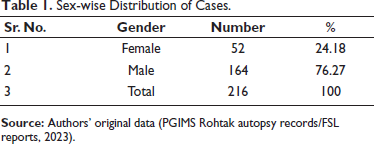
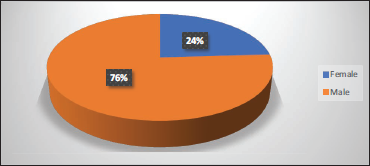
Out of 216 cases of poisoning, 164 (76.27%) were males, and the remaining 52 (24.18%) were females (Table 1 and Figure 1).
Sex-wise Distribution of Cases.
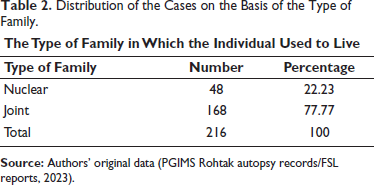
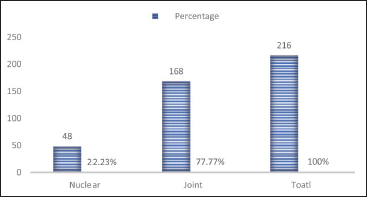
As mentioned in Table 2 the most of the cases lived in a joint family, that is, 168 out of 216 (77.77%) and 48 cases, that is, 22.23% were living in the nuclear family. The results obtained are statistically nonsignificant (Table 2 and Figure 2).
Distribution of the Cases on the Basis of the Type of Family.
In the present study maximum number of fatal poisoning autopsy cases were from the age group between 30 and 39 years (57 cases, i.e., 26.39%). This age group was the most active one, physically, mentally and therefore more prone to stressful situations in life due to the availability of poisons in the house or the working place is one of the factors which promote suicidal poisoning like, celphos, pesticides are mostly available to farming communities, etc (Table 3 and Figure 3).
Age-wise Distribution of Cases.
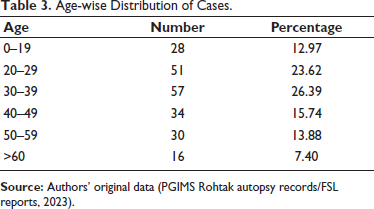
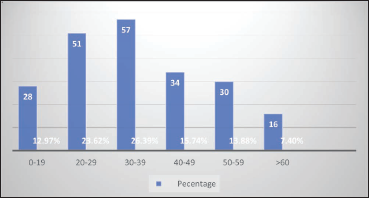
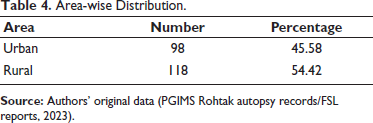
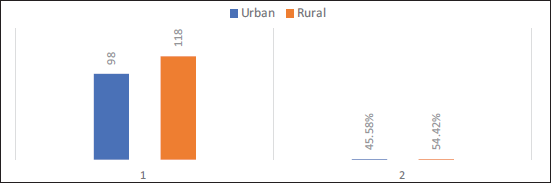
Table 4 depicts that out of 216 cases of poisoning, 118 (54.42%) were from rural areas and the remaining 98 (45.58%) were from urban areas (Table 4 and Figure 4).
Area-wise Distribution.
As mentioned in Table 5 that in most cases, suicidal (80.93%) is the most common manner of death, followed by accidental (18.60%) manner the least common is homicidal (0.45%) (Table 5 and Figure 5).
Manner of Poisoning.
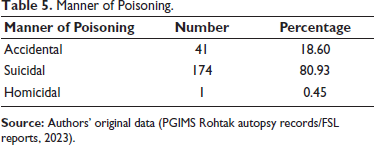
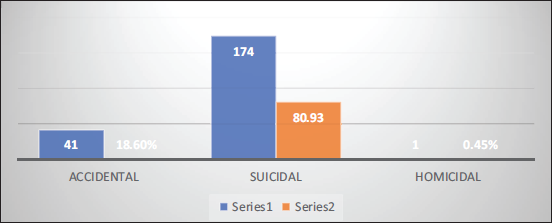
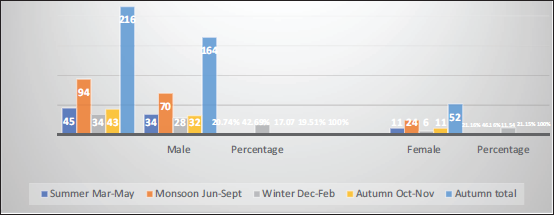
Table 6 shows that the maximum cases occurred in the monsoon season they were 94 cases in number, and 42.68% males and 14.62% females. It was followed by the summer season, that is, 45 (20.83%), and the fewest cases occurred in the winter season, that is, 34 (15.74%). The reason might be the difference between the season of consumption and the season of death (Table 6 and Figure 6).
Distribution of the Cases on the Basis of Seasons in India.

Chemical Analysis (FSL) Findings.
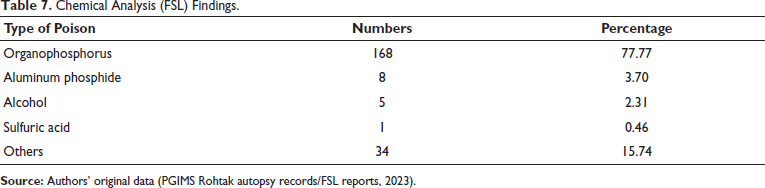
The next parameter studied was chemical analysis (FSL) findings, and the following results were obtained: In a study from Rohtak, Haryana, the maximum number of deaths due to poisoning involved organophosphorus compounds (77.77%), followed by aluminum phosphide (3.70%) and followed by alcohol poisoning (Table 7 and Figure 7).
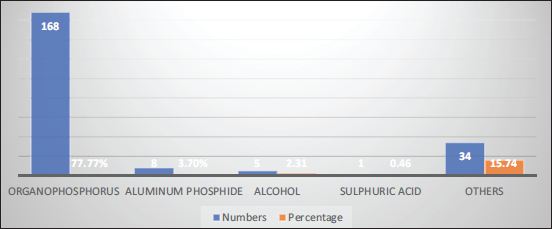
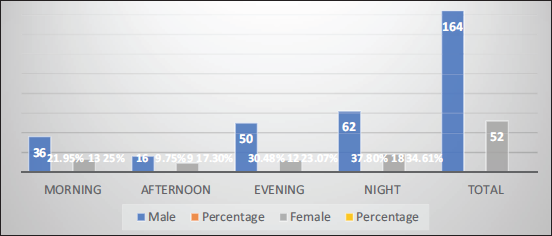
Table 8 shows that maximum poisoning occurred in the nighttime and the burden was 62 (37.8%), followed by evening time, and the burden shared was 50 (30.48%). The lowest incidences were noted during the afternoon time which were 16 (9.75%) (Table 8 and Figure 8).
Distribution of Cases on a Diurnal Variation Basis.

Discussion
Out of 216 cases of poisoning, 164 (76.27%) were males, and the remaining 52 (24.18%) were females (Table 1). Most of the cases lived in a joint family, that is, 168 out of 216 (77.77%), and 48 cases, that is, 22.23% were living in the nuclear family (Table 2). The present study shows that the maximum number of poisoning autopsy cases was from the age group between 30 and 39 years (57 cases, i.e., 26.39%). Most of the cases of poisoning, 118 (54.42%) from rural areas, and the remaining 98 (45.58.18%) were from urban areas. Similar findings were observed by B. Siwach et al. from Rohtak, 7 and Vashishtha et al. 8 Most cases of suicidal (80.93%) are the most common manner of death, followed by accidental (18.60%) manner the least common is homicidal manner (0.45%). The maximum cases occurred in the monsoon season, and they were 94 cases in number and 42.68% males and 14.62% females. It is contrary to Vashishtha et al., 8 Maharani et al., 9 and Dash et al. 10 In our study, organophosphorus (77.77%), aluminum phosphide (3.70%) and alcohol (3.70%) were common poisons. In a study by Mrinal H et al., 11 organophosphorus compounds were the most common agents responsible for poisoning, with 22.91% cases. While Tejus P et al., 12 noted that the commonest type of poison was pesticide in 33.9% cases, followed by household chemicals (26.8%), and in 74.6% of cases, poisoning was suicidal. Srinivasa K et al., 13 reported organophosphorus compounds (25.7%) being the commonest poison in poisoning cases. Singh B et al., 14 noted that agrochemicals were the preferred agents, with organophosphates alone responsible for maximum (50%) suicidal mortalities, followed by aluminum phosphide (40%) and others (8%). The maximum poisoning occurred at night, and the burden was 62 (37.8%), followed by evening, and the burden shared was 50 (30.48%). Lowest incidences were noted during the afternoon time, which were 16 (9.75%), which is contrary to the study done by Pawar et al. 15 and Patil et al., 16 which showed evening as the most common time.
Conclusion
The maximum number of victims of poisoning was young individuals and males. From the chemical analysis reports, we found that the most commonly used poisons were of agricultural use, such as organophosphorus compounds and aluminum phosphide. Incidence of poisoning is higher in joint families irrespective of gender, age group, educational status and residential status. The maximum cases occurred in the monsoon season, and they were 94 cases in number and 42.68% males and 14.62% females. It was followed by the summer season, that is, 45 (20.83%) and the fewest cases occurred in the winter season, that is, 34 (15.74%). Formation of specialized toxicological units for the detection and management of poisoning cases at all hospitals and primary health care centers could considerably minimize the morbidity and mortality due to poisoning.
Footnotes
Declaration of Conflicting Interests
The authors declared no potential conflicts of interest with respect to the research, authorship, and/or publication of this article.
Ethical Approval
Ethical clearance was obtained from the Biomedical Research Ethics Committee, PGIMS Rohtak (Letter No. BREC/25/91 dated 12 June 2025).
Funding
The authors received no financial support for the research, authorship, and/or publication of this article.
Informed Consent
Not applicable as this was a retrospective record-based medicolegal autopsy study using existing documents and laboratory reports; no direct contact with subjects was undertaken.