




Abstract
Forensic medicine integrates medical knowledge with legal applications, playing a vital role in medical education. The General Medical Council underscores its importance in shaping competent physicians, as it bridges medicine and law. Recognized globally as a distinct discipline, forensic medicine—encompassing legal medicine and forensic toxicology—necessitates standardized curricula to ensure uniform medical competence.
In Saudi Arabia, forensic medicine education varies significantly across universities. King Faisal University offers a one-credit course, while King Saud University and King Abdulaziz University provide two-credit courses, the latter embedding it within a Clinical Skills Module. Imam Abdulrahman bin Faisal University includes a three-credit course in the final year, whereas Qassim University assigns two credits under Clinical Sciences. Taif University combines toxicology and forensic science within pharmacology, while Alfaisal and Jazan Universities merge forensic medicine and toxicology in two-credit courses. Other institutions, such as Prince Sattam Bin Abdulaziz and Princess Nourah Bint Abdulrahman Universities, offer elective or integrated courses, further highlighting inconsistencies.
The Saudi Commission of Health Specialities developed a forensic medicine curriculum for the Saudi Board, but its complexity makes it unsuitable for undergraduates. Disparities in institutional approaches risk knowledge gaps, potentially compromising medicolegal service quality. A proposed standardized undergraduate curriculum aims to address these inconsistencies, aligning education with student needs. Implementing such a model nationwide could enhance forensic medicine training and improve educational outcomes. Additionally, its adaptable design may benefit other GCC countries with similar educational frameworks.
In conclusion, the lack of uniformity in Saudi Arabia’s forensic medicine curricula leads to suboptimal undergraduate training. The proposed “Model Forensic Medicine Curriculum for Saudi Medical Colleges” seeks to standardize education, fostering curricular reforms and elevating competency. Wider adoption could extend its impact beyond Saudi Arabia, promoting regional educational advancement in forensic medicine.
Keywords
Background
The author has conducted an examination of the prevailing conditions surrounding undergraduate forensic medicine education within Saudi medical universities. The findings of this review indicate that a notable lack of uniformity has led to restricted opportunities for Saudi medical graduates to engage with undergraduate forensic medicine instruction. Certain institutions do not provide standalone forensic medicine courses, while others amalgamate forensic medicine-related subjects within their undergraduate curricula. The author asserts that there is an urgent necessity for the standardization of the forensic medicine educational curriculum for undergraduate medical students in Saudi universities.
Introduction
The fields of medicine and law have been interrelated since the inception of both domains, with every medical specialty encompassing legal and regulatory dimensions in its practice. The terminologies Forensic Medicine, Legal Medicine, and Medical Jurisprudence trace their origins to the early 19th century and are frequently utilized interchangeably. 1
Forensic medicine is articulated as “the application of medical and paramedical scientific knowledge to specified branches of law, encompassing both civil and criminal domains.” 2 The discipline of Forensic and Legal Medicine possesses significant potential to enhance undergraduate medical education. The General Medical Council (GMC) posits that a comprehensive understanding of medical law constitutes a fundamental prerequisite for medical students aspiring to evolve into “competent physicians.” 3 The global medical curriculum integrates instruction in forensic medicine as an indispensable core element. In contemporary contexts, forensic medicine is increasingly designated as clinical forensic medicine in various countries and is recognized as a distinct professional discipline. Medical practitioners must not underestimate the critical role of forensic medicine, which encompasses legal medicine and forensic toxicology, within their professional practice. At this juncture, there exists a pressing necessity for the standardization of the forensic medicine curriculum to attain appropriate levels of medical competency on a global scale. Integration of Forensic Medicine is useful in integrated curricula. 4
Methodology
The present study was carried out at the Division of Forensic Medicine, Department of Biomedical Sciences, College of Medicine, King Faisal University, Al-Ahsa, Kingdom of Saudi Arabia. The author has conducted a thorough analysis of the existing curriculum and university website information to formulate the conclusions presented.
The data collection primarily utilized official university websites and the available academic curriculum of the colleges.
A total of 65 universities were reviewed based on specific selection criteria within Saudi Arabian higher education.
Institutions must be chartered or accredited by relevant authorities. Programs must offer at least a three-year bachelor’s or advanced degree. Courses should primarily be in a traditional format rather than distance education.
Inclusion Criteria
Data were sourced from official websites of medical colleges with undergraduate forensic medicine programs, including those offering forensic medicine within broader curricula.
Exclusion Criteria
Institutions lacking medical programs were excluded, as were those with inadequate data on forensic medicine. Universities offering only master’s-level forensic subjects without undergraduate counterparts were omitted, along with programs focused on computer forensics and those presenting forensics with unrelated disciplines.
Study Limitation
Outdated information was noted on some websites, and the integration of forensic medicine with other fields hindered clarity in the review process.
Results of Curriculum Review
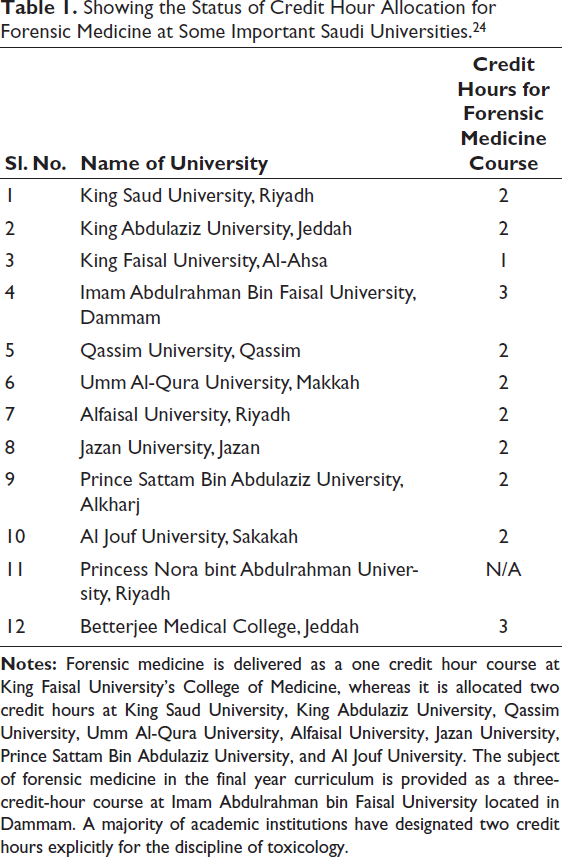
Ethical and legal aspects play a key role in forensic medicine teaching. 5 Forensic medicine is provided as a one-credit course at King Faisal University located in Al-Ahsa. 6 At King Saud University in Riyadh, forensic medicine is available as a two-credit offering.7, 8 As a prerequisite for students entering their fifth and sixth years, King Abdulaziz University in Jeddah incorporates forensic medicine as a two-credit course at the fourth-year level within the “Clinical Skills Module.” 9 In the final year, Imam Abdulrahman bin Faisal University in Dammam presents a three-credit course in forensic medicine. 10 At the University of Qassim, forensic medicine is instructed as a two-credit subject at the fifth-year level within the Clinical Sciences department. 11 The Department of Pharmacology at Taif University incorporates elements of toxicology and forensic science in its curriculum, aiming to educate students about both fields and their respective applications. Taif University does not provide distinct courses in toxicology and forensic medicine. 12 At Alfaisal University in Riyadh, third-year students enrolled in a two-credit toxicology course receive instruction in Forensic Medicine [Semester 5]. 13 In the third year, Jazan University offers a two-credit course in forensic medicine alongside toxicology. 14 Prince Sattam Bin Abdulaziz University in Alkharj provides a two-credit elective titled “Forensic Medicine & Biomedical Ethics.” 15 The Internal Medicine Division of the Clinical Science Department at Princess Nourah Bint Abdulrahman University concurrently offers courses in forensic medicine and toxicology. 16 At Betterjee Medical College in Jeddah, Saudi Arabia, forensic medicine is taught in conjunction with toxicology as a three-credit course (Table 1). 17
Showing the Status of Credit Hour Allocation for Forensic Medicine at Some Important Saudi Universities. 24
Limitations of the Review Process
The review has primarily relied on accessing the university’s official websites, which occasionally lack up-to-date information for review.
The quality of teaching has not been assessed.
The author does not have access to course files, which would provide better resources for evaluating the courses on multiple parameters
Inference Drawn by the Review Process
Forensic medicine is integrated into the educational framework for medical graduates in Saudi Arabia as a component of the undergraduate medical curriculum; however, variances exist among the various medical institutions within the Kingdom. In one institution, it is taught during the third year, while in another, it is introduced at the fourth-year level. Additionally, the allocation of credit hours for this course differs across various educational establishments. In light of these inconsistencies, achieving standardization in the Forensic Medicine curriculum within the Kingdom poses significant challenges.
Findings from a study conducted by Ibrahim M. Al-Anazi et al. in 2022 indicate a deficiency in the inclusion of forensic medicine within the college curriculum, highlighting an essential need for enhanced educational offerings concerning forensic science and its related subspecialties. The authors also inferred that further research is imperative to develop a suitable curriculum, standardize forensic medicine education, and evaluate the efficacy of these academic programs. 18
The author noted the existence of a notable inconsistency in the standardization of forensic medicine pedagogy across diverse academic institutions within the Kingdom of Saudi Arabia.
In this scholarly article, the author undertook a comprehensive examination of the curricula presented at various academic institutions and proposed a “Model Forensic Medicine Curriculum for Saudi Undergraduate Medical Students,” which duly incorporates the directives established by principal stakeholders such as the Saudi Commission for Health Specialties, the Ministry of Higher Education, and the Ministry of Health. Furthermore, the suggested model exhibits congruence with the SaudiMed Competency Framework 19 and the National Qualifications Framework for Higher Education within the Kingdom of Saudi Arabia. 20 Additionally, the proposed model demonstrates alignment with the SaudiMed Competency Framework and the National Qualifications Framework for Higher Education in the Kingdom of Saudi Arabia.
The Saudi Commission for Health Specialties delineated a standardized curriculum in forensic medicine for the Saudi Board in forensic medicine and toxicology. The curriculum for the Saudi Board encompasses the following courses: Basic and Applied Human Anatomy, Pathology, Islamic Shari’ah and Forensic Ethics, Forensic Medicine, Toxicology and Forensic Chemistry, Forensic Radiology, Statistical Analysis and Foundations of Scientific Research, as well as Forensic Science. 21
Discussion
The Saudi Commission of Health Specialties has delineated a standardized forensic medicine curriculum tailored for the Saudi Board in forensic medicine and toxicology. This reference document is methodically organized and thoroughly constructed to furnish guidance on all dimensions of educational instruction and assessment. This document serves as an authoritative resource that can be readily consulted as the principal guide for forensic medicine within the Kingdom. The salient question is, what necessitates the introduction of a proposed model when a standardized document is accessible as a reference? The response to this inquiry is that the prescribed curriculum contents substantially exceed the educational scope appropriate for undergraduate medical students concerning the subject matter under consideration. Furthermore, the requisites and established guidelines exhibit variability across different educational institutions. The core issue is that the curriculum components pertaining to forensic medicine are considerably more comprehensive and are in alignment with the standards set forth by the Saudi Board for Forensic Medicine. Indeed, the proposed model holds particular relevance for the instruction of undergraduate students, specifically in the realm of forensic medicine.
To elaborate further, we can assert that a markedly reduced proportion of students participate in undergraduate forensic medicine programs as part of their medical education when compared to those enrolled in the Saudi Board for Forensic Medicine. The caliber of medicolegal services in the Kingdom of Saudi Arabia would be profoundly affected by any inadequacies or deficiencies in knowledge at the undergraduate level.
Executing the proposed curriculum on a nationwide basis this would provide substantial justification for the prompt modifications to the curriculum in forensic medicine.
The proposed framework is categorized into multiple tiers ranging from zero to eight, contingent upon the quantity of pertinent subjects and the duration allocated for content dissemination, as well as the profundity of knowledge intended for transmission.
Level 1 and 2: Undergraduate medical scholars electing to specialize in forensic medicine within their undergraduate program are required to complete Levels 1 and 2. These levels exclusively encompass the foundational principles of forensic medicine in relation to medical practices; there are no experiential assignments or practical tasks.
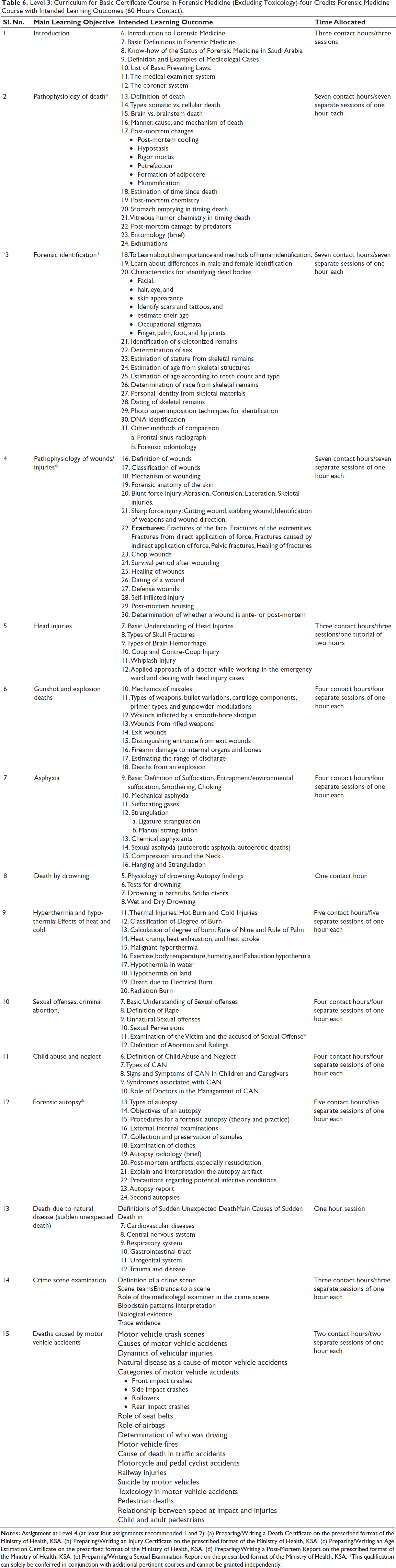
Level 3: For individuals who have completed their medical education, Level 3 constitutes a relatively advanced curriculum as it encompasses four credits of specialized content pertaining to subjects such as crime scene investigation. Certification for participation in this course may be pursued independently. Should undergraduate medical students express an interest in acquiring knowledge in advanced forensic medicine, they are permitted to enroll in this course. An additional credit hour may be procured as an elective option. When a student elects to participate in the Level 3 certificate program, they are able to fulfill the three-credit mandate for the forensic medicine course and are consequently exempt from completing one credit of elective coursework.
Level 4: The Associate Diploma course cannot be pursued in isolation. It constitutes an integral component of the 24-hour credit accomplishment corresponding to the NQF level of Associate Diploma. The Associate Diploma represents a full-time academic program spanning one year, which is conferred upon the successful completion of both an undergraduate medical degree and an internship. Furthermore, this program serves as an advantageous preparatory pathway for graduates seeking to apply for the Saudi Board in Forensic Medicine.
Level 5–7 is designated for advanced educational pursuits that fall outside the scope of the present investigation (Table 2).
Levels and Course Contents at Different Levels.
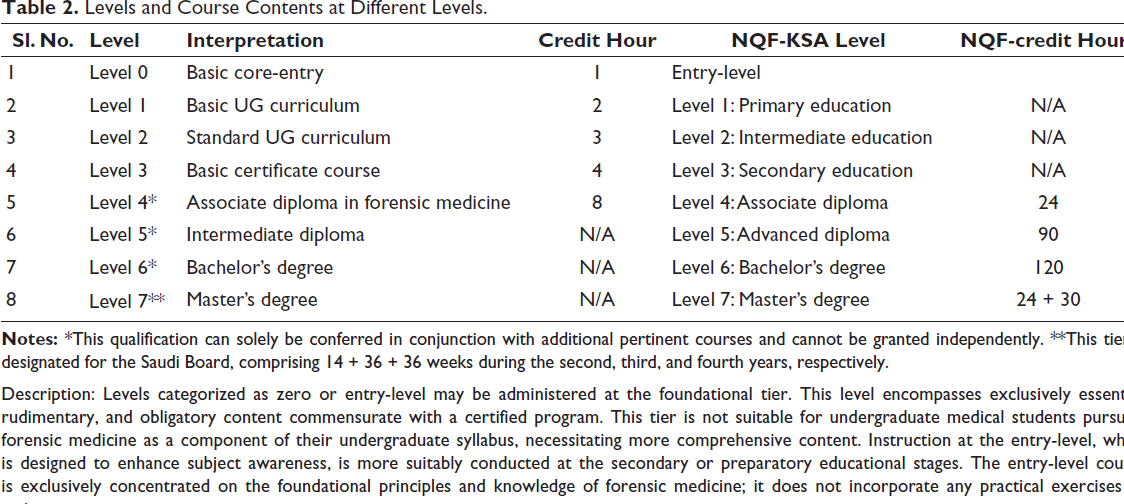
Description: Levels categorized as zero or entry-level may be administered at the foundational tier. This level encompasses exclusively essential, rudimentary, and obligatory content commensurate with a certified program. This tier is not suitable for undergraduate medical students pursuing forensic medicine as a component of their undergraduate syllabus, necessitating more comprehensive content. Instruction at the entry-level, which is designed to enhance subject awareness, is more suitably conducted at the secondary or preparatory educational stages. The entry-level course is exclusively concentrated on the foundational principles and knowledge of forensic medicine; it does not incorporate any practical exercises or assignments.
Forensic Medicine Contents Delivery at Various Proposed Levels Over Time
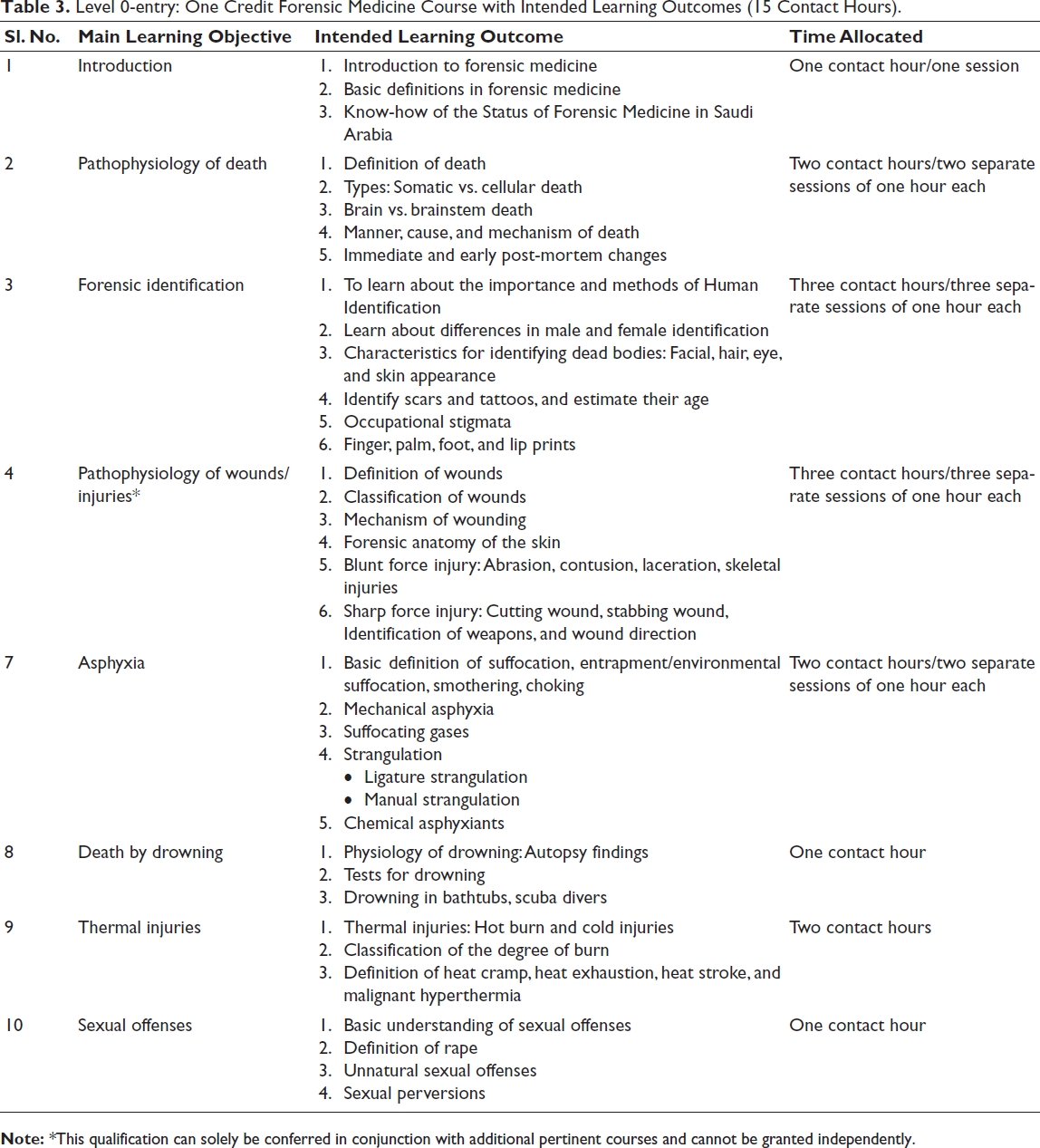
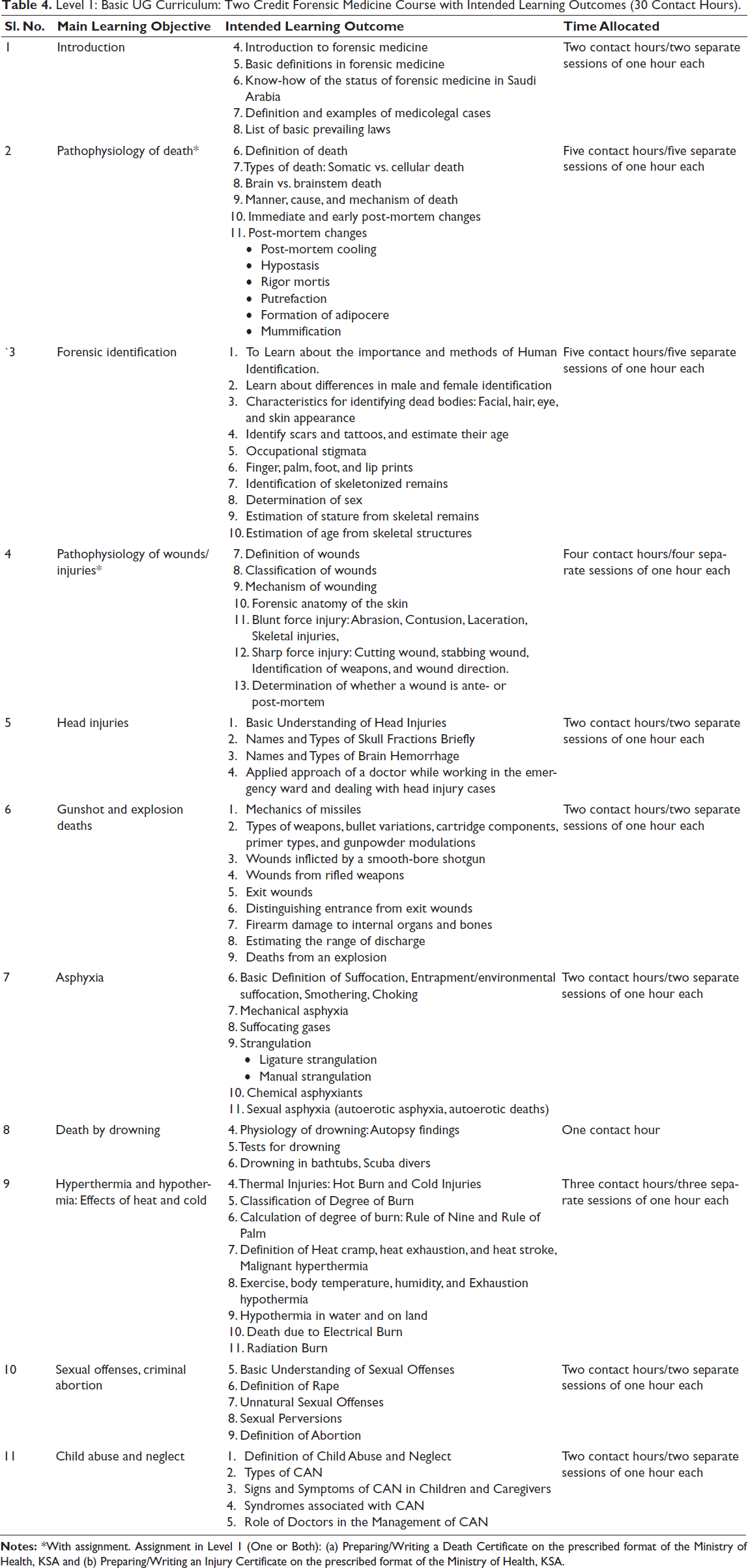
The delineated compilation of subject matters, accompanied by specified learning objectives and the duration of content dissemination, is incorporated in the annexure accompanying this manuscript.
Conclusion
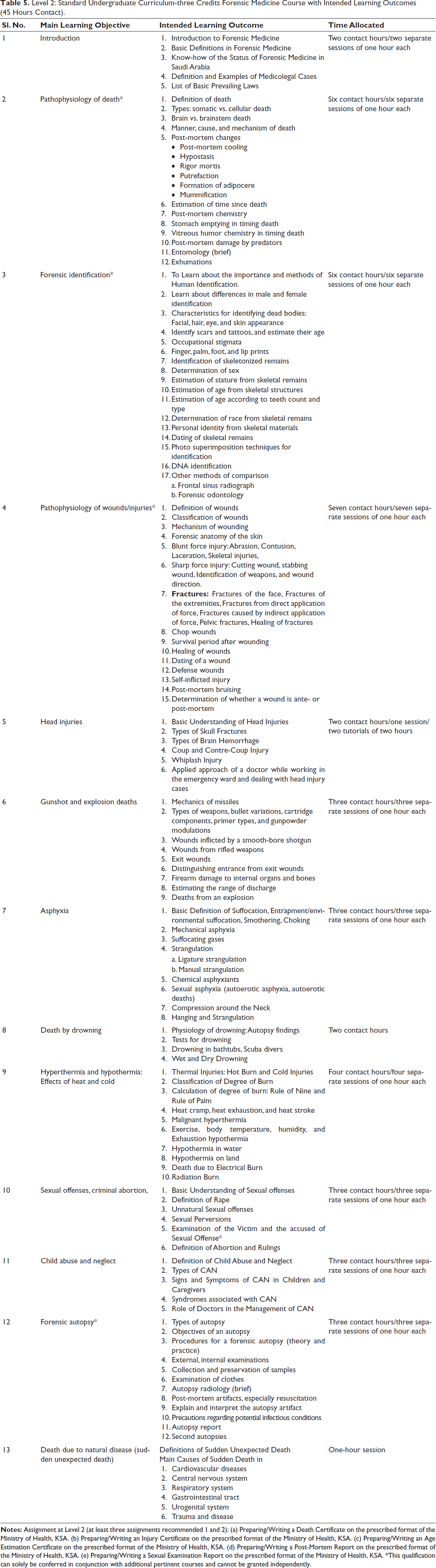
It is evident that, at this juncture, there exists a limited standardization of the Forensic Medicine Curriculum for graduates of medical institutions in Saudi Arabia. Certain universities exhibit deficiencies in the instruction of forensic medicine at the undergraduate level. The curriculum pertaining to Forensic Medicine that is currently implemented lacks uniformity, which frequently undermines the quality of forensic medical education. The proposed “Model Forensic Medicine Curriculum for Saudi Medical Colleges at the Undergraduate Level,” as suggested in this article, holds significant potential for standardizing the educational experience for undergraduate medical students. The nationwide implementation of the proposed curriculum offers substantial justification for initiating early curricular reforms in the field of forensic medicine. Furthermore, the model curriculum is also amenable to adoption by other countries within the Gulf Cooperation Council (GCC), as the contextual circumstances and conditions are analogous (Tables 3–6).
Level 0-entry: One Credit Forensic Medicine Course with Intended Learning Outcomes (15 Contact Hours).
Level 1: Basic UG Curriculum: Two Credit Forensic Medicine Course with Intended Learning Outcomes (30 Contact Hours).
Level 2: Standard Undergraduate Curriculum-three Credits Forensic Medicine Course with Intended Learning Outcomes (45 Hours Contact).
Level 3: Curriculum for Basic Certificate Course in Forensic Medicine (Excluding Toxicology)-four Credits Forensic Medicine Course with Intended Learning Outcomes (60 Hours Contact).
Further Recommendations
It is imperative that a standardized curriculum in Forensic Medicine be implemented across all Saudi universities at the undergraduate level. There should be a greater integration of Forensic Medicine with clinical subjects to enhance its relevance for medical graduates and facilitate its application in routine medical practice. The curriculum components that do not directly pertain to undergraduate education but are more suited for postgraduate studies should be excised from the core undergraduate forensic medicine syllabus, particularly if the allocated credit hours do not allow for comprehensive content delivery.
A mandatory 15-day training period within a Forensic Medicine department/division/unit is recommended for internship students in clinical forensic medicine, focusing on critical areas such as injury cases, age determination, sexual offenses, and other medicolegal cases, as well as the examination of blood and seminal stains, cases of burns, poisoning, post-mortem examinations, and issues related to intoxication, as suggested by Sabri I. 22
To enhance the depth of the curriculum and the assessment methodologies in accordance with the regulations established by each institution.
It is advisable to allocate three credit hours specifically for forensic medicine. In cases where it is combined with forensic toxicology, an additional credit hour should be conferred.
Improved student engagement in practical work is highly useful. 23 Fieldwork and practical site visits should be conducted whenever deemed appropriate and feasible.
Footnotes
Declaration of Conflicting Interests
The authors declared no potential conflicts of interest with respect to the research, authorship, and/or publication of this article.
Ethical Approval
No Ethical Approval is required.
Funding
The authors disclosed receipt of the following financial support for the research, authorship, and/or publication of this article: This research was supported by the Deanship of Scientific Research and the Vice Presidency for Graduate Studies and Scientific Research at King Faisal University, Al-Hasa, Saudi Arabia, under Grant No. KFU254297.
Patient Consent
Not applicable.
