




Abstract
The eagerly awaited Surrogacy (Regulation) Act of 2021, following extensive deliberations and amendments during its legislative journey, disappointingly neglects the essential rights of egg donors, notably in terms of health insurance coverage and safeguarding their well-being throughout and after the egg retrieval process. The Act lacks provisions for addressing reported instances of medical complications and, tragically, even the unfortunate demise of egg donors. This significant oversight not only infringes upon the fundamental rights of these contributors but also underscores a disproportionate emphasis on the rights of surrogate mothers within the framework of the Surrogacy (Regulation) Act, 2021. This research endeavor seeks to illuminate the deficiencies within the Act as it pertains to the rights of egg donors and, in response, proposes viable remedies for consideration.
Introduction
In 2021, at last, the Surrogacy Act was passed. Many amendments and discussions were made before passing this act. One of the important amendments that were done before passing it was the banning of commercial surrogacy
1
for the protection of surrogate mothers from being trafficked. Now, only altruistic surrogacy is allowed. As per Section 2(b) of the Surrogacy (Regulation) Act, 2021,
[A]ltruistic surrogacy means surrogacy in which no charges, expenses, fees, remuneration, or monetary incentive of whatever nature, except the medical expenses incurred by the surrogate mother and the insurance coverage for the surrogate mother, is given to the surrogate mother, her dependents, or her representative.
2
Thus, altruistic surrogacy means that the surrogate mother does not receive any monetary support from the intending couple except for the medical expenses of renting her womb. 3
From time to time, the government has taken various measures for the protection of surrogate mothers in surrogate industries. On July 15, 2019, before the passing of the act, when the Surrogacy (Regulation) Bill, 2019 was presented before the Lok Sabha by Dr. Harsh Vardhan, Minister of Health and Family Welfare, he said that the main objective behind the bill was that
The bill is aimed at ending the exploitation of women who are lending their wombs for surrogacy and protecting the rights of children born through this. The bill will also look after the interests of the couple that opts for surrogacy, ensuring that there are laws protecting them against exploitation by clinics that are carrying this out as a business. There are very few countries in the world that allow commercial surrogacy, with experts arguing that this is an exploitation and abuse of human dignity. We cannot allow women in our country to be exploited without their understanding what is happening to them. The government has a duty to protect the interests of these women.
4
This clearly shows that the government was concerned more about the surrogate mother’s rights as well as their health.
If we talk about the surrogacy process, most of us generally think that surrogacy consists of three parties, that is, the surrogate mother, the intended couple, and the hospitals. But there is one more party that plays an important role in the surrogacy process, that is, the egg donor. Egg donors are equally important as surrogate mothers. They also played an important role in the surrogacy process, especially in cases where the egg could not be retrieved from couples because of infertility issues.
Egg Donor
The surrogacy process is of two types: (a) gestational surrogacy and (b) traditional surrogacy.
Gestational surrogacy 5 : Gestational surrogacy is a type of surrogacy where the surrogate mother is not genetically related to the fetus. In this kind of surrogacy, either the intended parent’s egg or a donor egg is used for fertilization. Once the fertilization process is done, it is inserted into the womb of the surrogate mother through IVF. The pregnancy is carried out by the surrogate mother, who gives birth to the child. Here in gestational surrogacy, the surrogate mother is not genetically linked to the child, as she only rents her womb for carrying the child. The egg donor is needed here if gametes are not possible to retrieve from the couple in case of gestational surrogacy. In India, only gestational surrogacy is allowed for the surrogacy process. Actually, for many, there is a misconception that surrogacy means only intended couples and a surrogate mother. But the truth is that when the gametes from any of the couples cannot possible retrieved due to any medical conditions, then this sperm donor and egg donor are required for the surrogacy process.
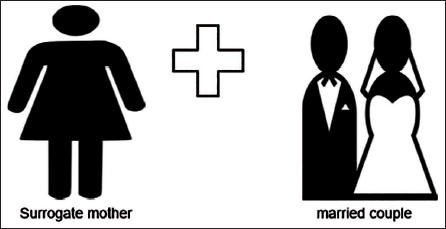
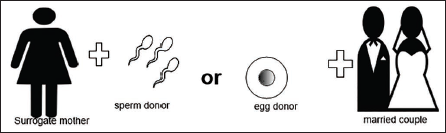
Pic- Compiled by the author to show that in the surrogacy process, apart from the intended couples and surrogate mother, egg donor and sperm donor are also required to complete the surrogacy process in some cases (Figures 1 and 2).
When Gametes Are Taken From the Intended Couple. Then the Parties for the Surrogacy Process Will Be Surrogate Mother and the Intended Couples.
When Gametes Are Taken From Any Donor (Egg or Sperm) Due to Medical Issues Related to the Fertility of Either Member of the Intended Couple. In This Case Sperm Donor or Egg Donor Is Required to Complete the Surrogacy Process.
Traditional surrogacy 5 : Traditional surrogacy, on the other hand, is the opposite of gestational surrogacy. In traditional surrogacy, the child will be genetically attached to the surrogate mother. Surrogate mother gametes are used here for fertilization. No egg donor is required here in this process. In India, it is not allowed.
Thus, from the above discussion, it is clear that in gestational surrogacy cases, an egg donor can also be a party to the surrogacy process when gametes are not possible to retrieve from the intended couples due to any medical reason.
Law Relating to Egg Donor
Criteria
The legislature has kept the same criteria for becoming a surrogate mother and egg donor in the Surrogacy Act. Section 4(iii)(b)(I) of the act states that
[N]o woman, other than an ever-married woman having a child of her own and between the ages of 25 and 35 years on the day of implantation, shall be a surrogate mother or help in surrogacy by donating her egg or oocyte or otherwise.
2
It is also mentioned that the surrogate mother cannot use her gametes for surrogacy and that only married women who are closely related to couples can become surrogate mothers, as well as these women can become surrogate mothers once in their lifetime. Here in surrogacy, it is mentioned that for surrogacy egg donor must be married and must have one child.
But if we go through the Assisted Reproductive Technology (Regulation) Act, 2021 (hereinafter referred to as the ART Act), we will find that the bank registered under the ART Act can obtain oocytes from “females between twenty-three years of age and thirty-five years of age, and an oocyte donor shall donate oocytes only once in her life, and not more than seven oocytes shall be retrieved from the oocyte donor.” 6 It is not necessary here in ART that the egg donor be closely related to the intended couple. Anyone here can donate eggs.
Medical Insurance
The definition given by the Surrogacy Act regarding altruistic surrogacy says that in altruistic surrogacy
[N]o charges, expenses, fees, remuneration, or monetary incentive of whatever nature, except the medical expenses and such other prescribed expenses incurred by the surrogate mother and the insurance coverage for the surrogate mother, is given to the surrogate mother, her dependents, or her representative.
2
Regarding insurance, it is defined as
[A]n arrangement by which a company, individual, or intending couple undertakes to provide a guarantee of compensation for medical expenses, health issues, specified loss, damage, illness, or death of a surrogate mother, and such other prescribed expenses incurred on such a surrogate mother during the process of surrogacy.
2
Section 4. (iii)(a)(III) of the same says that
[I]nsurance coverage of such an amount and in such a manner as may be prescribed in favour of the surrogate mother for thirty-six months covering postpartum delivery complications from an insurance company or an agent recognized by the Insurance Regulatory and Development Authority established under the Insurance Regulatory and Development Authority Act.
2
Surprisingly, the Surrogacy Act mentions the criteria for the egg donor. But nothing has been mentioned about the medical insurance for an egg donor. The act is silent about the insurance for an egg donor for a surrogacy process. Regarding insurance, one can see the Assisted Reproductive Technology (Regulation) Act, 2021. Section 22(1) of the ART Act says that
[T]he clinic shall not perform any treatment or procedure without insurance coverage of such amount as may be prescribed for a period of twelve months in favor of the oocyte donor by the commissioning couple or woman from an insurance company or an agent recognized by the Insurance Regulatory and Development Authority established under the provisions of the Insurance Regulatory and Development Authority Act, 1999.
6
Section 22(4)(ii) speaks about insurance, which “means an arrangement by which a company, individual, or commissioning couple undertakes to provide a guarantee of compensation for specified loss, damage, complication, or death of an oocyte donor during the process of oocyte retrieval.” 6 Even regarding oocyte donation, it is mentioned in the ART Act that an oocyte donor shall donate oocytes only once in her life and that no more than seven oocytes shall be retrieved from the oocyte donor. Though it is mentioned here in the ART Act that insurance should be provided to the egg donor, in actual cases, the situation is different. In cases of the death of the egg donor, the family members have to run here and there for the compensation amount. 7
Punishment
The Surrogacy Act has made it clear that
[N]o person, organization, surrogacy clinic, laboratory, or clinical establishment of any kind shall sell human embryos or gametes for the purpose of surrogacy; run an agency, a racket, or an organization for selling, purchasing, or trading in human embryos or gametes for the purpose of surrogacy; or import, or shall help in getting imported, in whatever manner, human embryos or human gametes for surrogacy or for surrogacy procedures.
2
Selling and purchasing of gametes are punishable offenses under the Surrogacy Act as well as under the ART Act. But what about the right to get compensation amount for the loss of wages suffered by the egg donor during the egg retrieval process? Nothing has been mentioned about the economic loss suffered by the egg donor under the ART Act, as well as under the Surrogacy Act.
Drawbacks of the Surrogacy and ART Act
One of the conflicts that arises here in the ART is whether seven plus seven oocytes from both ovaries can be removed or whether, in total, seven oocytes can be removed from both ovaries. This is not addressed here in the Act. Another conflict is that for surrogacy, it is specifically written that an egg donor should be married, but for ART, marriage is not a condition for an oocyte donor. Marriage is a condition only for the intended couples. Because nowhere in the ART Act except for intended couples’ marriage been used as criteria. Now it becomes a question for egg donors: which law will be followed?
Violation of Egg Donor Rights
Now, from the above discussion, we have seen that the egg donor is also one of the parties to the surrogacy agreement, depending upon the intended couple’s health conditions. Although nothing has been mentioned in the Surrogacy Act about the insurance benefit for the egg donor, reference can be taken from the ART Act, as surrogacy cannot be done without the support of ART. But there are many instances where it can be seen that egg donor rights have been violated. The following are some major areas where egg donor rights are violated-
Synthetic Hormone
There is no uniform law or guideline regarding the dosage of Gonadotropin injection, which is a synthetic hormone used in the process of egg removal. The number of oocytes that can be removed from the donor has been mentioned in the ART Act, but there is no mechanism to check in actuality how many oocytes have been removed. 8 Even because of the use of the synthetic hormone, many short-term and long-term health issues are associated with it. Short-term risk associated with it is ovarian hyperstimulation syndrome (OHSS), ruptured cysts, ovarian torsion, bleeding, pelvic pain, mood swings, infection, premature menopause, kidney failure, stroke, and even death. Other most serious long-term risks are future infertility and cancer, most commonly ovarian, breast, and endometrial. But if we check the insurance provider of the ART Act there, we will find that insurance covers only short-term risk; nothing has been mentioned about long-term risk. Here at ART Act, the insurance has been provided only for 12 months and not more than that, and from past research, it has been proven that long-term health risk is associated with the egg donation process. This is a violation of the egg donor’s right to health, as most of the time it has been noticed that egg donors were not aware of the risk associated with the egg removal process. 9 Even if we go through Section 21 of the ART Act, then we can find that the ART clinic has to provide professional counseling to the commissioning couple and woman regarding all potential outcomes and the likelihood of success of assisted reproductive technology procedures in the clinic. The clinic will inform the commissioning couple and woman regarding the costs, benefits, and risks associated with the procedures, including the possibility of multiple pregnancies; also, it will help the commissioning couple or woman to reach an informed decision on matters that would be important to them. But nothing has been mentioned about providing professional counseling to egg donors about the risks associated with the egg retrieval process. This is the drawback of the law because poor, innocent women become victims of these ART and Surrogacy clinics. 10
Number of Eggs Removal
Recently, an unidentified 23-year-old lady from Delhi died suddenly during the egg retrieval process. The woman was married with a child, and she was healthy when she went to the hospital for the egg-donate procedure. Upon her death, a post-mortem report revealed that she died from OHSS, a complication that affects one in three women undergoing IVF. 11 In general, the oocyte donation process starts with ovarian stimulation, the first step in IVF, which involves taking synthetic hormones to boost the number of eggs produced by the ovaries. This is done so that doctors can collect as many eggs as possible to fertilize, which increases the choice of embryos that can be implanted. 11 This is another violation of the rights of the egg donor. Even in many past research, it has been found that women donate eggs more than once in their lives. Even if they become a surrogate mother more than once in their life. This is a way for them to earn huge money 10 in a short duration.
Right to Remuneration
Before 2016, both the Assisted Reproductive Technology (Regulation) Bill and the Surrogacy (Regulation) Bill were considered to be consolidated laws that sat on a wall like “Humpty Dumpty.”
12
It was later, when commercial surrogacy was banned in India, Humpty Dumpty had a great fall, leaving the Surrogacy Regulation and Assisted Reproductive Technology Bill as two different laws. But even though they have been separated, these two have to run simultaneously. As surrogacy is not possible without ART. Here, it is important to mention that commercial surrogacy is strictly prohibited as per the Surrogacy Act 2021, and it is also a punishable offense; the surrogate mother will not receive any remuneration from the surrogacy agreement. Recently, a writ petition has been filed by Aniruddha Narayan Malpani Versus UOI and others | W.P. (Civil) No. 1129 of 2022 before the honorable Supreme Court regarding the violation of egg donor rights in IVF industries.
This petition specifically deals with the rights of egg donors. IVF through third-party donor eggs constitutes 40 percent of all IVF procedures and the Act completely overlooks their rights to compensation for the time and effort of going through the surgical procedure of going through egg retrieval and other expenses like food, travel, and accommodation, which is unjust and unreasonable leading to an extreme shortage of egg donors in the country. While surrogacy consists of three to five percent of assisted reproduction, IVF makes up 97 to 98 percent of it. Therefore, the number of people affected by it is very large. The provision of allowing only one oocyte donation in the lifetime of a donor and other ancillary provisions are not just unscientific and unreasonable but against international best practices. These issues have not been dealt with, in the surrogacy PIL.
13
Now, the IVF industry, which runs with the help of egg donors, violates the economic rights of the egg donor due to a lack of provisions in the ART Act related to remuneration benefits for an egg donor. Even if it may raise the issues of human trafficking in the surrogacy and IVF industries. 8
Conclusion and Suggestion
The insurance coverage for egg donors should be increased from 12 to 36 months, like that of the Surrogacy Act of 2021.
Remuneration should be fixed nationwide for egg donors, just like the government has fixed costs for knee replacement surgery in India. 14 By doing this, egg donors’ rights will be protected from loss of wages during the egg retrieval process, as well as their economic rights, which will not be violated. In most cases, it is the poor lady who approaches the ART clinic for egg donation. It is a kind of source of income that they can earn through this process.
Proper professional, as well as legal, counseling, should be provided to the egg donor to ensure that she has received all kinds of information related to the risks associated with the egg retrieval process, as well as about their rights and benefits from this process. After having professional counseling, the egg donor should sign the consent form along with the two witnesses. One witness must be from the family of the egg donor and one from the ART clinic.
There must be a mechanism to check the number of eggs that are retrieved during the egg retrieval process. A camera recording should be done for every egg retrieval process. That should be kept in the records of the ART clinic.
The National Board of the ART Act can create an All India System software for recording the details of an egg donor, which will be accessible only by the ART clinics registered under the ART Act. It will be linked with the Aadhaar card so that every single detail and history of the egg donor will be available in the portal for verification to check the number of times they have gone for the egg donation. An Aadhar card should be mandatory for egg donation to ensure that a woman does not donate her egg more than once during her life. Through the Aadhar card, it will be easy to track the record of the egg donor. Even by performing this insignificant act, a poor lady can be saved from human trafficking.
Guidelines must be framed for the usage and dosage of synthetic hormones in ART clinics for the egg retrieval process.
More research is needed to find the drawbacks of the ART Act and the Surrogacy Act. So that no one’s rights should be violated.
There is no doubt that surrogacy is a wonderful process for those who want to have their baby. It is an achievement for medical science to provide a ray of hope to infertile couples who hope to have their baby through this ART process. But on the other hand, this process has many drawbacks. This is a complex and costly process in which, directly or indirectly, many people are involved. The benefits of this process can be enjoyed by couples who are financially stable, and this process can provide a short-term earning opportunity to the egg donor, as they are one of such parties in the process of surrogacy. It has been seen in the past that the right to health and the economic rights of the egg donor have been violated most of the time in surrogacy cases. The lawmakers must check and provide a remedy to the egg donor, as they are an important part of the surrogacy process, and their rights should not be violated. Even so, it is the government’s responsibility to ensure that egg donor rights are not violated.
Footnotes
Declaration of Conflicting Interests
The author declared no potential conflicts of interest with respect to the research, authorship, and/or publication of this article.
Ethical Approval and Informed Consent
Not applicable.
Funding
The author received no financial support for the research, authorship, and/or publication of this article.
