




Abstract
Tire service stations present serious hazards, especially during high-pressure air inflation. While tire bursts are known to cause fatal injuries, metal rim ejections due to improper disk locking are underreported. This case highlights the risks associated with unsecured metal disks and underscores the need for safety measures in the form of a daily check-up of the machine before starting the work. Here a 40-year-old mechanic sustained fatal injuries when a loosely fitted metal rim was propelled by high tire pressure during air inflation. With the remolding machine door left open, rising pressure dislodged the poorly locked disk, sending the rim six feet, striking his head and face. The injuries matched the distorted rim found at the scene. He was hospitalized, unconscious, and died five hours later. This case highlights the dangers of improper locking during tire inflation, emphasizing the need for strict safety protocols. Secure disk fittings, protective barriers, and adherence to guidelines are crucial. Raising awareness, proper training, and enforcing safety regulations can help prevent fatal injuries in tire service stations.
Introduction
Exploding tires during inflation pose hazards, including direct injuries from metal rim fragments and barotrauma from high-pressure. Secondary injuries can result from falls or impacts caused by the explosion’s force. Most tire explosions occur at service stations or during maintenance. 1 Various factors, such as the size of the tire, the amount of pressurized air, and the distance between the tire and the victim, determine the severity of trauma. 2 Secondary explosion injuries occur when tire fragments or wheel components, accelerated by the initial detonation or high-pressure loads, strike the body.3, 4
Case Report
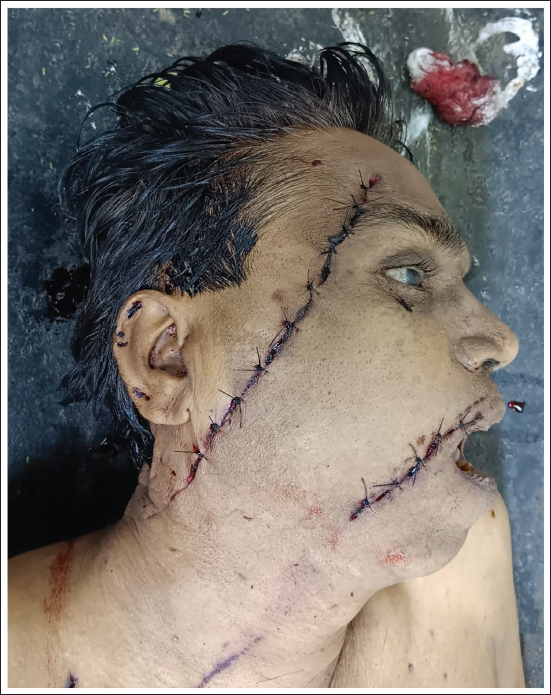
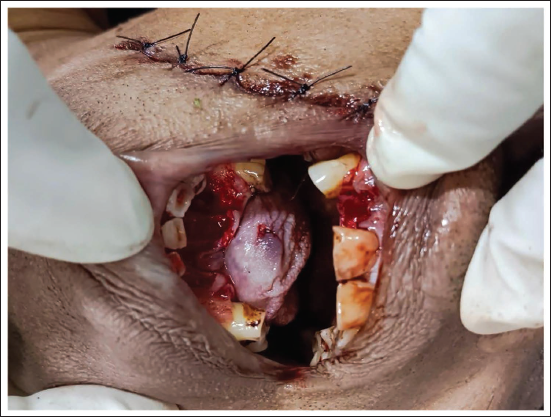
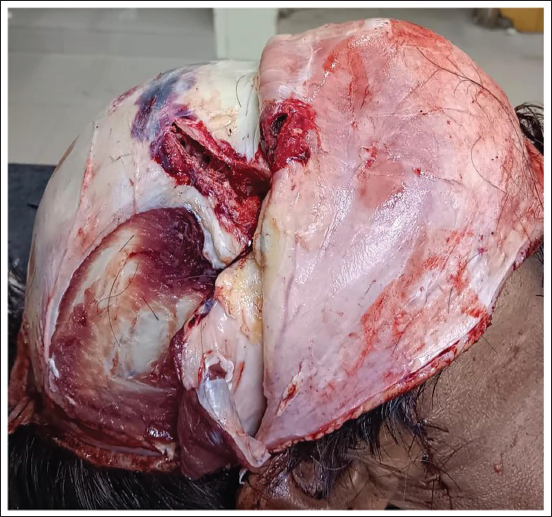
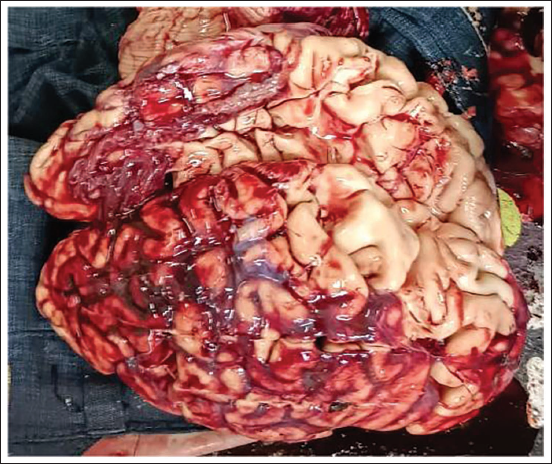
A 40-year-old mechanic suffered fatal injuries while working at a tire service facility. He left the retreading machine door open during truck tire maintenance and inflation. Due to improper locking, the metal rim separated from the tire under high-pressure and was propelled as a missile, striking the right side of his head and face from about six feet away. The impact caused him to fall, hitting the back of his head. He was hospitalized, unconscious, and died five hours later. The autopsy revealed a 5 cm stitched wound on the lower right face, 0.8 cm lateral to the right angle of the mouth (Figure 1). On suture removal, the wound margins were irregular and contused. The underlying mandible and teeth of both jaws were fractured (Figure 2). Another 18 cm stitched wound was present obliquely across the right neck, face, and forehead, starting 1 cm below the mandibular angle, crossing the lateral end of the right eyebrow, and ending 1 cm above it (Figure 1). A linear skull fracture of length 6 cm was found in the upper part of this injury at the right frontal bone and extended to the left parietal region. A lacerated wound was seen over the right frontoparietal region of the scalp with an underlying depressed fracture of dimension 08 cm x 02 cm (Figure 3). Subarachnoid hemorrhage was found over the right frontal, right parietal, and both occipital regions; subdural hemorrhage was seen over the right occipital region of the brain (Figure 4). Craniocerebral damage because of blunt force trauma to the head and face regions was opined as the cause of death.
Two Linear Stitched Wounds on the Right Side of the Face Were Caused by the Impact of the Metal Rim’s Edge (Blue Arrow).
Broken Teeth in Both Upper and Lower Jaws (Blue Arrow).
Depressed Skull Fracture with Scalp Laceration Resulting from a Fall onto the Edge of Another Metal Disk at the Tire Service Station (Blue Arrow).
Subarachnoid Hemorrhage Over the Right Frontal, Right Parietal, and Both Occipital Lobes of the Brain, Along with Patches of Subdural Hemorrhage Over the Right Occipital Lobe (Blue Arrow).
Discussion
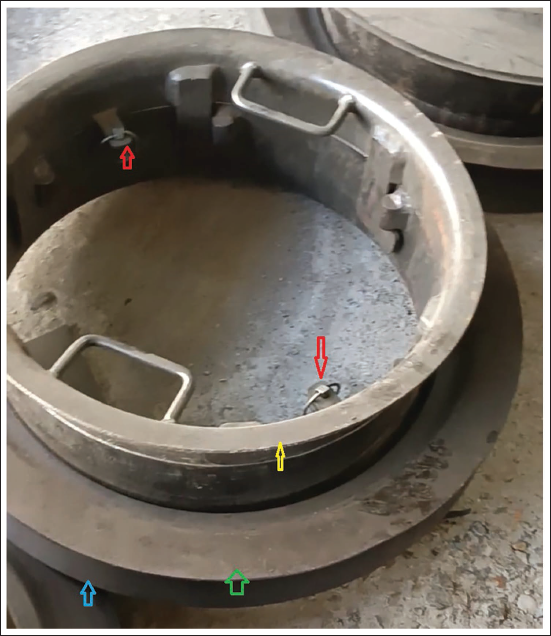
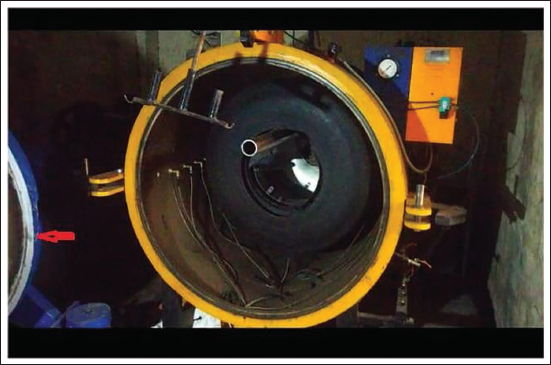
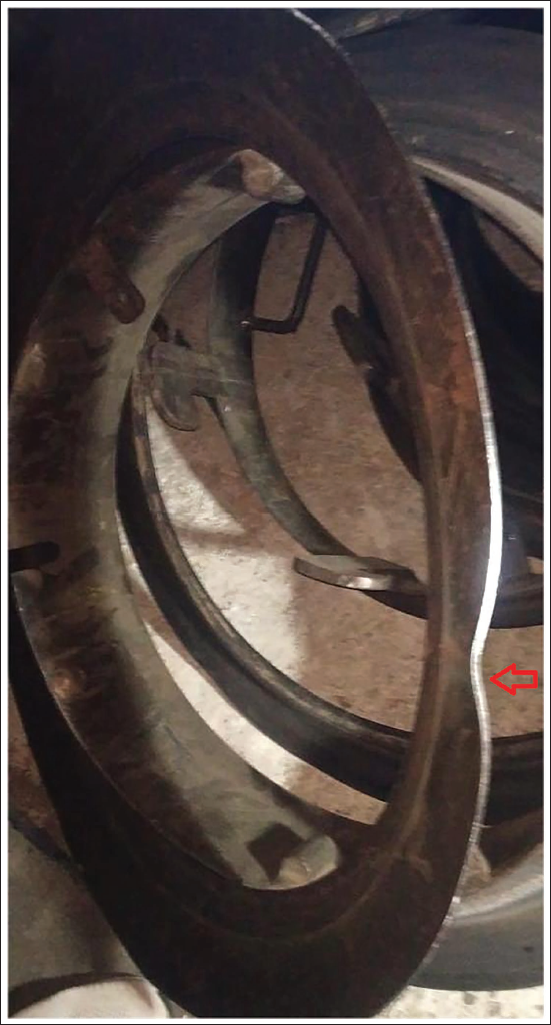
Tire remolding, or retreading, replaces worn tread with a new one, offering a cost-effective and sustainable alternative to new tires. The process involves placing an old tire on a metal disk with outer and inner parts secured by two locks (Figure 5). Metal rims (Figure 5) will be placed over both sides of the tire over the metal disk, and these rims will be kept in place due to the properly fitted and locked metal disk. After that, the tire is placed in the remolding machine (Figure 6). During air inflation, the rising tire pressure pushes the metal rims outward, but the secured disk locks prevent displacement. A truck tire explosion at 90 psi releases 63,000 ft-lb of energy—enough to lift a 3,000 lb car 21 feet, with an estimated force of 2000 g. 5 During inflation, high tyre pressure caused the sudden release of improperly secured metal locks, propelling the outer rim as a missile. The mechanic, standing and bending forward in front of the open remolding machine, was struck. A deformed metal rim was found at the scene due to the impact. (Figure 7). All machines may be installed in strict accordance with the standards of the Occupational Safety and Health Administration, the Bureau of Indian Standard Act, 2016, and the Occupational Safety, Health, and Working Conditions Code, 2020.6, 7
Metal Disk Used to Support the Tire During Inflation, Along with Both Metal Rims that Encase the Tire. Blue Arrows Indicate the Outer and Inner Metallic Rims; Yellow Arrows Point to the Metal Disk; Red Arrows Highlight the Metal Locks Securing the Metallic Disk Components Together.
Remolding Machine with an Open Door. The Red Arrow Indicates the Door Component.
Deformed Metallic Rim that Struck the Deceased’s Face. The Red Arrow Marks the Deformed Portion of the Rim.
The metal rim first struck obliquely near the right angle of the mouth, causing a fracture, broken teeth, and a laceration. Due to the facial contour, the rim’s movement led to a second impact on the right face and forehead, causing another fracture and laceration. The high-impact strike caused the mechanic to fall onto another metal disk, resulting in secondary injuries, including a laceration and depressed fracture. Both facial lacerations were linear, consistent with a high-velocity impact from the metal rim. Pneumatically induced injuries from tire inflation are rare. 8 Most reported cases involve tire/tube explosions, but this case is unique as no explosion occurred. Instead, improper disk locking and an open remolding machine door led to a fatal injury.
Interesting Facts About the Manuscript
It is the unique case in which a metal rim acted as a missile during mechanical air inflation without the explosion of a tire/tube. No similar case has been found even after extensive searches using various search engines, including PubMed, Google Scholar, and ResearchGate.
The deceased was working on another tire at approximately six feet distance at the time of impact; this fact is also unique about this case.
Secondary injuries due to the fall of the deceased over the edge of another metal disk kept at a tire service station caused a depressed fracture corresponding to the edge of the disk.
The mechanic in this case failed to lock the disk properly and left the remolding machine’s gate open after placing the tire. These facts highlight a number of risk concerns at the tire servicing station that could have dangerous repercussions.
Conclusion
Tire inflation carries significant occupational risks, including explosions due to overpressure or hidden structural flaws in the tire. Improper disc locking mechanisms can also result in fatal injuries. Ensuring that the remolding machine’s door is securely locked during the inflation process is critical for worker safety. This case highlights the occupational hazards faced in tire service centers and emphasizes the importance of strict safety protocols, including the installation of certified standard machines, adherence to manufacturer guidelines, and regular daily inspection and maintenance of equipment.
Footnotes
Author’s Contribution
All authors have contributed to this manuscript.
Availability of Data and Material
Data sharing is not applicable.
Consent for Publication
The authors declare their consent for publication.
Declaration of Conflicting Interests
The authors declared no potential conflicts of interest with respect to the research, authorship, and/or publication of this article.
Ethical Approval and Informed Consent
Not applicable, informed written consent obtained.
Funding
The authors received no financial support for the research, authorship, and/or publication of this article.
