




Abstract
Gender-based violence is recognized as a major public health concern and an intolerable violation of human rights. Unnatural death refers to fatalities from external causes, including intentional injury such as homicide or suicide, and accidental deaths. This study examined unnatural and non-accidental deaths among females of all age groups to suggest measures for reducing mortality and morbidity. Between September 1, 2018, and August 31, 2020, in the Department of Forensic Medicine, MKCG Medical College, Berhampur, Ganjam, 259 cases meeting inclusion criteria were analyzed using MS Excel and SPSS version 22. The highest deaths occurred in females aged 20–39, comprising 52% of cases. Suicide was predominant, accounting for 89.2%, while homicide was 10.8%. Most homicides resulted from mechanical injuries by assault (85.7%), with sharp-cutting weapons causing 50% and blunt weapons 30%. Poisoning was the most frequent suicide method at 67.5%. Family disputes accounted for 60.6% of underlying reasons for suicide or homicide, followed by love affairs at 34.4%. Illiterate and undereducated females were more vulnerable due to lack of rights awareness, whereas qualified women showed the least incidence. Marital disharmony, family disputes, and dowry demands remained major causes of unnatural deaths among women.
Introduction
The term “unnatural death” refers to death brought on by outside factors, such as intentional injury—like murder or suicide—or accidental injury and death. Any death that results from a deliberate act and has a purpose is considered intentional. 1 It is now acknowledged that gender-based violence is a serious public health issue and an unacceptable human rights violation. Because of the dominant values, norms, and customs of many societies, as well as personal shame, guilt, fear of retribution, and the social taboo associated with victimization, the majority of abuse and torture go unreported to neighbors, family members, clinicians, and researchers.
The relationships between spouses and family members, social standing, health, education, and financial independence—all of which are critical to a woman’s or any person’s well-being in the modern world—are the factors that influence unnatural deaths in women. As per NCRB data 2018, the number of suicides all over India in 2017 was 129,887, and in 2018, the number was 134,516, with a percentage increase of 3.6%. The data in Odisha in 2017 is 4,493, and in 2018 is 4,592, with a percentage increase of 2.2%. The purpose of the study was to identify various factors that contribute to unnatural and non-accidental deaths in females of all ages and to recommend appropriate actions to lower the mortality and morbidity rates among the same.
Objectives
To estimate the incidence of homicidal and suicidal deaths in females in this part of the state, so that it will be beneficial to develop preventive strategies to reduce the incidence in the future.
To know epidemiological aspects like age, marital status, literacy, occupation, cause of death, perpetrating factors, etc.
To study the means of fatal injuries in homicidal and suicidal deaths in females.
Methods and Materials
It is a prospective study conducted among the female victims of homicide and suicide of all age groups in the Department of Forensic Medicine, MKCG Medical College, Berhampur, Ganjam, from September 1st, 2018 to August 31, 2020, after approval by the Institutional Ethical Committee. The detailed history of the incident and the circumstances related to the incident were taken from the friends and relatives and the police in a predesigned proforma. Other details like history, family history, behavioral history, and psychological history were also taken in the predesigned proforma. The inclusion criteria consist of all female dead bodies of all age groups brought for autopsy with a history of homicide and/or suicide. All proven accidental death cases, natural death cases, and cases of obscure autopsy were excluded from the study. A total of 259 cases that met the various inclusion and exclusion criteria were included in the study out of a total 2649 numbers of autopsies conducted in the department during the study period. The data collected was entered into MS Excel, and the data was analyzed using SPSS version 22.
Result
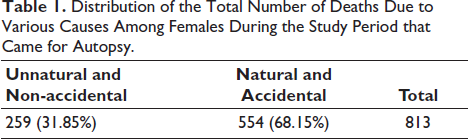
In Table 1, out of the total 813 female dead bodies brought for autopsy during the study period, 259 were due to unnatural/non-accidental causes, constituting 31.85% of the total. The remaining 68.15% were due to natural/accidental causes.
Distribution of the Total Number of Deaths Due to Various Causes Among Females During the Study Period that Came for Autopsy.
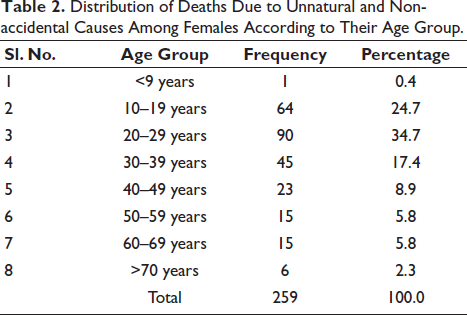
From Table 2, the highest percentages (34.7%) of deaths were found in the age group of 20–29, followed by 10–19 (24.7%). The mean age of cases was 30.343 ± 14.69 years. The range was between 9 and 76 years. The incidence of deaths due to unnatural and non-accidental causes decreases with advancing age beyond the fourth decade.
Distribution of Deaths Due to Unnatural and Non-accidental Causes Among Females According to Their Age Group.
Distribution of Death Due to Unnatural and Non-accidental Causes Among Females According to Marital Status.
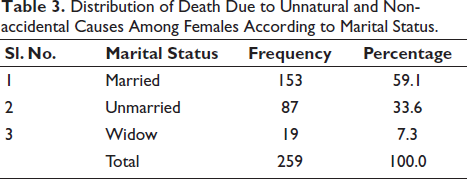
The highest (59.1%) number of cases was found among married ladies, followed by unmarried (33.6%), and widows (7.3%) constituted the least (Table 3).
Distribution of Death Due to Unnatural and Non-accidental Causes Among Females According to Educational Status.
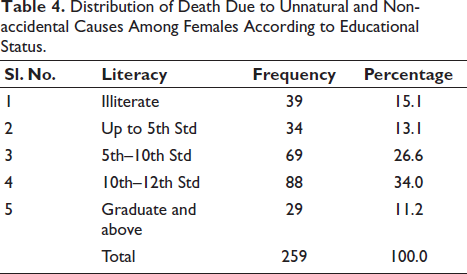
A maximum number (60.6%) of the deceased had an educational qualification between the 5th and 12th standards. A good number of deceased also belonged to the illiterate (15.1%) and graduation and above categories (11.2%) (Table 4).
Distribution of Death Due to Unnatural and Non-accidental Causes Among Females According to Manner of Death.
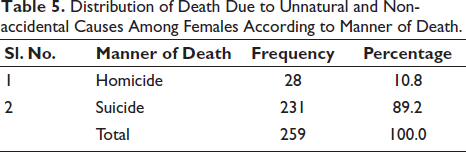
Suicide constituted 89.2% whereas homicide was the manner of death in 10.8% of cases (Table 5).
Distribution of Homicidal Deaths Among Females According to the Method Used.
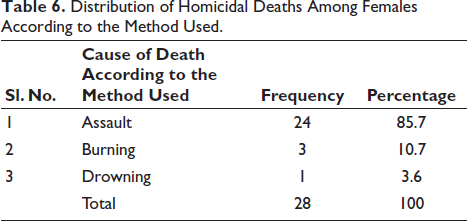
Out of the total 28 homicides, the majority (85.7%) was due to assault, followed by burning (10.7%), and the least common (3.6%) method was drowning (Table 6).
Distribution of Homicidal Deaths Among Females According to Means of Assault.
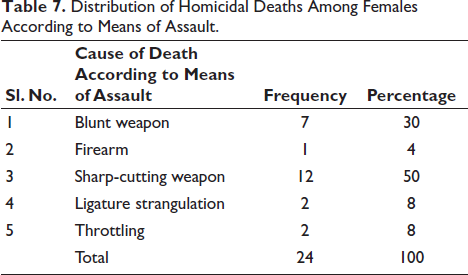
Almost half of the cases (50%) of assault were done by sharp-cutting weapons, followed by blunt weapons (30%). Ligature strangulation and manual strangulation (throttling) were used in 8% of cases each, and only one case (4%) of assault by firearm was found (Table 7).
Distribution of Homicidal Deaths Among Females According to Location of Incident.
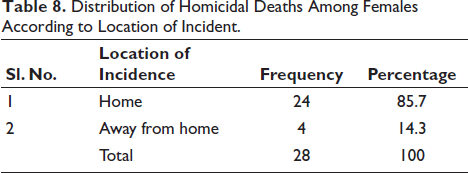
Of the total 28 homicide cases, 85.7% were recorded at home, and only 14.3% of cases occurred away from home (Table 8).
Distribution of Suicidal Deaths Among Females According to the Cause of Death.
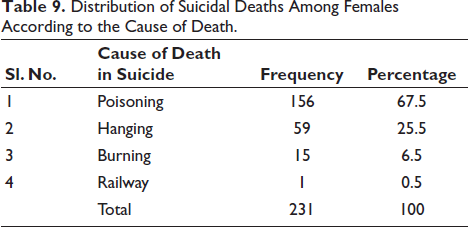
Out of a total 231 numbers of suicide cases, poisoning was responsible for the maximum number (67.5%) of deaths, constituting more than half of the cases, followed by hanging (25.5%). Burning was seen in 15 cases, constituting 6.5% of cases and suicide by railway was observed in one case (0.5%) only (Table 9).
Distribution of Death Due to Unnatural and Non-accidental Causes Among Females According to Alleged Perpetrator/Abettor.
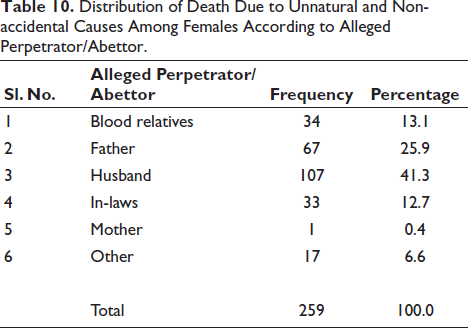
The husband was the alleged perpetrator/abettor in the largest number of cases, constituting 41.3% of total cases, followed by the father (25.9%). The in-laws were responsible in 12.7% of cases, whereas blood relatives were responsible in 13.1% of cases (Table 10).
Distribution of Death Due to Unnatural and Non-accidental Causes Among Females According to the Underlying Reason for Suicide/Homicide.
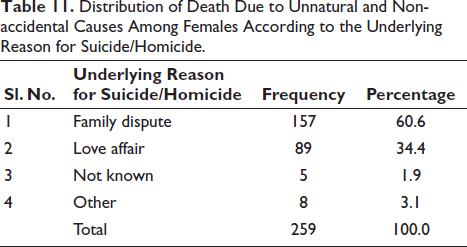
Family disputes were responsible for the highest number (60.6%) of cases, followed by love affairs (34.4%). In 3.1% of cases, other causes than the above two were responsible, whereas in 1.9% of cases, the reason could not be assessed (Table 11).
Discussion
During the study period, among the total of 813 female cases that were subjected to autopsy, 259 deaths were due to unnatural and non-accidental causes and were included for the study purpose. This constituted 31.85% of the total number of female autopsies. The lesser number of deaths among females appears to be due to several factors, such as low sex ratio, predominant confinement of females indoors, and also lesser exposure of females to quarrels, violence, etc.
About 59.1% of the study subjects were married. A total of 33.6% were unmarried, and only 7.3% of the subjects were widows. Kitulwatte et al. 2 also found that most victims, 81% were married. Anitha 3 found in the married group, maximum cases (33.65%) were seen belonging to 0–7 years of married life, whereas three out of four cases of homicide were seen in 0–7 years of married life.
A total of 34.0% of the study subjects had an education of 10th–12th standard, followed by 26.6% of the population with study up to 5th–10th standard. A total of 15.1% were illiterate. Anitha 3 in her study found the maximum number, that is, 43.90% studied High School, followed by intermediate/diploma 21.46% and middle school 19.02%. A study by Hussain et al. 4 showed a maximum number of cases in the illiterate group. From the study, it is evident that the highest number of deaths occurred between 20 and 39 years of age, accounting for about 52% of the total caseload. This is very critical, as this is the age that is among the most productive groups. Also, it was found that several incidents, from violence to suicides, are common in this age group.
Suicide was the most common manner of death, which was observed and amounted to 89.2% followed by homicide, which amounted to only 10.8%. Similar findings were also noted in studies by Srivastava et al. 5 and Radhika et al. 6 The increased incidence of suicide among females is due to depression as a result of domestic violence, marital disharmony, dominance by the male members of the family, reluctance of parents to allow for higher study, failure in love affairs, etc. The predominant means of death in suicidal cases was poisoning (67.5%), followed by hanging (25.5%). Burning was found in 6.5% of cases, and only one case (0.5%) of suicide by railway was found. Family dispute (60.6%) was the most common underlying reason for both suicide and homicide. It was followed by love affairs (34.4%). The reasons were unknown for 1.9% of cases.
The most common (85.7%) cause of death in homicide cases was found to be assault, followed by burning in 10.7% of cases, and only one case (3.6%) of homicidal drowning was encountered during the study period. Considering the methods of assault, almost half of the cases (50%) of assault were caused by sharp-cutting weapons, followed by blunt weapons (30%). Ligature strangulation and manual strangulation (throttling) were used in 8% of cases each, and only one case (4%) of assault by firearm was found. Similar findings were observed in the study by Kitulwatte et al., 2 where sharp injuries accounted for the majority of murders (39%). Kiran Kumar Patnaik et al., 7 observed that strangulation or smothering, amounting to 48.5% of cases, was the most common cause of homicidal deaths in women of reproductive age, and 30.9% of cases of burns were next on the list. Other (firearm, blast, sharp-cutting injuries, stab injuries) causes were encountered in 13.2% of cases and poisoning, at least, that is, 7.3% number of homicides.
The husband was the alleged perpetrator/abettor in the highest percentage (41.3%) of the cases; followed by the father (25.9%), other blood relatives (13.1%), and in-laws 12.7%. In 6.6% of cases, the perpetrator/abettor was not known. Kitulwatte et al. 2 found similar data, constituting that the alleged perpetrator in 30.5% of homicides was the husband, while a similar percentage was inflicted by a known person to the victim. Rajesh Kumar Verma et al., 8 also found that quarrels with husband/in-laws and dowry demands by a husband or his family members were two important reasons behind suicidal as well as homicidal deaths. Home was the most common location of the incident for both suicide and homicide. 96% of suicides and 85.7% of homicides took place inside the home. Only 4% of suicides and 14.3% of homicides were reported from somewhere other than home. Kitulwatte et al., 2 also found similar data, constituting most of the suicides (84%) as well as homicides (76%) taking place at home. Mohanty et al. 9 also observed that the majority of victims (84.6%) were killed in their homes. This is so because female persons usually stay inside the home the whole day and are engaged in household work only. Only a small fraction is employed in some office or business, so they have to go outside.
Conclusion
Out of the total 813 females that came for autopsy during the study period, 259 were due to unnatural/non-accidental causes, constituting 31.85% of the total.
Of the 259 cases included in the study, the mean age of cases was 30.3 43 ± 14.69.
The highest (34.7%) number of deaths was found in the age group of 20–29, followed by 10–19 years (24.7%). 59.1% of the study subjects were married, and a total of 34.0% of the study subjects had education up to 10th–12th standard. Most of them were married and housewives, 59.1%. The majority resided in joint families (56%). Suicide was the most common manner of death, 89.2%. The most common means of homicide was assault, inflicting mechanical injuries at 85.7%. Half of the cases (50%) of assaults were caused by sharp-cutting weapons, followed by blunt weapons (30%). The most common means of suicide was poisoning, 67.5% followed by hanging, 25.5%. 44% of the cases occurred in the late hours of the day, that is, after 12 noon to 8:00
Suggestions
The following are the steps that can be taken at various levels to prevent unnatural death in females.
Suicide is a social problem that is preventable by boosting confidence and courage.
Creating awareness about dedicated suicide helplines for women in distress. Giving ample freedom to the other spouse.
Discouraging dowry demands and costly and ostentatious marriage rituals through education.
Counseling to deal with love failure, exam stress, and inter-familial disputes are reasons for a handful of cases.
Pre-employment counseling among working couples to beat stress and work-related issues and to promote a healthy work-life.
Education about stress management for women, such as meditation, exercise, yoga, counseling, and group therapy, to help beat stress and depression.
Proper assessment of the symptoms and prompt treatment for women suffering from physical illness and mood disorders.
Promoting literacy and professional courses and encouraging employment among girls to make them economically independent at the time of marriage.
By addressing these issues related to women and by implementing the preventive measures suggested, unnatural deaths in women of reproductive age can be reduced, thereby helping in the progression of society, community, state, and the Nation.
Footnotes
Declaration of Conflicting Interests
The authors declared no potential conflicts of interest with respect to the research, authorship, and/or publication of this article.
Ethical Approval
This study was approved by the Institutional Ethical Committee, MKCG MCH, Berhampur (approval no. 691).
Funding
The authors received no financial support for the research, authorship and/or publication of this article.
Informed Consent
Consent was not required as the data was collected about the dead persons and in medico-legal cases only, without exposing the identity of the deceased.
