




Abstract
The authors present an unusual death of a 21-year-old female with an alleged history of firearm injury. On autopsy, a firearm entry wound was present over the lateral aspect of the left side of chest, and margins were found to bevel inside. Abrasion collar situated over superolateral aspect of wound. On its course, the bullet pierces the skin, muscles and ricochets off the underlying structures found at the back of the body. Margins of the exit wound were found to be beveled outside. Another stellate-shaped firearm entry wound with flame effects present over the right side of the face situated lateral to lateral canthus of right eye. Direction of wound found going downward medially and underneath temporal bone, which was found fractured with one associated radiated fracture, which was found running backward posteriorly and placed horizontally. The track of the bullet was found bright red and discolored, and the bullet was found embedded in the left occipital region of scalp. Two hard blackish abrasions due to heat effects and rubbing of bullet are present over right maxillary region of face. Tattooing of the skin was seen over the medial aspect of abrasion. The injuries seen over the body indicate close-range firearm discharge.
Introduction
Gunshot wounds are violent, complex, and traumatic injuries that are frequently seen in forensic investigations. Such injuries result from the penetration of the body by projectiles expelled from the barrel following the ignition of gunpowder. 1 In addition to the projectile and the resultant wound, the forensic pathologist must also consider the accompanying effects of flame, gases, smoke, unburnt powder, metallic residues, and barrel grease, which may be deposited on the surrounding skin or within the wound track. 2 Gunshot entry wounds are broadly classified as close-range, comprising contact, near-contact, and intermediate-range injuries, or as those without features of close-range discharge. The term ‘distant’ shot merely denotes the absence of close-range characteristics, which may occur when the firearm is discharged beyond the effective range of soot and powder deposition or when an intermediate object, such as clothing or other barriers, lies between the muzzle and the body. 3 This case is reported for its distinctive demonstration of close-range firearm injury patterns, which provide valuable insight into their forensic interpretation and medico-legal importance.
Case History
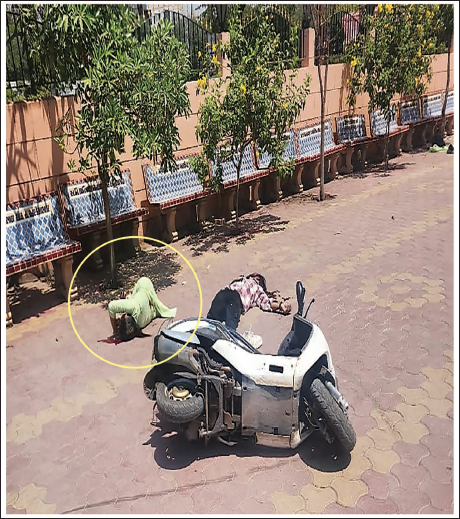
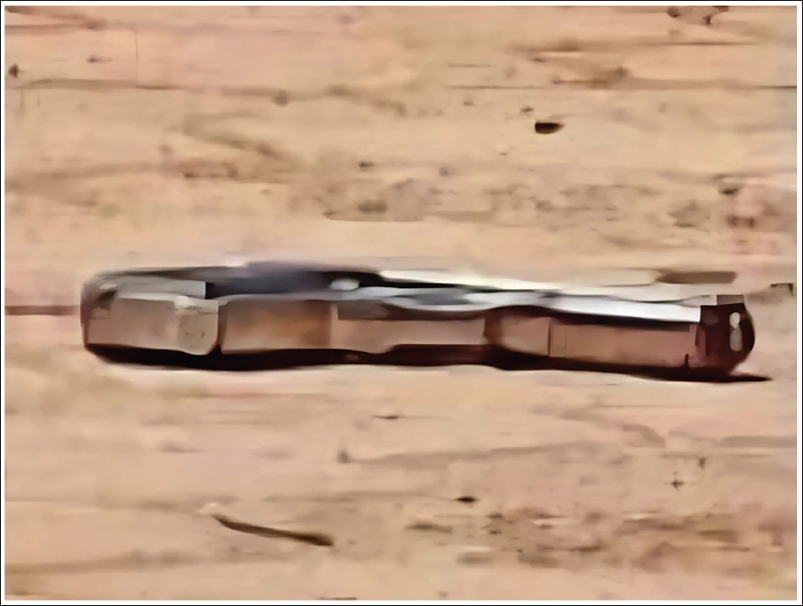
On April 4, 2024, a 21-year-old female was brought to the mortuary of our institute with an alleged history of death due to a firearm injury. On further inquiry from the investigating officers, it was revealed that the present case constituted a dyadic death. The victim, along with his companion, was intentionally killed by another acquaintance (Figure 1). Following the incident, the perpetrator committed suicide at a location in close proximity to the crime scene, where the alleged firearm was recovered (Figure 2). The sequence of events and the relationship between the individuals involved were established through police investigation and corroborated by eyewitness accounts.
Crime Scene Showing the Position of the Deceased (Encircled in Yellow).
Alleged Firearm Recovered from the Crime Scene.
Observation
Wearing one kurti, one salwar, one bra with strip and one strip-less bra. Salwar found torn over left side, below knee at anterior aspect, situated 25.0 cm above the lower end. Blood stains are present on clothes in places. Clothing found torn over the left axillary region, along with a blackish burn margin over the clothing surface, along with effusion of blood associated with the existing firearm injury. Dry clotted blood present over both nostrils, face smudged with dry clotted blood. Hairs were smudged with blood and in clotted form. Blood coming out of right ear.
Firearm Injuries
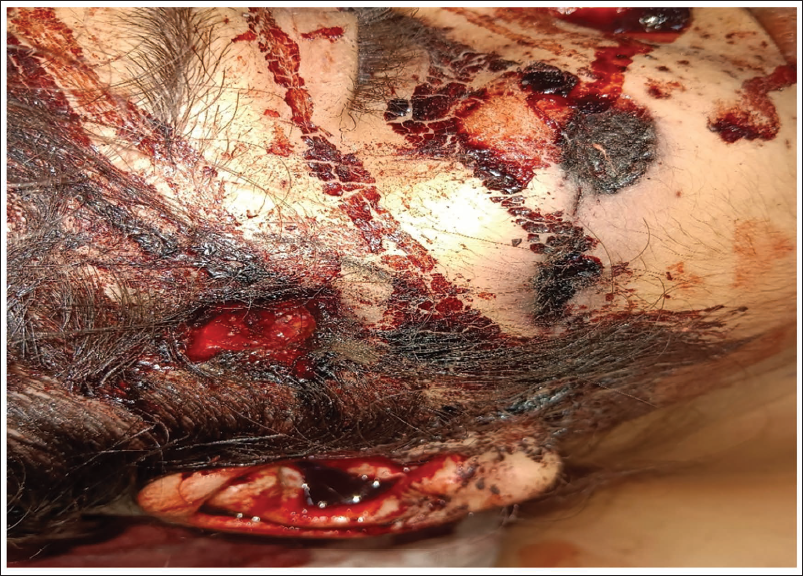
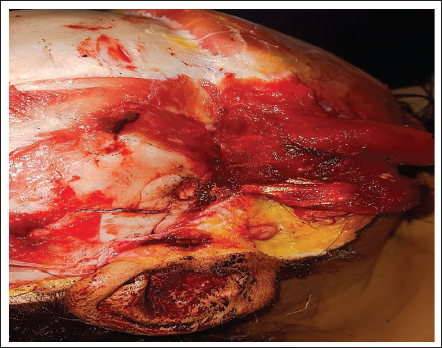
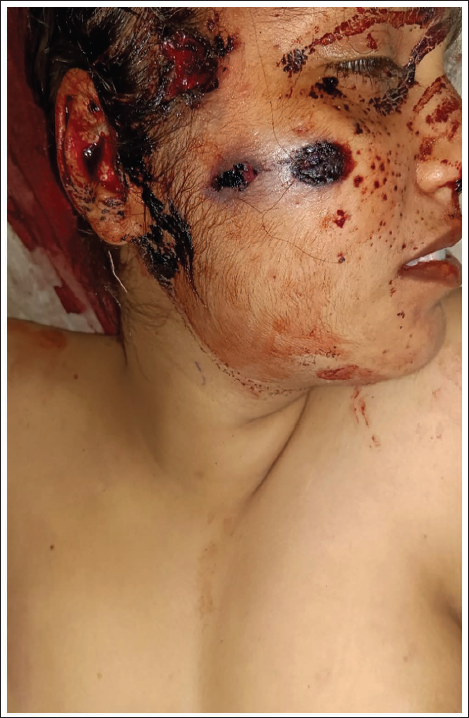
Firearm entry wound of size 2.1 × 2.0 cm, stellate-shaped present over right side of face, situated 3.6 cm right lateral to lateral canthus of right eye, and margins found beveling inside (Figure 3). The direction of wound was found going downward medially and underneath temporal bone, which was found fractured with one associated radiating linear fracture, which was found running backward posteriorly and placed horizontally (Figure 4). The track of the bullet was found bright red, discolored, creating an exit wound over left occipital bone, and the bullet was found embedded between scalp and skull bone. Subdural and subarachnoid hemorrhages were present throughout the brain and cerebellum at multiple sites. The recovered bullet, which was measured to be 1.1 cm in length, has been preserved for further examination.
Blackish burn abrasion 02 in number horizontally placed with a distance of 1.3 cm apart, present over right side of face over maxillary region situated 2.3 cm below the lateral canthus of right eye. The first abrasion was measured 2.6 × 1.2 cm in size, and second abrasion was measured 1.8 × 0.7 cm in size. Firearm tattooing in an area of 5.0 × 3.7 cm in size, varying from pinpoint to 0.3 cm, circular in shape, present over right side of face, situated between first abrasion wound and right ala of nose. Margins of abrasion wounds are found slightly hard and elevated, which appears to be due to rubbing of bullet over the skin. The direction of bullet in the above-mentioned abrasion wounds is from left to right (Figure 5).
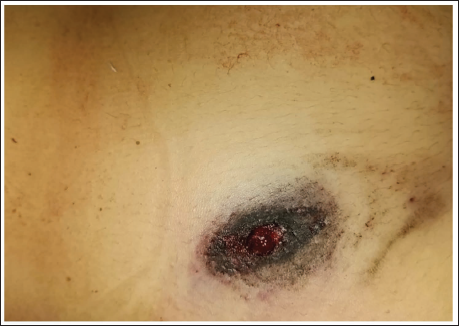
A firearm entry wound measuring 0.7 × 0.7 cm, with a 0.2 cm abrasion collar at its superolateral margin, was present over the lateral aspect of the left chest, 124.1 cm above the left heel (Figure 6). The wound exhibited internal beveling consistent with an entry wound. The bullet traveled downward from left to right, passing through the 8th–9th intercostal space, fracturing the upper border of the 9th rib, perforating the left lower lobe of the lung, and then the diaphragm and spleen. Along its trajectory, the bullet coursed medially and inferiorly, striking the left posterolateral border of the 5th lumbar vertebra, perforating it, and exiting from the right posterolateral margin of the 5th lumbar vertebra. The exit wound measured 0.6 × 0.5 cm, with outward beveling, located 104.0 cm above the right heel, 4.1 cm lateral to the midline, and 36.7 cm inferolateral to the nape of the neck. Along the bullet track, muscles, soft tissues, and internal organs exhibited ecchymosis and blood effusion.
Stellate-shaped Firearm Entry Wound Over Right Side of Face.
Fracture of the Right Temporal Bone with Associated Radiating Linear Fracture.
Blackish Burn Abrasions and Firearm Tattooing Over Right Side of Face.
Firearm Entry Wound Over Lateral Aspect of Left Side of Chest.
Internal Examination
The thoracic cavity contained approximately 800 ml of blood. The heart was found empty. About 1.0 L of blood was present in the abdominal cavity, and the spleen was noted to be ruptured. The stomach was empty, and the gastric mucosa appeared pale. In the cut section, all internal organs appeared pale. The trachea was empty, and the uterus was also empty on a cut section.
Discussion
The presence of seared, blackened edges along with red discoloration of the track of the bullet and stellate-shaped wound is suggestive of a hard-contact wound. In hard-contact firearm wounds, the muzzle is firmly pressed against the skin, producing an indentation and allowing the surrounding skin to envelope the muzzle. The margins of the entry wound are typically seared by hot combustion gases and blackened by soot, which becomes embedded within the seared tissue and cannot be removed by washing or scrubbing. When contact wounds occur overlying bony prominences, they often assume a stellate configuration. This pattern results from the propellant gases striking the underlying bone, reflecting into the subcutaneous tissues, and causing a sudden expansion that produces explosive tearing and laceration of the overlying skin and soft tissue. These findings are consistent with those reported in the textbooks authored by Dimaio VJM and Molina DK, 3 Aggrawal A, 4 Reddy KSN and Murty OP, 5 and Bardale R. 6 These findings are also consistent with research work done by other researchers like Shrestha R et al. 2
The presence of flame effects, along with the presence of soot, which is baked into the skin, resulted in tattooing are suggestive of a near-contact wound. In near-contact firearm wounds, the muzzle is held a short distance from the skin without being pressed against it. At this proximity, the powder grains expelled from the muzzle do not have sufficient distance to disperse and instead become deposited in a concentrated manner around the entry site. Such residues are often grossly visible within the subcutaneous tissue and may extend into deeper structures. These features are of considerable medico-legal importance, as they assist in estimating the firing distance and differentiating near-contact injuries from hard-contact and distant gunshot wounds. These findings are consistent with those reported in the textbooks authored by Dimaio VJM and Molina DK, 3 Aggrawal A, 4 Reddy KSN and Murty OP. 5 These findings are also consistent with research work done by other researchers like Shrestha R et al. 2
The presence of the majority of the seared, blackened zone in the downward direction suggests it is an angled contact wound. When the barrel is held at an acute angle to the skin, the muzzle does not make complete circumferential contact. The escaping gases and soot radiate outward through the gap, creating an eccentrically distributed soot pattern. The entrance wound is typically situated at the base of the seared blackened zone, with the bulk of the zone lying opposite to the point of muzzle contact, thereby indicating the direction of fire. These findings are consistent with those reported in the textbooks authored by Aggrawal A. 4
Based on the external and internal examination, the cause of death in the present case was attributed to shock and hemorrhage resulting from firearm injuries. The circumstances and wound characteristics were consistent with a homicidal manner of death. The post-mortem findings further suggested that the survival period was less than 24 hours prior to examination.
Conclusion
Illegal firearms pose a significant public health and forensic concern. Our analysis of close-range firearm injuries demonstrates that increased availability of illicit weapons contributes to a higher incidence of gunshot fatalities. This case report will aid in the estimation of firing range based on injury patterns, providing valuable guidance for law enforcement agencies during investigations. Effective reduction of homicidal deaths requires dismantling illegal firearm manufacturing and trafficking operations, alongside vigilant and coordinated efforts by law enforcement. Continued monitoring and analysis of firearm injury patterns are essential to inform preventive strategies and medico-legal interventions.
Authors’ Contributions
All authors have contributed to this manuscript.
Availability of Data and Materials
Data sharing is not applicable.
Footnotes
Declaration of Conflicting Interests
The authors declared no potential conflicts of interest with respect to the research, authorship, and/or publication of this article.
Ethical Approval
Not applicable as a Medico-legal autopsy does not require consent.
Funding
The authors received no financial support for the research, authorship, and/or publication of this article.
Informed Consent
Authors declare consent for publication.
