




Abstract
Electricity, while indispensable in modern society, poses significant risks, with electrical burns resulting in considerable morbidity and mortality, often preventable through basic safety measures. This study investigates the epidemiology of electrical fatalities in Goa, India, spanning from 2021 to 2023. Out of 3,627 autopsies conducted during this period, 37 cases were identified as deaths resulting from electrocution. Detailed analyses revealed insights into the prevalence, demographics, primary contact sites, and seasonal variations of electrocution incidents. The majority of fatalities occurred in the 21–30 age group, primarily due to occupational hazards. Histopathological examinations provided crucial diagnostic clues in confirming electrocution-related injuries. Understanding these patterns can aid in the development of targeted interventions to mitigate risks and enhance safety measures, thus potentially reducing the incidence of accidental electrocutions.
Keywords
Introduction
Electricity plays a crucial role in modern society, yet it also brings about significant risks, with electrical burns leading to substantial morbidity and mortality, often preventable through basic safety measures.1–3 While electricity was initially harnessed for commercial use in 1849, it was not until 1879 that unintentional deaths resulting from its use were officially recorded. 4 Artificial electric current exists in two forms: alternating current (AC) and direct current (DC), with the former posing a higher risk contrary to common belief.4–6 Exposure to significant electric currents can cause skin damage, organ injuries, and even fatalities, with both low and high voltage currents contributing to electrocution deaths, particularly in residential and small industrial settings. In India, the power system operates at AC 220–240 V, 50 A, with the vast majority of electrocution deaths being accidental due to the rarity of electricity-related homicides or suicides.5, 7
India reports three main types of electrical injuries, varying based on the contact site and current strength: contact injuries, burns or injuries from sparks, and flash burns, all stemming from incidents like high-tension cable accidents, electrical short circuits, and malfunctioning equipment.8, 9 Causes of death from electrocution range from ventricular fibrillation to respiratory inhibition and complications such as infections and burns, necessitating medicolegal autopsies for all electric shock fatalities.5, 10
Despite being preventable, electrical deaths remain a persistent issue. This study delves into the epidemiology of electrical fatalities in Goa, India, spanning from 2021 to 2023. It sheds light on the prevalence of accidental electrocutions in both occupational and domestic settings, identifies potential risk factors for fatal incidents, and proposes strategies for implementing effective safety programs to mitigate such risks. The findings of this study hold promise as a valuable resource for researchers, public health officials, and health educators seeking to minimize the occurrence of accidental electrocutions.
Materials & Methods
This study, conducted at the Department of Forensic Medicine & Toxicology of Goa Medical College, examined records spanning three years from January 1, 2021 to December 31, 2023. Out of a total of 3,627 autopsies, 37 cases (1.03%) were identified as deaths resulting from electrocution. All cases underwent thorough medicolegal postmortem examinations at the Goa Medical College Mortuary. Detailed autopsies were conducted for each case, utilizing police inquest reports, hospital records, and case files to collect data including the deceased’s age, gender, date and location of death, occupation, medical treatment received, cause and manner of death, and histopathological findings. This information was then compiled, tabulated, and systematically analyzed.
Results
Overall, we observed 37 cases (1.02%) of electrocuted victims out of a total of 3,627 medico-legal autopsies between January 1, 2021 and December 31, 2023. The majority of cases occurred in the year 2021, with 15 cases out of a total of 1,182 autopsies (1.26%), followed by 12 cases out of a total of 1,229 autopsies (0.97%) in 2023, and 10 cases out of a total of 1,216 autopsies (0.82%) in 2022. In total, 37 electrocution deaths occurred between January 2021 and December 2023. These cases represented approximately 1.02% of all autopsy cases received at the mortuary of Goa Medical College.
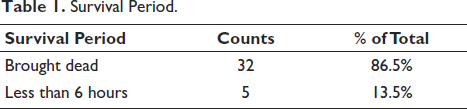
In our study, we observed that all 37 cases of electrocuted deaths were accidental in nature; no suicidal or homicidal cases were found. Out of all cases, 32 (86.5%) were dead on arrival at the hospital, and 5 (13.5%) died within 6 hours during treatment, as represented in Table 1.
Survival Period.
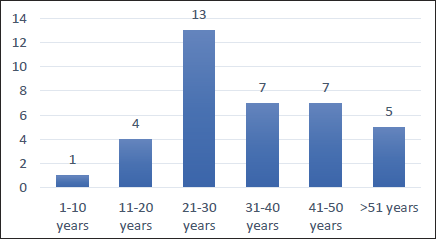
The age range of all electrocution deaths during the study period was 2–61 years. The majority of cases were observed in the age group of 21–30 years, comprising 13 cases (35.1%), followed by 7 cases (18.9%) each from the age groups 31–40 years and 41–50 years, 5 cases (13.5%) from the age group more than 51 years, and 4 cases (10.8%) from the age group 11–20 years. We observed one electrocuted victim from the age group 1–10 years in our study, as represented in Figure 1.
Frequencies of Age.
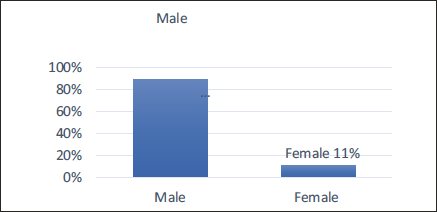
The majority of the victims, 33 cases (89%), were male, followed by 4 cases (11%) of females, as shown in Figure 2.
Age-wise Distribution.
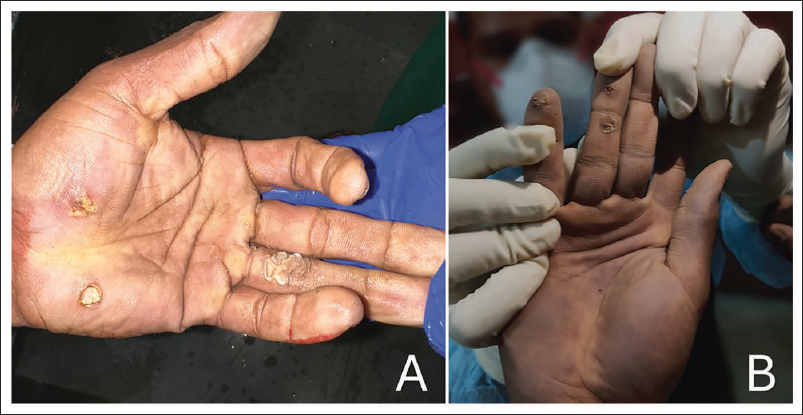
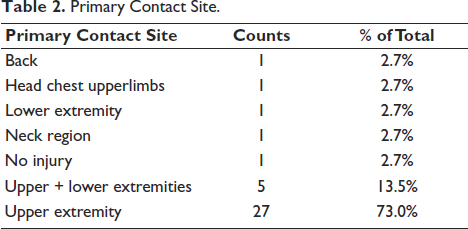
The upper extremity was the most common site involved, observed in 27 deaths (73%) as shown in Figure 3, followed by both the upper and lower extremities together in 5 cases (13.5%) as illustrated in Table 2.
Electrical Lesions on the Left Palm (A-insert), Electric Lesion of the Dorsal Face of the Fourth and Fifth Finger on the RIGHT Hand (B-insert).
Primary Contact Site.
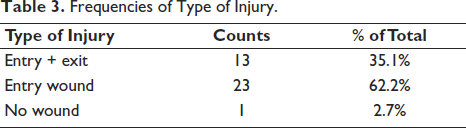
Among the victims, electrical contact marks, also known as entry wounds, were present in 23 cases (62.2%), both electrical contact marks and electrical grounding marks, also known as exit wounds, in 13 cases (35.1%), and no electrical burn marks in 1 case (2.7%), as represented in Table 3.
Frequencies of Type of Injury.
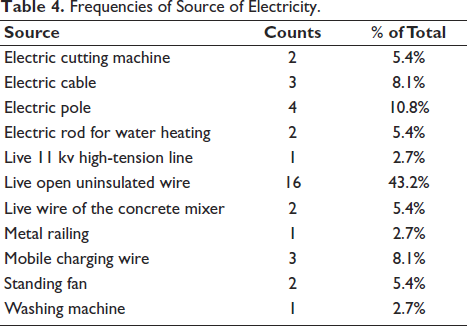
Work-related accidents were responsible for 29 deaths (78.4%), followed by household accidents, 7 (18.9%). Regarding the contact details, deaths were most frequently caused by touching electrical wires (16 cases, 43.2%), followed by electric poles (4 cases, 10.8%), electric cables and mobile charger wires (3 cases, 8.1%), and touching electrical water heaters in the bathroom, live wires of concrete mixture electric cutting machines, and standing fans (2 cases, 5.4%), refrigerator, washing machine, and motor railing (1 case, 2.7%) as represented in Table 4.
Frequencies of Source of Electricity.
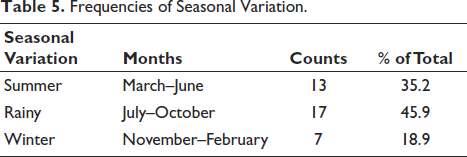
There was an increase in electrocution fatalities in the months of July–October (17 cases, 45.9%) as represented in Table 5.
Frequencies of Seasonal Variation.
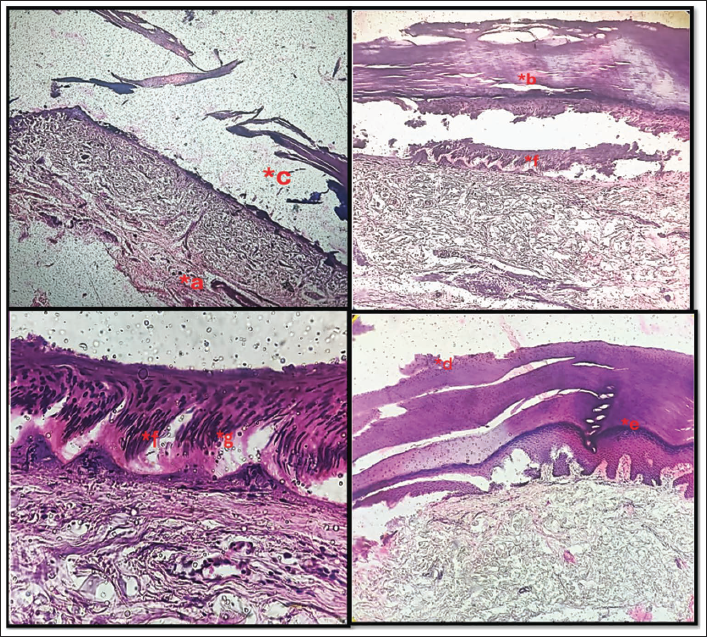
Histological analysis of the skin excised from the entry wound/joule burn site indicated collagen degeneration in the dermis, accompanied by coagulation necrosis, degenerative alterations in the keratin layers, dermo-epidermal separation, hyperkeratosis, microvesicle formation, nuclear streaming, and pyknosis of the nucleus. These observations are indicative of an electrical injury, as shown in Figure 4. Among the 37 cases, the most commonly found histopathological finding was nuclear streaming, followed by dermo-epidermal separation with vacuolation, and coagulative necrosis accompanied by collagen degeneration in the dermis.
Histopathological Findings of Skin Samples. (a) Collagen Degeneration in the Dermis Accompanied by Coagulation Necrosis, (b) Degenerative Alterations in the Keratin Layers, (c) Dermo-epidermal Separation, (d) Hyperkeratosis, (e) Micro Vesicle Formation, (f) Nuclear Streaming, and (g) Pyknosis of the Nucleus.
Discussion
This study investigated fatalities resulting from electrocution between January 1, 2021 and December 31, 2023. We observed 37 cases of electrocuted victims, out of which 33 cases (89%) were male, constituting the majority of the victims. According to data published by the National Crime Records Bureau in 2022, 11 there were 12,971 registered cases of electrocution, with 12,918 fatalities recorded, the majority of which were male. This male predominance may be attributed to men often being the primary breadwinners in families and being involved in occupations related to electricity, construction, painting buildings, etc. Similar findings were noted in studies conducted by Sumangala et al. 12 (2023), Shobhana et al. 13 (2022), as well as Reddy et al. 14 (2015).
The study found that electrocution deaths occurred across a wide age range, from 2 years to 61 years. The death of a 2-year-old resulted from contact with an electric immersion water heater rod. This tragedy could have been avoided with relative ease, at least in theory. Kuhtic et al. 15 (2012) study proposed the idea of improving parental awareness regarding potential dangers and the importance of adjusting their conduct when in the presence of their children.
The majority of fatalities fell within the 21–30 age group. In this age bracket, individuals often begin working to support themselves and their families, often undertaking risky jobs like climbing to elevated areas. This increases the chance of accidental exposure to high-voltage wires and transformers, many workers are unaware of the electrical hazards in their workplaces, heightening their vulnerability to electrocution.
Consequently, the high rate of work-related electrocution fatalities may be attributed to insufficient safety training for both workers and employers. The occurrence of a significant number of fatalities within the third decade of life is also noted in studies done by Sachil Kumar et al. 16 (2014), Akber et al. 4 (2021), and Tirasci et al. 6 (2006).
Most of the fatalities occurred during the rainy season (July–October), followed by summer (March–June). The elevated rate during the rainy season aligns with findings from studies conducted by Kumar et al. 16 (2014), Sachin Giri et al. 7 (2019), and Rautji et al. 8 (2003). Seasonal fluctuations in electrocution-related deaths are attributed to variations in humidity, moisture levels, and individual behavior. The higher incidence of electrocution deaths during summer could be attributed to increased humidity and heightened usage of electrical appliances such as coolers, air conditioners, and refrigerators, Reddy and Sengottuvel 14 (2014). Moreover, excessive sweating during the hot and humid season contributes to a decrease in skin resistance to electric current, thereby increasing the risk of electrocution as described by Spies et al. 17 (2006).
In electrical accidents, skin injuries can vary from mild redness to severe burns affecting deep tissues, including charring. Additionally, in certain situations, there might be no evident signs of electrical injury.
In our research victims with electrical contact marks, also known as entry wounds, were present in 23 cases (62.2%), both electrical contact marks and electrical grounding marks, also known as exit wounds, in 13 cases (35.1%), and no visible alterations were detected on the skin electrical burn marks in 1 case (2.7%). The upper extremities were overwhelmingly the most frequent area (73%) of initial contact with the electrical source. The occurrence of an electric burn mark arises when the skin closely interacts with an electrical conductor, enabling the current to pass through the skin’s high resistance, resulting in tissue heating. Additionally, fluids beneath the skin may produce steam. Conversely, if the contact is less secure and an air gap forms between the conductor and the skin, the current may traverse this space, leading to a lesion caused by sparks (known as a spark lesion). This burn, resembling sparks, is caused by exceptionally high temperatures, leading to the carbonization of the keratin layer, as noted in the present study and also observed in other study conducted by Bellini et al. 18 in 2016, Kuhtic et al. 15 in 2012 and Michiue et al. 19 in 2009.
In this study, among the 37 cases examined, the most frequently observed histopathological finding was nuclear streaming, followed by dermo-epidermal separation with vacuolation, and coagulative necrosis alongside collagen degeneration in the dermis. This study shares similarities with research conducted by Sachin Giri et al. 7 (2019), and Shobhana et al. 13 (2022), who identified nuclear streaming, dermo-epidermal separation, and coagulative necrosis as significant histopathological findings. These findings were instrumental in resolving cases where the exact cause of death was uncertain.
Conclusion
This study underscores the persistent threat posed by accidental electrocutions in both occupational and domestic settings. The majority of fatalities occurred in young adults, highlighting the need for increased awareness and safety training, particularly in high-risk occupations. Histopathological examinations emerged as a valuable tool in diagnosing electrocution-related injuries. Seasonal variations in electrocution incidents underscore the importance of adapting safety measures to environmental factors. Implementing targeted safety programs and promoting awareness among the general public, especially parents and caregivers, are essential steps in reducing the incidence of electrocution fatalities. By addressing these challenges, we can work towards creating safer environments and preventing needless loss of life due to electrical accidents.
Footnotes
Declaration of Conflicting Interests
The authors declared no potential conflicts of interest with respect to the research, authorship, and/or publication of this article.
Ethical Clearance
Ethical clearance was obtained from the Institutional Ethics Committee (Letter No: ECR/83/INST/ GOA/ 2013/RR-20, Reference Code: GMCIEC/2024/07).
Funding
The authors received no financial support for the research, authorship, and/or publication of this article.
Informed Consent
Informed consent was obtained, and participant confidentiality was safeguarded through the encryption of their identities.