




Abstract
Suicide represents a significant cause of mortality in India; however, the estimated suicide rates derived from the national crime records bureau are not dependable. The current suicide rate in India stands at 10.3 per lakh. Over the past 30 years, this rate has risen by 43%, while the male-to-female ratio has remained consistent at 1.4:1. Kota, a renowned coaching hub in India, is experiencing a daily influx of students. These students are arriving from various states, including Uttar Pradesh, Bihar and Madhya Pradesh. The objective of this study is describing the risk factors and different methods adopted for suicide, along with age sociodemographic profile in education city Kota by coaching students. It is a descriptive type of observational study. GMC Kota and attached group of hospitals were used during the study period. Hanging was reported as common methods to commit suicides. Males were more commonly involved (81.5%). National Eligibility cum Entrance Test (NEET) aspirants were involved which was more than 92.59%. Students from Uttar Pradesh were most commonly involved which was 37.03%. There is a notably higher prevalence of stress among male coaching students compared to their female counterparts. Additionally, 17-year-old students are more susceptible to suicidal tendencies, with factors such as academic pressure, financial difficulties, romantic failures and a lack of interest in studies contributing to this issue. Students are resorting to straightforward methods, such as hanging, to commit suicide.
Keywords
Introduction
The Government of India classifies a death as suicide, when it is an unnatural death and the intent to die commenced within the person. Suicide is the major cause of death in the present world. In every country, the ratio suicides are increasing day by day. According to Durham French biologist, suicide is death resulting directly and indirectly from a positive or negative act of the victim himself 1 Suicide is a major socioeconomic and public issue worldwide. 2 Moreover, there is a reason for the person to end his or her life. Those who have previously attempted suicide are at a greater risk of future attempts. The commonly used method of suicide varies between countries, and depends on the availability of effective means. Common methods adopted for suicide include hanging, pesticide poisoning, burns and drowning. Suicide is a worldwide phenomenon, though its rate varies from place to place. Kota is very progressive city for education where coaching students are coming from all over India. As per the details of coaching institutes, up to July 2022 more than 3 lakhs student admitted with dreams of success. Top coaching of Kota managed to admit more than 1.27 lakhs registration which was registered as world record in Guinness Book of World Record. 3 As the number of students increase in Kota, the cases of suicide also increase from the coaching city. This study targets to describe the most common methods adopted and to describe the sociodemographic profile and risk factors that lead to suicide. We can prevent suicide only by finding out the reasons behind it. The reasons may vary from region to region as they face different problems. So, it is necessary to find out the stressors affecting that particular region. To find out such stressors, medicolegal autopsy may have to be followed by psychological autopsy.
Materials and Methods
This study was conducted on the dead bodies brought for postmortem examination at the mortuaries of Government Medical College and allied hospitals during the period of October 2022 to September 2023 with the alleged history of suicides by various methods. A standard Proforma was prepared and the details collected with consent of parents. We collected all data of victim’s history, behaviour, relation with friends, food habits performance in class, attendance and how often they contacted their family, any issue that they share with their parents. The information was gathered in an Excel spreadsheet and extracted our findings. The manner of death was collected from relatives, police and law authorities. Only confirmed cases of suicides from hanging and poison jump from height were included in the descriptive study at GMC Kota and allied hospitals during the study period.
Inclusion Criteria
Study subjects are dead bodies brought for medicolegal autopsy with a history and postmortem finding being consistent with suicide.
Students aged between 15 and 24 years of any of the coaching institute.
Exclusion Criteria
Students who were attached with distant learning programme.
Students who were taking coaching for competitive examination after graduation.
Observation and Results
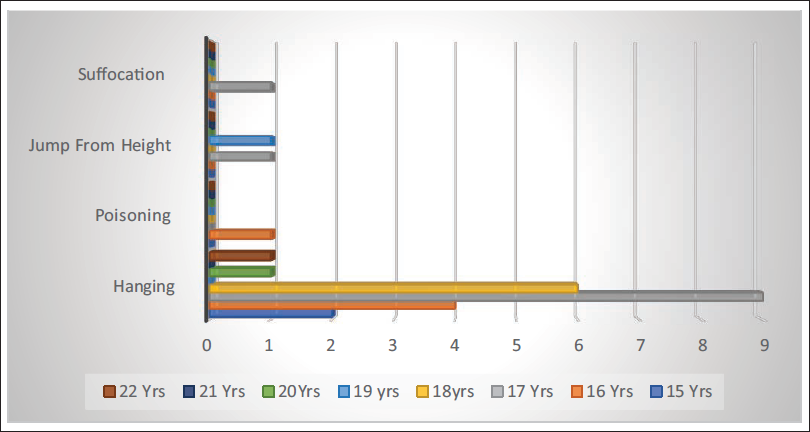
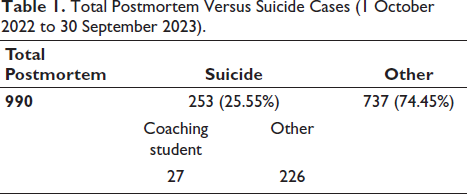
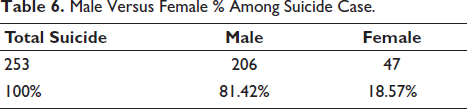
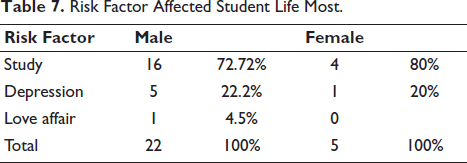
A total of 990 medico-legal autopsies were conducted during the study period, out of which 253 deaths were suicidal and among those cases, and 27 victims were coaching students (Table 1 and Figure 1). Most of the victims of suicide by any form of asphyxiation except suffocation were of 17 years age which was followed by the age 18 years (Table 2 and Figure 2). Total 23 students preferred hanging for suicide which was most common method followed by jump from height 2 (Table 3) 23 out of the 27 hanging deaths, belonged to the 15–25 years age group (Table 2). Out of 27 coaching students death, 22 students belonged to the male sex and 5 students were females. 25 students were preparing for National Eligibility cum Entrance Test Undergraduate (NEET UG) and 2 for Indian Institute of Technology Joint Entrance Examination (IIT JEE) competitive exam (Tables 3 and 4). Out of 27 cases, 10 cases belong to UP followed by 8 cases from Bihar state (Table 5). This research indicates that educational stress was the primary factor leading to suicide in 20 out of 27 cases. It is also observed that out of total suicides 81.42% were male students and rest 18.57% were female (Table 6). This was followed by financial and family issues, which contributed to 6 cases. Additionally, 1 death was attributed to a love affair (Table 7). Academic stress and emotional instability may be the possible reasons for higher involvement in this age group.
Number of Autopsy.
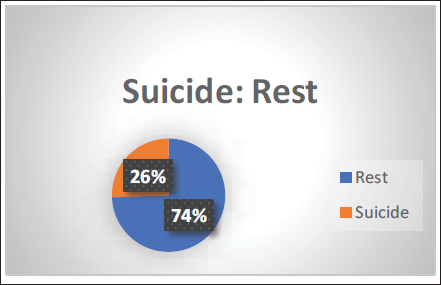
Age-wise Difference in Method Used for Suicide.
Total Postmortem Versus Suicide Cases (1 October 2022 to 30 September 2023).
Age-wise Difference in Method Used for Suicide.

Gender-wise Difference in Method Used for Suicide Deaths.

Course in Which Student Preparing for Exam.

State-wise Student Distribution.

Male Versus Female % Among Suicide Case.
Risk Factor Affected Student Life Most.
Discussion
Kota is the Manchester of coaching centre; lakhs of students come every year for coaching of medical and engineering. The age group of students is usually between 15 and 25. This age group is most vulnerable to depression, loneliness, curious about new things, usage of smartphone which make them vulnerable to harmful sites. Study conducted by Sreedevi et al. observed that hanging was the most common method adopted followed by poisoning, burns and drowning in the study population. Burns were chosen as a preferred method by females, same findings observed by us. 4 Hanging has been found to be the preferred method because fans are available in all rooms and ligature materials such as bedsheet and dupattas are also easily accessible. Males also outnumbered the females in study conducted by Sharija et al. 5 The study conducted by Meera et al. observed that 57.14% used rope as a ligature material 6 ; in our study hanging was the common method for suicide. Behera et al observed in their study that family dispute was he most common cause for suicide, whereas in our study it is academic pressure as our study is conducted on coaching students. 7 Vijayakumari in her study 8 and Sharma et al. 9 observed that most vulnerable age group is 21–30 years, whereas in our study it is 18 year.9, 10 Coaching centers administer weekly assessments and display the results on a notice board. Students who score lower marks are transferred to a different group according to their rankings. Additionally, results are communicated to their parents, which can be quite stressful for the students. There are no physical activities, no one at hostel to take care of them, food quality is also compromised in many hostels. Most of students take admission in dummy school; hence, they do not get any exposure to extracurricular activities such as sports and annual functions and their attendance is managed by the concerned school authorities. Students from same part of state will develop a relation of brotherhood and several students of the develop romantic feelings towards other students resulting in love affairs, which when fail can lead to students taking the drastic step of attempting suicide. All of these conditions make students mentally weak and depressed, hence, leaving them more prone to suicidal tendencies.
Conclusion
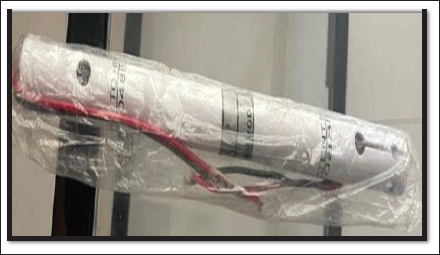
For reducing the incidence of suicide among students, administration must take steps like stopping weekly test or stop coaching management to publish results on notice board, stop changing their batch, make them to organize sports activities other cultural function, appoint local guardians for students, install C.C.TV cameras in hostel campus, regular monitoring of students activities, make groups of students to take care of themselves and make students to take care of each other and motivate each other. Administration should also make hostel owners to install anti-hanging rods in hostel rooms (Figure 3), make a toll-free help line no. for students and publish it publicly. We are happy to inform that after completing the study till January 2024 no coaching committed suicide.
Anti-hanging Device.
Footnotes
Declaration of Conflicting Interests
The authors declared no potential conflicts of interest with respect to the research, authorship and/or publication of this article.
Ethical Approval
The Institutional Ethical Committee has granted the permission for the study.
Funding
The authors received no financial support for the research, authorship and/or publication of this article.
Informed Consent
The informed consent has been collected from the patient’s family.