




Abstract
Delving into the dark realms of sexual violence, this study navigates the intricate web of sociopsychological factors that propel individuals to commit heinous acts. Focused on alleged perpetrators, the research spans two years, dissecting 302 cases of alleged perpetrators. Key findings expose a disconcerting surge in sex offenses, urging a deeper understanding and targeted prevention. Revelations include offenders predominantly aged 21–30 and victims falling within the vulnerable 11–20 age group. Unearthing motives such as invalid consensual intercourse and forcible rape, this study underscores the urgent need for preventative measures. This study’s design involves a meticulous examination of alleged perpetrators, extending beyond conventional boundaries to encompass familial and psychological dimensions. Findings emphasize the intricate dance between offenders and victims, often within known circles. In a bid to curb the rising tide, this study proposes a multifaceted approach, advocating for formal psychoanalysis of accused individuals and addressing root causes. Recognizing the pivotal role of education, employment and awareness, the research calls for societal introspection and proactive measures to reshape attitudes towards female sexuality. This study serves as a clarion call, urging stakeholders to unite in the fight against sexual violence. It illuminates the path toward a safer, more informed society, where shadows are dispelled, and the cycle of aggression is broken.
Introduction
Sexual violence against women, deeply ingrained in human history, reflects the societal value systems shaping its gravity and nature. From ancient times, where women were deemed property, to the present, acknowledging sexual violence as a crime against humanity, the evolution is stark. Today, the reported sexual violence against women is increasing year after year. Contemporary society witnesses a troubling rise in reported sexual violence against women, despite legislative efforts and feminist movements. Sexual violence ranges from unwanted advances to rape, constituting a pervasive and traumatic human rights violation.
Rape, the most common form of sexual violence, is a gendered crime with profound and enduring consequences. 1 It takes various forms and the perpetrators range from strangers to state agencies to intimate partners and members of the family. The term ‘rape’ originates from the Latin word ‘rapio’, signifying ‘to snatch’. Thus, it essentially implies a forceful seizure, which is a defining characteristic of the crime. 2 Rape is the only crime in which the survivor faces more degradation and social unacceptability. It leaves a lifelong stigma on the character and dignity of a woman, causing her and her relatives, the hard pain and agony. The mental torture is so deep that it hardly heals and if at all it heals, it is a long enduring one. Sadly, despite many legal reforms, sexual violence has remained a highly under reported crime with a persistent rising incidence, yet with a very poor conviction rate.
Despite legal reforms, sexual violence remains underreported, impacting survivors’ physical and mental health. Yet, the need of the hour is a multidisciplinary approach of health sector, law enforcement agencies, judiciary and the social welfare organizations like Child Welfare Committee, Central Women Commission, Ministry of Women and Child Development to deal with this critical problem. Comprehending the factors that drive sexual violence perpetration is crucial for the effective prevention of rape. 6 The study aims to unravel sociopsychological factors influencing perpetrators, analyse the perpetrators–survivor relationship dynamics and contribute scientifically informed insights for prevention.
Materials and Methods
The prospective study was conducted at the department of Forensic Medicine & Toxicology, Sri Rama Chandra Bhanja Medical College and Hospital, Cuttack, India after obtaining clearance from the Institutional Ethics Committee (IEC). In this study, the focus was on alleged perpetrators involved in sexual violence cases brought by the police to the Department of Forensic Medicine and Toxicology at Sri Rama Chandra Bhanja Medical College and Hospital in Cuttack for medicolegal examination. The study covered 302 alleged perpetrators examined from 1 September 2016, to 31 August 2018, and aimed to address the limited attention given to perpetrators males in existing research. The department, being a tertiary care centre, receives medico-legal cases from Cuttack City and nearby areas. While all cases of sexual violence registered by the police during the specified period were considered, the study concentrated on perpetrators males due to the prevalence of sexual violence cases and the inadequate focus on understanding the factors contributing to the actions of the perpetrators.
Inclusion Criteria
All alleged perpetrators brought by the police for medico-legal examination in alleged cases of sexual violence and/or under the Protection of Children from Sexual Offences (POCSO) Act, 2012.
Exclusion Criteria
Male and female perpetrators of sexual assault on male survivors and violators of the POCSO Act for male survivors.
Male perpetrators booked for kidnapping.
Perpetrators booked under the Immoral Trafficking Act.
Study Design
Informed consent was obtained from each alleged perpetrator for their participation in the study. The study involved a detailed interview and physical examination of each accused. Data collection extended beyond the accused individuals to include information from accompanying attendants, relatives, accompanying police and available documents. The collected data was entered into a pre-designed proforma, which was validated by several senior faculties of the department.
Result
Majority of perpetrators (64.90%) belonged to the age group of 21–30 years, whereas the under 20 years age group was a distant second at 14.90%. Most of the perpetrators were unmarried (71.19%), while there were quite some married (28.48%) perpetrators and a very few widowers or divorcees. Majority of perpetrators (80.13%) and victims (85.10%) are Hindus, attributed to the local demographic composition. Almost 80% of the perpetrators were either illiterate or educated up to school level. Semiskilled labourers constituted 38% of all perpetrators examined. The least involvement was seen from those who were continuing their education. The unemployed and those under skilful employment were equally represented, each constituting about just less than 20% of the total cases. The perpetrators belonged predominantly to the lower income group, closely followed by the middle-income group as per Modified Kuppuswamy Scale.
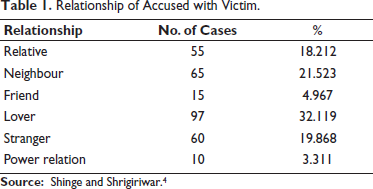
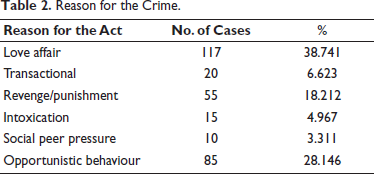
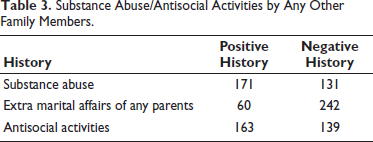
The study reveals that only one-fifth of the perpetrators were complete stranger to the respective survivors of the alleged crime and rest four-fifth were known to her (Table 1). Majority of the alleged perpetrators belong to nuclear family (80%). Table 2 shows that various motives for sexual offences include invalid consensual intercourse (49.67%), forcible rape (40.07%) and rape by multiple offenders (5.30%). The study finds a strong association between offenders and victims, often involving known acquaintances, such as lovers/boyfriends (32.12%) and neighbours (21.52%). When we look at the deterrent family background of the perpetrators, in 19.87% cases there was extramarital affairs of parents, and in about just less than 60% of cases there had been history of substance abuse by family members and also in more than half cases any one family member was involved in antisocial activities (Table 3).
Relationship of Accused with Victim.
Reason for the Crime.
Substance Abuse/Antisocial Activities by Any Other Family Members.
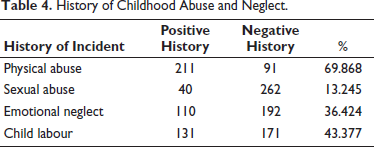
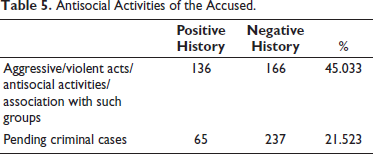
Mentioning about their rough childhood exposure, about 70% experienced physical abuse in their childhood and about 13.4% experienced sexual abuse. One hundred ten cases (36.4%) said they were neglected and were not taken care properly by their parents and 131 (43.4%) alleged perpetrators admitted to have worked before the age of 14 (Table 4). Out of 302 cases, a substantial 136 cases (45%) had been involved in aggressive/violent acts, antisocial activities and associated with antisocial groups and 65 cases (21.5%) already had pending criminal cases against them in the court of law (Table 5). Almost 78.5% of the cases had revealed history of substance abuse and 21.5% of them never had smoked, taken alcohol and used narcotic drugs. Only about 5% of the perpetrators had diagnosed psychiatric disorders. Most of the alleged perpetrators (73%) had acquired the sexual knowledge about female body parts and the act of sexual intercourse around the time of puberty or just before that. Majority (68%) of perpetrators have been exposed to pornography at an early age, that is, before attaining puberty or around that age. While most of the offenders had their first sexual contact after becoming adult, 15% of the alleged perpetrators had it before becoming major. The study reveals that almost 25% of the perpetrators had no prior sexual contacts with any woman prior to the incident.
History of Childhood Abuse and Neglect.
Antisocial Activities of the Accused.
Discussion
Several authors found the maximum perpetrators from age group 21 to 30 years, agreeing with our study, while a study on South African men found the perpetrators mostly to be of around 19 years of age.3–6 In Indian society, the third decade of life is identified as a period of increased independence, active sexual life and higher criminality. Agreeing with our study, the perpetrators were mostly unmarried in most such studies.4–8 Many countries no longer associate the marital status with sexual violence as it is known in the society that a lawful wedlock is not necessary for sexual contact to take place. The incidence of sexual violence being more in single male could be for the desire to explore their sexuality and female companionship, to satisfy the sexual urge, effects of movies which show a protagonist to always have female partner, peer pressure and substance abuse. Crime is in no way less heinous where the offenders were married. Our findings align with those of other authors, highlighting an inverse correlation between education and criminality.5, 6, 9 With education comes the awareness of laws and acceptance of civilized societal behaviour which help to curb the sudden instinctual eruptions. In contrast to other studies, our research reveals a notable difference where a higher percentage of assailants was found to be employed, though in unorganized sector.9–11 This may be due to the low- to lower-middle socioeconomic class where the crime exhibits its distinct presence. Similar to our study, several authors too found perpetrators belonging mostly to low socioeconomic class.5, 6, 9 Sexual violence against women is either very less or under reported when a person is found to be well educated and having high socioeconomic status. Agreeing with our study, several studies showed that majority of the perpetrators were known to the survivors and very few were strangers.4, 5, 12–15 The perpetrators either knew the victim and her actions, had information about their family’s whereabouts, or exploited the trust the survivor placed in them. These factors explain why acquaintances often end up committing such offenses. In concurrence with our study, George A Awad et al in 1991 noted that 25% offenders had a history of sexual pathology in the parents and came from a disturbed family. 16 Family environment affects a child’s thinking, behaviour and activities which define his future life. In dysfunctional families, a child feels more neglected, insecure about his feelings and is exposed early to the bad influences of outside world. The early exposure and lack of family values make the person more susceptible to criminal activities. Echoing with our study, physical abuse and neglect in childhood were seen in most offenders by several researchers.6, 14, 16, 17 Childhood abuse may render the perpetrators less emotional and sensitive to be inclined towards committing the sexual crimes. The lower incidence of history of sexual abuse may be due to nondisclosure of the fact as it has a social stigma attached to it or he may not have been able to understand such act in childhood and has now completely forgotten. Agreeing with our study Jewkes et al. in their work done in south Africa, 2011, observed 21.4% of the study subjects had gang membership and 29% perpetrators had pending cases against them. 6 A person associated with crime is more susceptible to commit other types of crime like sex offences. Pending criminal cases suggest jail time where he may come in contact with other hardened criminals who may change the thinking and judgement capacity of the person making him commit sexual offence with less offence. Like our study several studies also revealed the consumption of alcohol and other substance abuse among the perpetrators.6, 18, 19 The cause–effect relation is not direct. It may be due to the fact that substance abuse leads to antisocial activities and association with such groups which may lead to crimes which include sexual violence. In coordination with our study findings, Thornhill and Thornhill in their study in 1987 noted that most rapists were not psychotic or otherwise mentally disordered. 20 As inferred in our findings, various other authors also concluded that exposure to pornography is one of the instigating factors among perpetrators of sexual crimes.21–24
Conclusion
The study is a sincere effort to analyse the demographic parameters associated with sexual offenses, particularly focusing on the personal and family histories, surroundings and circumstances of accused individuals. It acknowledges limitations in probing certain sensitive aspects due to reliance on pre-designed questionnaires. The researcher suggests a formal psychoanalysis of accused individuals to gain a deeper understanding of the male psyche driving such aggressive behaviour towards women. The study emphasizes the potential positive impact of quality education, decent employment opportunities, awareness of existing laws and improved living conditions in reducing the incidence of sexual crimes. Furthermore, it highlights the crucial role of parents, guardians and family elders in fostering a healthy mindset regarding female sexuality and curbing aggressive instincts. Acknowledging the reality of sex-related crimes in contemporary society, the study proposes measures such as formal sex education and behavioural analysis by professionals at the school level to identify and address potential perpetrators early in their formative years.
Footnotes
Declaration of Conflicting Interests
The authors declared no potential conflicts of interest with respect to the research, authorship and/or publication of this article.
Ethical Approval
Ethical clearance was obtained from the Institutional Ethical Committee (IEC) of SCB Medical College, Cuttack, Odisha, India before commencing the study.
Funding
The authors received no financial support for the research, authorship and/or publication of this article.
Informed Consent
Informed consent was obtained from each alleged perpetrator for their participation in the study.