




Abstract
Footwear impressions are the marks which the outsole of a protective covering of feet, such as a shoe, sandal, slipper or boot leaves on a surface against which it presses. These marks are distinctive patterns which are endowed with both class and individual characteristics. As a result, they are considered valuable forensic evidence. In many crime cases, such marks can be traced back to specific footwear to the exclusion of all other varieties. Therefore, these have the potential not only to place the suspect at the crime scene, but also to track his/her movement within the crime scene.
Introduction
Like fingerprints and tool marks, footwear prints are classified as impression evidence. 1 Following the Locard principle, this type of evidence comes into being as a result of an exchange of matter between the outsole of the footwear and floor, carpet, furniture or any other artifact with a flat surface at the crime scene. 2 The footwear impression reveals an array of information about the suspect. Its dimensions divulge the size of the wearer’s feet; its depth gives an idea about the wearer’s weight; its shape may tell about the person’s occupation; its brand may provide an idea about the person’s economic status. If numerous footwear marks are present at a crime scene, these may throw light on the gait of the person and also on his trail. 3
Like other impression evidence, footwear patterns incorporate a host of class and individual characteristics. Class characteristics are present when a person purchases a pair of footwear. 4 These include size, design and outsole texture. Individual characteristics arise after the person has worn the footwear for as short a time as a few hours. These manifest themselves as defacement, scratches, nicks and cuts in the outsole. 5
Although footwear prints are not as unique as fingerprints, the information provided by a combination of class and individual characteristics can possibly reveal the identity of the suspect. In fact, criminals often wear gloves to neutralize fingerprints, but they just cannot avoid impinging their footwear prints while traversing the crime scene. If the protocols of crime scene management are properly followed, it is possible to retrieve 30% of footwear impressions from the scene of crime. 6 Moreover, if a suspect resorts to multiple unscrupulous acts in a short duration, it is unlikely that he/she will change the footwear between different crime sites. 7 Therefore, footwear evidence proves to be a promising asset in forensic investigations.8, 9 The forensic significance of footwear impression evidence is reviewed in this communication.
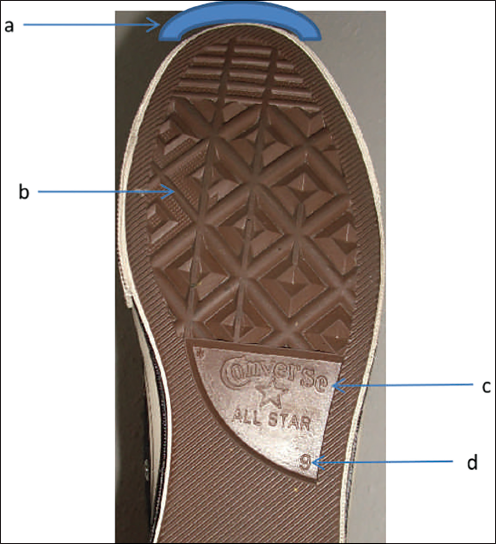
Footwear impressions as forensic evidence: The screening of footwear impression evidence involves examination, and subsequent comparison, of class and individual characteristics conflated therein. Class characteristics are a fallout of the manufacturing process. These include the physical size and design of the footwear. The textured pattern on the outsole is also a class characteristic. If the logo of the company is imprinted on the outsole, it too constitutes a class characteristic.10, 11 These characteristics are shown in Figure 1.
Class Characteristics of Footwear: (a) Design, (b) Outsole Texture, (c) Logo and (d) Size.
The individual characteristics are the wear marks which appear randomly and accidentally on the outsole once the footwear is put to use. These markings are unpredictable since their intensity and frequency depend on the type of surface on which the wearer walks, as well as on the way he/she walks. 12 If a person walks repeatedly on a rough surface like a concrete pavement or a metaled road, the wear marks initially appear as abrasions and scratches and later as cuts and grooves on the outsole. If objects like rock particulates, glass pieces or tapes become attached to the outsole and leave their pattern in the developed footwear print, then these too constitute individual characteristics. 11
As far as the personal walking habits of the wearer are concerned, wear patterns appear as ridges mainly on the toe and heel of the outsole. These ridges are called Schallamach patterns. 13 The ridges are separated by 0.05–0.5 mm and are distinct for each footwear. 14 The Schallamach patterns change after 48–50 hours and can be used as a comparative aid only if the known footwear is recovered within that span of time. However, other wear patterns, which appear as abrasion marks on the outsole either due to the roughness of the walking surface or due to the walking habit of the wearer, do not change or fade out. 15 The more footwear is worn, the greater the manifestation of wear patterns. 16 Such patterns appear more rapidly on harder leather soles, than on softer rubber soles. 17
When the questioned footwear impression, left at the scene of crime, is to be matched with a suspected footwear, the class characteristics are compared first of all. If the design or the size of the two do not match, then their association is ruled out. However, if their design and size matches, then there is a possibility that the impression was made by the suspected footwear and therefore the focus should shift to individual characteristics.
It needs to be emphasized that no other forensic evidence can narrow down a questioned sample to a control sample to such a large extent on the basis of class characteristics alone, as does the footwear impression. It is estimated that the possibility of a particular shoe design in a specific size to be repeated in another pair is of the order of 1% of the total shoe population. If the outsole design and the logo too are discernible in the impression, the probability of non-association further declines. 18 Nevertheless, for investigative purposes, no decision can be taken on the basis of class characteristics alone and, therefore, a comparison of individual characteristics too has to be taken into consideration.
Strictly speaking, wear patterns which originate due to erosion of the outer sole should serve as useful individual characteristics. However, the erosion of the outsole depends on too many factors, such as the type of surface on which the wearer walks, the way the person walks, the weight of the person, the duration for which the footwear is worn and the activity in which the wearer is engaged in. As a result, the wear patterns become so disordered that these cannot be classified as individual characteristics. 19 Moreover, two persons wearing the shoes of same size and design and engaging in similar activities will have near identical wear patterns on their footwear. On the other hand, the footwear impressions of a person who uses different pairs of shoes for different activities will show non-identical wear patterns.
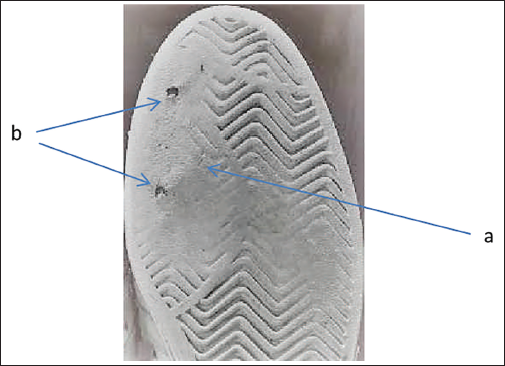
Nevertheless, when the footwear is worn for a relatively long time or the wearer is engaged in an aggressive activity, such as jogging, some of the wear patterns get eroded to such an extent that these get transformed from mere scratches to cuts, tears, holes, stone holds and/or irregular-edged distortions. These types of abrasions have the potential to serve as individual characteristics (Figure 2). Such damage appears prominently in the developed footwear impression and offers a better clarity for comparison than the chaotic line or ridge patterns.20, 21
Wear Patterns: (a) Which are not Individual Characteristics and (b) Which are Individual Characteristics.
This brings to the fore the significance of quantification of individual characteristics. The unique features found in the developed footwear impression as well as in the suspect footwear may be quantified on the basis of four parameters: Size, shape, position and orientation (or angle). 11 As a result of this quantification, a meaningful comparison can be made even if there are too few identifiable individual characteristics.17, 22 When a particular piece of footwear shows a set of unique individual characteristics which are also identifiable in its impression lifted from the crime scene, then it can be associated with the suspect to the exclusion of all other footwear of the same class.
Classification of footwear impressions: Footwear impressions are classified into three types: Visible, latent and plastic.
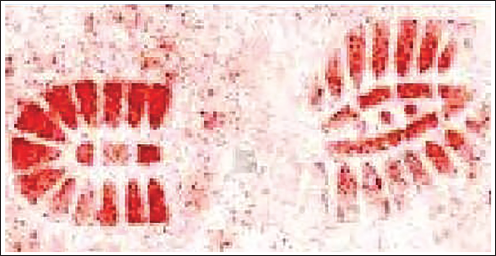
A visible impression results when footwear first comes into contact with a foreign substance like blood, grease, oil or water and then steps onto a clean surface. 23 The substance which becomes coated on the outsole leaves a contrasting, visible print on the walking surface. One such print is shown in Figure 3.
A Visible Footwear Impression.
A visible impression is a 2-dimensional print since only its length and width are identifiable. A latent impression too is a 2-dimensional print, but it is not visible to the naked eye. It is formed through the exchange of static charges between the soil particles adhering to the outsole and a smooth, hard surface. Examples include shoe prints on tiles, wooden floors or metal coverings. Ideally, these prints do create a coating of dry soil impression on the walking surface, but the dust layer is so thin that it is invisible. 24 A plastic impression occurs when the footwear steps into a soft surface like clay, wet sand or snow. 25 One variety is shown in Figure 4.
A Plastic Footwear Impression.
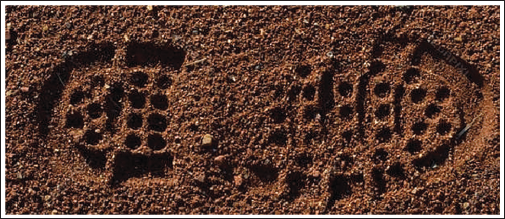
Such an impression is a 3-dimensional print since its length, width and depth are discernible.
Development of footwear impressions: There are three broad methods which are commonly used to develop footwear impressions at crime scenes: Chemical enhancement, electrostatic lifting and casting. While the first two may be used for visualizing both visible and latent impressions, the third is exclusively meant for plastic prints.
Chemical enhancement: A latent footwear impression may be faintly visualized by illuminating with white light, the source of which is held in an oblique position. The surroundings should be made as dark as possible. Once located, it may be rendered visible by treatment with a suitable reagent like 2, 2’-dipyridyl, 26 bromophenol blue, 27 potassium thiocyanate 28 or cobalt chloride hexahydrate. 29
Formulations used for detecting latent fingerprints may also be used for visualizing invisible or faintly visible footwear impressions. For example, Adair 24 used black powder and Hammell et al. 28 used magnetic powder to enhance footwear impressions. Ashe et al. 30 used cyanoacrylate fuming, in concert with basic yellow 40, to lift footwear marks present as grease or oil residues on plastic bags.
Fingerprint reagents may also be used to enhance bloody footwear impressions. Bodziak 31 recommended leuco crystal violet for this purpose. The same reagent proved useful for developing blood footwear prints on substrates like white cotton, newspapers and trash bags that had remained buried for different periods of time. 32 There are a host of other chemicals which enhance blood footwear prints on fabrics. These include protein stains, 33 luminol 34 and amino acid stains. 35 Once the latent or visible footwear impressions have been enhanced, these may be preserved for record by adhesive tape lifting 36 or gelatin lifting. 37
Electrostatic lifting: The most suitable method for recovering both the visible and the invisible footwear impressions is by a device called electrostatic dust apparatus or ESDA. 38 A lifting film is placed on the footwear print and a high voltage is applied. The film acquires a negative charge, while the outsole coating acquires a positive charge. The coating is attracted toward the film and gets deposited thereon as a precise mirror image of the original. The print appearing on the film is photographed for the record.
While the gelatin method is suitable for lifting both dry and damp footwear impressions, the electrostatic technique gives satisfactory results only if the imprint is dry. 39
Casting: A 3-dimensional plastic footwear impression is preserved as evidence in the form of a cast. The casting material is shaken in water to create a slurry which, in turn, is poured along the sides of the impression and then allowed to spread, slowly and evenly, over the entire print. It is advisable to apply a thin film of hair spray before pouring the casting material so as to prevent the cast from collapsing. 40 After about 30 minutes, the cast is lifted up with the aid of a knife. It is cleaned with a solution of potassium sulfate and air-dried for 24–48 hours. A cast gives an actual-size molding of the original impression. As shown in Figure 5, it captures even minor details of the impression.
A Footwear Impression Cast.
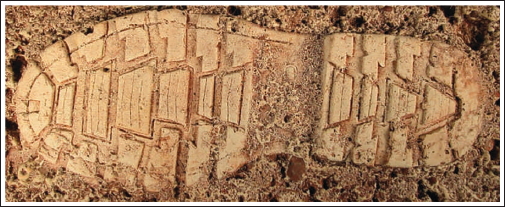
Examples of casting materials include plaster-of-Paris, Traxtone, crime-cast and dental stone.41, 42 The latter has emerged as a material of choice. It hardens quickly, and hardening is more durable than other analogs.
If the plastic impression is in water, then any debris material floating on the surface is first removed. A thicker slurry is poured and the hardening time is stretched to 60 minutes. If the plastic impression is in snow, either talcum powder or snow print wax is sprinkled onto it. 40 After about 10 minutes, the dental stone slurry, prepared in ice-cold water, is poured evenly over the impression and allowed to harden for 60 minutes. 43
Preservation of footwear impression evidence: Footwear impression evidence, when collected and documented by proper scientific protocols, can lead to the positive identification of suspects. While securing the crime scene, the barrier tapes should engulf a large enough area so as to obviate the possibility of entry and exit points being left out. Since these impressions are easily despoiled by weather and vehicles, priority should be given to documentation of outdoor prints. Indoor impressions are likely to be smudged by overstepping and therefore only one investigator should initially enter the scene to tag evidence markers onto these. Till the time the outdoor or indoor impressions are developed, it is better to cover these with boxes or cones. 2
The photography of the evidence should begin by showing its location with respect to other artifacts. Hence a few overview shots must be taken in the beginning, followed by mid-range shots. The evidence marker must be included in both types of photographs. To capture the details of the footwear evidence, a close-up photograph should then be taken by mounting the camera on a tripod. In order to minimize distortion, the plane of the film should be parallel to the plane of impression. A scale should be placed on the same level as the impression and about one inch away from it. However, the focus should be on the imprint and not on scale or evidence marker. Better details can be visualized if each impression is photographed using a light source positioned at different angles. 44
Conclusion
Footwear impressions are present at every crime scene. However, most often these are either overlooked or despoiled by overstepping. Nevertheless, when such markings are developed by sound scientific procedures and the class and individual characteristics embedded therein are recorded meticulously, these provide a definite link between the suspect and the crime scene. Therefore, the analysis of footwear patterns can go a long way to solving crime cases.
Footnotes
Declaration of Conflicting Interests
The authors declared no potential conflicts of interest with respect to the research, authorship, and/or publication of this article.
Ethical Approval
Not applicable.
Funding
The authors received no financial support for the research, authorship, and/or publication of this article.
Informed Consent
Informed consent on this research has been mutually agreed upon by both the authors.