




Abstract
Introduction
Sexual abuse of children has become a subject of great community concern and the focus of many legislative and professional initiatives. Despite the existence of a strong legal framework, there has been a substantial increase in the number of crimes against children. This study aims to study the demography of the child survivors, analysing the victim-perpetrator relationship and circumstances at the time of the crime.
Methodology
The study’s objective is to find out why the final judicial outcome of the cases has been decided. This is a retrospective study of records of victims of sexual assault who were brought for examination between January 2010 and December 2019.The study includes sexual assault victims who were under the age of 18.
Results
Thirty of the 231 cases under analysis resulted in a conviction, while 60 ended in acquittal. In court, 143 cases are still open.
Conclusion
The burden of proof typically rests with the defence party in matters involving sexual violence since they are commonly easy to report but difficult to prove. The current study contributes to our understanding of the system’s flaws and how people have taken advantage of them to their advantageous ends.
Introduction
Child abuse refers to the emotional, physical, economic and sexual mistreatment of individuals below the age of 18. This issue is widespread worldwide. Like India and other countries, there is limited awareness regarding the scope, scale and patterns of child abuse. The increasing complexities of life, coupled with significant socio-economic transitions in India, have significantly heightened the likelihood of children being subjected to different forms of mistreatment.
The Protection of Children from Sexual Offences (POCSO) Act, 2012 is a landmark law that resulted from years of civil society struggles and the Government of India’s acknowledgement of the problem. It protects children not only from penetrative sexual assault but also from other forms of child abuse.
This study aims to understand the reasons for the registration of cases, and the victim demography, and the main objective was to identify the reasons based on which judicial outcome was decided.
Materials and Methods
Study Design
Retrospective longitudinal study.
Duration of Study
From September 2021 to January 2023.
Study Material and Methods
As it is a retrospective study, data for the study was collected from the department’s records section, after approval of the Institutional Ethics Committee (ECARP/2021/133). Data of all the victims of sexual assault was segregated as per the inclusion criteria and information from the examination papers required like the age of the victim, sex of the victim, characteristics of the assault and relationship between victim and perpetrator were noted. As for the outcome of the court case, at the time of examination, the accompanying police brought a requisition letter for examination, which had an FIR number. With the help of the FIR number, its outcome was traced online on the E-courts services website of the District Courts of India.
Statistical Analysis
The data was entered in Microsoft Excel and analysed. The qualitative data like age groups of the victims, gender difference of sexually assaulted victims, laboratory reports, number of incidents, places of sexual assaults, type of alleged incident, type of injuries, consequences of sexual assault, time gap between incidents and examination, relation of accused to victim state, etc., and quantitative data like age, number of assailants, marital status, and so on, will be presented in appropriate formats.
Results
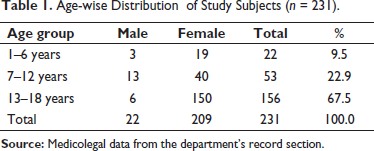
Table 1 shows that the most affected sex was females and those were mainly from 13 to 18 years of age group.
Age-wise Distribution of Study Subjects (n = 231).
Disposal without trial: Such disposal was given by the judiciary body for cases where the accused died during the course of court proceedings. There were only two cases with such disposal.
Uncontested: Such disposal was given by the judiciary body for cases where the accused was unknown and could not be traced by law enforcement.
Discussion
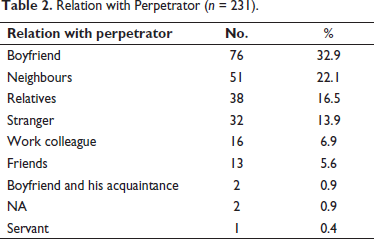
Victim-perpetrator Relationship (Table 2)
Out of 231 cases studied, the accused in 76 cases were the boyfriends of a victim (32.9%) and 38 were related to the victim as a brother, biological father, step-father, step-brother or maternal uncle (16.5%). The findings in the study were consistent with the following studies—Bhowmik and Chaliha, 1 Tamuli et al., 2 Adogu et al., 3 Sabale et al., 4 Jemal 5 and Surender et al. 6
Relation with Perpetrator (n = 231)
Rate of Disposal of Cases Registered Under the POCSO Act
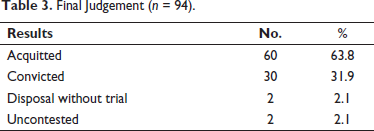
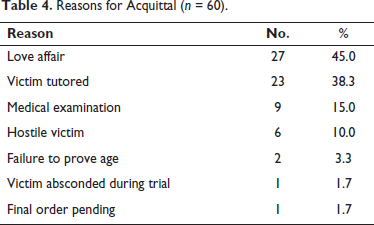
In 231 cases taken in our study, judgement orders of 94 cases were available on the portal (40.7%) (Table 3). These were disposed off by the court either as acquittal (Table 4), or conviction (Table 5), or disposed without trial (accused died), or uncontested (accused could not be traced) as their final judgement. Only 7.4% cases were disposed of in less than a year. The majority of cases, that is, 37.2%, were disposed of in one to three years of time duration followed by 33% of the cases being disposed in three to five years of time duration.
Final Judgement (n = 94).
Reasons for Acquittal (n = 60).
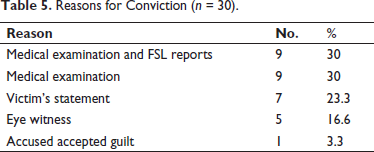
Reasons for Conviction (n = 30).
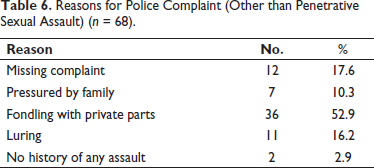
Reasons for Police Complaint (Other than Penetrative Sexual Assault) (n = 68).
This was consistent with a study named ‘A decade of POCSO: Developments, challenges and insights from judicial data’ by Vidhi Centre for Legal Policy, which observed the scenario of child sexual offence cases in the judicial system since the enactment of the POCSO Act till 2021 and found that, in Maharashtra, the percentage of disposed cases was at 39.77%. 7
Reasons for Police Complaint (Other than Penetrative Sexual Assault) and Judicial Outcome in the Concerned Cases (Table 6)
In 12 cases, the primary complaint was for missing reports. It was found that, in four out of 12 cases, the acquittal was the judicial outcome while others were pending. In all four of those cases, the victim and accused were in a romantic relationship and eloped from their respective homes as their parents were against the relationship and they had decided to get married. In three of those cases, the victim was above 16 years of age while one was 11 years of age. In eight cases, the trial is still ongoing.
In seven cases, the complainant was under family pressure. In three out of seven cases, acquittal was the final judgement. In all three cases, the victim was tutored by family members because of a feud over property or personal loss. In one case the accused died during proceedings and three are pending in court.
In 36 cases, there was a history of fondling with private parts of the victim. Seven out of 36 cases ended in conviction, in four of those, the victim’s testimony was the key to conviction while in the other three cases, it was eye witnesses’ testimony. Ten out of 36 ended in acquittal of the accused, in eight of those, the victim was tutored by the family to report for fondling with private parts to the police.
In 11 cases where the registered complaint was of luring (offering food, employment, giving a smartphone to play with, or promise of marriage). In these cases, four cases ended in conviction, based on FSL report findings of pornographic content in smartphones. In four cases, there was acquittal, as the victim turned hostile. In all of these 8 cases, the victims were in the late adolescent age group and working in prostitution. In the rest of the three cases, the trials are ongoing in court.
Victim-perpetrator Relationship and its Influence in Judicial Outcome
In 25 cases with the final judgement, it was found that the victim and perpetrator were in a romantic relationship, and all ended in the acquittal of the accused. The court identified those who had failed in the relationship at the time of filing the complaint and ruled its judgement as acquittal. However, in one case of conviction, although the victim stated that it was a LOVE AFFAIR and that her family was not against this. The accused stated that he wanted to marry her and had consensual sexual intercourse under the impression that she was a major and left her studies. The DNA of the FETUS matched that of the accused FSL REPORT). Still, the court ruled its judgement based on the fact that, if the person commits penetrative sexual assault on a child, then, the offence is made out and there is no need to prove that the accused did not know the juvenility of the victim.
In 84 cases out of the 231 cases studied, the victims were in the age group 16–18 years. 20 cases out of the 84 cases were of consensual sexual intercourse. Among these 20 cases, 17 were love affair cases. Among these 17, there were three cases where the accused and victim were married as per Muslim Marriage law. In those three cases, the age of the accused was 19, 22 and 23 years, respectively. This brings conflict between the POCSO Act, which defines sexual intercourse with a child <18 years of age as a criminal offence, and Muslim Marriage law, where the age for consent for marriage is 16 years or attainment of menarche.
In 38 cases, where the accused were related to the victim as brother, biological father, step-father, step-brother or maternal uncle, eight cases ended with conviction as final judgement. In three cases, the victim’s testimony was helpful. In three cases, medical examination helped in conviction. In one case, as per the FSL report, the pornographic content on mobile, concluded the judgement as conviction while in another case, the accused accepted his guilt. In 16 out of 38 cases, Acquittal was the final judgement. In 13 of those, the victim was tutored and it was due to a feud among family members or neighbour enmity for petty reasons.
These findings were consistent with the study of Hudaverdi Kucuker, where he found that 85 (38.6%) victims accepted to marry the so-called assailants during the trial, leading to the adjournment of the sentencing. 9
In the judgement for the case of Vijayalakshmi v State, 2021, the Madras High Court gave its views on consensual teenage relationships. They interpreted such relationships as integral to biosocial dynamics, cautioning against unfairly stigmatising them as criminal activities, as such a characterisation would be counterproductive. Furthermore, they emphasised that the primary goal of the POCSO Act is not to treat an adolescent boy entering into a relationship with a minor girl as an offender. Consequently, the court decided to quash proceedings under Section 482 of the CrPC, 1973, Section 366 of the IPC, 1860, and Section 6 of the POCSO Act, 2012, in line with their understanding of the nuanced nature of such relationships.10–12
In the case of Pradhuman v State, B.A. No. 2380 of 2021 (Del H.C.), the Delhi High Court labelled it as an ‘unfortunate practice’ when addressing the situation. This was due to the involvement of adolescents in a ‘consensual’ relationship, leading the police to file the case under the POCSO Act following the objections raised by the girl’s family against the relationship. 13
Findings on Medical Examination and its Role in Judicial Outcome
In our study, 25 cases had recent hymenal injuries on medical examination. The key and important point to note is, that all these cases were examined within 48 hours of the incident of penetrative sexual assault. The judicial outcome in seven out of those 25 cases was the conviction of the accused.
In two out of those 25 cases, a court acquitted the accused. In one case, the complainant (victim’s mother) denied that she lodged the complaint as she was told by an informant (eye witness) about the incident and he dictated the complaint to police and that no sexual violence was told to her by her daughter. The victim also denied any wrongdoing by the accused. The informant (neighbour) had previous enmity with the accused.
In the other case, the victim delivered a full-term neonate, inside the bathroom of the public toilet near their house. The accused was 19 years old, cousin brother to the victim. As mentioned in judgement order,
The victim nowhere testified that the accused committed non-consensual intercourse to her. Also, during the course of her pregnancy, neither her mother nor sister observed the changes in her body. Also, if there was a question of assault, she would have mentioned it to someone but she did not. This proved that the sexual intercourse was consensual and due to fear of scolding she didn’t tell her mom.
There were 24 cases out of 231, where a history of digit penetration was given by victims. In 10 cases, hymenal injuries (5 recent and five old) were reported. In 14 cases, no evidence of any injury was found. Four cases ended in conviction, six in acquittal, one accused died during the course of court proceedings while 13 are still pending in court of which four cases could not be traced.
In cases where a conviction was the final judgement, medical examination, victim’s statement, eye witness and FSL report of accused’s mobile phone were the respective reasons. In the case where medical examination findings were conclusive, recent hymenal tears were found.
In cases where the acquittal was the final judgement, victim tutoring was the main reason for the decision in five out of six cases and the reasons were feud among family members and neighbour enmity. One case was of a love affair.
In two cases, where a trial is still going on in court, local examination findings were conclusive of forceful penetration of vagina. In one case of a 9-year-old female child, congestion and tenderness were noted around the labia minora while, in other cases of a 3.5-year-old female child, congestion was present over labia majora and fresh hymenal tear was present at 6 o’clock position. The trial in both cases has been ongoing for the last five years.
Although there are not any references, describing injuries to the hymen due to digit penetration, our study showed that, if the perpetrator had forcefully penetrated his/her fingers into the vagina, findings will be conclusive of penetrative assault.
These Findings are Consistent with Findings of the Following Authors
In the study conducted by Hudaverdi Kucuker, noteworthy findings emerged in 221 cases (82.4%), predominantly in the perineal and anal regions. These findings encompassed various indications such as hymenal rupture, erythema of labia minora, perineal bruising-abrasion and anal bruising-abrasion or mucosal tears. Among these instances, 163 (74%) involved female subjects with exclusive vaginal injuries, while 12 (5.4%) displayed solely anal injuries and 15 (6.8%) exhibited both vaginal and anal injuries. Remarkably, anal injuries were identified in 31 cases (77.5%) involving male victims. Furthermore, 32 (11.9%) females had spermatozoa detected in their vaginal smears, prompting the application of DNA fingerprinting. Among all examined cases, legal proceedings resulted in the conviction of the accused in 156 instances (58.2%). Concerning assaults on female victims, sentences were imposed in 114 cases (51.8%). Postponement of sentencing (acquittal) occurred in 85 cases (38.6%) due to subsequent marriage between the victim and accused. Additionally, 21 cases (9.6%) saw no penalties imposed due to insufficient evidence. As for assaults on male victims, sentences were handed down to 42 accused individuals (87.5%), while in six cases (12.5%), no penalties were imposed due to insufficient evidence.9
In the study conducted by Palusci VJ, Cox EO et al., involving 497 children, only 17% exhibited positive physical findings. Notably, 35.8% of cases leading to successful criminal prosecution showed positive examination findings, contrasting with 12.7% in cases with no prosecution or a verdict of ‘not guilty’. Children revealing child sexual abuse were four times more likely to present positive findings for abuse during examination. Instances with positive examinations were 2.5 times more likely to conclude with a guilty verdict for the perpetrator; nonetheless, mere disclosure alone did not serve as a reliable predictor of guilt. 14
In the study conducted by P. Saint-Martin et al., which involved 756 cases, it was found that genital injuries were present in 6.8% of girls and 6% of boys in the under-15 age group. Convictions were secured against 36.3% of the assailants. The examination conducted at the request of law enforcement authorities and the prior acquaintance of the assailant by the victim were significantly linked to convictions. However, the presence of general body and/or genital trauma was not found to be associated with convictions. 15
In the study conducted by Peterson J et al., which examined 81 charged cases, it was discovered that convictions were obtained in 82.7% of these cases. Notably, when physical evidence was collected, the conviction rate significantly increased to 87.3%, compared to a 66.7% conviction rate in cases where no physical evidence was gathered. This underscores the importance of physical evidence in strengthening the legal outcomes of charged cases. 16
Positive Pregnancy Status and its Influence on Judicial Outcome
In our study, 12 cases out of 231, had positive pregnancy status on USG and UPT. However, only one case among those ended in conviction of the accused. In that case, the victim testified that it was a love affair and that her family was not against this. The accused stated that he wanted to marry her and had consensual sexual intercourse under the impression that she was a major and left her studies. The DNA of the foetus matched the accused’s (FSL REPORT). However as per the court’s understanding and inference of Section 3 of the POCSO Act, which defines, ‘Penetrative sexual assault on a child’, Accused was convicted. The court made its judgement stating that, if a person commits penetrative sexual assault on a child, then the offence is made out and there is no need to prove that, the accused had no knowledge of the juvenility of the victim.
In two cases, the acquittal was the final judgement. In one of the cases, victim was in a romantic relationship with the accused. They had a baby out of wedlock and later married as per Muslim Marriage law. But since the victim and her mother turned hostile, the court ruled its judgement as acquittal. This brings conflict between the POCSO Act, which defines sexual intercourse with a child <18 years of age as a criminal offence, and Muslim Marriage law, where the age for consent for marriage is 16 years.
In nine cases, the trial is pending in court in five cases while, in four cases, the record was not available due to unavailability of FIR no. In all the five pending cases, the victim and accused were in a romantic relationship and the cases have been ongoing for more than five years.
Importance of Testimony of Child and its Impact on Judicial Outcome
In our study, out of all the 30 cases ending in conviction, in seven cases court relied solely on the testimony of the child. Two cases had positive findings on local examination but in one case, the medical examination was rejected by the court because it was done 1.5 months after the alleged assault and in other cases, it was corroboratory to the testimony of the child. In five cases, there was only a history of fondling with chest and private parts of the child. The age of children in these cases was between 10 and 15 years, respectively.
These Findings were Consistent with the Following Studies
In the study by Sugue-Castillo M., 68.7% of the 115 cases solely relied on the victim’s testimony. She also noted that the most frequently cited cause of acquittal was dismissal because of the victim’s desistance. In 66.7% cases where medical findings were normal, resulted in conviction based on doctor’s testimony. 17
In the study by Eg MB et al., 226 girls reported a history of one incident of vaginal penetration. Among these cases, 22% exhibited hymenal clefts, with 34% of them having complete hymenal clefts. Notably, in instances with complete hymenal clefts, 63% led to prosecution, and 50% resulted in convictions. Age emerged as a significant factor in relation to conviction in this study. This observation was highlighted by the fact that cases resulting in conviction had a mean child age of 11.49 years. It was noted that children of this age demonstrated better recollection of the incident, enabling them to provide clear evidence during court proceedings. 18
In the research conducted by Hansen LA et al., it was determined that abnormal anogenital findings were observed in 38% of girls and 20% of boys. However, there was no discernible connection between these findings and the legal outcomes, which were categorised as ‘appearing in court’ and ‘being convicted’. Notably, the child’s age emerged as the crucial factor influencing legal outcomes rather than the physical findings. Out of the 190 cases analysed, 165 resulted in the accused being charged as ‘guilty’. Within different age groups, 28 cases in the 0–6 years range, 55 cases in the 7–10 years range and 82 cases in the 11–15 years range ended in convictions. This trend was attributed to the older children’s ability to provide clearer testimony in court. 19
A study conducted by Adams JA et al. involved a review of case files and colposcopy photographs from 236 children whose perpetrators were convicted of sexual abuse as per court judgements. The findings revealed that 28% of cases had no positive findings on genital examination, 49% had nonspecific findings, 9% were deemed suspicious and 14% showed abnormal findings. Through discriminant analysis, it was established that two significant factors correlated with abnormal genital findings in girls: the time elapsed since the last incident and a reported history of blood during the sexual assault. The study emphasised that abnormal genital findings are rare in sexually abused girls, according to standard classification systems. Consequently, the researchers concluded that particular attention should be given to documenting the child’s description of the sexual assault. 20
Conclusion
Sexual violence against children has been a matter of concern for the judicial system for the last two decades, not just in our country but also around the world. Various studies have shown how much of a grave concern it is for communities. It not only violates a child physically but also scars them for life. In our study, we observed that innocent adolescents are dragged into court because of rejection of their romantic relationships by their parents or guardians. We also observed, that due to conflict between Muslim Marriage laws and POCSO Act, over-age for consent, cases are registered. Since the POCSO Act has a provision, stating the importance of the testimony of the child and there are judgements, where the court decided conviction as its final verdict, it is of utmost importance for medical professionals to note the history narrated by the child at the time of examination.
Footnotes
Declaration of Conflicting Interests
The authors declared no potential conflicts of interest with respect to the research, authorship and/or publication of this article.
Ethical Approval
Ethical approval for this retrospective study was obtained from the Ethics Committee for Academic and Research Projects of Topiwala National Medical College, Mumbai (Approval No.: ECARP/2021/133).
Funding
The authors received no financial support for the research, authorship and/or publication of this article.
Informed Consent
The requirement for informed consent was waived due to the retrospective nature of the study.