




Abstract
A tool for improving the overall effect and enabling more effective work is skill development. Accelerating globalisation and technological transformation present both difficulties and possibilities for economic growth and job creation. The possibilities of globalisation will be easier for nations with higher and better levels of competency to respond to. When it comes to addressing the skill development of its youth, India has made important advancements. Under the auspices of Skill India, a full-fledged, independent ministry for entrepreneurship and skill development has been established. Through a public–private partnership approach, the government is luring private companies into the training sector. The National Skill Development Corporation was established particularly for this reason. However, as is the case with the bulk of skill development programmes, there is still a weak connection between skill development and career guidance and counselling, not just in India but in many other countries. The influence of the government of India’s numerous skill development projects on employment and their difficulties are examined in this article, along with the skill gap in that country. The research discovered that one of the main obstacles to closing the job gap is a lack of skilled and trained workers. Conservative thinking, reluctance to leave, low pay, a lack of standardisation and a lack of emphasis on non-technical skills are the root causes of the skill gap in India, which results in skilled workers being out of work.
Keywords
Introduction
By 2045, India’s 1.2 billion people are expected to increase to 1.8 billion. The expansion of the working age population (15–64 years) is a significant component in this growth. Due to its rising population dynamics, the majority of the country’s citizens are of working age, making it one of the youngest countries in the world. In India, 64.8% of the population will be of working age by 2026. India has a lower rate of literacy than some of the less developed nations, at approximately 70%, and just 20% of its population has access to employment. The definition of literacy also includes education and the concept of skills, such as technology abilities, vocational skills, job skills, digital literacy and other knowledge and abilities necessary for employment and survival. Only 25% of the Indian workforce, according to a survey, is involved in skill development programmes, despite the country’s need for a more trained labour force.
Knowledge and skills are what propel a nation’s economic and social progress. A set of capabilities known as skills is needed to complete tasks in the most effective way possible while upholding acceptable quality standards.
Through professional or technical training, skill development equips the workforce with the information and abilities required to fulfil industry demands and maintain competitiveness in the fast-moving global market.
Due to their huge career advancement potential and ability to effectively market the company, skilled workers are now often preferred by many businesses over low-skilled workers. Skills boost output and work quality for more impactful outcomes. According to the World Trade Organization (WTO), India’s GDP might increase by 3–5% in 2035 if it prioritises skill development and training. India must continue to educate and train its youth in order to improve the nation as a whole.
Activities for skill development in India are coordinated by the Ministry of Skill Development and Entrepreneurship (MSDE). The National Skill Development Corporation (NSDC) and the National Skill Development Agency (NSDA), which coordinate government efforts to promote skills development by setting up organisations and the private sector that wants to support in field and skill development, are just a couple of the organisations it has supported.
The Skill India Mission, which aims to train over 40 crore people in India in a range of skills by the year 2022, was officially launched on 15 July 2015, according to the MSDE. The National Skill Development Mission, the National Policy for Skill Development and Entrepreneurship, 2015, the Prime Minister Kaushal Vikas Yojana (PMKVY), the Skill Loan Scheme, Rural India Skills, etc. are just a few of the programmes included in this campaign.
This study assists in understanding the career alternatives and skill development programmes that are offered, as well as the many difficulties that these individuals encounter.
Review of Literature
Behera and Gaur (2022) determined that focusing solely on education, disregarding career counselling and skills development, or prioritising jobs while ignoring skills education is insufficient to achieve the desired objectives. It takes a lot of work to develop technical abilities and transferable talents. A major elementary education level should be provided via skill training, but it cannot be a substitute.
Gupta et al. (2021) conducted a research based on an initial survey of 600 respondents from various shareholders conducted in four districts of Sikkim to determine whether there was a significant difference in the level of confidence that shareholders indicated in relation to the skills environment’s problems. The rehabilitation of young employment in Sikkim, the stigma associated with labour-oriented jobs, the desire for government positions, the confidence of those with less education in their abilities, and chances in the state of Sikkim are a few of these problems.
Patil and Charanthimath (2021) concluded that employment rates may rise if key players like applicants, governments, educational institutions and training partners participated effectively. The curriculum must be improved with an industry–organisation interaction in order to improve infrastructure. A public–private cooperation can make sure that skill development programmes are properly funded, regulated and reviewed.
Swain and Swain (2020) have examined a number of government programmes, including Dean Dayal Upadhyaya Grameen and the Prime Minister’s Kaushal Vikas Yojana. Data analysis, skill planning, etc. were provided by the NSDC. The study found that although India enjoys a ‘demographic dividend’, it should capitalise on it in order to benefit. It can support the ‘Make in India’ programme and improve the economy by ensuring a highly skilled workforce. To increase employment in the nation, the Skill India effort should concentrate on fostering more entrepreneurial skills among the workforce. To draw the interest of the young and the target audience and to enable them to take advantage of such skill training and get more work, it is necessary to raise awareness about various government programmes.
Arora and Chhadwani (2019) evaluated the effects of the Skill India Mission on the country’s economic restructuring which led to the conclusion that the mission needed to be implemented properly in order to move forward more quickly. By 2022, the government hopes to employ nearly 400 million people, which is a lofty goal. However, the rate of job/placement transfer from training/skill has been seen to be too delayed and falls short of expectations. Only 1.97 lakh of the 24 lakh persons who were to be trained in the first phase have been trained.
Krishnamoorthy and Srimathi (2019) analysed the current norms in the various skill sets available and made recommendations for the future. The analysis found that over the next 20 years, India would probably have the best young workforce. This achievement is not possible under an arbitrary form of government. This calls for a thorough examination of the workforce’s demands on a global scale and suitable action to deliver professional and pertinent skills that are suited to industrial requirements. Indians have a stronghold on the world labour market. With a mix of best practices in need-based analysis, introspection, periodic review and skill development, together with the cooperation of all stakeholders, they may continue to grow and evolve.
Chenoy et al. (2019) concluded that the benefits of Industry 4.0 are extensive. Low prices, more efficiency, enhanced safety, speedier delivery and other benefits are attainable, strengthening the industrial sector and enhancing competitiveness on the international market. The implementation of Industry 4.0 has been greatly aided by the ‘Make in India’ initiative and the ‘National Policy for Advanced Manufacturing’. However, ‘Skill India Mission’ and ‘Make in India’ were both successful. The Make in India project and creating a skilled workforce are both difficult tasks that require collaboration between the government and industry partners.
Furtado (2018) intended to ascertain a candidate’s employment status, career prospects and employment at different points in their lives. The study also found that, despite the vast array of services provided by the government, there is competition for entry-level jobs with access to candidates. However, it has changed and has lost its youthful potential.
Srivastava and Vasantha (2018) conducted a study to ascertain how the NSDC, NSDA, Sector Skill Council (SSC) and Directorate General of Training (DGT) bodies operate. The study came to the conclusion that the ‘Skill India’ mission could be successfully implemented by agencies like the MSDE, the NSDC and the SSC, and that this would easily address the shortage of skilled workers. Realising that formal education and skill development go hand in hand is essential if we are to grow the nation’s economy.
Ansari and Khan (2018) observed that from an economic and statistical standpoint, it is crucial to capture skilled reform for India. It is a crucial instrument for lowering young unemployment, increasing employment levels and fostering self-employment.
Singh and Kaur (2018) found that poor quality work can result from a shortage of qualified painters. A novice painter produces work of poor quality. The performance of the manufacturing team might be significantly and favourably affected.
Prasad and Purohit (2017) directed that formal education, technical training and professional preparation should cover the qualification restrictions, availability requirements, qualification prerequisites, specialisation gaps and general status of operations undertaken by the Government of India for the promotion of skills development for the youth of the country.
Hazarika (2016) discussed a number of infrastructure offices, including asset emphasis and development focus, as well as asset focus like general office focus, and the lack of major business mind growth in Assam.
Saini (2015) intended to study the existing state of affairs and issues facing the skills development system and to propose some specific recommendations. The author talked about concerns with demand and supply, geography, poor education, private–public vocational training, issues with placement, the informal skills gap, infrastructure problems, the availability of qualified trainers, educational quality, etc.
Misra (2015) comprehended the existing approach to skill development and discovered strategies for producing highly competent labour through skill development programmes. In order to effectively serve business and the global market while developing private–public partnerships, it was stated in this article that the present Skill Development Policy should be updated.
Okada (2012) addressed Indian youth employment and education. The difficulties in developing skills were also covered. It explains why there are so many educational possibilities, but the dropout issue results in kids without skills. The study came to the conclusion that in order for the Government of India to assure the success of the Skill Development Mission, the population should benefit from the demographic dividend.
Research Gap
There have not been many researches done on skill development programmes before. The majority of studies did not concentrate on the severity of the skill gap or the adoption rate of skill development initiatives. As a result, this study aims to comprehend the skill gap and how India’s skills are evolving. It also shows the degree to which various skill development programmes have been adopted.
Research Objectives
The study seeks to:
Study the skill gap and skill development in India.
Explore how skill development programmes affect employment.
Study the issues that India’s skill development initiatives faced.
Research Methodology
Exploratory research is currently being conducted. Secondary data are especially supported in the current research work. The data are collected from various websites, magazines and newspaper articles. The descriptive and conceptual nature of the study is used.
Skills Gap in India
The skill gap is the difference between what employers and their employees demand. In today’s fast-paced environment, the employment skills gap is significant for individuals and employers. This is due to the acceptance of digitisation and the advancement of technology. India has a literacy rate of almost 70%, less than the least developed countries globally, and employs only 20% of its citizens. According to a survey, although India needs many skilled workers, only 25% of the Indian workforce is involved in the skills development programme. According to the WTO, if India focuses on skills development and training, its GDP will increase from 3% to 5% by 2035. India needs the training and skills of its youth to take the country’s overall development further.
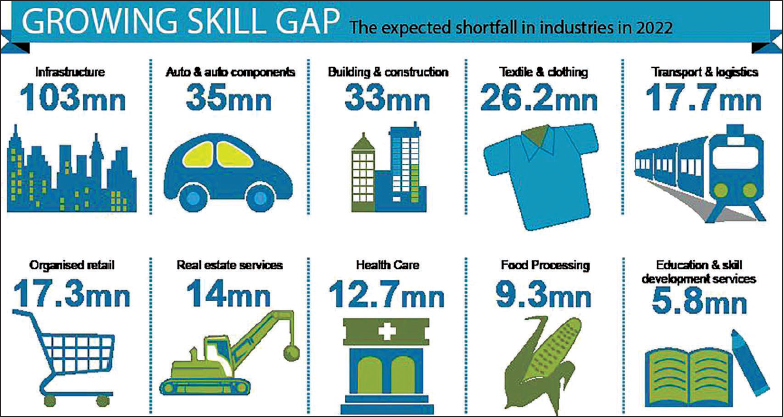
The skills gap in India is a significant obstacle to the economy’s growth potential. The lack of workforce to run enterprises makes it difficult for companies to develop or maintain competitiveness. According to the International Labour Organization (ILO), by 2030, there will be a shortage of 29 million people in India. Many factors have contributed to the lack of skills in India, but analysts point to the education system’s failure as the root cause of the problem. They noted that Indian schools are not giving children the skills needed to succeed in today’s work economy. Although essential elements and principles are included in the college curriculum, there is a disconnect between teaching and learning methods. Corporate India and research institutes agree that 65–75% of the youth are unemployed while 65 million enter the workforce every year. Research shows that India’s skills gap has closed enough for young people to be employed nationwide. Working to narrow the skills mismatch can improve professional outcomes, increase participant access to marketing possibilities, boost output and improve employee retention. Figure 1 exhibited the anticipated shortage of workers across industries by 2022, highlighting a large disparity between the supply and demand of qualified labor in key sectors. The figure identifies ten sectors facing substantial shortfalls, represented by icons: Infrastructure (103 million workers), Auto & auto components (35 million), Building & construction (33 million), Textile & clothing (26.2 million), Transport & logistics (17.7 million), Organized retail (17.3 million), Real estate services (14 million), Health care (12.7 million), Food processing (9.3 million), and Education & skill development services (5.8 million). These projected shortfalls highlight the urgent need for strategic planning, investment in skill development, and efforts to bridge the gap between industry requirements and the available talent pool.
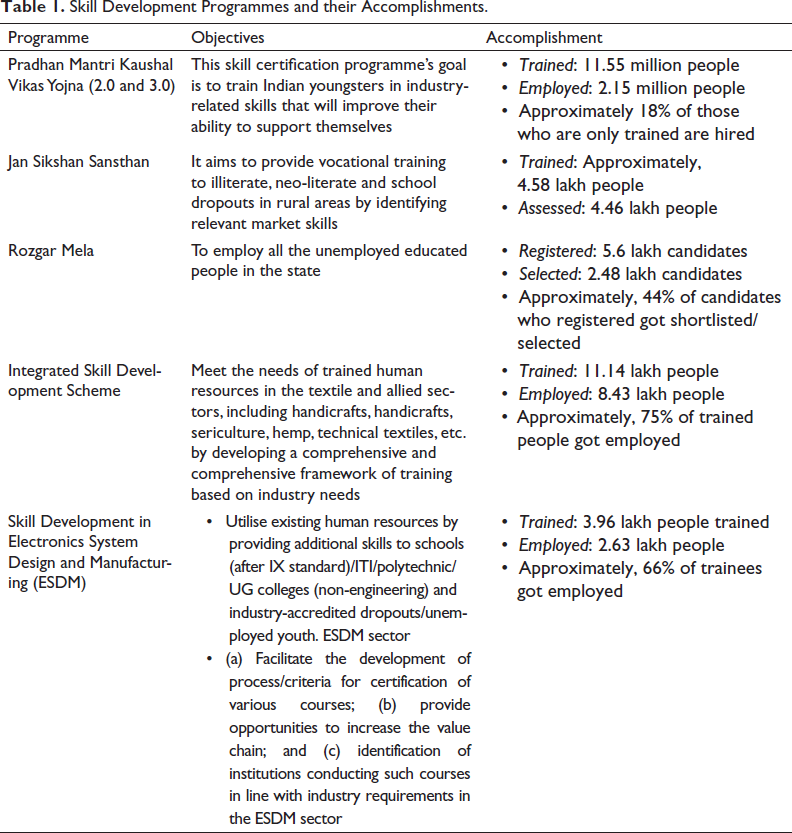
Skill Development Programmes and their Accomplishments.
Skill Development in India
In India, improving one’s skill set is thought to be crucial for employment generation. With more than 60% of the population being under 25, India has a distinct population advantage. But improving employment is necessary if we are to benefit from having such a huge workforce. According to recent statistics, just 10% of recent grads are employed, while the other 90% lack the qualifications to be hired by a corporation. The GDP of India is increasing at a rate of 6–8%, while job growth has lagged.
Concerns about supply and demand have an effect on employment chances.
India has not been able to provide enough employment possibilities on the supply side,
while on the demand side, professionals entering the labour market lack the necessary skill sets, leading to increased unemployment rates and unfavourable employment conditions.
Work skills, youth skills and the need for a competent workforce are the three most important components of strong demand for skill development.
The skill development system in India is enormous, diverse and extremely complicated, providing a wide range of abilities to a population that is quite diverse. In India, the two main fields related to skill development are education and vocational training. To gain skills, formal and informal methods are also used. For the purpose of skill development, government entities, businesses and NGOs offer official vocational training. Some of the main ways to receive formal vocational training include government-run industrial training institutes, privately run industrial training institutes, vocational schools and specialised institutions for technical training.
The Director-General of the Ministry of Employment and Training, the Ministry of Labour and Employment, is the nodal agency for vocational training at the national level.
The Director-General of Employment and Training is responsible for developing policies, setting standards, providing affiliations, trade testing, certification and issues related to vocational training and employment services.
Currently, a number of ministries, state governments, union territories and industry partners are working together to develop skills in India. The MSDE, which was established in 2014, will engage with all stakeholders to provide the best framework for delivering skills, close the skills gap between demand and supply, boost skills, develop new skills, innovate and guarantee availability. The system of youth employment initiatives in India is being developed under their direction, as is the Skill India programme. The MSDE and other ministries can support expertise initiatives with the help of the National Skill Qualification Framework. Additionally, playing significant roles as coordinators for the private sector are the NSDC and the SSC.
The current skill status of India reflects:
Over the next five years, India would require 3.9 billion sessions on digital skills. By 2025, the number of digitally trained workers in India is expected to expand nine-fold; however, there is now a shortage of talented workers in India because just 2% of the workforce is skilled.
The current education and training ecosystem is dynamic and does not meet the needs of emerging industries. According to one study, only 7% of engineering and MBA graduates have jobs.
A high percentage of the workforce has old skills. Advances in technology, economic growth rate and market disruption mainly seek new skill-based employment opportunities. Furthermore, to correct the disorders caused by technological advances, India needs to bring about generational changes in its education and skills development ecosystem.
The labour market is undergoing a dramatic structural change. The labour force participation rate (LFPR) of women in India is about 31%, and they contribute only 17% to India’s GDP.
Demands in the Labour Market and Young People’s Aspirations
The ‘National Skill Development Policy-2015’ lists the different industries (in 24 numbers) that need more qualified personnel. The top four sectors were construction, transportation and logistics, beauty and wellness and retail. Infrastructure, information technology, tourism and hospitality and healthcare also helped India create jobs. There are numerous distinct abilities needed. New skills are needed for jobs requiring various skill levels. There will be an increase in demand for nearly 110 million skilled people, and over half of the workforce will work in positions that do not exist yet or call for entirely other skill sets. High-level cognitive skills and soft skills have different skill sets. Employers typically seek for communication skills, compatibility, accessibility and learning agility in addition to technical, field-specific talents. The goal of skill training initiatives is to boost employee productivity and wage effectiveness while also improving access to employment. Young people must continually learn new things and acquire skills in order to stay competitive in the job market and keep up with technological advancements.
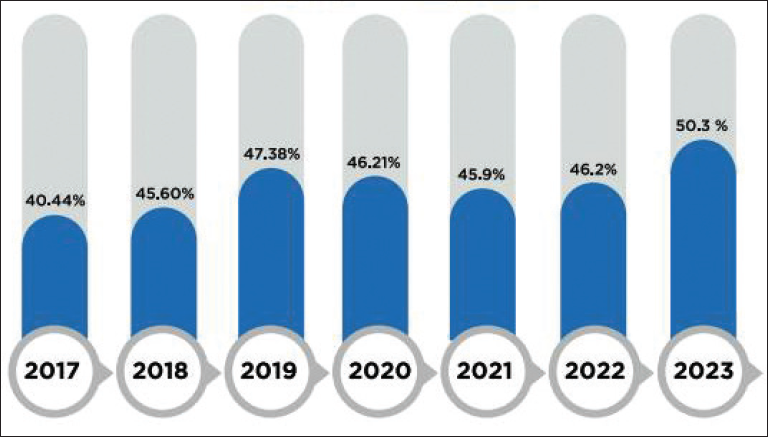
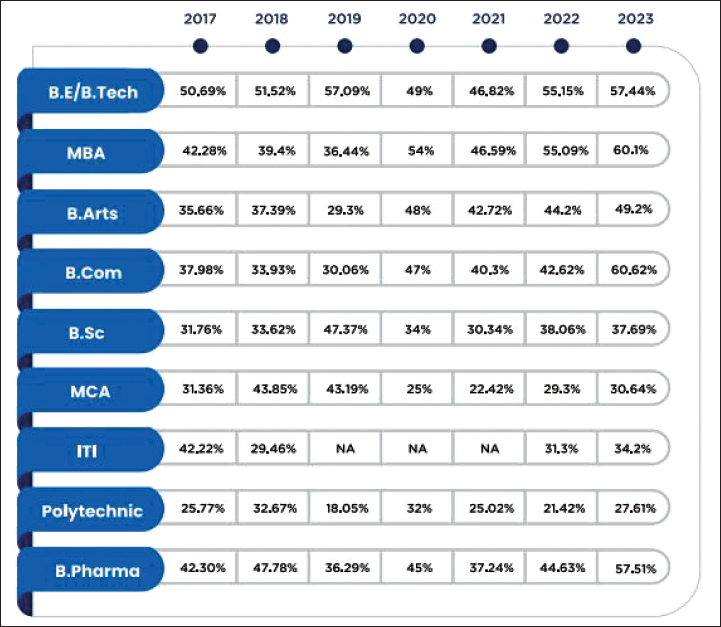
The most employable skills between the ages of 22 and 25 have been recognised, according to the India Skills Report, 2023, as shown in Figures 2 and 3. These are encouraging data for the developing nation of India. In India, 50.3% of young people have access to employment possibilities, while 88.4% of test takers look for internships to jumpstart their careers. Graduates of B.Tech and MBA programmes tend to have the greatest job averages and job standards (Skill Report for India, 2023).
Challenges Faced by Skill Development Programmes.
Government’s Skill Development Programmes and Their Impact on Employment
There are many programme types in several ministries, including the Ministry of Human Resource Development (now the Ministry of Education), the Ministry of Rural Development, the Ministry of Minority Affairs and the MSDE. Numerous skill development initiatives target young employment and employment in entry-level positions.
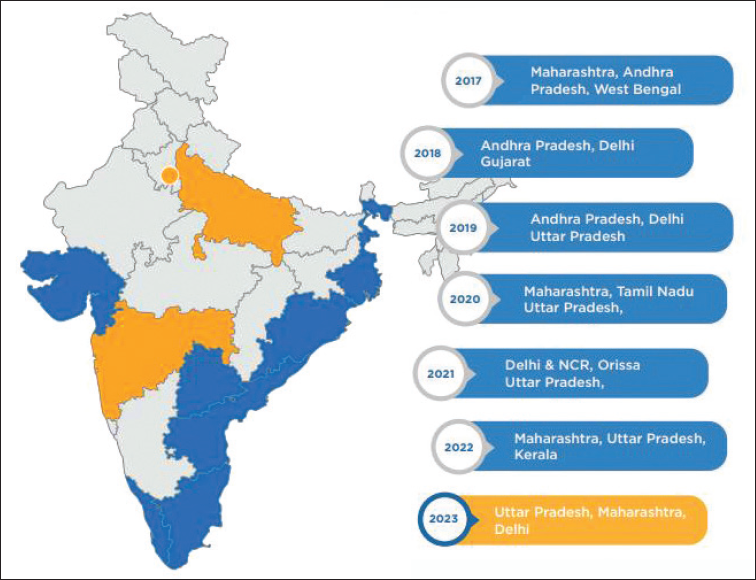
Figure 4 depicts a map of India with different states highlighted in either grey or orange, accompanied by a list detailing the states with the maximum supply of employable talent from 2017 to 2023. In 2017, Maharashtra, Andhra Pradesh, and West Bengal led in employable talent supply. The following year, Andhra Pradesh, Delhi, and Gujarat were prominent. In 2019, Andhra Pradesh, Delhi, and Uttar Pradesh topped the list. By 2020, Maharashtra, Tamil Nadu, and Uttar Pradesh were highlighted. In 2021, Delhi & NCR, Orissa, and Uttar Pradesh had the highest supply of employable talent. The year 2022 saw Maharashtra, Uttar Pradesh, and Kerala leading, while in 2023, Uttar Pradesh, Maharashtra, and Delhi were the top states. Notably, Uttar Pradesh and Maharashtra have appeared multiple times over the years, indicating a consistently high level of employable talent in these states.
Skill Development Shaping the Future of India
Better employment opportunities: It has been discovered that many trainees are easily placed during placement drives as the government and colleges lay a strong emphasis on skill development. Every business needs employees who are effective, efficient and productive. People could work more successfully and efficiently in less hours by developing their skills, improving their own development and practicing good company governance. Youth have improved chances, thanks to the government, based on their preferences and requirements. To raise the employment rate to at least 70% is its goal. People who participate in skill awareness programmes are better able to comprehend the benefits of skill training programmes and accomplish more.
Individual advancement: Developing one’s skills improves one’s aptitude in a certain field. Professional networks help to develop abilities for better bargaining, time management and communication.
Developing skill: Learning is a process that results in the development of skill. People can discover, develop and cultivate their intrinsic skills in the preferred sector with the aid of skill training.
A low dropout rate: India’s major issue is unemployment. Learning new talents enables individuals to better understand the necessary abilities of companies and direct their careers.
Enhanced professional growth opportunities: Everyone hopes to have a successful career in their life. Every effective professional path includes skill improvement. Skills increase a person’s employability, dependability, productivity and efficiency as well as their professional options.
Table 1 focuses on enhancing vocational skills and employment opportunities. The Pradhan Mantri Kaushal Vikas Yojna (PMKVY 2.0 and 3.0) aimed to train Indian youth in industry-related skills, successfully training over 11.55 million individuals and securing employment for 2.15 million. The Jan Shikshan Sansthan provided vocational training to illiterate, neo-literate, and school dropouts in rural areas, training approximately 4.58 lakh people and assessing 4.46 lakh individuals. The Rozgar Mela focused on employing unemployed, educated people in the state, with around 5.6 lakh candidates registering and about 44% being shortlisted or selected for employment. The Integrated Skill Development Scheme targeted the need for trained human resources in various sectors, such as textiles, training about 11.4 lakh people and achieving a 75% employment rate. The Skill Development in Electronics System Design & Manufacturing (ESDM) program aimed at providing additional skills to students and unemployed youth, training approximately 3.96 lakh individuals, with about two-thirds finding employment. In conclusion, these programmes have significantly contributed to skill development and employment in India, addressing the diverse needs of various sectors and populations, thereby enhancing the employability and livelihood of millions.
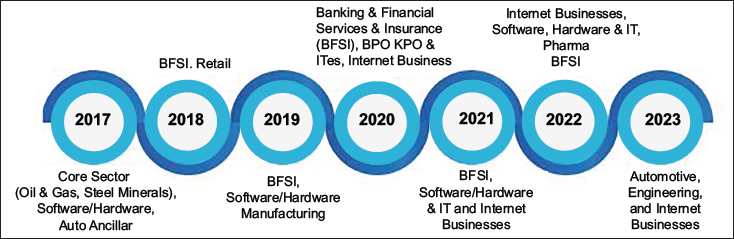
Figure 5 represents a horizontal timeline from 2017 to 2023, detailing the major hiring sectors for each year. In 2017, the significant hiring sectors were the “Core Sector (Oil & Gas, Steel Minerals),” “Software/Hardware,” and “Auto Ancillary.” In 2018, the focus shifted to “BFSI” (Banking, Financial Services, and Insurance) and “Retail.” The key sectors in 2019 were “BFSI,” “Software/Hardware,” and “Manufacturing.” In 2020, hiring opportunities were prominent in “BFSI,” “BPO, KPO & ITes,” and “Internet Business.” The primary hiring sectors in 2021 included “BFSI,” “Software/Hardware & IT,” and “Internet Businesses.” By 2022, the focus was on “Internet Businesses,” “Software,” “Hardware & IT,” “Pharma,” and “BFSI.” In 2023, the spotlight shifted to “Automotive,” “Engineering,” and “Internet Businesses.” Overall, the timeline from 2017 to 2023 highlights the dynamic shifts in major hiring sectors, reflecting evolving economic priorities and technological advancements. Initially, traditional industries like the Core Sector and Auto Ancillary dominated hiring in 2017. However, there was a noticeable shift towards BFSI, Software/Hardware, and Internet Businesses over the years, indicating a growing emphasis on financial services, technology, and digital enterprises. By 2023, the focus included Automotive and Engineering, alongside sustained interest in Internet Businesses, showcasing the diversification and expansion of hiring trends across various industries. This progression underscores the adaptability and responsiveness of the job market to changing economic landscapes and technological innovations.
Over the past few years, the groundwork has been done for the creation of an ecosystem for the efficient, effective and sustainable development of skills. India’s GDP is expected to increase from $2.7 trillion in 2019 to $5 trillion in 2025 and $8.4 trillion in 2030, according to the Bloomberg Financial Report and its projections. How we invest in this decade and how well we eradicate it will determine if we succeed in doing this. With more encouragement during the interruptions, we should make use of this chance to rebuild our critical thinking and logical thinking skills.
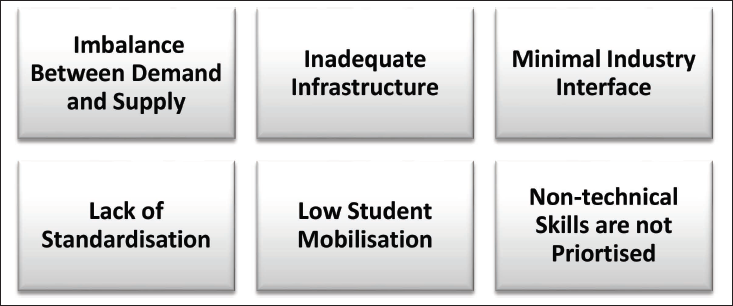
Challenges Faced by Skill Development Programmes (Figure 6)
Imbalance between supply and demand: The skill gap is the considerable discrepancy between the workforce’s existing capabilities and the necessary skills. In India, there is a significant skill gap between the abilities attained via education and training and the demands of businesses driven by rapid economic expansion. The demand–supply imbalance not only hinders individual economic progress but also the expansion of the economy as a whole. In order to achieve equitable growth, it is the government’s duty to be aware of these skill gaps and to implement new steps to close them.
Inadequate infrastructure: According to the NSDC, India will require 347 million skilled workers by 2022, but with roughly 12 million new employees joining the workforce each year, the nation will confront substantial skill development challenges. The country as a whole only has a training capacity of 4.3 million, therefore every year, close to 64% of new immigrants are denied access to training in skill development. Building such a huge infrastructure is difficult.
Minimal industry interface: Any education or training facility needs to have a minimal industry interface since it aids in determining the local or regional demand for particular skills and in updating course content. The bulk of training institutions have little interaction with the business world, which has a negative impact on their performance in terms of wage offers and skill placement records.
Low student mobilisation: Compared to their enrolment capacity, ITIs and polytechnics have lower enrolment than other skilled schools. Due to conservative mindset, unwillingness to immigrate and poor entry-level pay, the main cause of this issue is the mobilisation of students for training. Students believe that a conventional degree is preferable to a certificate because, given the same circumstances, it is more valuable than vocational training.
Lack of standardisation: Because there is no standardisation of the curriculum or training delivery system, courses at different training institutions cannot be compared, which leaves students uncertain about the skills necessary for any training under a given course.
Non-technical skills are not prioritised: Employers’ needs for behavioural skills are a major focus of vocational training institutions in India, in addition to the development of technical abilities. Employers also place a strong emphasis on interpersonal skills, domain-specific knowledge, cultural fit, honesty and integrity values, compatibility and learning style. This presents a significant challenge because it leaves many skilled workers without jobs.
Conclusion
By bridging the employment skills gap through various training and skills development programmes, India will become an ‘Atmanirbhar Bharat’ and a global hub for talented human resources. One of the main obstacles to closing the job gap is a lack of competent and trained workers. The most crucial element in national growth is skill development. To create successful programmes, it needs the combined effort of all agencies, stockholders and students. To promote greater job creation in the nation, the Skill India effort should concentrate on and foster more entrepreneurial capabilities in the workforce. To maintain quality and guarantee the model, it is crucial to build ties with training institutions. For the workforce to create the most jobs in the nation, the skill development programmes should concentrate on and promote more entrepreneurial talents. Offering training and skill development programmes to the educated and unskilled population is essential to reducing unemployment. This means that we should prioritise employment in the current environment and raise demand for even more qualified individuals. The capacity to meet the demands of the post-pandemic work strategy should result from the development of a self-sustaining activity model. Changes in technology have had a huge impact on company models and the talents required to create them even before the present crisis. Dynamic remote work and process digitisation are only two aspects of this. Colleges must reconsider how experts may refine their abilities and instruct pupils to satisfy market expectations. For the country’s citizens to receive an education and develop their skills, we must support initiatives like enhancing access at the local level and to educational possibilities.
Footnotes
Declaration of Conflicting Interests
The authors declared no potential conflicts of interest with respect to the research, authorship and/or publication of this article.
Funding
The authors received no financial support for the research, authorship and/or publication of this article.
