




Abstract
The outburst of COVID-19 has not only distressed the economic and social activities of Indian economy but also the world economy as a whole. Out of different economic activities, the micro, small and medium Enterprises (MSMEs) affected a lot. This article attempts to measure the contribution of MSMEs towards Indian economy and also attempts to find out the challenges and problems in pre- and during COVID period. We have used different descriptive statistics to measure the impacts of MSMEs and also use of correlation and co-integration to measure the relationship among the variables such as number of MSMEs, investment amount, employment and output. This pandemic is an exceptional shock for MSMEs. It is evident that there is a high degree of significant positive correlation among the variables. Johansen’s co-integration analysis resulted in the rejection of the null hypothesis signifying the existence of long-run co-integrating relationship. Given the extensive COVID-19 chaos, the government needs to establish an ongoing monitoring system and declare urgent relief steps to improve the MSMEs sector’s confidence. E-market linkage for MSMEs should be promoted, and fiscal stimulus should increase for this sector. The Government of India should take various measures to improve Indian MSMEs and achieve the vision of Self-reliant India.
Introduction
The unprecedented outbreak of COVID-19 brought misery to all the sectors, including micro, small and medium enterprises (MSMEs). The untried lockdown undersized the business activities of the MSMEs sector and mounted adverse shocks in the form of non-procurement of raw materials, reduced production and supply of final products, and non-availability of employees to work in the process of production. The consequences are wide and open, like loss of employment, reduction in revenue generation, declined sales and a cut back in the income of the working class (Hariharan et al., 2021).
In India, the MSMEs sector has played a vital role in the country’s economic and social development as these are essentially dependent on traditional inherited skills and mostly use local resources (Indrakumar, 2020). As on fact, MSMEs particularly widen their sphere in rural and industrially underdeveloped areas by fostering entrepreneurship in resource-poor communities and manufacturing over more than 6,000 quality products in national and global markets. In recent years, the MSMEs have been mounting significance for their rolling contribution to employment and income growth with export earnings and their ability to be reactive to alteration in the market and innovative practices in local or global spheres (World Bank Group, 2018). According to the National Sample Survey (NSS) 73rd round conducted during 2015–2016, beyond the agricultural sector, MSMEs were the only sector to generate huge employment opportunities of 11.10 crore jobs through 6.34 crore MSME units. It generates backward and forward linkages in the economy by promoting non-agricultural livelihood and appealing more investments to the sector (Ministry of MSMEs, 2018–2019).
The MSMEs sector has been widely accepted as the backbone of the Indian economy for its far-reaching impacts on the economy. But the hard blow of COVID-19 has made this sector to struggle for its sustainability. The threat of lockdown has become conscious in the MSMEs sector, bringing plentiful problems in financial crisis, demand, supply chain trouble, freezing of import and export opportunity, etc. (Banu & Suresh, 2020). To battle against health crisis challenges and maintain their growth process, this sector requires urgent stimulus. The government has shown its concern in need of attention in the form of monetary and fiscal support to induce economic activity in the sector.
Defining MSMEs in India
Comparison of Criteria Used for Defining MSMEs.
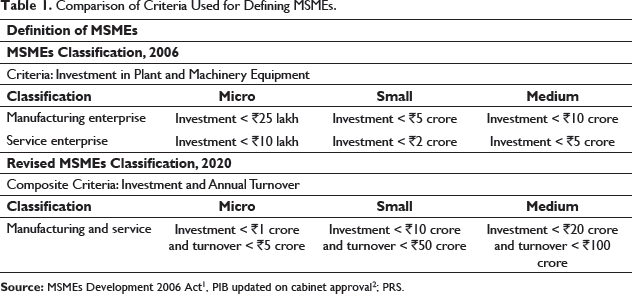
The revised definition may attract new entrepreneurs to the field, resulting in more investment, output and employment in the economy (Vaishnav & Surya, 2020).
Review of Literature
From the days of the National Planning Committee, it had been emphasised that the MSMEs would play a crucial role; hence, they need to be promoted on a sustainable basis and their vital issues to be addressed (Das, 2008). The growth of the MSMEs sector is a precondition for the growth of a developing economy like India as it comprises more than 50% of the manufacturing output of the economy (Ali & Husain, 2014; Eniola & Entebang, 2015). In recent years the MSMEs sector has been growing at a higher growth rate compared to the industrial sector. The foremost advantage of the sector is its employment prospective at low resource base. The MSMEs sector provides the maximum employment opportunities in terms of both self-employment and jobs after the prime agricultural sector (Kumar & Sardar, 2011). MSMEs sector had an important contribution towards employment generation and rural industrialisation, encouragement to entrepreneurial instinct and truncating regional disparities (Bhuyan, 2016). Communications bottlenecks are not yet completely resolved, so it’s the responsibility of the ministry of MSMEs to support the state governments for promoting the growth and development of MSMEs to make them able to compete in the changed global scenario (Ali & Husain, 2014; Kumar & Sardar, 2011).
This sector has immense potential in investment with generating infrastructure base, making more employment, developing innovative skills and proficiency, ensuring a fair regional development, developing backward areas, making the economy self-contained through import substitution and making possible the nation’s development process. At the same time, the MSMEs sector is the most vulnerable one in the era of the COVID-19 pandemic because of its size, the scale of business, limited financial executive resources and notably they do not have the capacity to compact with something so unexpected (Sipahi, 2020). COVID-19 has enormous depressing impacts on the MSMEs sector through disruption in demand chain problems of the production process and raw material and labour availability, which resulted in shrinking revenue generation (Singh, 2020). This unfamiliar incident forced the enterprises to either cut down their business activities due to lack of financial strength, lack of raw material availability, labour shortage, etc., or to switch according to the need from non-essential to essential commodities such as mask, PPE kits, sanitisers, etc. (Tripathy, 2020). A survey conducted on MSMEs by the All India Manufacturers Organisation confirmed that the self-employed MSME units, predominantly 35% of MSMEs sector, have no chance of recovery for their businesses as they have already initiated the shutting down procedure (Tripathy & Bisoyi, 2021). The apparel manufacturing units of the export sector were under the business loss of over ₹150 crore from March 2020 to May 2020 due to the pandemic aftermath situation (Roy, 2020). The export loss to India’s leather industries is estimated to be $1.5 billion due to the slowdown of the global market. The MSMEs sector is struggling for its payment to workers, payment for fixed variables such as electricity, rent and interest, reduced cash flow in the economy, labour force migration, controlled material supply, etc. (Tripathy & Bisoyi, 2021).
In order to stir the economy forward, countries have to reinforce their enterprises in the MSMEs sector (Sipahi, 2020). The government has primarily introduced urgent stimulus and precautionary measures to safeguard the MSMEs, such as liquidity support to address cash flow issues, preserving jobs through varied schemes and ensuring business continuity, as well as measures to expand trade opportunities by building their capacities (Chauhan, 2020; WTO, 2020). There are problems in inculcating the relief measures as India’s real challenge will be in spotting the 63.4 million informal MSMEs, where the majority are micro-enterprises (Prasad & Mondal, 2020). It is also identified that most of the policy instruments announced by the government are not directly targeting the MSME units; rather there lies the need for a more comprehensive policy measure to restructure the backbone (Reddy et al., 2020). The relief measures taken by the central government will not be sufficient enough to revive the collapsed MSMEs sector (Raney, 2020). Therefore, the government has to make sure through sufficient procedures and tracking mechanisms to reach every stakeholder in the MSMEs sector (Ghosh, 2020).
It is substantial from the above analysis that although there exists surplus of studies on MSMEs sector and its significance for the development of Indian economy but the outbreak of this crisis has negatively crashed the MSME units in terms of production, distribution, investment, employment, revenue generation, social integration, monetary needs, etc., and studies related to impact analysis of COVID-19 on MSMEs sector is partial in all Indian context. Also evaluation relating to policy response by the government and revival strategies is strangely limited. Through this article, a clear assessment will be prepared on finding a statistically significant relationship among the key variables of MSMEs sector like the volume of MSMEs, investment, production and employment and the long-run relationship between variables will be recognised. The study will have its own significance in the field of assimilating the experimental COVID-19 situation with the MSMEs sector.
Objectives
This article highlights as follows:
The contribution of the MSMEs sector to the Indian economy in terms of output, employment, income, investment and export The challenges encountered by the MSMEs segment before and during the COVID-19 pandemic The policy initiatives to revive the MSMEs sector by the government To suggest revival strategy of MSMEs to sustain in post-pandemic situation
Data and Methodology
The article is an analytical one. The data in relation to this has been collected primarily from secondary sources, including the published sources such as the annual report of Ministry of MSMEs, data by Central Statistics Office, Ministry of Statistics and Programme Implementation, RBI and Press Information Bureau (PIB)/Directorate General of Commercial Intelligence and Statistics (DGCIS), data released by CIBIL, Report of Regional Development Bank, the press release of the various news agency, etc.
The variables for deducing the proposed linkage are numbers of MSMEs, employment, investment and production, which has been assembled for the period 1992–1993 to 2015–2016. The study has confined its analysis period up to 2015–2016, as in further annual reports of Ministry of MSMEs, the said variables are not in same set-up as earlier. The study has made use of descriptive statistics, correlation and co-integration analysis. Correlation has used to know the degree of association between variables. Co-integration has been applied to check the long-run relationship between variables that whether they are integrated or not. So we have used the time series data to obtain the long-run relationship and trend among the variables. The statistical tools are the unit root test, augmented Dickey–Fuller test, Johansen’s co-integration test, the trace test and the maximum eigenvalue test estimated using the statistical software package E-views 7.
Contribution of MSMEs Sector
Contribution of MSMESs in Country’s Economy at the Current Price (in rupees crore).
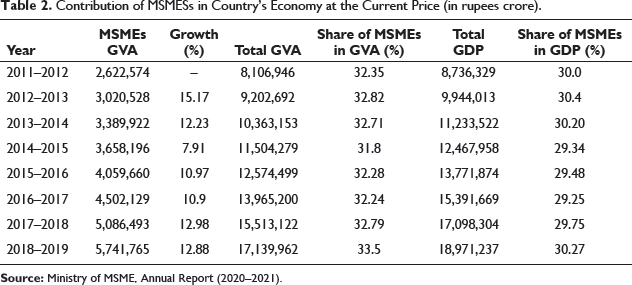
The contribution of MSMEs sector in country’s gross value added (GVA) has been continuously increasing. The share percentage of MSMEs sector in total GVA and in total GDP is increasing over the years. There are 633.88 lakh MSMEs in the country engaged in different economic activities like 31% MSMEs are found to be engaged in manufacturing activities, while 36% are in trade and 33% in other services.
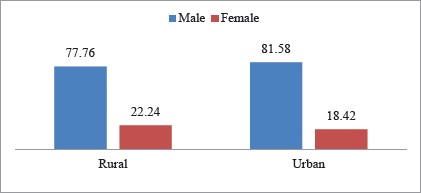
The micro-sector enterprises account for more than 99% of total estimated numbers within the defined sectors, where the small and medium sectors account for only 0.52% and 0.01% of total estimated MSMEs, respectively. Another point to consider is that out of the total estimated MSMEs, 51% are in rural India, and 49% are in urban areas. The ownership distribution of MSMEs in different areas can be presented as follows:
In ownership of enterprises, male dominance is noticeable irrespective of areas, as 79.63% of enterprises are male-owned compared to 20.37% owned by females. In comparison to urban areas, female ownership is concentrated in rural areas and more particularly in microenterprises. Ownership distribution of MSMEs in social category-wise has been presented as follows:
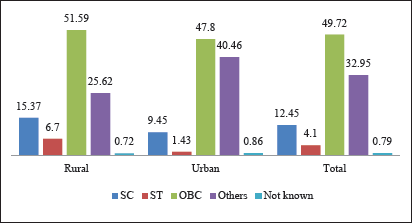
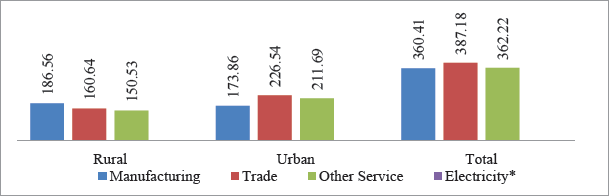
In the total MSMEs, 66.27% are owned by socially backward groups (SC, ST and OBC). Precisely in rural and urban areas, many MSMEs are attributed to OBCs owning (49.72%). The same picture of category-wise distribution is perceptible in different segments of the sector. According to the 73rd round report of NSS, 1109.89 lakh employees of the MSMEs sector work in different activities like 360.41 lakh in manufacturing, 387.18 lakh in trade, 362.22 lakh in other services and 0.07 lakh in non-captive electricity generation and transmission work of the country.
Within different MSME sector segments, only the micro-sector provides employment to 1076.19 lakh persons, which accounts for around 97% of total employment and the small and medium sectors are 2.88% and 0.16%, respectively. Of the total employment, 844.68 lakh (76%) are male employees, and 264.92 lakh (24%) are females.
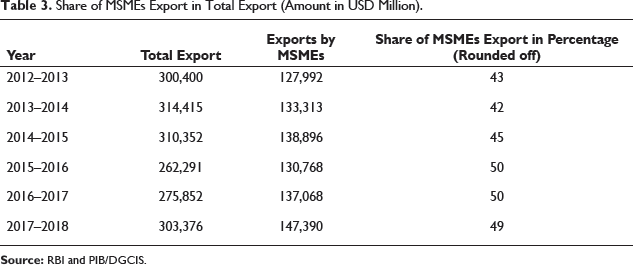
The export from the MSMEs sector plays a crucial role in determining the country’s total export. It is apparent from Table 3 that when the export from MSMEs sector declines, total export also diminishes. The share of MSMEs export is nearly 50% of the total export in India.
Share of MSMEs Export in Total Export (Amount in USD Million).
Correlation Analysis
A rudimentary mathematical approach for measuring the intensity of the relationship between two variables is preferred through correlation analysis. Mostly correlation is used to enumerate the exact degree of directional relation between the selected variables. The significance level of the respective correlation is being established through their respective t-statistics and probability values.
All the data series have been transformed to the logarithmic form to achieve stationary in variance. The theoretical reason behind the log transformation is to make values compare in percentage terms. There are huge differences in numbers of MSMEs units with respect to production, investment and employment; to linearise the extremity in variable variance, log transformation is necessary. The correlation equation among the variables is as follows:




where α0, β0, γ0 and δ0 are intercept parameters, α1, α2, α3, β1, β2, β3, γ1, γ2, γ3, δ1, δ2 and δ3 are slope coefficients,
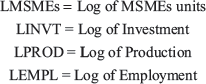
u1 t , u2 t , u3 and u4 are error terms in Equations (1), (2), (3) and (4).
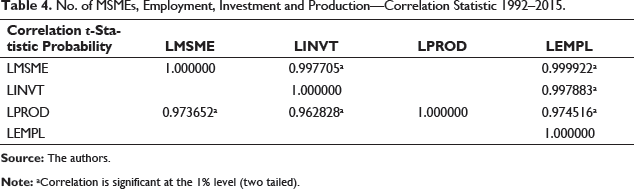
The correlation statistics for MSME units, production, employment and investment postulated that the variables are highly correlated as represented in Table 4. The coefficient of LMSME and LEMPL (0.999) is statistically significant with high degree of positive correlation. Similarly the positive correlation between LMSME and LINVT (0.997), and LINVT and LEMPL (0.997) are also statistically significant. Moreover, the correlation statistics between LPROD with LEMPL, LMSME and LINVT (0.974, 0.973 and 0.962, respectively) indicates a high degree of significant positive correlation among the variables.
No. of MSMEs, Employment, Investment and Production—Correlation Statistic 1992–2015.
Unit Root Test.
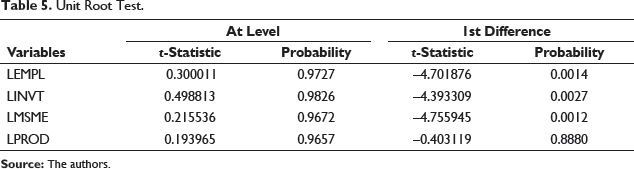
Taking the logarithmic transformation of MSME units, employment, investment and production for unit root test, it has been evident from Table 5 that employment, investment and MSMEs units are non-stationary at the level but they become stationary at the first difference, that is, I(1) at 1% level of significance. But production is not stationary at the level as well as the first difference. For the second difference, an instrumental variable needs to be taken as a proxy for the production. So we take only three variables like employment, investment and MSMEs units to examine the long-period relationship.
Johansen Co-integration Analysis
The Johansen co-integration is developed over Engel–Granger methodology. Different researchers widely use the 1988 version of Johansen’s co-integration test model. The relationship between the rank of a matrix and the roots of its characters can be tested using this developed version of the Johansen co-integration test model. Johansen proposes two different likelihood ratio tests: the trace test and maximum eigenvalue test, for finding the long-run co-integrating relationship among the variables. These two test statistics are given below:


where T = no. of observations
λ = estimated values of characteristic roots or the eigenvalues
r = co-integration rank
Co-integration Rank Test (trace).
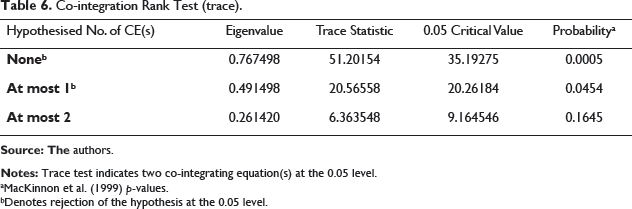
aMacKinnon et al. (1999) p-values.
bDenotes rejection of the hypothesis at the 0.05 level.
Co-integration Rank Test (Maximum Eigenvalue).
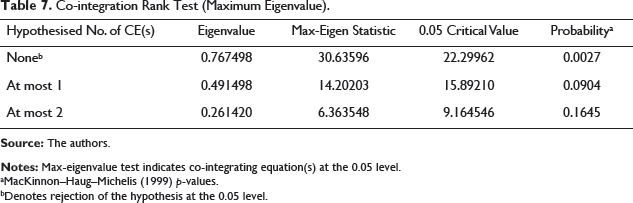
aMacKinnon–Haug–Michelis (1999) p-values.
bDenotes rejection of the hypothesis at the 0.05 level.
In the maximum eigenvalue test, the null hypothesis and procedure of testing are the same as the trace statistic. At none, the probability value (0.0027) is less than 5, which means the null hypothesis is rejected. This shows there is long-run co-integration among the variables. With the rejection of the null hypothesis, there is no need for checking at most 1 and most 2.
Impact of COVID-19 on MSMEs
The MSMEs sector plays a substantial role in stimulating the growth of the Indian economy. Prior to the COVID-19 turmoil, this sector is experiencing sluggish growth due to multitude of challenges like lack of financial support, absence of proper infrastructural facility, non-availability of advanced technology, etc. But the problems have been provoked more by the process of demonetisation (2016) and Goods & Services Tax (2017). As most of the MSMEs have a rural unskilled labour base, smaller problems have a larger influence on these units, and such a health crisis puts their potentiality and sustainability to further distress.
COVID-19 has changed the operational environment for MSMEs. The strictest lockdown to decontaminate the spread of the COVID-19 crisis resulted in the biggest shock for the MSMEs sector, particularly for the smallest firms. The sudden announcement to pursue all protocols of COVID-19 emergency in the process of production gives rise to supply chain problems like raw material import for cross-state and cross country boarder, panic migration of labour force to their native places, procurement of perishable products, monetary crunch, etc., generate unemployment, consumer fear element, the demand side problems, price rise, malfunctioning, reduced profit, etc.
The MSMEs sector experiences its worst situation as 55% loss in employment, production falling from an average of 75% of capacity to just 11%, about 17.2% of their annual sales loss, delay in raw material received, less possibility of paying wage, more labour shortage and lost the access to credit. Overall, 70% of firms report that they will not survive the crisis beyond the next 3 months if the lockdown continues, and the smallest one might collapse in 1 month (Ghosh, 2020; Rathore, 2020; WTO, 2020).
As per the survey of 5,000 MSMEs by the All India Manufacturers Organisation, The Hindu reported that 71% of firms are not able to pay salaries to their employees. At present, in India around 25% of firms will face closing if the lockdown goes ahead of 4 weeks, while 43% will face closing if lockdown extends further than 8 weeks (The Hindu, 2020). Unfortunately, the lockdown period continues with certain relaxation, which will intensify the situation to worsen than imagination.
In the Indian economy, cash plays a vital role in the transaction system. But the lockdown has affected the Indian MSME sector because most of the payments in small businesses are made in cash, like payments to labourers, purchase of raw materials, etc. They are not much comfortable adopting digital payment in their business. This may raise the problem of liquidity crises, and without adequate liquidity, the MSMEs might be closed down. Around 55% of electronic component import from China has decreased to 20% for coronavirus and lockdown. To overcome this difficult situation, India is reducing its dependency on China and makes the product at home (Prasad & Mondal, 2020). There is also no demand for hotels and restaurants around 5 months, and people are avoiding traveling. Due to the lack of imported raw materials in lockdown time, the production of textile industries is declining day by day, which shows they might go for stop producing; for example, sambalpuri, maniabandha sarees, etc. The COVID-19 has unnatural effect on the communities, businesses, organisations, financial markets and the international market as a whole. In this situation, the uncoordinated government lockdowns have escort to a supply chain problem (Sipahi, 2020). That means lower labour and it means lower production, lower production leads to lower supply that will create the inflation situation in the whole economy.
There are also some positive impacts on MSMEs due to COVID-19. In the time of lockdown, the movement of goods has been stopped. MSMEs are self-dependent and try to produce goods within the country. MSME is a great opportunity to produce hand sanitiser, face mask, etc. Some businesses are positively affected, which deal with the required items for livelihood. People demand the essential items more than necessary, which ultimately increases the price due to lower supply. In the containment zones, movement of the individual has been banned and in this critical situation, some business deals with packed products hold the opportunity by making home delivery and creating a healthy society.
Government Responses to Support MSMEs
The government of India has taken serious measures to revive the MSMEs during the COVID-19 pandemic. The government has announced the Emergency Credit Line Guarantee Scheme, which is the biggest fiscal component of the ₹20 lakh crore Aatmanirbhar Bharat Abhiyan package, in May. The main purpose of the package is to enhance businesses with a major focus on the MSMEs sector. The initiatives are as follows:
MSMEs have been redefined based on both investment limits and turnover size. Enlarged investment limit for micro units in the manufacturing sector from ₹25 lakh and in service sector ₹10 lakh, which is now 1 crore, for small units in the manufacturing sector from ₹25 lakh to ₹5 crore and in service sector ₹10 lakh to ₹2 crore, but it is now 10 crore, and for medium units in the manufacturing sector from ₹5 crore to ₹10 crore and in service sector ₹2 crore to ₹5 crore and now it is ₹50 crore of both manufacturing and services sectors. Introduced additional criteria of turnover for micro, it is ₹5 crore, for small ₹50 crore, and for medium it is ₹100 crore for both manufacturing and services in investment and turnover.
RBI also took some initiatives like decrease the repo rate; as a result, the bank can lend at a cheaper rate, giving some help to the MSMEs sector. In Mumbai, the State Bank of India has targeted to allocate ₹700 crore to MSMEs.
The government announced a collateral-free automatic loan worth ₹3 lakh crore and did not repay for 12 months to support the struggling MSMEs sector. This will help ₹45 lakh MSMEs units across the country in restarting business activity and safeguarding jobs. For the strained MSMEs, the government will provide ₹20,000 crore subordinated debt. A fund is created for the MSMEs sector that will be injecting ₹50,000 crore equity.
To compete and supply in government tenders, the global tenders will be banned for government procurement up to ₹200 crore that will support ‘Make in India’ and going towards Self-reliant India. The government of India and central public sector undertakings (CPSEs) will honour all dues to MSMEs within 45 days.
As a replacement for trade fairs and exhibitions, there has been started e-market linkage for MSMEs. Fintech will enhance transaction-based lending using the data generated by the e-market for the MSMEs that were currently facing the problem of marketing and liquidity due to COVID-19.
The government has decided to provide PF and EPF support for both businesses and workers by providing a liquidity relief of ₹6,750 crore to reduce the business’s financial stress. The PF contribution of employer and employee reduced from 12% to 10% for all official establishments under EPFO to increase the liquidity in the hands of the consumers as well as producers, but in the case of CPSEs and state PSUs, it will continue 12% as an employer contribution. Under this support of the government, around 6.5 lakh employers and 4.3 crore employees get benefited. Under PM Garib Kalyan Package, this benefit also applies to workers who are not eligible for 24% EPF support.
Further, to increase more liquidity in the hands of the taxpayer government announced cutting the TDS rate by 25% for SMEs, NBFCs and TCS. Under direct tax measures, government decided that the income-tax return for FY 2019–2020 will be extended from 31st July 2020 and 31st October 2020 to 30th November 2020 and tax audit from 30th September 2020 to 31st October 2020. The government also announced that all pending refunds to charitable trusts and non-corporate businesses and professions, include proprietorship, partnership, LLP and co-operatives, shall be issued immediately.
Revival Strategies in Post-epidemic Situation for Policymakers
We have proposed a variety of policy initiatives to assist MSMEs in alleviating their hardships. There is a need for MSMEs to access their financial status and security. Given that most firms are experiencing financial difficulties, the government should consider granting loans to these businesses to help them in the current crisis. Low-interest loans with long-term repayments can be offered. Additionally, the credit limit for MSMEs must be increased. Loan repayments might also be deferred to reduce the burden. Entrepreneurs should expect consistent good cash flows from the government. MSMEs payment delay should be addressed. The budgets, projected inflows of money, expected risks and obligations, etc., should be taken into account with the finance department to create a fresh 3/6-month action plan. Reliable and accurate information about government financial relief package and support provided by trade organisations are necessary before preparing and executing a financial strategy. MSMEs have to rethink their strategy for goods, differentiators, distribution models, quality of products, etc. MSMEs should perform an inspection of their operations in order to develop a strategy for post-COVID-19 operations. While consumers’ discretionary spending is evident, there is also a pronounced shift in consumer tastes that can be leveraged. There is a need to create a strong digital ecosystem. New innovations are transforming business. New technologies are connecting buyers and suppliers across more locations and activities, opening opportunities for MSMEs. The government’s e-Marketplace (GeM) has been set up to raise MSMEs’ share in government procurement in goods and services. Beyond online purchases, a strong and constructive engagement in the social media will prove an advantage for the involvement of consumers and stakeholders. A digitally activated internal environment should also be built, which enables remote work or homework without hampering data protection or employee productivity. There is a need to incorporate new-age technological advances in MSMEs. Technology adoption can help MSMEs improve process efficiency, reduce cost, information visibility and enhance worker safety. MSMEs may also foster product and process developments by collaborating with technology leaders, that is, research institutions, tech start-ups and students. Partnerships may be another avenue for MSMEs. It may collaborate with existing foreign players to penetrate the Indian market or develop a low-cost production base. Work in three shifts and ensure social distancing at workplace to restart an industry that suffered after the COVID-19 pandemic. The ILO proposed that governmental efforts should address worker health and safety, economic stimulus and income and employment support (ILO, 2020). Online banking enables MSMEs to conduct business transactions without the need for physical contact. This enables organisations to reduce transaction expenses while also speeding up the transaction process. Learning from the current crises, it is important to chalk up an appropriate crisis management strategy that can address both immediate and long-term consequences.
Conclusion
India’s main focus is being ‘from local to global’ for MSMEs. A larger chunk of Indian MSMEs is in rural areas, which are going to play a significant role in making Self-reliant India. The effect of the modification in the definition of MSMEs on their economic performance has not been examined yet and remains a subject for future research. The revised definition will definitely add to the volume of MSME units so also an affirmative rise in the output, employment, product diversification, investment and export. Empirically analysing the decisive elements of the MSMEs sector, it is evident that there is a high degree of significant positive correlation among the variables (MSME units, production, employment and investment). Johansen’s co-integration analysis with trace test and maximum eigenvalue test connotes in null hypothesis rejections, which means the said variables have a long-run co-integrating relationship. Majority of MSMEs are facing the problem of access to finance and marketing their products during COVID-19. They struggle to cover expenses such as salaries, power bills, rent, property and water taxes, telephone and internet charges and bank loans. Hence their fundamental issues like registration issues, credit constraints, marketing problems, adopting technology, inadequate infrastructural facilities, etc., need to be tackled on a sustainable basis. Given the extensive COVID-19 chaos, the government needs to establish an ongoing monitoring system and declare urgent relief steps to improve the MSMEs sector’s confidence. ‘Make in India’ and ‘Digital India’ will be encouraging more. E-market linkage for MSMEs should be promoted, and fiscal stimulus should increase for this sector. The Government of India should take various measures to improve Indian MSMEs and achieve the vision of Self-reliant India.
