




Abstract
The COVID-19 pandemic has ushered in an unprecedented global crisis, profoundly affecting industries and managerial sectors worldwide, including supply chain management (SCM). This study explores the impact of the pandemic on research trends in sustainable supply chain management (SSCM), which has gained significant attention in recent years due to its promising advantages and environmental imperatives. By comparing pre- and post-pandemic periods, we investigate the paradigm shift in SSCM issues caused by COVID-19. To conduct our analysis, we utilised data from the Scopus database, focusing on published research spanning the past decade (2010–2021). Through trend estimations, we identified the key areas that experienced shifts in research focus, shedding light on the evolving landscape of SSCM in the COVID-19 environment. This study contributes to the literature by providing valuable insights into how the pandemic has influenced research directions within the domain of sustainable supply chains. Scholars and practitioners can use these findings to assess the most explored and overlooked areas in SSCM during the COVID-19 era. Ultimately, our research aims to guide future investigations and inform strategies for resilient and environmentally conscious supply chain practices in the post-pandemic world.
Introduction
The interdependence of organisational growth and supply chain management (SCM) (Green et al., 2008) has led to SCM becoming one of the most extensively researched management fields in recent times (Raj et al., 2022). Despite the absence of a universally accepted definition for SCM (Chicksand et al., 2012; Ellram & Cooper, 2014), various researchers have presented their interpretations of SCM within organisational contexts (LeMay et al., 2017; Queiroz et al., 2020; Wieland, 2021). This has resulted in diverse terminologies being used, such as supply networks (Tatham et al., 2010), logistics management (Kain & Verma, 2018), supply and demand planning (Tate et al., 2015) and demand and order management (Narayanan et al., 2019). However, the significance of effective SCM in driving organisational success remains a consistent theme among researchers.
Notably, sustainability has emerged as a critical influencing factor within the explored areas of SCM for achieving organisational excellence (Sarkis, 2020). Sustainable supply chain management (SSCM) refers to integrating environmental, social and economic considerations into an organisation’s supply chain operations (Ahi & Seracy, 2013; Font et al., 2008). Research in SSCM emphasises the triple bottom-line approach, addressing environmental and social concerns while considering the financial aspects of the supply chain (Sarkis, 2020). Due to the growing importance of environmental and social factors, SSCM has become a prevailing trend, with numerous organisations integrating sustainability into their business strategies (Srivastava, 2007; Tseng et al., 2015).
However, the emergence of COVID-19 in 2019 brought about significant changes in operational strategies and business perspectives for organisations, influencing research directions as well. SCM was particularly impacted, facing lockdowns and import bans in nearly every country worldwide (Sharma et al., 2020a). Various industries experienced economic challenges due to COVID-19’s impact on their supply chains, with many still in the process of recovering functionality (Sharma et al., 2020a). The three dimensions of SSCM—economic, environmental and social—were also profoundly affected by the operational fragilities resulting from containment measures to curb COVID-19 (Sharma et al., 2020b). Moreover, the pandemic introduced new social and sustainable regulations, including social distancing, remote work, lockdowns, curfews, reduced face-to-face meetings and restrictions on interstate movements and imports. These measures not only impacted the social aspect of SSCM but also posed obstacles to the environmental and economic sustainability of supply chains (Karmaker et al., 2021; Sarkis, 2020). Recognising the major effects of COVID-19 regulations and fears on SSCM, researchers, academicians and experts have started seeking innovative solutions to achieve sustainability while considering the pandemic’s impacts. This has led to a notable shift in research explorations within sustainable supply chain areas. The resulting research opportunities arising from the COVID-19 pandemic warrant investigation and necessitate a comparison of research trends in SSCM to assess the emergence of new dimensions and potential pathways for exploration (Sharma et al., 2020a, 2020b).
This study relies on literature findings and research trends in SSCM, comparing the pre– and post–COVID-19 situations. It aims to provide a comparative analysis of sustainability factors within supply chains, both in a pre-pandemic world and post–COVID-19 challenges. The study delves into the research opportunities engendered in the area of SSCM due to the wake of COVID-19 and its critical impact on industries’ supply chains. The study’s objective is to compare research inclinations and identify new dimensions in SSCM influenced by the pandemic, providing valuable insights for practitioners and researchers in achieving sustainable supply chains amidst COVID-19 challenges. The study assesses research trends in SSCM pre– and post–COVID-19 by conducting a systematic review of literature from 2010 to the present. The Scopus database was used for article identification. In the pre-COVID-19 period, 1,373 articles were selected, and in the post–COVID-19 period, 523 articles were chosen for assessment. This study contributes to existing knowledge by providing a comprehensive analysis of research trends in SSCM amidst the COVID-19 pandemic, enhancing our understanding of the field’s evolution and offering insights for future theoretical developments in SCM.
Research Methodology
This study is a systematic review of the available literature on SSCM. It assesses research trends in pre–COVID-19 conditions, considering SSCM literature from 2010 to 2019, and explores inclinations in post–COVID-19 time, covering research works from 2020 to the present. The study focuses solely on research articles published in journals, excluding theses, books, book chapters, conference proceedings and web articles. The well-known Scopus database, managed by Elsevier, was utilised to identify research articles, comprising approximately 35,000 peer-reviewed journals across various fields (Oliveira et al., 2018). The research article selection followed a three-step approach. Initially, keywords such as ‘sustainable supply chain’, ‘sustainable supply network’, ‘sustainable supply and demand’, ‘sustainable logistics’ and ‘sustainable value chain’ were used for data search in pre– and post–COVID-19 contexts. In the second step, only research articles published in journals were retained, while other forms of publications were excluded. The last step involved removing duplicate and non-relevant articles. For the pre–COVID-19 time, the process yielded 2,043 identified articles, 1,421 considered articles and finally, 1,373 selected articles for analysis. Similarly, for the post–COVID-19 period, 623 articles were initially identified, 529 were further assessed and 523 articles were ultimately chosen for the study. The comprehensive methodology adopted in this research provides valuable insights into the evolving trends of SSCM in the pre– and post–COVID-19 eras.
Results and Discussion
This study analyses research trends in SSCM before and after COVID-19, considering various parameters such as publications by countries, domain-wise trends in SSCM and the contributions from journals. In addition, an analysis of the most cited articles in both pre– and post–COVID-19 periods is conducted to study the inclinations in research focus. The empirical research findings are presented comprehensively in the subsequent subsections, followed by a discussion of the study’s implications.
Annual Publication Trend of Research in SSCM
Figure 1 presents the annual publication trend of research articles in SSCM from 2010 to 2021. The figure includes a linear trend and a two-period moving average forecast, which provides the projected research publication value for the next years. The results reveal a steady and consistent growth in research publications in SSCM over the past decade, and this trend continues even after the emergence of COVID-19, with an increased number of articles published in the post–COVID-19 period. Both the linear trend and the two-period moving average forecast indicate a positive progression in research publications for the upcoming years.
Annual Publication Trend of Research in SSCM.
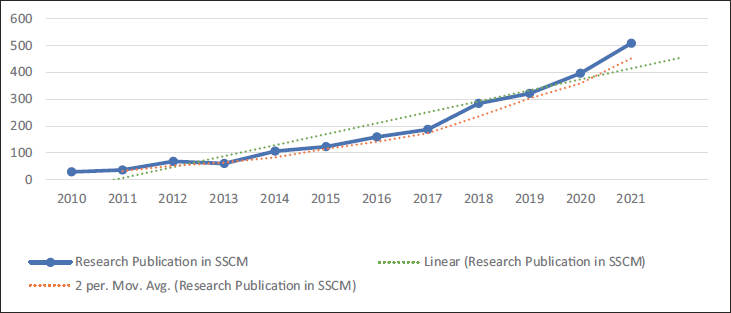
The findings highlight the enduring relevance and growing interest in SSCM as a research area (Mardani et al., 2020). Despite the challenges posed by the COVID-19 pandemic, scholars and practitioners remain actively engaged in exploring SSCM topics. The upward trend in research publications signifies a sustained commitment to understanding and improving supply chain sustainability, even amid global disruptions (Khan et al., 2021). The results also suggest that COVID-19 has not diminished interest in SSCM research; instead, it may have catalysed a deeper focus on sustainability issues within supply chains. The continued growth in SSCM research publications indicates the significance of the field in addressing contemporary environmental, social and economic challenges (Khan et al., 2021; Martins & Pato, 2019). Researchers and practitioners are likely exploring innovative strategies to enhance supply chain resilience, reduce environmental impacts and promote social responsibility in response to the pandemic’s disruptions. The findings underscore the need for ongoing investigation and knowledge generation in SSCM to develop robust and adaptable supply chain practices for a sustainable future (Khan et al., 2021; Mardani et al., 2020; Martins & Pato, 2019).
Contribution of Original Research Articles and Review Works
The study yielded insightful results from the analysis of 1,373 articles on SSCM for the pre-COVID years 2010 to 2019. Among these, 1,253 articles represented original research work, while 120 articles were review works summarising existing literature on SSCM. For the post–COVID-19 period, out of 523 identified articles, 40 were review works and 483 were original research studies. Figure 2 visually depicts the percentage comparison of total review articles and original research studies for the pre– and post–COVID-19 times.
Percentage Comparison of Review Articles and Original Studies in Pre– and Post–COVID-19.
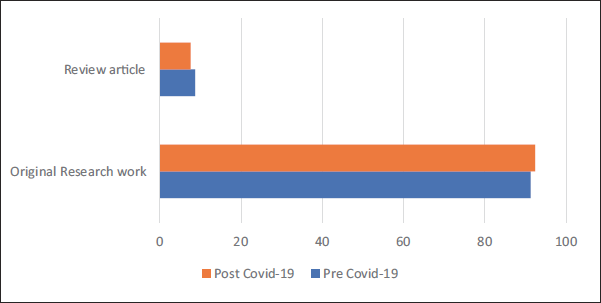
The findings suggest a notable shift in research focus after the COVID-19 pandemic. Before the pandemic, a significantly higher proportion of published articles consisted of review works, indicating an effort to synthesise and consolidate existing knowledge on SSCM. However, after the emergence of COVID-19, there has been a clear preference for conducting original research studies in SSCM. This shift indicates a heightened interest among academicians and researchers to explore new dimensions, challenges and opportunities in SSCM prompted by the pandemic’s impact. The emphasis on original research studies in the post–COVID-19 period indicates a growing demand for innovative solutions and evidence-based approaches to address the evolving complexities faced by supply chains in the wake of the pandemic (Faramarzi-Oghani et al., 2023). This shift in research inclination reflects a proactive response to the disruptive nature of COVID-19 on supply chains and a commitment to developing practical and effective strategies for achieving sustainability in supply chain operations. The results indicate that the COVID-19 pandemic has spurred a renewed focus on empirical research in SSCM, with researchers and academics seeking to contribute new insights and knowledge to navigate the challenges and opportunities arising in the post-pandemic era. This research-driven approach is essential for shaping resilient and sustainable supply chains capable of adapting to future uncertainties and global crises (Faramarzi-Oghani et al., 2023; Seuring et al., 2022). The shift towards original research studies underscores the field’s dynamism and its commitment to finding novel solutions for SSCM amidst rapidly changing global circumstances.
Subject Area-wise Publications in SSCM in Pre– and Post–COVID-19 Times
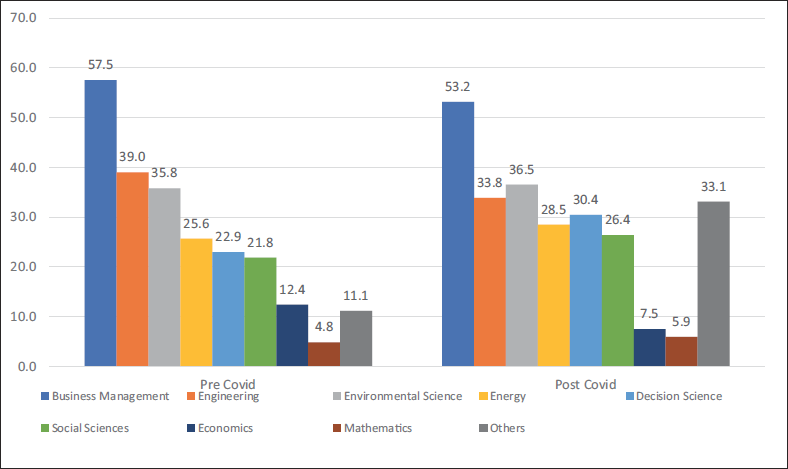
The analysis of subject area-wise contributions in SSCM research, as provided in Figure 3, offers valuable insights into the shifting research focus in the pre– and post–COVID-19 periods. Over the last decade, around 58% of research articles belonged to the business management domain, followed by engineering and environmental domains. However, post–COVID-19, there was a notable reduction in the contribution from the business management domain, with approximately 53% of research articles originating from this area. In contrast, environmental science and engineering domains gained prominence in SSCM research. The observed shift in subject area contributions suggests a changing research landscape influenced by the COVID-19 pandemic. The increased emphasis on environmental science indicates a growing recognition of the environmental impacts on supply chains and a heightened interest in sustainable practices to address ecological concerns. Decision science’s enhanced contribution reflects the need for robust decision-making frameworks in managing supply chains amidst uncertainty and disruptions caused by the pandemic. The findings also signify a significant transformation in the perceived priorities of SSCM research in the post-pandemic era. With businesses facing unprecedented challenges, there is a growing recognition of the importance of environmental sustainability and resilience in supply chains (Shekarian et al., 2022). The inclusion of diverse subject areas highlights the interdisciplinary nature of SSCM research, where scholars from different domains collaborate to explore comprehensive and holistic solutions to sustainability challenges.
The shift in subject area contributions in SSCM research after COVID-19 underscores the field’s adaptability and responsiveness to emerging global challenges. It signifies the research community’s readiness to explore new dimensions and incorporate diverse perspectives in achieving SSCM. As supply chains continue to navigate complexities and uncertainties, the findings suggest a strong commitment to advancing sustainable practices and resilience in supply chain operations. The increased focus on environmental and decision science areas in SSCM research post–COVID-19 reflects a collective effort to create environmentally responsible and robust supply chains, ensuring long-term viability and success in an ever-changing global landscape. The findings from this analysis provide important guidance for researchers, practitioners and policymakers seeking to shape sustainable and resilient supply chains for the future.
Comparative Analysis of Percentage Contribution of Different Subject Areas for Research Publications in SSCM in Pre– and Post–COVID-19 Times.
Country-wise Research Publication Trends in SSCM in Pre– and Post–COVID-19
Table 1 presents the article count and percentage contributions of the top 10 countries in SSCM research during the pre– and post–COVID-19 periods. The analysis reveals a noteworthy shift in the leading contributors to SSCM research. While the United States and the United Kingdom were prominent in previous years, developing economies such as China and India have emerged as significant contributors in the post–COVID-19 era. This shift reflects the growing research and development capabilities of developing economies, as well as their increasing focus on environmental and sustainable factors in SCM (Sánchez-Flores et al., 2020). The rise of China and India in SSCM research signifies their heightened commitment to addressing sustainability challenges in supply chains, aligning with the global drive for environmentally responsible practices. Their increased contributions also reflect the growing importance of SSCM in the context of the COVID-19 pandemic’s disruptions and the need for resilient supply chain solutions. The findings underscore the increasing recognition of the role that developing economies play in shaping sustainable supply chains and the growing influence of their research and innovation in the field (Nisar et al., 2023). The increased research output from China and India suggests a maturing research landscape in these countries, with academia, industries and policymakers actively engaging in addressing sustainability issues in supply chains.
Article Count and Percentage Contributions of Top 10 Countries.
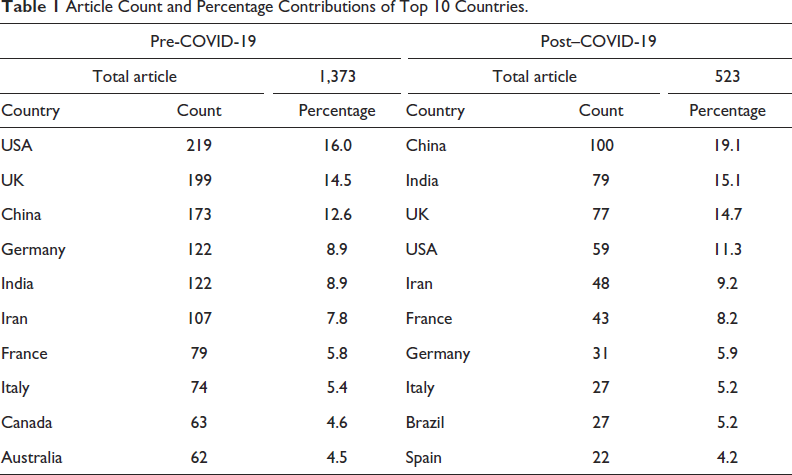
The changing dynamics in the geographical distribution of SSCM research highlight the global nature of sustainable supply chain challenges and the need for collaboration and knowledge-sharing among countries to achieve collective sustainable development goals. The research trends indicate a more inclusive and diversified approach to SSCM, with a broader range of perspectives and experiences contributing to the advancement of sustainable practices in SCM. The findings demonstrate the dynamic nature of SSCM research and its responsiveness to evolving global contexts. The increased contributions from China and India, alongside other countries, signify a collective commitment to promoting sustainability, resilience and innovation in supply chains. Policymakers, businesses and researchers can draw insights from these trends to enhance collaborative efforts and devise effective strategies for achieving sustainable and resilient supply chains in a rapidly changing world.
Research Journals Contributions
The analysis of research journals and their contributions to SSCM during the pre– and post–COVID-19 periods is presented in Table 2. Interestingly, the results reveal a shift in the most contributing journals. While the Journal of Cleaner Production held the top position in the pre-COVID-19 era, the Sustainability journal emerged as the leading platform for research publication during the COVID-19 period. This shift highlights the changing landscape of SSCM research and the growing significance of sustainability-focused journals in disseminating research findings amidst the pandemic. The presence of core operations research journals, such as the International Journal of Production Research and Annals of Operations Research, among the top 5 most contributing journals in both pre– and post–COVID-19 periods, signifies the increasing importance of SSCM in the field of operations management. This trend indicates that SSCM has gained traction as a critical area of research, garnering attention from renowned operations-focused journals. The prominence of sustainability-oriented journals and core operations research journals in SSCM publications during the post–COVID-19 era indicates a convergence of environmental concerns and operational efficiency in SCM. This reflects the recognition that sustainability and resilience are vital considerations in supply chain operations, especially in the context of disruptions caused by the pandemic.
Top 5 Research Journals for SSCM in Pre– and Post–COVID-19.
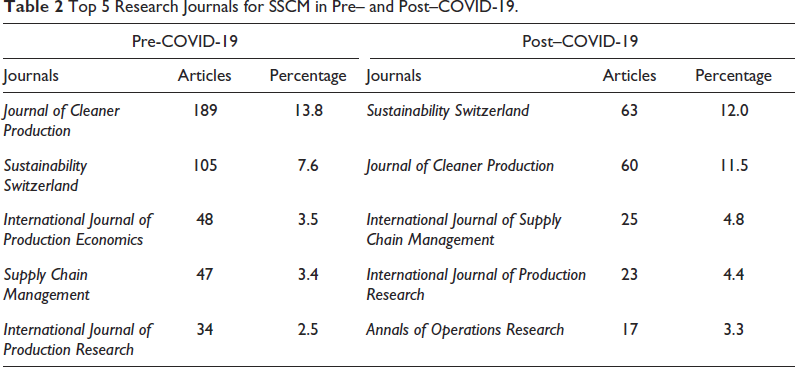
The findings underscore the growing relevance of SSCM research in addressing real-world challenges, with academia, industries and policymakers actively engaging in finding sustainable solutions to supply chain disruptions (Martins & Pato, 2019; Shekarian et al., 2022). The increased focus on SSCM in high-impact journals also implies that the research community acknowledges the urgency of sustainable practices and their potential to enhance supply chain resilience and adaptability. The shift in the most contributing journal and the prominence of core operations research journals in SSCM publications signify a maturing research landscape. This suggests that SSCM has evolved beyond being a niche topic to become a key area of interest for scholars and practitioners alike, with far-reaching implications for sustainable business practices and global supply chain resilience. Policymakers and businesses can draw valuable insights from these research trends to adopt sustainable strategies and foster resilient supply chains that can withstand future disruptions.
Implications of the Study
The study provided a detailed analysis of research trends in the SSCM area during pre–COVID-19 and post–COVID-19 times. The study’s implications are significant and offer valuable insights into the research trends and opportunities in SSCM amidst the COVID-19 pandemic. The study highlights the resilience of the research community in the face of the pandemic. Despite the challenges posed by COVID-19, researchers and academicians have continued to focus on SSCM and sustainability in supply chains. This indicates the enduring importance of sustainability considerations in supply chain operations, even during times of crisis. The research trends show that even with the impact of the COVID-19 pandemic, the sustainability factor is equally important in the present time, considering all three domains of environment, economics and social sustainability in supply chains (Sarkis, 2020). Also, the increase in original research works in SSCM during the post–COVID-19 era suggests a shift towards addressing specific challenges and opportunities arising from the pandemic. Researchers are actively exploring ways to manage sustainability factors while simultaneously dealing with the impact of COVID-19 on supply chains (Sarkar et al., 2022). This underscores the need for integrated approaches that consider both sustainability and pandemic response strategies in SCM (Eggert & Hartmann, 2023). It also signifies a growing awareness of the interconnectedness between sustainability and resilience in supply chains.
The comparative analysis of subject area contributions reveals an interesting trend towards increased focus on environmental factors in SSCM during the post–COVID-19 period. This suggests that researchers are recognising the critical role of environmental sustainability in supply chain resilience. The convergence of green SCM and SSCM indicates a growing integration of ecological concerns with overall supply chain sustainability, reflecting a shift towards greener and more sustainable supply chain practices. Also, the prominence of developing economies such as China and India in SSCM research publications highlights the global interest and commitment to sustainable supply chain practices. The increased contribution from these countries suggests a growing awareness of the importance of sustainability and the role of SSCM in achieving it. This has implications for the future of global supply chains, as developing economies play an increasingly influential role in shaping sustainable supply chain practices (Nisar et al., 2023).
The COVID-19 pandemic has also opened up new research opportunities in SSCM. Scholars have the chance to assess the pandemic’s sustainability impacts on social, economic and environmental domains of supply chains. The pandemic can serve as a catalyst for exploring innovative solutions and optimisations with COVID-19 considerations (Sarkis, 2020). Researchers can develop models and strategies to minimise pandemic-related disruptions and identify ways for building more robust and resilient supply chains. The study’s implications demonstrate that sustainability remains a critical focus in SCM, even in the face of unprecedented challenges like COVID-19. The pandemic has not deterred researchers from exploring sustainability in supply chains but rather has encouraged them to adapt their research to address new opportunities and challenges arising from the crisis. These findings offer valuable guidance for policymakers, businesses and researchers to prioritise sustainability and resilience in SCM and drive towards a more sustainable and pandemic-resilient future.
Conclusion
Our study provides valuable insights into the research trends of SSCM during both pre– and post–COVID-19 periods. Utilising a systematic and structured literature review methodology, we conducted an extensive analysis of research articles from the Scopus database, encompassing a total of 1,896 articles. Our findings demonstrate consistent and steady growth in the field of SSCM, irrespective of the challenges posed by the COVID-19 pandemic. Through our analysis, we observed interesting shifts in research focus and subject-wise contributions. Notably, the post–COVID-19 period witnessed a significant increase in original research works, highlighting the urgency and importance of addressing sustainability challenges in the context of pandemic disruptions. This trend signifies the dedication of researchers and academicians to explore innovative solutions for achieving sustainability while effectively managing the complexities arising from the pandemic. We also identified a noteworthy change in the leading countries contributing to SSCM research. Developing economies such as China and India emerged as significant contributors during the post–COVID-19 period, reflecting their growing research capacity and focus on sustainable practices.
Our research serves as a comprehensive resource for understanding the impact of COVID-19 on research trends in SSCM. It can be leveraged to assess underexplored areas and delve deeper into the most explored aspects of SSCM in the context of the COVID-19 environment. As supply chains continue to grapple with uncertainties, our study provides practitioners and policymakers with valuable guidance on navigating sustainability challenges while effectively managing pandemic-related disruptions. In the future, this research can serve as a foundation for further investigations in SSCM, offering avenues for in-depth exploration of sustainable supply chain practices amidst the COVID-19 era. By fostering a deeper understanding of SSCM in the post-pandemic world, our study contributes to the advancement of knowledge and drives innovative solutions to create more resilient and sustainable supply chains for a rapidly changing global landscape.
While our study offers valuable insights, it is essential to acknowledge its limitations. We assumed that all articles published in 2020 in SSCM were impacted by COVID-19, given the absence of a tool to segregate articles based on varying publication times in a year. To enhance the accuracy of future studies, manual assessments can be conducted to exclude post–COVID-19 published articles that pertain entirely to the pre–COVID-19 period.
Footnotes
Declaration of Conflicting Interests
The authors declared no potential conflicts of interest with respect to the research, authorship and/or publication of this article.
Funding
The authors received no financial support for the research, authorship and/or publication of this article.