




Abstract
This article uses a case study method to explore implementing an organisation’s digital competency-building strategy. The research examines the organisation’s context, including its size, industry and current digital landscape, to comprehensively understand its challenges and opportunities in developing digital competencies. Through qualitative data collection techniques such as interviews, surveys and observations, the research uncovers the specific strategies employed by the organisation to build digital competencies. These strategies may include training programmes, mentorship initiatives, online learning platforms and other relevant interventions. Additionally, the research explores the factors that influence the success or failure of these strategies, such as leadership support, organisational culture and employee engagement. This study used the multi-criteria decision-making analysis technique VIKOR to prioritise these factors and provide a prescriptive approach for digital competency building in a business programme to remove subjectivity and bias. Findings indicate that the digital competency-building initiative, including improved employee performance, enhanced digital literacy and increased innovation, is analysed to gauge the overall impact on the organisation’s success. Ultimately, this research aims to inform organisations about the importance of digital competency building and provide guidance on effective strategies for implementation. The case study approach allows for a deep exploration of the contextual factors and provides actionable recommendations for organisations looking to enhance their digital capabilities. By aligning their workforce’s skills with the demands of the digital age, organisations can better position themselves for success in an increasingly digitalised world.
Introduction
Educational management is used in institutions or organisations. Early in the twentieth century, a branch of study known as educational management was first developed in the United States. In the UK, development did not start until the 1960s (Deem, 2004). The study and practice of educational management emerged from management theories applied initially to business and industry, primarily in the United States. The development of theories mainly included adapting industrial models for use in educational contexts (Bush, 2006). As the topic gained recognition as a distinct academic discipline, its theorists and practitioners created alternative theories based on their observations and experiences with schools and colleges. Its objective is to oversee, plan, strategise and implement systems to carry out a system of education (Ahmed, 2022). Education management should encompass all institutions, including universities, public schools and private schools. Educational management and administration’s primary responsibilities are developing policies, conducting research and providing advice. These activities also include finding ways to improve the educational system at the institutional level. Additionally, it involves enhancing teaching and learning in a classroom setting through the efficient use of management tools, educational software and best practices (Holder, 1982).
The last ten years have seen a lot of social, economic and cultural changes in society. Thanks to technological advancements, information and communication technologies (ICTs) now pervade every aspect of human activity. The demand for and focus on digital-related competencies have expanded due to the increasingly faster digitalisation process. Changing tactics have been developed in response to the changing demands for skills in society’s talent development (Zhao et al., 2021). The most recent term for technology-related abilities is ‘digital competence’. Some have referred to the ability to use digital technologies described in recent years, including ICT skills, technology skills and digital abilities (Krumsvik, 2008). The words ‘digital competence’ and ‘digital literacy’ are frequently used interchangeably (Ilomäki et al., 2011). Digital competence is also defined as a cognitive, behavioural and technological talent that aids in resolving many of today’s problems and challenges in today’s knowledge society, and it has a dynamic and transversal nature. Digital competence encompasses technical abilities and the social and emotional elements of utilising and comprehending digital devices and related technology (Janssen et al., 2013).
Multiple competence frameworks, evaluation instruments and concepts drawn from different national and global settings are used to identify and clarify the skills that instructors require for effectively addressing the problems of learning and teaching using technological resources (Barany et al., 2020). Notable are the European Digital Competence model for Citizens (DigComp 2.1) and Technological, Pedagogical and Content Knowledge (TPACK) model (Käck et al., 2019), International Society for Technology in Education (ISTE), European Digital Competence Framework for Educators (DigCompEdu), ICT skills framework for instructors, British model for Digital Education, Spanish Common Framework of Digital Teacher Competence (Cabero-Almenara et al., 2020), ICT Awareness Skills, the International Information and Media Literacy Evaluation Framework, and the European e-Competence Framework for ICT Practitioners (Kuzminska et al., 2019).
Gaps in the literature, new technology affirm new skills, artificial intelligence (AI) and natural language processing requirements, massive open online courses, online education acceptability and unavailability of literature. The question this research intends to answer is twofold; First, what are the most important factors for digital competency building in management education? Second, which factors and needs are most important to be addressed first? Hence, answering the research question requires us to understand the twofold research objective. First, perform a literature review to identify the top seven factors important for building digital competency in management education. Second, use multi-criteria decision analysis for prioritisation of identified enablers and barriers.
The rest of the paper is organised as follows. The next section covers the literature review and methodology. The findings and research framework resulting from the analysis are then presented in the following section. Finally, we provide our study’s discussion, limitations and concluding notes.
Literature Review
Factors Affecting Digital Competency
Digital transformation has significantly impacted our lives. Technology has changed how people engage with one another, how we communicate, learn, shop and even spend our free time. Digital skills are now critical to success and must be essential for every career (López Peláez et al., 2020). There are various ways that modern technology can be used to enhance classroom instruction and learning (Graham & West, 2005). New technologies can assist education across the curriculum and create chances for teachers and students to communicate effectively in ways that were not previously conceivable. ICT in education has the potential to have an impact on changing how people are taught. But as Dawes pointed out, ‘problems arise when teachers are expected to implement changes in what may well be adverse circumstances’. It may be challenging to realise this potential (Dawes, 2012). Understanding the potential enablers and barriers to integrating these technologies in schools would be a crucial first step in raising the calibre of teaching and learning because of the relevance of ICT in society and, perhaps, in the future of education. Although educators seem to recognise the value of ICT in classrooms (Ghavifekr et al., 2006), challenges still arise when adopting these technologies.
The Scopus and Google Scholar article databases, which contain various social sciences articles, were utilised to identify research that investigates the potential impact of background variables on digital competence. The keywords must appear in the article’s title to specify the query stream. We utilised numerous keywords to provide comprehensive research coverage, including ‘digital competence, digital skills, digcomp, digital competence assessment, digital competence evaluation, digital skills analysis and digital skills quantification’.
The usage of a computer is an essential basis for digital competency. According to research on the degree of digital proficiency across various ages conducted using the DigComp framework, younger individuals (i.e., the ‘next generation’) do better (Khan & Vuopala, 2019). Guillén-Gámez and colleagues in Spain discovered that teachers’ digital competency is affected by their age (García-Vandewalle García et al., 2023). Similarly, a DigComp-based self-assessment instrument revealed an adverse connection between digital skills and years of age, particularly in developing content (Napal Fraile et al., 2018). There are reports on people with internet skills claiming that schooling is the most influential factor (van Deursen & van Dijk, 2009). Age additionally turned out to be significant, particularly for operating and institutional internet ability.
Moreover, studies have revealed a link between ageing and functional and digital management skills. They also confirm that professional experience is crucial (Van Deursen & Van Dijk, 2014). They also confirm that occupational background is significant. Studies on students in the school were carried out and discovered that the degree domain was an essential element in determining their future digital competency (Pérez-Navío et al., 2021).
Furthermore, the research utilised DigCompEdu to establish a disparity in digital proficiency between students enrolled in bachelor’s degrees and graduate-level courses (García-Vandewalle García et al., 2023). Similarly, Koyuncuoglu emphasised the necessity of teaching technology as a vital aspect of students’ digital competency (Koyuncuoglu, 2022). Studies have also indicated that age and technological readiness contribute to digital abilities, with the first being negatively connected and the latter positively (Synnott et al., 2020). Finally, students’ family backgrounds considerably impacted digital competence (Hatlevik et al., 2015).
First-order impediments to successful technology integration in the classroom are variables outside of the control of the teachers who employ technology. External constraints must be addressed at the institutional level, and improvements are usually incremental (e.g., rolling out technological access one level at a time) (Crossley & McNamara, 2016). Implementing instructional technology is impossible if a teacher’s school lacks suitable computers and a fast internet connection. The issue of inadequate technological training and teachers is also enabled to utilise new technology unless they receive good professional development fully. Also, there is the support constraint, that is, inadequate technical support and administrative/peer support are two support hurdles to technology integration.
Undoubtedly, widespread access to the equipment required to run instructional computer programmes is the most fundamental step towards effective technology integration. Consistent usage of instructional technology is impossible if computer lab time is limited to one hour per week (OECD, 2016). Due to inconsistent computer access, instructors find it incredibly difficult to integrate technology into existing lecture plans. A core necessity is routine access to hardware (e.g., laptops or tablets), software (e.g., reading and writing software, internet browsers) and an internet connection (Crossley & McNamara, 2016).
The most frequently reported cause for the lack of technology application in the classroom is a deficiency of professional education and training (Ertmer et al., 2012), regardless of whether a system hires solely instructors fluent in current classroom technology. Innumerable new technologies will emerge during their teaching careers, necessitating additional training to maintain their abilities up to date. Educational institutions and local governments will continue to claim inadequate professional development as a primary obstacle to technology implementation without the requisite resources to provide continual technological training (Crossley & McNamara, 2016). Crossley and McNamara further observed that the sort of training teachers provide is also an essential factor to consider. Many educational institutions, for example, have bought iPads, yet, the utility of iPads in education is not always obvious.
Adopting a new instructional tool can take some time. If technology is implemented across the school, teachers should have access to ongoing support from trained professionals rather than a single hour-long meeting before the school day begins. This will almost necessitate additional school money, but instructional technology producers should also emphasise user support more. Teachers will have access to the resources they need with high-quality backing from educational technology creators and school staff. The knowledge that help is available may boost acceptance of classroom devices (Crossley & McNamara, 2016).
Enablers of Digital Competency
The availability of digital technologies and the current COVID-19 scenario have pushed organisational digital transformation projects (Argüelles et al., 2021). While Vial (2021) defines digital transformation as ‘a process that aims to improve an entity by triggering significant changes to its properties through combinations of information, computing, communication, and connectivity technologies’, Wessel et al. (2020) contend that the process of digital transformation results in the emergence of new organisational identity. Enablers of digital competency have been widely researched. Pelletier and Cloutier (2019) argue that, when developing a digital strategy, it is critical to identify areas where organisations should position their resources and identify and use such talents. IT capabilities are an organisation’s ability to assemble and utilise its IT-based resources (including IT physical resources and IT staff) in conjunction with other organisational resources, and capabilities have been identified as one of the digital competence enablers (Bharadwaj, 2013). A successful digital transformation project will necessitate the effective use of IT resources (Lokuge & Sedera, 2020). Organisational culture and leadership support one of the critical enablers of the digital competency of an organisation (Norveel et al., 2022).
Incorporating critical digital competencies into the first phase of teacher preparation necessitates several preceding concerns. Essential digital competencies must be structured in advance to integrate ICT-related parts of future-proof education into the teaching practices of all faculty involved in university teacher training (Thoms et al., 2021). A growing number of educational institutions are outfitted with an ever-improving digital infrastructure, which includes school-wide wireless network access, school cloud storage, interactive whiteboards, video projectors and devices such as computers, laptops and tablet computers. This creates opportunities but necessitates teacher training in new or adapted competencies to use these digital tools effectively.
Research Methodology
AHP Method
Analytical hierarchy process (AHP), developed by (Saaty, 1980), is one of the most popular and used analytical techniques for complex decision-making problems. This method decomposes the decision-making problem into objectives, attributes (for criteria), hierarchies and alternatives. Its ability to handle various decision-making situations that involve subjective judgements, multiple decision-makers and measures of consistency of preference (Triantaphyllou, 2000) makes it an instrumental methodology. Also, it can handle both objective and subjective attributes effectively.
Recently, AHP has been used extensively to identify the criteria weights that can be further used for various other multi-criteria decision-making (MCDM) methods. The steps identifying the weight of the criteria using the AHP method are as follows: First, the objective and the evaluation attributes are identified. After this, a hierarchical structure based on the objective is developed at the top level, the attributes at the second level and the alternatives at the third level. Second, the relative importance of attributes concerning the objective is determined. For this, a pair-wise comparison matrix is constructed using a scale of relative importance. The judgements are based on the relative importance scale of the AHP (Saaty, 1980). Table 1 shows the relative importance scale of the AHP.
The Relative Importance Scale of AHP (Saaty, 1980).
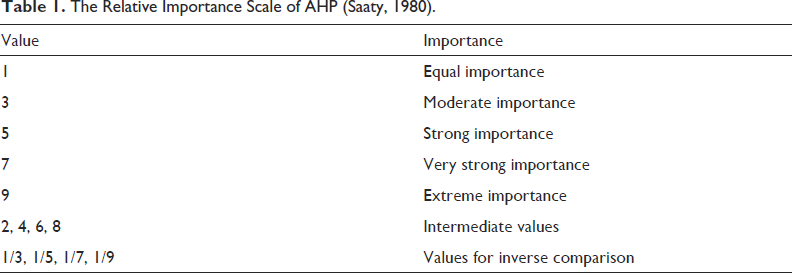
When there are M attributes, the pair-wise comparison of attribute i with attribute j gives a square matrix Rm*m where aij denotes the comparative importance of attribute i concerning attribute j. In the matrix, aij = 1 when I = j and aji = 1/rij.

Step 3: The normalised pair-wise matrix is then calculated. The normalised value of each aij is determined by calculating the average of the jth column and then dividing each aij value by this average.
Step 4: From the normalised pair-wise comparison matrix, the weights of the attributes are calculated by calculating the average across the rows.
VIKOR Procedure
The VIKOR method (Opricovic, 1998) is a well-known MCDM technique which focuses on selecting and ranking alternatives based on sets of conflicting criteria. It employs a multi-criterion ranking index created by comparing how close each criterion is to the ideal choice. VIKOR focuses on ranking and selecting the best alternative from a set of alternatives in the presence of multiple conflicting criteria (Opricovic, 2011). In VIKOR, the ranking index is derived by considering both the opponent’s maximum group utility and minimum individual regret (Liou et al., 2011). Its main advantage is that it can solve discrete decision problems with conflicting and non-commensurable (different units) criteria and can provide a solution closest to the ideal solution. In the research, the VIKOR method has been studied and applied to a wide range of problems, and its application in making accurate life decisions has been increasing. Chen and Wang (2009) used VIKOR to rank optimised partners’ choices in IS/IT outsourcing projects. Liou and colleagues (2011) used it to improve domestic airlines’ service quality. Chen and Wang (2009) used the VIKOR method to prioritise land-use restraint strategies in the Tseng–Wen reservoir watershed. Yang and Chen (2023) used VIKOR for water quality assessment. Abdul et al. (2022) used an integrated VIKOR and AHP methodology for renewable energy planning for electricity generation. It has been used in deciding on many other areas, such as the selection of third-party logistics in the supply chain (Gao et al., 2020; Phaneendra et al., 2016), evaluation of the satisfaction level of citizens, risk management (Li et al., 2022), resource planning (Lee et al., 2020; Opricovic, 2011; Yang et al., 2021), digital competency evaluation of low-cost airlines (Büyüközkan et al., 2021) and identification of the best strategy plan for improving the digital convergence (Hsu et al., 2018).
If there are n alternatives as A1, A2,..., An. For an alternative Ai, the merit of the jth aspect is represented by fij; that is, fij is the value of the jth criterion function for the alternative Ai. The methodology of VIKOR is as follows:
Step 1: The best 

Step 2: Next, the values of Si and Ri, i = 1,2,3,..., n, using the following equations:


where
Step 3: After that value of 
where
Step 4: Rank the alternatives, sorted by the values S, R and Q in decreasing order.
Evaluation of Enablers of Digital Competency of Management Educational Organisation Using AHP-VIKOR Hybrid Approach
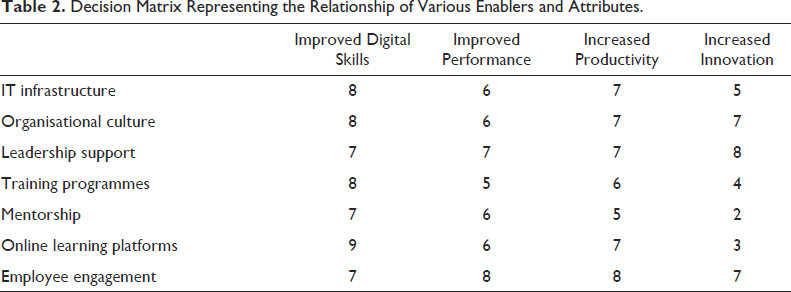
For the present work, enablers of digital competency are identified from the literature review. From that, seven enablers were selected for the final selection. Four attributes were identified based on which these seven enablers were ranked. These enablers are IT infrastructure, organisational culture, leadership support, training programmes, mentorship, online learning platforms and employee engagement. These attributes were improved digital skills, performance, productivity and innovation. The data for the relationship between enablers and attributes were collected using the Delphi method, in which five experts brainstormed and reached a mutual decision regarding the relationships. These data are shown in Table 2.
Decision Matrix Representing the Relationship of Various Enablers and Attributes.
The implementation of the AHP-VIKOR model and analysis is explained in the following six steps:
Step 1: Based on the expert data, the decision matrix has been prepared, as shown in Table 2, which illustrates the effect of enablers concerning all four attributes.
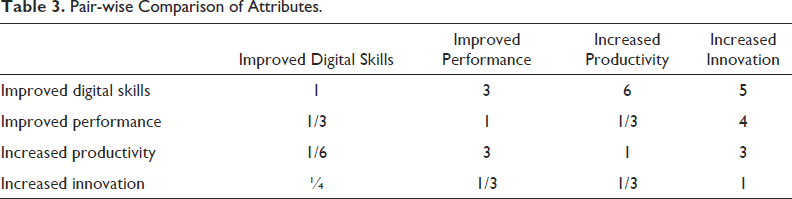
Step 2: In the present work, five experts from a management educational organisation were consulted for making the required pair-wise comparison of attributes. The pair-wise comparison matrix is given in Table 3.
Pair-wise Comparison of Attributes.
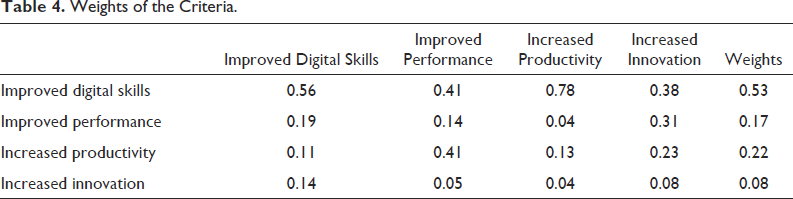
The attributes’ weights were computed using the AHP method described in the previous section Table 4.
Weights of the Criteria.
Step 3: The best
Best
and Worst
Values.

Step 4: Value of
Value of
for Enablers.
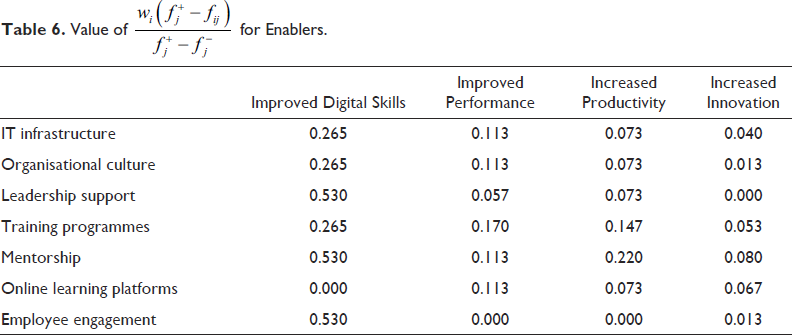
Step 5: Based on Table 6, in Equations (3), (4) and (5), values of
S* Value and Ranking.
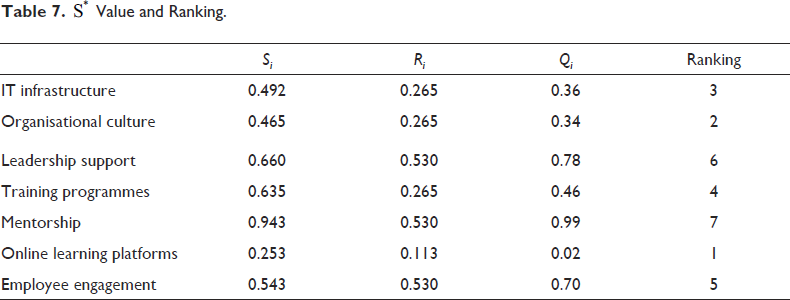
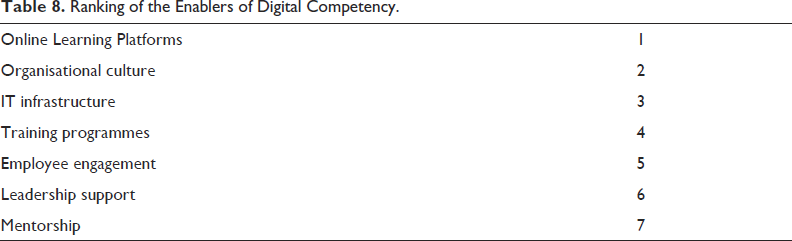
Step 6: Based on the
Ranking of the Enablers of Digital Competency.
Discussion
Digitalisation affects a company’s entire system, including its IT, strategy and workforce. Researchers concur that technology serves a purpose, making the task of digitalisation a revolutionary one. However, prior research on digitalisation has focused on organisational perspectives on digital transformation (Blanka et al., 2022) and technological problems, ignoring the significance of human resources (Legner et al., 2017). Through qualitative data collection techniques such as interviews, surveys and observations, the research uncovers the specific strategies employed by the organisation to build digital competencies. These strategies may include training programmes, mentorship initiatives, online learning platforms and other relevant interventions. Additionally, the research explores the factors that influence the success or failure of these strategies, such as leadership support, organisational culture and employee engagement to address our study topic. The VIKOR method (Opricovic, 1998) is a well-known MCDM technique which focuses on selecting and ranking alternatives based on sets of conflicting criteria. It employs a multi-criterion ranking index created by comparing how close each criterion is to the ideal choice. VIKOR focuses on ranking and selecting the best alternative from a set of alternatives in the presence of multiple conflicting criteria (Opricovic, 2011). In VIKOR, the ranking index is derived by considering both the opponent’s maximum group utility and minimum individual regret (Liou et al., 2011). Its main advantage is that it can solve discrete decision problems with conflicting and non-commensurable (different units) criteria and can provide a solution closest to the ideal solution. The VIKOR method has been studied and applied to many problems, and its application in making accurate life decisions has been increasing.
Chen and Wang used VIKOR to rank optimised partners’ choices in IS/IT outsourcing projects (Chen & Wang, 2009). Liou and colleagues used it to improve the domestic airline’s service quality (Liou et al., 2011). Chang and Hsu used the VIKOR method to prioritise land-use restraint strategies in the Tseng–Wen reservoir watershed (Chen & Wang, 2009). Yang and Chen (2023) used VIKOR for water quality assessment (Yang & Chen, 2023). Abdul and the group used an integrated VIKOR and AHP methodology for renewable energy planning for electricity generation (Abdul et al., 2022). Using the AHP-VIKOR hybrid approach to create a framework that reflects employees’ digital and intrapreneurial competencies, we bridged the gap between digitisation and enablers of digital competency in management educational organisations.
Knowledge and skills are crucial in digitalisation, but so is the capacity to apply them in particular situations—hence, the idea of competency. Our study confirms prior findings about adjustments to competency standards by digitalisation (Kohtamäki et al., 2020). The quick and comprehensive effects of digital transformation on a corporation have extended the variety of competencies. New competencies are required due to employees’ active participation in seizing digital opportunities and their empowerment (Martínez-Caro et al., 2020).
The practical applications of this research are numerous. Beneficial, practical consequences come from the perspective that combines human capital (competency) and organisational digital transformation. Our research indicates that digital transformation necessitates a developing process at the personal and organisational levels based on evaluating the developed framework. Due to the technical foundation of digitalisation, research is frequently centred on technologies and digital knowledge.
Policy Recommendation and Conclusion
It is beyond dispute that digitalisation has had a substantial impact on business. Companies face several obstacles due to this predicament, including keeping up with the rapid speed of technological advancement and fighting against their resistance to change. The organisation must be challenged in all areas, including IT, strategy and personnel. To summaries our research, using a human-centred digital transformation strategy means addressing those issues takes multiple approaches. This research first applied a competency analysis to digital transformation by fusing IS and management studies. We have an integrated perspective and contributed to theoretical breakthroughs by employing established theories and pre-existing frameworks from both study fields. We recognised the importance of individuals as resources, not only those in managerial positions. Our work supports prior research on the range and dissemination of competencies in digital transformation by focusing on competency rather than skills (considering the application of knowledge) and transformation competency (digital and intrapreneurial) rather than digital competency.
However, this study’s limitations should be considered when interpreting its results. Our research focused on design science by creating a framework that included employee competency and the stages of digital transformation after linking competency and digital transformation. Although this framework design adds to the area, it is the first attempt to approach the transformation phenomenon through a human-centred lens. More empirical research is necessary to gain a more in-depth understanding of the digital revolution and precise findings on the importance of human capital. Qualitative research methods may be employed to evaluate the applicability of integrating competencies into corporate strategy and test the designed framework’s capacity for explanatory power.
The empirical study would also be required to examine how IT functions as the primary enabler of digital transformation and how people and human capital transmit digital strategies. We concentrated on the function of employee competency as a human resource regarding thematic restrictions. However, we considered that organisational structures are also connected to digital transformation. The role of organisational learning and dynamic skills in the transformation process may be examined explicitly in studies conducted in the future. Such research could offer in-depth explanations of organisational learning and the next stage of transformation in organisations. We believe both are essential for any successful digital transformation, and it is crucial to study the relationship between organisational capabilities and individual competency properly. The role of organisational structure (e.g., company size) and features (e.g., principal duties or industry) would be among the topics of future research that would help us understand more fully how context affects competency and digital transformation.
Footnotes
Declaration of Conflicting Interests
The authors declared no potential conflicts of interest with respect to the research, authorship and/or publication of this article.
Funding
The authors received no financial support for the research, authorship and/or publication of this article.