



Abstract
This article considers smart rurality within wider European debates and policies addressing innovation in peripheries. It explores the meaning of ‘smart’ through a critical reading of the smart villages concept in official European Union (EU) communications. The content and structure of key EU websites and linked documents are analysed, asking how smart villages are defined and differentiated among the sources. This is followed by a framing of the EU discourse on smart villages that seeks to characterise the problems that smart villages are aimed to address, their causes, effects and prescribed solutions. Partly due to the early-stage formation of the concept, a lack of richness in the smart village discourse is found. The sources indicate a range of problem definitions and limited treatment solutions, while the causal interpretation and moral evaluation behind smart villages are both lacking. To gain a better understanding of the potentials for smartness, implementation challenges and recommendations for smart villages are discussed, drawing lessons from similar innovation and smart specialisation initiatives. Finally, an outlook for conceptual development is proposed with a supporting framework to structure discursive development around smart rurality. The article thus provides for much needed academic reflection on smart villages prior to their widespread implementation. Through framing and typological thinking, it seeks to overcome current conceptual limitations that may jeopardise smart villages as a policy concept by stimulating deeper discursive development.
Introduction
As many rural areas in the European Union suffer from structural problems such as a lack of attractive employment opportunities, skill shortages, underinvestment in broadband and connectivity, digital and other infrastructures and essential services, as well as youth drain, it is fundamental to strengthen the socio-economic fabric in those areas, in line with the Cork 2.0 Declaration ‘A Better Life in Rural Areas. [. . . In particular, this can be achieved] through job creation and generational renewal, by bringing the European Commission’s jobs and growth agenda to rural areas, by promoting social inclusion, support for young people, generational renewal and the development of ‘smart villages’ across the European countryside, and by contributing to mitigating depopulation. (European Commission, 2021a: 32)
The above paragraph 32 from the European Union (EU) regulation on the Common Agricultural Policy (CAP) introduced ‘smart villages’ into the highest level of rural policy for the 2021–2027 period. In doing so, it has been connected to the EU objective, ‘to promote employment, growth, gender equality, including the participation of women in farming, social inclusion and local development in rural areas, including the circular bio-economy and sustainable forestry’ (European Commission, 2021a: 28).
Now with a relatively prominent role foreseen in the future of EU rural policy, smart villages (SV) 1 have been building momentum since the 2017 launch of a SV thematic group initiative of the European Network for Rural Development (European Commission, 2021b). Nevertheless, SV lacks a legal definition, leaving EU member states with flexibility in use and interpretation (EU CAP Network, 2023) and creating space for meaning to be developed over time. Though its development has been relatively bottom-up or informal compared to other concepts underpinning EU development policies such as territorial cohesion or smart specialisation, the beginnings of SV institutionalisation call for a scholarly pause for reflection on the meaning and future of SV as a useful concept for rural development. Reinforcing this is a lack of theoretical understanding of SV (Slee, 2019), set in a similarly underdeveloped wider discourse of smart rurality.
Since its inception, SV has aimed to strengthen rural areas’ socio-economic fabric by fostering knowledge, innovation and digitalisation. It conceptually targets rural communities facing challenges such as depopulation, lack of services, economic opportunities, energy crises and connectivity issues, situating SV as an approach for achieving future-oriented rural development. Accordingly, it has been presented as place sensitive (i.e. an attribute), giving the concept a socio-spatial dimension covering ‘human settlements in rural areas as well as the surrounding landscapes’ (European Commission, 2019b: 3). Alternatively, it has been described as ‘a tool to promote digital and social transformation’ that would build synergies across the main EU funding bodies for rural development (Bled Declaration, 2018: 2). Thus, initial readings of SV can be inconsistent and lead in multiple directions, raising questions about its specific meanings.
Given its current status in rural policy, it is relevant to analyse SV together as an interdisciplinary concept and as a policy approach of rural development, drawing from the fields of geographical political economy and rural and peripheral innovation. As a concept, SV signifies a collection of attributes to describe a rural place or community as smart, and it could therefore be prescriptive or normative in describing what SV should look like compared to other rural places from a policy perspective. As a policy approach, SV extends to the set of principles and strategies for making a rural place or community smart. Although it can be difficult to disentangle the two in practice when the sources themselves are ambiguous, we refer primarily to SV as a concept when seeking to understand its meanings, such as signified attributes, and as a policy approach when discussing its application towards achieving the aims of ‘smart’ in rural development.
Even though SV has potential to deal with ‘smartness’ in a rural context, indications of the term seem to presume a general understanding in the reader, perhaps taking for granted familiarity with the better-known smart cities. EU sources have presented SV as an emerging concept in need of further development (European Commission, 2019b). At the same time, as shown in this article, SV is already infiltrating into high level rural development strategies and concrete projects alike, risking its conceptual and pragmatic integrity as it remains a fuzzy concept, at best, or a weak signifier for initiatives and projects generally aiming at yet another iteration of sustainable rural development, at worst. At the core of this problem are questions concerning what signifies ‘smart’ in a rural context and how an unambiguous understanding of smart rurality can be implemented in policy.
In this article, we explore the meaning of smartness in the rural context through a critical reading of SV in the EU, focusing on official communications including websites and linked documents. In doing so, we ask how SV is defined and differentiated across EU sources. We use a framing approach that seeks to identify the problem that smart development aims to address, its causes, effects and prescribed solutions (Entman, 1993). Through this, we aim to reflect on challenges encountered in ascribing deeper meanings for SV implementation and on the outlook for its development as a goal-oriented policy concept with strengthened potentials for operationalisation. In this sense, a policy concept aligns with a collective idea, articulated such that ‘societies consider appropriate to achieve their interests in specific issue areas’ (Legro, 2000: 421). We contend that the SV concept ought to clearly relate to specific problems of rural areas and lead to new solutions, addressing specific actors, stakeholders and decision makers that have been unmet by prior approaches. Moreover, the potential priority-setting, trade-offs and viability of purported solutions should be openly debated. This would rely on a rich, high-quality discourse surrounding SV and smart rurality, more widely, that allows for the framing of issues and alternatives. Underpinning the development of a richer discourse on SV is a need for an approach to analysing ‘smart’ in rural contexts which, by the end of this article, will be provided.
The article proceeds with an overview of the policy context and problematisation of rural development in the EU, followed by a discussion of rural smartness and innovation as theoretical and policy streams underpinning the SV concept. We then analyse key EU sources on SV with attention to content and structure, before framing the EU discourse and discussing challenges for implementation. The article concludes with an outlook towards strengthening its potential as a policy concept, proposing a framework for smart rural analysis and identifying areas for future research.
A smart(er) rural development?
Policy and context of rural development
Rural areas have long been a focus of European policy interventions between two streams of policymaking – Cohesion Policy (CP) and Common Agricultural Policy (CAP) – both of which provide resources and objectives for rural development (Table 1). CP has had the goal of reducing differences between regions, especially ‘the backwardness of the less-favoured regions’ (European Commission, 2024b: xiii). Through CP, approximately 529 billion euros have been planned for allocation from the EU budget during the 2021–2027 multi-annual financial framework, including 310 billion euros for the European Regional Development Fund and 49 billion euros for the Cohesion Fund specifically targeting ‘less developed’ regions which tend to be rural or non-metropolitan areas (European Commission, 2024a). CAP, on the other hand, originally focused on farming and farmers with attention to agricultural productivity and market stabilisation, food supply and pricing and farmers’ living standards (European Council, 2023). Since the 2000s, rural development became a second pillar of CAP, funding infrastructure and public services in rural areas as well as digital modernisation of farming. For the 2023–2027 period, approximately 387 billion euros or one third of the EU budget has been planned for allocation to CAP, including 95 billion euros for the European Agricultural Fund for Rural Development to address the agricultural competitiveness and territorial development of rural areas (European Commission, 2023).
Key EU policies and resources available for rural development.
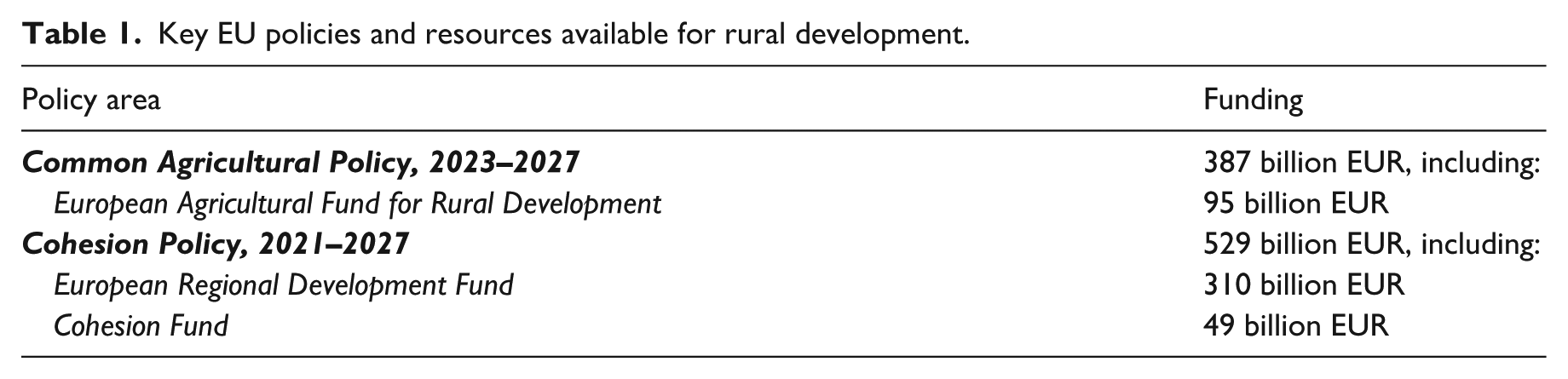
Even though both EU policy and funding mechanisms provide for development in rural areas, the two streams have historically been siloed from one another. A fundamental contradiction between these two policy streams can be summarised in the drive to make rural areas economically self-sufficient (even innovative and growing through economic specialisation, according to CP related strategies 2 ) while risking dependence on external support from CAP to maintain agricultural productivity in less competitive regions or sectors. Considering both CP and CAP together, decades of policy intervention targeting balanced territorial development and improvements in economic competitiveness have failed to turn the trend of socio-economic decline in rural areas (European Commission, 2024b). Moreover, looking beyond traditional socio-economic measures of inequality, rural areas are also recognised as being vulnerable to existential challenges of sustainability, including the injustices of energy transition (O’Sullivan et al., 2020) and uneven effects of climate change (Rodríguez-Pose and Bartalucci, 2024).
In addition to the material decline seen through economic stagnation and population loss, the era of multiple crises has intensified the marginalisation of rural areas, which have already been subject to discourses of peripheralisation (Plüschke-Altof, 2016), raising issues of spatial justice (Woods, 2025) within wider framings of rural sustainability (Mahon et al., 2023). Despite a strong legacy of scholarly attention to the problems of rural and peripheral regions (Pugh and Dubois, 2021; Richardson, 2000; Woods, 2006), the peripheralising discourses have manifested in rising populist policy narratives about rurality (Valero, 2022). At the same time, contestations to rural peripheralisation have emerged to challenge neoliberal notions of development. These often relate to critiques of the growth imperative and issues of justice (e.g. as seen through the productivist-consumptionist lens [Calvert et al., 2022] and the return of extractive regimes in rural areas (del Mármol and Vaccaro, 2020)), and the promotion of rural sustainability through alternative development models (e.g. post-growth futures [Blühdorn, 2017; Koch and Buch-Hansen, 2020; Loewen, 2022b]).
Given these debates concerning rural development, the role of innovation in policy and the current need for sustainability seem to advantageously position SV as a central concept for the near future. The rural development paradigm has shifted in recent decades from being focused primarily on agriculture towards wider social and developmental issues (Mahon et al., 2023; Richardson, 2000; Woods, 2006, 2025). Meanwhile, EU policy has aligned innovation and developmental issues towards sustainability (Schunz, 2022), partly in response to the ongoing crises of neoliberal development and climate change (Loewen, 2022a). Furthermore, the so-called digital transformation has been extended to rural areas (Roberts et al., 2017; Salemink et al., 2017; Sept, 2020) and expanded in scope from the purely technological to include social innovation (Ravazzoli et al., 2021; Slee et al., 2022). In light of these trends, SV could be used to enable alternative visions of rural development. However, to do so, it must also overcome current limitations of the ‘smart’ discourse.
Between techno-economic and eco-social applications, smartness has emerged as a potential solution for bridging socio-spatial divisions by overcoming negative developmental trends in European rural areas. This approach aligns in principle with mainstream strategies for innovation and economic growth in peripheries and could also serve less defined alternatives on the margins. However, a precise common understanding of smartness underpinning policy orientations is lacking. We therefore seek a better understanding of smartness and the SV concept, in particular, as a more goal-oriented policy concept which can be meaningfully deployed and distinguished from competing concepts like sustainability and resilience as well as other ‘smart’ approaches, like smart cities and smart specialisation.
Rural smartness and innovation
Smartness cannot be discussed in the EU policy space without relating the concept to innovation, considered to be the driver of regional development underpinning European strategic policy approaches since the 2000s. From an economic geography perspective, rural areas belong to peripheral innovation systems which are limited in the context of growth-oriented policies by the characteristics of institutional thinness and a lack of human capital. Smartness, by virtue of its connotations with innovation – referring to both ‘intelligence’ and ‘digital’ from its urban origins (Komninos, 2018) – brings a promise to overcome these shortcomings through technological solutions including digitalisation.
Following the economic logic of smart specialisation, rural smartness should support the development of regional competitive advantages in promising rural economic sectors. These are not necessarily limited to upgrading agricultural activities, as was the case with the green revolution that increased agricultural productivity in the twentieth century. In light of current ICT possibilities and the rise of remote working, rural areas show potential for green, digital and social innovation (Ammaturo and Schmidt, 2024 ; Loewen, 2022a; Ravazzoli et al., 2021; Sbardella et al., 2022) based on applications of digital solutions going beyond economic to social and environmental sectors. The 2021 CAP update concretely relates smartness to technological development and digitalisation, as well as to new knowledge which together offer an opening to rural innovation. Moreover, the update seeks to support CAP objectives by developing synergies between SV and other mechanisms, for example, European Innovation Partnerships and local action groups associated with the LEADER programme (European Commission, 2021a).
In sum, rural smartness is linked to innovation, digitalisation, technological development and competitive advantage. Despite the wide net that smartness casts, operational definitions are needed for targeted policy that goes beyond the current concepts and approaches used for regional development in Europe. SV has the potential to become a strong policy concept, but the meanings behind it appear overly vague as it attempts to address multiple problems of rural areas without operational precision. Accordingly, it is necessary to consider smartness as a discursive device with inherent meaning(s) that warrant further examination.
Questioning the ‘smart’ in smart villages
Contextualising their investigation into smart visions of the future, de Hoop et al. (2019) establish ‘smart’ as a signifier 3 often used alongside sustainability in urban development. Yet, the term ‘often remains malleable and undetermined, leaving ample space to accommodate different interpretations of and interests in smartness’ (de Hoop et al. 2019: 438). Despite multiple scholars asking the question – ‘what is smart?’ – the discourse around smartness in the more established urban field has highlighted its vagueness and ambiguity while also distinguishing smart ambitions from actually existing smart cities (Anthopoulos, 2017; Hollands, 2008; Shelton et al., 2015). To further elaborate ‘smart’ as a signifier in a rural context becomes even more difficult due to its recent emergence in policy and lack of interpretation through applications needed to trace its discursively ascribed meanings.
Learning from analysis of sustainability, an ‘empty’ signifier is not meaningless and without use, as it may still serve a purpose to open possibilities for political action, referring to and unifying diverse phenomena (Brown, 2016). The meanings ascribed to sustainability have been traced through several decades of policymaking to show how it first moved from environmental to broad interpretations across sectors, subsequently losing its strength as a policy concept. In comparison, ‘smart’ does not yet have the history of use and interpretation in the rural context to consider it as an empty signifier. Rather, as a potentially floating signifier, smart rural may come to hold ‘partially overlapping and partially contradictory understandings’ inherent with conceptual vagueness (Hofferberth, 2015: 598). It is now being transferred from the urban to rural context, carrying with it notions of technological innovation but being applied with a broad brush alongside other signifiers like sustainability, resilience, eco-, and so on (de Jong et al., 2015) and in association with digital and social innovation (Christmann et al., 2024; Ravazzoli et al., 2021). Nevertheless, it is not yet possible to follow such an evolution in the uses of ‘smart’ in the rural context to distinguish differences in interpretation and meaning.
As Slee (2019) stated, ‘policies for smart villages have evolved without any real reference to theoretical foundations’ (p. 645). Several published works have traced the history of SV within EU policy processes, showing a clear line of development through the Cork 2.0 Declaration (European Commission, 2016) and Bled Declarations (European Network for Rural Development, 2018) 4 into the CAP and national strategies (Adamowicz and Zwolińska-Ligaj, 2020; Jezic et al., 2021; Vaishar and Šťastná, 2019). In their comprehensive review, Bokun and Nazarko (2023) highlight the early formulation stage of the concept, finding applications in research areas including technology and connectivity, rural-urban linkages, people, energy and natural resources, governance, rural economy and tourism. Yet, this literature generally lacks critical reflection on smartness itself. Cowie et al. (2020), on the other hand, point out the importance of framing smart rural futures to address specific rural issues, which draws our critical attention to the SV concept in its current and future intended uses. In terms of European rural development, the critical study of SV, with attention to its enrichment and operationalisation, holds potential to support alternative visions of rural development associated with green, digital and social transformation.
Methodological approach
In the preceding section, we have focused on the emergence of rural smartness and institutionalisation of SV in the EU policy space. To better understand ‘smart’ in the surrounding discourse, we further investigate meanings of smart in two-stages. First, we analyse public discourses in content and structure through a review of public-facing EU sources, including official websites, their referred (online) policy and programme documents and specific project websites. Next, these sources are taken as communicative, textual media representations through a framing analysis of SV based on Entman’s (1993) approach for media framing.
The field of SV research currently faces structural limitations, with the absence of concrete project results that may be used to evaluate the impact of EU policies on rural smartness. The adopted methodology addresses these limitations by focusing on the policy discourse in its abstract sense. Our use of framing is interpretive and ideational in scope, aligning ontologically with social constructionism (Potter, 1996) and sitting within the broader field of critical social analysis (Fairclough, 2010). Thus, it can be considered as a type of critical analysis of discourse that, among other methods, ‘sets out to make visible through analysis, and to criticise, connections between properties of texts and social processes and relations (ideologies, power relations) which are generally not obvious to people who produce and interpret those texts, and whose effectiveness depends upon this opacity’ (Fairclough, 2010: 132). While we refer to the SV discourse and seek to improve our understanding of it and develop it, we do not conduct a ‘critical discourse analysis’ (CDA) per se (see Fairclough, 2010). In that regard, we approach the material not as linguists or psychologists (see Potter (1996)) but as interdisciplinary regional scholars with an interest in rural development and policy.
Our choice of methodology also reflects the analytical possibilities of the source material. As will be shown, the SV material contains meaning but is not yet sufficient for a deep analysis, for example, of discursive practices and social practices at the heart of CDA (Fairclough, 2010), nor of the practical actions and argumentations at the heart of political discourse analysis (PDA) (Fairclough and Fairclough, 2012). Our approach, nevertheless, shares a systemic context with methodological alternatives by being critical of neoliberal capitalism and taking a normative stance against the crises produced by it. These approaches can support each other in the future study of SV, once differentiated discursive practices and lines of argumentation emerge. Our subject is also constrained to the specialised EU policy area bridging regional, innovation and rural policy areas. It is interpreted from a normative stance that encompasses the paradigmatic context of rural development, the challenges and solutions espoused by EU policy perspectives and related academic disciplines. These are diverse in principle but are often seen by EU scholars to be relatively monolithic in practice.
Table 2 presents the range of empirical material gathered, from the most general websites to the most detailed projects. It is worth mentioning here that the project level is in early stages of development and not exhaustive. To find project examples, we surveyed those related to smartness in rural areas funded within EU Interreg programmes. 5 This search found projects specifically targeting SV as well as smart rural areas and smart communities, funded in the 2021–2027 period, indicating a range of SV applications in their initial stages of interpretation and implementation.
Levels of media representations of smart village concept on key EU websites.
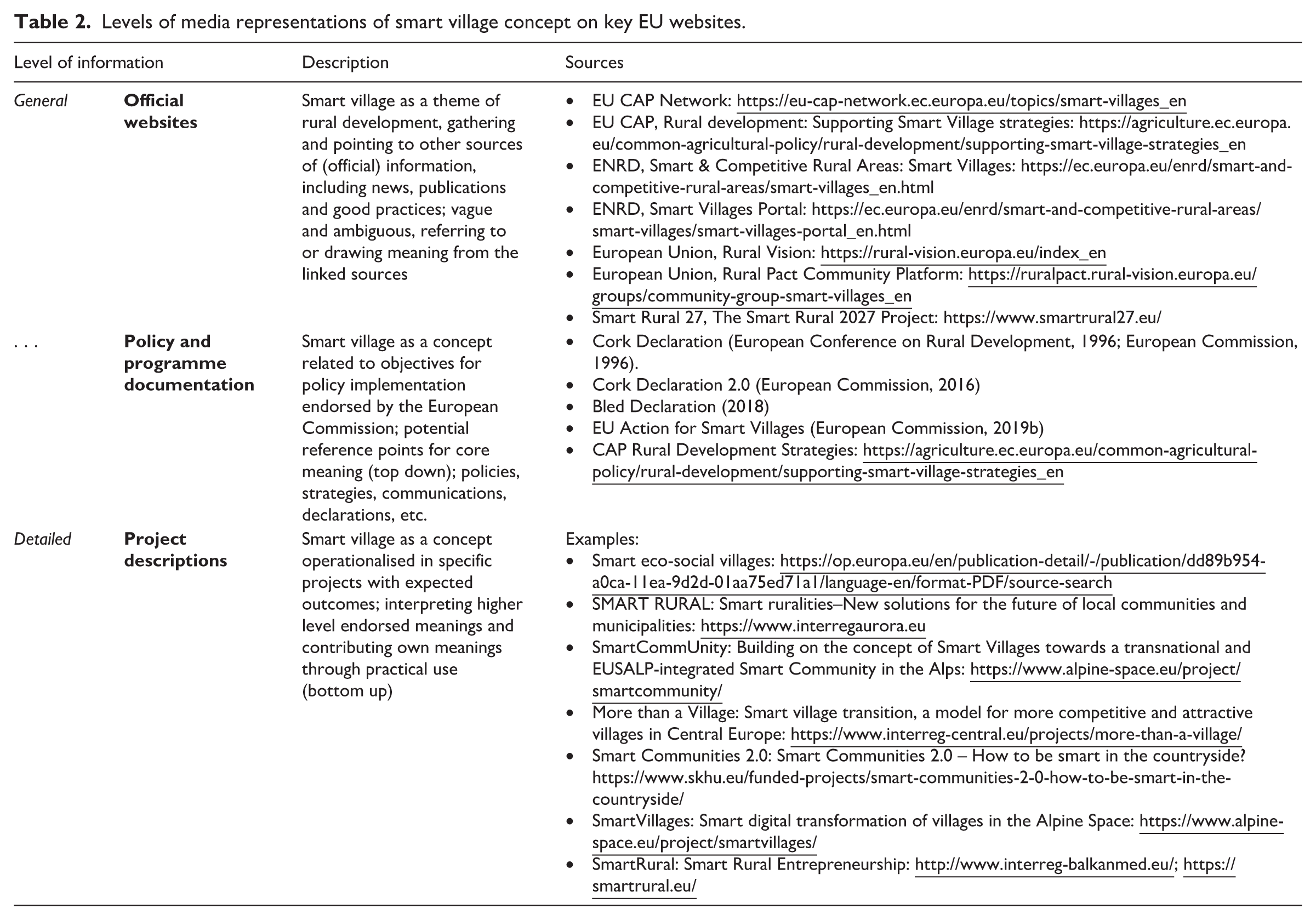
To begin our search, we identified EU level (non-national) websites that could be crucial for understanding the SV concept. We used ‘smart village’ as a key phrase in Internet searches and employed ChatGPT to identify and verify relevant websites. Our use of generative AI was strictly in the preliminary exploratory stage, whereas our practical search for source material was done conventionally using a manual (digital) Google search for SV websites, complemented with snowballing through linked sites and documents.
For selection criteria, we focused on websites operated by the EU or related international institutions that prominently feature ‘smart village’ in their title, web address (i.e. URL), or layout (e.g. thematic headline). These sites typically include a main page with subpages providing more detailed information. This part of the analysis aimed to understand the user’s impression of SV and assess the clarity of its structure and presentation. We examined whether these sites present a definition of SV that would inform the presence of a single standardised definition or multiple definitions representing different understandings within an SV discourse. In addition, we explored the structure of the information to understand how the sources may reference each other and which, if any, may serve as a central SV meta-page.
Notably, only a handful of pages are specifically dedicated to SV as a topic, resulting in a surprisingly limited text corpus for analysis. Instead of treating this as a shortcoming, we exploit this lack of information as a crucial factor for the conceptual development of SV and wider discourse around smart rurality.
For the second part, we interpreted the findings through a framing lens using Entman’s (1993) four aspects for media framing: (1) problem definition (to determine what a causal agent is doing, with costs and benefits); (2) causal interpretation (to identify the forces creating the problem); (3) moral evaluation (to evaluate causal agents and their effects); and (4) treatment recommendation (to justify treatments for the problems and predict their likely effects). Framing is intended to identify different and often conflicting understandings of particular phenomena based on a common set of analytical themes, as revealed in discursively constructed frames. Developed in the context of communications, journalism and media studies, Entman’s (1993) approach to framing centres on the subject of a communication and draws political implications for the way an issue is perceived and discussed. As conveyed above, framing can be considered alongside CDA and other methods to critically analyse discourses. We have deemed framing to be appropriate for our purposes due to the communicative and promotional function of the online SV sources in their current state of development, particularly at the preliminary ideational level. Entman’s four aspects provide an analytical lens for our purposes, lending order to further conceptual development.
The choice of framing analysis originally sought to maximise on a range of empirical material, allowing for the detection of different interpretations of and directions for SV, but this did not unfold as expected. Unique to this case and reflecting a lack of richness in the sources needed to distinguish multiple framings, we present a singular frame as one dominant perspective for critique. Finally, we reflect on the state of the art and future conceptual development of SV, discussing the implications of the limited discourse at a time when smart rurality is gaining traction and the concept of SV is coming to the core of EU rural development policies, programmes and strategies.
Content, structure and inter-referencing of smart village websites
Content analysis
To gain an understanding of SV in the EU context, we identified the following official websites (Table 3, also listed in Table 2), which have been reviewed to determine whether and how they define SV.
EU smart village websites, description of relevance and definitions.
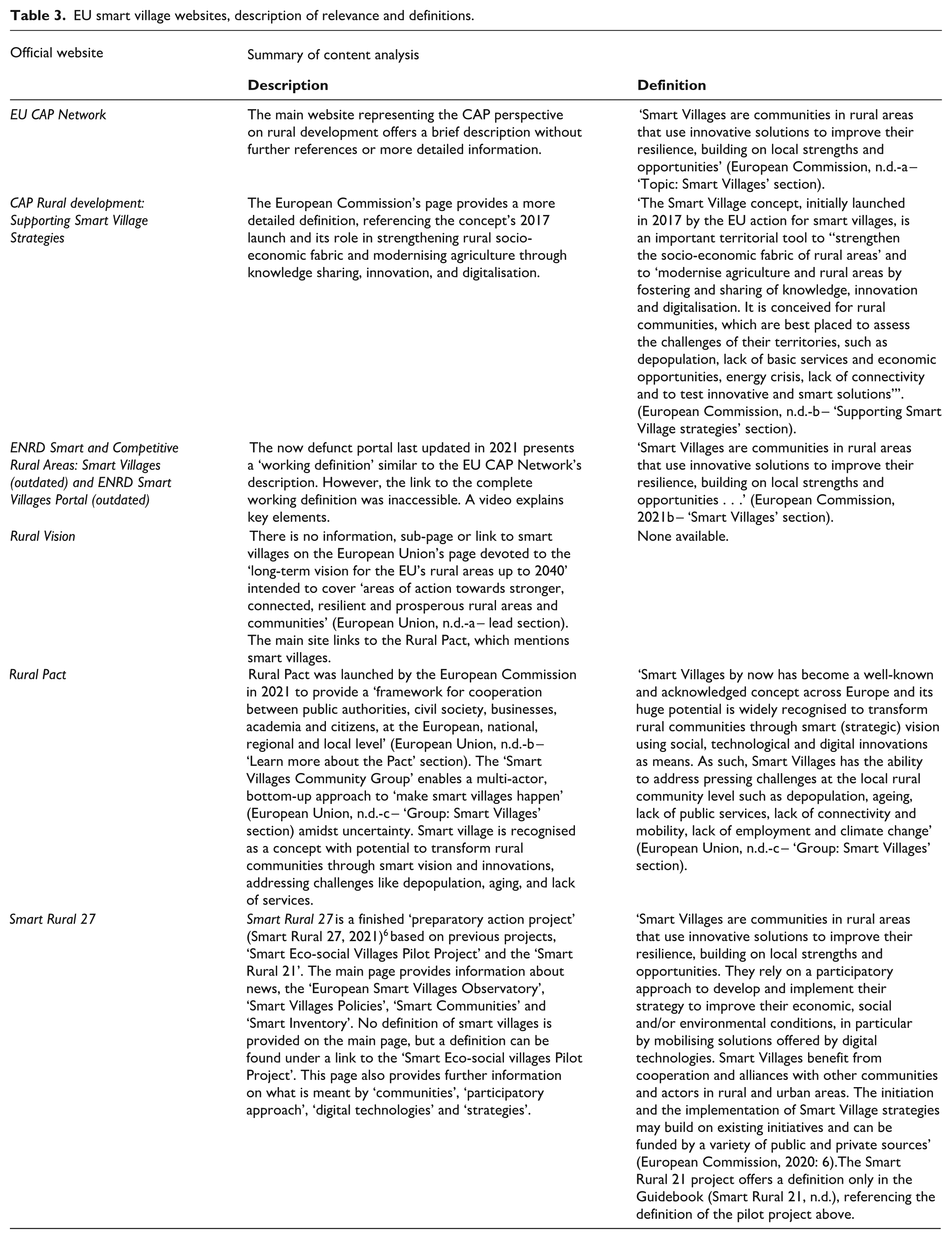
Based on the above definitions, the sources share a common focus on rural communities and innovation. Although we did not find contradictions across the definitions, there are differences in the level of detail and areas of focus. The CAP ‘Rural development’, ENRD ‘Smart and Competitive Rural Areas’ and ‘Rural Pact’ pages provided the most detailed descriptions of challenges faced by rural areas. The CAP and ENRD pages provided almost identical definitions, focusing on resilience and local strengths. The CAP ‘Rural development’ page uniquely emphasised the role of communities in assessing their own challenges, and was also the only page to explicitly mention agricultural modernisation as a goal, corresponding to the rural development aspect of the CAP.
Lack of a common definition and seemingly intentional flexibility from the EU side to enable a bottom-up conceptual development through operationalisation is already resulting in conceptual differences that may be difficult to reconcile under a future policy umbrella. Across the range of sources, SV refers to a strategy (EU CAP Network), a concept (Rural Pact) and a tool (EU CAP Network), with potential implications for the strength of SV as a policy concept. This situation carries over at the country level, into national strategic plans that should consider SV as a relevant development tool. In this way, SV connects with smart village strategies (Hungary), smart rural strategies (Lithuania), smart village concepts (Poland), smart village initiatives (Latvia), development cooperation projects with preparatory actions (Finland), and an integrated development concept (Austria) (Smart Rural 27, n.d.), all having different conceptual implications.
The content analysis highlights the inconsistent presentation and lack of a unified definition of SV across official websites, potentially leading to confusion and difficulties in understanding and implementing the concept. Based on the level of detail and depth of discussion in these most prominent of EU resources, we identify a lack of richness in the EU discourse on SV and a need to search beyond the most publicly visible sources.
Structural analysis
The structural analysis reveals a striking lack of coherence and cross-referencing among the official SV websites. This absence of clear interrelationships is evidenced by the sites’ failure to reference one another. Notably, there is no hierarchical structure with a central meta-page that consolidates all necessary information or provides links to other relevant pages. This deficiency complicates targeted information searches and contributes to a lack of clarity in both content and structure. Each page serves its own, sometimes overlapping, functions, making it challenging to comprehend the connections between various aspects (e.g. political development process, background and objectives, definition, projects, events and funding).
For instance, the ‘Rural Pact Community Platform’ functions as a networking platform (‘Smart Villages’ group) but offers no further links. More comprehensive information is available on the EU CAP site’s ‘Supporting Smart Village strategies’ page accessible via ‘Rural Development Programmes’, which features a video explaining the concept and provides access to the foundational policy document ‘EU Action for Smart Villages’. The ‘Smart Rural 27’ site lacks a definition or explanation of the concept, appearing to target experts interested in specific projects and initiatives (via the ‘SV Observatory’ and ‘SV Geomapping’).
Despite the lack of a definition, ‘Smart Rural 27’ can be considered a primary SV resource due to its comprehensive information. The ‘Home–Smart Rural 27’ site is the most structured overall, building upon the ‘Smart Eco-social Villages Pilot Project’ and the ‘Smart Rural 21 project’. However, the site belongs to E40 Group (the lead partner of the Smart Rural 21 project) and contains no links to EU policy pages or financing options, clouding the provenance of the information. In addition, none of these pages reference thematically related topics such as ‘Digital Agriculture’, despite the EU CAP site referring to SV as a crucial instrument for agricultural modernisation.
Paradoxically, another highly visible central point of contact, the ENRD ‘Smart Villages Portal’, has not been updated since 2021 and contains outdated links to the finished Smart Rural 21 project, while still appearing to be a source of latest news, publications and best practices. However, this and other outdated EU sites are among the first web search results of ‘smart villages EU’. Similarly, relevant CAP and Rural Pact sites do not appear on the first page of search results. Thus, the structure and timeliness of readily retrievable SV information is a serious weakness for potential users from the SV community.
The EU frame of smart villages
Building on our understanding of the content and structure of the SV sources above, we present a framing of the SV concept and its implementation in the EU. Here we interpret the findings in terms of Entman’s (1993) four aspects and make the link back from the public websites to source policy and programme documents to trace for deeper meaning. Once again, Table 2 organises the key sources from which we base our framing, from the official websites that present thematic information, to the communications, policies and programme documents that elaborate on meaning, and finally to the most detailed project descriptions that have potential to operationalise the SV concept. The discussion is intended to lend a more theoretically informed approach towards recognising challenges within the current SV discourse, acknowledging its shortcomings in content and structure, as a basis for advancing the discourse and conceptual development for policymaking.
Smart village: main features and implementation challenges
Referring back to core documents, the SV concept features four elements to be considered for SV strategies; the strategies should be place-based, participatory, innovative and strategic (EU CAP Network, 2023). These indirectly address Entman’s (1993) ‘problem definition’ and ‘causal interpretation’ (place-based conditions and challenges) and point to approaches for ‘treatment recommendation(s)’ (participatory, innovative and strategic). We can take objectives of the CAP and CP – balanced rural development, alleviation of social and economic inequalities and farmers’ living standards – as a common overarching ‘moral evaluation’.
Lacking sufficiently useful definitions from the public sources analysed above, we assemble a range of objectives indirectly from the EU Action for Smart Villages (European Commission, 2019b). This information further informs the problem definition through its aim to improve rural resilience by enhancing quality of life, public services, resource use, environmental impact, and economic opportunities through digital and innovative solutions. Specific goals address the following topics:
Improving access to health, training, and transport services.
Enhancing business opportunities and job creation.
Developing short food supply chains, and sustainable farming practices and innovative agri-food systems.
Promoting renewable energy and circular economy practices.
Better sustainable exploitation of natural resources and adaptation to climate change.
Preserving the environment and biodiversity.
Valorising cultural heritage and boosting tourist attractiveness.
A key aspect that is unaddressed by the material, however, is the ‘treatment recommendation’ in terms of how SV should be implemented as a solution to the problems defined for rural areas. In Table 4, we point out challenges to SV implementation according to the CAP’s four elements for implementation (EU CAP Network, 2023).
Smart village elements, challenges and proposed improvements.
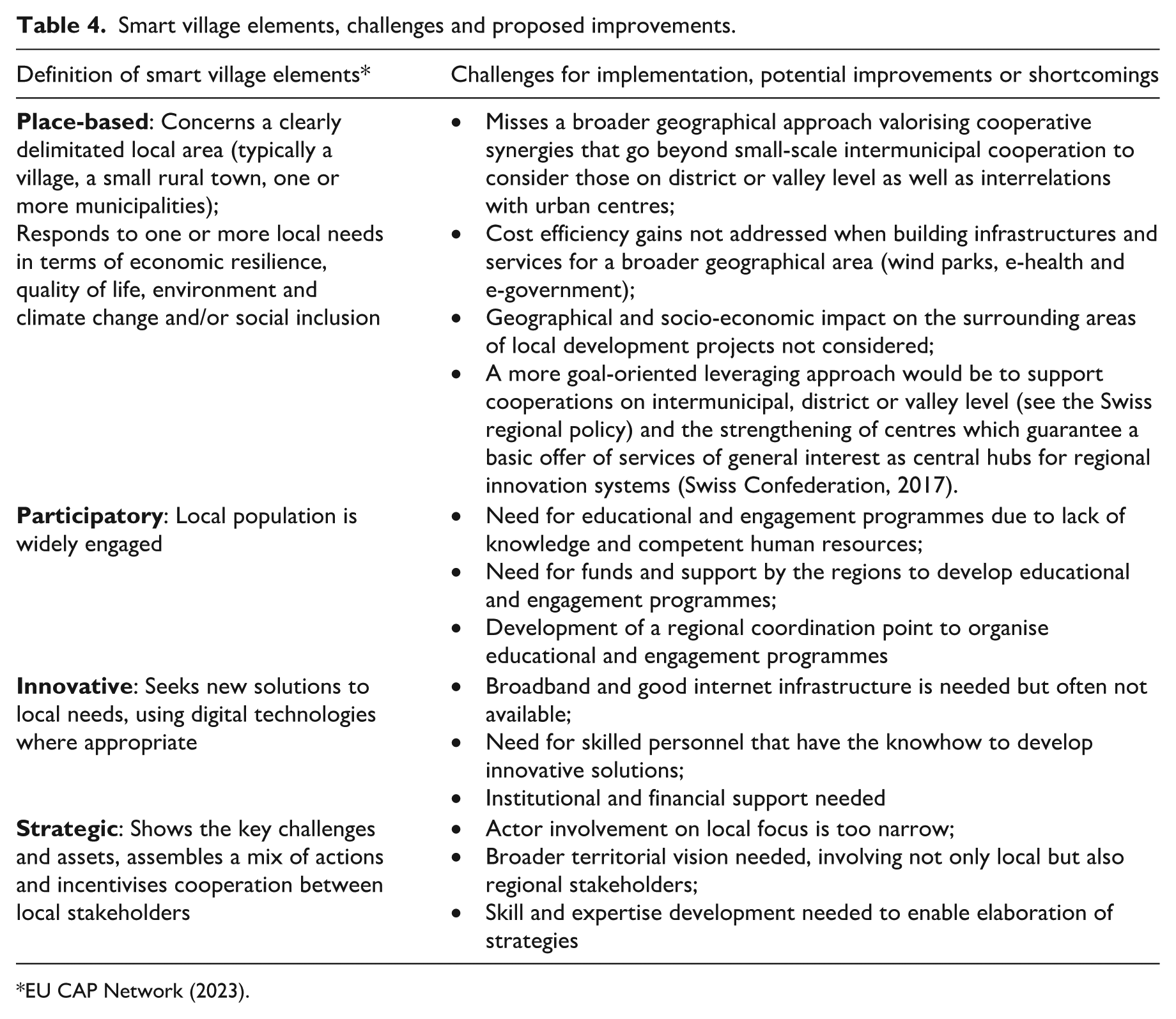
Referring to the aforementioned literature on rural smartness and innovation, and learning from the implementation of CP objectives 7 , the institutional capacity and human capital required to deal with SV will likely be the crux of implementation in rural areas. Central to these are the identification of competences required for SV, followed by the training and skill development of people who will be charged with SV implementation. Although ‘improved training’ and ‘enhancing business opportunities and job creation’ are mentioned among SV objectives in the EU Action for Smart Villages (European Commission, 2019b), these points have not been sufficiently elaborated yet. In short, ‘smart personnel’ for SV are needed to assure efficient and effective implementation.
In line with the Cork 2.0 and Bled Declarations, the regional innovation and development literature has highlighted the role of the public sector (including, for example, local governments, public service centres and higher education institutions) as a central coordinating actor in rural and peripheral regions, requiring place leadership and institutional entrepreneurship skills (Grillitsch and Sotarauta, 2020; Isaksen et al., 2019; Nilsen et al., 2023). In addition, the role of the public sector is crucial for overcoming a lack of local capacity, skills and knowledge among the local stakeholders, who are typically overstretched and lacking the financial and human resources needed to implement SV strategies. The question therefore arises as to how this challenge can be met.
While the SV concept holds significant potential, its implementation through the Common Agricultural Policy (CAP) and other policies requires improvement. Effective governance, community involvement, and tailored strategies are critical to avoid administrative burdens and ensure practical outcomes. Besides being named in the CAP, the institutionalisation of SV is undefined. CAP encourages synergies with other mechanisms, including the LEADER programme to promote local development and social inclusion, CAP strategic plans to integrate SV initiatives which can generate employment and support local development, and pilot projects to test innovative solutions and strategies. However, without further specification on the roles and capacities needed to serve SV development, there risks a strain of resources to integrate its multiple objectives with other initiatives while maintaining clear conceptual distinctions.
Missing links in an emerging policy discourse
Our analysis of various levels of representations finds that the SV concept offers a flexible, territorially sensitive framework for rural development, focusing on digital innovation and community-driven strategies to address local challenges and opportunities. Its success may depend on effective governance, community participation, and tailored implementation strategies. Nevertheless, the EU’s own communication has left the meaning behind SV open to interpretation with little central coordination: ‘the concepts linked to development of Smart Villages, including rural connectivity and the challenges and opportunities it offers, will remain an issue to be addressed over several years’ (European Commission, 2019b). Given the ongoing vagueness and ambiguity of SV, it is important to draw attention to the conditions necessary for developing a strong policy concept that will have an impact on rural development without sliding into the position of another modern buzzword.
The lack of cross-linkages between SV and other prominent policy areas like CP has been found above with respect to the structure of the SV sources. When comparing SV with the influential smart specialisation strategy for regional innovation, we also note a different trajectory of CP-related development and institutionalisation from theory (or in the SV case, a lack of theoretical foundation [Slee, 2019]) to practical policy tool. For the CP related approaches of smart specialisation (Foray et al., 2021; McCann and Ortega-Argilés, 2015) and the more recent mission-orientation (Mazzucato, 2018), there has tended to be a close alignment between academics and policymakers to enable fast-tracked policy experimentation, which cannot be seen in the CAP sphere. In addition, despite the policy ‘success’ of CP related concepts, we note a lack of connection within the rural development sphere with existing innovation policies and initiatives that ought to complement SV.
Examples of missing innovation-related links include Agricultural Knowledge and Innovation Systems (AKIS) and Smart Specialisation Community of Practices (S3 CoP). AKIS and AKIS 2.0 (European Commission, 2019a), discussed as a concept for rural innovation systems before the latest CAP reform, is not mentioned in the SV sources despite suggesting strong relevance. AKIS strategies outline four types of actions: (1) enhancing knowledge flows and strengthening links between research and practice; (2) strengthening all farm advisory services and fostering their interconnection within the AKIS; (3) enhancing cross-thematic and cross-border interactive innovation; and (4) supporting the digital transition in agriculture. Similarly, there is no explicit connection in the SV sources to the CP-related S3 CoP (European Commission, n.d.-c), where we would expect to find links to the topic areas of digitalisation and innovative transformation in a rural context. These omissions indicate a very weak development of SV in relation to already existing EU policies and initiatives intended to foster innovation that have been made available to rural areas. Moreover, we note a lack of attention to sustainability aspects, for example, addressing climate change, where rural development policies including SV have strong potential to make an impact. In EU policy terms, this indicates a lack of ‘additionality’ of SV.
Based on the framing analysis approach, aspects of problem definition and treatment recommendation are most apparent in the EU’s singular, underdeveloped framing of SV, while causal interpretations and moral evaluations are hardly represented. The problem definition could be narrowed, as it currently encompasses a multitude of objectives that are already addressed by other initiatives besides SV, and the treatment recommendations could be more clearly focused on roles and capacities needed to implement ‘smart’ initiatives in rural contexts. However, the missing causal interpretations and moral evaluations could be crucial for developing conceptual distinctions and meanings in the smart rural discourse. Moreover, these could be crucial areas to develop for understanding the real potentials and pathways for rural development, especially amid emerging visions of socially and environmentally sustainable rural futures that challenge dominant views of neoliberal development.
The contentions within causal interpretation and moral evaluation must be openly debated, which requires a richer discourse to weigh alternatives and possibilities. The discourse on smart rurality needs to not only allow for flexibility, as it has been described in EU sources, but it also needs to allow for alternate framings of smartness and development, challenging systemic conditions that frame societal understandings of problems, their causes and potential solutions, to reach the desirable visions of the future.
If we would follow the above examples of CP-related approaches that achieved a strong policy position, like smart specialisation or mission-orientation, we could suggest that academic communities claim a supportive role in the development of SV, not least by providing structure to the emerging discourse (e.g. drawing attention to problem definition, causal interpretation, treatment recommendation and moral evaluation) and encouraging a variety of interpretations to rise from the bottom that contribute to its enrichment.
Outlook: towards a strengthened policy concept
Even though SV has been determined to be in a formative stage (Bokun and Nazarko, 2023), its applications to date relate to a broad problem definition that refers generally to the social and economic problems of rural areas and peripheries. However, within its conceptual vagueness, characteristic of a floating signifier, we quickly lose track of causal interpretations, moral evaluations and treatment recommendations (Entman, 1993) useful for framing SV. This is perplexing given the conventionally limited and specific nature of ‘smart’ as inherently digital or technological. Without the possibility to distinguish alternate framings of smartness for rural areas, we miss out on the opportunity to investigate possible smart rural futures (Cowie et al., 2020), to compare alternatives offered by competing discourses (see Plüschke-Altof, 2016; Ravazzani and Maier, 2017) as well as to be critical of the actors and motivations behind the drive to become smart (see Supran and Oreskes, 2021). As a policy concept, we would agree with de Jong et al. (2015) in drawing distinctions from other signifiers such as sustainable and resilient by focusing on what ‘smart’ adds to the strategic outlook and toolkit for rural areas. However, without a central coordinating source of information, lack of ownership by any policy area, and lack of cross-linkages with complementary concepts and initiatives, SV remains a relatively weak policy concept. Furthermore, despite being presented as more open and bottom-up than other EU regional development concepts, it is difficult to both trace which actors could be behind SV and bring it towards clearer meaning, institutionalisation and implementation.
Brown (2016: 125) has discussed how the institutionalisation of sustainability resulted in a ‘slippage’ of meaning, when it was previously strongly rooted in environmentalism. In the case of SV, we seem to have the beginnings of institutionalisation before the concept and approach obtain clear meaning. Yet, because the needs for institutional capacities to govern and implement SV have not been addressed so far in the discourse, a premature institutionalisation of the concept could pose a risk to its overall development, setting it up for failure. Such an institutionalisation of SV could undermine its intended bottom-up nature and expose SV to similar shortcomings and critiques levelled at the smart cities movement, while reinforcing the lack of theoretical basis for SV (see section 2.3). This highlights the urgency to enrich and concretise the meaning of SV within wider discourses of smart rurality, while encouraging alternative perspectives to develop.
With the opportunity to enrich smart rurality still before us, we add to the discourse by proposing a conceptual distinction between ‘smart’ as a system characteristic (different aspects of social, technical and economic innovation covered) and as a community value (a cultural trait, with many parts of different local actors and citizens involved and benefitting) in rural areas. Such a distinction could build capacity for nuance in defining and elaborating different aspects of smart rurality, enabling better future framings of SV according to local conditions, i.e. addressing Entman’s (1993) aspects, thereby supporting strategic actions.
Taking inspiration from Hofferberth’s (2015) analysis of meaning leading to a taxonomy of global governance, de Hoop et al.’s (2019) socio-technical goals of smartness and Ammaturo and Schmidt’s (2024) value in rural social innovation processes, we expand on smartness by focusing on place-based potentials for smart rurality (Table 5). As with smart specialisation in regional policy, which recognised potentials for innovation in all regions, a binary logic of ‘smart’ and ‘not smart’ can be avoided by focusing on the potentials for all rural areas to become smart(er). The supporting framework proposed relates the rural innovation or socio-technical system view associated with EU regional development with the local community value orientation of rural development. This builds on EU CAP and LEADER approaches that emphasise social and cultural infrastructure as well as conditions of responsible rural innovation (Cowie et al., 2020).
Supporting framework for smart rural analysis.
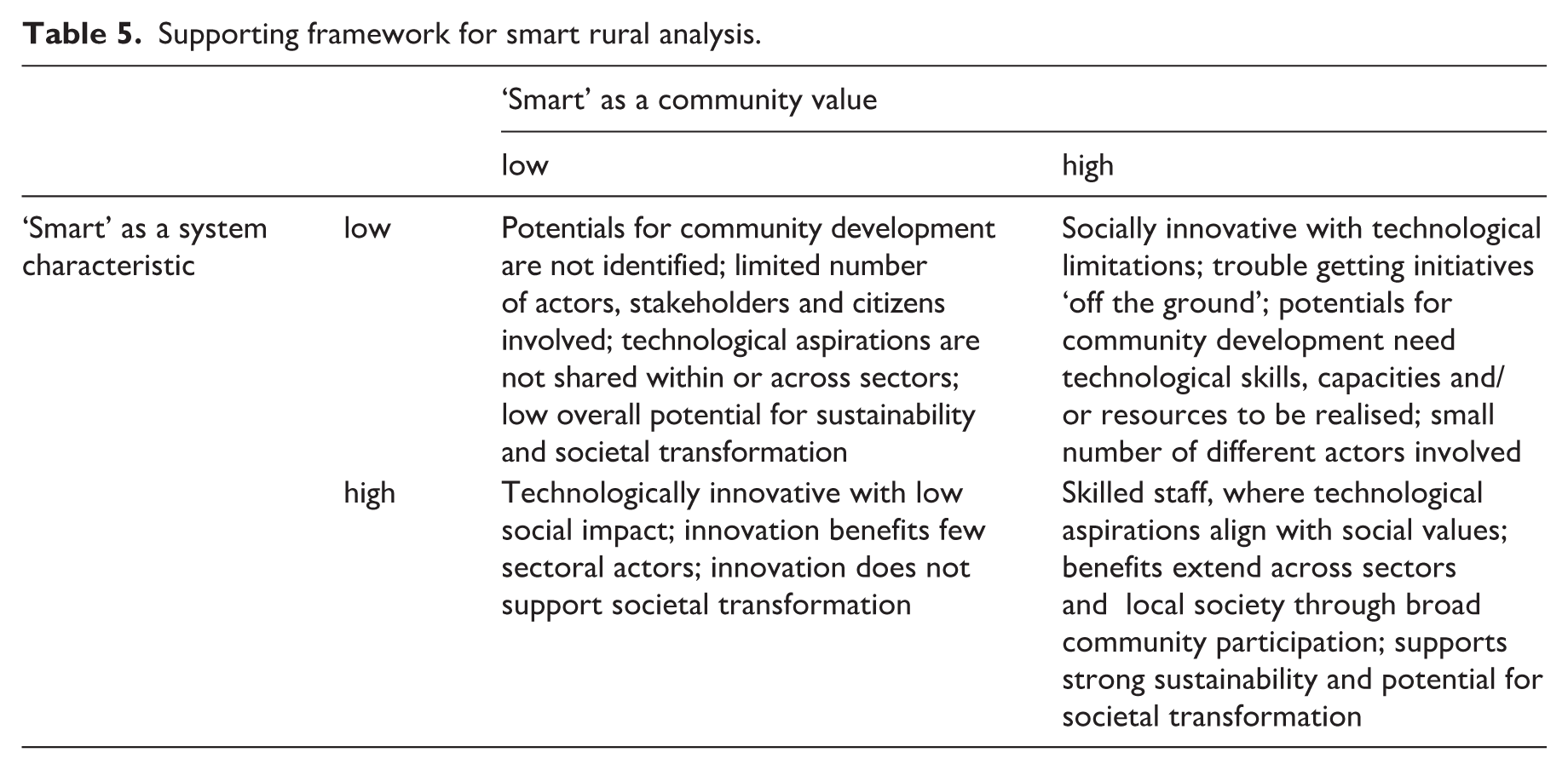
The distinction of smartness as a system characteristic and community value intends to stimulate deeper consideration for the meaning of smart rurality. The SV discourse stands to gain credibility through the application and testing of such theoretical propositions. Future research can take inspiration from Table 5 for designing SV projects (e.g. through deeper consideration of problems and causes to prescribed solutions). Nevertheless, we caution against its extension as an evaluation framework until a sufficient evidence base from projects is gathered. Moreover, in the search for a deeper understanding of smartness, the discursive distinctions between the meanings of smart in urban and rural contexts deserve separate attention. To underpin notions of weak or strong smartness in SV strategies and projects, we point again to the need to understand problem definitions, causal interpretations, moral evaluations and treatment recommendations. Developing these would be worthwhile to better legitimise SV as a goal-oriented and efficient policy concept.
This article has critically analysed SV as represented in EU sources and highlights weaknesses in the EU framing of SV. By starting from a perspective of rural smartness, innovation and development, it seeks to overcome siloed thinking between CP and CAP policy spheres and elevate SV for serious academic discussion by laying sorely needed theoretical underpinnings (Slee, 2019). Discursive development is not only an academic exercise. In accordance with the bottom-up principles of SV behind its inception as a policy concept, a clearer structure and direction is needed to channel thinking and debate around the meaning of rural smartness, made concrete through SV. By providing a supporting framework focused on the potentials of SV, we aim to stimulate further academic debate and encourage multiple perspectives to emerge from current and planned SV projects.
Limitations and future research
Due to the early stage of formation and institutionalisation of SV in the EU, the analysis and discussion presented in this article has been limited by the scope of empirical material found in websites and related source documents. While we surveyed concrete projects attempting to detect differences in definitions and operationalisation of SV on the ground, the most substantial wave of projects initiated during the 2021–2027 programming period intends to develop definitions using a bottom-up approach. Therefore, project level analysis to contribute to the SV discourse remains a topic for future research.
As mentioned in our methodological section, the framing approach offers insights into the ideational level of SV and smart rurality by taking texts as media representations. Looking forward, other established methods of critical social analysis may be employed to investigate SV, including critical discourse analysis (CDA), once the discourse has been sufficiently deepened. For example, CDA could be used to demonstrate a plurality of discernible SV discourse practices and social practices (Fairclough, 2010), and PDA may be useful once an evidence base of concrete projects has been assembled to demonstrate SV actions and lines of argumentation (Fairclough and Fairclough, 2012). At the current stage of SV discourse development, however, these methods have not been viable options. Our final contribution, the supporting framework for smart rural analysis, enables further thinking about smart rurality and the diverse conditions under which SV may be realised, underpinning future discourse development and a stronger overall conceptual and policy outlook.
Supplemental Material
sj-docx-1-eur-10.1177_09697764251398439 – Supplemental material for Smart(er) rural areas: Framing ‘smart villages’ for conceptual development and EU policy
Supplemental material, sj-docx-1-eur-10.1177_09697764251398439 for Smart(er) rural areas: Framing ‘smart villages’ for conceptual development and EU policy by Bradley Loewen and Thomas Streifeneder in European Urban and Regional Studies
Footnotes
Acknowledgements
We would like to thank Amber Nordholm for her help in editing the final manuscript. We thank the editors of the special issue on ‘Smart rurality and regional inequalities’ for their comments on earlier versions of this manuscript.
Authors’ Note
This paper has benefitted from workshops held within the ‘Smart Rurality’ project (Estonian Research Council, PRG1919) and special sessions at the Regional Studies Association (RSA) Annual Conference, hosted by the University of Porto (6–9 May 2025, Porto, Lisbon) and the 10th EUGEO Congress, hosted by the Austrian Academy of Sciences (Vienna, Austria, 8–11 September 2025).
Declaration of conflicting interests
The authors declared no potential conflicts of interest with respect to the research, authorship, and/or publication of this article.
Funding
The authors disclosed receipt of the following financial support for the research, authorship, and/or publication of this article: This work was funded by the European Union’s Horizon 2020 research and innovation programme under the Marie Skłodowska-Curie Actions grant agreement no. 101024926 and ‘Rethinking smartification from the margins: Co-creating Smart Rurality with and for an Aging Population’, PRG1919, Estonian Research Council.

Supplemental material
Supplemental material for this article is available online.
Notes
References
Supplementary Material
Please find the following supplemental material available below.
For Open Access articles published under a Creative Commons License, all supplemental material carries the same license as the article it is associated with.
For non-Open Access articles published, all supplemental material carries a non-exclusive license, and permission requests for re-use of supplemental material or any part of supplemental material shall be sent directly to the copyright owner as specified in the copyright notice associated with the article.
