




Abstract
This commentary explores the potential of a localised, community-based resource exchange approach for rural Central and Eastern Europe. It is proposed as a regenerative strategy to address challenges concerning rural building infrastructures, informed by an understanding of building decay as a staged, ecological process. By facilitating the sharing and reuse of materials salvaged from decaying structures within communities, this approach aims to enable communities to take a more active role in shaping their built environment, support community resilience and contribute to sustainable development. The commentary examines the core principles and conceptual functions of this proposed community-based approach. It further analyses its potential benefits and inherent challenges, advocating its value for regenerative resource management and reuse. This article argues for integrating such an approach with existing policy frameworks to advance a more sustainable and equitable future for rural communities.
Keywords
Introduction
Rural areas are essential to the European Union’s (EU) social, economic and environmental well-being (Augère-Granier and McEldowney, 2021). By 2040, the EU aims to create stronger, more connected, resilient and prosperous rural areas, as outlined in the European Commission’s (2024) Long-Term Vision for the EU’s Rural Areas (LTVRA). Policies like the Common Agricultural Policy and the Rural Pact (European Commission, 2023) will help achieve this vision, supporting the European Green Deal and Biodiversity Strategy. The specific situation in rural Central and Eastern Europe highlights the need for regenerative methods. These areas often possess significant cultural and architectural heritage linked to traditional social-ecological systems and biodiversity (Hartel et al., 2016; Skataric et al., 2021). However, this rich heritage coexists with pressing socioeconomic challenges, notably persistent depopulation (Popa, 2023) and post-socialist development disparities (Leibert, 2013), alongside modernisation pressures (Máté et al., 2024). In order to navigate this tension effectively, there is a need for integrated, community-focused strategies that balance heritage preservation with sustainable resource management and socioeconomic well-being, which motivates the approach discussed in this commentary.
The proposed community approach operates within a challenging context defined by the profound impact of depopulation in rural Central and Eastern Europe. This trend, fuelled by economic migration, creates a landscape of vacant, decaying buildings, presenting major environmental and social problems. Like many Central and Eastern European countries, Romania, for instance, is witnessing its villages deteriorate due to emigration, resulting in empty, decaying buildings. The built environment is crucial here, yet rural Eastern Europe faces significant challenges concerning its rural building infrastructure: underutilisation, deterioration and inefficient resource use, exacerbated by depopulation. Crucially, this depopulation also creates an important, often untapped, reservoir of building materials locked within these abandoned structures. This forms the potential resource base that such a community initiative could mobilise. This deterioration follows a dynamic progression, presenting distinct challenges and opportunities for salvage or reuse.
Therefore, this commentary proposes a localised, community-based system for resource exchange as a practical regenerative strategy. This conceptual approach aligns with the LTVRA by aiming to enhance community viability and local economies through resource circulation (European Commission, 2021, 2024). By facilitating the circulation of local resources, the system engages with critical aspects of European policy. First, it addresses the ambitions of the Rural Pact (Augère-Granier and McEldowney, 2021) by proposing a tangible mechanism for fostering resilience and prosperity through community-led resource management. Second, it operationalises the European Green Deal and Circular Economy Action Plan by addressing construction waste. Third, it intersects with debates surrounding the effective use of Cohesion Policy funds for sustainable rural infrastructure, supporting the Smart Villages concept through enabling local resource management (Anastasiou et al., 2021). Fourth, it addresses the broader political challenge of responding to rural depopulation. Therefore, by leveraging the innate spatial tactics of residents (Egger et al., 2024), this initiative aims to empower communities, reduce waste, promote a circular economy and acknowledge the embedded cultural and heritage value within the decaying building stock. These community-based interventions can therefore contribute to sustainable rural development goals within challenging socioeconomic contexts, primarily when characterised by depopulation and development disparities.
To better understand the potential for such interventions, it is helpful to consider the building life cycle. The life cycle of a building, particularly when left unattended in depopulating areas, mirrors ecological processes of decay (Motalebi and Shaffer, 2023). Just as a fallen tree nourishes new life, an abandoned building undergoes a dynamic process, progressing through stages with distinct material states and potentials. Understanding this progression offers a potentially powerful lens for interventions that, like ecosystem processes, can transform decay into resources, fostering circularity rather than linear abandonment. This conceptual lens informs the community-based initiative explored in this study, as shown in Figure 1.
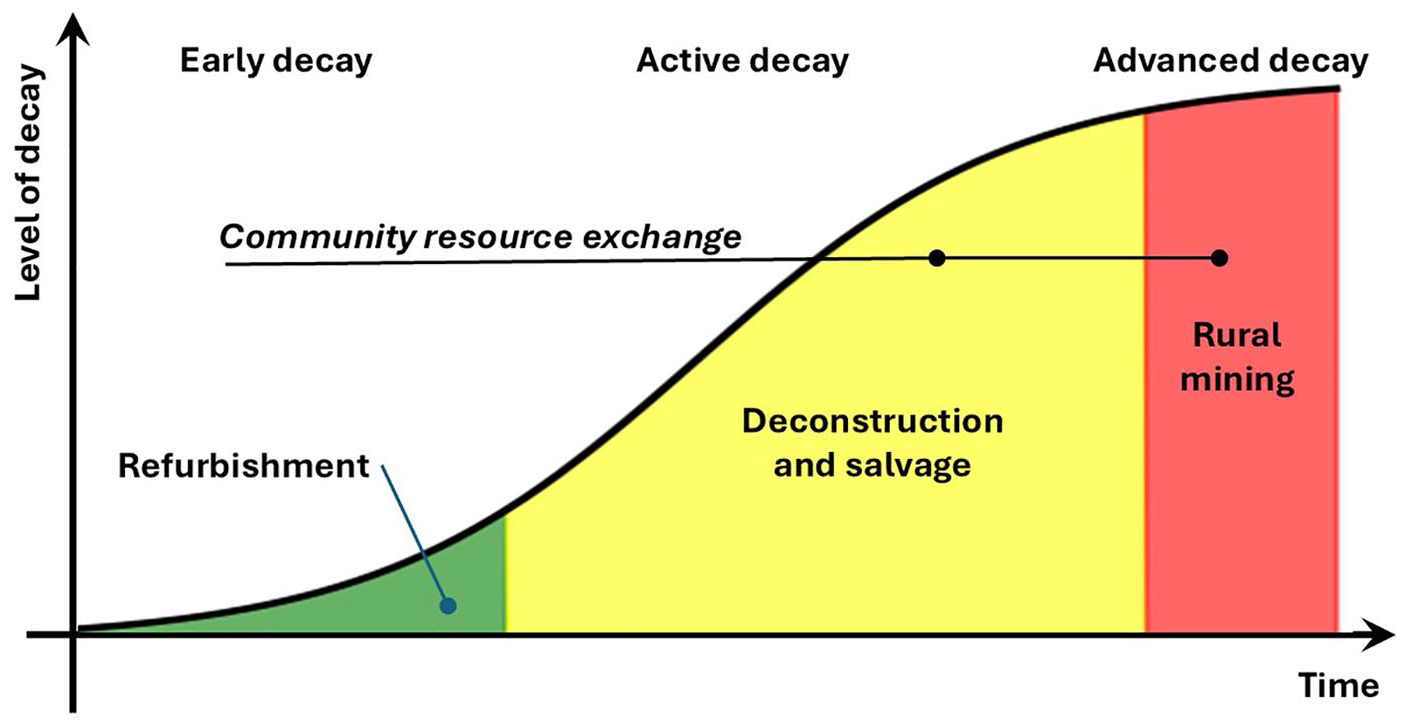
Conceptual model of building decay and intervention stages.
Figure 1 presents a conceptual and illustrative model of a building’s ‘general decay’ progression. It shows how increasing levels of building decay correspond to different phases, starting with vacating the building, representing some early form of decay. In this stage, refurbishment is viable. As decay progresses in the second stage, deconstruction or salvage is appropriate, while in the advanced stage of decay, measures could include ‘rural mining’. The two later stages are where the proposed community-based resource exchange approach plays its role, facilitating the recovery and circulation of materials that might otherwise be lost to demolition and waste.
Indeed, the conceptual model reflects that rural building infrastructure, particularly its building stock component, undergoes a dynamic process of decay. This inherent progression alters intervention possibilities and the nature of recoverable resource potential at each stage. However, standard demolition practices often fail to engage with this dynamic, instead preventing the recovery of valuable material and immaterial resources lost during the decay process (Krag, 2017).
Deteriorating building stocks in rural areas are multifaceted. Economically, this translates to lower property values and less demand for construction and upkeep. Demolishing abandoned buildings erodes community identity and destroys tangible links to shared history, exacerbating the decline (Lakševics et al., 2025). From an environmental perspective, these structures contribute to pollution and increase energy waste. As decay progresses, the less potential there is for material reuse, highlighting the need for early action. Besides these factors, the outdated national regulations (e.g. on waste recycling in Romania or waste management in Ukraine) potentially hinder circular approaches.
Furthermore, climate change further complicates the problematic situation of rural buildings in Central and Eastern Europe. The rising frequency and severity of extreme weather events, including floods and storms, cause physical infrastructure damage and intensify building decay (Ortner and Weitkamp, 2020; Scholze et al., 2023). Simultaneously, higher temperatures and irregular rainfall damage buildings (Igić et al., 2020) and farming (Eitzinger et al., 2013), weakening rural economies and possibly increasing population decline (Graus et al., 2024; Igić et al., 2020). The pressure of the climate crisis exposes the weakness of current buildings, demanding localised adaptation and community-based approaches prioritising resilience and resource management (Aguiar et al., 2018; Dwyer, 2016).
Existing policy and governance barriers deepen the physical and social challenges. While national strategies aim to address rural development, they often lack specific measures for building stock sustainability. Weak institutions hinder effective policy implementation (European Commission, 2025). EU funds like the Common Agricultural Policy and Cohesion Policy, intended for rural development, are often insufficient to access targeted building stock management needs, while the complexity of accessing these funds further complicates efforts to revitalise rural infrastructure (European Commission, 2025). National policies like Romania’s Development and Anti-Poverty Policies also underscore the need for initiatives to improve livelihoods and the sustainability of rural communities.
Future prospects and opportunities
Despite these contextual challenges, implementing a community-based resource exchange system offers significant opportunities that align with key European trends and principles. First, such a system aligns with circular economy principles by emphasising resource conservation, waste reduction and reuse. It contributes to sustainable rural regeneration by creating local loops for building materials, reducing external resource dependency and potentially fostering local skills related to deconstruction and reuse. This approach provides a mechanism to capture resources in mid-to-late stages of decay, facilitating ‘rural mining’ of materials with remaining utility and embodied energy. The circular economy presents opportunities for rural job creation, economic diversification and resilience. This approach, consistent with initiatives such as the New European Bauhaus (European Commission, 2020), prioritises repurposing existing structures and using sustainable materials, boosting community collaboration and reducing waste.
Second, this localised approach encourages community participation and capacity building. Through this, residents can actively participate in and leverage their local knowledge in the circular economy. By fostering collaboration, such initiatives enhance community resilience and social cohesion. This bottom-up approach could go beyond EU strategies like the LEADER programme to give local action groups more power to create projects tailored to local needs. It can catalyse broader development, address depopulation by engaging younger generations and contribute to rural revitalisation, supporting the LTVRA’s aim of attracting new residents. By potentially lowering renovation costs through the use of affordable, reused materials and fostering local micro-activities, this approach could help counteract depopulation pressures. Furthermore, it preserves local identity by facilitating the exchange of materials with recognised heritage or emotional significance (Dişli and Ankaralıgil, 2023) and the need to preserve cultural identity during regeneration (Krag, 2017).
Third, while success requires the support of local government and policymakers, existing policy directions offer avenues for integration. Support includes infrastructure, digital literacy promotion and partnerships. Although digital tools aid resource management, aligning with Smart Villages initiatives (Anastasiou et al., 2021), the primary need is support for the community coordination mechanism itself. This concept is in line with the EU’s broader rural development strategy (as the EU Rural Action Plan and the Rural Pact), which supports the social economy’s role in local development. Funding for projects enhancing the sustainability and resilience of rural communities may be available through the Common Agricultural Policy’s rural development focus and the EU Cohesion Policy. Crucially, policies must favour deconstruction over demolition to create a sustainable supply for local reuse, meeting broader EU circular economy goals.
Limitations and future directions
Implementing such a community system must address challenges related to technological access, community engagement and resource management. Ensuring inclusivity and fairness in resource sharing is crucial for the success of this initiative as a tool for community regeneration. Overcoming resistance requires outreach, education and incentives. Any specific tools employed, whether digital or otherwise, must be user-friendly and accessible to all residents, addressing potential barriers such as limited technological access or skills (Toșa et al., 2024). This can be achieved through partnerships with local organisations and influential members in the community who can advocate for the overall approach and provide support to residents. A specific challenge involves developing methods for assessing and communicating the value of reused materials, particularly those with heritage significance, which is vital for preserving cultural identity during regeneration processes.
While promising, the practical implementation of this community-based resource exchange approach requires a critical assessment of its real-world viability. One concern is scalability, or whether this model can be successfully applied beyond specific rural areas with strong community leadership, or is it replicable across diverse rural settings? Realising this approach requires overcoming key practical barriers related to balancing material supply and demand. Securing a critical mass of usable materials is crucial for determining the cost-effectiveness of deconstruction versus demolition, as well as the condition of salvaged items from decaying structures. Conversely, stimulating local demand requires a sufficient number of renovation projects, alongside local skills and trust in using non-standardised, reused building materials. Other critical factors include achieving long-term operational sustainability, particularly securing ongoing funding, and ensuring equitable community access by actively addressing barriers such as digital literacy. Finally, significant effort is needed to address logistics, establish quality control frameworks and foster the behavioural change required for widespread adoption of deconstruction and material reuse.
These complexities underscore the need for future research grounded in a pragmatic, mixed-methods approach. Such research could combine qualitative insights into user needs, community dynamics and cultural values with quantitative assessments of economic viability, environmental impacts and logistical efficiencies. This mix is essential for evaluating this resource exchange concept in a realistic manner and guiding its effective, context-aware implementation.
Conclusion
The proposed community-based resource exchange approach offers more than just resource sharing. It represents a context-aware and decay-informed strategy for the regenerative management of rural building infrastructures, aiming at regeneration. This makes it particularly vital for rural areas facing depopulation and development disparities. This approach intervenes within the decay process and provides a mechanism for material circulation that respects both utility and heritage. In doing so, it aligns circular economy principles with preserving local identity and community resilience, core elements of the LTVRA’s plan for sustainable and thriving rural futures. This initiative also aligns with EU and national policies that emphasise rural development, the circular economy and community empowerment. Furthermore, the approach fosters local agency, enabling communities to navigate complex socioeconomic and environmental pressures, including the impacts of climate change. With sufficient support and collaboration, this novel strategy can therefore pave the way for a more resilient and equitable future for rural Central and Eastern Europe.
Footnotes
Acknowledgements
The author acknowledges the use of Scopus AI to assist with identifying relevant literature, SciSpace to aid in summarising and interrogating sourced literature and ProWritingAid for language editing suggestions, including rephrasing and clarity enhancement.
Declaration of conflicting interests
The author(s) declared no potential conflicts of interest with respect to the research, authorship, and/or publication of this article.
Funding
The author(s) disclosed receipt of the following financial support for the research, authorship, and/or publication of this article: This article is part of the Future Energy hub project funded by the Research Council of Norway (grant agreement number 280458).
