




Abstract
Driven by the recent investment surge in large-scale green technology projects, the European Union’s shift towards climate neutrality has sparked new development in formerly ‘left-behind’ places across Europe. This article critically revisits the core of extended urbanisation theory to explore how peripheralisation dynamics evolve and are reinforced when ‘left behind’ places become new centres of urban and economic development linked to Europe’s green transition. Drawing empirically on the implementation of a Chinese gigafactory for electric vehicle battery cells and associated infrastructure in Thuringia, Eastern Germany, the article explores three dimensions of centralisation-peripheralisation dynamics (economic, infrastructural and institutional) that reveal how the project’s implementation has led to (1) outward-oriented value flows with limited local benefit; (2) large-scale infrastructure that fails to address socio-ecological needs on-site and (3) exacerbated power imbalances between state institutions and local planning, administration and policy professionals. Challenging the prevailing assumption that large-scale projects and associated built infrastructure inevitably drive the development of ‘left-behind’ places, the article demonstrates that the rise in transnational capital and reinforced peripheralisation are closely intertwined across scales and time spans. Overall, it seeks to inspire a relational framework that combines the multi-scalar dimension of extended urbanisation in Europe’s peripheries with a grounded analysis of (trans)local histories and power relations.
Keywords
This is an investment of unprecedented scale. [. . .] The technology enabling the German and European mobility transition will now come from Thuringia, [. . .] propelling us toward becoming the future world-leading hub and value-creation centre for electric vehicle battery technology in the heart of Europe.
1
Introduction
Recent efforts in the European Union’s (EU) shift towards climate neutrality and diversified supply chains post-COVID-19 have sparked a major investment surge in formerly ‘left-behind’ places across Europe, including Eastern Germany. Whether it be offshore and onshore wind farms, solar photovoltaic and solar thermal technologies, green hydrogen and hydropower plants, or battery manufacturing and recycling facilities, a growing number of large-scale green technology projects, spurred by transnational investment, are being envisioned as key development drivers. Propelled by the political-economic ambitions of local officials, these projects are considered development ‘frontiers’ poised to foster new concentrations of employment, value creation, infrastructure development and transnational connectivity.
The increase of green technology projects and associated built infrastructure in Europe’s formerly bypassed regions echoes what scholars in urban and regional studies have (re)called the ‘peripheral turn’ (Ren, 2021), pointing out the epistemological, economic, socio-spatial and ecological relevance of peripheries within the production of the contemporary urban (Phelps et al., 2022). These efforts align with debates on extended urbanisation (Brenner, 2014), which contain a larger research initiative on ‘global suburbanisms’ (Güney et al., 2019) and ‘post-suburbanization’ (Charmes and Keil, 2015). Others refer to metabolic approaches interrogating the deployment of peripheral infrastructure projects as globally networked urbanising frontiers that serve the world’s urban centres at the expense of ever-expanding ‘operational landscapes’ under urbanisation with ‘planetary’ scale (Arboleda, 2020; Brenner and Katsikis, 2020). Collectively, the literature pushes forward the shared attempt to grasp conditions of the contemporary urban beyond the methodological and empirical boundaries of cities (Angelo and Wachsmuth, 2015) by focusing on and theorising from peripheries and thus ‘from the outside in’ (Keil, 2018a).
In parallel, since the 2008 financial crisis, a renewed interest in peripheries has been developed among economic geographers and urban policymakers, with the term ‘left-behind’ places gaining particular prominence (Fiorentino et al., 2024; Rodríguez-Pose, 2018). Recent works explore the term’s origin and diverse meanings (Pike et al., 2024), related geographies of discontent (De Ruyter et al., 2021), including their alleged political revenge (Förtner et al., 2021) and dialectics of embitterment and hope (MacKinnon et al., 2024). More policy-focused initiatives address urban development responses (MacKinnon et al., 2022), or question whether infrastructure investments truly support levelling-up ‘left-behind’ places (Gansauer et al., 2024). However, extended urbanisation literature and recent inquiries into ‘left-behind’ places rarely intersect. Instead, the latter remains entrenched in spatial imaginaries of uneven development, characterised by interconnected yet geographically distant regions of growth and underperformance that result from broader processes of peripheralisation and metropolitanisation (Lang et al., 2015). But what does this relational approach mean for ‘left-behind’ places that are themselves about to become new centralities? Research on extended urbanisation also struggles to address this question adequately. While some argue that peripheralisation – and thus conditions of being ‘left behind’ – is intrinsic to the extended urban fabric (Schmid, 2019: 161), there is still a lack of robust empirical and methodological evidence on how centralisation–peripheralisation dynamics manifest spatially in the same place and beyond.
This article examines how recent deployments of large-scale green technology projects in Europe’s ‘left-behind’ places are linked with extended urbanisation, including the varying ways of how the multi-scalar processes of centralisation and peripheralisation interconnect over space and time. Given Europe’s ongoing reliance on East Asian, especially Chinese, corporations for key technologies and critical resources essential to the green transition (MERICS, 2022), the empirical focus of this article lies on a recent large-scale Chinese investment in a new gigafactory for the manufacturing of electric vehicle (EV) battery cells and associated built infrastructure in the town of Arnstadt-Ichtershausen in Thuringia, Eastern Germany. Positioned as a politically endorsed ‘green flagship project’, the investment serves as a model for envisioning new economic opportunities and prosperity, thereby raising the region’s entire profile. At the same time, the region integrates into far-reaching networks of China’s EV supply chain that increase multiple relations between dominance and dependence, thus reinforcing peripheralisation within the region and beyond.
The article challenges the widespread assumption that green technology projects and their associated built infrastructure create new economic centralities and inevitably drive the development of ‘left-behind’ places. Rather, it demonstrates that the new surge in transnational investment and reinforced peripheralisation dynamics are closely intertwined across various scales and time spans. Through revisiting the conceptual core of extended urbanisation theory, the article develops a multi-scalar framework that allows for exploring the varied and partly contradictory centralisation–peripheralisation dynamics that occur in light of recent developments surrounding the gigafactory project. Therefore, the article deploys three key dimensions (economic, infrastructural and institutional) that reveal how centralisation efforts in the project’s deployment have led to outward-oriented value flows with limited local benefit, large-scale infrastructure that fails to meet socio-ecological needs on-site, and exacerbated power imbalances between state institutions and local actors in planning and administration. The findings indicate that the Thuringian state government has mainly shaped these relational processes by leveraging infrastructure investments to attract transnational capital and thus govern futurity. In parallel, it is also the structural constraints and the lack of local resources that drive the disadvantage on the local level.
In the next sections, I first examine the literature on peripheralisation, outlining why a new link between peripheralisation and extended urbanisation is important to study. I then introduce my selected case in the town of Arnstadt-Ichtershausen, before I deploy empirical findings to discuss three identified dimensions of centralisation-peripheralisation dynamics – economic, infrastructural and institutional – that occur in the context of the project’s implementation. The concluding section evaluates the conceptual relevance of the empirical findings.
From ‘left-behind’ places to centralisation–peripheralisation under extended urbanisation
Following the 2008 financial crisis, the term ‘left-behind’ places has gained increasing attention in urban disciplines, particularly describing post-industrial regions, cities and towns suffering from economic underperformance and decline (Rodríguez-Pose, 2018). In Germany, referred to as Abgehängte Regionen (suspended regions), the term is closely linked to spatial imaginaries of negatively connoted places that are geographically distant from economically successful and growing regions, cities or city-regions. This relational construction (Massey, 1979) reflects a general focus on geographic inequalities resulting from processes of peripheralisation and metropolitanisation (Lang et al., 2015). However, while the term ‘left-behind’ places is relatively new, its underlying processes have been addressed since the late 1990s through the relational and multidimensional concept of ‘peripheralization’ (Fischer-Tahir and Naumann, 2013; Nitz, 1997).
In contrast to the rather static notion of periphery, peripheralisation addresses the variegated dynamics behind processes through which peripheries are produced (Kühn, 2015). This moves away from a purely spatial understanding, highlighting the economic, political, social and/or communicative dimensions of peripheral change. Peripheralisation, and thus the emergence of ‘left-behind’ places, is to be understood more as the result of political, economic and societal relations and less as the product of spatial differences. Rather, it constitutes a relational concept to interrogate the polarisation between the access to and exclusion from, for example, economic and social resources or power and decision-making processes (Kühn et al., 2017).
Such understanding was increasingly evoked in the context of the post-socialist transformation following 1989 and the concomitant reintegration of Central and Eastern Europe (CEE) into the global capitalist system. Social and economic crisis led to regional polarisation on the sub-national level where the dynamics of spatial and economic centralisation in urban centres determined the peripheralisation of small towns and rural areas in the wider region (Ehrlich et al., 2012). As a result, focusing on Eastern Germany, peripheralisation processes have been witnessed that are linked to, for instance, out-migration (Keim, 2001), weak infrastructural provision and a qualitative and quantitative decline of public services (Naumann and Reichert-Schick, 2013), the shrinkage of cities (Oswalt, 2005), the discursive stigmatisation of ‘left-behind places’ (Lang, 2012; Meyer and Miggelbrink, 2013) and the construction of East German identities through media representation (Hörschelmann, 2001).
This rich bulk of urban research has undoubtedly contributed to a more profound understanding of uneven socio-spatial development across CEE regions. However, although the concept of peripheralisation aims to take into account multi-scalar (local, regional, national, global) relations (Ehrlich et al., 2012), previous studies are primarily limited to peripheralisation processes in dependence to one or more metropolitan core regions. Such ‘metrocentricity’ (Bunnell and Maringanti, 2010) follows a dualistic understanding that distinguishes metropolitan growth centres and resulting processes of peripheralisation mainly referring to the decline of outlying places of the wider metropolitan region (Kühn and Lang, 2017). Recent inquiries into the concept of ‘left-behind’ places also problematise such scale-based fixation, emphasising the need to consider multiple interrelations with other near and far locations in the analysis of the plurality of conditions that characterise these places (Martin et al., 2021). Rather than driving forward the homogenising tendency of the term – which risks obscuring the differing dimensions, predicaments and potentials of ‘left-behind’ places – scholars call for more place-specific investigations in various spatial and temporal settings (Kinossian, 2019). Given that formerly peripheralised regions are now becoming new economic hubs of the EU’s energy transition, such multi-scalar and place-sensitive investigations become all the more important to examine the mutually influencing centralisation–peripheralisation dynamics that occur in the same place and beyond.
Linking peripheralisation with the concept of extended urbanisation sees the opportunity to overcome the metro-centric scale of previous work and, instead, consider the variegated and partly contradictory dynamics of urbanisation linked to large-scale green technology projects in Europe’s peripheries. Extended urbanisation was first introduced by urbanist Monte-Mór as part of his work on industrialised urban spaces and networks in the rural Brazilian Amazon. According to him, ‘extended urbanisation assumes diverse forms: it includes the dynamic metropolitan centres and, increasingly, distant peripheries that are linked dialectically back to the centres and subcenters of the capitalist system’ (2014: 112). This conceptualisation builds on Lefebvre’s (2003 [1970]) notion of the ‘urban zone’ describing the dialectical relationship between ‘urban centres’ (implosion) and ‘urban fabrics’ (explosion) as the result of vast industrial expansion and spatial re-configuration of entire territories under global capitalism. Besides Soja (2012), who applied the term in the context of regional urbanisation, it is Brenner and Schmid (Brenner, 2014; Brenner and Schmid, 2015) who elevate the approach to the analytic foundation of ‘planetary’ urbanisation. By referring to Lefebvre’s notion of implosion/explosion, according to them, contemporary planetary urban conditions consist of two relational parts. ‘Concentrated’ urbanisation refers to dense urban agglomerations linked to the centralisation of economic centres as it has been conceptualised with the global cities formation. Conversely, an extended form of urbanisation
denotes the production and perpetual reorganization of broader operational landscapes – including infrastructures for resource extraction, logistics and communication, energy and food production, water provision and management, waste disposal and environmental planning – that at once support and result from the dynamics of urban agglomeration. (Brenner, 2017: 201)
This hierarchical structuring between concentrated (cities, city-regions, megacities) and extended (operational landscapes, hinterlands) forms of the urban, paired with the subsuming of these categories under the notion of the planetary, falls short in two important points.
First, as Lefebvre’s notion of the urban revolution emphasises, the moment of implosion and thus the key condition for creating ‘centrality’ can also and crucially evolve across ‘non-urban’ places distant from urban agglomerations (see Keil, 2018b; Langguth, 2022; Vogelpohl, 2011). This is contrary to the conceptualisation of concentration as described with the planetary urbanisation thesis. Against the backdrop of 20th-century globalisation, centrality according to Lefebvre describes the foundational characteristics of a ‘completely urbanised society’ and its relational connections to the world through, for instance, global circuits of information, social relations or cultural goods. Thus, the essence of centrality enables the development of open spaces of ‘difference’, which is the prerequisite for everyday encounters, political co-creation and the emergence of something new (Lefebvre, 2003 [1970]). In what ways differences are produced, for example, through multiple lifeworlds, development plans, imaginaries or interests, depends on how these elements are socially constructed and represented.
Second, as Keil (2018c) has recently elaborated, the moment of implosion represents a ‘singular and unified’ aspect equated with concentration. In contrast, the moment of explosion results in ‘numerous, disjunct elements’. Encompassing the diversity of such disjunct elements under the label of the ‘planetary’ would oversimplify and overlook the varied relations, imaginaries and lived realities inherent in the urban explosion moment, including its multiple socio-spatial formations and multi-scalar relations. In other words, perceiving the deployment of new large-scale green technology projects projects in formerly bypassed regions as a multifaceted and relational interplay of ‘implosion-explosion’, allows for an unbiased framework that does justice to today’s multi-scalar complexity of extended urbanisation in peripheries. Such perspective moves away from dominant approaches to examining peripheries in relation to one or more urban centres on metropolitan scale. Rather, it interrogates the ever-changing processes between the creation of new ‘centrality’ and modes of ‘peripheralization’ in and from peripheries, including their multi-scalar relations that shape these places. As Keil states in his recent invocation, ‘there is much to learn by foregrounding the explosion antithesis conceptually and recognizing its own differentiated dynamics of multiple and multifarious implosions–explosions’ (Keil, 2018c: 500). Viewing recent green technology developments as forms of extended urbanisation thus implies recognising the emergence of new centralities (implosions) in previously bypassed places, such as economic growth and employment opportunities. However, it also allows to acknowledge the emergence and/or reinforcement of multi-scalar dependencies (explosions), including associated dynamics of socio-spatial peripheralisation and exclusion in the same place and beyond. Before exploring these interrelations based on the empirical data, I will first provide an overview of recent Chinese investments in Europe’s EV battery cell market, particularly focusing on the case of Arnstadt-Ichtershausen in Thuringia, Eastern Germany.
Chinese outbound investment in Europe’s EV battery cell market: the case of Arnstadt-Ichtershausen
As of August 2023, a total of 58 gigafactories for the manufacturing of EV battery cells were planned, under construction, or operational in the EU and neighbouring countries such as the United Kingdom and Turkey (Figure 1). Of these, 13 are financed by Chinese firms, which, in comparison with the other projects, are the most advanced and have the highest manufacturing capacity. This can be attributed to Chinese firms’ leading role in the global EV battery cell market and the EU’s continued dependence on this sector (MERICS, 2022). In addition, seven Chinese EV battery component manufacturing sites have either been planned or in operation. While the global COVID-19 pandemic led to an abrupt decline in China’s outbound investment in the European EV industry in 2020, investment rebounded quickly and, by late 2022, constituted the mainstay of China’s investments in Europe (Rhodium Group and MERICS, 2023). Gigafactories have become the main driver for the shift of Chinese capital from previous mergers and acquisitions (M&A) to new greenfield projects (Rhodium Group and MERICS, 2023), which highlights the increasing role of gigafactories for European urban planning and governance.
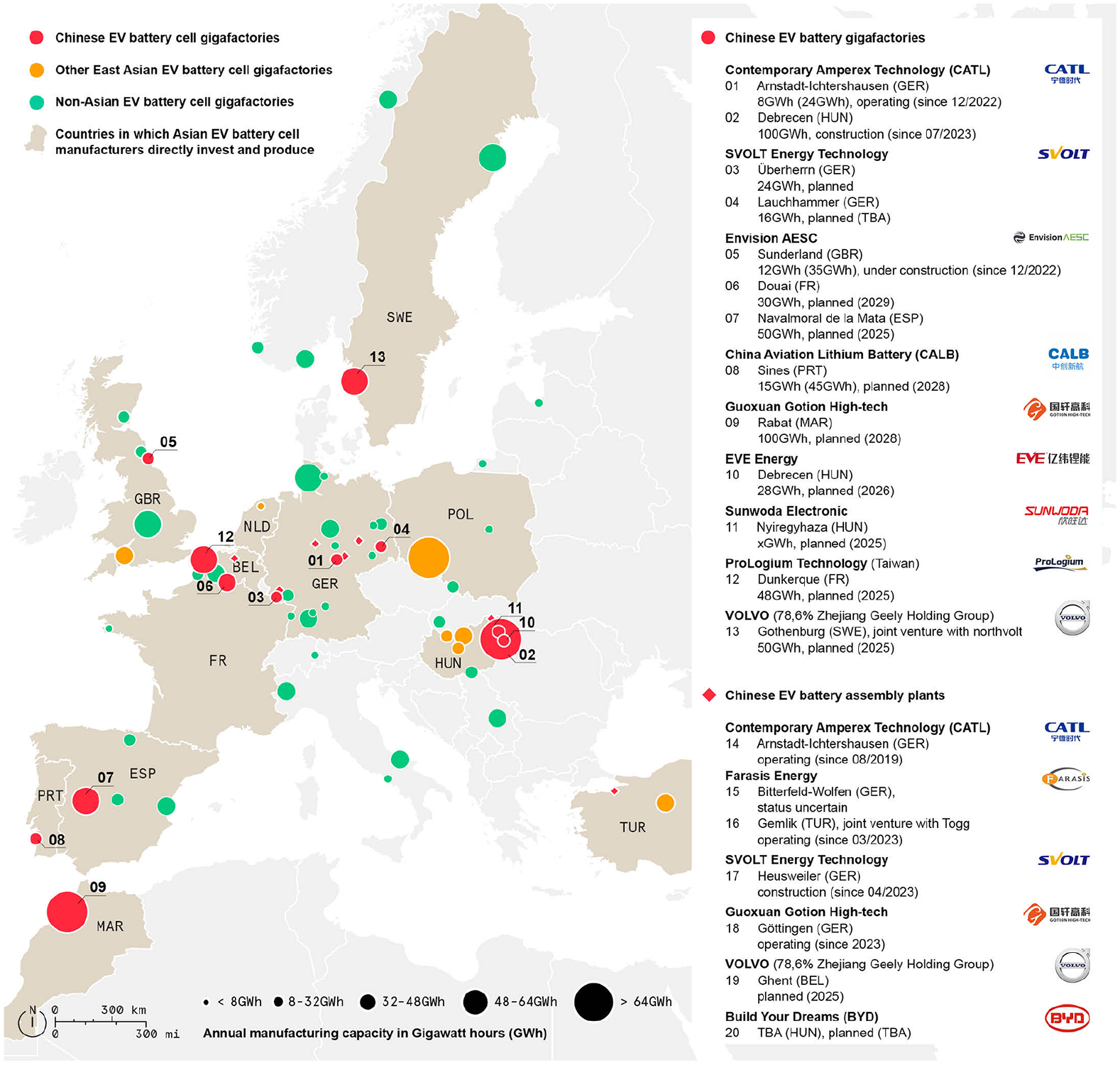
EV battery cell gigafactories and battery assembly plants in Europe, August 2023; Graphic: Author (based on battery-atlas.eu by PEM RWTH Aachen University, 2022 and own research), no claim of completeness.
In October 2019, the groundbreaking ceremony for the largest single investment in Thurningia’s history took place at the 439 hectares Erfurter Kreuz industrial park near Arnstadt, a town of 28,000 inhabitants, 40 km southwest of Erfurt (Figure 2). With an initial cost of €1.8 billion, later exceeding €2 billion, CATL built Europe’s first Chinese EV battery gigafactory in 3 years on a 34-hectare plot. The facility, measuring 540 m by 220 m, is part of a larger 70-hectare site reserved for expansion (Figure 3). The investor, Contemporary Amperex Technology Thuringia GmbH (CATT), is a subsidiary of the Chinese EV battery cell world market leader Chinese Contemporary Amperex Technology (CATL), headquartered in Ningde, Fujian Province. Initially planned as a three-stage expansion project with a total manufacturing capacity of 60 GWh per year, it was announced in December 2023 that the project would conclude after phase 1, reaching up to 14 GWh. In January 2020, plans were revealed for a 2.15-km-long 110 kV high-voltage overhead power line with an additional transformer station, which would extend across the northern area.
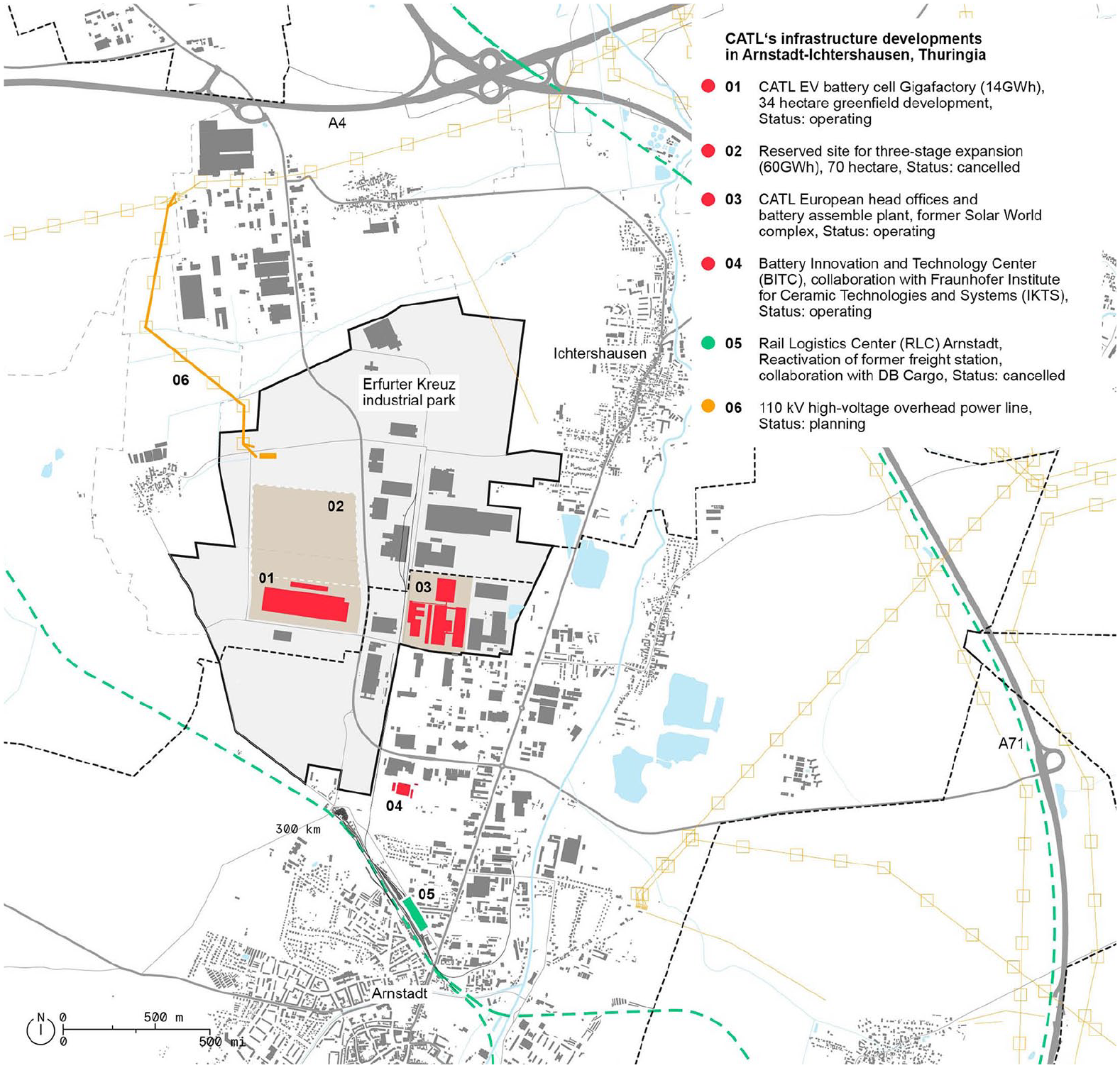
Site plan of CATL’s infrastructure developments at the Erfurter Kreuz industrial park in Arnstadt-Ichtershausen; Graphic: Author (based on © GDI-Th, DL-DE BY 2.0, https://geoportal.thueringen.de/gdith/download-offene-geodaten).
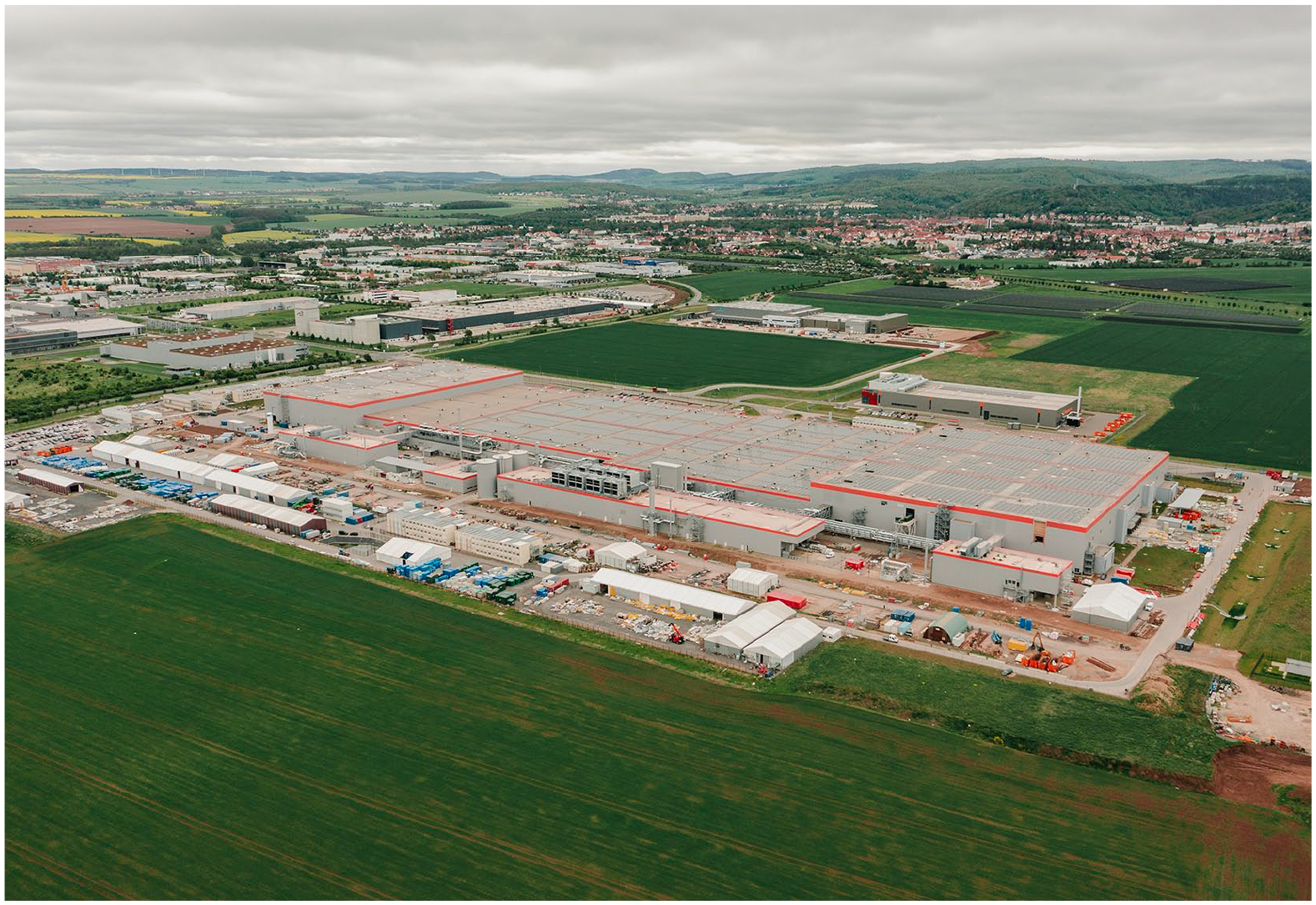
Construction site of CATL’s EV battery cell gigafactory at the Erfurter Kreuz industrial park in Arnstadt-Ichtershausen, Thuringia; Image: Marcus Glahn, 2024.
In addition to the gigafactory development, in 2019, CATL acquired a vacant factory and office complex of former Solar World. This site now serves as CATL’s European head office and a bonded warehouse for untaxed storage of commodities and battery cell modules, delivered to customers such as BMW, Volkswagen (VW), and Mercedes-Benz, whose proximity influenced the location choice. CATL also partnered with the Fraunhofer Institute for Ceramic Technologies and Systems (IKTS) to establish a Battery Innovation and Technology Center (BITC) near the gigafactory. Plans for a Rail Logistics Center (RLC) at Arnstadt’s former freight station, including tracks, cranes, and lorry facilities, were cancelled in 2023 due to CATL’s failure to commit to minimum freight volumes. Additional warehouses in Erfurt and Magdeburg store imports from China, transported by lorry or via the freight terminal in Eisenach. CATL employs 700 local workers and 750 Chinese staff, who oversee manufacturing, train the workforce, and strengthen European supply chains.
My research builds on fieldwork I conducted between spring 2021 and summer 2024. Starting from the actions of and cooperation among local planning, administration, and policy professionals, central to my exploration was the question of which multidimensional dynamics of centralisation and peripheralisation are shaped by the planning and implementation of the project and its associated infrastructures, and how these manifest socio-spatially in the region and beyond. To foreground the situated actions of professionals and its (trans)local implications and relations, I chose a qualitative approach based on institutional ethnography (Smith, 2006), which I adopted in the field of urban studies. It bears the potential to effectively address the multi-scalar dimensions of complex project ecologies by examining professionals’ actions as well as the institutional, legal, societal, and discursive frameworks that shape and coordinate them (Billo and Mountz, 2015).
In practice, this involved 14 in-depth interviews with 15 professionals from local and state authorities, ministries, planning firms, consultancies, and Chinese firms (see Appendix 1). Interviewees for the semi-structured sessions, averaging 1.5 hours each, were selected through initial conversations, observations, and snowball sampling. This was enriched by background discussions and participatory observations at planning meetings, information events, town halls, trade fairs and conferences. Following a mobile ethnography (Streule, 2020), the method of walking also proved essential in my embodied and sensual examination of the project’s actual implementation progress on-site, including its socio-spatial impacts and symbolic dimension for local town development. In addition, my analysis incorporated diverse textual sources, including architectural plans, land use policies, FDI data, directories, media reports, local gazettes, and social media. The data were evaluated using qualitative content analysis.
Emerging centrality and reinforced dimensions of peripheralisation
My analysis identifies three key dimensions (economic, infrastructural and institutional) of peripheralisation dynamics that are being reinforced as part of new economic centralisation efforts in the wake of CATLs gigafactory development in Arnstadt-Ichtershausen. The three dimensions are not all-encompassing or absolute, neither do they work in isolation from each other. Rather, they are interconnected, partly overlapping and vary across scales and time spans. Despite local variations, all the three dimensions are linked to broader relationships between processes of economic value creation and extraction. The first dimension highlights the region’s economic ‘left-behindness’, rooted in profound structural changes following Germany’s reunification in 1989/1990, leading to the region’s ongoing dependency on transnational investment with outward-oriented value flows and minimal local benefit. The second dimension addresses the physical-spatial imprints of the project’s built infrastructure, which primarily serve value extraction and neglect the actual social-infrastructural needs on-site. The third dimension underscores the exclusion of local actors and institutions, marked by state-led paternalism and a lack of transparency in planning, paired with the hierarchical corporate management structures of the inward investing Chinese firms.
Economic: between short-term local gains and the dominance of outward-oriented value flows
May 2024, I stand in front of a 10-storey GDR-era residential block in Arnstadt East. The beige-toned façade is punctuated by an expansive grid of uniform windows, interrupted only by three bold orange stripes marking the building’s entrances. At the central door I notice a large intercom panel with around 50 different doorbell labels. Mostly Chinese surnames catch my eye. Some labels, hastily taped over older ones, show up to three names, organised as Entrance C/left, C/right, D/left and so on. An elderly resident exits, allowing me inside. The stairwell appears grey and worn, the narrow corridors are functional and somewhat uninviting. In stark contrast, a few apartment doors display ornately decorated door couplets, with bright and eye-catching Chinese characters offering greetings to those entering, such as ‘peace across all seasons’.
The building block is owned by Arnstadt’s municipal housing company, with a significant portion rented to an agency that secures accommodation on behalf of CATL for its Chinese employees (AR13, 2024). When asked about the rental arrangement, a local policy representative, who serves on the housing company’s supervisory board, highlights the direct benefits for the housing provider, noting that they can now invest considerably more in the units than usual, further stating:
We can afford to invest more because we have rented out entire sections of the block to CATL, at a rental price we would typically never consider. It was a CATL-specific rate. I knew they would practically pay any rent, even for apartments where you would think, ‘Well, maybe we should renovate first, but alright, let us see what happens’. And they accepted everything; this is fixed for five years now. (AR04, 2023)
Envisioned short-term local gains were a key factor following the public announcement of CATL’s investment in 2018, widely impacting on the region’s real estate market during the following years. Between 2021 and 2023, property prices in Arnstadt surged by 147%, with international, partly Chinese, investors buying apartments, multi-family houses, and even a vacant hotel in the town and nearby municipalities to accommodate CATL employees (AR01, 2023). Other sectors adapted too. Arnstadt’s food and hospitality offerings expanded for a growing Chinese clientele, with new Chinese family-owned restaurants and an East Asian food distribution network. While this reflects value-extracting processes typical of China’s global expansion (see Apostolopoulou, 2021), speculative value-creation measures were also pursued by a range of local actors. For example, the Thuringian tourism agency introduced Chinese-language brochures and guidance systems at regional attractions, such as the Leuchtenburg Kahla near Arnstadt, and the Arnstadt town authority sent local tourism staff for training focused on a yet untapped Chinese tourism market (AR04, 2023).
Although, over the past 5 years, CATL’s significant influx of capital has generated a range of short-term economic opportunities and speculative investments in the wider area, interviews highlight concerns about sustainable value circulation and CATL’s long-term commitment within the region. By the end of 2023, according to official figures, CATL has created around 1500 jobs in Arnstadt-Ichtershausen. However, a substantial portion consists of temporary positions held by specialist engineers from the Chinese parent company, typically staying for just 1–2 years, alongside flexible labour supplied by temporary employment agencies. A state-level division manager involved in negotiating the initial investment agreement explains that it was only through determined deliberations and persuasive efforts that they were able to prevent CATL from operating solely with Chinese workers in Thuringia:
We repeatedly had to explain to them [CATL] that Chinese specialists are too costly long-term. There’s housing, transfers, and ultimately, knowledge drain – because every two years, they return to China, taking their training, expertise, and German language skills with them. New staff arrive and have to learn the context all over again. However, they could only be partially dissuaded from their plan to hire only Chinese employees. (AR03, 2023)
The lack of regional value creation is anticipated to persist due to the absence of business tax revenues for local municipalities in the foreseeable future. Regarding CATL’s high tax deductions resulting from the large investment sums, a local policy representative says:
Given the scale of the investment, a larger impact was expected, and that expectation remains unmet to this day. [. . .] When you know the size of the investment and can roughly estimate the revenue and profits, there will be no business tax in the coming years. I don’t expect a single concrete euro of business tax solely due to the firm’s presence in town. (AR04, 2023).
CATL operates in Thuringia with a well-developed network of Chinese and international partners, which continues to have value-extracting effects locally. While CATL’s initial attempt to implement the new gigafactory in cooperation with a Chinese planning company failed due to Germany’s complex planning system (AR12, 2024), CATL continues to work with Chinese partner firms and their subsidiaries in many other areas, such as factory equipment, automation technology, commodity sourcing, packaging and logistics, and daily employee transport between the manufacturing site and places of accommodation (AR13, 2024).
However, outward-oriented value flows fostered by transnational firms are by no means new to the region. CATL’s recent presence aligns with the region’s path dependency on foreign industrial investments dating to the post-reunification era of the 1990s/2000s. During this period, the restructuring of land and corporate ownership in the former GDR led to the absorption or dismantling of industries by West German and international firms, resulting in prolonged industrial recovery, high unemployment, brain drain, population decline and socio-economic deterioration (Lang, 2012). As public funds waned, local municipalities sold land to the newly established State Development Corporation of Thuringia, overseen by the Thuringian Ministry of Economic Affairs. This marked the beginning of almost three decades that have been defined by the State Development Corporation’s ongoing commitment to attracting large-scale, globally appealing industries featuring cutting-edge technology (AR06 2023).
Post-reunification restructuring and peripheralisation entrenched a dominance of outward-oriented value flows, decisively conditioned by state-led initiatives to provide essential infrastructure and attract corporate investment from transnational firms (Halseth, 2017). As a result, the region has been repeatedly exposed to global market volatility and cycles of boom and bust, as last seen in the failed solar cell industry push of the 2010s (Dunford et al., 2012). This persistent instability has compelled local industries to repeatedly seek new foreign capital to mitigate recurring structural breaks and transformations, perpetuating a locked-in regional economy that ‘constrain[s] in-situ value retention’ (Gansauer et al., 2024: 396). Such a dilemma aligns with recent analyses of regional political-economic shifts based on global infrastructure development (Wiig and Silver, 2019), thus exposing the contradictions inherent in triggering regional growth through transnational investment in ‘left-behind’ places.
Infrastructural: between transnational connectivity and infrastructural decay
Early morning, December 2022. I make my way to CATL’s new gigafactory, under construction in the Erfurter Kreuz industrial park’s western extension. Walking along Thöreyer Straße, I spot cranes on the horizon erecting a colossal power transformer station. On the opposite side of the road, 15 to 20 workers, clad in yellow CATL-branded safety vests, move in small groups. The air is filled with a deafening roar as cars and lorries rush past. The latter – specialised container chassis – bear bold markings of Cosco Shipping, China’s state-owned fleet. The workers and I cross a busy traffic-light-controlled junction. On the other site, we arrive at the vast construction site. Ahead, a windowless industrial complex stretches for hundreds of metres, its structure largely scaffolded, looming over the surrounding fields. Dozens of material and office containers lie scattered in front of it, bustling with activity as workers move between them.
CATL’s developments have become materialised and graspable in the wider region, but its benefits to the local public and the environment remain little. While local development plans and regulatory requirements mandated general environmental and safety measures – such as the creation of green noise-reduction hillsides, a helicopter emergency landing site and a CATL in-house emergency response team – the project has caused new environmental pressures and worsened existing issues. Among others, this implies high traffic volumes and the strain on local road infrastructure around the Erfurter Kreuz industrial park. A local policy representative expresses disappointment with the Thuringian state government, which has failed to advance necessary main road expansion, leaving the municipalities to manage the problems and costs on their own:
We are fighting hard with the [Thuringian] state authorities to get the key roads expanded. [. . .] There is no understanding of our position. Our concerns are dismissed and ignored. And we simply lack the funds to at least expand our own municipal roads. (AR04, 2023)
The feeling of being ‘left alone’ to shoulder the burdens of the project intensified, ultimately culminating in legal disputes. By late 2023, the local municipality of Ichtershausen, together with local landowners, filed a complaint with the Thuringian State Administrative Court. The dispute centred on the construction of the high-voltage overhead power line, which cuts through an area originally designated for environmental compensation. The municipality views the state-initiated overruling planning procedure of the power line as a violation of its local planning authority and, in response, issued a set of demands, making further development contingent on their fulfilment. These demands included, among other things, financial support and improvements to local public infrastructure, particularly in the areas of housing, childcare and schools (AR01, 2023).
However, the lack of improvements to local infrastructure stemmed not only from insufficient state support but also from the CATL’s inadequate preparation for operating in the German context (Langguth, 2024). Engineers from a partnering transport company noted that CATL failed to consider European logistics practices, worsening local traffic due to heavy lorry reliance (AR08, 2023). To address this, Deutsche Bahn Cargo proposed reactivating Arnstadt’s former freight station as a new Rail Logistics Centre. Despite the project’s high-profile launch, with local and regional politicians touting it as a solution to the troublemaking traffic issue, the project failed and left the local traffic issue unsolved. Consequently, the rail freight project became a speculative venture for Deutsche Bahn Cargo, which had already invested around €3 million prepayment into its development (AR08, 2023).
Another issue concerns the mono-functional built infrastructure developments, whose long lifespan contrasts sharply with the relatively short temporal rhythms of the global EV market on which they depend. A local policy representative highlights the future scenario of underused and potentially redundant industrial facilities as a genuine concern for the local population:
If the Chinese feel that this is not profitable in the medium term or if the hurdles become too great, they just pack up and leave immediately [. . .]. That was a clear statement [from CATL] already in 2019. [. . .] And this has made local politicians very alert. We’re talking about massive built infrastructures that are difficult to repurpose – 110 kV power lines designed to last not just five or ten years, but 80 to 100 years, along with substations built specifically for the factory’s needs. Other companies, whether in logistics or production, wouldn’t require such infrastructure, yet these structures remain in the landscape. (AR01, 2023)
In early 2024, local officials’ concerns grew as signs of withdrawal and downsizing took shape. Due to a lack of orders, CATL placed many employees on short-time work or furloughed them. At the same time, the firm announced that it would no longer pursue the originally planned three-phase 60 GWh expansion of the gigafactory, opting instead to maintain the current 8 GWh manufacturing capacity while investing in a new 100 GWh facility in Debrecen, Hungary. The result is a vast, underutilised facility in Arnstadt-Ichtershausen, unfinished and far below its manufacturing targets. An engineer from a planning firm working with CATL wonders:
Inside the factory, there’s a yawning emptiness. Equipment is incomplete or entirely missing. I don’t understand how the firm [CATL] is making any money with this factory. (AR12, 2024)
This highlights the Janus-faced nature of new infrastructure developments driven by transnational investments, which are heavily dependent on the fluctuating and often short-lived dynamics of global capital and profit-making. While the new manufacturing, transport and logistics infrastructure have enhanced the region’s transnational connectivity, embedding it into broader networks of global resource extraction and consumption (Schindler and Kanai, 2021), they remain disconnected from the lived realities and socio-ecological needs on the ground, in parts even exacerbating these issues (Schouten and Bachmann, 2022). Moreover, the fast-paced logics of global markets contrast sharply with the long lifespan of built infrastructure, which materialises as spatially fixed capital assets that require continuous maintenance and investment to keep functional (Howe et al., 2016). As soon as industrial activity declines, profits dwindle and capital withdraws, the region remains ‘left-behind’, facing a growing risk of vacant and deteriorating facilities and built infrastructure, often forcing the public to shoulder associated costs (Carse and Kneas, 2019).
Institutional: between stabilising state-led actions and growing state paternalism
In late October 2021, on a cool autumn day, I step into a tent on the partially cleared site of the former Arnstadt freight station. With wooden flooring, chandeliers and standing tables, it resembles a festive marquee, though no celebration is taking place. Instead, display boards are set up, and a few visitors and suited individuals engage in conversation. The event, hosted by Deutsche Bahn Cargo and the State Development Corporation of Thuringia, was announced as a citizens’ dialogue to present plans for a new Rail Logistics Centre that supports CATL’s gigafactory development. I speak with a young logistics planner who highlights the project’s innovation, including CO2-neutral terminal operations and electric lorries, to enable fully sustainable freight transport for the final mile. In a later interview, another logistics planner present at the event recalls:
Residents came to us and said, ‘Thank you, Deutsche Bahn Cargo, for talking to us. Thank you for holding information events because we know nothing about what’s happening’. [. . .] we figured out that it wasn’t really about the RLC [Rail Logistic Centre], where we expected tough questions. Instead, it was more about what CATL is doing. The event felt like a lightning rod for many visitors. [. . .] Many issues came to light that weren’t directly related to the project’s scope but rather to how it was being carried out. (AR09, 2023)
A lack of transparency and the absence of local stakeholder involvement were persistent issues during the implementation of CATL’s developments. While a state-level division manager admits that ‘regional acceptance doesn’t concern the firm [CATL] at all’ (AR03, 2023), a local division manager reports that CATL’s secrecy led to insufficient public information, heightening uncertainty among residents as well as local planning, administration and policy professionals (AR06, 2023). This became evident in summer 2019, when the construction of the high-voltage overhead power line was officially announced shortly after one of CATL’s information events, where public concerns about the need for and potential impacts of new energy infrastructure were dismissed by both the investor and the State Development Corporation as unfounded. A local policy representative reflects,
Perhaps 14 days after [. . .] we suddenly received the formal planning approval for the 110 kV high-voltage power line. From that point on, everything changed – community groups started forming, initially opposing the high-voltage power line project itself, but soon becoming very critical of CATL’s entire presence in the area. (AR01, 2024)
Even within CATL’s institutional operations, the company’s hierarchical structures provided local engineers and planners with only the information that was absolutely necessary. A former senior employee of CATL describes a lack of transparency regarding the firm’s management and its objectives, further stating, ‘We didn’t receive the information. [. . .] all of us at the local office were kept at a distance’ (AR13, 2024). Instead of involving their employees on-site, they were mainly given top-down directives from the distant and opaque CATL headquarter in Ningde, China. Combined with a high workload and intense pressure for success, the working conditions, especially in the initial years, were described as largely disempowering (AR13, 2024).
However, the lack of local stakeholder involvement is also rooted in site-specific legacies, which gradually strengthened the power of host-state institutions, particularly at the federal state level. Following post-reunification restructuring – as outlined above – the State Development Corporation acquired ownership of the development land, distinguishing it from similar corporations in other Eastern German states, which typically market land on behalf of individual owners. This gave the State Development Corporation a strong negotiating position with investors, at the same time leading to significant one-sided concessions in the case of CATL. To persuade the Chinese firm to abandon their original investment plans for Debrecen, Hungary, and invest in Thuringia, electricity costs were drastically reduced for CATL (AR03, 2023), and the massive expansion of local transport and energy infrastructure, at the expense of municipal budgets, was not prevented (AR04, 2023). Instead, local officials only encountered the project’s specific conditions after the investment agreements were signed.
The State Development Corporation’s strong position led to significant tensions and conflicts, especially at the municipal level. Local policy representatives felt their concerns were often ignored and dismissed, particularly due to the patronising manner in which the State Development Corporation operated (AR01, 2023). Regarding the dispute over the implementation of the high-voltage overhead power line, where local officials perceived a state-led deliberate bypassing of established local development rules, a state-level division manager comments,
They [local municipalities] won’t be able to avoid this. They’ve to and they’ll realise it. And once it’s built, they’ll see that no one will even notice the overhead power line. (AR03, 2023)
This underscores the importance of place-specific histories in understanding centralisation–peripheralisation dynamics. Past decisions have shaped hierarchical roles and unequal power relations between host-state institutions (MacKinnon et al., 2009), in this case leading to an ambivalent role for state-level actors. Bolstered by their institutional status – largely shaped by post-reunification restructuring – federal state officials have responded swiftly and thus stabilised regional economic crises, leveraging their direct and strong negotiating position with investors. At the same time, the centralised authority has bypassed local interests and needs, fostering a growing paternalism in state-level actions. This resonates to broader geographic studies on uneven power geographies stemming from ‘left-behind’ places’ dependence on economic and political decision-making centres (Ek and Rauhut, 2024). In this context, the marginalisation of local planning, administration, and policy professionals is further exacerbated, as they are confronted with faits accomplis and thus increasingly struggle to reconcile economic, political, ecological, and socio-infrastructural concerns at the local level.
Conclusion
This article explores how peripheralisation dynamics in formerly ‘left-behind’ regions evolve and are reinforced when these places themselves become new economic centralities. It therefore examines the recent investment surge in large-scale green technology projects at Europe’s peripheries as processes of extended urbanisation driven by global capitalist markets. Using the case of a new Chinese EV battery cell gigafactory and associated infrastructure in Thuringia, Eastern Germany, the study highlights how centralisation efforts surrounding the project’s deployment have led to outward-oriented value flows and limited value retention within the region; large-scale built infrastructure that barely address the actual socio-ecological needs on-site; and the exacerbation of unequal power relations between federal state institutions and local planning, policy and administration professionals. The article thus challenges the prevailing assumption that investments by transnational firms automatically drive development in ‘left-behind’ places. Instead, it demonstrates that the influx of capital and peripheralisation dynamics is intricately linked across scales and time spans.
The analysis of empirical findings reveals, first, that the region’s power relations with federal state institutions have gradually been built up over time, enabling its transformation into a new economic centrality. However, these processes of forging centrality have significantly heightened the region’s dependency on both near and distant economic and political decision-making centres, thereby reinforcing economic, infrastructural and institutional peripheralisation. Second, the reinforcement of peripheralisation is not exclusively the result of the dominance of economic and political decision-making centres but also stems from a lack of local resources. This hinders local authorities from influencing decision-making processes effectively (Kühn et al., 2017), as decades of institutional and land ownership restructuring have led to job and responsibility cuts in municipalities, financial constraints due to austerity policies, the shortage of skilled personnel and a lack of audacity to pursue alternative development paths.
Future urban and regional research on ‘left-behind’ places should bring both the role of lower state-level actors and the structural deficiency of local resources in decision-making back into the equation. This would prevent the binary view of peripheralised regions as being solely dominated by metropolitan centres or external political and economic forces, as indicated by much of the existing literature. Instead, peripheralisation and disadvantage are co-produced and reinforced at the local level, which implies questions about local agency in coping and/or exacerbating path dependencies and peripheralisation (see Bosák et al., 2024). This is associated with urgent questions that arise regarding the recent electoral victories of the right-wing Alternative for Germany (AfD) in Thuringia (strongest party with 32.8% of the vote in September 2024), Saxony and Brandenburg (second strongest in both), and their influence on future large-scale project investments. While scholars highlight that the far right endangers future investments and the immigration of skilled workers (André et al., 2020), the AfD has claimed a direct link between its electoral successes and increased investment in Eastern Germany. 2 This underscores the appropriation of large-scale green technology projects as locally contested arenas around the rise of the far right (see Beveridge et al., 2024; Nettelbladt, 2025), a focus that future research should further examine.
My inquiry concludes that critically revisiting the core of extended urbanisation theory offers untapped potential for applying a relational, multidimensional and multi-scalar approach to studying ever-changing centralisation–peripheralisation processes in and from peripheries, respectively, ‘left-behind’ places. The article demonstrates that such a framework contains the ability to zoom in on the local level, addressing the situational planning and development of large-scale projects, while also accounting for broader urbanisation dynamics. Compared to previous binary-focused approaches to peripheralisation – contrasting metropolitan cores and decision-making centres – extended urbanisation thus provides a critical lens for examining how modes of governance surrounding centralisation efforts within formerly ‘left-behind’ places perpetuate peripheralisation at the same place and beyond (Gansauer et al., 2024). Overall, the article speaks to broader efforts of understanding the role of power and the state in consolidating uneven development by inspiring a relational framework that combines the multi-scalar dimension of extended urbanisation in Europe’s peripheries with a grounded analysis of (trans)local histories and power relations.
Footnotes
Appendix
All interviews were conducted by the author between March 2023 and June 2024. The interviews were semi-structured and lasted on average 90 minutes. Quotes from the interviews are presented in anonymous and non-attributable form. The following chart provides an overview about the interviews.
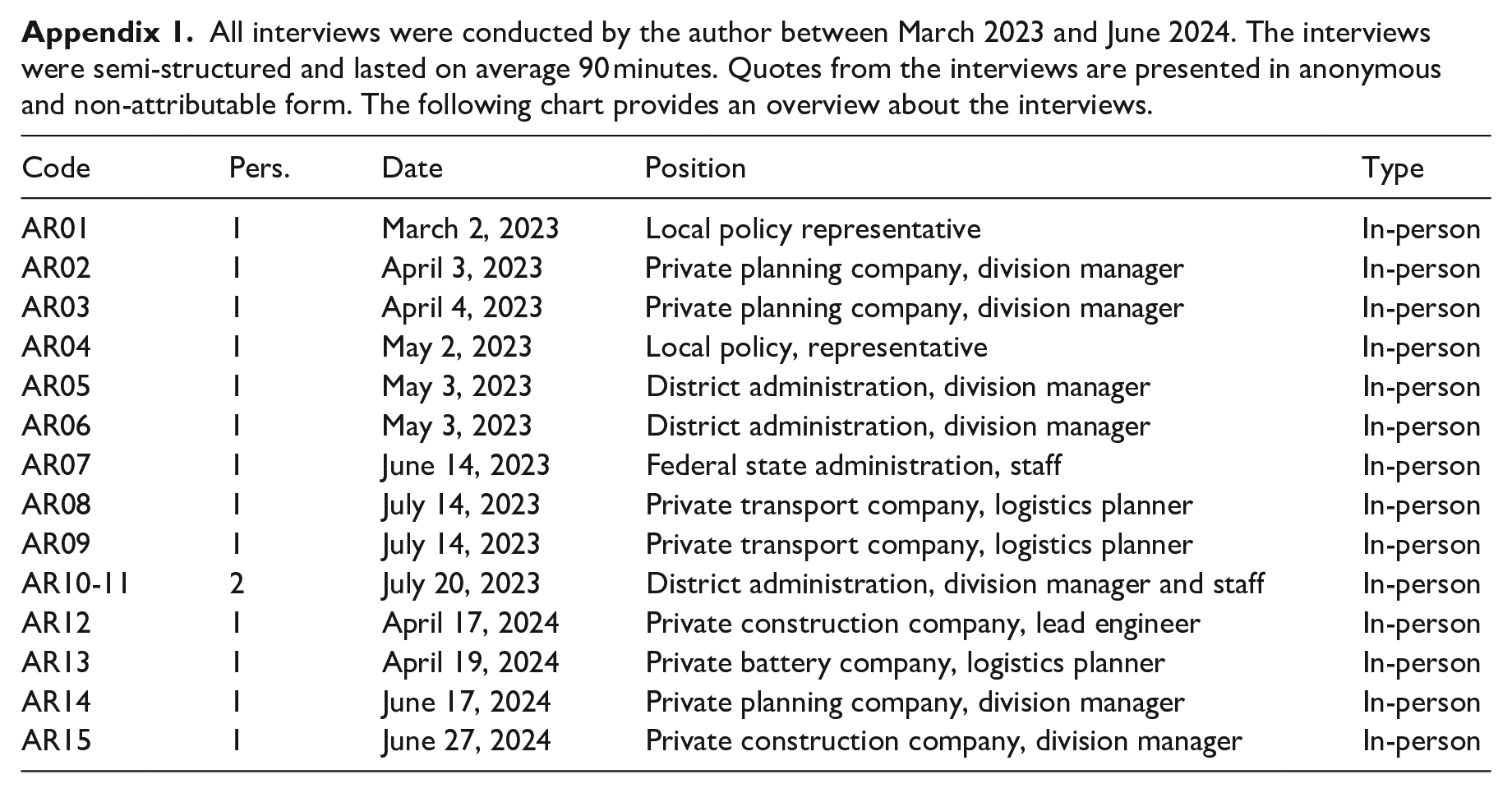
| Code | Pers. | Date | Position | Type |
|---|---|---|---|---|
| AR01 | 1 | March 2, 2023 | Local policy representative | In-person |
| AR02 | 1 | April 3, 2023 | Private planning company, division manager | In-person |
| AR03 | 1 | April 4, 2023 | Private planning company, division manager | In-person |
| AR04 | 1 | May 2, 2023 | Local policy, representative | In-person |
| AR05 | 1 | May 3, 2023 | District administration, division manager | In-person |
| AR06 | 1 | May 3, 2023 | District administration, division manager | In-person |
| AR07 | 1 | June 14, 2023 | Federal state administration, staff | In-person |
| AR08 | 1 | July 14, 2023 | Private transport company, logistics planner | In-person |
| AR09 | 1 | July 14, 2023 | Private transport company, logistics planner | In-person |
| AR10-11 | 2 | July 20, 2023 | District administration, division manager and staff | In-person |
| AR12 | 1 | April 17, 2024 | Private construction company, lead engineer | In-person |
| AR13 | 1 | April 19, 2024 | Private battery company, logistics planner | In-person |
| AR14 | 1 | June 17, 2024 | Private planning company, division manager | In-person |
| AR15 | 1 | June 27, 2024 | Private construction company, division manager | In-person |
Acknowledgements
While writing this article, I benefitted greatly from the generous engagement of many colleagues. I am particularly grateful to Tim Bunell and the members of the Asian Urbanisms cluster at the Asia Research Institute (ARI), National University of Singapore (NUS), for their constructive feedback on an earlier version of the manuscript. Heartfelt thanks also go to Monika Grubbauer and Nina Gribat for their recommendations, as well as the anonymous reviewers for their critical reading and helpful comments. Last but not least, I thank the numerous interviewees whose contributions made this article possible.
Declaration of conflicting interests
The author(s) declared no potential conflicts of interest with respect to the research, authorship and/or publication of this article.
Funding
The author(s) disclosed receipt of the following financial support for the research, authorship, and/or publication of this article: This work was supported by the Deutsche Forschungsgemeinschaft (DFG, German Research Foundation) under the grant number 445103843 (GRK2725 ‘Urban future-making’).
