




Abstract
In many countries, there are signs of declining migration to high-productivity urban areas due to restrictions in the housing market and increasing regional differences in housing prices. Using detailed population-wide register data for Sweden, we estimate how regional variation in housing prices and homeownership is associated with the individual’s decision whether to accept a job offer in the Stockholm metropolitan region and the interrelated choice between migration and commuting as the mobility mode. Our findings indicate that high relative housing prices in the Stockholm area and homeownership are associated with decreasing total geographical labour mobility to the region. This is pronounced among the young and among highly skilled workers. The negative effects of high relative housing prices and homeownership on migration are partially but not fully compensated by positive effects on commuting to Stockholm.
Introduction
The geographical mobility of labour is important for macroeconomic issues such as unemployment and economic growth. Extensive international research shows that migration to larger and denser urban areas is associated with increased productivity and higher wages (e.g. De la Roca and Puga, 2017; Glaeser and Maré, 2001; Puga, 2010). However, without sufficient housing supply, high-productivity cities become increasingly expensive places to live, which discourages migration of labour. In the United States, for example, land use regulations and other barriers to home construction have limited residential development and led to rising housing prices in a growing number of metropolitan areas (Glaeser et al., 2005, 2006; Glaeser and Gyourko, 2018; Saks, 2008). Similarly, Hsieh and Moretti (2019) show that land use restrictions have pushed up housing prices in the most productive cities in the United States and have led to a spatial misallocation of labour that has substantially reduced the GDP.
In the Swedish context, a discussion has emerged on whether restrictions on housing supply and soaring housing prices in the Stockholm region have prevented labour from moving in, with negative economic consequences for the region and the country. For example, analyses carried out by the Stockholm Chamber of Commerce indicate that over half of companies surveyed in the region state that the housing shortage impairs the possibilities of filling vacancies and that this, in turn, leads to significant negative effects on economic growth in the region. 1 While the evidence supporting these claims is scarce, research confirms that in Sweden, as in other countries, labour mobility to larger urban areas is associated with increased productivity and higher wages (Ahlin et al., 2014; Korpi and Clark, 2019). This particularly pertains to migration to the Stockholm metropolitan region, by far the largest regional labour market in Sweden. The Stockholm area stands out in terms of human capital endowments and labour market diversity. New research shows that work experience from the Stockholm labour market is associated with a high and increasing wage premium that is not lost when workers relocate to smaller cities, suggesting that the premium reflects the productivity effects of learning and human capital accumulation in Stockholm (Eliasson and Westerlund, 2023). For these reasons, housing constraints that reduce labour mobility to the Stockholm area may negatively affect productivity and growth in the Swedish economy.
In this study we estimate the effects of housing market conditions on labour mobility to the Stockholm region. The primary contribution of this article is that we simultaneously model how homeownership and spatial differences in housing prices affect the individual’s decision whether to accept a job offer in a high-productivity region (Stockholm) and the interrelated choice between migration and commuting as the mobility mode. In the econometric analysis, we focus on the Stockholm region and the 99 surrounding municipalities located within a maximum of 240 minutes’ road travel time distance to Stockholm City. The analysis is based on detailed population-wide register data that allows us to control for many other factors influencing the mobility decision and the choice of mobility mode. To our knowledge, this is the first article that, based on microdata, simultaneously models how conditions in the housing market affect inter-regional job matching and geographical mobility in terms of both migration and commuting. Moreover, we provide estimates taking account of partial observability because the choice between commuting and migration to jobs in Stockholm is only observed for a subsample of the large sample of potential job seekers residing outside Stockholm.
We find that increased relative housing prices in Stockholm are associated with decreased labour mobility to the region because of reduced in-migration. This effect is partially but not fully compensated by a positive effect on commuting to Stockholm. Our estimates also indicate that homeowners are less likely to be mobile and to choose migration as the mobility mode when matched to a job in Stockholm. This applies especially for young individuals and for high-skilled workers.
When analysing how conditions in the housing market can affect labour mobility to high-productivity regions, it is important to consider both migration and commuting. The existing literature (discussed in the following section) suggests that homeownership and differences in regional housing prices tend to reduce migration and increase commuting. The negative effects of a tight housing market on migration can therefore to some extent be mitigated by commuting. In this context, it is worth emphasizing that the choice of mobility mode – migration versus commuting – has different implications, for example, local tax bases and the ability to provide amenities and welfare services. In Sweden, as in many other countries, the local public sectors are by law obliged to provide services such as education, elderly care and local infrastructure. In addition, the choice of mobility mode has different implications for housing markets in the sending as well as in the receiving regions.
There are a few specific features related to the Stockholm housing market that make it particularly interesting. One is that the supply of rented dwellings in relation to the population has decreased substantially in Stockholm during the last three decades. This is partly due to tenure conversions from rented to tenant-owned apartments. The queue time for a rental apartment in the Stockholm area has increased over time and currently averages over 9 years. As a result, job searchers considering moving to a new job in Stockholm are encountering less opportunity to rent relative to needing to buy property. Moreover, during the last decade, the Swedish Financial Supervisory Authority has imposed stricter regulations on mortgages, including higher down payment requirements and mandatory amortization on new mortgages. Both these features may particularly affect the ability of young people, with limited financial resources, to accept job offers in the Stockholm region. We will therefore pay specific attention to how conditions in the housing market affect the mobility decisions of young individuals.
The next section discusses previous literature focusing on housing market conditions and geographical labour mobility. After that, we provide some institutional background and descriptive statistics regarding the Swedish housing market and geographical mobility during recent decades. We then proceed with a presentation of the econometric model, data and results. The final section summarizes the findings and offers some final remarks.
Previous literature
International research provides compelling evidence that housing prices affect residential mobility (e.g. Chan, 2001; Ferreira et al., 2010; Genesove and Mayer, 1997, 2001; Henley, 1998; Stein, 1995). Ganong and Shoag (2017), Austin et al. (2018) and Hoxie et al. (2023) report that, since the 1990s, internal migration in the United States has declined considerably and become less directed towards high-productivity places; the authors associate the slowdown in labour mobility with increasing differences in relative housing prices between low-income and high-income areas. Falling housing prices in lower-income areas raise loan-to-value ratios for incumbent homeowners, and the remaining equity may be too low to meet down payment requirements to purchase a new home (see, for example, Bloze and Skak, 2016). In addition to equity constraints, homeowners tend to be averse to realizing nominal losses. Falling housing prices in lower-income areas thus lock in existing homeowners. Transaction costs such as broker fees, stamp duties, mortgage fees, and capital gains taxes also reduce residential mobility (e.g. Van Ommeren and Van Leuvensteijn, 2005).
In an influential article, Oswald (1996) argued that homeowners have constrained mobility due to transaction costs and that the increase in homeownership has contributed to higher and persistent unemployment in many countries. Oswald’s hypothesis has inspired several papers that analyse the effects of homeownership on migration and on outcomes such as unemployment and wages (e.g. Battu et al., 2008; Bloze and Skak, 2016; Borg and Brandén, 2018; Helderman et al., 2004; Munch et al., 2006). Although the papers differ in their definitions of migration, data and econometric techniques, they all find that homeowners are less geographically mobile than renters. 2
There are also a few papers based on microdata that study how geographical differences in housing prices affect residential choice and long-distance commuting. If workers in low-price areas cannot accumulate enough equity to meet down payment requirements for homes in a high-price area, they might have to forgo moving altogether or choose to commute to the new location. Both incumbent homeowners and new entrants into the housing market can face these types of spatial lock-in effects. Öhman and Lindgren (2003) and Mitra and Saphores (2019) find that the probability of commuting a long distance decreases with housing prices in the region of residence and increases with housing prices in the region of the workplace. Schéele and Andersson (2018) show that the likelihood of choosing to reside in an area decreases with its level of housing prices.
Similar patterns can be observed in studies based on aggregated data. Cameron and Muellbauer (1998) conclude that high relative housing prices discourage net migration to a region but encourage net commuting. Ahrens and Lyons (2021) report increasing commuting time with increasing differences in rental prices between locations. Cannari et al. (2000) find a negative effect of high relative housing prices on net migration. Hämäläinen and Böckerman (2004) show that both increases in regional housing prices and a large share of homeownership discourages net migration to a region by reducing in-migration.
Previous research has made important contributions about how homeownership and regional differences in housing prices affect the geographical allocation of labour. Most attention has been devoted to the effects on residential mobility and migration, less on the impacts on commuting. This is somewhat surprising given the importance of commuting for the functioning of local labour markets (see, for example, Monte et al., 2018) and that commuting can help mitigate the negative effects of a tight housing market on the efficient spatial allocation of labour. Cameron and Muellbauer (1998) is the only article we have found that studies the effect of relative housing prices on both migration and commuting, albeit using aggregated data and providing separate estimates for commuting and migration. 3 Cameron and Muellbauer call for more research based on better data and with a particular focus on the importance of inter-regional commuting. We contribute to the existing literature by simultaneously modelling the effect of relative housing prices and homeownership on inter-regional job matching and total labour mobility in terms of both migration and commuting using detailed population-wide microdata. Our focus on job matching means that we study individual outcomes of potential job searchers and estimate the effects of relative house prices on the flow into employment and the associated migration and commuting decisions. In the empirical analysis, we acknowledge that individuals who conduct inter-regional research, who receive and accept a job offer in a specific regional market, are a self-selected sample of the underlying population of potential job searchers.
The Swedish housing market and geographical mobility
Homeownership is comparatively low in Sweden but has increased slightly during recent decades. 4 At present, about 62 per cent of the housing stock consists of owner-occupied housing and 38 per cent of rented housing. 5
The Swedish market for rental housing (privately and publicly owned) is highly regulated compared to other countries. 6 Both the private and public sectors, to a large extent, operate under a centralized rent-setting system, where rents are negotiated between representatives of tenants and property owners. The rents are supposed to primarily reflect the condition and location of a dwelling. In this regulated market, two separate segments of rental housing have emerged: a stock of newly produced dwellings with relatively high rents and a stock of older dwellings with lower rents. In principle, the latter is only available via different queuing systems. Therefore, entrants into the rental market are primarily referred to newly produced dwellings with comparatively high rents. The share of social housing in the rental sector is very limited. Instead, individuals in need of economic support can apply for a housing allowance. This allowance is not tied to a specific home but instead follows the individual.
There are some elements of taxes and transaction costs that favour homeownership and potentially reduce mobility in the housing market. The former property tax (a typical ad valorem tax) was abolished in 2008 and was replaced by a highly regressive municipal property fee (with a low ceiling and sharply declining in terms of share of the property value). Taxes on earnings can be reduced by up to 30 per cent of the interest paid on mortgages. There is 22 per cent taxation on capital gains when selling a property (however, the tax can be postponed if a new home is bought). In addition, there are stamp duties (1.5% on the property value) and mortgage fees (2% of the mortgage). It is worth mentioning that the Swedish Financial Supervisory Authority (FI) recently has introduced stricter regulations on mortgages. 7
Figure 1 presents the development of real housing prices and the share of rented dwellings for various regions over the last three decades. The regional classification consists of the three major metropolitan regions in Sweden and three size categories of municipalities located outside the metropolitan regions. What stands out is the significant increase in absolute price differences between the Stockholm region and other areas in Sweden. 8 Because of declining nominal interest rates during the period, growing regional differences in housing prices have not automatically translated into corresponding regional differences in housing costs. Nevertheless, due to regulations such as down payment requirements and mandatory amortization of mortgages, housing prices can still be a binding restriction, even for potential buyers who could afford to pay the interest on a mortgage. 9
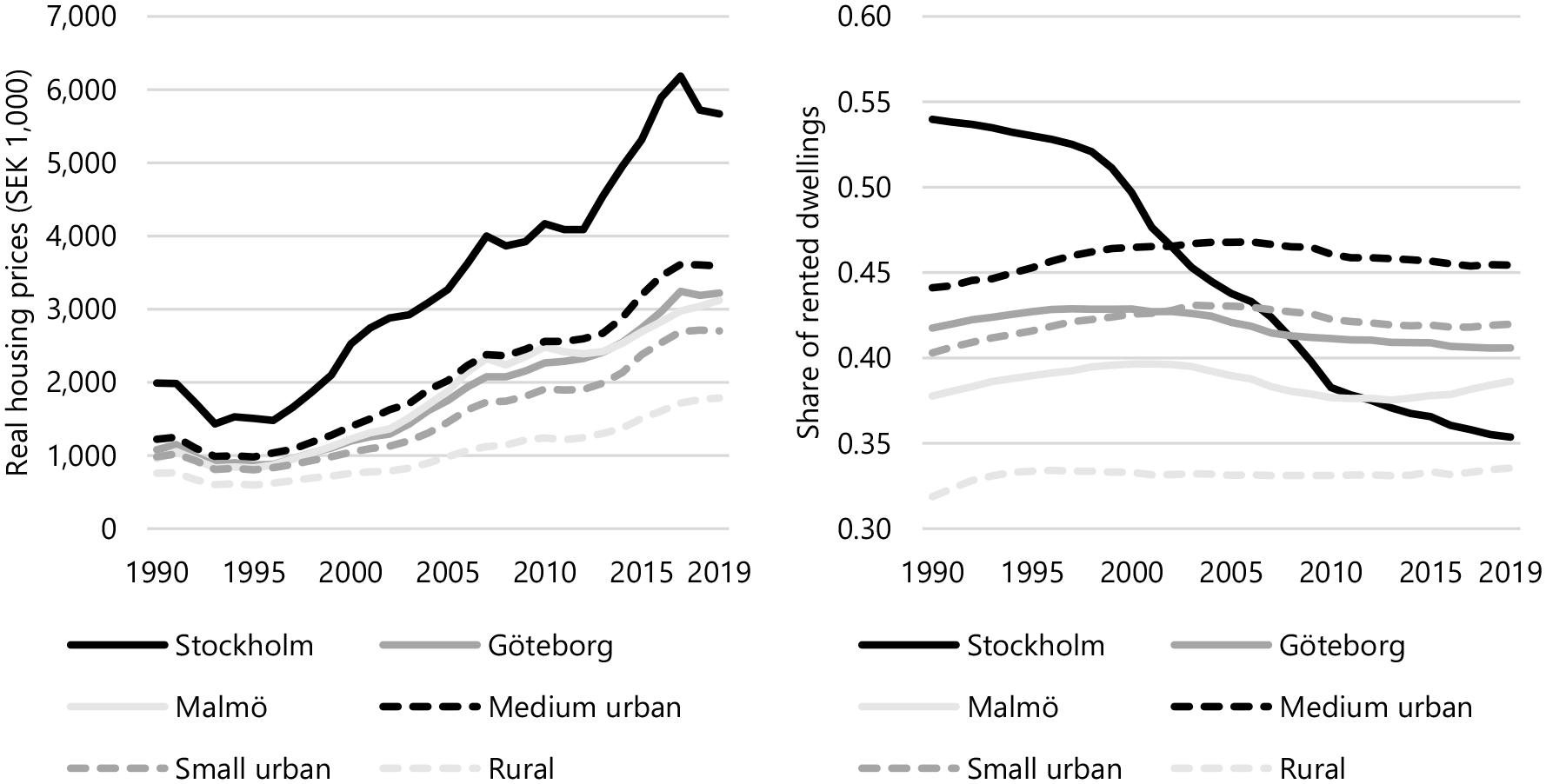
Real housing prices and share of rented dwellings by region (1990–2019).
Figure 1 also displays a dramatic decline in the share of rented dwellings in the Stockholm region. Since 1990, the share has dropped from 54 to 35 per cent. Since 1990, the total number of rented dwellings has decreased by around 50,000, corresponding to 11 per cent of the initial stock (partially due to tenure conversions from rented to tenant-owned apartments). In the same period, the population in the Stockholm region has increased by 45 per cent. 10 New entrants into the housing market in the Stockholm area thus compete for a much smaller supply of rental housing than previously. This situation has led to increasing average queue times for rented dwellings. For those who received a rental apartment in the Stockholm region in 2022, the average queue time was 9.4 years. In the more central locations of the region, the average queue time was 20 years or more. 11
Turning to geographical mobility, there is no trend of decreasing inter-regional migration in Sweden, unlike the trend reported by Ganong and Shoag (2017) and Austin et al. (2018) for the United States. Since the early 1980s, the inter-county migration rate in Sweden has hovered around 2 per cent, with a slightly increasing trend over time. During the same period, commuting between Swedish municipalities has increased dramatically. Between 1980 and 2019, the share of employed individuals who commute to work outside their municipality of residence has increased from 20 per cent to 34 per cent.
Figure 2 presents data on labour mobility in terms of migration and commuting to and from the Stockholm region since 2000. The focus is on mobility related to the labour market. In-migrants are individuals moving into the Stockholm region for work, and out-migrants are individuals moving out of the region for work in other parts of the country. In-commuters are individuals residing outside the Stockholm region who began commuting to work in the Stockholm region in that year, and out-commuters are individuals residing in the Stockholm region who began commuting to work in other parts of the country in that year. These definitions of labour mobility capture gross flows of increasing/decreasing labour supply in the Stockholm region. 12
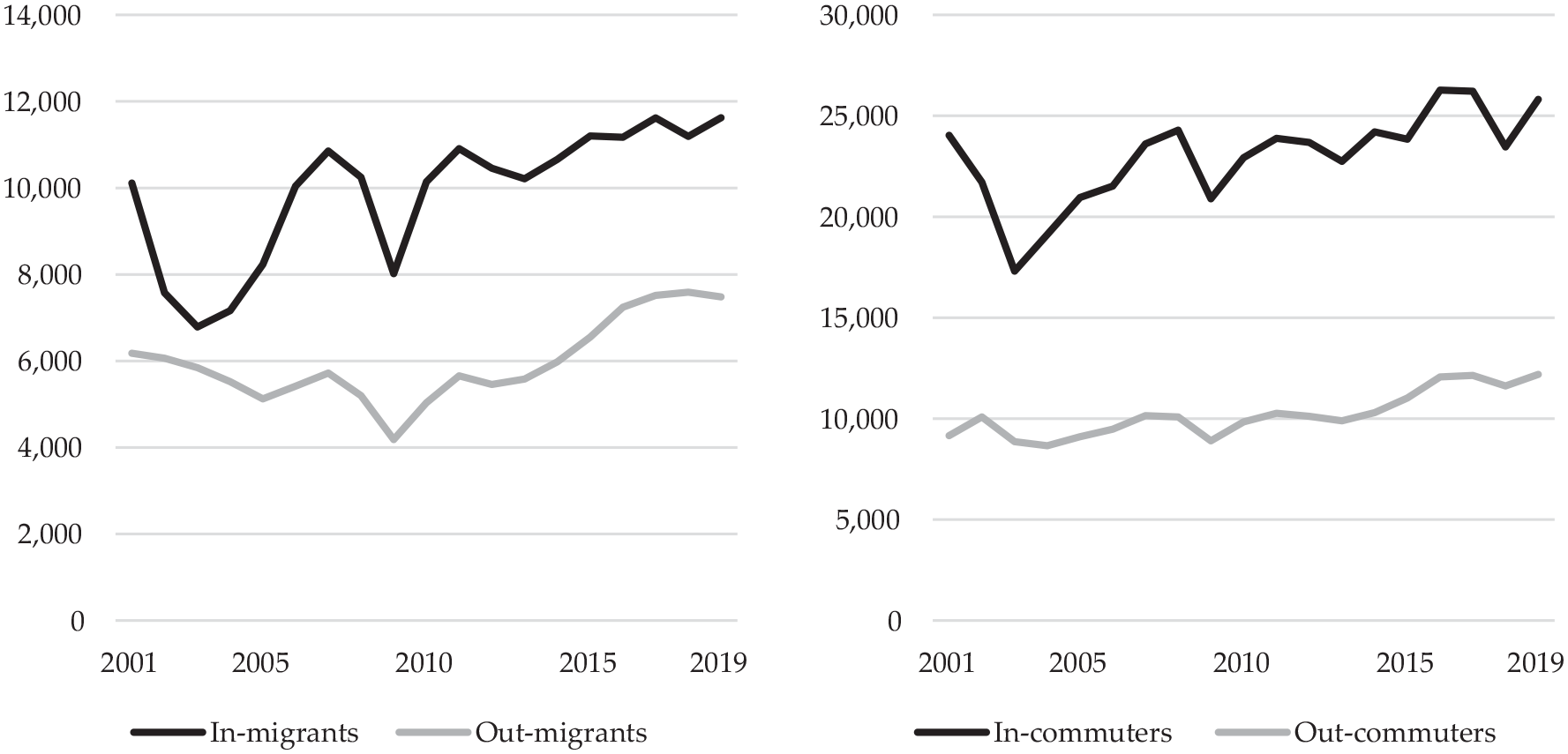
Labour mobility to and from the Stockholm region (2001–2019).
In-migration to the Stockholm region displays a clear cyclical pattern, with considerable downturns in the early 2000s and in connection with the global financial crisis in 2008–2009. Out-migration from Stockholm shows a similar development, although the cyclical pattern is less pronounced. Throughout the period, the Stockholm area has experienced positive net migration.
Figure 2 also presents patterns of commuting to and from the Stockholm region. The reported numbers refer to the flow of individuals who began commuting to and from Stockholm each year (i.e. not the stock of commuters). The scale of the figure reveals that the number of individuals beginning to commute to Stockholm each year is much higher than the number of in-migrants to Stockholm. Again, we find cyclical variations (particularly for in-commuting) and positive trends after the financial crisis. Throughout the period, the Stockholm area received substantial net gains of people beginning to commute, with an average of around 13,000 individuals annually.
Thus, the Stockholm region has continued to experience net gains in labour supply by geographical mobility over the last two decades. One could argue that increasing absolute differences in real housing prices vis-à-vis other regions in Sweden and a decreasing share of rented dwellings in the Stockholm area have at least not resulted in a negative trend in labour market-related net migration. The growing in-commuting to the Stockholm region could, on the other hand, be interpreted as an indication that people searching for jobs in the Stockholm area find it increasingly difficult to find affordable housing in the region.
Looking at the age distribution of migration to and from the Stockholm region (Figure 5, Online Appendix), the data reveal significant net gains in labour market-related migration among individuals 20–30 years of age. In the age group 30–45 years, when family formation typically occurs, the Stockholm area experiences net out-migration. This might reflect that families who are searching for larger homes experience difficulties in finding affordable housing in the Stockholm region. But there might be many other causes in play behind the net out-migration from Stockholm in the family formation age groups (e.g. Aner, 2016; Sandow and Lundholm, 2020).
Geographical setting and definitions of mobility
In the econometric analysis of how housing market conditions affect inter-regional job matching and geographical mobility, we focus on the Stockholm region and the 99 surrounding municipalities located within a maximum of 240 minutes road travel time distance to Stockholm City. We will primarily focus on individuals residing within 180 minutes travel time distance to Stockholm, but as a robustness check, we also consider workers living within 240 |or 120 minutes from Stockholm. 13 The geographical definition of the Stockholm region includes all municipalities in Stockholm County (26 in total). Figure 3 presents a map of the regional system, with the Stockholm region marked in black and surrounding municipalities within the three distance bands marked in different shades of grey.
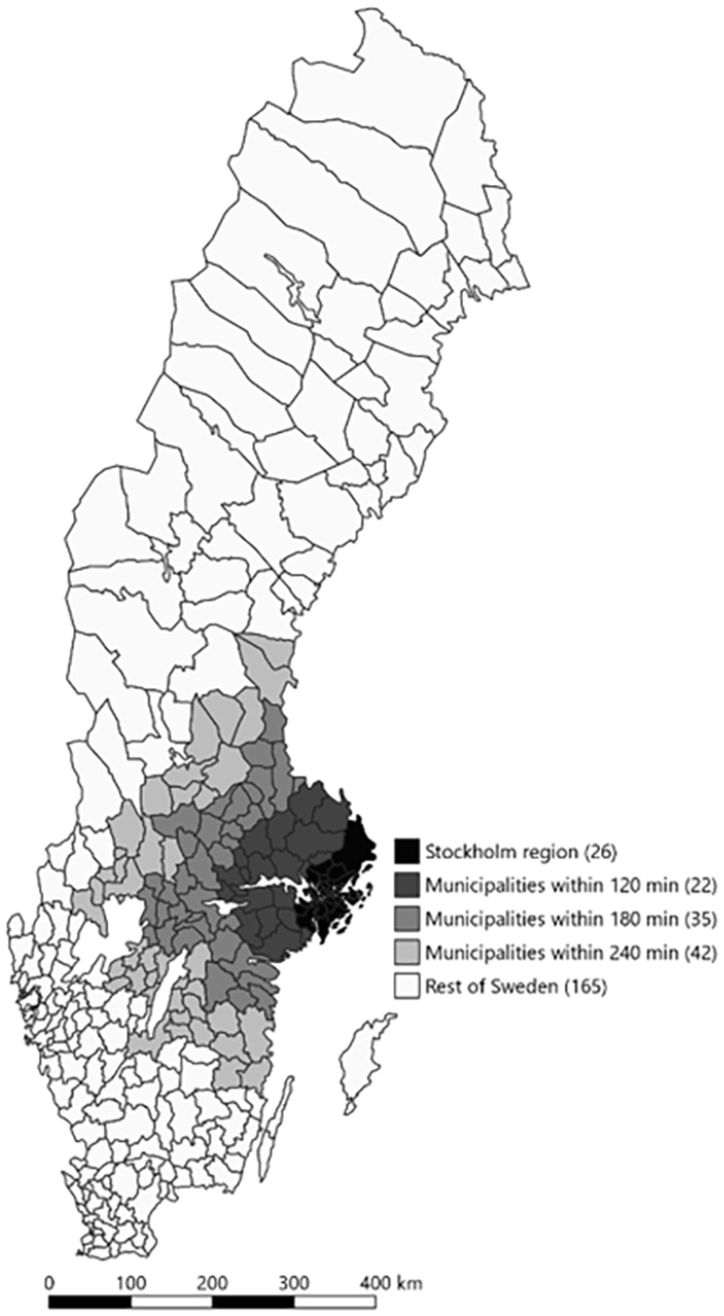
The Stockholm region and surrounding municipalities.
In terms of employment, Stockholm County is heavily dominated by Stockholm City and the most closely adjacent municipalities. The number of jobs in the region is about 1.3 million (about 25% of the total number of jobs in Sweden), of which around 72 per cent are in these core municipalities. In the Swedish urban context, Stockholm stands out in terms of labour market thickness (e.g. the number of different industries and occupations) and human capital resources (Eliasson and Westerlund, 2023).
Previous research shows that the functional integration of a region depends on labour commuting. The tendency to commute as a function of travel time distance generally follows a non-linear pattern, with high commuting rates at short distances and low rates above approximately 45 minutes (Johansson et al., 2002). All but one of the 26 municipalities in the region are within 40 minutes of travel time to Stockholm City. The region is highly integrated internally in terms of commuting; commuting flows out of the region are very limited. 14
In applying our definition of labour mobility to the Stockholm region, we simplify the regional system to a set of two regions: the Stockholm region and the aggregate of municipalities located outside the region (the latter within a maximum of 240 minutes travel time distance to Stockholm City). We study mobility between year
Data and econometric approach
The analysis is based on detailed population-wide longitudinal register data administered by Statistics Sweden. The Swedish register data is known to be highly reliable and to have near complete coverage. The data is updated annually and includes information on housing prices, residential tenure, location of residence and workplace, and a wide range of demographic and socio-economic variables that characterize individuals. The data includes about 1 million individuals aged between 20 and 60. We focus on geographical mobility between 2017 and 2018.
We estimate two outcomes observed in year
Labour market-related migration can be characterized as ‘contracted’ or ‘speculative’ (e.g. Jackman and Savouri, 1992). Contracted migration applies when an employment contract in the new location precedes migration. Speculative migration refers to situations where job searchers move to a regional labour market to look for a job after migration. Commuting to a new workplace is, by definition, contracted. In this study, observations of migration or commuting to Stockholm are conditional on employment in Stockholm, that is, we study contracted geographical mobility.
The individual’s decision on where to work and where to live involves a trade-off between commuting costs and housing costs (e.g. Alonso, 1964; Van Ommeren and Fosgerau, 2009). The individual is assumed to jointly select a workplace and residence to maximize utility under financial and other constraints. We do not observe the underlying job search process and utility, but the observed choice of workplace and residence reveals which combination provides the highest utility.
The specification of our empirical model is based on the assumption that all individuals in our sample are potential searchers for a job in Stockholm. Job search may be conducted by the non-employed as well as by the employed (on-the-job search). Somewhat simplified, the probability of a match to a job in Stockholm is determined by the probability of receiving a job offer and the job searcher’s reservation wage to accept a job offer in that region. The former is assumed to be determined by workers’ search intensity and the ratio of job openings in Stockholm in relation to job openings in the current region of residence. Reservation wages are affected by preferences and alternative income under continued search, for example, the present wage or unemployment benefits.
Job searchers’ geographical allocation of job search intensities and reservation wages are not observed but assumed to be systematically influenced by factors such as regional labour market and housing market conditions, individuals’ labour market status, demographic characteristics, search/information costs, and mobility costs.
Based on theoretical considerations and previous research,
15
we use the following independent variables for the simultaneous estimation of the probability of mobility to Stockholm and the choice between migration and commuting (where index i indicates municipality of residence in year
Definitions and sample means.
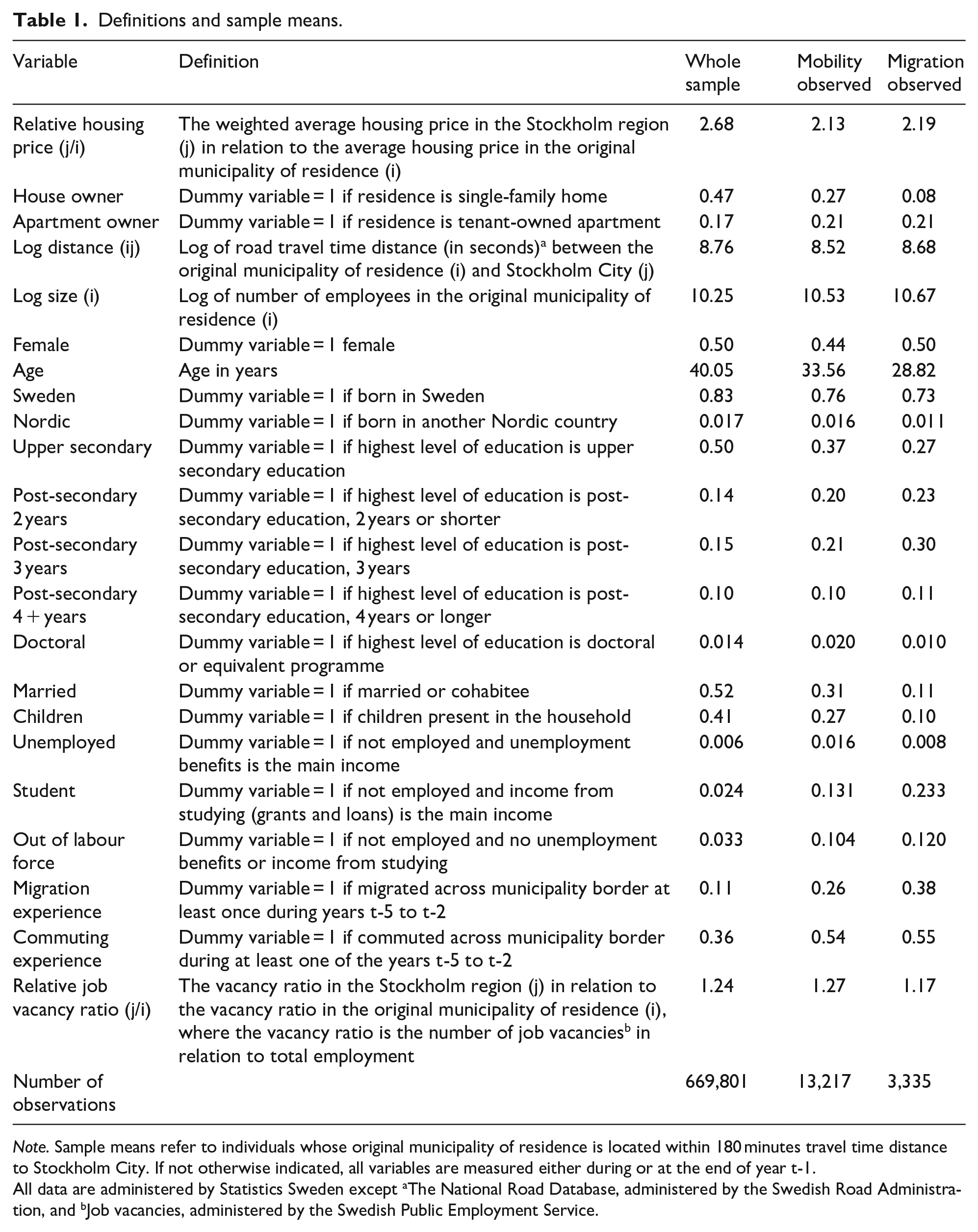
Note. Sample means refer to individuals whose original municipality of residence is located within 180 minutes travel time distance to Stockholm City. If not otherwise indicated, all variables are measured either during or at the end of year t-1.
All data are administered by Statistics Sweden except aThe National Road Database, administered by the Swedish Road Administration, and bJob vacancies, administered by the Swedish Public Employment Service.
The three variables of main interest are the relative housing price (j/i), house owner and apartment owner. Higher relative price for housing in Stockholm is assumed to have a negative impact on the probability of matching to a job in that region because of lower search intensity and a higher reservation wage for accepting a job located in Stockholm. Given a successful match to a job in Stockholm, the higher cost of housing in Stockholm is expected to increase the probability of commuting relative to the alternative of migration.
The variable measuring regional differences in housing prices is defined as the weighted average housing price in the Stockholm region in relation to the average housing price in the individual’s original municipality of residence. 16 The weighted average housing price for Stockholm is calculated with respect to the number of purchases and the average purchase price in each of the 26 municipalities in the region. Therefore, although we treat the housing market in the Stockholm area as one market (which makes sense from a labour supply perspective because the region is highly integrated in terms of commuting), the weighted average housing price takes into account revealed preferences for housing in different locations in the region. We use differences in housing prices instead of differences in housing costs. Apart from the practical matter that housing costs are not available in our data, housing prices are relevant for the mobility decision in that the individual must satisfy down payment and amortization requirements to buy a house in a new location. 17
Ownership of a house or an apartment may indicate place attachment and high transaction costs for mobility. Therefore, ownership of housing may reduce search intensity and increase the reservation wages for accepting job offers outside the region of residence. However, these two attributes may have the opposite effect on mobility – that is, they may facilitate migration – due to the less binding financial restriction on buying a house or an apartment in Stockholm. Thus, the effects on mobility and mobility mode are indeterminate on theoretical grounds. The model includes two dummy variables for homeownership: one for single-family homes and one for tenant-owned apartments (renters are hence the reference category).
Distance between the original place of residence and Stockholm is assumed to decrease search intensity for jobs in Stockholm and increase reservation wages due to information and mobility costs. Research shows that distance is a deterrent to both migration and commuting. We therefore include a variable measuring the road travel time distance between the individual’s original municipality of residence and Stockholm City.
Previous research has shown that people prefer to reside in large cities/regions, especially dual-income families. We include a variable measuring the size of the individual’s original municipality of residence in terms of employment. Residing in a larger regional labour market is assumed to decrease inter-regional mobility and increase the probability of commuting, conditional on mobility. Larger labour markets offer better long-term career prospects, which have a negative effect on search intensity outside the current region of residence and increase the reservation wage for jobs in other labour markets. The advantages of larger labour markets increase the implicit cost of migration and increase the probability of commuting, conditional on mobility.
Mobility to Stockholm is expected to increase with individuals’ educational attainment due to higher search intensity and more attractive job offers. This is partially due to the occupational structure of employment in Stockholm and an especially high urban wage premium among the highly educated (e.g. Carlsen et al., 2016; Eliasson and Westerlund, 2023). The independent variables control for six levels of education.
The individual’s labour market status is a potentially important determinant of job search behaviour and mobility. For example, unemployment is generally expected to increase search intensity and reduce the reservation wage. Being unemployed in the current location may also reflect spatial mismatch, leading to higher search intensity in other regions and contracted mobility. We add a set of variables indicating whether the individual is employed (the reference category), unemployed, enrolled in education, or outside the labour force (for reasons other than education).
We include the relative job vacancy ratio (j/i) as a measure of regional differences in labour demand. This measure is defined as the vacancy ratio in the Stockholm region in relation to the vacancy ratio in the original municipality of residence, where the vacancy ratio is the number of job vacancies in relation to total employment. Higher labour demand in Stockholm increases search intensity for jobs in that region and increases the probability of receiving an offer for a job in Stockholm. The relative job vacancy ratio is thus expected to be positively associated with mobility to Stockholm. 18
We also include controls for some basic demographic attributes: sex, age, country of birth (three categories), and family status (married, children in the household). Since several studies report considerable differences in mobility depending on previous experience, we add variables indicating the experience of migration or commuting during years
The specification of our econometric model reflects, to some extent, limitations in available data and institutional factors affecting the functioning of the Swedish labour market. We prefer to use a measure of regional labour demand (vacancies) instead of hourly wages or yearly earnings as measures reflecting regional differences in job offers. The population register data contains information on yearly incomes but not on hourly wages. Moreover, wage setting in Sweden is influenced by strong trade unions and central bargaining based on average productivity in large sectors. Trade unions are still influenced by a ‘solidaristic wage policy’ (equal pay for equal work) which over several decades has contributed to a compressed wage distribution across occupations and regions. Inter-regional labour mobility has also contributed to small regional differences in wages (see, for example, Collin et al., 2019; Ek and Skedinger, 2019: 4–5). Although there have been tendencies towards more decentralized wage setting over time, regional differences in gross wages and yearly earnings are relatively small. There is a narrow dispersion of gross wages, combined with a strongly redistributive system of income tax and transfers. The resulting distribution of net disposable income offers relatively small incentives for mobility in Sweden. Instead, typical findings on Swedish data indicate that regional differences in employment opportunities and long-term career opportunities offer stronger incentives for mobility (see, for example, Axelsson and Westerlund, 1998; Eliasson et al., 2007; Niedomysl and Hansen, 2010; Westerlund, 1997).
Given our simplified regional structure, we observe the outcome of two simultaneous decisions: the individual’s decision whether to search for and accept a job requiring mobility to the Stockholm region and the related choice between migration and commuting as the mobility mode. The choice of mobility mode can be observed only for those individuals who start to work in Stockholm. However, the sample of geographically mobile workers is not necessarily a random sample of the underlying population of job searchers. Potential problems with sample selection bias are handled in the econometric specification by employing an extension of the standard Heckman (1979) procedure in a bivariate probit setting (Greene, 2018; Van de Ven and Van Praag, 1981).
Let
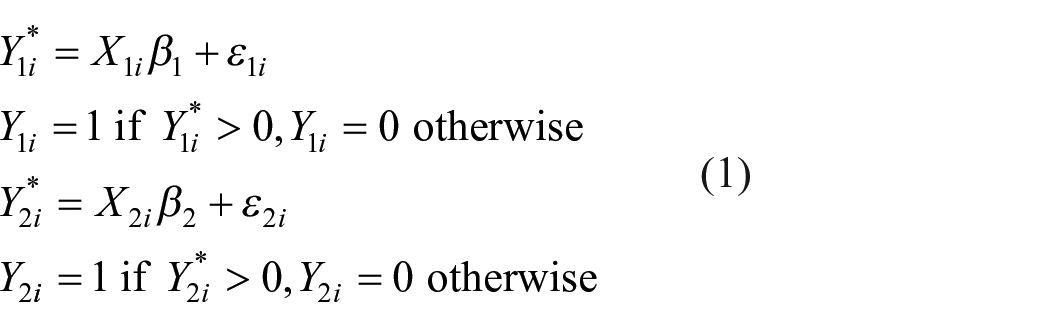
where
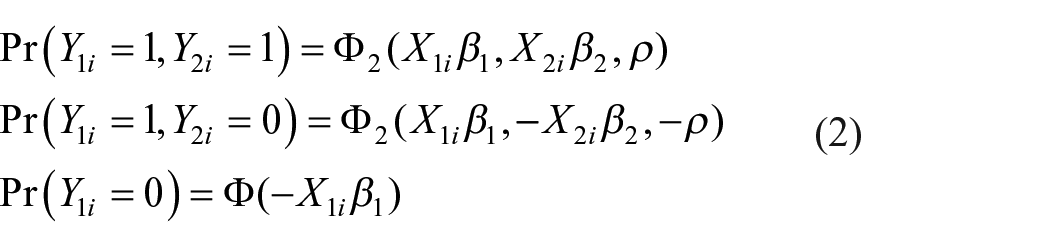
where

The parameters
All independent variables, except the relative job vacancy ratio (j/i), are included in both vectors
Results
The model is estimated for individuals whose original municipality of residence is located within three different radiuses from Stockholm City. Our baseline estimates include all individuals residing within a 180 minute travel time distance to Stockholm. As a robustness check, we also estimate the model for individuals living within 240 or 120 minutes of Stockholm.
Table 2 presents the maximum likelihood estimates of the baseline model. We find that the relative housing price in the Stockholm region decreases the probability of starting to work in Stockholm and decreases the probability of choosing migration as the mobility mode. 20 In other words, the higher the housing price is in the Stockholm area in relation to the housing price in the original municipality of residence, the less likely the individual is to begin to work in Stockholm and to choose migration as the mobility mode. The finding that high relative housing prices tend to discourage migration and increase the likelihood of choosing commuting as the mobility mode is in line with previous research. However, our results also show that, if we consider geographical labour mobility in terms of both migration and commuting, high relative housing prices have an overall negative effect on labour mobility to the Stockholm region.
Estimates of the bivariate probit model with sample selection.
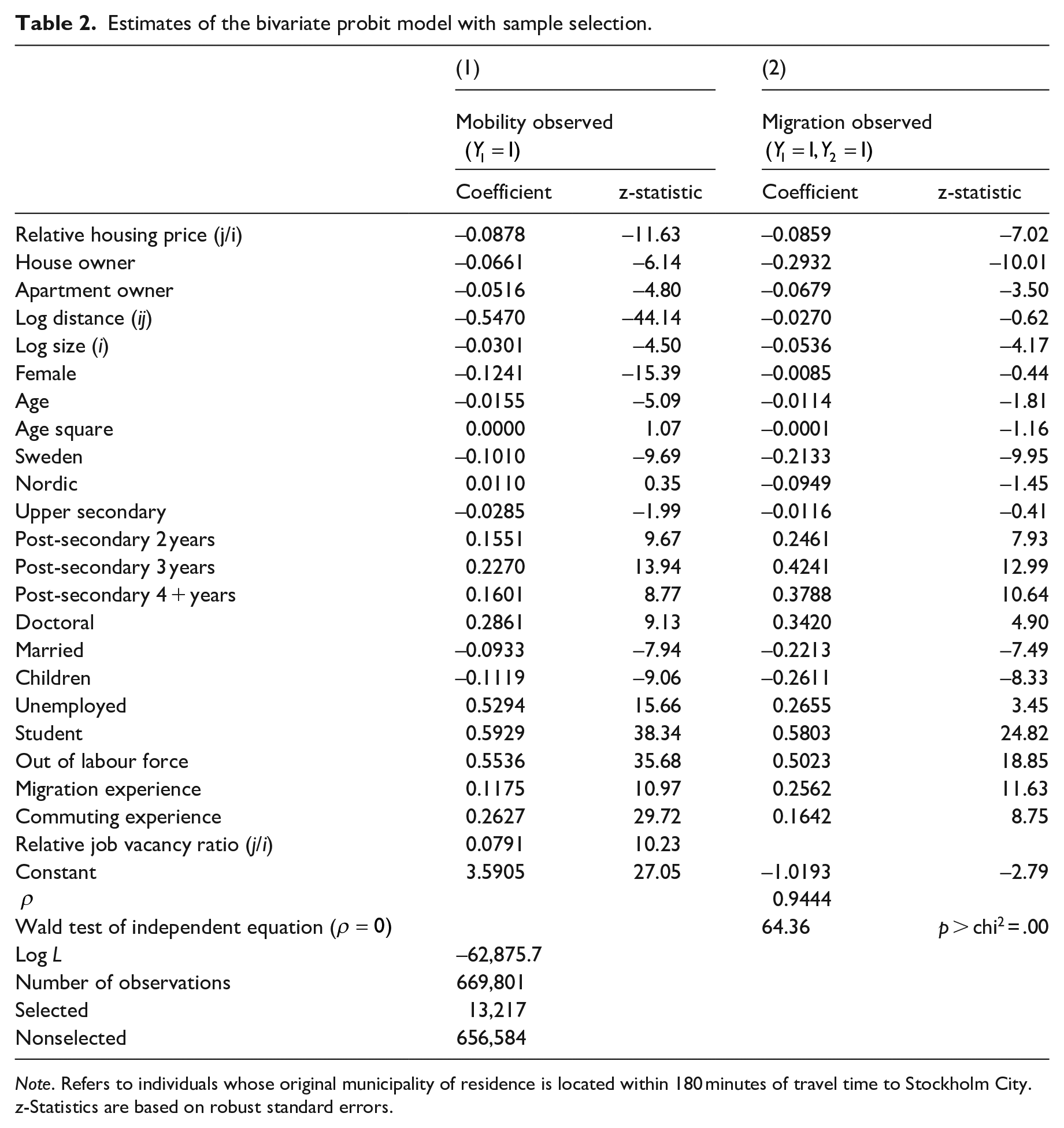
Note. Refers to individuals whose original municipality of residence is located within 180 minutes of travel time to Stockholm City. z-Statistics are based on robust standard errors.
The estimates show that both house owners and apartment owners are less likely than renters (the reference category) to begin working in the Stockholm region and to choose migration as the mobility mode (i.e. homeowners have a higher probability of choosing to commute). This finding not only confirms results from previous research indicating that homeowners are less likely to migrate but also shows that homeowners are more geographically constrained in general (i.e. when both migration and commuting are considered).
The estimated effects of relative housing prices and homeownership on geographical labour mobility are qualitatively similar when we re-estimate the model for individuals residing within 240 or 120 minutes" distance to Stockholm (Table 5, Online Appendix).
An alternative to using the bivariate probit model with sample selection is to treat the mobility equation and the migration equation in equation (1) as independent probit equations, which implies that we assume that
Turning to the other variables in the model, the estimates in Table 2 show that, as expected, the probability of taking a job in the Stockholm region decreases with distance to Stockholm and with the size of the original municipality. The latter also has a negative effect on the probability of choosing migration as the mobility mode. This result confirms findings in previous research showing that people tend to prefer to live in larger cities.
The estimates indicate that geographical mobility decreases with age and that people with a post-secondary level of education or higher are more likely to take a job in the Stockholm area and to choose migration as the mobility mode, compared to individuals with only primary or lower secondary education (the reference category). Family ties appear to have a negative effect on geographical mobility. Being married or having children in the household reduces the probability of starting to work in the Stockholm region and of choosing migration as the mobility mode. The individual’s attachment to the labour market also influences geographical mobility. Unemployed individuals and persons enrolled in education or outside the labour force for other reasons are more likely than employed individuals (the reference category) to begin working in the Stockholm area and to migrate. Individuals with previous experience of geographical mobility are more inclined to take a job in the Stockholm region and to choose migration as the mobility mode. The probability of starting to work in the Stockholm area increases with the relative job vacancy ratio. In other words, the higher the vacancy ratio is in the Stockholm region in relation to the vacancy ratio in the current municipality of residence, the more likely the individual is to begin to work in Stockholm. The estimated effect of the different demographic and socio-economic attributes listed above generally confirms results found in previous literature. 21
Finally, the estimate of
Marginal effects
Table 3 reports the estimated average marginal effects of relative housing prices and homeownership in the bivariate probit model. To simplify the interpretations, the two tenure types (single-family homes and tenant-owned apartments) are combined into one category, labelled homeowner. In all cases, the marginal effects are negative and statistically significant. An increase in the relative housing prices reduces the probability of mobility by about 0.4 percentage points, and being a homeowner reduces the probability by slightly below 0.3 percentage points. Given that the underlying average mobility is 1.97 per cent, the marginal effects are quite substantial. 22
Estimated average marginal effects of relative housing price and homeownership.
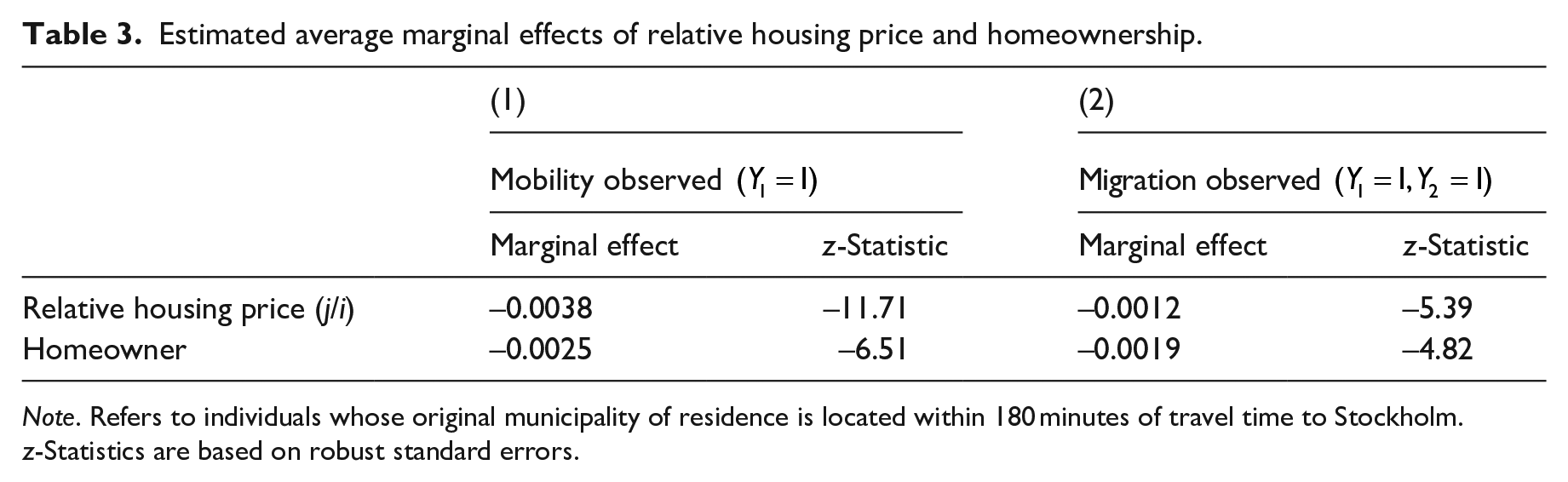
Note. Refers to individuals whose original municipality of residence is located within 180 minutes of travel time to Stockholm. z-Statistics are based on robust standard errors.
Two groups that are particularly interesting in this context are young people and highly educated individuals. The literature on geographical mobility consistently shows that individuals around 20–30 years of age are the most mobile, particularly in terms of migration (see also Figure 5, Online Appendix). Another recurring finding is that geographical mobility tends to increase with the individual’s level of education (which is confirmed by the estimations above). The latter result is interesting given that empirical research on agglomeration economics indicates that the positive effect on labour productivity of working in large cities/regions is particularly high for individuals with high levels of education or high levels of cognitive skills (Bacolod et al., 2009; Carlsen et al., 2016; Eliasson and Westerlund, 2023; Korpi and Clark, 2019; Rosenthal and Strange, 2008). This finding implies that spatial misallocation of highly educated individuals due to constraints in the housing market can be particularly damaging to productivity and economic growth.
Figure 4 reports the estimated marginal effects of relative housing prices and homeownership in the probit model for mobility across different age groups (i.e. the probability of starting to work in the Stockholm region). The negative effect on mobility of high relative housing prices in the Stockholm area tends to decline with increasing age (i.e. the negative effect is higher for young individuals than older persons). The estimated effect is about −0.7 percentage points for 20-year-olds, compared to around −0.1 percentage points for 60-year-olds (we saw earlier that the average marginal effect was −0.4 percentage points). One possible explanation is that, for young people with limited accumulated financial wealth, down payment requirements might be a binding constraint for entering the market for owned housing. 23 Therefore, if young individuals receive a job offer requiring mobility, their choices to a larger extent are limited to the rental market (which, we know from Figure 1, has declined considerably in the Stockholm region) to commuting as the mobility mode, or to forgo the job offer altogether.
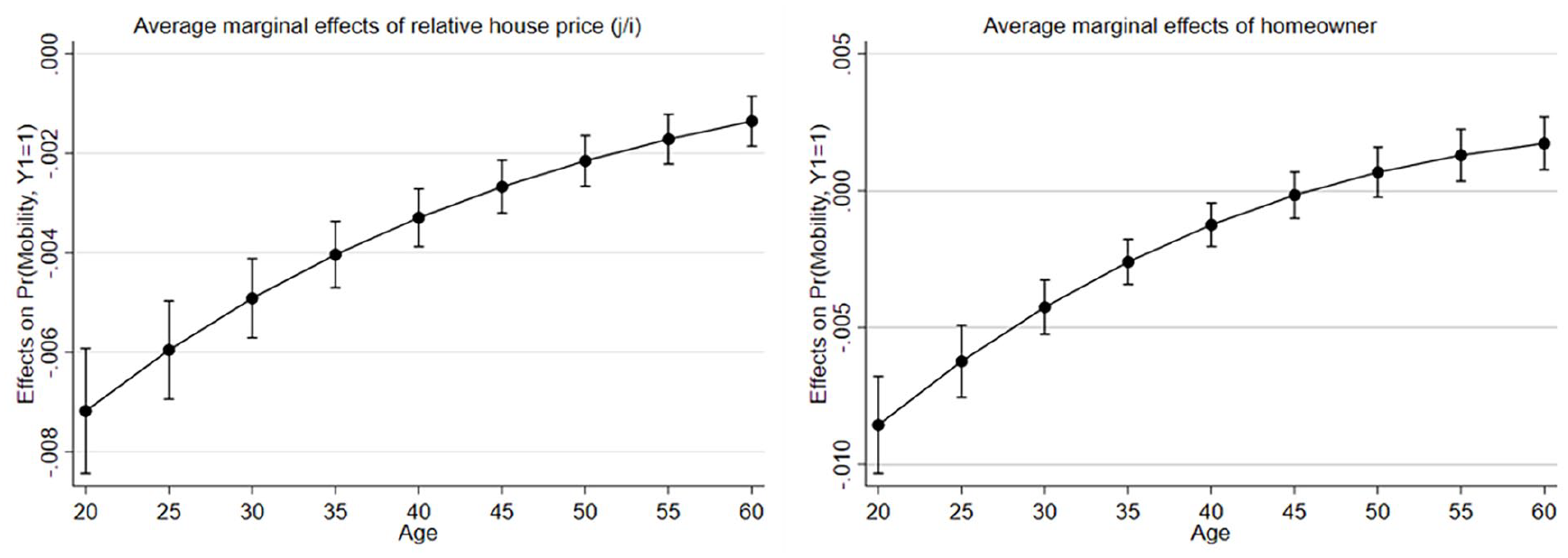
Estimated average marginal effects of relative housing price and homeownership on mobility across age.
Figure 4 also reveals that the negative effect of homeownership on mobility tends to decline with increasing age. For 20-year-olds, the effect is around −0.9 percentage points, compared to an estimate of about +0.2 percentage points for 60-year-olds (we saw earlier that the average marginal effect was slightly below −0.3 percentage points). This result could reflect differences in loan-to-value (LTV) ratios between younger and older homeowners. The higher the LTV, the less equity is left after a sale to purchase a new home. This can be a binding constraint when entering a high-priced housing market like the Stockholm region. Data from the Swedish Financial Supervisory Authority show that the LTV ratio decreases significantly with age (Finansinspektionen, 2019). For individuals under 30 years of age, the average LTV is close to 80 per cent. For people between 50 and 60 years of age, the average LTV is well below 60 per cent.
Table 4 presents estimated marginal effects of relative housing prices and homeownership on mobility for individuals having at least 3 years of post-secondary education (high-skilled), and for individuals with less education (low-skilled). The results indicate a slightly larger negative effect of relative housing prices for high-skilled individuals. The negative effect is about 0.5 percentage points, compared to around 0.3 percentage points for low-skilled individuals. One might expect the opposite, given that high-skilled individuals presumably have higher earnings capacity and more financial resources available for buying a home in the Stockholm area. Among university graduates in Sweden, in-migrants to the metropolitan labour markets have higher school grades and parents with higher education and earnings as compared with university-graduate migrants to smaller local labour markets (Eliasson et al., 2020). One possible explanation for the somewhat surprising estimates is that the two groups are focused on different subsets of the Stockholm housing market when deciding whether to start working in the region. High-skilled individuals might primarily consider owned housing in locations with high commuting accessibility to Stockholm City (and thus relatively high prices), whereas the residential choice set for low-skilled individuals might also include owned housing in less expensive areas, as well as homes in the rental market.
Estimated average marginal effects of relative housing price and homeownership in the probit model for mobility across skill levels.
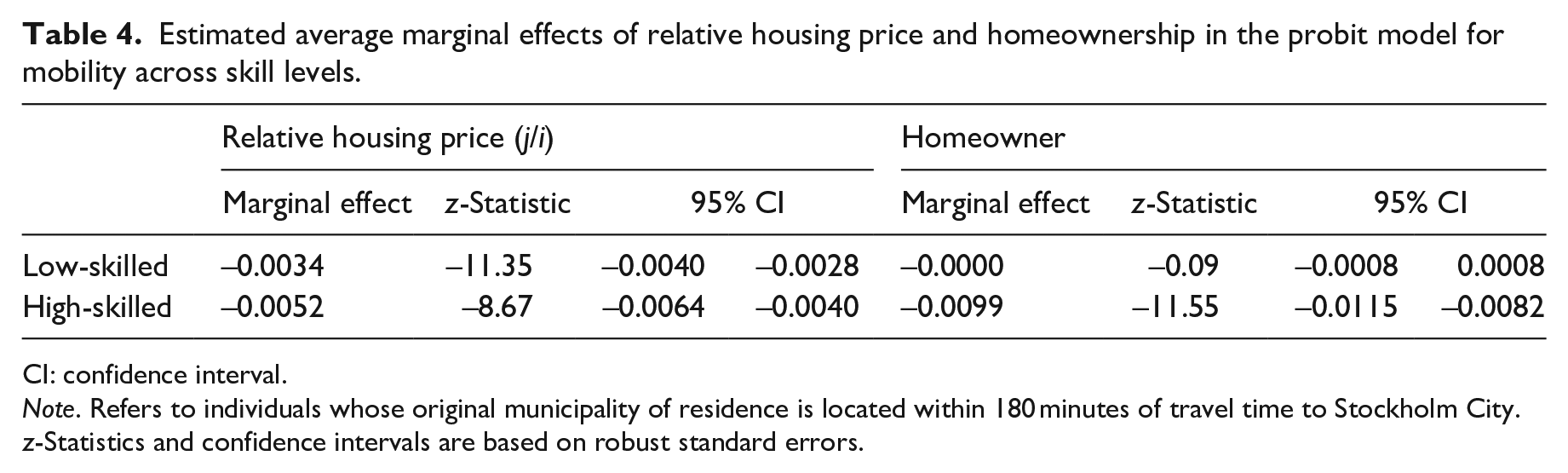
CI: confidence interval.
Note. Refers to individuals whose original municipality of residence is located within 180 minutes of travel time to Stockholm City. z-Statistics and confidence intervals are based on robust standard errors.
Furthermore, the estimates in Table 4 reveal that homeownership only seems to constrain the mobility of high-skilled individuals. This finding is also somewhat unexpected. Again, it might reflect that the residential choice set differs between the two groups. If high-skilled individuals primarily aim for more attractive locations in the Stockholm region, the equity left after a sale might be insufficient to purchase a new home in a high-price area in Stockholm.
Summary and discussion
The article analyses how conditions in the housing market are associated with the individual’s decision whether to accept a job offer in the Stockholm region and the interrelated choice between migration and commuting as the mobility mode. We specifically focus on the role of regional variation in housing prices and homeownership. Using population-wide register data, this study contributes to previous empirical research by simultaneously modelling how conditions in the housing market affect inter-regional job matching and geographical mobility in terms of both migration and commuting. In the econometric analysis, we take into account that the choice between commuting and migration to jobs in Stockholm can only be observed for a subsample of the large sample of potential job seekers residing outside Stockholm. In line with previous research, our study is based on observational data. Therefore, estimated parameters may or may not reflect causal effects. Although we provide theoretical arguments for causal effects and follow the mainstream practice of using ‘estimated effects’ in the results section, estimates should be interpreted with caution.
We find that high relative housing prices in the Stockholm area are associated with decreasing labour mobility to the region, particularly labour mobility in terms of migration. Our estimates also indicate that homeowners are less likely to be mobile and to choose migration as the mobility mode. This applies especially to young individuals and for high-skilled workers.
Among the previous literature, Cameron and Muellbauer (1998) is the article that is closest to ours. In their conclusions, the authors discuss the important role of commuting in the spatial allocation of labour and stress that ‘. . . commuting can act as a significant safety valve to offset the pressures the housing market can exert on the operation of regional labour markets’ (p. 441). We fully agree with this conclusion and have underlined the importance of considering both migration and commuting when analysing how conditions in the housing market may affect labour mobility to high-productivity regions. The finding that high relative housing prices and homeownership are linked with a lower probability of migration and a higher probability of commuting suggests that the negative effects of restrictions in the housing market on migration might be mitigated to some extent by increased commuting. However, our results indicate that, even if this is the case, high relative housing prices and homeownership are negatively associated with total labour mobility to the Stockholm region.
There are (at least) three fields/areas of policy of relevance for increased efficiency of inter-regional and internal matching to employment in the Stockholm region: policies to increase the supply of housing and efficiency of the housing market, policies to improve the transport and information infrastructure, and policies to increase employment among local residents.
Affordable housing is central for workers to be able to take jobs in high-productivity cities. Restrictions on land use and housing construction lead to increasing unaffordability and a spatial misallocation of labour. If more workers are to move to high-productivity areas, it may be necessary to reduce regulations in order to increase the supply of housing (see, for example, Glaeser and Gyourko, 2018). In that context, one area that might deserve more attention is how the Swedish system with centralized rent-setting affects the supply of rental housing and queue times for rented dwellings. As discussed in this study, conditions related to the financing of a home purchase, such as down payment and amortization requirements, can also be important for the spatial allocation of labour. One area for future research would be to more explicitly analyse how regulations on mortgages and other housing market policy measures have affected different groups’ residential and geographical mobility.
New work arrangements, such as combining work from home and work in the physical workplace and less frequent but longer commutes, have implications for policies related to transport and communication infrastructure. Pre-pandemic, the vast majority of commuting was in the form of physical travel, on a daily basis. It is well documented in the literature that commuting in its traditional form is associated with various types of costs for individuals, as well as for society as a whole. Among these are negative environmental impacts and negative effects on health and well-being (see, for example, Sandow et al., 2014; Sutton-Parker, 2021). New research shows that the pandemic initiated a large and enduring shift to remote work (Aksoy et al., 2022). If workers are able to combine work from home with less frequent commuting, this increases the potential for a sustainable geographical decoupling between place of residence and place of work. Pre-pandemic evidence suggests that telecommuters travel to work less frequently but commute longer distances (Mokhtarian et al., 2004; Zhu, 2013). Traditional infrastructure as well as ICT-infrastructure have to be adapted to new patterns of mobility and communication in the labour market. An interesting topic for future research is to analyse how the large and sudden shift to remote work may further ease the negative effects of housing market constraints on labour supply in high-productivity cities.
Increased labour supply among local residents is another means to increase employment in Stockholm, for example, through improved integration of immigrants. Immigration from non-European (non-OECD) countries to Sweden has been relatively large over recent decades. Immigrants tend to locate in the larger cities, with the largest group residing in the Stockholm regional labour market. While this has resulted in increased demand for housing in Stockholm, the potential for increased regional labour supply has, for various reasons, not been fully realized. Labour force participation is lower and unemployment is higher among large groups of immigrants. There is a potential to increase labour supply and improve regional labour market matching within the Stockholm region through education and other policy measures.
Besides the important role of commuting for labour supply to Stockholm, there are some other economic effects of increased commuting of interest for further research and related policy issues. Contrary to migration, commuting to employment with higher labour productivity has a positive effect on local tax bases outside Stockholm. This is important because local and regional taxes constitute around 90 per cent of total direct income tax revenue, and the local/regional public sectors are by law obliged to provide services such as education, health care and local infrastructure. Inequalities in local per capita tax bases following urbanization have been counteracted by direct grants from the state and by redistributive tax equalization schemes favouring low-income regions at the expense of contributing regions with higher per capita incomes. The need for this somewhat controversial policy instrument is reduced when inter-regional job matching to jobs in regions with higher productivity is associated with an increasing share of commuting (or combinations of commuting and working from home) instead of migration. Another potential effect of increased commuting on local tax bases outside Stockholm may come from the dispersion of agglomeration economies from the centre to the periphery. For example, increased productive skills through learning effects acquired at workplaces in the centre and portable to market and non-market activities in the hinterland/periphery.
Supplemental Material
sj-docx-1-eur-10.1177_09697764231210791 – Supplemental material for Housing markets and geographical labour mobility to high-productivity regions: The case of Stockholm
Supplemental material, sj-docx-1-eur-10.1177_09697764231210791 for Housing markets and geographical labour mobility to high-productivity regions: The case of Stockholm by Olle Westerlund in European Urban and Regional Studies
Footnotes
Declaration of conflicting interests
The author(s) declared no potential conflicts of interest with respect to the research, authorship and/or publication of this article.
Funding
The author(s) received no financial support for the research, authorship and/or publication of this article.

Supplemental material
Supplemental material for this article is available online.
Notes
References
Supplementary Material
Please find the following supplemental material available below.
For Open Access articles published under a Creative Commons License, all supplemental material carries the same license as the article it is associated with.
For non-Open Access articles published, all supplemental material carries a non-exclusive license, and permission requests for re-use of supplemental material or any part of supplemental material shall be sent directly to the copyright owner as specified in the copyright notice associated with the article.
