




Abstract
Amid growing interest in the creative industries and their influence on urban planning and regeneration strategies, this article revisits cultural backstages and their underlying infrastructural conditions. By cultural backstages, we mean those urban production sites which accommodate small-scale, independent and often invisible cultural producers and businesses who operate from the margins of the creative sector in cities. This study approaches backstages as urban creative ecologies because a complex set of relationships and interactions exists between the physical spaces, the individuals, their activities and the resources required for cultural production in cities. It also argues that these relationships are defined by four infrastructural conditions: (a) financial models, (b) social networks, (c) public interfaces and (d) the adaptive capacity of their spaces and organisations. Based on a fieldwork-led comparative analysis, the research examines the ecologies of four production sites in the Barras area of Glasgow’s East End and analyses how their fourfold infrastructural conditions are constantly negotiated between top-down strategies and bottom-up initiatives. It concludes that while the relationships, interactions and infrastructures within these ecologies differ, they still share common ground: they operate in close proximity to each other and rely heavily on localised yet collective forms of support. Together, they form a wider ecology at the neighbourhood scale and they add cultural and social value to its function. This article concludes that cultural policies and urban planning strategies need to consider the complexity and dynamic nature of these ecologies and design recommendations ought to prioritise these fourfold infrastructural conditions to safeguard diversity in the public culture of cities.
Keywords
Introduction
Stating the problem: culture-led urban regeneration
During the last decades, the focus of economic strategies in cities has been on the creation of ‘attractive’ and ‘creative’ spaces (Florida, 2002). Private and public bodies have increasingly invested in creative industries and culture has been used as a banner in urban regeneration (Evans and Shaw, 2004) and city branding campaigns (Jensen, 2007). Unfortunately, these investments and strategies have favoured spaces of cultural consumption for performance or display of the arts, instead of spaces of cultural production. This article sheds light on the latter, which we will call backstages of urban culture or cultural backstages, meaning spaces like studios, rehearsal rooms, workshops or kitchens, where culture is produced; spaces which are less visible and often overlooked by formal regeneration strategies and investments. Considering the recent struggles of small and small-medium cultural producers during the pandemic and the ongoing energy crisis which takes a toll on culture-led regeneration plans, this article takes the city of Glasgow as an example to explore cultural backstages and their contribution to the cultural life of the city. This article is part of a wider study conducted by the Theatrum Mundi organisation in London that looks at this phenomenon in both the UK and France (Chua et al., 2023); however, only reports on findings in the context of Glasgow are discussed here.
Within the last 30 years, the rejuvenation of Glasgow’s economy and urban form has relied on major investments linked to cultural events including the city’s designation as the European City of Culture (ECOC) in 1990, the UK City of Architecture in 1999, the European Capital of Sport in 2003 and the host of the Commonwealth Games in 2014. Since the 1990s, the use of cultural events to drive regeneration developments has become popular (Bianchini, 1999). The legacies of these developments as flagship projects have been criticised for channelling available funds into the design of speculative cultural buildings rather than the nurturing of connections with local communities (Tribillon and Bingham-Hall, 2020). Although they have helped provide amenities, attract tourism, increase employment and build community identity (Vickery, 2007), they have also exacerbated existing social issues of marginalised communities and contributed to the rise of inequalities among the city population (Mooney, 2004).
The Calton district of Glasgow had suffered from a series of ineffective and short-sighted urban renewal policies implemented post-war and a rapid industrial decline (Gómez, 2002; Pollock, 2019; Robertson, 1998), resulting in a depopulated Glasgow and the highest concentration of vacant and derelict land in the city, amounting to approximately 19.5% of the land (Glasgow City Council, 2010). In view of the increasingly central role that culture plays in urban regeneration processes around the globe (Richards and Wilson, 2006), the new Calton Barras Action Plan was initiated in 2012 by the Glaswegian authorities to regenerate the Barras neighbourhood of Glasgow’s East End as an artistic quarter with creative and craft industries (Glasgow City Council, 2012). Two years later, The Barras Vacant and Underused Floorspace Grant Scheme (Glasgow City Council, 2014) provided funding for several refurbishment projects facilitating partnerships between landowners and tenants with the aim of increasing local socio-economic activities through the provision of artist studios, craft markets and event gallery spaces (Glasgow City Council, 2016). However, the council’s intention to encourage further investment, boost the local economy and attract new ventures and populations as a response to deprivation, led to further trouble in the area. Despite the council’s initiatives, some of the local businesses and cultural producers have struggled to access public funding and receive support from investors and the City Council. Although their practices are acknowledged as the cultural heritage of the Barras, they do not fit into the top-down defined category of the ‘creative arts industries’ in the area.
Against this background, this article looks deeper into some of the small-scale cultural producers in the Barras neighbourhood to understand the way they operate amid formal regeneration processes initiated by the city. By adopting a qualitative case study approach, it seeks to tell the story of what happens on the ground: a reality that is often overlooked by urban development strategies.
Unfolding backstages
It is necessary here to clarify exactly what is meant by cultural backstages and why it is important to unfold and discuss this concept for cultural life in the city. We use the backstage as a metaphor to highlight the wide distinction between consuming culture and producing culture, in terms of their visibility and their ability to receive political attention and public investment. While the former supports landmark cultural institutions and spaces of display, the latter – the backstage – supports spaces and systems for different types of production like garage bands, wood carving workshops and dance studios. It is crucial to scrutinise such an imbalanced focus within the context of the UK where urban planning strategies for the support of cultural infrastructures proliferate.
A focus on cultural backstages raises awareness of cultural production sites which tend to accommodate small-scale, independent artists, producers and businesses who operate from the margins of the creative industry. As the metaphor of their name suggests, they are not at the forefront of aesthetic design or advanced technology, but they infill declining or odd spaces in the city, behind, under, in-between or next-to others, being tactically nested within the urban fabric. They rely on existing resources and build on current infrastructures. They operate outside formal organisations, or the upperground category of the creative city (Cohendet et al., 2010) whose specific role is to bring creative ideas to the market linking individuals immediately to the commercial and industrial world. Backstages are not simply informal spaces because they are still shaped by clear visions for their design and use. They do not contribute less to the cultural heritage of the city than the highly invested and well-known front-end projects. Unlike the latter, backstages exist and operate as a consequence of a formal system that fails to provide for them.
While the main question that drives this research concerns how cultural backstages operate as creative ecologies, its contribution to relevant literature and theorisation extends beyond that. This article aims to draw the attention of planners, architects and policy-makers to the fourfold infrastructural conditions (financial, social, public interface and adaptive capacity of space and organisation) that support the production of culture in cities and the diversity of these conditions against current regeneration processes that wish to flatten and homogenise the landscape. In addition, this article also proposes an infrastructural perspective to urban studies which is informed by sociological and critical humanities scholarship. By adopting a case study approach, it puts forward the need for a more relational understanding of cultural life in cities, focussing on the relationships and combinations between resources, spaces, individuals and practices. Such knowledge can also be useful for the public, the potential funders, the state authorities and the policy-makers who seek to gain a better understanding of what it takes to produce culture and safeguard its diversity in a city today.
An infrastructural perspective
Cultural backstages operate within a series of complex relationships between available resources and physical space, as well as with individuals with different motivations who use, manage and design such spaces. For that reason, we find it useful to approach cultural backstages as creative ecologies (Jackson, 2016) to highlight the needs and necessities within these spaces, and the dynamic relationships between physical space, people, activities and the resources that support these spaces to operate over time. By conceptualising backstages as ecologies, we dismantle them not as mere spaces but as creative infrastructures that afford relations defined by certain financial, spatial, political and social conditions. In other words, these conditions carry an infrastructural capacity which maintains and sustains backstages in the city. The following discussion focuses on these underlying conditions that determine these complex and ever-changing relationships within the the ecologies of backstages.
From spaces to conditions
For professionals of the built environment, infrastructures are traditionally seen as the physical structures and services needed for the functioning of a city. The social aspects of the urban infrastructures including their ‘symbolic power and their social selectiveness’ (Amin, 2014: 138) reveal their promise of progress and modernity. Other disciplines have discussed the notion of infrastructure too. In the field of sociology, Star (1999) expands the term infrastructure by including all ‘complex systems of relations’ and conditions that exist in different registers. Using, in particular, the notion of embeddedness as one of the characteristics of infrastructure, Star highlights the installed base, ‘other structures, social arrangements, and technologies’ that surround infrastructure (Star, 1999: 381). Within social geography, Graham and Marvin (2001) also explain infrastructures as networks that are socially constructed processes, which are assumed to be integrators of urban spaces and contribute to their cohesion. Following the same line, Simone (2004) extends the notion of infrastructure directly to people’s activities in cities and discusses how ‘complex combinations of objects, spaces, persons, and practices’ become ‘an infrastructure – a platform providing for and reproducing life in the city’ (Simone, 2004: 408).
In social sciences, the act of making infrastructures translates into the creation of shared experiences and social bonding (Amin, 2014) through which other social values can emerge spontaneously. This draws further attention to the anthropology of infrastructures that reveals the politics and the poetics behind discussions on infrastructure (Larkin, 2013) and of socio-technical processes and the agents involved in them (Harvey, 2012): in other words, what is invisible and takes place behind the scenes. So, the infrastructural conditions of backstages incorporate not only their social values but also the politics and economies within them and in fact the dynamic among these aspects.
Planning policies for urban culture consider infrastructures as distinct spaces and frameworks to formulate strategies and plans. However, viewed through a socio-anthropological lens, this gives an incomplete picture of the complex cultural productive ecologies that exist in cities and a limited homogenised approach to building, supporting, and sustaining them. For example, the Cultural Infrastructure Index undertaken every year by AEA Consulting (2019) for the Global Cultural Districts Network focuses on measuring ‘investment in capital projects in the cultural sector, identifying projects with a budget of US$10 million or more’ (p. 1). Here, the term infrastructure is used to refer to physical objects that constitute financial and political assets and contribute to city branding. Such approaches also represent the focus and limited scope of understanding of culture and skilled labour and accordingly of the creative economy and industries (Comunian, 2011).
The definition of cultural infrastructure and its relation to urban planning policy has been attempted in the context of the UK (Tribillon and Bingham-Hall, 2020). In 2019, the Mayor of London released a Cultural Infrastructure Plan with the aim of sustaining and enabling cultural spaces in the city. The Cultural Infrastructure Map, initiated by the Mayor of London (2019), proposed to give ‘a live, fine-grained picture of London’s cultural assets [. . .] from recording studios to theatres, clubs to community halls [. . .to. . .] broaden our understanding of the true richness of hidden creative clusters and help safeguard jobs and talent’ (p. 8). While the plan and map help understand geographical dynamics of so-called cultural assets in relation to larger-scale infrastructures and systems such as transport, they fail to expand the notion of cultural production and to capture and include the small-scale physical spaces, in which cultural producers are at the margin of the creative industry.
It is with this limited viewpoint in mind and informed by a sociological and critical humanities scholarship that we see the study of backstages requires an expanded understanding of infrastructures (and the act of their making) from a set of physical spaces to a set of infrastructural conditions that build, support and sustain cultural production in cities. The question is then what these conditions are and how they relate to the rest of the ecological system of cultural backstages.
Infrastructural conditions of cultural backstages: financial models, social networks, public interfaces and adaptive capacity of spaces and organisations
In the ‘Making Cultural Infrastructure’ project launched in 2016, Theatrum Mundi ran a series of focus groups with 60 London-based practitioners working in performance, making and virtual forms of culture to better understand the infrastructural conditions for culture and the relationships between them that affect the use of production spaces. These discussions, as summarised by Bingham-Hall and Kaasa (2017) are: ‘material’, ‘immaterial’ and ‘ecological’. Material conditions mean the architectural qualities of spaces which are rarely part of city-wide strategies; for example,
whether spaces are visible or audible to or from the public realm; the degree to which spaces can be made messy and inhabited with a personal archive from which to work; and, if in these spaces people work alongside or separate from one another (Bingham-Hall and Kaasa, 2017: 9).
Those usually seen in city planning are the ecological conditions, which cover the urban qualities of production sites, addressing questions of light, noise, cleanliness, density, typology, land uses and proximity to housing and transport. Finally, the immaterial conditions refer to ‘the way ideals and regulations are applied to spaces for cultural production, in terms of labour protections or minimum pay’ (Bingham-Hall and Kaasa, 2017: 9).
Participants in the Theatrum Mundi workshop indicated that their needs for space as well as resources for cultural production vary based on different types of operation and production. Therefore, cultural producers require a range of infrastructural conditions that support individuals to sustain their practice, rather than just the provision of space. Bingham-Hall and Kaasa (2017) propose four broader concepts that reflect the wide range within which cultural production operates, which are either overlooked or not addressed properly by larger cultural infrastructure strategies. These concepts are value, stability, determinacy and visibility. ‘Value refers to whether cultural production is seen as craft or labour. Stability highlights the degree to which infrastructures are temporary or permanent. Determinacy asks whether infrastructures are adapted from found space or purpose-built. Visibility addresses the level of publicness or privacy that cultural production operates within’ [emphasis in original] (Bingham-Hall and Kaasa, 2017: 9). These four concepts highlight a greater or lesser degree of resources that support and sustain cultural production and lead us to understand a wide range of operation within cultural production. Analysing these concepts also justifies the existence of some cultural practices while identifying the vulnerability of a few others (Adger, 2000).
These concepts are further explored through unfolding the interrelations, networks and connections between the resources, individuals and their spaces as well as their context. Throughout the research and informed by our own empirical research these conditions were refined to the following four: (a) financial models, (b) social networks, (c) public interfaces and (d) the adaptive capacity of the spaces and organisations. Each condition hints at either the financial, social, spatial or political infrastructures of cultural backstages’ ecologies. Financial models are related to economic resources and financial arrangements, such as land ownership, rent prices, payments, kinds of contracts (long-term, short-term, fixed, flexible) or access to public or subsidised funding. Social networks deal with the management regulations of the organisations, which affect the way these sites are managed and the individuals are supported in their activities. Public interfaces describe the visual and virtual ways these backstages communicate with the public, such as accessibility, facade design, social media and so on, while the adaptive capacity of organisations and spaces draw attention to both the architectural and the urban qualities of spaces as well as the vision of their management.
Based on the above theoretical framework and on what we witnessed on the ground, we sought to further examine the dynamic between these conditions and how this enables and supports individuals to adapt to changes and continue production. All conditions are interdependent; for example, financial models affect the relationships between tenants and managers; social networks affect the agency of producers and the potentials of adapting their space; and the size and dimensions of space affect what can be produced and therefore which practices are excluded. Equally, there are implications that derive from this interdependence which affect the dynamic between individuals, activities, spaces and resources. For instance, if organisations wish to benefit from culture-led regeneration strategies or widen their opportunities to access public funding, they should be branded as creative hubs or coworking spaces for artists; this affects the stability of individual artists and artisans who may no longer afford to either compete against or be part of this process. Similarly, the financial conditions can affect the ways labour rights are protected and the extent to which the voices of the independent makers are heard. Therefore, the relationships between these conditions are complex and non-linear, shaping a range of diverse and resilient dynamics.
Each one of the four conditions seems to tie into further conceptual work. With regard to the stability and determinacy of social networks, small-scale and independent producers, such as migrant businesses or unskilled labourers excluded from sectoral support, can be particularly vulnerable due to the effect of possible changes (financial or otherwise) on their practice (Peck, 2012). They tend to cluster and proliferate as an act of resilience to be able to manage their resources and cope with disturbances and recover from changes (Adger, 2000). By clustering, they can establish networks of mutual support and empowerment (Simone, 2004). Being incorporated within formalised, unionised and legal structures, they can resist political agendas and sectoral policies which threaten their right to produce and seek to control the means of production (Harvey, 2012). Operating under the umbrella of larger organisations provides individuals with the necessary professional legitimacy and visibility to gain support and recognition from other producers and clients. Meanwhile, it promotes socio-cultural values as a result of their collective action (Merkel, 2015). Also, it is envisaged that a higher degree of social networking and interactions, as a result of centrality and proximity, affects economic outcomes and performance (Kemeny et al., 2015). Facilitating social networks among the individuals is therefore a vision many organisations aim to achieve, either through spatial strategies such as designing common spaces or by encouraging their participation in organised public programmes. Although the causality of building place-based social networks is unclear (Kemeny et al., 2015), the myth has created the rising phenomena of flexible workspaces (Merkel, 2015).
Flexible approaches to the conditions and limitations of small-scale and independent practices provide another level of support constructed through micro-interactions between organisers and individuals who are tenants of these spaces. Such flexibility requires an understanding of the labour conditions and characteristics of creative work ‘such as precarious employment with low and sometimes non-existent wages, multiple jobs, extensive emotional stress and dense social networking, a blurring of the distinction between private and professional contacts, identity investments, and self-exploitation’ (Merkel, 2015: 126). However, such micro-interactions and understandings relate to other factors such as the financial situation of the spaces as well as their form. Lack of resources, as discussed earlier, could result in mutual support among individuals but also in organisers’ flexibility towards individuals to build their own infrastructure and networks, if the spatial form and configuration allows it. This can define the extent to which these spaces and organisations running them have the capacity to adapt to individual productive practices. The appropriation of work units, floors or entire buildings, expressed as the taking and changing of abandoned or owned property for one’s own purposes, can enhance the ‘spatial agency’ of individual producers at different scales (Awan et al., 2011). In the case of entire buildings, this subversive tactic extends to the occupation of buildings which were never designed for the purpose of receiving cultural productive activities but could nevertheless be adapted for such reuse.
The theoretical framework of this article therefore suggests a more comprehensive understanding of cultural backstages; it addresses both the physical spaces, the people, activities and the resources that coalesce in them as well as the infrastructural conditions that build, support and sustain their complex relationship. In other words, cultural backstages function as ecological systems for the purpose of producing culture in the city. The metaphor gains further ground when we consider that the concept of an ecology represents a holistic, dynamic and adaptive way of living and functioning, and where the interactions of organisms with their environment and to other related organisms shape the ways they live, grow and exist. In the case of cultural backstages, this refers to the kinds of interrelations between producers and their space: the possibilities and limitations of using the space considering the material and tools they work with; networks between producers (tenants) and managers in terms of the services provided by the latter and their flexibility to organise such co-habitation; and the connection between their workspace and the street (public interface), where the backstage meets the stage. These interrelations, networks and connections identify backstages as creative ecologies, and shape the ways they operate and make culture and vice versa. In the next section, we will explain the methods used to explore such dynamic and complex relationships.
Methods of exploring creative ecologies
Methodologically, a deeper understanding of cultural backstages is achieved through an ethnographic and interview-led case study approach (Yin, 2009) that aims at providing detailed insightful information about the complexity of relations and processes through which cultural backstages operate on the ground. Although largely contextual and limited in their scope, the four selected cases in the Barras area of Glasgow’s East End offer a good range of different kinds of cultural backstages, from formalised organisations in purpose-built coworking complexes to grassroots initiatives appropriating left-over buildings.
The choice of case studies
The focus on the Barras area emerged from the participatory roundtable organised by Theatrum Mundi in November 2018, where a group of invited artists, architects, designers, performers and city planners (15 in total) was asked to address the problems behind the provision of cultural infrastructure in Glasgow (Theatrum Mundi, 2018). The Barras is a unique neighbourhood to study because it embodies the above-mentioned narratives of a top-down cultural regeneration strategy marked by a high percentage of real estate vacancy and a plethora of emergent grassroots initiatives, that is, two of Glasgow’s latent qualities for planning for culture. It can also be seen as the backstage of the city itself in both spatial and metaphorical sense, where small-scale cultural producers and initiatives have taken refuge in former market spaces and warehouses (Chua and Karimnia, 2020).
We selected four case studies: Many Studios (MS), Glasgow Collective (GS), The Space (TS) and Barras East End Studios (BEES). Operating from an invisible neighbourhood of the city and at the margins of the creative sector of the city (more evident in some cases than others), the four cases constitute compelling examples of what we consider cultural backstages. Furthermore, they are all located in the same area and in close proximity to each other (Figure 1), a shared characteristic which facilitates the comparison between them. Moreover, all of them accommodate productive activities in formerly derelict sites which have undergone refurbishment after 2015. Many Studios, a former market building, was transformed in 2016 into 45 workspaces and currently accommodates a range of workers from visual artists and designers to writers and engineers. It has been designed and co-managed by New Practice architects. Glasgow Collective took over and refurbished the ground floor of the Dovehill studios building and three shops on Gallowgate high street. It is a creative hub hosting around 13 workspaces and 36 different businesses comprising a mix of social enterprises, charities, community interest companies as well as multiple small and medium-size creative corporations. The Space is a former furniture store, then used for storage, which became converted to Scotland’s first Pay-What-You-Decide Community Arts Venue run by the People Without Labels charity. It offers creative workspaces, rehearsal and communal facilities and supports homeless people. The BEES is run by a collective of traders who operate within a former warehouse. From 2019, the market accommodates different creative practitioners, from chefs to textile printers.
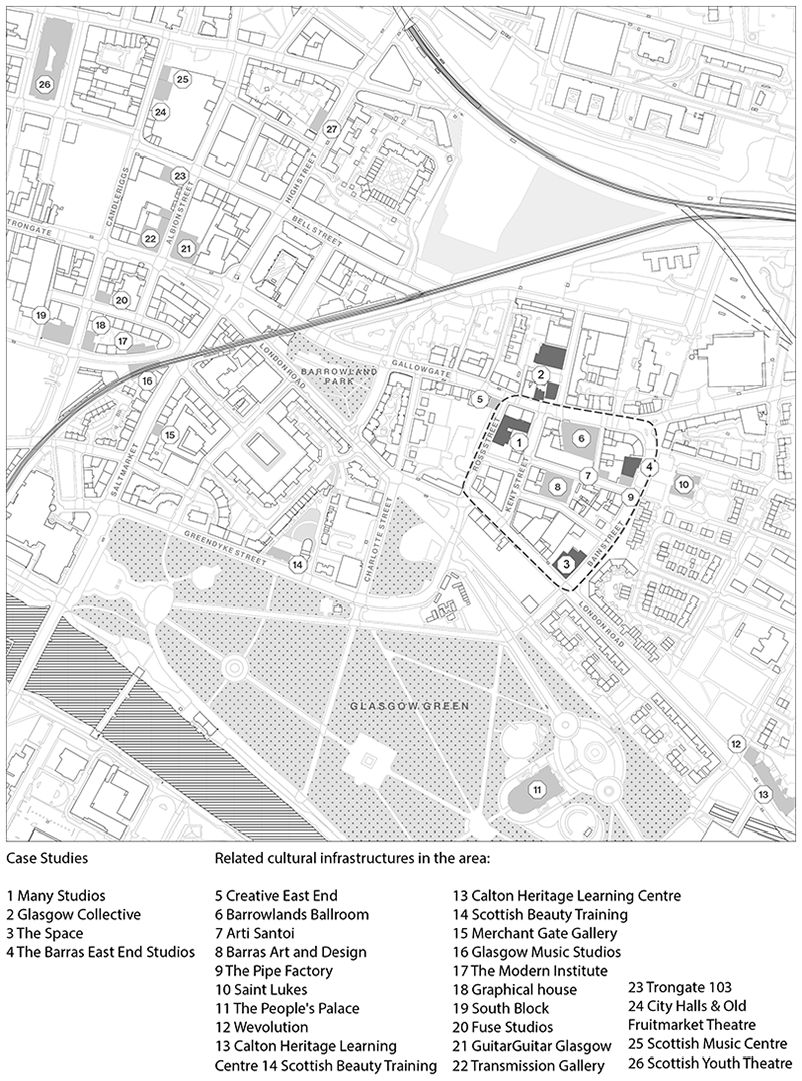
The location of the four case studies and other cultural venues in their surroundings. The dashed line shows the Barras Market boundary. Source: Theatrum Mundi.
Despite the common denominators, the sample remains ‘theoretically diverse’ (Yin, 2009) to allow exploration of different infrastructural conditions and reveal examples of their operation within the ‘underground’ and ‘middleground’ of a creative city (Cohendet et al., 2010). Indeed, the four cases demonstrate a diversity in the type of culture they produce, in the kind of spaces they occupy (as illustrated in Figure 2) and in their degree of visibility, which in turn affects their placemaking role within the local community and the ongoing regeneration process of the Barras. Although there were many other potential sites, due to practical constraints of the adopted research methodology, it was not feasible to investigate them. Nonetheless, future research could address that limitation.
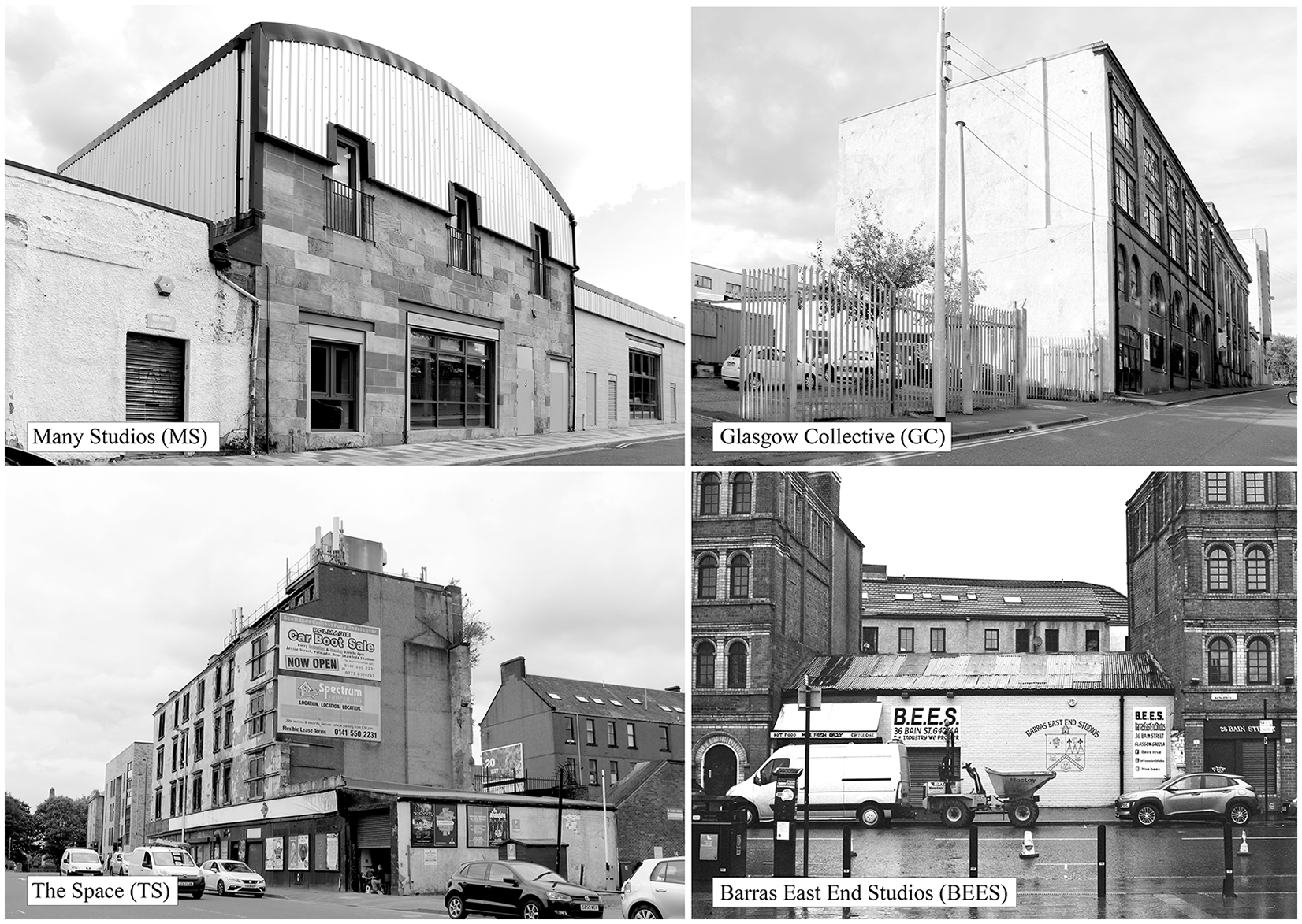
The four case studies in the Barras. Source: Theatrum Mundi.
Data collection and analysis
By narrowing down the number of cases, the study succeeds in carrying out an in-depth comparative analysis based on four infrastructural conditions: the financial model, the social network, the public interface and the adaptive capacity of spaces and organisations. Data were collected during three organised field trips in November 2018, June 2019 and January 2020. The research used multiple methods including ethnographic exploration, cartographies and interviews at three different scales:
At the city scale: the review of maps and planning documents including the historical evolution of Glasgow’s development and culture-led regeneration helped us contextualise the Barras’ ongoing regeneration.
At the neighbourhood scale: through the participatory roundtable (transcribed), review of historical maps of the Barras, configurational analysis, observations and mapping of cultural infrastructures in the area (Figure 1), we aimed to explore the existing resources, networks and relationships within the neighbourhood and beyond in relation to the centre.
At the case study level: we conducted a review of planning documents including land-use regulations, photographic surveys, observations and ethnographic explorations of the buildings and tenants’ workspaces, mapping the interior space and the building transformation, Figures 2 and 3, to analyse the adaptations of individual space and the buildings. The main approach was to capture the ‘value, stability, determinacy, and visibility’ (Bingham-Hall and Kaasa, 2017) of the cultural practices within these case studies through recording, transcription and text analysis of 24 semi-structured interviews – 17 tenants and 7 managers of the case studies – out of 30 overall, conducted in a wider context to create a benchmark for comparison. The interview questions followed our theoretical framework. We asked about the tenant’s experiences of accessing and using the space and its affordability, the spatial requirements, relationships with other tenants and the managers, their support and flexibility, also about the formal and informal rules which have constrained or empowered their production in these sites. The analysis was based on the interviewees’ responses, codified transcripts with financial relations, social networks including individual operation and the organisation’s flexibility, which would justify spatial adaptations and the building’s public interface.
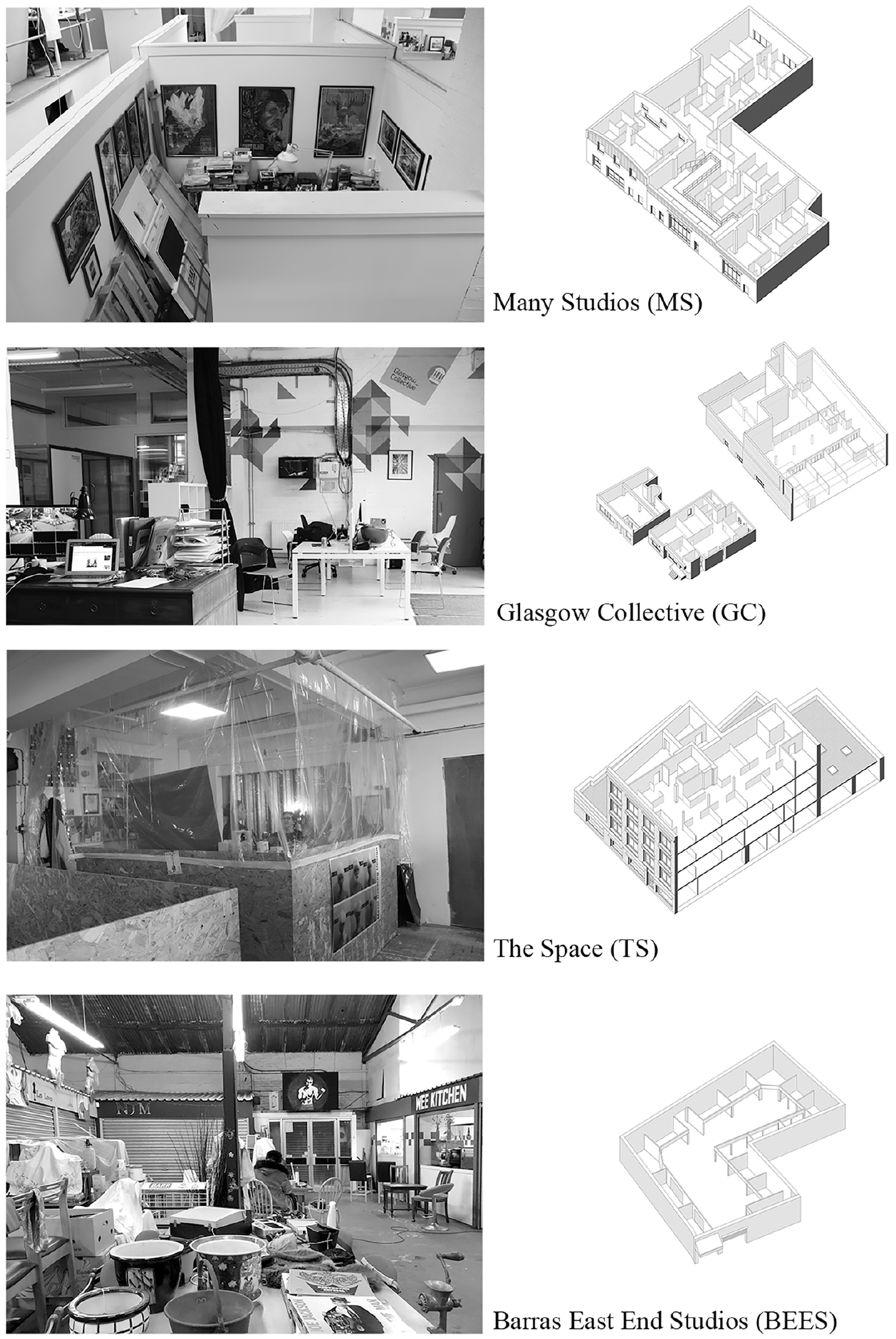
Photographic surveys and 3D drawings of the four case studies. Source: Theatrum Mundi.
Although the selection of interviewees was limited by their availability, we considered them to cover a diversity of occupations (from fine artists to set designers, to sound engineers) to highlight different spatial needs, and a suitable age range (50% below 35) to mark different levels of stability in their practice and gender. The interview conversations in combination with detailed cartographies at different scales helped obtain a better perspective on the kinds of activities and resources associated with these creative ecologies.
Originally derived from the theoretical framework of Bingham-Hall and Kaasa (2017), the four infrastructural conditions discussed above and their impact on cultural production are further examined in this study. In the following section, our analysis of the selected production sites in the Barras neighbourhood of Glasgow makes visible the interdependence of these infrastructural conditions.
The infrastructural conditions of four cultural backstages in Glasgow
Condition 1: financial model
The financial model of backstages describes the way organisations balance their expenditure on such costs as services, maintenance, programme and salaries, and their sources of income, such as rents from workspaces or venues, public funding or donations. The selected case studies display different models. Figure 4 shows that rent from workspaces is the main source of income in all four sites, while the key expense is the maintenance and lease of spaces. MS and TS are the only cases to receive public funding to transform and reuse their buildings and host public events to generate more income. The managers of MS explained during the interview that financial considerations determined the provision of different types of spaces, such as galleries, shops and workspaces. Although GC has not received any funding, its organisers acknowledge the privilege of owning the building and not paying rent sustains their organisation and allows them to set a flexible financial model with their tenants.
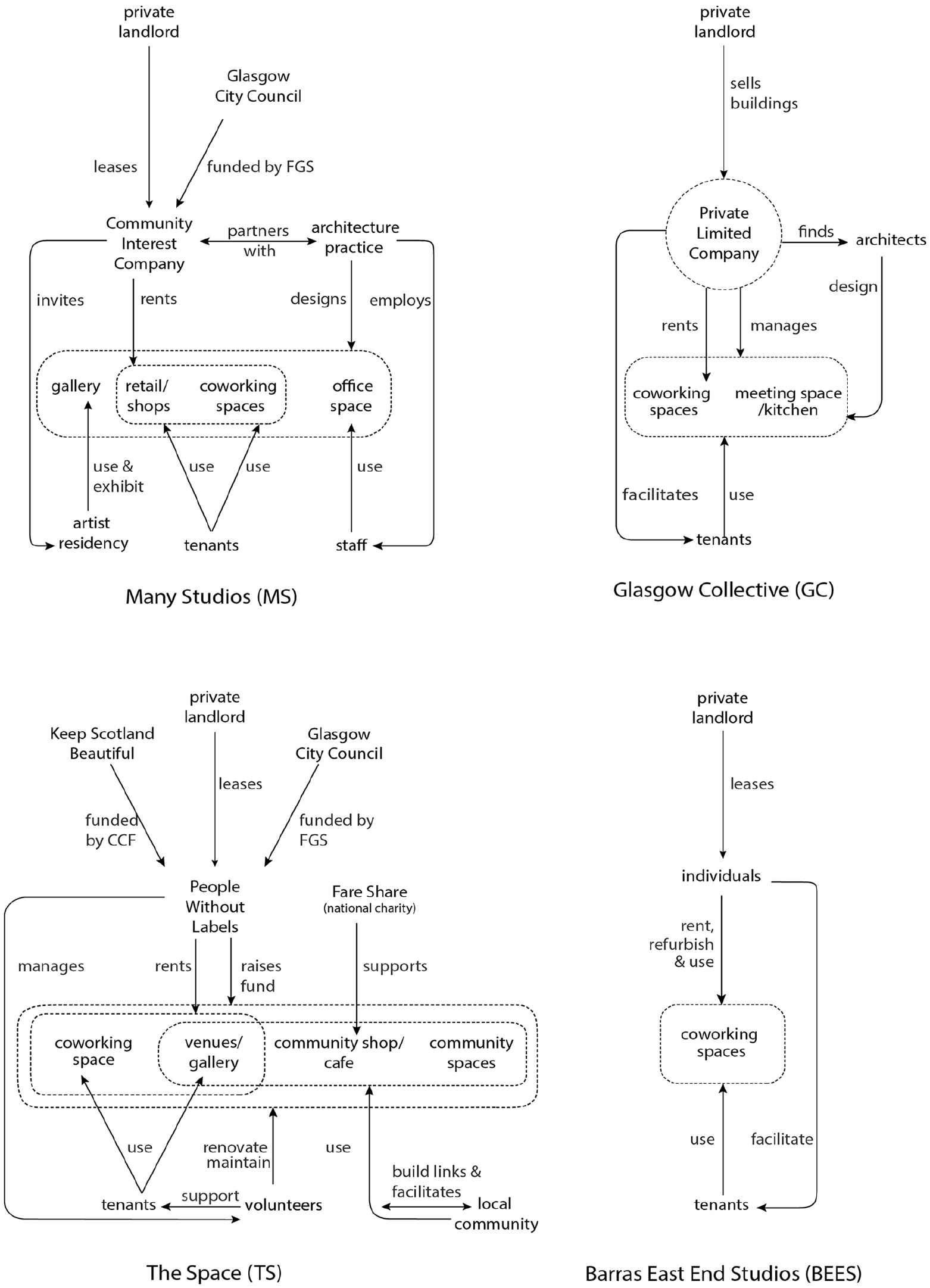
Network diagrams show the underlying financial and social conditions of each organisation. Source: Elahe Karimnia.
The financial model of TS mostly relies on crowdfunding and donations. The volunteer manager confirmed that because of its social scope to support the local community, the rents from the workspaces and the contributions from the community under a Pay-What-You-Decide scheme are barely enough to maintain the building. This is different from BEES whose organisers fund the costs of the lease and ongoing refurbishment without any subsidy. They rent any available workspace even if it is not ready for occupation or if its main services such as heating are missing. As one of the organisers explained, BEES adopted the label of ‘Studios’, as a strategy, to fit council’s current strategy for cultural regeneration and access public funding opportunities:
I’ve been here for about ten years, and establishments were getting run down due to a lack of vision, and also, the footfall [. . .] it became a sort of difficult place to trade. So that’s why we use the name ‘studios’, rather than ‘stalls’. So everywhere else you go in Britain, or other parts of the city, as soon as you change the word ‘market’ to ‘studios’, it’s a whole new ballgame (interview with one of the organisers of BEES).
Having a growth-driven agenda and attracting suitable producers–customers is the financial strategy used by organisations such as MS to create a formal identity in the creative industry. This affects their eligibility to apply for funding but also gives them legal grounds to raise rents. On the opposite end of spectrum, organisations with a more socially oriented scope, such as TS, or a loose economic direction, such as BEES, may not entirely fit within the narrow definition of the cultural sector, and thus end up being deprived of certain privileges that come with such tagging.
Condition 2: social network
The next infrastructural condition concerns the social networks developed within the organisations, which largely depend on the visions and proactiveness of their organisers, together with their financial structure. In our study, the organisers carry different roles, ranging from owners of space (GC) and mere managers (MS and GC) to volunteers (TS) and community collectives (TS and BEES). Their visions and interests have influenced the way these organisations operate and sustain over time. For example, all organisers mention their family heritage or personal investment in the history of the area and how that has encouraged them to build relationships with the neighbourhood and the local producers.
MS’s and GC’s visions aimed to create new destinations for culture in the Barras and attract new audiences and partnerships beyond Glasgow’s East End, and by doing so, increase the footfall and the socio-economic diversity of the neighbourhood. MS’s managers – two out of the three also designed the building – have created a business model to, as they state: ‘maximise footprint, maximise income generation and maximise likelihood of us being able to grow as an organisation’. To sustain a formal structure the space is maintained at high standards, which is vital for those seeking a well-presented, plug-in-and-go infrastructure:
What I’ve always loved about Many [Studios] compared to other sorts of design studios that I’ve seen is, it’s like, really presentable. It feels like a professional workspace. [. . .] I can bring a director here or a producer, and we can sit down and look at a model (interview with a set and costume designer in MS).
The brothers who own and refurbished GC have aimed at enhancing the networks between individual producers and helping those whose businesses need support to kick off and grow. Unlike MS, whose tenants are mainly artists, GC’s tenants are mostly commercially focused, from different sectors and scales including larger and more profitable commercial businesses, social enterprises and small independent commercial producers. The organisers clearly intended to create a destination and provide an infrastructure for bringing people together. For example, they encouraged a cake designer working for another business in the building to set up her own business:
They [the managers] set me up here. I wouldn’t have been able to do it without them [. . .] they gave me a really good deal. They put me in touch with a second-hand catering supplier, that all the equipment has been used for demos and stuff like that. So I just went down there, and they sorted me right out (interview with the cake designer in GC).
The visions of TS and BEES reach well beyond profit making and business branding. TS performs a social role by hosting Pay-What-You-Decide events for homeless people to bring them closer to art and culture:
So people pay what they can afford. There’s a homeless hub, just about five minutes or so down the road, and they occasionally refer homeless people up here, so if people are really struggling, we’ll give them some food, or a drink or whatever [. . .] Cause that’s the whole idea, you know, to try and be community-oriented (interview with one of the managers in TS).
This is a shared view not only of the managers but also of the individual producers who rent out the workspaces:
The Space was created for people around it, so if it’s not serving those people, then what is the purpose of the space anymore? And I think that’s the same with any community arts centre. If you detach and alienate the people, what’s the point? (interview with an artist in TS).
Furthermore, TS relies on free labour and local volunteers who manage the community shop and cafe, rent the private venues and programme social and cultural events for the community venues. The dynamic between the volunteers managing the building and the producers occupying the workspaces is therefore agile with the common purpose to help the organisation to operate both as a whole and as a sum of parts.
The organisers of BEES – two former traders – have aimed at providing space mostly to local working-class producers, who are not trained professionally and are thus more likely to be excluded from high-profile creative spaces and public funding. Those producers who finally get accommodated face similar difficulties in their professional life, meaning the need to establish their practice and achieve some financial stability. For this purpose, BEES acts as a space of trust and mutual aid where skills, labour and services are exchanged, as explained by one of the producers:
I have a guy who is coming from time to time for a free cup of coffee because he changed our pipes. [. . .] I was never used to that, because, you know, you pay for everything. And then people say ‘yeah, it’s fine, I’ll just do it for a coffee’. So that’s how we do it, like the Barras way (interview with a chef running the cafe in BEES).
From our research, we conclude that the vision and roles of all organisers are constrained by the financial models of their organisations, which in turn limits the approaches through which these cultural backstages engage with their potential users and the public. Two main tactics are observed. On the one hand, the organisers of more formalised spaces such as MS or GC have set a clear vision since the beginning, that is to create a destination for people working across culture and creative entrepreneurship, respectively, in Glasgow. Their role is then to pursue that vision according to the available budget, while marketing the organisation for the support of individual producers. On the other hand, in less formal organisations with makeshift and thus rudimentary infrastructures like the TS and BEES, the organisers spend a lot of time negotiating with individuals and businesses and take decisions in consultation with them.
Condition 3: public interface
Effectively, the last two conditions influence the ways cultural backstages reach out to and engage with their audiences, including users, clients, other professionals in the industry and the general public. Much of this engagement has to do with the level of publicness or privacy that cultural production allows for and operates within, which largely comes down to the physical visibility (facade design) and virtual accessibility (online presence) of the spaces.
Apart from BEES, whose businesses rely on word of mouth, the other three cases mainly use social media and online platforms to advertise their work and reach out to the public. Not that the physical factor goes unnoticed. MS has intentionally increased the visibility of the building from the street by installing fully glazed windows at the ground-floor edges of the old building. To showcase the cultural production that happens inside the building, the designers and managers designed a public facing gallery and two shopfronts and parallel to that, they also invested in building a strong presence in social media and a new website. The workspaces of GC that are located on Gallowgate street also benefit from the high visibility and accessibility of the high street. In addition, the organisation features the work of its individuals and businesses on the organisation’s website. This serves as a means to promote the work of their existing tenants but also attract new ones.
In contrast, the people working at the top four floors of TS’s corner building are not visible from the street level, and unlike the tenants of MS and GC, their work is not being advertised on the organisation’s website. The situation is more strained for the producers of BEES because the site is the least visible among the four cases. Passers-by do not spontaneously visit what they cannot see as they move through the area. As a result of working inside a market with closed shutters most of the weekdays, they have to rely heavily on the word of mouth and the BEES Facebook page to advertise their work. However, physical access and natural footfall are not the determining factors to sustain their businesses and attract customers, although they appreciate their benefits when the market is open on the weekends.
We found out that public visibility is not always required for success. For example, the tenants of the GC’s workspaces on the high street claim that their work does not depend on highly visible and accessible conditions. In fact, some of the producers benefit from increased levels of privacy. The cake maker enjoys the privacy of her space for it allows her to complete her work with no interruption:
If you have a shopfront, you’ll need to employ someone to. . . just, deal with walk-ins. Even though it can be quite lonely, I get my head down and get stuff done. I have a lot of people being like, can I come down to your shop? And I’m like, ‘Well it’s not a shop, it’s just a kitchen’. Social media’s your shopfront (interview with the cake designer in GC).
This example reveals that often council strategies like the one to upgrade and improve the appearance of the neighbourhood’s shopfronts through The Barras Shopfront Improvement Scheme in 2014, may come at odds with the actual needs of the local people and communities.
In other words, some types of production require less public interface than others. Such an example are music rehearsal studios or storage spaces. Similarly, some types and scales of production are appointment-based and deal with individual clients while some others are service-based practices that operate entirely thanks to professional networks.
Condition 4: adaptive capacity of spaces and organisations
The adaptive capacity of spaces refers to the flexibility of spaces to accommodate different activities and continue to adapt as a result of this – together with organisations and regulations that permit this. If this is not provided by the organisation itself, it offers the possibility to cultural producers to appropriate their own workspaces. In more affordable and informal settings, such as TS and BEES, there is enough freedom to adapt one’s own space. For example, an artist working with paints at TS explained how their work inspired physical modifications:
I started dipping things in paint, and I would dream of building an ultimate support unit. I got into the idea that if the process that an artist engages in is the most important part, how do I represent that in a final setup. I decided to line the floors with wood and then make a caged support structure within it (interview with an artist in TS).
Although the ability of backstages to change and adapt over time ensures their resilience as an organisation, such fluidity requires self-organisation and adaptive capacity on the part of the tenants. It relieves the organisers and managers of the responsibility and the cost of investing labour and resources in the provision of basic infrastructure. For instance, one of the tenants of TS had to make an elaborate structure to enclose her workspace with plastic curtains to improve its thermal comfort:
Since this is a really large space and it’s all shared. It’s really cold in the winter, but I thought I can complain about how cold it is, I can pay a lot more money, or I can box myself in. So I just was proactive and decided to make a greenhouse out of my old space. It worked really well (interview with a product designer in TS).
At the same time, the ability of spaces to change is also the result of a flexible organisational model, which seeks to provide for different types of production and creative practices. In these cases, and as a trade-off for the lack of provided services and facilities, spaces are more affordable, and rents are reduced. Therefore, designed and well-equipped sites such as MS and GC operate mostly as plug-in-and-go infrastructures and offer less affordable workspaces than TS and BEES. To illustrate this, the rent of a 13 sqm workspace in TS is almost one-third of what is paid for a space of similar size in GC. Although TS cannot afford to provide basic infrastructures such as heating or sound insulation, it offers greater freedom to its tenants to build their own:
You’ve just got a lot of freedom. You can kind of do whatever – what you like – without knocking walls down essentially and I think it’s that feeling that you get; it just makes the place great (interview with the podcasters in TS).
Dynamic relationships among infrastructural conditions
The above infrastructural conditions foreshadow the complex and dynamic relationships between the people, the spaces and the resources afforded by the ecological nature of these cultural backstages. Each case study comprises a different set of relationships among the infrastructural conditions which affects the operation of the whole system. Table 1 summarises the diversity of these relationships for each case study.
Delayering and comparing the infrastructural conditions of the case studies.
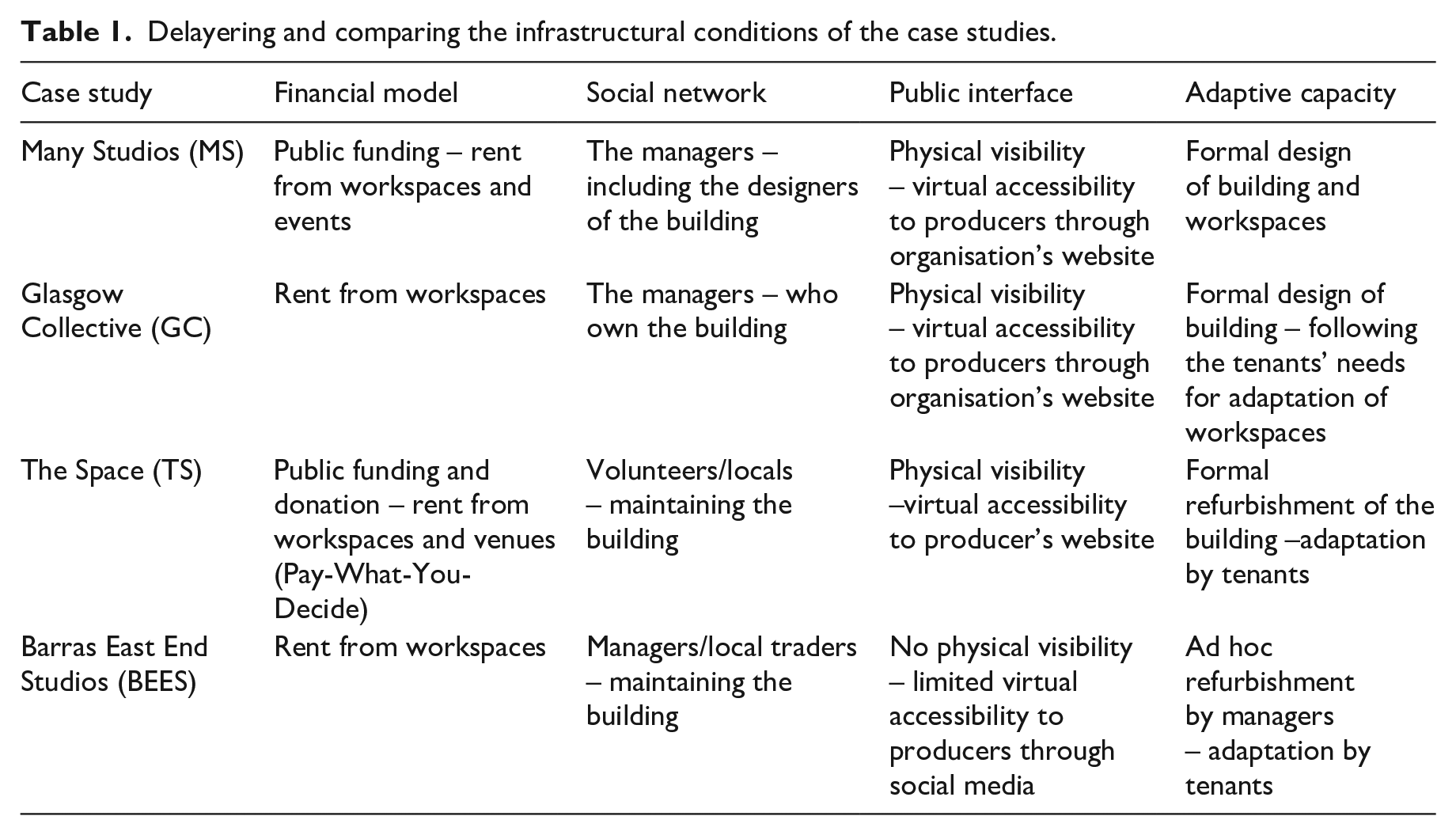
Although the four conditions are interdependent, some have a greater impact on the adaptive capacity of the backstages, shaping the relationships between the tenants and the managers and the sustainability of the resources. For example, MS’s financial structure affects the design and strategy of its public interface through which the organisation offers a more concrete vision as a whole. Its organisational model and communications to the public often place MS more towards the front stage of cultural production in the city – only to retract at times to the backstage to build a more resilient and sustainable model. For example, they have a public exhibition programme (surely a ‘frontstage’) which projects the visibility of the organisation to local authorities and the creative industry. In GC, the social relationships built between the managers and the tenants support and empower the latter. Although the space’s physical visibility does not favour the production that operates within, the tenants use the organisation’s website and social media to reach out to potential clients. Both MS and GC have relatively formalised structures, leaving the producers with less freedom to change the spaces they rent. Social networks are also key infrastructural conditions for both TS and BEES to sustain their operation. Due to their community-oriented vision and lack of external funding, these organisations consult more with the tenants on the management of the space. In BEES, the social network developed among the producers based on knowledge and skill exchange as well as their attachment to the place has instigated a sense of community and belonging, which in return feeds into the desire of individuals to stay in the area.
As the study reveals, there are advantages in all the different degrees of formality and visibility observed in the four cases. For example, MS, which offers a clear financial and social model, acts as a plug-in-and-go infrastructure for established practitioners who mostly deal with virtual, screen-based forms of practice. The organisation has to deal with fewer inquiries by the tenants whose material requirements are relatively known and standard. GC’s flexible approach to negotiate changes in spatial arrangements and rents provides spatial agency and economic support to young and small businesses which have only just started out. Finally, in the least formalised settings such as TS and BEES, rules that determine cultural production are constantly negotiated. If the organisers are less involved in management, case in point the volunteers running the TS, the tenants get directly involved in the making of resources that can be shared by those with similar requirements, for example, an insulated music venue. Further on, thanks to the informal communications between the managers and the tenants in BEES, a level of trust has been built in a community that can respond with more solidarity against top-down planning in the neighbourhood.
The different dynamics among infrastructural conditions ensure diversity in the results, that is the creative ecologies of cultural backstages. This diversity by extension ensures diversity and resilience in the cultural production at the level of the neighbourhood, itself acting as an ecology of a larger scale that allows different spaces and resources to serve different kinds of cultural producers. The findings highlight the dependency and interconnectivity of these ecologies, at both micro and macro levels in creating networks among cultural producers, provision of resources and spatial connections to the neighbourhood and city. The fieldwork study showed that while the conditions within each cultural backstage case differ, the backstages still share common ground: they operate in close proximity to each other and rely heavily on localised yet collective forms of support. When it comes to the relationship between each other, we observed that although MS and GC acknowledged the existence and operation of each other, they did not fully recognise the activities within TS and BEES. Similarly, the tenants of the latter organisations were not fully acquainted with MS and GC. This hints at a certain operational distance between the four backstages, which could be a result of an unspoken distinction between actors who occupy purpose-built ‘creative’ spaces and grassroots initiatives.
Furthermore, the four backstages form a wider ecology at the neighbourhood scale and add, besides the obvious cultural benefits, a social value to their functioning. The diversity of their infrastructural conditions builds into the ecological system of the entire Barras neighbourhood and its ‘incomplete’ nature, that as Sassen (2017) argues, gives the possibility of ‘remaking’ these individuals and organisations. The negative perception constructed around the Barras due to its economic and urban decline has discouraged developers and big investments in the area, despite its very central location in the city. Another factor that contributes to the complex relationships within the ecology of the Barras is land ownership that is ambiguously divided between many individual landlords with often historical marketing connections. However, other circumstances have invited many individuals and small-scale independent businesses to establish their practice in this part of the city. Favourable conditions to reactivate the area are provided by the private ownership of properties in the Barras, the high number of vacant plots of land, empty buildings at an affordable rate and support from the City Council. The Barras thus offers a wider ecology that opens the space for less advantaged producers and less speculative forms of production.
Conclusion
To sum up, this article contributes to the ongoing critical debate about the role of culture in urban planning and regeneration efforts by shifting the focus onto cultural backstages and revealing the complexity and diversity of conditions that are present in them. It offers a welcome contrast to the institutionalised and policy-based accounts of urban innovation in cities.
At a theoretical level, the contribution of the article is twofold. First, it introduces a shift in the understanding of spaces for cultural production in cities from a set of physical spaces to a set of infrastructural conditions that build, support and sustain the creative sector. In combination with insights from urban economics, geography and transport planning, this socio-anthropological framing can help policy-makers and planners to shape design recommendations for more sustainable culture-led regeneration strategies in the UK and abroad.
Second, this article also puts forward the concept of cultural backstages as creative ecologies because they are not only production sites but also consist of a complex set of relationships among the physical spaces, individuals and resources that coalesce in the sites. These relationships are defined by four infrastructural conditions: financial models, social networks, public interfaces and the adaptive capacity of spaces and organisations. Since backstages operate at the intersections of community, culture and economy, the dynamic relationships between their spaces, individuals, practices and infrastructures are constantly negotiated and evolving between the top-down and the bottom-up initiatives.
By approaching cultural backstages as creative ecologies this article highlights the complexity of social, spatial and political processes that shape and support cultural production. Such complexity is not often acknowledged and addressed in planning strategies which favour linear processes and underestimate the diversity of approaches in the provision of culture. Hence, this article calls for more informed planning strategies and policies that acknowledge the social value of cultural backstages and ensure the conditions to safeguard their socio-spatial diversity. It is the hope of this article that future research will help build an extended database of cases of cultural backstages, which will allow us to compare findings from different contexts and cities.
Footnotes
Acknowledgements
This study is part of Theatrum Mundi’s research project: Urban Backstages, which investigates the conditions of cultural production in four European cities: Paris, Marseille, Glasgow, and London. The research was conducted by John Bingham-Hall, Andrea Cetrulo, Cecily Chua, Elahe Karimnia, Fani Kostourou and Justinien Tribillon. A fieldwork report on the initial findings of this article has been published by Theatrum Mundi Edition in 2020. The authors wish to thank the Creative and Cultural Ecologies Research Network particularly Dave O’Brien, Jonathan Gross and Emma Coffield for their constructive feedback on different versions of this article. The authors would also thank those who participated in this study as interviewees and those who contributed to the roundtable discussions.
Declaration of conflicting interests
The author(s) declared no potential conflicts of interest with respect to the research, authorship and/or publication of this article.
Funding
The author(s) disclosed receipt of the following financial support for the research, authorship and/or publication of this article: This study is part of the Urban Backstages research project with support from the Ax:son Johnson Foundation. In Glasgow, Creative Scotland provided exhibition and public programme funding, and Agile City has been a programming partner.
