




Abstract
This article takes the concept of spatial imaginaries to explore how the post-Brexit negotiations shifted meanings of ‘Europe’ for Polish migrants residing in Scotland. A flourishing subfield of ‘Brexit geographies’ has explored the meaning and consequences of Brexit (as an event, process and affect) for wide-ranging communities on the move and in place. Yet, the question of how ‘Europe’, and in particular ‘EUrope’, is being re-imagined and re-constituted by EU migrants residing in uncertain political spaces remains understudied. In this article, we address this lacuna through analysis of biographical narrative interviews and spatial mapping exercises. In doing so, we conduct a multi-scalar analysis of Polish migrants’ discursive and visual representations of EUrope, defined both as a geographical and institutional space. The study is spatially and temporally situated at a particular time and place in the Brexit timeline – the summer of 2019 in rural and urban Scotland. At this time, Brexit negotiations were ongoing, there was widespread uncertainty about the consequences for migrants in the United Kingdom, and, in Scotland particularly, much resistance to leaving the European Union. The article argues that while Brexit might have not affected European identity among Polish migrants in Scotland, it has prompted them to reconsider their place in Europe and to reimagine both the geographical and conceptual parameters of EUrope.
Introduction
Brexit is a hugely significant event in the history of Europe and the European Union (Hobolt, 2016). Its consequences have been particularly acute for EU migrants living in the United Kingdom. Yet while there is a vast scholarship on the impact of Brexit on EU migrant populations, the question of its impact on European identity remains understudied (Benson et al., 2022). This is surprising, given that migration has been cited as a key driver of Brexit (Dennison and Geddes, 2018), with EU migrants at the forefront of debates on European identity (Favell, 2008) and EU policy as a whole (Geddes et al., 2020). The Brexit referendum, and its aftermath, therefore offers a unique opportunity to analyse how meanings and identifications with Europe are potentially transforming.
To address this research gap, this article focuses on Polish migrants in Scotland. A focus on Scotland is unique and timely due to the Scottish Government’s strong resistance to Brexit, alongside the promotion of civic nationalism (Paul, 2020) and a deliberate two-pronged strategy to establish a political distinction between Scotland and England and fulfil the objective of becoming an independent nation-state in the European Union (Jackson, 2014; Leith and Steven, 2010). EU migrants residing in Scotland are entangled with these political processes as rights to mobility and citizenship are altered and livelihoods are affected (McGhee and Pietka-Nykaza, 2016). Brexit therefore has the potential to generate political struggles that reshape understandings and attachments to Europe. We explore how this is unfolding by analysing the meanings of ‘EUrope’ (Antonsich, 2008) as a geographical and political institution (e.g. border regimes, rights), as well as cultural identifications with it (e.g. European identity, sense of belonging). Through triangulation of narrative interviews and spatial mapping exercises produced with Polish migrants, the article responds to the call for more bottom-up perspectives on ‘spatialities of Europeanization’ to produce ‘discursive scalar practices through which Europe “becomes”’ (Moisio et al., 2013: 744). It further contributes to scholarship on ‘Brexit Geographies’, particularly concerning regional integration and identity formations (Boyle et al., 2018). Moreover, the specific timeframe of the study, incorporating the period when Brexit was not yet formally concluded, allows us to gain valuable insights into how meanings of and attachments to EUrope might be anticipatory of socio-political transformation and shaped by protracted uncertainty.
The article begins by presenting a brief overview of existing scholarship on the consequences of Brexit for EU migrants in Scotland. We then explain the rationale and significance of spatial imaginaries and discuss how European identity has been conceptualised in multi-disciplinary academic debates. Next, we present the methodological framework. Finally, we analyse the spatial imaginaries of Europe and the meaning of European identity among Polish migrants in a threefold vignette format. We conclude the article by highlighting its main findings and suggest areas for further research.
Brexit, Scotland and EU migrants
The United Kingdom’s vote to leave the European Union, known hereafter as ‘Brexit’, was an unprecedented event with far-reaching and uncertain consequences for the United Kingdom and the European Union (Bailey and Budd, 2019; McEwen, 2018). In Scotland, where a majority of the electorate (62%) voted to remain in the European Union, the referendum deepened political divisions between Scotland and England (Paddison and Rae, 2017). Brexit, arguably, amplified the feeling of Scottish distinctiveness (Gawlewicz, 2020) and reignited calls for a second Scottish independence referendum (Thompson, 2019). The results also gave a new impetus to the debate on whether Scotland could re-join the European Union in some capacity or even as an independent nation-state (McEwen, 2018; Scottish Government, 2016). However, while the attitudes of Scottish voters in favour of the European Union have been steadily on the rise in recent decades (Henderson et al., 2016; Paddison and Rae, 2017), the perspectives of EU migrants in this respect remain understudied (Benson et al., 2022).
At the time of the Brexit vote (2016), there were approximately 209,000 EU migrants living in Scotland, amounting to 3.9 per cent of the overall Scottish population (Scottish Government, 2017), with Poles being the largest EU minority group (National Records of Scotland, 2021). Polish migration to Scotland is not new, but it has increased significantly following the 2004 EU enlargement (Burrell, 2009, 2018). Since then, Poles have been the focus of many academic studies (e.g. Moskal, 2016; Pietka-Nykaza and McGhee, 2014; Shubin and Dickey, 2013; Trevena, 2009), with the Brexit referendum generating a renewed interest in the conditions for EU migrants in Scotland. Botterill and Hancock (2018) observe that Brexit caused Polish migrants to ‘rescale their belonging’ and question their national identities and affiliations, while Knight (2017) suggests that the referendum resulted in feelings of anxiety and fear among EU migrants. Gawlewicz (2020) argues that Brexit has reinforced the narrative of Scottish distinctiveness, characterised by a pro-migration and pro-EU stance (see also Davidson et al., 2018). Brexit also heralds a critical change to existing citizenship regimes requiring UK-resident EU migrants to apply for the EU Settlement Scheme by June 2021 to remain legally in the United Kingdom and retain their resident status (Botterill et al., 2020: 370). Crucially, the process also highlighted the unpreparedness and inability of the European Union to protect the rights of EU citizens when a member state leaves the union, underscoring some of the problems with territorialised citizenship (Balibar, 2009).
It is clear that Brexit has significantly affected the livelihoods of EU migrants in Scotland in ways that are complex and still unfolding. Prompted by new challenges and the waning of rights to mobility and settlement in the United Kingdom, it has produced various shifts in the loyalties, attachments and perceptions of Scotland and the United Kingdom. Exactly how their attitudes towards Europe, as well as their loyalties and attachments towards the European Union have changed, and what this might mean for European integration/disintegration, remains understudied, however.
Spatial imaginaries of Europe and European identity
Spatial imaginaries are ‘deeply held, collective understandings of socio-spatial relations that are performed by, give sense to, make possible and change collective socio-spatial practices’ (Davoudi et al., 2018: 101). They are ‘produced through political struggles over the conceptions, perceptions and lived experiences of place’ (Davoudi et al., 2018) and in doing so are capable of transmitting anxieties and uncertainties about the future (Gregory, 1995). Howie and Lewis (2014: 132) argue that understanding spatial imaginaries is ‘an attempt to capture not only that there are multiple geographical imaginations at large in the world, but that they do work in framing understandings of the world and in turn making our different worlds’. Consequently, unravelling spatial imaginaries of ordinary citizens allows for a unique perspective on how people perceive and adapt to socio-political transformations (see Bürkner and Scott, 2019; Jessop, 2013).
Applying these definitions to Brexit, it becomes apparent that Britain’s vote to leave the European Union and the reinstatement of a border between the United Kingdom and the European Union heralds a transformation not only in terms of European geography and political structures but also in the cultural meanings of Europe and potentially of a European identity. During the negotiations of Brexit too, re-bordering practices have challenged spatial imaginaries of those living in the ‘borderlands’ and as non-citizens in limbo. For example, Walsh (2019: 138) argues that at the border between Northern Ireland and the Republic of Ireland/the European Union, Brexit has challenged the existing spatial imaginaries of border communities for whom ‘the border itself continues to hold emotional and symbolic significance’. For Polish migrants, Brexit has unsettled a sense of belonging to Scotland and ‘challenged normative notions of nationalism and citizenship’ (Botterill and Hancock, 2018: 1). More broadly, Sykes (2018: 137) observes that Brexit has caused ‘the eruption back into mainstream political and media discourse of spatial language and representations’. This is apparent in popular commentaries that mobilise Brexit as a spatial transformation imaginary characterised, for instance, by a shift away from neoliberal globalisation. Critically however, such accounts tend to simplify and polarise the debate (Rogaly, 2019). Drawing on Anderson and Wilson’s (2018) notion of ‘everyday Brexits’, we argue for a more grounded and nuanced analysis of the lived experience of Brexit. Connected to this is the rationale that spatial imaginaries are more than simply discourse or modes of representation but rather they are embodied, material practices that are performed and enacted (Watkins, 2015). As such, spatial imaginaries are a useful heuristic device to understand how people – in this case, EU migrants – make (political) claims to space, what effect this has on identity and belonging and how this is practised in everyday life.
European identity has been studied comprehensively over the years (e.g. Checkel and Katzenstein, 2009; Risse, 2010) and it can be generally defined as ‘a shared feeling of community [and belonging] among European citizens’ (Verhaegen et al., 2017: 163). However, its strength and how it is understood among those residing in Europe and in the European Union remains a contested matter. Some argue that despite the continued economic and political integration of EU member states, European identity among EU citizens is not as prominent as many would have hoped for (White, 2012). Others propose that European identity is felt and manifested alongside traditional national identities. It varies across different countries (Pichler, 2008) and is determined by factors such as history and geopolitics (Case, 2009), national economics (Garry and Tilley, 2009) and demographics (Lutz et al., 2006). The myriad processes underpinning the production of, identification with and rejection of European identity must therefore be considered in relation to cultural (Scalise, 2015), ethnic (Cinnirella and Hamilton, 2007), racial (De Genova, 2016) and religious (Byrnes and Katzenstein, 2006) factors. Moreover, political events and institutional structures play a role in fostering European identity (Risse, 2010: 3), with some evidence suggesting that Brexit itself has strengthened identification with Europe in the remaining 27 member states of the European Union (Leith et al., 2019). However, this should not be overstated. Rather, European identity is a complex, multi-scalar concept that is contingent on who defines it, and when and where it is defined.
Fligstein et al. (2012: 106) argue that a strong sense of belonging to Europe is particularly visible among those who ‘participate in Europe’ as opposed to those ‘whose economic and social horizons are essentially local’. Indeed, survey data indicate that compared to less mobile populations, EU migrants have much higher levels of support for the European Union and are more likely to identify with being European (Roeder, 2011). According to the Eurobarometer survey, in 2019, Poles ranked among ‘the most Europhile’ of the EU migrant populations (European Parliament, 2019). Yet, as White (2012: 109) points out, ‘while there are certainly those willing to declare that they “feel European”, how far this translates into meaningful practices of identification away from the polling context is unclear’. What is also unclear is the effect of Brexit, and its aftermath, on the shared feeling of community and belonging among EU migrant populations at large, and in Scotland in particular.
Method
Our analysis is based on research conducted as part of the project ‘Re-making the European: Spatial identities and spatial practices of Polish nationals in Scotland after the UK Referendum on EU membership’, funded by the Carnegie Trust for the Universities of Scotland. Data collection took place at a specific time during the Brexit process, the summer of 2019, when following failed attempts of the UK government to pass the Brexit deal, a new general election was looming and Brexit itself appeared still up for a debate.
Two members of the project team – Dr Kate Botterill and Mariusz Bogacki – conducted a series of semi-structured narrative interviews and spatial mapping exercises with 21 Polish nationals (11 females and 10 males) living in urban (Edinburgh) and rural (Moray county) Scotland. Participants were between 18 and 61 years old with a length of residency in Scotland varying between 4 and 15 years. Their professional and education statuses were diverse, spanning from students and professionals to unemployed. The sampling followed a snowball sampling method (Bryman, 2012: 202): in Edinburgh, building on author’s existing networks of acquaintances, whereas in Moray county, relying on advertising on Polish groups of interests on Facebook. The field-sites were chosen to reflect the diversity of Scotland in terms of its geography, populations and the voting preferences of the referendum. While all local authority areas voted to remain in the European Union, Moray county had the smallest margin with only 0.2 per cent difference between Leave and Remain (Palmer, 2016). The inclusion of a rural case study responds to calls for more focus on the rural areas of the United Kingdom experiencing increased migration following the EU expansion of 2004 (de Lima, 2012; Moore, 2019).
The interviews followed a biographical narrative structure (Maynes et al., 2008) with the aim to ‘elicit interviewees’ reconstructed accounts of connections between events and contexts’ (Bryman, 2012: 584). Participants were encouraged to talk about the connections between life events, migration history and their sense of belonging to particular places. During the interviews, we deliberately asked open questions about the meaning of Europe and European identity, leaving it to participants to differentiate and delineate the Europe-EU dichotomy. Our aim was to unravel the meaning of European identity, rather than assessing its extent or strength. The interviews were supported by a spatial mapping exercise, to ‘both harness the value of individual knowledge about geographic space, and to concurrently empower the research participants by inviting them to take an active stake in the representation and explication of their spatial environment’ (Literat, 2013: 199). The participants were asked to draw a map of everyday community connections without any geographical limitations. They were encouraged to think about the maps creatively, allowing for multitude of artistic forms (Grasseni, 2012: 99), and apart from indicating places of particular importance, draw connections and express emotions attached to these places.
To analyse the data, we drew on Potter and Wetherell’s (1987: 138) concept of interpretative repertoires as ‘a lexicon or register of terms drawn upon to characterize and evaluate actions and events’. This method enabled us to explore how individuals invoke interpretative repertoires in relation to different spatial imaginations or geopolitical themes. The analytical process was carried out in two steps. First, halfway through the 2-hour-long interviews, we asked participants to describe the maps and add feelings and emotions to particular localities if they have not done so prior to the interview. The remaining part of the interview concentrated on joint analyses of the maps in relation to what has been discussed during the first part of the interview. Second, transcripts of the interviews and maps were analysed using NVivo software to inductively identify reoccurring themes and repertoires related to opinions, definitions and meanings ascribed to Europe and European identity. This process led us to the selection of three vignettes that, while not representative or generalisable, summarise key positions from the sample of 21 study participants.
What about Europe? Three vignettes
Hanna
Hanna is 18 years old and came to Scotland with her parents at the age of 6 years. Figure 1 outlines Hanna’s map of community connections. At the time of interview, she had completed a first year of an undergraduate degree in Glasgow but she continues to spend her weekends and holidays in Edinburgh with her family. Despite having spent most of her life in Scotland, Hanna is very proud of her Polish identity and does not see the need to apply for British citizenship unless she would find it necessary to remain in the United Kingdom. While her national identity is firmly set on being ‘a Pole living in Scotland’, her spatial map reveals a very international and European outlook. Freely switching between English and Polish, the list of connections and places of importance to Hanna resembles a map of Europe. The map of Hanna’s ‘local’ connections is an example of ‘idealized space imaginaries’ relating to a description of places based on stories about their universal characteristics (Watkins, 2015: 512): Warsaw evokes feelings of ‘being lost’, Edinburgh ‘safety’ and ‘peace’, while Alicante brings ‘happiness’. For Hanna, these stories are personal and grounded in her lived experiences and relationships with friends and family in different European cities. Watkins (2015: 515) argues that spatial imaginaries should be considered as ‘performative discourses’ that ‘prefigure material action through providing justifying narratives’. This is evident in Hanna’s plans of moving to Spain – which features prominently in her map – as she ‘adore[s] their [Spanish] language and culture’. Taking mobility for granted, along with the cultural idealisation of Spain, should be understood in the context of the affordances of the European Union – a borderless political and geographical realm that allows its citizens to move and work freely within its territory.
(. . .) I want to ask how Brexit influenced, and whether it influenced, your map?
I think, well, I’m choosing the next place to live, if something bad was to happen, well. I think, I didn’t think of another place, about going to live somewhere else, until I realised, I might not be able to live in Scotland for as long as I thought I would live there. If that makes sense.
So Brexit has prompted you to . . .
Yes, it has prompted me, like, the wish to . . . ‘Oh, and maybe, I don’t need to live only in Scotland, I can also live somewhere else, learn a language, live there’. It prompted me to think that way.
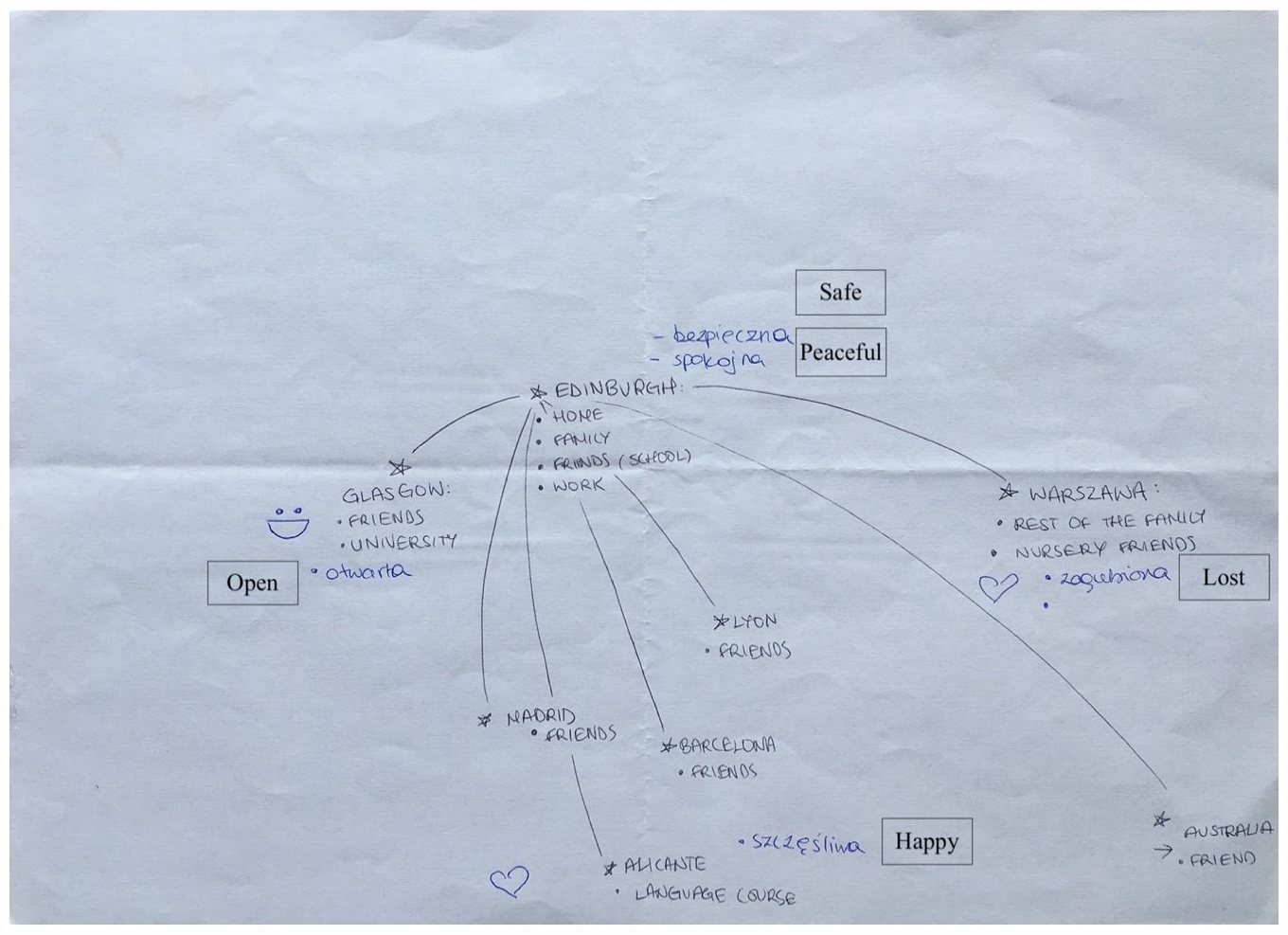
Hanna’s map of community connections.
While Brexit might be seen as a culmination of UK Euroscepticism (Van Der Zwet et al., 2020), the referendum has arguably brought Hanna closer to (continental) Europe. It has prompted her to broaden her geographical imagination and consider a future outside of the United Kingdom. Her map features various European cities as potential future destinations for onward migration (see Sredanovic, 2020), which she rationalises through the potential lack of opportunity to stay in the United Kingdom. Hanna’s attachment to Scotland and the United Kingdom is therefore shifting in favour of other European spaces of opportunities. Her account confirms earlier studies on how Brexit unsettled EU migrants’ sense of attachment to Scotland (Botterill and Hancock, 2018). As such, Brexit has not only been a process of unmaking Europe but also prompted practices that affirm and make use of the European Union, for example, as an institution that provides transnational citizenship rights.
Brought up between two European countries; multilingual; well travelled; and engaged in local, national and European politics, Hanna appears to actively ‘participate’ in ‘free’ EUropean mobility with linguistic and cultural privileges that reflect the ideals of European integration. Yet, this participation does not translate into identification with a ‘European’ identity, or attachment to the European Union, highlighting the disconnection between practices and identity (see Fligstein et al., 2012).
Okay. And how about ‘European’? Because, you see, coming back to your map, you said that you speak French, you want to learn Spanish . . .
No, I wouldn’t refer to myself as a European. No, I don’t know, I mean, well, maybe it’s suggesting that, European, but I don’t know, I have never had the need to say I’m a European. Just, for me always, now, at this point, saying that I’m from Poland is just great. A Polish person living in Scotland is just the first thing I say if someone says: ‘Oh, so tell me something about yourself’. I do not know, hah, it has never been a ‘European’.
Hanna’s position confirms that those who might be considered as the archetypal new Europeans – speaking multiple languages, moving freely between countries for professional and leisure reasons – do not automatically identify with Europe (Favell, 2008, 2010). For Hanna, Europe represents a space of possibilities for personal development but the sense of belonging within the continent is still being achieved through the prism of a nation-state and patriotic sentiments. Hanna’s young age means she has no direct experience with the transformative events of 1989 (dismantling of the Soviet Union) or 2004 (EU enlargement). She is one generation removed from the ‘transformation’ of ‘Eastern Europeans’ into ‘Europeans’ following the EU enlargement in 2004 (Sztompka, 2004) and the critical debates surrounding this problematic categorisation (Kuus, 2004). Moreover, her formative teenage years corresponded with a period of heightened populism and Euroscepticism in Poland (Csehi and Zgut, 2021), which might explain her more positive outlook on the incumbent Polish government, which she says ‘is much better and looks after the citizens and the country’. However, surprisingly, it was her privileged university experience that allowed her to take full ownership and pride in her national identity (‘It’s because of the uni. For me, now, saying that I am from Poland, and being, like, certain of my roots, and nationality, is (. . .) cool, different, like, unusual (. . .) it is something that is mine’). This demonstrates that patriotism crosses borders, and some international educational experiences may reinforce national identities, rather than strengthen European (regional) identity (Sigalas, 2010). It remains to be seen how Hanna’s ‘cosmopolitan nationalism’ (Nielsen, 1999) will develop in her future encounters with Europe.
Marcin
Marcin is 32 years old and has lived in rural northern Scotland for over 9 years. He has a wife and three daughters who are attending a local primary school. He has a mortgage on a house and works in public transport. The detailed map drawn by Marcin – entirely in Polish – is representative of the dichotomies underlying his identity and lifestyle: split geographically and emotionally between ‘Polish heart and mind’ and ‘more distant’ Scotland (Figure 2). Marcin’s life clearly revolves around his family and children as he believes ‘it will be easier for them’ in Scotland. Eventhough he admits that Brexit did not cause him any major concerns, he is not immune to imagining the potential consequences the referendum might have on his family and their livelihood in Scotland.
I expected that they would not vote for Brexit however, and the results were very close. I was a little surprised, but not somehow, I didn’t get worried about it at all.
Didn’t it move you at all? Were you not afraid?
No, no, you know, I look at myself, right? Will they abolish the Schengen zone or something else, it will be harder on the border, or inviting your parents here, for example, for a while, or will they not have a problem with it? (. . .) You know, if there is a bad deal and then the prices may increase a lot, right? (. . .) Maybe the attitude of the society here can also have some impact, right? I don’t know. Generally, people seem friendly, right? I don’t know. I don’t know if I should be afraid of being somehow deported, right? Some people think that something like this may happen. I’m not afraid of this, for example, right? I even could, maybe I would even be glad if they deported me, somehow, I’m laughing so haha. Why? I don’t know, because I miss Poland, right?
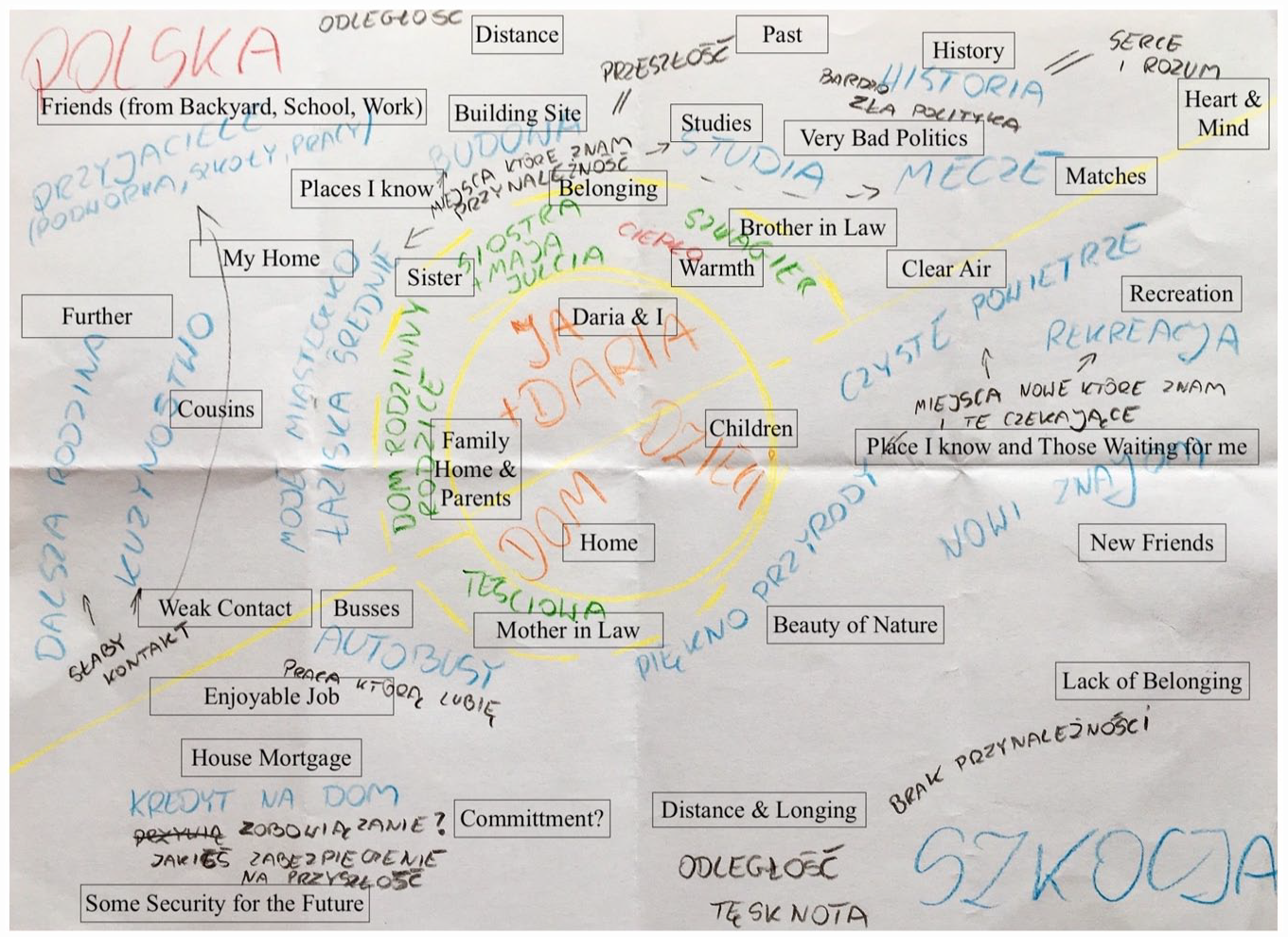
Marcin’s map of community connections.
Marcin’s considerations regarding Schengen Zone, border regimes, economic stability and societal attitudes towards migrants reveal the importance of ‘imaginaries of an aftermath of Brexit’ (Sykes, 2018: 11). The straight borderline between Poland and Scotland sketched on his map, and cutting across his family, metaphorically exemplifies the importance of borders and the dichotomy of the UK–EU relationship. His claims of Brexit not affecting his life appear contrary to the fears of the long-term aftermath of the referendum as any changes to the existing agreements between the United Kingdom and the European Union will have a direct effect on his family. This uncertainty is of particular significance in Scotland, a sub-state nation where discussions about independence and re-joining the European Union are ongoing (Thompson, 2019). Marcin also confirms that homesickness is among the main reasons for potential return migration (Dustmann, 1997), or re-migration of the Polish labour force living in the United Kingdom (Filimonau and Mika, 2017). Brexit might have compounded this phenomenon as the vote and its consequences serve as an impetus, or even an excuse, to ‘come back to Poland’.
Marcin negotiates between places that ‘he knows’ in Poland and ‘those that are waiting’ for him to discover in Scotland. His spatial imaginaries, as illustrated by his map, are representative of his emotions and perceptions of the everyday lived experience (see Gregory, 1995), which is characterised by ‘longing’ for Poland and ‘commitment’ to his life in rural Scotland. Despite living in Scotland since 2010, Marcin continues to struggle with a ‘lack of belonging’ and grapples with his national identity as a ‘non-practicing [Polish] patriot’. Such inner conflicts echo previous studies of EU migrants living in rural areas of Scotland (e.g. de Lima and Wright, 2009).
And tell me how would you describe your national identity?
My national identity? (. . .) I felt for example, you know, because it was also explained like that by everything, wasn’t it? That ‘We are Europeans’. After all, we have always been Europeans, haven’t we? We have never been Asians or Africans. We have always been Europeans. But it was explained that by entering the Union ‘Now we will be in Europe, we are Europeans’, right? Well, and . . . yes, I’m a European after all, right? After all, that’s no problem that I will live in Scotland or somewhere, is it? I am Polish, I am European and that’s normal. (. . .) How do I feel now? Where do I belong now? Well, I feel I am a Pole living in Scotland. (. . .) Do I feel less European? No, I still feel I’m just European because Poland is in Europe, isn’t it? On the map it’s in Europe, it has always been in Europe, hasn’t it? Then it’s normal, I’m a European, right? I am an earthling too, haha.
Marcin normalises the idea of European and national identities proving that ‘identity construction often begets a process of “othering” rather than “nesting”’ (Checkel and Katzenstein, 2009: 8). This is visible on two axes: geographical and conceptual. Marcin is a European because he is not an African or Asian and because of his residency in two countries geographically located in Europe. Indeed, Marcin places high importance on geographical locations, history and culture in his understanding of national identity. His position confirms that people ‘make sense of EUrope [sic]’ through ‘the prism of the nation-state [by reproducing] the isomorphisms between territory and identity which has characterised, at least in theory, the nation-state itself’ (Antonsich, 2008: 691). While his map does not feature Europe or the European Union explicitly, his remarks on Poland always existing ‘on the map’ of Europe highlight the importance of geographical representations for how we perceive and understand the world. Marcin also directly alludes to the debate on EU8 enlargement in 2004 and its underpinning ‘orientalists discourse’ that assumed the essentialist ‘dichotomy of Europe versus Eastern Europe’ (Kuus, 2004: 472). He echoes the proponents of the enlargement who proclaimed the ‘return to Europe’ of the eastern countries (Moisio, 2007: 82). As the United Kingdom departs from the European Union, the metaphorical tables have turned – if Poland returned to Europe in 2004, the United Kingdom left it in 2019. It appears that Europe continues to be ‘an essentially contested concept’ with Brexit heralding another conceptual framework through which this concept is being redefined (Moisio, 2007: 82).
Mia
Mia is 28 years old and moved to Scotland with her husband after finishing her high school at the age of 19 years. They have been living in Edinburgh ever since. She had completed her undergraduate and postgraduate studies there and is currently working in human resources. Places of significance in Mia’s life are characterised by geographical scales extending from local places in Edinburgh to locations far beyond Europe (Figure 3). According to Flint (2016: 74), ‘place is just one scale in a hierarchy that stretches from the individual to the global’. The hierarchy of Mia’s locations is driven by its imagined properties (e.g. ‘feeling safe’ in Leith, ‘sentiment’ towards Switzerland, ‘happiness’ in South Africa and Singapore) and life experiences (e.g. ‘growing up’ as an adult in Edinburgh, ‘childhood’ in her hometown and the city of Lodz). Geographical scales are therefore instrumental in Mia’s life trajectory and how she perceives the world around her.
Do you think that the vote for Brexit has affected you in any way?
I think it’s definitely surprised me . . . haha . . . (. . .) I wasn’t disappointed in any way. I was just thinking if that’s the will of the people, if that’s what people want – fair enough. (. . .) I was first thinking if we would be made to leave . . . How difficult it will be for us to stay. Would I need a British passport, would this mean more paper work for us . . .? (. . .) We talked about what would be an alternative . . . Would we fight for staying here . . .? You know, if staying here would be very difficult from the point of paper work and just hassle, and just go somewhere else. I think we talked about going maybe to France or moving to Canada, or moving just somewhere else, that would be easier. So, yeah, we thought we would just stay and see what was happening . . . (. . .) I wouldn’t say it’s the worst that happened . . . It’s just I think, just accepting this and planning more . . .
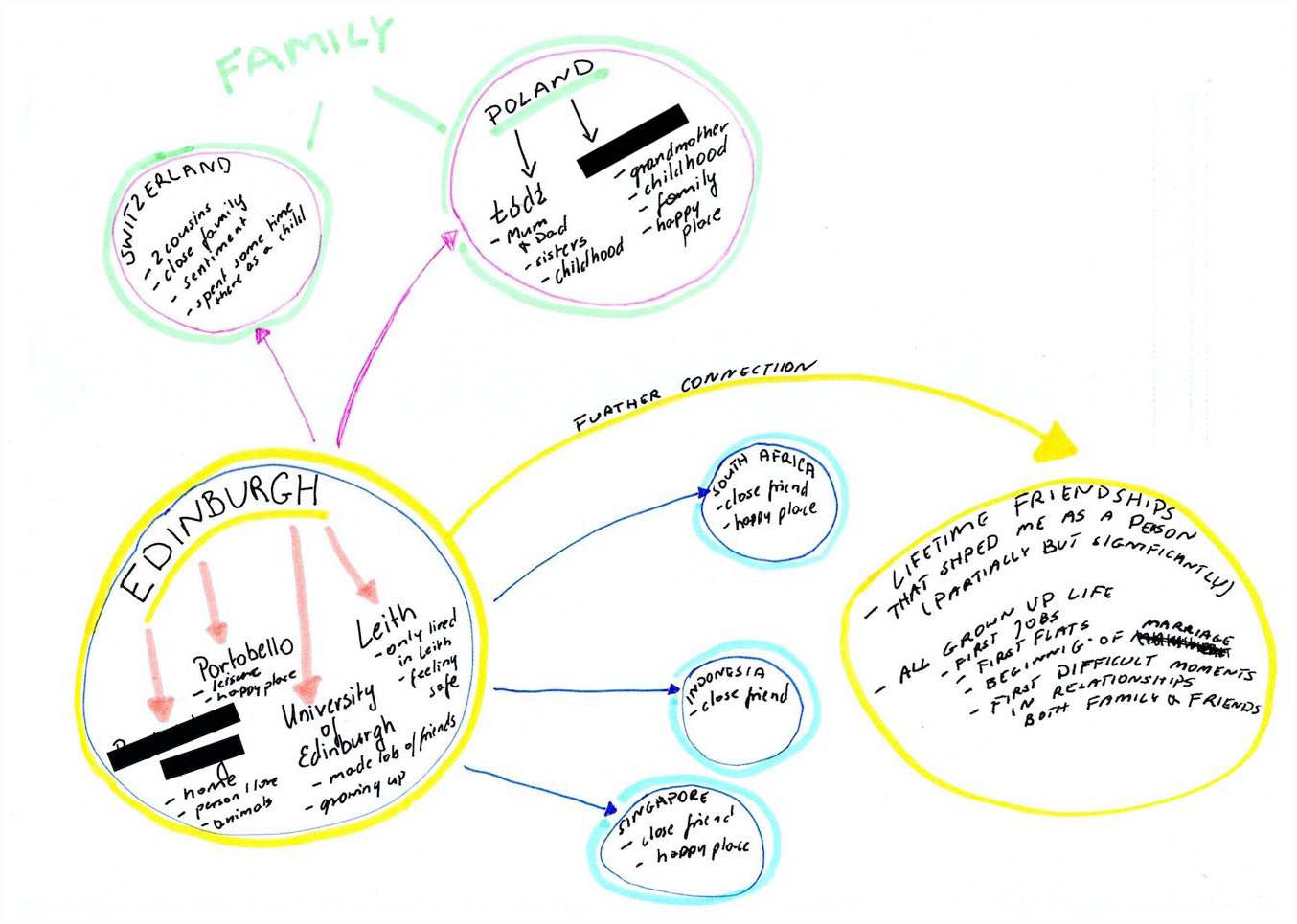
Mia’s map of community connections.
Geographical scales can also be representative of limitations as ‘political opportunity structure of scale interacts with structures and practices embedded in the nation-state. The geography of citizenship then, is organized around both scale and territory’ (Staeheli, 1999: 60). Indeed, one of the consequences of Brexit is a newly established citizenship regime in which EU migrants status in the United Kingdom is being formally transformed from EU citizens to settled or pre-settled citizens (Botterill et al., 2020). Mia is aware of this as she grapples with the potential bureaucratic burden of obtaining a British passport and consideration of further migration. The consequences of Brexit for EU migrants in the United Kingdom are therefore multi-level and reflect the importance of geographical scales. Mia’s spatial map should therefore be read as a map of potential future migration trajectories and a visualisation of how she copes with and adapts to socio-political transformations. After accepting the results of the referendum, Mia’s ‘everyday Brexits’ (Anderson and Wilson, 2018) are characterised by anticipation and contingency planning. An EU passport allows her to consider destinations within the European Union as well as outside of the continent – a right which might be taken away from the UK passport holders (Countouris and Ewing, 2021) and potentially reinforce identification with EUrope. Mia’s account confirms that Brexit caused Polish migrants to ‘rescale their belonging’ (Botterill and Hancock, 2018) not only in Scotland but also in Europe.
How would you describe your national identity?
Well, I was thinking about it before . . . And I don’t have one (. . .). Because I don’t feel Polish anymore. And I don’t feel Scottish, or British, necessarily. Yeah, I don’t feel like anything other than maybe European . . .
When did that change? When did you stop feeling Polish?
Probably a couple of years ago. I feel like when I’m going back there, every year, I’m so different now. It’s just a different mentality. It’s just . . . I’m not anymore on this one road . . . Viewpoint . . . And I’m, yeah . . . I’m more open minded and yeah. Probably mentally I’m more British than Polish now. But I don’t think I’m fully British either. Yeah, I wouldn’t say I’m anything, really . . .
Mia’s apparent identity struggle might be a result of her experience of living in two European countries, extensive travels and the priority given to personal connections. She is ‘not attached to places’ but ‘more attached to people’ and her spatial imagination of the world is a map of personal connections. Her lack of strong national identity could therefore be explained by transcendence of geographical barriers characterised by the friendships spread across the world and the possibility of following her friends in those locations. Interestingly, eventhough Mia has never lived in other parts of the United Kingdom, she contemplates national identification with Britain rather than Scotland. This is particularly striking at the time of heightened nationalism in Scotland where Scottish civic nationalism is actively championed and promoted by the Scottish ruling party (Paul, 2020). Yet, Mia’s reluctant identification as a European appears uncertain, feeble and a last resort.
You said European before? What does that mean? What does it mean to be European?
Yeah, I would only say European because I belong from, like I was born in Europe. And you know, Europe is close to me. I know Europe quite well. Geographically and people, I know loads of people from Europe, you know, customs in Europe. I know two languages used in Europe. I could recognise more languages. (. . .) I could, even if I will have a conversation with someone from a random country from Europe I would know where it is. I could kind of say ‘Oh, yes, that’s not far from ours . . .’ You know . . .
Mia’s account shows that ‘shared feeling of community [and belonging] among European citizens’ (Verhaegen et al., 2017: 163) can arise from senses of linguistic and geographical diversity, chiming with the official motto of the European Union: ‘United in diversity’ (European Union, 2023). Unlike the EU motto, however, the reference to different customs and languages in Europe still reproduces exclusionary essentialisations and the privileges that underpin a rather touristic understanding of difference. Such privileges are confirmed in Mia’s definition of Europeans as ‘free moving people that live anywhere, make home anywhere – wherever they are comfortable. (. . .) And that’s I think how I describe myself – free, free soul, haha . . .’ For Mia, European identity is defined by a lack of national borders and ‘freedom’ allowed to its citizens. Yet, while Europe is imagined as a territory and a lifestyle rather than a political entity, it is the European Union that enables such imaginations and possibilities. As Brexit may compromise some of them, she adopts a broader, global perspective, which is evident in her considerations of moving to Canada.
Conclusion
Drastic political events are often a ‘showtime’ for European integration and European identity (Risse, 2010: 3). Brexit undoubtedly serves as such event with its consequences continuing to be ‘dynamic and prone to change’ (Gawlewicz and Sotkasiira, 2019: 1). This article looked at the understudied effects of Brexit on European identity and the spatial imaginaries of Polish migrants in Scotland. Combining the notions of geography and identity allowed us to gain new perspectives on whether and how the meanings of EUrope (Antonsich, 2008) are transforming amid uncertain and protracted Brexit negotiations of 2019. In doing so, we went beyond survey studies and statistical analysis to investigate how the ‘everyday Brexits’ (Anderson and Wilson, 2018) unfolded among ordinary people, thus seeking to bridge divides between ‘culturalist’ (discourse and representation) and ‘structuralist’ (practices and relations) approaches (Moisio et al., 2013; Recchi, 2014).
Despite evidence suggesting that Brexit has strengthened European identity among citizens of the remaining 27 members of the European Union (Leith et al., 2019), our analyses reveal that European identity among Polish migrants in Scotland has not been significantly affected. This could be explained by the fact that unlike British citizens, Polish passport holders remain EUropean. European identity appears feeble, taken for granted and a last resort, with the consequences of Brexit more visible in conceptualisation and imagination of Europe. This is evident in various life course reconsiderations characterised by anticipation and contingency planning among the participants. Their place attachments and sense of integration in Europe were closely connected to national, historical, cultural and personal-biographical factors. It is interesting to note that identification with Scotland did not play much of a role in this process, putting into question the continued efforts of the Scottish government to nurture forms of Scottish or European identity among its residents (Douglas-Scott, 2016; Paul, 2020). There are clear political and socio-economic factors involved in developing a cohesive European identity among EU migrants living on the edge of the Union, not least the rise of Euroscepticism, not only in the United Kingdom but also in Poland, Hungary and, most recently, Italy (Di Mauro et al., 2022). Yet, there are also cultural and emotional factors that shape identification with Europe as a territorial region, an institutional structure and more fluid notions of Europe as an unbounded and cosmopolitan space (Martinelli, 2017).
Our analyses confirm that European identity does not necessarily translate to identification with the European Union as an institutional actor or protector of rights (see Castiglione, 2009; Cmeciu and Manolache, 2018; Pryke, 2020). The importance of the European Union featured indirectly in the narratives and concentrated on freedom of mobility and the importance of relating to familiar others in a borderless Europe (e.g. having friends and family in other countries), as well as to personal-biographical aspects. EUrope is (re)defined through and in relation to national, historical, geographical and cultural identifications; instrumental uses of citizenship; scaled senses of plural belonging; personal-biographical aspects; and processes of othering that are tied to territorialised understandings and affirmations of identity and difference. Yet, such conceptualisations are inseparable from the European Union as they rely on the rights and possibilities offered by the institution. Consequently, eventhough the European Union does not feature in conceptualisations of Europe explicitly, the institution underpins how Europe is practised and imagined by EU migrants. Their loyalties and attachments to Europe are therefore arguably inseparable from the European Union. It remains to be studied whether the same can be said about other migrant groups (now also including UK citizens), and if and how Brexit will continue to affect the shared feeling of community and belonging among Europeans.
Our analyses confirm that spatial imaginaries should be considered as representative discourses and performative acts that are suggestive of embodied, material practices (Watkins, 2015). In the context of Brexit, they potentially serve as a regenerative practice invoked to deal with acute socio-political transformations. This was most evident in participants’ deliberations on border regimes and mobility plans, featuring alternative destinations outside of the usual East-West routes associated with the intra-EU migration. Indeed, Brexit prompted Polish migrants to reconsider both pragmatic and symbolic attachments to Europe with potential new patterns of intra-European Union, as well as global, mobility. Consequently, the referendum might herald the beginning of a new migration phenomenon and migrant category: a Brexit émigré. Judging by the number of EU migrants in the United Kingdom (Auer and Tetlow, 2020), and in light of the likely decline in ‘Europeanised’ migration policy in the United Kingdom (Dennison and Geddes, 2018), this is potentially a significant migratory development requiring further academic attention.
Footnotes
Acknowledgements
The authors would like to thank all the participants for their time invested in this study and for sharing their personal stories and contemplations. We also appreciate the help offered by those who helped us to reach out and connect to the participants in different parts of Edinburgh and northern Scotland. Finally, we are grateful to the two anonymous reviewers and to the editors of the European Urban and Regional Studies journal for their comments on earlier drafts of the article.
Declaration of conflicting interests
The author(s) declared no potential conflicts of interest with respect to the research, authorship and/or publication of this article.
Funding
The author(s) disclosed receipt of the following financial support for the research, authorship and/or publication of this article: This research was supported by the Carnegie Trust for Scotland, an independent foundation, providing grants to undergraduates, postgraduates and academic researchers in Scotland (grant number: RIG007461).
