




Abstract
The European Union (EU) has long projected the vision of an integrating Europe, centred on successful regional integration, as a better geopolitical model in comparison to ‘others’, such as the Cold War superpowers, US neoconservativism or diverse autocratic regimes. The purported superiority of the ‘European model’ is thereby linked to credibly advancing the story of successful regional integration – internally as well as externally. This article suggests a narrative continuum between EU-optimism and EU-scepticism and argues that perceptions about the ‘success’ of the EU as a model for regional integration have changed between the first and the second decade of the new millennium. As part of this shift, EU-scepticism has gained in prominence over EU-optimism. This is related to a series of geopolitical ruptures since the late 2000s, in particular, the financial crisis, disputes on human mobility and border management, rising nationalism, Brexit and other right-wing populist movements across the continent. Focussing on the divisions within the EU as regards financial and migration policy, this article highlights three interrelated simultaneities. It argues (a) that process and discourse of (b) integration and disintegration have (c) internal and external dimensions. Empirically, it builds on interviews with African and European geopolitical elites that have been conducted as part of two research projects on external perceptions of the EU in East Africa between 2010 and 2018. It thus offers a snapshot on the shift of both ‘internal’ and ‘external’ perceptions of the EU against the context of wider geopolitical transformations over the course of this decisive decade.
Keywords
Introduction
On 31 January 2020, the United Kingdom left the European Union (EU). It was the first time that a member state had decided to leave, not join, the Union. Ever since European integration became graspable after the disaster of the two world wars in the first half of the 20th century, countries sought to participate in this process. The decade that preceded Brexit, the 2010s, was arguably the most difficult in the history of the Union. It was overshadowed by disputes on financial management and human mobility as well as by nationalist populism of which Brexit is only the most tangible example. The decade prior to that, the 2000s, was markedly different. It witnessed the introduction of the Euro as a common currency, the ‘big bang enlargement’ of 2004–2007 and the implementation of the Lisbon Treaty. Unlike at the current conjuncture, in the 2000s, ‘EUrope’ 1 was en vogue. 2
This article traces this shift in perceptions and narratives of the EU – broadly from EU-optimist to EU-sceptic perspectives – over the past decade and a half. Its vantage point is that of the EU as a geopolitical actor; the empirical context that of interviews with African and European geopolitical elites that have been conducted as part of two research projects 3 on external perceptions of the EU in East Africa between 2010 and 2018 (see Bachmann, 2016, 2019b; Bachmann and Müller, 2015; Graf and Hashim, 2017). Focussing on those two groups of geopolitical elites, the article examines geographical imaginations of EUrope among those who project EUrope ‘externally’ as geopolitical actor as well as among those who cooperate with EUrope and are subjected to these projections. While the study is qualitative and does not claim to be representative, it offers insightful snapshots – both ‘internal’ and ‘external’ ones – on how such geographical imaginations have changed over the past decade and a half. I thereby understand the term ‘geographical imaginations’ (Agnew, 2016; Gregory, 1994; Sidaway, 2013) as ‘a semiotic ensemble (or meaning system) that frames individual subjects’ lived experience of an inordinately complex world and/or guides collective calculation about that world. There are many imaginaries [. . .] at different sites and scales of action’ (Jessop, 2012: 7). Even though always selective, subjective and incomplete, such geographical imaginations nevertheless ‘serve the useful purpose of spacing the world into distinct realms’ (Ó Tuathail, 2017: 41) and thus determine the ways in which we spatially make sense of places and actors – how we perceive, represent and articulate them – and their relations with others. My arguments are conceptually rooted in critical geopolitical approaches that emphasise materiality (Dittmer, 2014; Müller, 2012; Squire, 2015; Tolia-Kelly, 2013) as well as ‘thick’ or ‘multiperspectival’ analysis (Bachmann, 2016; Bachmann and Toal, 2019; Murphy et al., 2018; Ó Tuathail, 2017).
It is in this context that the article highlights two interrelated simultaneities: (a) the constant duality of tangible/material process and accompanying, representational discourse of (b) further integration and disintegration on different scales of EUrope. Whereas the latter traces how European integration has been accompanied by the lurking possibility of disintegration, the former examines how both integration and disintegration are shaped by concrete material realisations as well as by respective discursive framings. I offer those observations using the term ‘interrelated simultaneities’ to emphasise how both process and discourse of both integration and disintegration have always gone hand in hand and occurred simultaneously as opposed to in linear sequence. In addition to reflecting how those simultaneities unfolded within the EU, the article pays attention to the ‘external’ dimension. It illustrates how such evaluations, often considered as fundamentally ‘internal’ affairs of European integration, are also closely observed by the EU’s ‘external’ cooperation partners and have, thus, profound ramifications on the EU’s international role.
The article proceeds as follows. The next section briefly traces the shift in perceptions of the EU. In the following, I provide a conceptual framing in recent critical geopolitical literature emphasising materiality and ‘thick’ geopolitical analysis. I then illustrate the dual simultaneities of process–discourse of integration–disintegration through the example of collective financial and migration policy. In the penultimate section, the article offers empirical insights from a range of studies on external perceptions of the EU in East Africa between 2010 and 2018. It shows how the dual simultaneities as well as the shift in perceptions are not internal affairs but are also reflected in the views of the EU’s external cooperation partners.
Shifting perceptions
Given the complexity of the EU, respective geographical imaginations are highly heterogeneous and equally complex. They are, inter alia, shaped by both internal and external dynamics, asking how European (dis)integration affects the global role of the EU and how the EU interacts with and is seen by ‘others’. The former, the internal dimension, has long been studied popularly as well as academically. For instance, the public Eurobarometer surveys have been inquiring into EU citizens’ opinions about the EU (and its predecessor organisation, the European Community) since 1973. As regards the latter, the external dimension, most academic engagement has focussed on foreign policy and external relations formation of the EU, that is, the way the EU positions itself as a global actor. Even though systematic and comprehensive studies on how the EU is seen and geographically imagined from the outside have started to emerge in the 2000s, they remain a relatively minor concern in European Studies (Chaban et al., 2006; Chaban and Holland, 2008; Elgström, 2006, 2008).
The emergence of those studies on external perceptions of the EU in the mid-2000s was no co-incidence. By that time, the international appeal of the EU was at a peak. The Cold War had been over for a decade; China had not fully grown into the geopolitical giant it has since become; Russia was still consolidating its international role during the early phase of Putin’s reign; and American foreign policy had become increasingly aggressive and resented under the regime of George W Bush and in the wake of the Iraq invasion of 2003. The EU, on the contrary, was often seen as a counterweight to American militarism – a more civilian, normative counterweight (Bachmann and Sidaway, 2009; Bretherton and Vogler, 2006; Manners, 2002, 2010). It was perceived as a geopolitical model that is less aggressive than the United States, yet that has delivered peace and relative prosperity and that, at the time, was the largest integrated economy in the world (Bachmann, 2011, 2013). It had grown from 15 to 27 members between 2004 and 2007, and has thus set an example of how assistance to ‘weaker countries’ and a ‘fair partnership’ can be of ‘mutual interest’ (author interview in 2008, cited in Bachmann, 2016: 45). Its international appeal at the time derived largely from convincingly ‘living by example’ (Newman and Stefan, 2020: 474) and from the ‘empirical proof’ that its model of collective, multilateral regional integration was beneficial for its members.
Those, admittedly very pro-EU biased, observations are mentioned here not to suggest that by the mid-2000s, the EU was an unquestioned El Dorado or free of critique. They illustrate, rather, that there was a moment when the geopolitical constellation had been more favourable for an international role of an integrating/integrated EUrope that it had ever been before and has since been. This moment emerged after the Cold War and the transformation of the European Community into the EU in the 1990s; it witnessed, with George W Bush, an internationally resented American president and the relative absence of geopolitical challengers; it included an unprecedented period of territorial and economic growth for the EU; and, maybe most importantly, it preceded the financial crisis. It is hardly a surprise that at this particular geopolitical conjuncture in the mid-2000s, a more extensive engagement with ‘external’ imaginations and perceptions of the Union emerged. The EU had become too important a geopolitical factor to ignore – or rather to ignore the question of how it is seen by those around the globe that it cooperates with and who are immensely affected by its policies.
The years to follow this moment have seen a reverse trend in the form of a decreasing international role for the EU. The EU encountered a series of crises (Bürkner, 2020): George W Bush had been replaced with the charismatic Barack Obama as US president (we blind out the ‘Trump issue’ at this point), and other geopolitical actors, in particular China, have quickly grown into their decisive international roles and ambitions. Geographical imaginations of the EU have changed away from a model of success for delivering peace and relative prosperity to one of economic decline, political inertia, socio-economic inequality, xenophobia and disintegrative tendencies – of which Brexit is only the most tangible (Bachmann, 2017; Bachmann and Sidaway, 2016). Clearly, none of those negative ascriptions is completely novel in Europe. ‘In most cases’ Bürkner (2020: 550) observes, those developments of the 2010s ‘have a historical dimension. They reach back to unresolved struggles of the past about the conditions of Europeanisation and European integration. Europeanisation [. . .] always implied contestation by protagonists of political counter-movements, rooted in nationalism, regionalism and opposition to EU-imperialism’. Yet, through a multitude of crises, they have become more visible, more popularised and more strongly associated with the integrated polity than before. Euroscepticism, Bürkner (2020) continues, ‘must be rated a phenomenon imminent to the construct of the EU right from the beginning. Its articulations, however, often escaped public recognition’.
Geopolitical materiality and ‘thick’ analysis of the EU
The EU is a peculiar case to engage with through geopolitical analysis. It is not a state, yet it is somehow ‘state-like’. It is comprised of states and, thus, intergovernmental, but it also has supranational authority. At the same time, its geopolitical agency is not only supranational but multi- and bilaterally dispersed and enacted through multiple actors (Commission, member states, regions, the EU’s diplomatic service, etc.). Not least because of this fuzziness of the EU as geopolitical actor, the school of thought of critical geopolitics offers a suitable conceptual apparatus for studying geographical imaginations of the EU as well as the lead narratives and shifts that accompany them. Since its emergence in the late 1980s, critical geopolitics has evolved substantially (Dodds et al., 2013; Koopman et al., 2021). While its concern with decentring and deconstruction of ‘hegemonic discursive practices’ (Ó Tuathail, 1987: 197) as well as supposed geopolitical realities and identity constructions remains important, it has developed into a much broader, ‘intellectually vibrant, empirically open, and politically important’ (Koopman et al., 2021: 2) research approach. As it is beyond the scope of this article to systematically review this multifaceted evolution, I will briefly introduce only two of such inputs that are of particular importance to the argument to be laid out in the following.
First, in the context of the ‘materialist’ and ‘practice’ turns in the social sciences, various scholars started to challenge also critical geopolitics’ possible ‘overinvestment in representation, culture and interpretation in the field [of critical geopolitics] during the 1990s and early 2000s’ (Squire in Koopman et al., 2021: 6). In an early call for a more feminist geopolitics, Dowler and Sharp (2001) suggest more attention to the materiality of the human body, arguing for the ‘need to think of bodies as sites of performance in their own right rather than nothing more than surfaces for discursive inscription’ (p. 169). Critical geopolitics, in this sense, should not abandon the analysis of discursive framings but be seen in ‘a broader way that is less dominated by representation and more attuned to actual practices’ (Dowler and Sharp, 2001). Relatedly, and drawing on the discourse theory advanced by Laclau and Mouffe (1985), Müller (2008) suggests a more holistic understanding of discourse, including also social practice in discourse analysis.
The attention to discursive and social practice has to be seen in a wider context of shifting attention in critical geopolitical analysis from the ‘big players’ of global politics towards what Thrift (2000) referred to as the ‘little things’, the mundane practices, materialities and details of how ‘geopolitics’ is enacted. ‘The turn to practice’, Reckwitz (2002: 244) argues, ‘seems to be tied to an interest in the “everyday” and “life-world”’. More specifically, Müller (2012: 386) suggests more attention to the ‘material world’ through a socio-material perspective that ‘encourages us to examine how material objects are implicated in making geopolitical power possible or impossible’. Such analysis does not replace attention to geopolitical narratives but points ‘beyond the content of representations and looks at the modes of their production. In so doing, it conceives of the subjectivating power of geopolitical discourse not as a purely symbolic force but as emerging from a socio-material apparatus’ (Müller, 2012). Related calls for attention to sociomateriality have been frequently voiced throughout the 2010, for instance, for cultural geography (Anderson and Wylie, 2009; Bennett, 2010; Tolia-Kelly, 2013) or through assemblage theory (Dittmer, 2014; Moisio and Kangas, 2016). What unites those, admittedly heterogeneous, approaches is not a separation or exclusive analysis of discursive and material factors, but a fuller consideration of non-human elements alongside the more established, representational focus, often centred on powerful elites, in critical geopolitics.
Second, complementary to the materialist and practice turn in critical geopolitics, I emphasise the necessity of a ‘thick’ and multiperspectival analysis of geopolitics. For so doing, Gearóid Ó Tuathail (Gerard Toal) suggests to structure critical geopolitical analysis into the three arenas of geopolitical field, culture and condition. Geopolitical field thereby describes the ‘sociospatial context of statecraft and the social players, rules, and spatial dynamics constituting the arena’. Geopolitical culture refers to the ‘spatial identities and understandings of [states’] position and mission in the world [and] the ongoing debate about it’. And geopolitical condition lays out ‘an enduring concern in geopolitical writings with how emergent technological assemblages – military, transportation, and communication infrastructures – transform the way in which geopolitics is experienced, understood, and practiced’ (Ó Tuathail, 2017: 9–13). It is this latter aspect of geopolitical condition that most decidedly points to the inclusion of materiality into critical geopolitical analysis. However, Toal’s emphasis in outlining the three arenas illustrates the need for simultaneous, integrated consideration, for developing a better understanding of geopolitics in its messy complexity – in particular, for a ‘fuzzy’ geopolitical phenomenon, such as the EU. The type of ‘thick’ geopolitical analysis that Toal suggests, thus, builds onxs recognition of the importance of spatial relationships and in-depth knowledge of places and peoples. Grounded in the messy heterogeneity of the world, it strives to describe the geopolitical forces, networks, and interactions that configure places and states. It recognizes that local conditions matter, that agency is rarely singular, that power is exercised geographically, and that location, distance, and place influence its operation. (Ó Tuathail, 2017: 279)
Geopolitics, in this sense, is not merely seen as a distanced and disembodied ‘grand game’ (Murphy et al., 2018: 293) playing out between powerful nation-states – as in traditional geopolitics – but heterogeneously enacted by many actors on all scales.
To critical geopolitics, the social construction of ‘geopolitics’, as opposed to the presumed naturality of ‘geopolitics’ in terms of given ‘facts’, has always been central. As such, understanding geopolitical phenomena as socially constructed inevitably entails more complex, holistic analysis than accounting merely for physical or natural factors or (military) power capabilities characteristic of traditional geopolitics (Heffernan, 2000). For such analysis, I suggest elsewhere a take on geopolitics that takes seriously power-relations on all scales and is primarily interested in how actors and spatial parameters both influence and are influenced by processes and structures through which the complex relations between humans and space are negotiated (Bachmann, 2016: 9–10). Geopolitics is considered through multiple perspectives and as structured around four twin dimensions: historically and spatially conditioned, politically and economically framed, locally and internationally embedded, and both materially and representationally constituted (Figure 1). Through a focus on those four twin dimensions, geopolitics is seen, first, in terms of ‘space-time’ (Massey, 1994) and as processes conditioned through historical development and the socio-political nature of space. Second, it also takes account of the interdependence of political and economic framings of geopolitics in terms of interests, capabilities and resulting actorness. Third, geopolitics should be approached as ‘localised’ and ‘grounded’ (Ó Tuathail, 2010), embedded in both the local context of the specific research site as well as in wider international (power) structures and networks. And fourth, the coexistence of representational and material factors is emphasised, that is, geopolitics as constituted both by imaginations, perceptions, experiences, expectations and narratives and by materiality of ‘power’, capital, physical infrastructure and so on (see above). Such multiperspectival analysis considers, ideally, all four twin dimensions in their interplay as a step towards developing a more holistic, ‘thick’, geopolitical understanding (see also Bachmann, 2019a; Bachmann and Toal, 2019; Ó Tuathail, 2017).
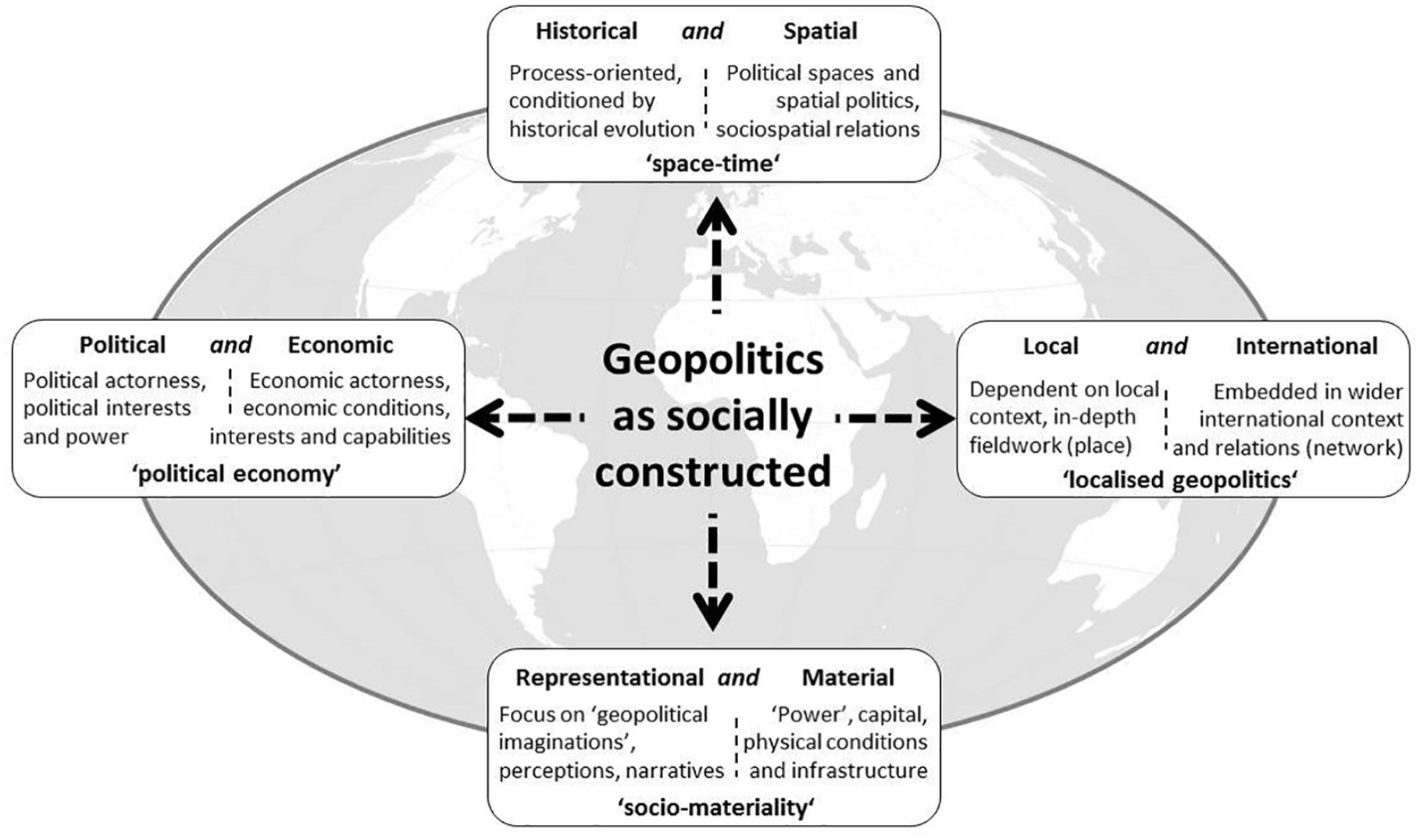
Multiperspectival critical geopolitics.
For understanding the social construction of EU geopolitics, I chose to examine dominant geographical imaginations of African and European geopolitical elites. The focus on assessing perceptions of elite individuals through interviews, thereby, constitutes the empirical basis for capturing such geographical imaginations and conceptualising them as key components of how EU geopolitics is both enacted by EU geopolitical agents and experienced by its ‘external’ cooperation partners. Before turning in more detail to the empirical material below, however, I first trace two interrelated simultaneities that could be observed over the past two decades: those of (a) process and discourse of (b) integration and disintegration.
The dual simultaneities process–discourse and integration–disintegration
The type of ‘thick’ geopolitical analysis outlined above entails the consideration of geopolitical phenomena not as singular events but in the context of the simultaneity of processes and discourses that influence the specific phenomenon. It is against this background that I highlight in the following two interrelated simultaneities in the geopolitics of European (dis)integration. First, taking the four twin dimensions of multiperspectival geopolitical analysis outlined above as an entry point, the focus is on the duality of material and representational factors. Tangible, material processes are inherently interwoven with representational discourses that frame and are framed by those processes. While I consistently use the term ‘process’ here, I emphasise the implications between ‘process’ and ‘practice’. In practice theory, the latter is understood, inter alia, as an ‘emphatic term to describe the whole of human action (in contrast to “theory” and mere thinking)’ (Reckwitz, 2002: 249). Such human action is implicated with ‘process’ through routinization. Repeated, routinized social and discursive practices ‘make’, materialise a process. For instance, the European Monetary Union (EMU) is ‘made’ through the usage of the Euro as currency; Schengen is ‘made’ through the absence of internal border controls and so on. Second, the simultaneity of process and discourse is thematically illustrated through the simultaneity of European integration and disintegration. Even though following a roughly linear path towards more integration, European integration has never been ‘only’ or completely linear; both process and discourse have always been accompanied by what I will refer to as ‘EU-optimist’ and ‘EU-sceptic’ 4 measures and articulations.
Emphasising the duality of material and representational factors (see Figure 1), Table 1 summarises those interrelated simultaneities and provides an overview of the following two subsections. I exemplarily use two of the most controversial questions of the 2010s, the management of the financial crisis as well as border and migration policy, to illustrate how integration and disintegration discourses instrumentalise the same processes for their respective objectives.
Dual simultaneity of process–discourse and integration–disintegration.
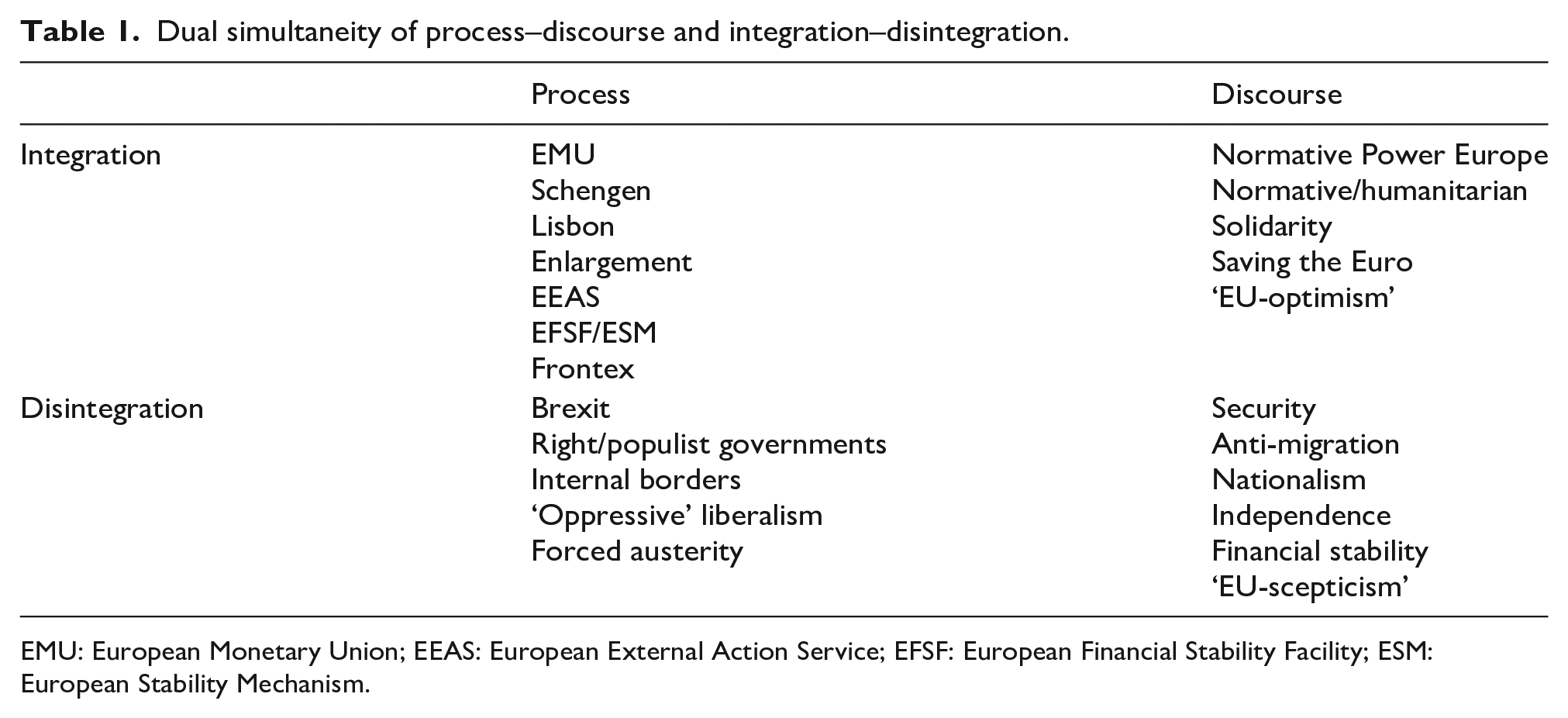
EMU: European Monetary Union; EEAS: European External Action Service; EFSF: European Financial Stability Facility; ESM: European Stability Mechanism.
Process and discourse of integration
As outlined above, successive steps of European integration have always been accompanied by respective geopolitical discourse (Bachmann and Sidaway, 2009). In the language of critical geopolitics, academic discourse is considered as part of ‘formal geopolitics’, the ‘highly codified and professionalized narratives [. . .] used by politicians or practitioners’ (O’Loughlin et al., 2005: 324). In the case of European integration, such discourse has been dominated by the notion of Europe as a normative power (NPE) over the past two decades (Manners, 2002, 2006, 2010, forthcoming). While the EMU and the Schengen area had been put into practice before the turn of the millennium, the 2000s witnessed a series of key tangible integration steps: most notably the ‘big bang enlargement’ of 2004–2007 and the eventual signing of the Lisbon Treaty, including the formation of the European External Action Service (EEAS) as the Union’s own, and the world’s only multilateral, diplomatic service. During the second decade of the new millennium, other integration steps have been taken in response to the geopolitical developments that unfolded. The two examples mentioned above, financial and migration policy, will now be regarded through an EU-optimist vantage point.
First, EMU has intensified cooperation, often in the form of the imposition of austerity measures on countries that had fallen into high debt (Ballas et al., 2017; Bhambra, 2016; Murphy, 2013). In an EU-optimist view, the ‘troika’s’ (European Commission, European Central Bank and International Monetary Fund) handling of the financial crisis, mainly through the European Financial Stability Facility (EFSF) and the European Stability Mechanism (ESM), is framed as not only rescuing the indebted countries of the Eurozone in an act of solidarity but also as saving the Euro as the common currency as a whole. Second, the unprecedented expansion of FRONTEX (the European Border and Coast Guard Agency) has been one among other means to intensify cooperation with respect to border and migration management as a result of an increase in the number of people coming to the EU (Celata and Coletti, 2016, 2019; Scott et al., 2019). Against the background of the EU’s normative power orientation, EU-optimist debates articulate the collective handling of human mobility into the EU as normative engagement and a necessary step towards further European cooperation in the fight against human trafficking and ‘illegal’ migration. Relatedly, also the importance of collectively protecting the external border in order to maintain the Schengen zone’s internal free circulation has been frequently emphasised. Despite the attempt to position such cooperation on migration and border management through a lens of EU-optimist discourse, it remains imperative to point to the tragic sarcasm of such collectively instigated violence against human beings in light of the EU’s claim to human rights and normative power (El Qadim et al., 2020; Jones, 2017; Rouland, 2017; van Houtum and Bueno Lacy, 2020).
Both examples (imposition of austerity and restrictive border regime) are highly controversial steps of integration; however, from a strictly EU-optimist point of view, there are tangible means of further integration. And through this lens, the integration steps of the 2000s went hand in hand with a type of ‘EUphoria’ that could be widely observed, even tempting certain observers to postulate a new European ‘superpower’ in the making (McCormick, 2007; Reid, 2005). EU enlargement to include 12 Southern and Eastern European states was framed as a geopolitical event finally tearing down the Iron Curtain and completing a process of reunifying the European continent that had previously been artificially separated. At the time, the EU had grown into the largest integrated economy of the world and laid out its path to also play a more influential role globally (Bretherton and Vogler, 2006; European Commission (EC), 2004, 2007). The purported success of simultaneous integration process and discourse over the 2000s also laid the foundation for much of the EU-optimist debates of the 2010s.
Process and discourse of disintegration
Despite the EU’s abovementioned hypocrisy as regards normativity and human rights at its borders, and despite its shortcomings on issues of social policy, for instance, politically it is the (far) right that is determining EU-sceptic discourse with its xenophobic, nationalist or even fascist utterances (Bachmann, 2020; Bialasiewicz and Stallone, 2020). The most visible example in this context has been Brexit. While Brexit discourse cannot be completely transferred to other Eurosceptic movements across the continent, its nationalistic, anti-European agitations have certainly set the tone in the EU-sceptic debate. It remains unique, though, in its apparently unequivocal belief in the restoration of British grandeur as well as in actually having succeeded in removing a member-state from the Union (Bachmann and Sidaway, 2016; Saunders, 2020). Nevertheless, in the wake of Brexit, right-wing and populist governments experienced a (temporary) surge in several EU member states. As part thereof, governmental control of the media and the judicial system, increasingly ‘normalised’ respective anti-European, nationalist and xenophobic, discourse in public debate (Bialasiewicz and Stallone, 2020; Förtner et al., 2021; Hendrikse, 2018).
While the previous section laid out the simultaneity of process and discourse of integration and how the two examples chosen, financial and migration policy, are instrumentalised for EU-optimist purposes, I will now turn to their respective instrumentalisation through an EU-sceptic lens.
First, in EU-optimist terms, EFSF and ESM are articulated as necessary steps and solidary acts by solvent EU countries to save their indebted peers in the Union as well as the Euro as the collective currency in its entirety. Through an EU-sceptic lens, however, the emphasis is on the imposition of austerity as patronising and as undermining collectiveness and solidarity in the Union. Austerity is articulated as a key divisive moment between debtor and creditor states as well as between the collective institutions, most notably the ‘troika’, dictating austerity and those countries most severely affected by it. For the case of Italy, Agnew (in Casaglia et al., 2020) observes how it was one of the countries that suffered most from the austerity policies that followed from the increasing spread in yields between German and Italian bonds, showing the limits of a monetary system in which the lack of European Union-wide bonds and banking imposed costs very unevenly across member states of the Eurozone. (p. 4)
This unevenness came with perceptions of undermined independence and national self-determination (Vasilopoulou, 2018). The aligned discourses ‘are articulated around the idea of “taking back control of the nation”’ and emphasise a ‘notion of sovereignty that is strongly spatialized within the boundaries of the nation-state’ (Casaglia and Coletti in Casaglia et al., 2020: 1). And such (perceptions of) heteronomy facilitates entry points for what the sociologist Wilhelm Heitmeyer (2020) refers to as ‘fear exploiters’ to instil a populist, nationalist, fascist dominance of the debate (see also Dijkstra et al., 2020; Eribon, 2013; Karolewski, 2017).
Second, and relatedly, in EU-optimist discourse, the collective measures of migration control, including the increasingly restrictive and violent European border regime, are articulated as necessary efforts of collaboration to guarantee Europe’s security and its internal freedom of movement. Through an EU-sceptic lens, however, the divisions over European migration and border management are obvious – both between and within the different states. Liberal and humanitarian voices harshly criticise those advocating and/or implementing strict measures of migration and border control, while for others, the existing measures are insufficient and need to be tightened. While it is impossible to identify a clear-cut geographical dividing line, Doboš (2020) exemplarily analyses a simplified division between East and West on migration policy: Europe is contrasted with the vision of East-Central European countries of the Visegrád Group (Czech Republic, Hungary, Poland, and Slovakia) which oppose the invasion [sic]. Not only can we find opinions about Visegrád Group states as the last unconquered islands representing true European values, but we can also find calls to fortify these states against a defeated Western Europe. (p. 6)
In this view, the ‘problem’ is thus no longer the ‘invasion’ of non-Europeans, that is, Muslims and Africans, to Europe, but the naïve Western European societies that have already lost the fight to defend the ‘real’, that is the White Christian, Europe (Doboš, 2020). A range of fascist demagogues, such as Matteo Salvini or Victor Orbán, have built their political careers on such ‘state-led Euroscepticism’ (Bürkner, 2020: 561) – inciting their electorates against multiculturalism, a liberal society, gender and minority rights supposedly forced upon their more ‘traditional’ societies by Brussels (Bialasiewicz and Stallone, 2020; Hendrikse, 2018; Müller, 2018). In so doing, threats are being ‘territorialised’ as ‘external’ against which the ‘internal’ requires protection. In national populist narratives, such protection needs to be provided by strong borders that function ‘both as “containers” of national identity and as crucial markers of national sovereignty, with respect to external influences, including transnational mobility, multiculturalism, supranational and international organizations’ (Casaglia and Coletti, 2021: 1–2).
From an EU-sceptic view, the two examples of migration and financial management are not signs for increased cooperation but rather the opposite. They are indicative of the purported end of the EU as an ‘ever closer union’. The solution to the problems is not cooperation but disintegration and a resurgence of the nation-state.
The simultaneity of integration and disintegration seen from the ‘outside’
This section highlights how the dual simultaneities of process–discourse and integration–disintegration outlined in the previous section, and mostly seen as fundamentally ‘internal’, are closely observed from the ‘outside’. ‘Outside’ thereby refers primarily to the physical location of my research, predominantly in the Kenyan capital of Nairobi, but also in other strategic locations in East Africa, such as the headquarters of the East African Community (EAC) in Arusha, Tanzania. Through a focus on such an ‘outside’ view, my objective was to assess geographical imaginations of the EU as a geopolitical actor that go beyond the way the EU is generally seen, narrated and presented internally. Nairobi is a strategically central place for such research. It is one of sub-Saharan Africa’s key metropolises; it hosts the headquarters of several UN agencies; and it is a key hub of the global development industry. As such, it is a place of key importance to all agents of European external relations (Commission, the European External Action Service, member states, etc.) as well as to all other geopolitical actors. While physically located outside of Europe, my research covered not only ‘outside’ voices. As indicated above, it interrogated both African and European geopolitical elites in a context of how the EU’s integration narrative is perceived by those who are professionally charged with projecting it to the ‘outside’ as well as by those upon whom it is projected. The inclusion of both ‘outside’ and ‘inside’ perspectives thereby follows the objective of a ‘thicker’ and multiperspectival critical geopolitical analysis (see above) that allows for capturing different viewpoints and developing a more integrated understanding of the EU as a particularly ‘fuzzy’ geopolitical phenomenon.
Figure 2, based on research undertaken in Kenya between 2010 and 2014 in the context of the EUROGAPS project (see footnote 3 and Bachmann, 2016; Bachmann and Müller, 2015), summarises some of the findings and serves as an entry point for discussion. The presented data derive from interviews and focus groups discussions with a total of 124 informants – 36 of whom were European diplomats or development officials (the darker lower parts of the columns) and 88 were (mostly Kenyan) foreign policy or development experts with considerable experience in cooperating with European partners (the upper lighter parts of the columns). Figure 2 shows the quantified and qualitatively categorised responses to the question of what the informants primarily associate with the EU. 5 In addition, some quotes presented below have been collected in the context of the AFRASO project between 2017 and 2018 (see footnote 3 and Bachmann, 2019b; Graf and Hashim, 2017). While the complete data sets invite for a more comprehensive analysis, I will focus here on highlighting how the shifting perceptions about the EU as discussed in the second section as well as the simultaneity of integration and disintegration have emerged as consistent patterns from the field studies in East Africa.
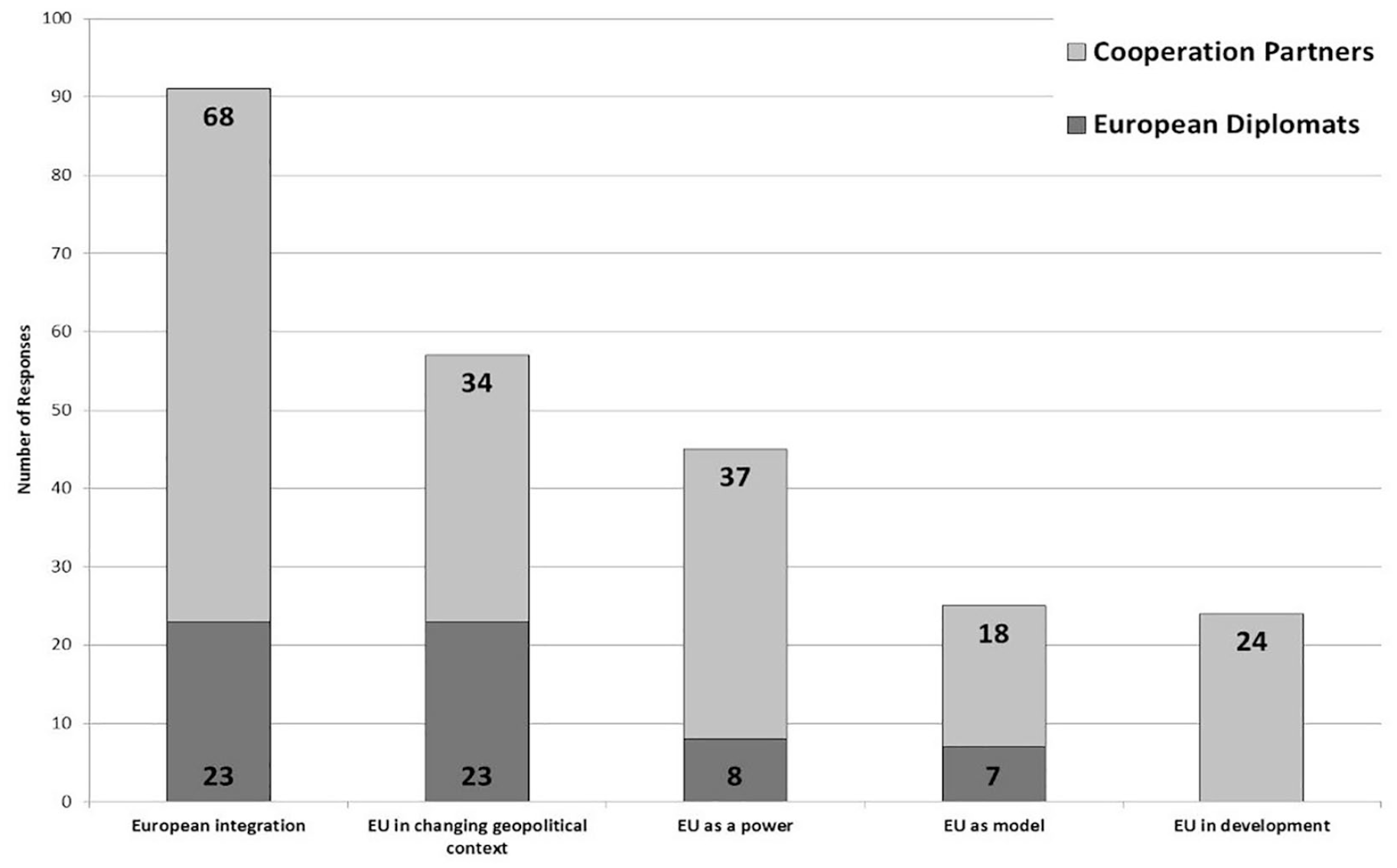
Perceptions of the EU as a geopolitical actor (data collected between 2010 and 2014).
The two largest categories of Figure 2 indicate both the shifting perception and the simultaneity of integration and disintegration. The first category, ‘European integration’, summarises responses that refer to tangible steps in the process of integration as well as to respective, EU-optimist discourse. It includes articulations of the EU as an integrative peace project that could serve as a model for Africa. A Kenyan informant, for instance, described the EU as a supranational organisation, the embodiment of my dream for Africa – an ‘African Union’ – whereby all African countries come together, under an umbrella body governed by one currency, multiple streams of economic, political as well as diplomatic engagement. (Focus Group, March 2012)
However, this first category also includes more critical viewpoints that point to how the integration process concentrates European power for further subordination of their African cooperation partners. The EU, another informant argued, is a means of some European countries [that] have joined together to impose their policies to the underdeveloped countries of course for their own gain. (Focus Group, March 2012)
The duality of such different ‘external’ views of European integration have elsewhere been referred to as ‘the EU’s civilian/power dilemma’ – describing the Union’s appeal as a more civilian geopolitical model of multilateralism and regional integration on one hand and the neoimperial projection of its economic power on the other (Bachmann, 2013). Both aspects can also be read in the other categories of Figure 2. The third category, ‘EU as a power’, summarises mostly negative perceptions related to the projection of EU power and an uneven African–European relationship – often, though not exclusively, in economic and trade terms. It is worth noting here that those perceptions are much more common among African informants than they are among Europeans. While this could be expected to some extent, it was interesting to see that most European informants were unaware of how persistent such perceptions were among their African counterparts. The fourth category, ‘EU as model’, refers to mostly positive perceptions in terms of the EU’s role as a geopolitical model for regional integration that has managed to generate internal peace and relative prosperity over the past half century. It is precisely such dualities and heterogeneities of a geopolitical actor that the abovementioned approach for multiperspectival critical geopolitics calls for. The EU is neither only a resented economic power nor only an appealing geopolitical model. It is both. And both roles are (re)produced through its materiality and tangible processes/practices, for instance, as Africa’s most important trading partner, and the respective representational discourses of the EU as model and/or power – depending on the vantage point and the policy field.
What is more, Figure 2 also shows how informants’ perceptions not only cover those positive and negative aspects of the EU’s civilian–power dilemma, but also how EU integration is perceived as temporal, uncertain and as subject to internal and external challenges and transformations (see the second category: ‘EU in changing geopolitical context’). As early as 2012, a Kenyan informant observed how the EU is a ‘structure that brings [European countries] together, but that can also break up at any time’ (Focus Group, March 2012). And while in 2012, the European divisions over financial policy were obvious, the differences over migration policy were not yet a major part of the integration debate – neither was Brexit. Nevertheless, already in 2012, the supposedly ‘internal’ disputes over the management of the financial crisis were much more than merely an ‘internal debate’. The following quote illustrates clearly how, despite a generally ‘positive’ perception of the EU as a model for integration, the financial crisis has succinct ramification for its role as an international model to be adopted elsewhere. The Kenyan informant described the EU as a block of 27 countries and associate members with common internal and external policies to promote interest of its members. It is a formidable union that gave exemplary history to other continents that divided we fall, united we stand. But recently its Euro crisis seems to be a negative lesson to others. (Focus Group, March 2012)
Such sentiments entail more than subtle doubts as regards the EU’s reliability as cooperation partner. During an interview with an official at the Kenyan Ministry of Foreign Affairs, the informant pointed to an undeniable and steady process of change as regards Kenya’s international cooperation partners: given the Eurocrisis and the situation in the EU, funding is not secured on a long-term basis [. . .] Europe remains a significant partner for us, but it needs to realize that the Africa of 2012 is not the Africa of the 50s or 60s. China has been playing an important role. (Author interview, December 2012)
As the quote also indicates, these doubts about the EU as a reliable cooperation partner are closely linked to major geopolitical transformations such as the financial crisis and the increasing role of China in Africa (see the second category in Figure 2: ‘EU in changing geopolitical context’). What is more, we can observe how such doubts have been increasing when longitudinally contextualising those observations (taken from the EUROGAPS project with fieldwork conducted between 2010 and 2014) with previous and subsequent research. The abovementioned civilian–power dilemma has been identified in the context of a prior study, conducted between 2006 and 2009 (see Bachmann, 2009b). This dilemma describes the duality of perceptions of the EU as relatively positive with respect to its role as a civilian geopolitical model on one hand and as relatively negative in terms of its role as a neoimperial (economic) power on the other (Bachmann, 2009a, 2013). What is worth noting, however, is that in this prior study (2006–2009), doubts about the EU’s international role, its reliability as partner or even about its persistence as such hardly existed. Such doubts had become visible over the course of the EUROGAPS project (2010–2014) and were central to how the EU was perceived during the AFRASO project (with fieldwork conducted in 2017–2018). Particularly dominant were perceptions of the EU as a decreasingly attractive and important cooperation partner to African countries because of three key factors: (a) disintegration discourse and process in the light of Brexit and internal divisions over financial and migration policy; (b) double standards as regards human rights in light of an increasingly restrictive migration and border regime; and (c) the increasing role of China and other ‘Southern’ cooperation partners as alternative to ‘Western donors’ (Bachmann, 2019b). The disintegrative process of Brexit has had a key impact on the discourse of integration – both in Europe and as regards the model of regional integration in the African context. I quote here from an interview with an official in the Kenyan Ministry of EAC. The informant explained how questions are being asked about lessons to be learnt from the financial crisis in Europe. [. . .] Also with the Brexit questions are being asked. If Britain has pulled out, this thing [regional integration] is maybe not so interesting after all and we need to look otherwise. People wonder if this thing [regional integration] is good. (Author interview, March 2017)
It is important to emphasise that the quote is taken from an interview with a person whose ministry is dedicated to promoting regional integration and how, even in this context of someone charged with regional integration, Brexit and the financial crisis have severely undermined the EU’s ability to serve as a geopolitical model. The materiality of Brexit, which was made possible by persistent anti-EU discourse in the United Kingdom, thus, decisively influences the discursive practice on the EU – not only internally but very much so also ‘outside’ – where the EU is attempting to materialise its geopolitical role.
We can thereby observe not only a dual simultaneity of material process and representational discourse as well as integration and disintegration but a triple simultaneity including also the internal and the external. Supposedly ‘internal’ processes, such as the malfunctioning of collective financial management and, in particular, the disintegration of a member state, have profound ramifications on how the EU is seen and narrated externally. And modifications in such external discourse on the EU influence, by consequence, the credibility of the EU as a global actor, that is, the process of how it projects power and its ‘preferred world order model’ (Hettne and Söderbaum, 2005: 538).
Conclusion
. . . there were times when you could see the EU as the big geopolitical project in a sense of bringing the European continent together. The Eurocrisis has revealed that in most countries most people do not want a political union. (Author interview with European diplomat in Nairobi, November 2012)
It remains uncertain if indeed ‘most people do not want a political union’ as the European diplomat in the quote above remarks. However, we can observe a certain shift in perceptions about the EU, both internally and externally, around the turn from the first to the second decade of the new millennium. It is thereby useful to imagine a continuum between complete integration, that is a full political and economic union, on one side and complete disintegration on the other. EU-optimists lean more towards the former, EU-sceptics more towards the latter. The ‘shift’ referred to in this article therefore has to be understood, not as a rigorous transition from one to the other, but rather as a difference in how the EU is, dominantly, narrated and perceived, whereby EU-scepticism has gained in prominence vis-à-vis EU-optimism. There is no exact timing for this ‘shift’. Bürkner (2020) observes how Euroscepticism has long ‘escaped public recognition’ (p. 550); however, once the effects of the financial crisis started to be painfully felt by European citizens, it became much more visible and, with it, nationalist populism a sizable political force in most member states.
Against this background, I have highlighted three interdependent simultaneities in this article. First, a ‘thick’ and ‘multiperspectival’ reading of critical geopolitics calls for attention to the simultaneity of tangible, material processes and representational discourses. In addition to critical geopolitics’ traditional focus on deconstructing lead narratives and discourses, this reading emphasises the importance of materiality and affect of geopolitical phenomena (Bachmann, 2016; Dittmer, 2014; Ó Tuathail, 2017). The empirical application of this conceptual avenue has focussed, second, on the simultaneity of European integration and disintegration. The evolution of the EU, as the currently materialised polity of process and discourse of European integration, has clearly followed a path of successive integration since the end of World War II. However, this path has never been completely smooth or streamlined but has always been contested by both narratives and tangible actions of Euroscepticism and disintegration – ranging from those fearing a renewal/continuation/intensification of European imperialism to Brexiteers and the New Right. Third, this dual simultaneity of discourse–process of integration–disintegration is complemented by the simultaneity of internal and external factors. It has been an important ambition of this article to not only consider European viewpoints, but to explore a view from the ‘outside’. The consideration of perceptions of both African and European geopolitical elites thus allowed highlighting how supposedly internal questions of European integration, such as the financial crisis and Brexit, are hardly exclusively internal. Even though Brexit has taken the UK’s global weight (in terms of gross domestic product (GDP), diplomacy, military strength, culture and language, etc.) out, the EU remains a fundamentally global actor: it is the third largest economy in the world, 6 it has a vast diplomatic and cooperation network and is a key trading partner for most countries. EU politics, and the discourses surrounding it, has profound global ramifications. The multiperspectival approach to a critical geopolitics employed here thereby reveals how certain aspects of the EU’s geopolitical role are perceived completely differently depending on the viewpoint. For instance, the materiality of EU economic power can be discursively framed in positive terms as a necessary, and maybe the only, strength of a collective European role in the world. However, it can equally be framed as the source of persistent European neoimperialism.
As outlined above, the international agency of the EU, as that of any geopolitical actor, depends on the strength and reach of both its material power as well as the discourses framing it. The EU’s global role is inextricably linked with the success of European regional integration. While in Europe, and against the background of two world wars in the first half of the 20th century, regional integration has long been seen as a virtue in itself and been credited for overcoming war, this is not necessarily the case when seen from the ‘outside’. Regional integration is legitimate as long as it is useful as a vehicle for delivering growth and development (Bachmann, 2019b). If it fails in so doing, it becomes redundant. This applies to the EU, as the materialised polity of regional integration, too. If it no longer functions, its reliability as cooperation partner becomes doubtful and its role as ‘model’ implausible. While the real, tangible processes of how it ‘functions’ – and clearly in terms of legislation that affect almost half a billion EU citizens, it ‘functions’ very well – are important, what counts equally are its discourses, the appeal and credibility of the story it has to tell. And at the current geopolitical conjuncture, the story does not sell well. On the narrative continuum between EU-optimism and EU-scepticism, the trend has moved towards the latter over the past decade and a half. The divisions over financial and migration policy are clearly visible both internally as well as externally; with Brexit, the EU lost its most ‘global’ country; and the hypocrisis of proclaimed normativity in light of its border regime severely undermines the EU’s international credibility.
Europe does not forcibly have to play a global role. However, the normativity and the cooperation ideal it proclaims through its regional integration narrative remain appealing – in particular, in light of the Russian invasion of Ukraine and many other autocratic and violent pushes around the world. A more solidary and unequivocally value-oriented EU could set a powerful geopolitical example and live up to what it proclaims – and thereby reverse the trend on the narrative continuum and reorient it towards more EU-optimism. It is possible, but appears a long trajectory at the current geopolitical conjuncture in, around and beyond Europe.
Footnotes
Declaration of conflicting interests
The author(s) declared no potential conflicts of interest with respect to the research, authorship and/or publication of this article.
Funding
The author(s) disclosed receipt of the following financial support for the research, authorship, and/or publication of this article: Veit Bachmann received support for this research through several projects:
1) IMAGEUN (2021-2023), funded by the German Research Foundation (DFG) and the French Agence nationale de la recherche (ANR): DFG/ANR grant BA 4702/4–1
2) AFRASO (2013-2019), funded by the German Ministry for Education and Research (BMBF): grants 01UC1302 and 01UC1702
3) EUROGAPS (2010-2014), funded by the German Ministry for Education and Research (BMBF): grant 01UE1001
