




Abstract
Urban designers have long sought to plan more secure public spaces by encouraging a sense of territory through the surveillant and the surveyed. Nevertheless, the racial dimension of this territorialisation is insufficiently recognised. Our research tool, which we have trialled in Milan, identifies the influence of design in creating a sense of security in public space and, independently, the influence of race. It provides designers with a tool that could facilitate a more radically just practice that takes ownership of the role of race in perceptions of secure public space and challenges existing conscious and unconscious bias and which in so doing makes design practice more resilient to the rise of populist administrations increasingly engaging in bordering practices that conjoin migration, race and security at a national scale, but which are often enacted at the city scale.
Introduction, urban design and fear of crime
Urban designers 1 have emphasised the surveillant and the surveyed and the role of territoriality in securing space but have been largely silent on the racial dimension (e.g. see Lee, 2021 for a discussion on Natural Surveillance and Urban Design). Through our case study of design and the perception of safety in public spaces in Milan, we illustrate that the alignment of race 2 and sense of security by some Milanese is significant. We do not believe Milan to be unique in this respect. Therefore, our research challenges more globally those involved in design-security to test for this linkage with race, and where it holds, to develop practices that directly address and counter it. Moreover, as urban designers seek to take ownership of race, context is also important. In recent years populist administrations across Europe have engaged in bordering practices that conjoin migration, race and security at a national and city scale (Aelbrecht et al., 2022; Stanfield and van Riemsdijk, 2019). Independent of our research, which shows how some Milanese link race and security, Italian right-wing populist parties at national and city levels are developing bordering practices that link race and national security, making it all the more urgent for practitioners in their respective settings to ‘[. . .] defend democratic planning ideals’ (Sager, 2020: 81).
Designing out crime through physical measures
Urban designers have sought to change an individual’s perceived level of risk through measures such as clear sightlines and better lighting, and while this may seem dated to an academic audience, it is important to note that these practices still make up a large part of current urban design guidance. Recent publications and training from UN Habitat (2015, 2020) alongside advice issued by experts in the European Forum for Urban Security 3 all point to maintenance, lighting and permeability as key planks in increasing both the perception and reality of safety in public spaces. In England, the police, as statutory consultees in the planning process, still influence urban design through the application of dated ‘secured by design’ principles (Harper, 2022). The underlying idea is that people feel safer when they can ‘see’ their route and whom they may encounter when moving through an area. This also offers the opportunity for ‘eyes on the street’ or mass surveillance (a sort of analogue CCTV). The intention here is to reduce perceived levels of personal risk while also discouraging criminality by increasing the perceived risk of being caught (Clarke, 1997). This produces a binary population of the law-abiding (surveyors) and the criminally inclined (surveyed), by inducing greater feelings of safety for the former and frustrating the inclinations of the latter (Chiodi, 2016; Iglesias et al., 2013).
The acclaimed journalist and urbanist, Jane Jacobs, credited with the phrase ‘eyes on the street’, provides an early example of the good versus bad person binary in managing public space, notwithstanding her positive intent to most strangers. She wrote, ‘The streets must not only defend the city against predatory strangers, they must protect the many, many peaceable and well-meaning strangers who use them ensuring their safety too as they pass through’ (Jacobs, 1961: 45). This act of anthropomorphism lends a benign aspect to social control by diverting attention away from who defines whom as predatory or peaceable. Again from New York, the ‘Broken Windows Theory’ (Kelling and Wilson, 1982) was also rooted in journalism and so is driven by observation rather than theoretical testing. First appearing in The Atlantic, it rested on the assumption that minor forms of physical disorder in a neighbourhood, such as broken windows, graffiti or uncollected garbage, would cause a vicious cycle of neglect and decay, thereby suggesting that a lack of regulation was linked to a lack of safety. However, although it provided an innovative explanation for urban insecurity, any rising fear of criminality is rarely backed up by rising crime rates. Instead, tropes such as broken windows serve to ‘reassure’ and ‘disturb’ people in equal measures by offering a solution to fears that the analysis itself has exacerbated (Pitch, 2013; Riva et al., 2017) and justifying interventions in public space and the management of the ‘undesirable subjects’ who occupy that space (e.g. see Newman and Thornley, 2005, on the strategies of city managers to ‘cleanse’ Times Square to make it ‘safer’).
In between these interventions sits Oscar Newman’s (1973) influential work on ‘defensible space’. For our purposes, a key feature in Newman’s work is the contention that territoriality is to be encouraged to design out crime. ‘[Territoriality] consisted of several interconnected effects:
the process of establishing a sense of ownership for legitimate users of the space;
which in turn provides a clear definition of areas controlled and influenced by inhabitants; and
is encouraged through familiarity with neighbors [sic] or passers-by’ (Warwick, 2009: 32).
Newman’s ideas are echoed in work that shortly followed the influential Crime Prevention Through Environmental Design (CPTED) research agenda (Jeffery, 1977). Importantly, this has, more recently, been widely supported by the European Union (Davey and Wooten, 2016), which attempted to implement it as a European Standard, prevention of crime – urban planning and building design (2011) CEN/TR 14383-2. Although this top-down approach failed, many community initiatives have been enacted across Europe using similar mechanisms as seen in the formalised standard (Saraiva et al., 2016). The principles upon which the CPTED and later European projects were founded, sought to diminish the occurrence of crime via natural surveillance (for instance, windows overlooking sidewalks), access control (design of the urban landscape), and territorial reinforcement strategies to limit the opportunity for criminal activity (through planned activities in public areas). Two key foci of the CPTED were: (1) public participation in planning matters and (2) the construction of a sense of community rooted in place to motivate ‘eyes on the street’ (Chiodi, 2016; Iglesias et al., 2013; Park and Garcia, 2019).
Certainly, Newman’s call to restructure ‘the residential environments of our cities so they can again become liveable and controlled not by police, but by a community of people sharing a common terrain’ (Newman, 1973: 2) has been criticised for mistakenly encouraging the creation of an isolationist urban form. For instance, the Space Syntax theory (Hillier, 1996; Hillier and Hanson, 1984) provides a caution to territorial approaches insofar as they encourage physical isolation from the broader network of city streets and spaces and, therefore, may be more prone to criminal activity. Space Syntax shares with Jacobs a belief that having active streets reduces crime, and its contribution is to analyse patterns of street connectivity that help achieve active streets (Iglesias et al., 2013). However, although Newman and Space Syntax might differ over the desirable extent of neighbourhood permeability, both focus on the link between territoriality and securing public space.
Race, security and place ignored
Surprisingly, there is a distinct lack of focus on race in local territoriality in both past and contemporary urban design writing. Yet, a diverse body of work highlights important linkages between race, security and place: that is, how race impacts the ways public space is perceived, controlled and/or managed, and often, in a wider context of symbolic and material inequities promulgated by the right and/or right-wing populism (see Summers and Howell, 2019). For example, in the context of a hegemonic ‘White America’, Lipsitz (2011) illuminates how people of colour have long-suffered spatial and social discrimination due to the perceived threats they apparently represent to Whites. Such perceptions of fear stem, not only from the privileged positions held by Whites in contemporary USA, but also from a wide range of discourses and practices that ascribe ‘threat’ to Blacks implemented by a powerful political Right. Furthermore, demonstrating how White suburban residents in the United Kingdom seek to manage their racially-motivated anxieties through a novel ‘constitution of the self’ (Kinnvall and Mitzen, 2020: 240), Mace (2019) examines how they employ imaginaries of the English village to secure their White identities in increasingly multicultural settings. Such ‘relational place making’ based on ‘deeply racialised frames’ is, sadly, not uncommon and serves to mediate the various ways in which public spaces are accessed, performed and affected as ordinary people construct their everyday geographies (see Van Eck, 2021 on Amsterdam; also Carpio et al., 2011 on US suburbia; Knowles, 2013 on ‘Nigerian London’ and Hyra, 2017 on the ‘cappuccino city’). More than this, such spatially manifest ‘fear and loathing (of others)’ (Summers and Howell, 2019) serves to identify people’s bodies as ‘. . . the bearers of socially demarcated borders and boundaries . . .’ (Dixon and Marston, 2011: 445). We contend that the urban design literature has not engaged sufficiently with such material to address the relationship between the ‘racially marked’ body, security and place. We cannot speak to local practice internationally but given the absence of attention in the design literature, the hypothesis informing our research was that territorially based perceptions of safety in public space would be as, or more, influenced by the race of those others occupying a space as by the design of the space. If this were the case, we argue that designers must incorporate into practice greater awareness of how discourses of urban security are informed by conscious or unconscious racism. We tested for a race-security link showing this to be the case in Milan, a finding relevant in itself and requiring a response from designers. Moreover, the increase in right-wing populist movements across Europe makes it all the more urgent to expose and challenge the role of race when considering design-based responses to security. In many populist movements, the defence of the national border has been framed in an imaginary of ‘them’ versus ‘us’, with migrants othered as ‘insecure’ and ‘disordered’ in opposition to the ‘secure’ and ‘orderly’ in-group (Gallardo, 2008; Makarychev, 2018). The border has become the performative place of ‘taking back control’, symbolically and practically (Casaglia et al., 2020). This is not exclusive to right-wing populist administrations but certainly is a characteristic of them. While bordering may focus on the defence of national borders from penetration by racial ‘others’, the practices of bordering can happen away from physical borders (Özdemir and Ayata, 2018). As we will detail in section ‘Discussion’ below, in Italy, there is a distinct city dimension to such bordering practices that has shaped the narration and disciplining of racial minorities (Rossi, 2018), making it even more pressing for urban design guidance and practice to recognise race in their measures to design out crime.
The rest of the article is structured as follows. In the next section, we turn to our research in Milan, where we employ a tool that identifies the impacts on people’s perceptions of security of the design of spaces and also the impact of skin colour 4 on perceptions of security. Italy falls in the group of EU countries (e.g. Luxemburg, Austria and Germany) that lists skin colour as the most commonly mentioned ground for discrimination (European Union Agency for Fundamental Rights, 2018) and ranks fourth in the EU on believing this discrimination is widespread in the country (European Union, 2019). The tool comprises a random control trial experiment using contrasting images of several types of public space, for example, play areas where one is ‘well-maintained’, while the other is ‘rundown’. Alongside baseline images with no people, we have scenarios with composed groups of people of differing skin colour. Our purpose in employing the tool was to demonstrate its use as a way for designers to develop a more radical practice by taking ownership of the role of race in securing public space. After this, in section ‘Discussion’, we embed our findings in a wider political context by looking at how the city-scale represents a vital space for the enactment of and resistance to bordering practices which, in the face of right-wing populism are increasingly shot through with race. In section ‘Conclusion’, we return to our findings and their direct implications for practice and how these must be understood and enacted in the context of wider political shifts in practices of bordering.
Design, security and race in Milan
To better understand the extent of the relationship between the perception of security in public spaces and the race of those in that space, we designed a survey to test how the Milanese rated their perceived level of security in several urban scenarios via photo simulation. The method offers the advantage of measuring perceptions and attitudes to a variety of scenarios using real rather than generated representations of public spaces in the city, thus adding accuracy to the technique (see Kaplan and Kaplan, 1989; Navarrete-Hernandez et al., 2021b; Rossetti and Hurtubia, 2020). Photo simulation has been employed in various contexts, including perceptions of urban density, perceived safety in terms of design and subjective well-being in greenspace (Jorgensen et al., 2002; Navarrete-Hernandez et al., 2021a). However, all these experiments have focussed on the design of space rather than who is occupying the space. We offer a unique approach to use this method as we are testing for underlying biases related to race.
To select locations, we scouted different Milan neighbourhoods outside its external ring road, both in the western and eastern parts of the city. We visited neighbourhoods characterised as recently regenerated areas (e.g. Lambrate, Loreto and Piola) and areas with a higher prevalence of social housing and fewer renovation interventions in recent years (e.g. San Siro, Selinunte and Corvetto). We took geotagged photographs of potential locations for each visit to run the experiment, collecting 129 potential site images. Later, we classified them as ‘rundown’ public spaces if the image met specific criteria, including the presence of graffiti, garbage and other signs of neglect; or ‘well-maintained’ if the urban images had salient visual signs of renovation. Images that did not clearly show any of these signs were discarded. A further classification of images was completed to select eight typologies of public spaces representing different urban contexts: playgrounds, piazzas (squares), pocket parks, car parks, consumption areas, residential areas, alleyways and tree-lined avenues. For each of these categories (except the tree-lined avenues), two locations were selected to represent a ‘well-maintained’ and a more ‘rundown’ space, giving 15 places in total to run the experiment 5 (see Figure 1 for examples). Finally, an extra day was spent in Milan to revisit the chosen places and plan the route to follow with our models to take onsite the control and treatment photographs. Our models comprised men and women of similar ages (young adults), but of differing skin colour (White and Black). The pictures were taken from the point of view (POV) angle to enhance the respondents’ sense of immersion in the scene.
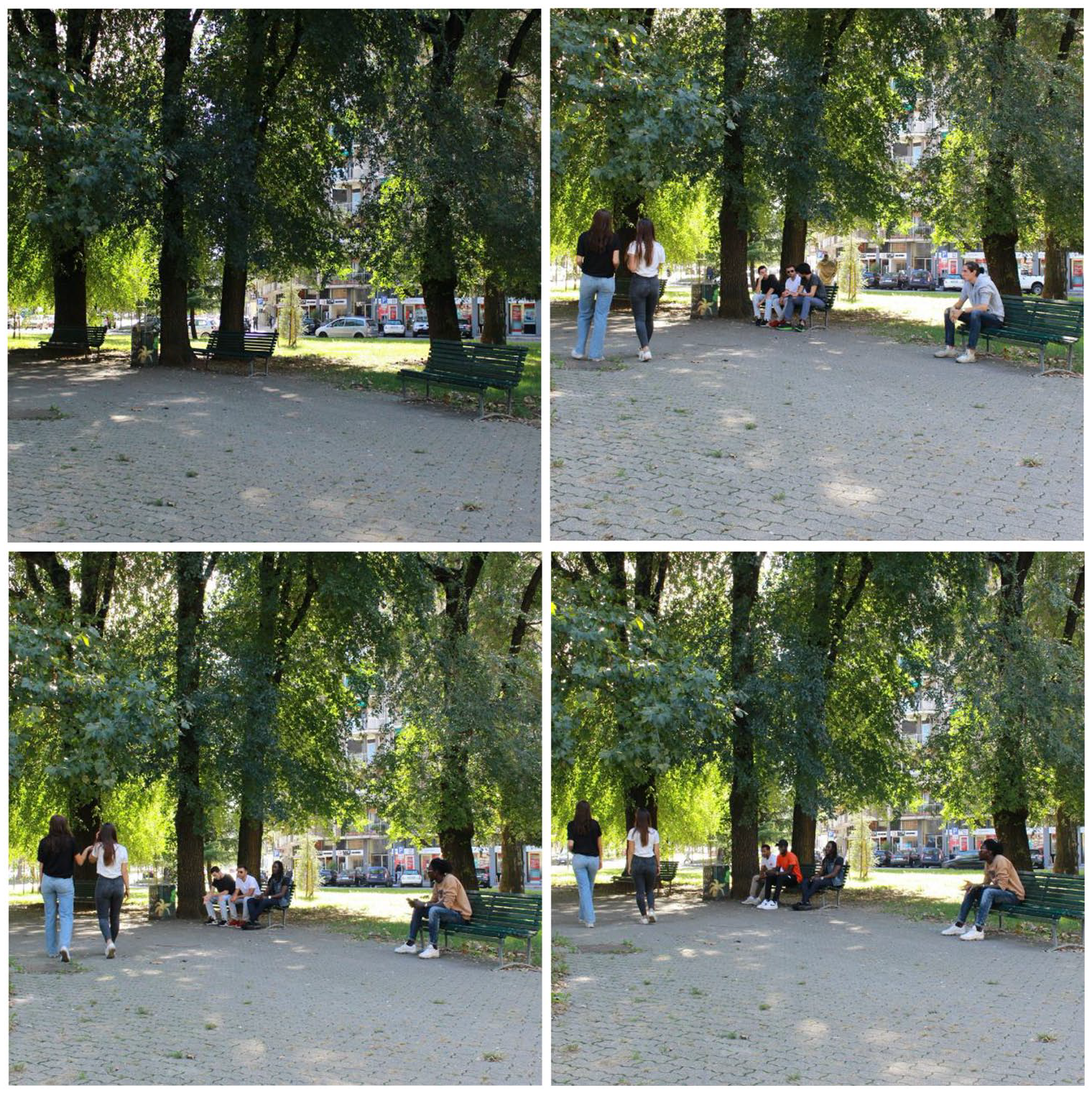
(Top right) baseline scene; (top left) baseline composite picture, six White people; (bottom left) four White, two Black (bottom right), two White, four Black. All pictures have been cropped to bring people to fore, to make easier to view in smaller format.
The 15 sets of pictures were reproduced to give a control scenario with no people and three treatments: the first with six White models, the second with four White models and two Black models, and the third with two White models and four Black models. We decided to exclude a treatment without White models as it would be an unusual scenario for Milan, thus risking drawing the respondents’ attention solely to the race factor and producing an unwanted bias. Furthermore, we decided to keep constant the mix of sexes (two females and four males in every picture) to avoid unwanted variables. One reason for using a mixed sex group was to avoid possible biasing where an all-male group (of any racial composition) may be seen as more threatening. However, the results of the test as applied do not allow us to talk to the possible effects of the sex of those in the image.
Due to the second COVID-19 lockdown in Milan, we conducted an online experiment. In late 2020, we contacted 340 neighbourhood committees, local associations, cultural centres, political associations and religious groups in Milan. Eleven confirmed their willingness to participate and shared a link to the experiment through their social networks. In addition, the researchers shared the survey through their social media and networks. In total, 250 participants took part in the survey and completed the experiment on the platform www.urban-experiment.com. We provide descriptive statistics of our respondents in Table 1. Of note is that we did not ask the race of our participants. There were two reasons for this. First, we did not want to draw attention to race so as not to influence responses to the images, where they were asked to respond to the general scene and not to the people in the scene. Second, asking about the race or ethnicity of the respondent on a survey, as is commonly done in the United States or the United Kingdom, can be negatively perceived and can reduce response rates (Rainews.it, 2018). Therefore, our findings are not of White Milanese’ responses to the racial mix of people in the street scene, but rather how the mix might influence senses of safety regardless of the race of the participant.
Descriptive statistics of participants.
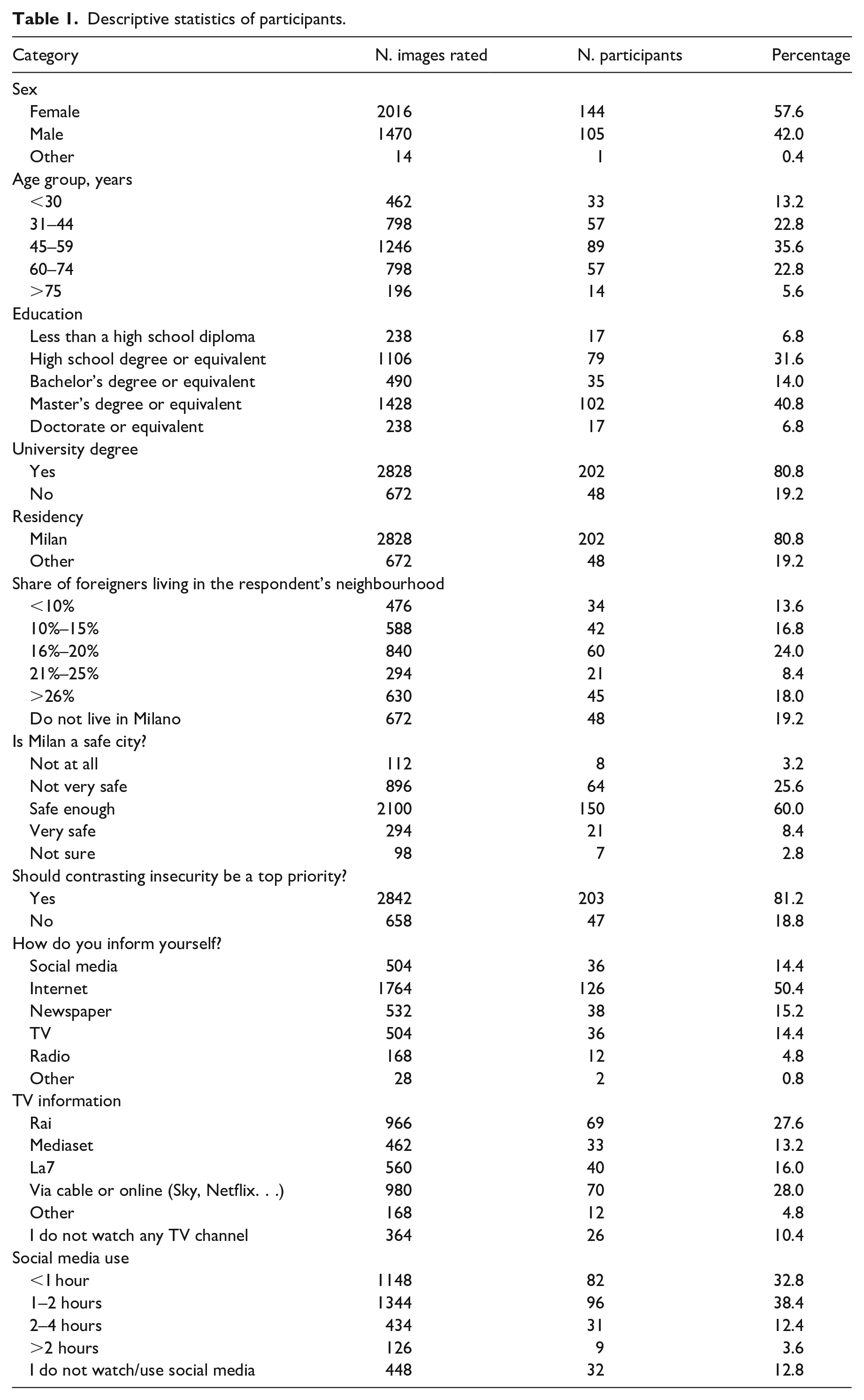
We divided the survey into two parts. The first included respondents’ sociodemographic characteristics (age, sex, nationality, study title, place and neighbourhood of residence, see Table 1), general attitudes regarding urban safety in Milan and media consumption habits. In the second section, respondents were asked to rate a series of 15 images on a 10-point Likert-type scale, based on how safe they perceived the urban location.
A double process of picture randomisation was implemented to ensure that every respondent had a unique combination of viewing-order and control-treatment images. First, the platform randomised the image category order to control for fatigue and spill-over effects from rating multiple images. Second, the platform randomly assigned one image from every picture-set, namely the control or one of the three treatments.
In this article, we are interested in how people perceive different levels of security depending on the race of those in the street scene. We also want to analyse whether the perceived level of security varies with location, urban conditions, or the respondents’ characteristics and opinions. To do so, we ran the following regression: Perception ij = β1 + β2Treatment i + Eij
The dependent variable Perception ij gives the security perception rating for the ith image by the jth individual on a scale of 1 to 10. β1 represents the intercept (in our case, the baseline images with no people); Treatment, the independent variable of interest, is a categorical variable, and the magnitude of its average effect on people’s perceptions of security in the ith image is indicated by the coefficient β2; E ij is the error term. This regression is independently run for all the categories of interest.
Finally, in describing our methods, we reference out positionality. We are a group of six researchers composed of two women and four men. Our disciplinary and cultural backgrounds and age groups are diverse from one another. This has helped our research by considering different aspects of urban security that one author alone might have skipped or not found of considerable importance. However, we are all White people and thus do not share the lived experiences of people of colour. We engaged in extensive discussion of the selection and placing of ‘models’ for the images but we recognise that our individual perspectives might have influenced the selection of the models, their placing and of the urban spaces themselves.
Design and perceptions of safety (baseline images)
Our results are striking, offering a causal confirmation of our hypothesis – perceptions of security are significantly impacted by the race of the other individuals in public space. Before giving more detail, we report first on the influence of urban design to provide a baseline before moving to the effects of race. The key finding here is that design interventions nearly always make a positive contribution to reported feelings of security.
We begin our analysis by examining the baseline images (i.e. those without people). For each scenario, randomised respondents rated ‘well-maintained’ and ‘rundown’ control images of specific areas. When we take both baseline images together, we find rundown public spaces are perceived as less safe than well-maintained public spaces (Figure 2(a)). Of note is that class may also play into the sense of residential areas as ‘well-maintained’ or ‘rundown’. In the residential areas, physical design and upkeep were likely reasons for the perceptions of safety felt by respondents. However, the ‘well-maintained’ location was a middle-class residential area with human-scaled buildings, good upkeep and facades painted in traditional colours. The ‘rundown’ area was a working-class neighbourhood notable for an identifiable social housing block and signs of neglect in things like unkempt public infrastructure like sidewalks. While we cannot talk to class here, it would be interesting to investigate in a future study the extent to which sense of security is related to class as well as to race.
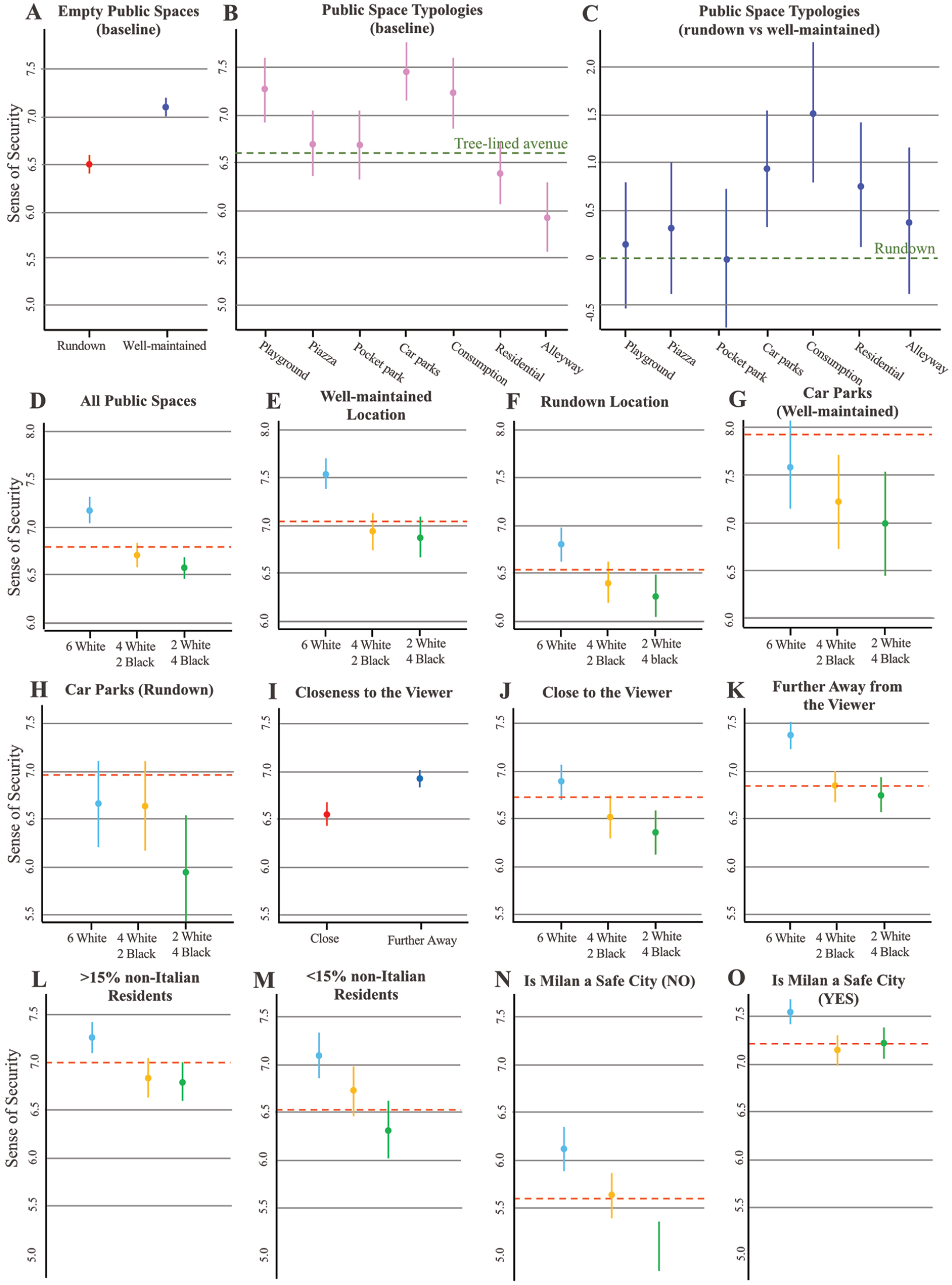
Sense of security in different settings populated by six people of varied ethnic composition.
Overall, our findings show that the difference in perceptions of security in ‘well-maintained’ and ‘rundown’ design’ scenarios is significantly different: the ‘well-maintained’ locations images received a mean score which surpassed by more than half a point the mean score of the ‘rundown’ locations. Therefore, this could be where one stops, concluding simply that the good design of public space produces the desired results of improving perceptions of security. However, in the next section, we look at the perceived level of security once the race of others in the public space is factored in.
Race and perceptions of security
The mean scores given to those scenarios in which only White populations appear show statistically significant perceptions of higher security than those with mixed populations (Figure 2(d)–(f)). Also noteworthy is that consistently having six White people in the image resulted in higher ratings for safety than the baseline image which contained no people. Here we find that despite their good overall results, well-kept, well-lit and well-maintained areas do not level out the impact of race. In fact, the increases in the areas deemed ‘well-maintained’ highlight the significance of race. The mean score difference between images with six White people versus the scenario with two White people and four Black people is significantly higher for ‘well-maintained’ locations. One possible reason for this links back to the notion of ‘othering’ whereby people who are considered outsiders in particular spaces are viewed with suspicion. Simply put here, ‘well-maintained’ areas may be viewed as the survey of White Italians. The significance is that urban renovations that merely seek to ameliorate design failings may entirely miss notions of inclusivity in public space.
This can readily be seen in the car park scenario where the incorporation of a tactical urbanism improvement acts to increase the mean difference between overall levels of safety perception in the scenarios of (a) six White and (b) two Black People and four Whites, compared with the rundown car park (Figure 2(g) and (h)).
We found that two other factors influenced the perceived safety of the images: that is, the closeness of the models to the viewer, and the relative positioning of those who were White and those who were Black. Analysing the effect of how close the models are to the ‘point of view’ related to the methodology’s reliability. If the presence of our Black models produces a lessened sense of security, we might expect this to be reinforced by closer proximity. First, testing for the general effects of proximity, we divided the location images into two groups: half with at least two people closer to the viewer and half with the models more distant. The results show that the locations with people closest to the viewer received lower scores, indicating a lessened sense of security given to the image (Figure 2(i)). This can be explained by a feeling of unease felt by the respondents when imagining themselves in proximity to strangers. Importantly, proximity had a racial dimension to it: images with White people close to the viewer were rated as safer when compared to those with Blacks closest to the viewer (Figure 2(j) and (k)).
We also considered selected characteristics of our participants, for example, whether our respondents lived in Milan and, if so, in which neighbourhood to see if this impacted their perceptions of security. While the impact of the city of residence appears to have little effect, a larger sample is needed to make a firmer conclusion. Where participants live in Milan, their neighbourhood of residence has an apparent effect. We subdivided the neighbourhoods into two groups: Those with more than 15% of non-Italian inhabitants, and those with less than 15% of non-Italian inhabitants. Those who lived in neighbourhoods with more than 15% non-Italians generally felt more secure, and even though race still had an impact, it was much less significant than for those living in neighbourhoods with less than 15% non-Italians (Figure 2(l) and (m)). This result seems to confirm that the less the ‘other’ is known or familiar, the more they are feared.
Finally, we can look at how participants’ responses correlate with their perception of whether Milan is safe (Figure 2(n) and (o)). An individual’s attitude towards the city’s level of security is a factor that strongly impacts both the perception of security and how different races are perceived. Those who feel that Milan is a safe city see all scenarios as safer and perceive little difference among the diverse racial compositions. On the contrary, those who feel Milan is not a safe city perceive all scenarios as less safe. Moreover, they feel less secure when there is a mixed population, particularly the two Whites and four Black people scenarios. The findings are very similar when we look at which of our participants thought fighting insecurity should be among the top three priorities for Milan’s administration. This question reflects a poll taken by the city to establish priorities for a future local plan (security was not voted into the top 10 priorities). People who agreed that fighting insecurity should be one of the top-three priorities perceived all the situations as less secure, and, again, according to them Black people populations make urban spaces less secure.
Those who think that fighting insecurity should not be a top-three priority not only perceive places as generally safer, but racial composition seems to have little to no impact. As this variable has such a strong impact on the perception of security, it would be interesting to dig deeper into the matter. It certainly indicates the importance of exploring with individuals their perceptions of insecurity because these can be overtly or covertly associated with race.
Discussion
Our findings show that the race of those in an urban scene is influential on the perception of security for our participants in Milan. The test could be replicated elsewhere to see if the results are similar. We have no reason to suspect that Milan is an exception. Where it is the case that race impacts perceptions of safety it illustrates that designers cannot be colour blind when seeking to design in a sense of security. This is not only important in itself but, also, because of the broader social context in which race and security is being brought together through right-wing populism. This will have local variation which we now consider briefly for Italy and Milan, and which sets the context in which urban designers will seek to take ownership of race in their practice.
As noted above, the national border has become a performative place of ‘taking back control’, symbolically and practically (Casaglia et al., 2020). While bordering may focus on the defence of national borders from penetration by racial ‘others’, the practices of bordering can happen away from physical borders (Özdemir and Ayata, 2018). In Italy, there is a distinct city dimension to bordering practices and the ‘narrating’ and ‘disciplining’ of racial minorities (Rossi, 2018). The ability to create new regulations has been passed to the local level leading in some cases to reactionary regulation aimed at immigrants (Marchetti and Molteni, 2013; Pitch, 2013) that is framed discursively as a fight against degrado (decay) – echoing the broken windows policing of Giuliani’s New York, which also targeted ‘people of colour neighbourhoods’ (Fagan and Davies, 2000). Concerning this, Fabini (2015, 2019) argues that ‘local’ bordering practices control the access to the city of the ‘undesirable’ (non-)people where skin colour and age are sufficient conditions to appear disorderly and so to be stopped by police (Fabini, 2015; Palidda, 2000) with North Africans and Sub-Saharan Africans more likely to be asked for documents (Fabini, 2015). The argument echoes the experiences from the United States where people of colour were perfectly aware that in the attempt to bring civility to the city, they would be seen as the problem (Lundsteen and Fernández González, 2020; Smith, 2001: 70).
In Milan, in 2007, mayor Letizia Moratti (Forza Italia) called for a street demonstration to raise public awareness on the issue of urban safety and demanded more powers for local councils to regulate antisocial behaviour (Molteni, 2012). The government produced a ‘security package’ that enabled mayors to implement local ordinances in the matters of urban safety and security, initiating the ‘season of ordinances’ in the period 2008–2010 (Molteni, 2012). The ordinances aimed to address degrado (decay) and restore decoro (decorum) by removing the undesirable features of the city and cleaning it. Notably, these features included not only physical objects like rubbish, graffiti or broken street furniture but, like most places that adopted a zero-tolerance approach to public behaviour, separated the population into ‘good’ and ‘bad’ – those to be protected and those to be disciplined – those who are normal and acceptable and those who are different – the ‘other’ (Pisanello, 2017; Pitch, 2013).
In Milan, Riccardo De Corato, vice-mayor and security deputy in the Moratti council, was explicit in linking criminality and race but went further by acknowledging that the perception of criminality is as important as the reality when making racial minorities a ‘problem’ for the city, There haven’t been any actual episodes of criminality since 1998 [. . .]. The problem is the vast number [of racial minority people], which is becoming unbearable. In via Padova, nothing happens, but the old lady who sees 100 people of colour in front of the phone centre is scared. It’s a matter of perception, it's just how it fucking is. (Molteni, 2012, authors’ translation)
De Corato’s statement provides two crucial windows into our research. First, his frankness offers a clear link from security and race-based national bordering to a racially infused city management concerned with security. Fear is not of actual crime but, rather, fear emerges from the elision between migrants (frequently perceived as a proxy for race) and criminality. If black and brown people are present, so too must there be the potential for crime. Second, this is self-reinforcing as the more people perceive there to be issues of safety the more security becomes an issue (Castel, 2002). The outcome is, as De Corato crudely puts it, that whether there is crime or not, the mere presence of people of colour strikes fear in our eponymous old lady.
Insofar as urban design guidance and practice promote predominately physical measures that design out crime without recognising race, this fails to challenge the existing conscious or unconscious bias at the personal level and which our research reveals. This is reason enough to call for a more race aware practice. But, as we have discussed in the case of Milan, the challenge for urban design is to expose and confront individual biases that link race and security with the aim of preventing them from being further fuelled by right-wing populist agendas.
Conclusion
Claims for urban design have often been asserted rather than proven through rigorous testing. Using a randomised control trial, we find support for the claims of urban design. We show that design interventions can make people feel more secure. In short, better design and ‘eyes on the street’ appear to be a sensible conclusion. However, like many simplified solutions to ‘wicked problems’ the finding manifestly is lacking in contextualisation or causal inference as to why this may be. Therefore, we argue that stopping here is dangerous.
By analysing this finding further and trying to understand causality, we see that design has a weak effect and that they ‘eyes’ observing the street are highly racialised. Respondents felt more secure when the people that they observed were White, they felt less secure the more racially mixed the population became and when racial minorities were more prominent, closer to the observer the sense of security decreased. Bluntly race mattered.
Treating design interventions as if they are solutions to our end goals of convivial social spaces full of harmony and security leaves a gaping hole in our understanding of what creates security in the minds of local populations. Passive surveillance, lighting, upkeep and clear sightlines may all be important to a degree but focussing only on this without comment on how this can create a divide between legitimate and illegitimate users of public space provides an inroad for populist race-based discourses of security, reinforcing the arguments of populist politicians. We, therefore, argue that urban designers must adapt their practice to focus on who is determining which spaces are and are not secure and on what basis they are doing so. Similarly, ignoring how individuals assess security in public space through the lens of race would passively support discrimination by failing to acknowledge and challenge it actively. The research method presented here offers a tool that designers could employ to make explicit the connection between race and security and draw critical attention to the practice.
Our test was undertaken in Milan but could equally be applied elsewhere to evidence whether the race-security nexus in public spaces is significant. Where this is the case, we argue it is beholden on urban designers to seek to challenge race-based perceptions of security. Moreover, the exploitation of race by right-wing populists is not unique to Milan/Italy and therefore urban designers must be sensitive to context, to national and local political discourses, as they seek to challenge the race-security nexus. An urban design practice that makes explicit the function of race in secure public space offers an opportunity to push back against right-wing populist practices of bordering and city management rather than risk being appropriated by them.
Footnotes
Declaration of conflicting interests
The author(s) declared no potential conflicts of interest with respect to the research, authorship and/or publication of this article.
Funding
The author(s) received no financial support for the research, authorship and/or publication of this article.
