




Abstract
This article explores the role of contemporary urban redevelopment in invoking a renegotiation of citizenship. There has been a wide acknowledgement that neoliberalism is a political project involving transformations in the state–market–citizen relations. However, the scholarly emphasis on market-led principles in remaking places and people falls short of acknowledging political aspirations and struggles that intrude in processes of inclusion and exclusion at the city scale. Focussing on the case of Turkey, where neoliberal urban policies and practices have been linked to the central government’s political ambitions, the article illustrates that urban redevelopment projects help the state actors realign citizenship with the authoritarian regime. A focus on the state-led urban interventions from the perspective of bordering the ‘good citizen’ suggests that neoliberal urban redevelopment projects are mobilised by the state to promote official citizenship agendas. Drawing on in-depth interviews, photos and observations from 9-month fieldwork in Dikmen Valley (Ankara), this article ethnographically documents how the ideals of the ‘good citizen’ in an authoritarian context differ from the market-led promotion of consumerist, aspirational and active citizens.
Introduction
Society and urban space have been progressively layered along visible fault lines since neoliberalism has become the hegemonic ideology and policy framework unevenly shaping cities worldwide. Profit-seeking urban redevelopment programmes instrumentalise physical and perceptual borders so as to open up inner-city spaces for consumption and investment purposes (Spierings, 2012). These borders notably separate valued consumers from those who fail to conform to the profitability criteria of the market, and the ‘nonprofitable’ groups find their presence in the central city increasingly untenable (Hubbard, 2016: 666).
There has been a wide acknowledgement that neoliberalism is a political project (Wacquant, 2010) involving transformations in the state–market–citizen relations. The critical urban studies have discussed the role of urban redevelopment and gentrification policies in cultivating the ‘good citizen’ project of neoliberalism. This scholarship shows that neoliberal urbanism prioritises remaking subjectivities, as well as places, that are regarded as problem (see Ferguson, 2010; Paton, 2010, 2014). Market-led processes underpin state-led interventions in the urban space to transform ‘problem places’ into sites of active consumption (Paton et al., 2012: 1470). The argument is that these interventions generate a politically instilled framing of citizenship that distinguishes between ‘good’ and ‘bad’ working class (Koster, 2015: 217) and attempt to shape their behaviour according to what is thought to be good, appropriate and responsible conduct (see Gray and Mooney, 2011; Stapper and Duyvendak, 2020; Ward, 2003). In the UK context, for example, gentrification targets ‘civilising’ working-class subjectivities by inciting their aspirations to become more like middle classes and encouraging consumer behaviour (Paton, 2014; Paton and Cooper, 2016). It helps realign their identities with the ‘good citizen’ ideals of neoliberalism by promoting active, responsible behaviour and, in terms of tenancy, privileging homeownership over renting (Miles, 2012; Paton et al., 2012). These are usually undertaken by the state through opening the way for regeneration through fiscal and regulatory policies that restructure the housing market and attempts at shaping dispositions and politically steering the urban and regional planning (Wacquant, 2008: 202–203). Also, by mediating the regeneration of public housing stock (Watt, 2020), it may facilitate reversion of welfare entitlement and legitimisation of practices around possession (Paton and Cooper, 2016).
Despite addressing the interventions in subjectivities that represent the complexity of bordering processes and strategies, these debates remain market oriented. But scholars from both Global North and Global South discuss that political goals can be integrated into the neoliberal urban and housing policy. For example, in the case of Dutch urban policies, the state’s goals to safeguard the economic functioning of cities and concerns with national unity and integration coexist. The ‘civilising offensive’ (Uitermark and Duyvendak, 2008: 1489) targets de-concentrating minority ethnic groups through creating mixed neighbourhoods, which also serves inciting working-class consumerist aspirations (see also Uitermark, 2014). Similarly, Eraydın and Taşan-Kok (2014) examine how the authoritarian government’s political ambitions to transform the society shape the reallocation of urban resources in a way that favours pro-government social groups, including some segments of the urban poor, in Turkey (see also Demiralp, 2016). More recent studies have also shown that economic goals are not the only or the most important motivations behind urban policy. States might have explicit demographic purposes, such as in Israel (Shmaryahu-Yeshurun and Ben-Porat, 2020) or can use inclusive urban redevelopment programmes to control and dominate, as in some African and Asian cities (Goodfellow and Jackman, 2020).
This article aims to draw on and shine new light on these debates on state implementation of neoliberal urban policy by focussing on its implications for citizenship. The argument made is that urban redevelopment projects not only fit into neoliberal goals but are also mobilised by the authoritarian state to shape the ‘good citizen’. Drawing on an understanding of borders as ‘devices of inclusion that select and filter people . . . in ways no less violent than those deployed in exclusionary measures’ (Mezzadra and Neilson, 2013: 7), I will show how state-led urban redevelopment projects can generate exclusionary meanings of belonging in the nation. I will focus on Turkey where cities have been reconstructed according to the government’s ambitions for a broader socio-political transformation in ways that combine economic neoliberalism with increasing social control, restrictions, penalisation and exclusion of certain social groups (Eraydın and Taşan-Kok, 2014: 111). Using data from 9 months of fieldwork in the Dikmen Valley (Ankara) in 2015, I will ethnographically document competing notions of good citizenship, defined as ‘obedience’, ‘civility’ and ‘loyalty’, which are mobilised by different actors. Connecting citizenship studies and urban redevelopment using the lens of bordering, I will discuss the need to think urban space and its redevelopment as a medium to border the ‘good citizen’.
The next section will set the theoretical framework of the article drawing on citizenship studies and border studies. It will be followed by a brief background of urban redevelopment in the Turkish context and then the details of the method and the case study. The empirical findings will be presented in three subheadings highlighting different, competing practices of bordering the ‘good citizen’.
Remaking the boundaries of citizenship through the city
Citizenship indicates a status in the sense of value, worth and honour, which is not secured by officially acquiring citizenship, but rather, the entry to the community of value is defined in explicitly normative ways (Anderson, 2012). Thıs makes citizenship fundamentally exclusionary, as it is measured against not only ‘them there’ but also ‘them here’ (Painter and Philo, 1995: 112). Thus, the question is not so much ‘what is citizenship?’ but rather ‘what is called citizenship?’, as Isin (2009: 369) argues, to understand definitions of who belongs and who does not, and what are the minimum common grounds (in terms of origin, culture and normative behaviour) that are required to signify belonging (Yuval-Davis, 2006: 207). De Koning et al. (2015) introduce the concept ‘citizenship agendas’ to explore the normative framings of citizenship that prescribe what norms, values and behaviour are appropriate for those claiming membership of a political community.
Strategies of framing the ‘good’ citizens take place both at the spatial scale of states and also within them. Urban contexts reveal much about the rationales and mechanisms behind bordering processes (Scott and Sohn, 2019) and have been central to how the meaning of citizenship is constructed (Staeheli, 2003: 99; see also Holston and Appadurai, 1996; Isin, 2008). Claims for rights raised in the neighbourhood, in the city and the urban region (Purcell, 2003) have become mediums of constructing not only a new city but also a different order of citizenship (Holston, 2009: 246) that goes beyond the formal-legal status that is less vital for access to substantive rights. Simultaneously, shifting boundaries of urban citizenship may also draw the line between insiders and non-citizens as outsiders even more strictly (Fauser, 2019: 610).
Moving from that, this article will examine how urban redevelopment-led competition over the renovated city space invokes struggles over citizenship. This will be analysed focussing on shared understandings regarding who can be accepted as a worthy, valuable and responsible member of an everyday community of living and working (Painter and Philo, 1995: 115). By examining struggles over ‘good’ citizenship through the medium of urban processes and contexts, the article will shed light into how the reworking of social and cultural borders at the city scale are connected to the ‘good citizen’ project of the state, rather than the market.
Urban redevelopment as a means to communicate the ‘good citizen’ project of the state
Since coming to power in 2002, the governing method of the AKP has relied on an increasingly incommensurable citizenship regime based on explicit boundaries between good and undesired citizens. In line with its growingly authoritarian agenda, the Turkish state imagined good citizens as obedient and loyal to its authority and policies. One of the main channels to communicate the state citizenship agenda has been urban and housing policy. In 2004, the Turkish state embarked upon an ambitious programme of urban redevelopment to clear informal housing and redevelop the lands via public-private partnerships (Arslanalp, 2018). This country-wide campaign was framed as the driving force of economic growth. According to the official narrative, it would revitalise businesses and provide jobs, help create physically upgraded and properly planned cities without informal substandard housing and expand the supply of affordable formal housing for low- and middle-income groups (TOKİ, 2011). The narrative of modernisation and progress was used to legitimise an increasingly aggressive centralisation of power (Batuman, 2018; Eraydın and Taşan-Kok, 2014; Kuyucu, 2018; Penpecioğlu, 2013; Tansel, 2019). Central state institutions such as the TOKI (Mass Housing Administration) were granted unmonitored excessive financial and decision-making authority to undertake urban renewal projects. As a result it became exempt from parliamentary oversight and auditing as it took orders directly from the Department of the Prime Minister (Kuyucu, 2014: 616).
With large-scale redevelopment projects, the government promised not only new, modern units of housing but also a sense of entitlement to the prosperous, modern nation that was to be constructed. As Koster and Nuijten (2012) discuss in the Brazilian context, such projects come full of promises of modernity that generate strong aspirations in slum dwellers for a better future and social inclusion as citizens (p. 177). They argue that these enable the disenfranchised slum dwellers to imagine a future in which they would be redeemed through becoming part of the dream of progress (Koster and Nuijten, 2012: 186). However, Corporate Profile of TOKİ (2011) shed light on a different aspect of these projects, which concerns governing state–society relations: TOKI acts with a whole-encompassing vision concerning modern urbanisation. We aim to contribute to consolidating the notion of a welfare state . . ., formation of a state structure that serves its poor citizens with justice and compassion and strengthening the trust of law-abiding citizens in the state. (TOKİ, 2011: 13)
As this quotation reveals, urban redevelopment projects helped the government to reclaim the legitimacy of the state as the main actor that is responsible for setting the common good and working towards the welfare of its citizens. Thus, citizen participation was sacrificed for the sake of urgent implementation of urban redevelopment projects, and citizens were expected to cooperate, rather than negotiate or object. Moreover, despite generalised goals of progress and welfare, the promotion of urban redevelopment projects was done in a way that cultivated exclusionary understandings of belonging and deservingness. In a speech in one of the turnkey ceremonies in February 2013, the then President Erdoğan explained in detail the meaning of urban redevelopment projects that is much broader than providing people with better housing: We are demolishing because as you see we are developing and will develop much better. Not with force, not with the police but we are undertaking these demolitions with the consent of the residents . . . All over Turkey, there are some opponents of urban redevelopment projects, led by the main opposition party. They are trying to disrupt this very important transformation process saying ‘don’t touch my house’!. The main opposition party, its partner organisations that are extreme leftist, and terrorist organisations oppose this transformation for obvious reasons, claiming that it victimises people. What they actually want is to maintain the existing system in which they exclude the nation from the decent living conditions they have enjoyed. The main opposition has always sought to monopolise all the privileges. Therefore, with this urban transformation we are annihilating a degenerated order in Turkey. (Sular, 2013)
From a populist antagonistic division between ‘us’ and ‘them’, the government derived official ideas regarding who is entitled to belong in the ‘new Turkey’ under their socio-political transformation project. Erdoğan drew on the old forms of political polarisation between elites and the allegedly exploited and marginalised nation to introduce the boundaries of his desired political community. This distinction between ‘us’ and ‘them’ became more manifest in the urban redevelopment policy in 2011 onwards when the governing AKP won the national elections the third time successively. While obedient and loyal behaviour was encouraged, dissent or opposition to the projects was essentially viewed as a disruption of the state’s benevolent efforts of ‘building the future of Turkey’ (TOKİ, 2011). The latter was criminalised through a series of legal regulations including the Law on the Transformation of Areas under Disaster Risk, enacted in 2012, and entailed the denial of utility services in areas deemed risky (Sehir Planlamacilari Odasi, 2012). Alongside an economic restructuring, the urban and housing policy was thus integrated into a broader political project through which the Turkish government shaped the ‘good citizen’, based on obedience and loyalty, rather than consumerist aspirations. Below I will draw on in-depth interviews, ethnographic observations and photo-elicitation, and discuss how these new fault lines separating ‘good citizens’ were invoked and negotiated through urban redevelopment in ways that coexist with and diverge from market-imposed hierarchies.
Case study and methodology
The Dikmen Valley was one of the largest squatter housing areas in the capital Ankara, hosting approximately 10,000 people in 2000 dwellings (Eğercioğlu and Özdemir, 2006: 8). The housing and urban redevelopment project started in 1989 proposing a relocation model based on self-financing. The new luxurious housing units were marketed, and the money was used to resettle squatter dwellers in affordable apartments in the area (Uzun, 2005: 188). The project was planned to be implemented in five stages (see Figure 1). It targeted integrating the former squatter dwellers resettled in the east and the upper-income groups in the west by connecting them with a two-storey bridge hosting social and commercial facilities such as a cinema, retailers and cafes (Eren, 2016: 67). The first two stages were in accordance with the original plan, and squatter dwellers attended face-to-face meetings with the municipal construction company and got organised in state-led cooperatives (Türker-Devecigil, 2005). The main purpose of these meetings was to inform the dwellers about the project, their rights, expropriation costs and so on while the Greater Municipality was the final decision-maker. Thus, the participation principle was implemented in a way that represents ‘top-down, hierarchical, and expert-driven structure of the urban decision-making process in Turkey in which citizen participation is allowed only after the plans are prepared’ (Gunay, 1992 cited in Türker-Devecigil, 2005: 172).
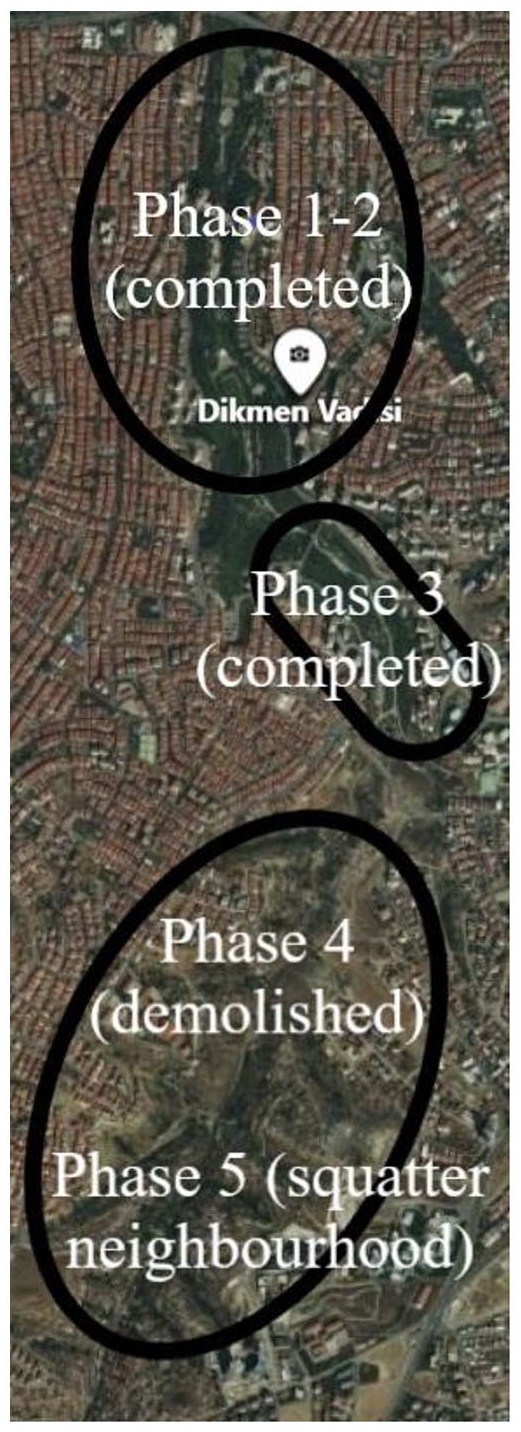
Dikmen Valley urban redevelopment and housing project area as phases.
In 1994, the mayor of Ankara Metropolitan Municipality changed following the local elections. This was an important turning point for the Dikmen Valley Project as the new mayor was from AKP, the ruling party since 2002. Following that, the initial rehabilitative approach was replaced with more explicit concerns of profit-making and consultation meetings with the squatter dwellers were cancelled. Land earmarked for municipal services such as parks in the remaining three stages of the project was re-designated as residential land and progressively more luxurious housing started to be constructed. Following the changing housing policy from 2004 onwards in particular, a demolition-relocation scheme (in peripheral mass housing units) was introduced replacing the initial goal of social integration with social segregation.
During fieldwork in 2015, 1 there was a complex tenure structure in the valley, including affluent middle-class individuals living in highly secured apartments, white-collar professionals in high-rise, mixed buildings in the first three phases and approximately 600 squatter dwellers mostly lacking legal title deeds in the unfinished part. Some dwellers in the last group had been leading a right to shelter struggle since 2006 against forced relocation and long-term indebtedness imposed by the municipal agreement. This multi-layered and heterogeneous demography form a valuable laboratory to move beyond the homogenising logic of the market that assumes impermeable boundaries between beneficiaries and victims of urban redevelopment.
Over 33 weeks commencing on 15 January 2015, I conducted ethnographic fieldwork 2 in the Dikmen Valley Housing and Urban Development Project area. I undertook weekly visits to the squatter neighbourhood in the fifth phase of the project area to attend the community meetings and observed the patterns of interactions within the activist group, which helped me build rapport with leading activists and long-time residents. I used my own network to access middle-class residents, and then they referred me to their neighbours. I conducted semi-structured interviews with 26 squatter residents lacking legal title deeds of the land/housing and involved in the right to shelter mobilisation, and 29 middle-class residents (20 owner-occupiers and 9 tenants) 3 living within the second and third phases of the project area or the neighbouring Oran district in which the progression of the Dikmen Valley project triggered regeneration.
During the interviews, I asked people to describe their residential history, their housing and locational preferences, their social networks and relationships, their relations to the neighbourhood and the city, and their thoughts about the ongoing redevelopment project in the valley and beyond. I used photo-elicitation in middle-class interviews as I did not have a chance to observe them like the squatters. I showed them photos I took in different phases of the project area to encourage them to comment about the project’s progression and the ongoing squatter activism, which would be a topic to be avoided within the increasingly polarised socio-political environment.
The transcribed interviews were coded inductively, and then grouped according to themes. In analysing the data, I took a relational ethnographic stance, which focusses on processes involving configurations of relations among different actors or institutions (Desmond, 2014). I analysed such processes that reconstitute boundaries between multiple actors ‘occupying different positions within the social space and bound together in a relationship of mutual dependence or struggle’ (p. 554). This ethnographic work enabled me to observe how the upper- and lower-middle classes and squatter residents negotiate with in/exclusion in urban redevelopment settings. Due to the promotion of urban redevelopment campaign as a means to national pride, development and modernisation, the city scale became a useful lens to explore negotiations of national belonging. Moving from that, I will discuss below how the competition over renovated city space paves the way for reframing the shared understandings regarding the ‘good citizen’.
The city for the ‘civilised’ citizens
The government’s commitment to build the new Turkey and terminate ‘the order of the squatters’ (Övür, 2008) appealed to the owner-occupier middle-class residents living in the second and third phases of the project area. These discourses reactivated their long-lasting aspirations to live in a modern city, of which they are the legitimate residents. Squatter communities were traditionally imagined as ‘peasants’ undermining the urban/modern way of life while also disturbing the dream of planned cities as beacons of modernity through the squatter houses mushrooming on the city’s outskirts (Erman, 2012: 299). The urban elites looked down upon squatter communities, regarded as ‘ignorant’, ‘culturally backward’ masses ‘lacking manners’ disrupting the social order (Erman, 2001: 991), which was still prevalent in their shared imaginations. When I showed her the below photo of a building in the third phase originally constructed to resettle former squatter dwellers (see Figure 2), Leman, an owner-occupier in a non-gated building, immediately assumed that former squatter dwellers must still be living in that building when she saw the laundry hanging from two balconies (see Figure 2). She commented, These are the remnants of the squatter culture; they are an offence to the eye. We dry the laundry in our drying racks inside the house. Today, there must be nobody left without a drying rack in houses of that kind anyway. (3 April 2015)
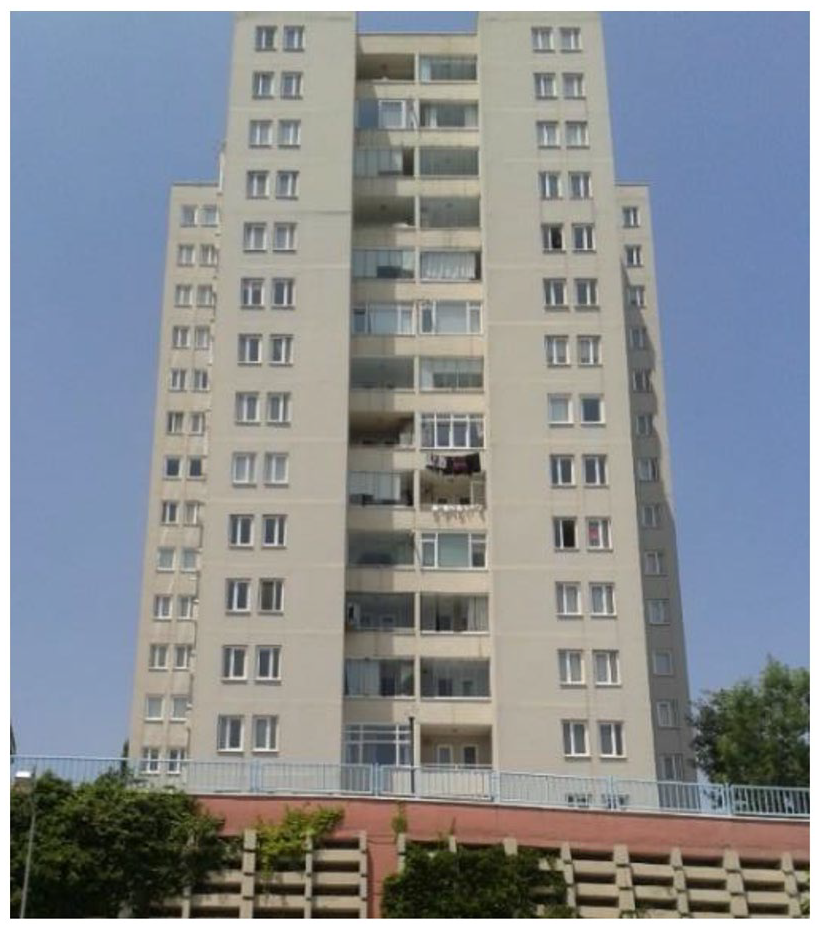
This building was constructed to resettle the former squatter dwellers in the third phase of the project area. Note the laundry hanging from two balconies.
The emphasis on cultural divisions not only highlight the prevalence of class antagonism but also demarcate particular norms and behaviours that are regarded acceptable within the city, that is, the boundaries of urban citizenship. The latter reflects shared understandings regarding who is capable and worthy of membership to the community of value at the city scale. Squatter dwellers lacked the manners of appropriately being present in the shared urban space, as shown by the citation by Berkay, an owner-occupier in a prestigious gated estate: The people who lived in the valley at the time, their children and nephews, were probably used to this area so much that they still come to the valley in the evenings, park their cars, and sit for hours . . . I think it might be because of their habits because this is not the best place in Ankara. There are so many other places to go; I mean, what is the point that you come here to enjoy yourselves? Besides, this is not a place to have fun; there is only sightseeing. At best, you come, take photos for two minutes and leave. But they park their cars and sit there for hours and hours. This started to be a very disturbing situation. (11 August 2015)
This citation manifests an ongoing border struggle since Berkay understands the act of those male groups as border crossing. This fuelled explicit demands of a highly surveilled urban space in which behaviours deemed inappropriate are policed, as he added: Usually, the police walk around and cleanse the streets . . . I mean, do not usually allow people to listen to loud music or drink alcohol on the streets and disturb other people, but for some reason, they never come to our neighbourhood, never! (11 August 2015) (see Figure 3)
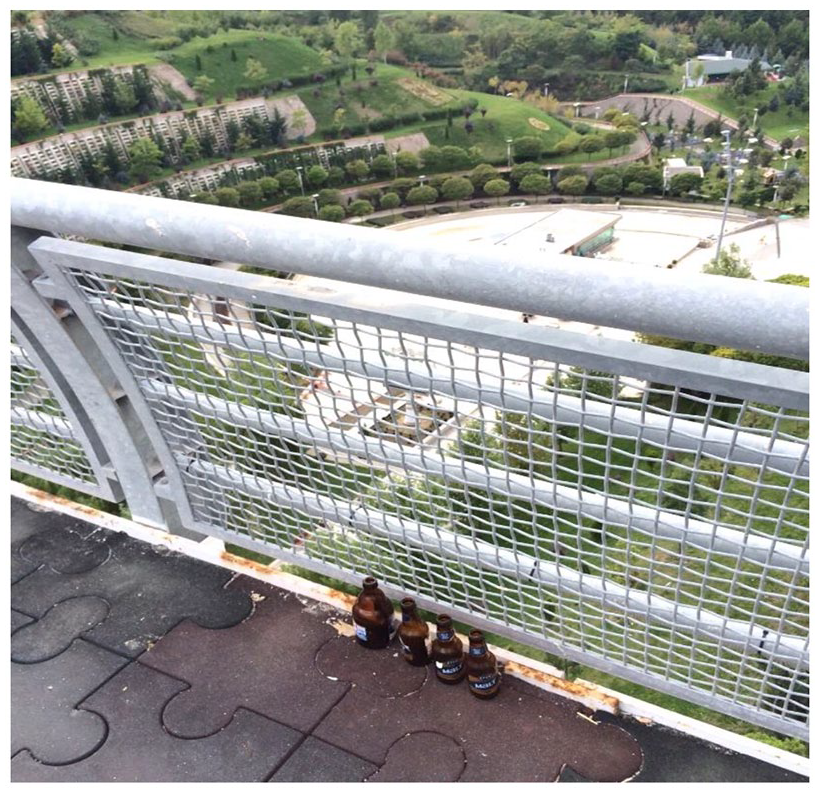
A photo taken by Gozde, who complained that despite the high management fees she pays, the security was not perfect in the valley as young male groups hang around drinking alcohol. She sent me this photo to demonstrate the things she did not like about her neighbourhood.
The urban community of value was defined on the basis of middle-class modes of living and being present in the city and those regarded ‘uncivilised’ should be removed. Hazal suggested that the state should convince rather than force squatter communities to move out, as the latter only leads to opposition, and thus, delays in the projects (Interview, 12 October 2015). Berkay similarly proposed resettling squatter dwellers ‘in the outer city’ and these could be in ‘luxurious apartments’ (Interview, 11 August 2015). What mattered for these affluent participants was swift implementation of urban redevelopment projects rather than housing rights and who gets what. Urban policy was seen as a technical tool that can be used to bribe particular groups as long as it serves wider purposes, that is, modernising the city.
Some participants had sharper ideas of who belongs in the modernised city and supported the use of urban and housing policy to punish and discipline law-breaking citizens, namely, the squatters. Nagehan supported urban redevelopment projects in principle but objected to the recognition of squatter dwellers as right holders within project areas as they were illegally occupying the land. Nilgun referred to squatter communities opposing to redevelopment projects saying that they were undeserving to be included as what they did was to ‘talk back to the state’ for giving them a smaller share from the rental gains offered by the projects (Interview, 25 July 2015). Hakan, an owner of a construction company, commented that ‘the land belongs to the state, and the authorities may even cut off the electricity and water in the opposing neighbourhoods’ (Interview, 12 September 2015).
These citations signify a particular imagination of the city as a bounded and uniform space to which only the law-abiding, middle-class residents are granted access. Claiming to be members of the community of value, these affluent participants expected urban redevelopment campaign to purify the city space through state-led implementation of large-scale projects. Viewing the state as the primary actor in reallocating resources and people in the city, they denied the agency of squatter communities in terms of claiming and negotiating their rights to the city. This is interconnected with the wider social and political context, in which the state remakes the urban space in a top-down manner in accordance with its citizenship agenda that depends on passive, obedient citizen behaviour and the marginalisation of rights-based claims.
The city for the ‘loyal’ citizens
In the squatter neighbourhood in the Dikmen Valley, a right to shelter struggle continued since 2006. It enabled them to negotiate the greater municipality about the progression of the redevelopment project and the resettlement terms imposed on them. At the same time, however, they were struggling with physical decay, feelings of displacement and exhaustion, and intensifying state stigmatisation.
The struggle became a milestone in shaping identities as equally worthy citizens, as was revealed by the below excerpt from an interview with Haydar, a leading activist:
Following the municipal announcement in 2006 of the fourth and fifth phases of the project without notice, some households came forward and mobilised what could initially be regarded as a self-interest movement (Eraydın and Taşan-Kok, 2014: 120) to stop forced eviction and renegotiate the terms of their inclusion in the project. However, the support from left-leaning activists (People’s Houses 5 ), voluntary lawyers and civil society associations helped them configure themselves as rights-claimants, rather than submissive villagers.
Almost all participants highlighted that ever since they arrived in the city, they have contributed to the urban society through maintaining the territory in the absence of infrastructure and formal municipal services. Their strong claims over the land and housing dwelled on their long-lasting, unpaid labour, the lack of which they argued would have let the area suffer from decay. Nevertheless, the state was still powerful in shaping their identities as in most interviews, people attempted to prove themselves worthy to be included in the urban redevelopment processes. ‘Neither villa nor palace, we demand a place to live’, a very popular slogan of the struggle, for example, emphasised their limited aspirations. Gulsen defended her opposition saying that: ‘My illegal squat is worth 40–50 million Turkish liras, but the illegal palace of the President costs billions!’ (Interview, 8 February 2015). In that, she derived legitimacy, not from her denied right to affordable, decent housing but a morally legitimised claim founded on her modesty as opposed to the growingly luxurious and corrupt urban governance (Yardimci, 2018: 168). By doing so, she undermined their rights-based claims to the land and housing, replacing it with a demand to be recognised as a deserving citizen.
Their claims over housing rights based on inhabitation and maintenance of the lands were shadowed also by their emphasis on patriotism and nationality. During unstructured chats with male groups before weekly meetings, I was told stories of how their grandfathers fought for their country in the Turkish War of Independence and how the men in their families all completed compulsory military service. Some participants explicitly based their claims to deservingness on nationhood. For example, Kardelen asked me reproachfully, ‘OK, let them demolish our houses, but where will the Turkish nation living in squats go? Where will these Turkish citizens go?’ (Interview, 22 February 2015). A group of women I interviewed likened the interventions of the riot police in their neighbourhood to the Israeli military attacks on the Palestinian people and commented that it was as if they were ‘citizens of a foreign country’ (Interview, 8 February 2015). Aysel more explicitly referred to exclusion of the insurgent citizens as opposed to the state’s allegedly protective approach towards the Syrian refugees by saying: I mean, I can’t say that I have a state as it doesn’t protect its citizens or people. . . They come from a foreign country, invade my country, whereas I am beaten and oppressed by the state in my own country! (1 February 2015)
These citations reflect shared ideas defining the community of value that are moral modesty, patriotism and loyalty to the nation and the state rather than citizen rights, which is parallel to the state’s growingly authoritarian citizenship agenda.
Disengaging from the community of value
There emerged a third group of residents, that is, less affluent and politically unfavoured segments of middle-classes. Raised by public servants, who invested in their children’s education that once promised upward mobility, they all had bachelor’s degrees in notable universities in Turkey and a master’s degree from abroad in a Western European country. With no possessions or wealth inherited, they were either tenants or had purchased an apartment in non-gated buildings before the 2007–2008 financial crisis using bank credits and savings of their own and family members.
Despite expectations from the state goal to modernise cities, these participants were disappointed by the use of urban policies as a corrupt source of profit in a way that promotes paternalistic redistribution schemes. For example, the recent changes in the state’s squatter policy were related to the increased levels of potential rental gains that should not be left to the squatter communities (Bora, Interview, 11 March 2015) and government’s redistribution of valuable urban lands among their clientelist circles (Umay, Interview, 26 May 2015). They viewed urban redevelopment as a political rather than a moral issue, as it involved encouraging more entrepreneurial behaviour through top-down decisions that serve a close-knit circle of pro-government actors. A feeling of ‘entitlement to live in prosperity and luxury without the means to afford them’, was being promoted mainly through media, as Aynur put it (Interview, 2 July 2015). Kivanc acknowledged the temptation of the promotion of homeownership through housing credits but thought that this was likely to put low income families’ future at high risk as they do not know how to manage debts other than by taking more credits (Interview, 1 July 2015). However, while the new mass housing units offered better infrastructure, healthier living standards and presented a relatively tidier image, which ‘maybe felt more developed’ (Bora, Interview, 11 March 2015), they looked like ‘ghettos in which people are enclosed’, (Deniz, Interview, 3 June 2015) or ‘put in a cage’ (Ceylan, Interview, 19 February 2015). Rather than these top-down initiatives, these participants supported participatory methods that take the consent of the squatter communities and their lifestyles and needs into account. For example, Oktay suggested unanimous rather than majority vote should inform decisions about redeveloping squatter areas and resettling the residents (Interview, 11 September 2015). In contrast to above cited normative definitions of who belongs in the urban community of value, these individuals proposed a rights-based approach to housing and the city.
Unlike more affluent participants and squatter dwellers, this group had neither a sense of ownership of the neighbourhood they lived in nor a desire to invest in it. Being a resident in the same apartment for 12 years, Ceylan did not develop any close relationship with her neighbours, never attended annual community meetings, and always gave power of attorney to the elected manager of the building. Deniz and Umay were living in the same building and shared a lack of knowledge regarding other neighbours. Neither felt any attachment to the street or the neighbourhood as they commute to work by car, do their shopping from large malls, and socialise in districts occupied predominantly by secular, Westernised adults such as Tunali Hilmi and Çayyolu. For these women, it was a choice not to engage with the people in their building and neighbourhood as they felt being judged (Ceylan, Interview, 19 February 2015) and ‘neighbourhood pressure’ (Umay, Interview, 26 May 2015). Refraining to private spaces and homogeneous bubbles, they had relatively restricted ability to appropriate the neighbourhood and the city space.
This disengagement from the neighbourly relations can be read as an indicator of their eroded sense of belonging in the broader community of value. Umay mentioned the social exclusion people like her had to face that restricted their career progression and comfort in social life because of not being pro-government. She said that, had she not been married then, she would have never returned after completing her master’s degree in the United Kingdom, where people do not interfere in others’ lives (Interview, 26 May 2015). Similarly, throughout the interview, Ceylan told me in detail her dreams to live in one of the Nordic countries, where ‘you can live without engaging with and being judged by other people while enjoying high levels of social welfare’ (Interview, 19 February 2015).
These discussions demonstrate how urban redevelopment-led competition over the city is intertwined with reframing the community of value. The state use of neoliberal urban policy mediates mobilisation of competing notions of belonging and citizenship based on obedience, civility and loyalty/patriotism. In contrast to the normative framings of citizenship, less affluent and some politically unfavoured segments of the middle classes refer to rights-based approach to housing and the city. The absence of exclusivist claims over the neighbourhood can be parallel to their eroded sense of belonging in the wider community. Thus, the practice of bordering in the Dikmen Valley differs from the market-imposed social boundaries that prioritise ‘consumer’ (Paton et al., 2012) and ‘aspirational’ citizens (Raco, 2012) in advanced capitalist contexts. These discussions indicate the significance of the city scale in invoking new borders of deservingness to belong in the citizenry that diverge from the market-imposed hierarchies favouring the ‘profitable’ individuals.
Conclusion
Current urban redevelopment policies and practices articulate broader questions around citizenship, which is not restricted to market-imposed hierarchies. Research from both Global North and Global South supports this by showing how urban policies of de-concentration and integration are intertwined with ideas about citizenship (Van Eijk, 2009) and how the question of what citizenship means is being debated through the conflict over the use of urban (public) space (Anjaria, 2009). Similarly, this article reveals that state-led urban redevelopment policies shape ideas regarding who can be regarded as the ‘good citizen’ and who cannot. Focussing on the regulatory functions and the symbolic power of the border (Mezzadra and Neilson, 2013: 8), this article ethnographically documents how the ideals of the ‘good citizen’ in an authoritarian context differ from the market-led promotion of consumerist, aspirational and active citizens. Strong claims over the neighbourhood and the city are linked to expressions of anxieties about the ‘other’ invading ‘our’ neighbourhood and/or city – such as the ‘uncivilised’ squatter or the Syrians. However, absence of exclusivist claims can be an indicator of an eroded sense of belonging to the community of value, as is shown by the disengagement of some politically unfavoured, lower middle classes from their intimate geographies.
Moving from that, I argue that the contemporary urban redevelopment practices and policies should be viewed as a bordering practice to remake citizenship in accordance with the state’s political aspirations. This article is thus a reminder of the importance to take seriously the autonomous logic of state interventions, rather than seeing state actions as necessarily tied to the dynamics of capitalist accumulation (Parnell and Robinson, 2012: 597). This also requires attention to the agency of different individuals in making claims over neighbourhood and the city in ways that are not restricted to negotiating with attempts of neoliberal governmentality to align their subjectivity with the market logic. Instead, what we see is that the citizenship is reframed with reference to competing ideas of deservingness and moralities manifested through the medium of the city. Further research on the role of the city space as a medium of reconstructing citizenship, rather than capital accumulation, can provide deeper insights into the ways of contesting the functioning of borders within growingly authoritarian and populist regimes.
Footnotes
Acknowledgements
The author would like to thank Daryl Martin, Gareth Millington, Nancy Holman and three anonymous reviewers who read the earlier versions of this article for their much needed comments. The author is also grateful for all the research participants for sharing their stories with the author.
Declaration of conflicting interests
The author(s) declared no potential conflicts of interest with respect to the research, authorship and/or publication of this article.
Funding
The author(s) received no financial support for the research, authorship and/or publication of this article.
