




Abstract
We contribute to the literature on cluster dynamics to show that the outcome for declining industrial clusters are not necessarily restricted to death or renewal or replacement. We do so by considering upward and downward causation pressures in the evolution of the North Staffordshire’s ceramics cluster and the role of actors, their visions and the modification of their assets as influenced by both local knowledge sharing and exposure to ‘global buzz’ at international trade fairs. Efforts by cluster-level actors to reinvigorate the cluster appear to be having an effect, and we highlight the types of knowledge being infused into the cluster through these activities. We find the cluster is experiencing two different pathways simultaneously: the first is one of renewal, where traditional ceramicware firms have been supported by cluster-level actors to find new knowledge and make incremental innovations to support the aesthetic appeal of their product offerings and market reach; the second is a form of cluster exaptation where technical ceramics firms have moved onto a pathway with radical innovative potential associated with the properties of ceramics as advanced materials. We conclude with some policy suggestions for the revival of declining clusters.
Introduction
It has been suggested cluster growth is possible through a place-based approach (Barca et al., 2012) in which a region’s future pathways are based less on their industrial past, and more on their current underlying competences, capabilities and resources. For mature clusters or those at the onset of decline where competences are weak, the theoretical discussion speaks of new industrial foci emerging to replace what existed before. However, as Baumgartinger-Seiringer et al. (2021) suggest, it is possible for some mature industrial regions to transition to more innovative paths and thrive. Yet, the literature says little about clusters which have been in long-term decline. They are assumed to have gone past a ‘point of no return’ and will disappear, but in doing so will release resources for use in some reconfigured form as imagined by new entrepreneurial firms (Martin and Sunley, 2011).
Employing mixed-methods, we showcase how North Staffordshire’s ceramics cluster (considered to have been declining for 40+ years) is attempting to transition from traditional ceramics (tableware/sanitary ware) into a growing cluster increasingly based on advanced materials, with technical ceramic applications in the automotive, aerospace and medical industries. We consider upward and downward causation pressures (Martin and Sunley, 2011) in this process with respect to actors, their visions of the future and the modification of their assets (Baumgartinger-Seiringer et al., 2021). Efforts by cluster-level actors to reinvigorate the cluster appear to be having a positive impact, and we highlight the types of knowledge being infused into the cluster through these activities. As a first point of novelty, we find the cluster is experiencing two divergent pathways: the first is one potentially of renewal, where traditional firms have been supported by cluster-level actors to find new knowledge and make incremental innovations to support the aesthetic appeal of product offerings and improved manufacturing processes; the second is one of cluster emergence. As a second point of novelty, we find the latter is being led by cluster-level actors encouraging existing technical-based firms onto new pathways, rather than the emergence of new entrepreneurial firms. Our findings contribute to the literature on cluster dynamics (Martin and Sunley, 2011; Menzel and Fornahl, 2010; Ter Wal and Boschma, 2011) by showing even clusters believed to be in terminal decline have the potential to recover through transitioning and are not necessarily replaced by new ones. Indeed, a dual outcome is possible: a subsector of the older, original cluster can be renewed, while another subsector of the original cluster can be encouraged to morph into a new form and emerge alongside the other subsector rather than replacing it. We also contribute by demonstrating the strong role cluster-level actors play in this endeavour in the absence of firm-level entrepreneurial impetus.
The article is set out as follows. The ‘Literature review’ section focuses on the mature and declining stages of the cluster lifecycle. We introduce multiscalarity into our analysis and examine the importance of access to local and global knowledge, and how these have influenced firm-level and cluster-level actors in the formation of their views of the future: the way they have been/are modifying their assets. The section ‘Case study: The North Staffordshire ceramics cluster’ provides contextual background to the case and to the results of an analysis of the grey literatures outlining the initiatives undertaken by cluster-level actors to encourage the sharing/accessing of information and knowledge within and beyond the cluster. The section ‘The role of firm-level actors’ presents some quantitative results (from primary survey data) confirming the importance of local and global links to firm innovation in the cluster and is indicative of the positive impact of these cluster-level initiatives. We then consider insights from two rounds of interviews to highlight the micro-level dynamics leading to the development of dual trajectories for two different subsectors in the cluster. The ‘Discussion’ section discusses our findings, followed by a section on ‘Contribution and conclusion’.
Literature review
Cluster dynamics
Cluster lifecycle models (Menzel and Fornahl, 2010; Ter Wal and Boschma, 2011) have been criticised for predicting a linear, deterministic pattern towards cluster death (Martin and Sunley, 2011). Given cluster lifecycle models tacitly assume a cluster cannot/does not reorient its resources/structures towards different products, any reinvigoration in the heterogeneity of local knowledge by injections from non-local sources may only enable the cluster to oscillate between ‘growth’ and ‘decline’ (Menzel and Fornahl, 2010), temporarily delaying, but not preventing, the cluster’s ultimate demise. For mature clusters already in the decline phase for some time, the outlook is bleak.
In contrast, in the Modified Cluster Adaptive Cycle Model (MCACM, Martin and Sunley, 2011; see Figure 1), the linear inevitability of disappearance is replaced by the more hopeful possibility of renewal. They identified six possible evolutionary pathways, with the cluster reorientation stage indicating how a cluster, upon/near maturation or the onset of the decline phase, can reorientate towards new products and either be renewed or replaced. Our cluster is well along the pathway to decline (see star position in Figure 1), and we are interested in whether it can avoid disappearance and reorient towards another outcome.
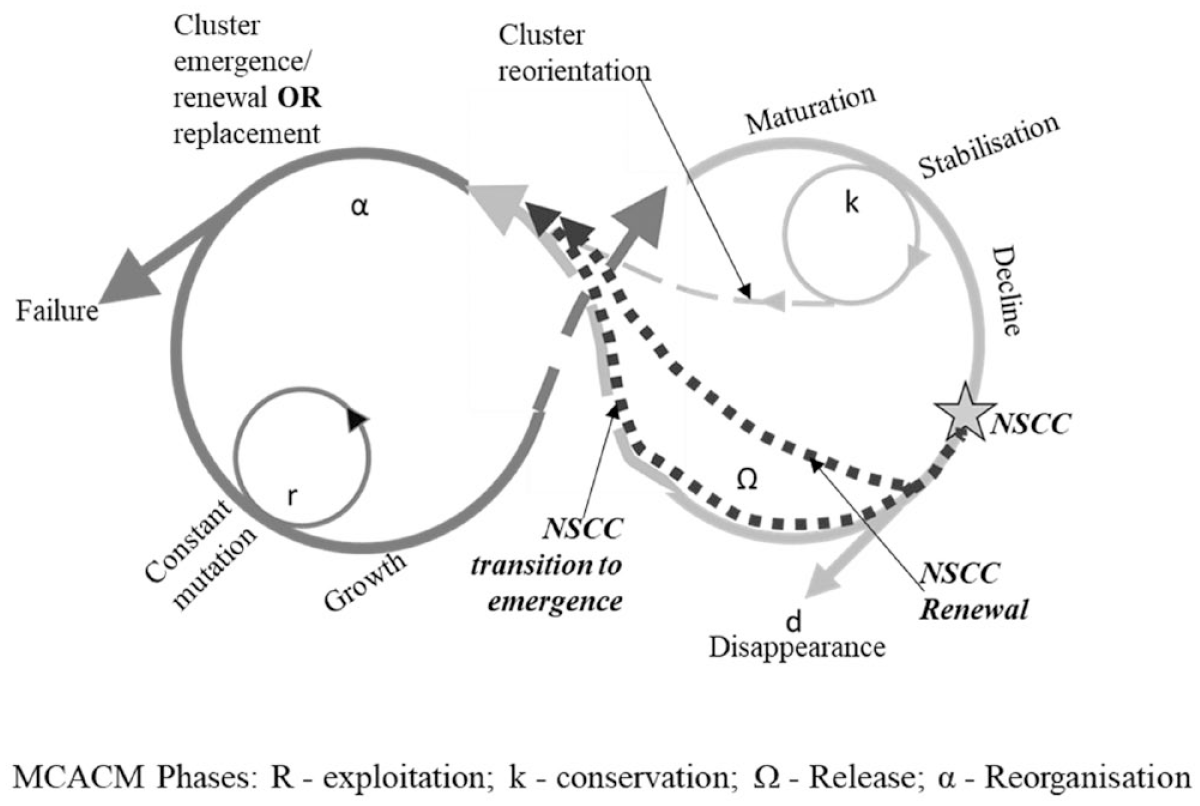
Authors’ adaptation of Martin and Sunley’s (2011) Modified Cluster Adaptive Cycle Model.
Martin and Sunley (2011) describe how a cluster’s structure, relationships, assets, capabilities and knowledge are: (1) exploited in the emergence and growth phases of a cluster’s lifecycle; (2) conserved and become stabilised around a mode of self-reproduction during the maturation phase; (3) released as relationships and structures erode during the post-maturation to decline stage; and (4) reorganised if, and when, the cluster enters a replacement stage. In each of these four activities, Martin and Sunley (2011) draw attention to the role of upward and downward causation pressures nested in a cluster’s hierarchy. Upward pressures come from firm-level activities (e.g. innovation/entrepreneurship, inter-firm interactions and competitive/cooperative forces) and are assumed to progress rapidly, particularly during the release and reorganisation activities. In contrast, downward pressures come from higher meso-level entities at the cluster/sectoral level (e.g. institutions, regulatory environment, meso-level governance structures, routines and behaviours). It is assumed exploitation and conservation activities are both longer and slower, and during these times meso-influences exert downward, stabilising pressures on firms, while the potentially disturbing impact of any upward pressures on the cluster as whole during the shorter release and reorganisation phases are dampened by downward causation pressures acting as the memory of the past.
The literature regards the potential emergence of a renewed or replacement cluster as a binary outcome (Grabher, 1993; Martin and Sunley, 2011; Ter Wal and Boschma, 2011). This binary outcome, however, neglects a third way. Baumgartinger-Seiringer et al. (2021) postulate it is possible for an existing cluster in its mature, or even potentially declining, lifecycle phase to move onto a pathway of more radical change via a three-stage transition process of initiation, acceleration and consolidation. Importantly, they highlight it is not only the industrial past of a cluster which is important but also visions of the future the cluster may hold. If the existing cluster wishes to operate in the industries of the future, then it can seek to do so by reconsidering the roles of its actors, their visions and asset modification at each of the three stages of transition. We now consider actors, vision and asset modification in more depth.
Actors
The primary actor of interest in Evolutionary Economic Geography (EEG) studies is ‘the firm’, but demands to pay attention to non-firm actors and the issue of multiscalarity are escalating (Abbasiharofteh, 2020; Benner, 2021; Gong and Hassink, 2019; Hassink et al., 2019; Trippl et al., 2015). Martin and Sunley (2011) draw attention to multiscalarity by reference to upward and downward causation pressures in cluster evolution. Martin and Sunley posit that as the cluster enters or experiences maturity (k in Figure 1), cluster-level downward pressures stabilise and preserve system-wide structure, institutions and practices (i.e. conserve things). While there is a pathway around k showing reorientation of resources towards renewal being possible during the mature phase or at the onset of cluster decline, for our case study, decline has been occurring for some time.
We are interested in the lower pathway (the darker dashed lines, Figure 1), which show how a long declining cluster can avoid disappearance. Martin and Sunley comment that following a period of decline, resources become released (Ω in Figure 1) enabling upward pressures (i.e. from entrepreneurial firms) to emerge and potentially disturb the stabilising downward pressures from the meso level and allow the cluster to reorientate onto a pathway of replacement. It is implied a switch occurs between k (where downward pressures dominate) and Ω (where upward pressures dominate). However, Martin and Sunley do not comment upon the dynamics at work during the (potentially long, drawn out) trajectory of cluster decline between k and Ω. We view Baumgartinger-Seiringer et al.’s (2021) heuristic model useful to fill this gap. They, like Martin and Sunley, emphasise the importance of both firm- and system-level agency for the path transformation of mature systems, but in contrast to the former, they identify system-level agency as being particularly important for modifying infrastructural, human and institutional assets rather than acting as a stabilising force in the face of disruptive upward pressures from firms. This latter role for system-level agency resonates with the notion of institutional entrepreneurship within knowledge regions described by Sotarauta and Pulkkinen (2011) as ‘. . . actors (organizations and/or individuals) who, first of all, have an interest to change particular institutional arrangements and who, second, mobilize resources, competences, and power to create new institutions or to transform existing ones’ (p. 98). Grillitsch et al. (2022) also address the multi-level and distinct roles for different regionally based agents in their ‘Trinity of Change Agency’ constituting of innovative entrepreneurship (that associated with our typical understanding of new products, processes, business models), institutional entrepreneurship (which introduces new, or changes existing, organisations/institutions, i.e. formal or informal rules) and place-based leadership (which transforms regions by coordinating and mobilising multiple actors in their pursuit of common interests).
Actors’ visions
Actors are habitual and rely on subconscious routines developed within, and embedded in, their cluster/regional setting. By the cluster maturity stage, actors may have become comfortable with the existing pathway and routines; they are engaged in reproductive agency (Grillitsch et al., 2022), are blind to, or ignore, changes exogenous to their experiences, which might threaten their survival. Particularly within traditional industries, there can be pride, arrogance even, that ‘this is the way things have always been done’, leading to niche producers with limited markets and impact on local growth. Therefore, actors should engage in change agency and undertake actions that are transformative over the longer term (Grillitsch et al., 2022).
Grillitsch et al. (2022) separate out two forms of temporality: the temporality of intentions (i.e. the actors’ perception and valuation of opportunities) and the temporality of consequences (the consequences of action); both encompass short- and long-term considerations. While Grillitsch et al. (2022) do not address actor ‘vision’ directly, we infer that (actor) intention relates to actor vision but with ‘vision’ expressing the big picture for the end state or the dream outcome and ‘intention’ describing actions that can be executed (over the shorter or longer term) forming a pathway to the vision. Yet, actors can develop different visions of the future (or indeed intentions for the same vision); some may be contested or shared between actors at different levels (firm/cluster) and indeed within each level. Convergence upon a shared vision across actors/levels takes time and benefits from proximity in all its dimensions (Boschma, 2005). We consider this aspect within our case.
Asset modification
Firm- and cluster-level assets are configured to align with existing trajectories and their path-dependent, cumulative nature can inhibit an actor’s ability to move off pathways of diminishing opportunities, even if they have the vision/desire to do so (Tödtling and Trippl, 2013). Asset modification is necessary and can be ‘modified or reconstructed by the deliberate and purposeful action of individuals and groups within or outside the area’ (Maskell and Malmberg, 1999: 10). In addition, a supportive environment for path transformation is key to encouraging and enabling local actors to reach out to non-local actors and sources of knowledge.
Actors (their visions and the modification of their assets) and how they create upward or downward pressures on cluster dynamics, of course, rely on their state of knowledge and the inflows of new knowledge, the sources of which can be local or non-local – created and shared at the firm and/or cluster level. It is to knowledge sources to which we now turn.
Knowledge sources in mature to declining clusters
The benefits of industrial clustering in the emergence and growth stages of a cluster lifecycle are well known (Bathelt et al., 2004; Gertler, 2003; Markusen, 1996). Visions of the actors be they firms or cluster/regional-level organisations are being formed 1 and communicated, and assets mobilised.
As the cluster continues to grow, mature and stabilise, colocation offers the opportunity to purposefully create localised inter-organisational networks to transmit knowledge in formal collaborations (Asheim et al., 2007). Physical and other forms of proximity facilitates social interactions, which in turn build trust; some informal relationships may become more purposeful and formal (Asheim et al., 2007), and local institutions can develop, leading to a thick network of knowledge sharing (Breschi et al., 2003). Local knowledge can become a source of collective learning opportunities for the cluster’s ongoing development (Maillat, 1995). Institutions formed at the system level become forces of stabilisation, yet at the firm level, scope remains for innovative entrepreneurship (Grillitsch et al., 2022) albeit likely to be of an incremental innovative nature.
Over time, knowledge homogenisation in the cluster can lead to diminishing returns to innovation (Menzel and Fornahl, 2010), the original vision of the actors may have been realised and all original intentions met, or failed. Either way, new injections of knowledge are vital. Organisations within a local cluster may deliberately seek to build quasi-permanent pipelines to other parts of the world to purposefully access knowledge sources (Bathelt et al., 2004) to re-stimulate local buzz which in turn may provoke renewed visions at the micro and/or meso level or even inspire entirely new visions. The sources are manifold: organisations with extra-cluster connectivity into other knowledge assets, for example, universities/research institutions, trade unions and industry associations; supply chain partners; and overseas subsidiaries or corporate group partners. Cluster firms may also engage in time limited (e.g. trade fairs, professional meetings) (Bathelt and Turi, 2011; Rallet and Torre, 2009) and virtual activities to tap into sources of non-local or global ‘buzz’ (Bahlmann et al., 2009). 2 We elaborate on trade fairs in the next section.
International trade fairs as sources of global buzz
International trade fairs (ITFs) are an important means to access global technical knowledge and frontier technologies, while also an opportunity to liaise and establish links with leading global firms in the field (Chen, 2009). ITFs provide opportunities for vertical knowledge formation about suppliers (Maskell, 2014) and customers’ preferences for current and future products. Indeed design-intensive innovation relies on understanding customers’ and users’ needs (Brown, 2008). In horizontal dimensions, firms can gather competitive intelligence about products, marketing strategies and pricing plans. Information exchange can be purposeful with meetings scheduled in advance, but much is opportunistic and relies on ‘buzz’ at the event (Bathelt and Schuldt, 2008; Fitjar and Huber, 2014; Maskell, 2014). Information and knowledge is obtained through casual observation of exhibitors’ stalls, listening to conversations/informal exchanges during coffee breaks/dinners (Cook and Brown, 1999; Schuldt and Bathelt, 2011). It can see solution providers marketing themselves to firms who only recognise at, or after, the fair that a solution might address an as yet unacknowledged problem.
Following the fair, attendees may take knowledge gained from the event back to their home facilities. Ramírez-Pasillas (2010) found the knowledge initiated by attending ITFs can compensate for the lack of more formal knowledge flows (e.g. via inward foreign direct investment). While much of the knowledge from global buzz gained from ITFs is likely to result in reproductive agency which renews existing visions and short-term intentions regarding seasonal sales and revenues, sometimes the knowledge gained can and be significant enough to upgrade local industry (Chen, 2009) as well as enhance the cluster’s collective absorptive capacity. In the case of regional-level/cluster-level actors, the connection made between several sources of new knowledge over time has the possibility to facilitate transformational agency (Grillitsch et al., 2022) with regard to a completely new vision for the cluster/region. In addition, as ITFs tend to take place on a regular basis (e.g. annually, biannually), repeated attendance by the organisations could deepen inter-organisational ties, imbuing more trust and more knowledge exchange which may, in turn, lead to better-quality knowledge gathering and transfer.
Dependent upon the presence of absorptive capacity (Cohen and Levinthal, 1990), global buzz and local knowledge could be complements (Belso-Martinez, 2012; Maskell et al., 2006) or substitutes (Moodysson, 2008; Torre, 2008). Morrison et al. (2013) find support for both relationships with the outcome being contingent on the characteristics of the local cluster’s knowledge base. Dyba et al. (2020) found in the mature Livenza furniture district, traditional mechanisms of inter-firm local knowledge transfer were rare and perceived as unmeaningful, since firms were reticent to share knowledge with competitors. Knowledge acquisition from universities and other local public institutions, who act as a bridge to external knowledge sources, was more influential especially when seeking the introduction of a new technology or market expansion. Of the other means of accessing knowledge, participation in professional events such as trade fairs was the most highly rated.
While it is known that beyond the maturity stage (k, Figure 1), over-embeddedness and the exhaustion of knowledge sharing opportunities in the decline phase can lead to cluster disappearance (d), the existing literature largely ignores whether and how (local and global) knowledge can help long declining clusters to renew their individual and/or collective visions or transition onto a new path (the two dark dashed lines in Figure 1) with new, ambitious vision and intentions brought into being through transformative agency at the meso level. We seek to address this.
Case study: The North Staffordshire ceramics cluster
Context and research focus
Our study observes the North Staffordshire ceramics cluster, which dates to the 17th century and is based in and around the city of Stoke-on-Trent. The genesis of globally famous brands, such as Wedgwood, Minton and Spode with their own unique styles and technological innovations (held as deeply guarded secrets), shaped the region’s industrial heritage and social fabric. While the cluster experienced fame from the international popularity of their products, local rivalries prevented the purposeful creation of local inter-organisational networks.
Between 1979 and 2008, the cluster entered a ‘long decline’ which had been considered terminal as firms struggled to adapt to globalisation. Under strain, firms turned inward rather than reaching out to share knowledge. Several high-profile manufacturers closed, others merged and/or were acquired by international corporate entities, some turned to global outsourcing to secure cost efficiencies, and although several artisanal micro-firms survived, the hollowing out of local employment and skills became the norm (Hervas-Oliver et al., 2011). The region remains one of the most economically lagging in Europe. Nevertheless, Stoke-on-Trent remains the centre of UK ceramics production with approximately 300 firms across multiple subsectors from tableware/giftware to technical/refractory ceramics (Tomlinson and Branston, 2014). The cluster proclaims itself to be the World Capital of Ceramics, 3 and there is a growing sense of optimism. Since 2008, there has been some re-shoring of production back to the cluster, due to narrowing cost differentials with the Far East alongside inconsistent quality and issues with international logistics of outsourced products that harmed brand reputation. Some firms in the cluster have made significant investments in new plant, equipment and technology during the re-shoring process. Within traditional tableware/giftware, firms have adopted numerous incremental product and process innovations (improved clays, glazes, design techniques, single-fire technology, computerised kilns and heat recovery systems). Heightened cooperation in supply chains has delivered faster throughput times, raised efficiency, reduced waste and improved product quality throughout the industry (Tomlinson and Branston, 2014; Warren et al., 2000).
Drawing upon the previously outlined literatures, our case focuses on the recent activities of firm- and cluster-level actors, their use of knowledge from local/global sources and how this influences their visions and asset modification. Specifically, we consider the following:
Q1. At the higher level of the cluster’s nested hierarchy, what have cluster-level organisations done (via downward causation pressures) to support the renewal of the cluster/its transition onto a new trajectory? What are their visions for its future and how have they modified their assets to enable this?
Q2. At the lower level of the cluster’s nested hierarchy, what have firms within the cluster done (via upward causation pressures) to renew the cluster/transition it onto a new evolutionary trajectory? What are their visions for its future and how have they modified their assets to enable this?
Q3. Have, and if so how have, the upward and downward pressures coupled to renew/transition the cluster?
Throughout, our analysis draws upon a mix of evidence from cluster reports, the grey literature, and unique survey and interview data from cluster actors.
The role of cluster-level actors
Several critical industrial-level actors are in the region including the industry’s main trade association (British Ceramic Confederation (BCC)), labour union (Unity) and several ceramic research centres: the most significant of which is Lucideon. Founded in 1948 as the British Ceramic Research Association – a research and technology organisation – Lucideon (as renamed in 2014) remains a specialist consultancy providing testing/technical support across the whole ceramics and related industries. 4 Lucideon itself endured significant change during the cluster’s long decline. Falling membership reduced income, which was exacerbated by the withdrawal of matched government funding. Consequently, Lucideon adopted a more commercial focus, branching out into related fields reliant on materials technologies and processes. It extended its international activity to include partner laboratories across Asia and the United States. In 2021, Lucideon established MaterialsMatrix, 5 an online hub bringing together international experts from industry/academia to foster the cross-fertilisation of ideas and technology in materials science, for example, in medical uses (e.g. bio-inserts, drug delivery systems), energy-efficiency (e.g. fuel cells, gas turbines) and industrial equipment (e.g. mobile phone transmitters, aircraft components). Locally, Lucideon has been particularly instrumental in promoting new technologies across the cluster, acting as a conduit for innovative ideas, facilitating collaboration and knowledge transfer from across the globe to local firms, and assisting cluster firms to secure/manage external research funding. Lucideon also works closely with both the region’s universities (Staffordshire and Keele), which both have specialisms and international links that feed directly into ceramics and material science–based industries or their application areas. Lucideon has been a key actor in the strengthening and renewal of existing traditional ceramics cluster and industry-level institutions, but it has also been critical to the development of a new vision of the region and the part it can play in the oncoming and future world of advanced technical ceramics.
Local government actors have also played a key role, actively encouraging a greater emphasis upon local inter-firm horizontal networking which had been historically weak and possibly constrained regional growth (North Staffordshire TaskForce, 2003; SQW Consulting, 2009). One significant outcome of their vision for the region is the establishment of the ‘Ceramics Valley’ Enterprise Zone, where local companies across several industries (ceramics, automotive and transport, power electronics, energy, built environment and medical technologies) are encouraged to collocate and collaborate to strongly drive research, development and creativity in advanced and composite materials. At the heart of Ceramics Valley is The Applied Materials Research, Innovation & Commercialisation Company (AMRICC) – conceived and co-funded by Stoke-on-Trent City Council and Lucideon with support from the Local Enterprise Partnership and founded in 2016 as ‘. . . a unique international facility that translates materials, processes and technologies into real world products and solutions through the commercialisation of innovative ideas . . . [and] provides an unparalleled educational facility in partnership with some of the world’s leading universities’. 6 It has rapidly established itself as the global leader in flash sintering, a technology that enables new product development in sectors utilising advanced technical ceramics, such as healthcare, electro-ceramics and defence. In 2021, AMRICC was part of the successful Midlands Industrial Ceramics Group £18.27 million bid for the UK Government’s Strength in Places Fund (SPIF), to support the development of an advanced ceramic campus in North Staffordshire offering industrial PhDs and MScs in materials science in partnership with some leading universities in both the United Kingdom and United States. Clearly, local government actors, in partnership with key industry-level actors and universities, have acted as place-based institutional entrepreneurs (Grillitsch et al., 2022), setting out a new vision for their region and the role they envision for a ceramics cluster within this.
In terms of international knowledge sourcing, council and industry representatives participated in the EU Urban Network for Innovation in Ceramic Cities (2008–2011), which supported a series of workshops/exchange visits of ceramics experts, industrialists and policymakers to share ideas and discuss growth initiatives. Since 2009, the council has co-sponsored the British Ceramics Biennial, a 5-week exhibition that acts as an international showcase/platform for excellence and innovation (and fosters new links) in contemporary ceramic art and practice. In addition, The North Staffordshire Chamber of Commerce (NSCC) has supported local firms’ attendance at ITFs. This is significant because except for the famous historical brands/companies, many firms in the cluster did not seek international markets. These activities serve to reinvigorate the existing visions of mainly the traditional ceramics firms which may be met by new intentions, for example, to serve new previously untapped markets with variants of existing products.
In answer to our first research question, on the upper level of Martin and Sunley (2011) nested hierarchy, cluster/regional-level actors have coalesced around a shared vision of the area as a high-tech knowledge and skills hub, with significant technological capabilities in ceramics and advanced material science to feed into multiple science and advanced engineering-based sectors for the foreseeable future. They have collaboratively invested in both the physical manifestation of, as well as the aspirational brand ‘Ceramics Valley’; they have mobilised regional- and cluster-level assets and committed to the establishment of AMRICC as the actor and mechanism to modify the cluster’s existing assets in ceramics and develop ones in a broader range of advanced materials fit for the future (Baumgartinger-Seiringer et al., 2021). Downward causation pressures on firms take the form of encouraging more vertical and horizontal networking to facilitate knowledge sharing and by supporting their participation in ITFs.
The role of firm-level actors 7
We have shown cluster-level actors have generated a future-cluster vision they would like the existing ceramics industry to transition on to – they have started the initiation phase of the transition process (Baumgartinger-Seiringer et al., 2021). Yet, visions of the actors in a cluster do not necessarily align, and there may be contradictory stakeholder interests that cause conflict (Boschma et al., 2017). In our case, those of the cluster-level actors do align, but do firms’ visions also align? To consider this, we undertook a mixed-methods approach in two stages.
First, we conducted quantitative research using data collated from a survey conducted within the cluster over a four-month period during 2013-14. Questionnaires had been sent to all ceramics manufacturers in the North Staffordshire cluster who were registered with the BCC, listed on Yell.com (a public directory) or identified to us by industrial or regional third-party organisations. In total, 282 ceramics manufacturers were approached from whom we received 121 responses; 112 provided complete information used for this study (see Supplemental Appendix A, Table A1). We used these to confirm whether the cluster-level-led initiatives (1) built more local networks for knowledge sharing, and (2) whether their support for international connectivity to global buzz was having a positive effect on the cluster’s innovative performance.
We also conducted 25 semi-structured interviews with senior managers of ceramics firms and high-level representatives from the cluster’s main institutions in July to September 2013. We broached a range of issues including the cluster’s global linkages. A further 14 post-survey telephone interviews were also conducted, in mid-2016, with senior managers selected from those firms that attended ITFs (see Supplemental Appendix A, Table A2) to elicit further details about firms’ involvement in ITFs and the types of knowledge exchanged there which our original survey did not capture. By triangulating our survey and interview responses, we mitigate potential biases and ensure consistency and validity in our data interpretation (Rothbauer, 2008).
Insights from survey data
The aim of the quantitative investigation was to confirm the importance of local and global knowledge linkages for firm-level innovation in the cluster, which may indicate that recent cluster-level led initiatives were having a positive impact. The multivariate model was estimated by ordinary least squares, and the results are presented in Table 1 – for brevity, we provide the details/justification of this methodology in Supplemental Appendix B. As expected, firm size and R&D expenditure are positive and highly significantly associated with firm-level producer and process innovation. The dummy variable to capture overseas manufacturing activity is insignificant, reflecting our earlier discussion about outsourcing to producers in the Far East being for cost reduction purposes only, rather than any knowledge gathering. Both local linkages and global linkages are also positively associated with more innovative output. We also included quadratic transformations of our predictor variables and found (perhaps surprisingly given its age) there remain increasing returns to exploiting local linkages within the cluster indicating the recent investments in new research facilities, knowledge transfer activities, and wider collaborative activity are working, and hence diminishing returns from this activity have not yet set in. The quadratic term on linkages to global buzz, although positive, is insignificant in each case.
Results of regression analysis.
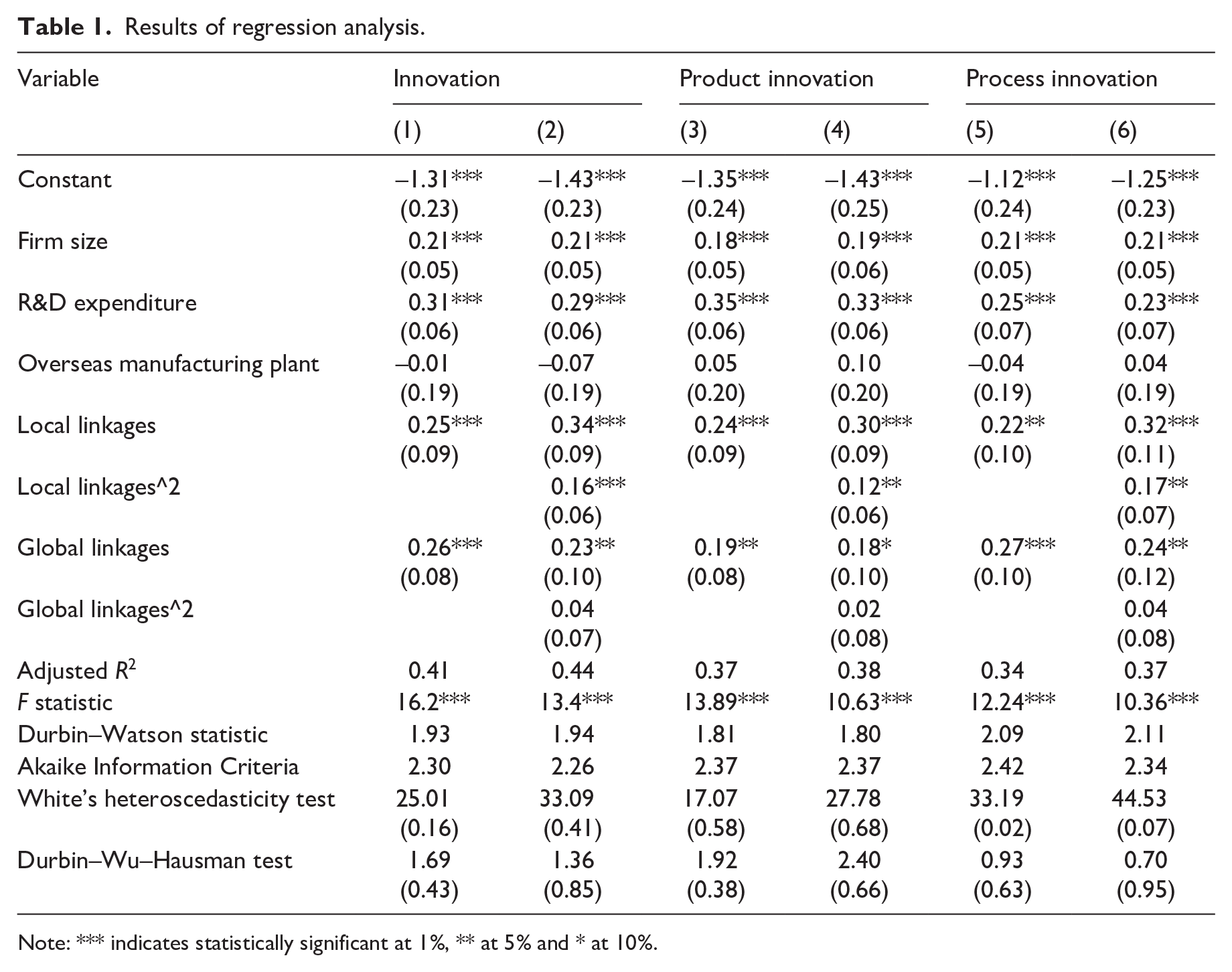
Note: *** indicates statistically significant at 1%, ** at 5% and * at 10%.
The quantitative analysis confirms the importance of both local and global links and may be indicative of the cluster benefitting from cluster-level initiatives to stimulate the growth of both formal local knowledge sharing and from access to global buzz available at ITFs. We now consider the types of innovation arising from participation in ITFs and how this might affect the future trajectory of the cluster.
Insights from cluster interviews
Local knowledge
Historically, knowledge sharing across firms in this cluster occurred incidentally through local outsourcing of non-proprietary production stages to cope with swings in demand. Since 2007/2008, deliberate technical knowledge sharing within vertical supply chains has increased. As interviewee 201 identified, ‘the supply chain has become more important because of continuity of skills and technique . . . where we need to share technique with the designer to get a particular product made, we’ll be quite open’. However, vertical supply chains largely remain firm-specific due to long-held rivalries and lack of trust. Horizontal knowledge sharing arrangements among firms remains more limited ‘your glaze recipe is still something that people will want to protect because it is your competitive advantage’ (interviewee 141). This emphasis on continuity and self-reliance suggests reproductive agency is strongly embedded in these firms as they work to maintain their long-held visions. Any (reluctant) horizontal knowledge sharing appears to relate to downward causation pressures, having largely emerged due to the efforts of the BCC which works in, and beyond, the cluster to help firms across the ceramics industry with best practice development in process improvement, design, marketing and human resources. Similarly, Lucideon has been responsible for the creation of research networks across the broader ceramics sector, beyond the cluster (e.g. MaterialsMatrix). Significant inter-institutional actor collaboration has been catalysed by the creation of the Ceramics Development Group (CDG) to energise collective regional-level responses to local skills training deficits, reduction of energy use in response to climate change levies as well as external funding from the EU and the UK government.
Nevertheless, an increase in informal conversations between managers, the formal use of benchmarking of products and processes, and cross-factory visits has been visible: ‘I try to engage with [the competition] . . . occasionally have a beer with one of the owners and can call the others at any time’ (interviewee 201). Its clear upward causation is at least in part responsible for the growth and use of local knowledge sharing, both formal and purposeful, as well as spontaneous and informal buzz. There continues to be a low level of innovative entrepreneurship.
Linkages to global buzz via ITFs
Our interview data strongly confirmed ITFs as knowledge spaces (Li, 2014; Sarmento et al., 2015), which present opportunities to: interact with existing and potential partners, and competitors who are based overseas (Bello, 1992; Bello and Barczak, 1990; Ling-Yee, 2006); get new ideas – ‘[ITFs are a] . . . great opportunity to sit down with a customer . . . and really get to the bottom of what they are looking for’ (interviewee 12); and build relationships – ‘it’s about building that rapport that you just can’t get over the telephone’ (interviewee 42).
Traditional ceramics firms gain knowledge about differentiated market trends across different geographies for colours, glazes, shapes, packaging (i.e. incremental, ‘soft’ innovations). The efforts of the NSCC to encourage attendance at ITFs do help firms, that is, the NSCC encourages reproductive agency. Attending international, as opposed to regional/national trade fairs quickly led to a broadening of their design concepts: ‘an international trade fair . . . definitely has a different atmosphere [to a national one] . . . In Europe it’s made some huge differences in the past . . .’ (interviewee 14). A presence at ITF exposed firms to more design-ideas particularly from rivals, than if they did not attend and so prolonged the longevity and success of the firm. They got a sense of current and future trends, which led to incremental changes as direct result: ‘you see how you can improve . . . See[ing] what’s going on outside of your own bubble is always a beneficial thing’ (interviewee 72). This supports the quantitative analysis that global buzz stimulates innovative activity in the cluster.
However, attendance at ITFs seemed to generate more significant innovations in materials and production technologies that led in new directions (akin to more radical innovations), at least for technical ceramics businesses that attended ITFs. One interviewee recalled when their production manager saw some equipment when attending a fair in Munich and just put ‘two and two together’ enabling their company to make a massive technological jump forward. Another told of how their attendance at a technical materials exhibition led them to make contacts with customers that ultimately radically switched their focus from their existing products to new products and associated services: . . . we’re focussing more on X now as the product we’re developing within the company, rather than the existing products. . . . we’re introducing a new range of materials; . . . we’re also offering a process . . . it’s something new . . . this is a radical change. (Interviewee 62)
Such encounters mark the potential transformation of these firms and their alignment with the new vision held by the institutional entrepreneurs in the Staffordshire region.
The sense of buzz in these ITFs was present for the duration of the IFT created by pre-arranged, formal meetings, and spontaneous, opportunistic situations. Firms find social times particularly important for knowledge gathering (Bathelt and Schuldt, 2010; Schuldt and Bathelt, 2011). Interviewee 12 told, ‘It is pretty much from breakfast time to taking people out at night for meals’. These informal, social occasions potentially led to novel information which the attendee had previously been unaware of: ‘the occasion when somebody would mention something to you, could be at a trade fair, . . . of something which is happening in the marketplace which you know absolutely nothing about’ (interviewee 14). From these interactions, some sales deals could be concluded immediately, while other types of deals are initiated but finalised in a period after the conclusion of the ITF. For example, initial contacts led to both future relationships with distributors, suppliers and customers about existing products or customised/bespoke versions of such products, and also to potential technologically oriented, deeper, ongoing relationships (Maskell, 2014). In the case of the latter, Interviewee 6 explained it was not possible to do more than create these initial contacts at ITFs because of potential intellectual property rights issues that might need to be clarified prior to a deeper, detailed discussion (e.g. confidential disclosure agreements).
In answer to Question 2, we can see there is activity at the lower level of the MCACM’s nested hierarchy, but this is not sufficient to claim it is creating upward pressure for dynamic change in the cluster. Despite many resources having been released over the years, the cluster still experienced significant decline. There was/is a little misalignment between the vision of traditional ceramics firms (who still dominate the cluster in numbers) and the cluster-level vision, but there is much greater alignment between the latter and the vision of the technical ceramics/equipment firms. Nevertheless, the traditional firms have received attention and support from cluster-level actors, which mitigates somewhat against a feeling of abandonment which could arise from the misalignment of the ‘bigger vision’ for the cluster and their own subsectoral-level vision.
In answer to Question 3, about the presence of coupling in the downward and upward causation pressures, this does not appear to be the case. The entrepreneurial vision emanates from the collective of institutional actors, not from firm level. Nevertheless, both types of firms seem to be positively responsive to initiatives from the higher level. It is likely in this initiation phase of the cluster’s transition (Baumgartinger-Seiringer et al., 2021), upward pressure has not yet built up sufficiently, but as the successes of the technical ceramics firms become more visible to others in the cluster, and opportunities of the location and its institutional support network more visible to outsiders, the cluster will, in time, move to the acceleration phase of the transition process. We speculate at that point, pressure from the bottom-up will accumulate to move this subsector of the cluster onto a new path with greater growth potential, possibly replacing the original cluster. During the acceleration phase, we might also expect to see a shift from the downward causation pressures being responsible for change (as it is in the current initiation phase), to it working to stabilise the cluster as it moves towards the consolidation phase. Conversely, the upward pressures may become stronger in the acceleration phase, but later moderated by the downward pressures in the consolidation phase just as Martin and Sunley (2011) conceptualised.
Discussion
This study demonstrates that it is possible for a cluster to be substantially within the decline phase (as opposed to just entering it), yet it may still not be too late for the existing capabilities in the cluster to be combined with new knowledge from non-local sources and give it new life. Returning to the pathway between k and Ω in Figure 1, we have shown at the upper level of the nested MCACM (Martin and Sunley, 2011), cluster-level actors clearly indicate their vision (Baumgartinger-Seiringer et al., 2021) for the ceramics cluster lies in utilising the underlying knowledge and capabilities in the cluster that pertain to the properties of ceramics as a material. Starting from a base of understanding the materials they are modifying the cluster’s existing assets with investments in physical assets in the form of buildings and research centres like AMRICC and in ‘softer’ assets like the CDG and MaterialsMatrix networks, and the Midlands Industrial Ceramic’s Group. These downward pressures are initiating change in a cluster that has experienced a period of long decline (in line with Baumgartinger-Seiringer et al., 2021) rather than stabilising change dynamics rising up from the lower level of the nested hierarchy (as Martin and Sunley, 2011, describe). Many resources from the original cluster have been released in recent decades but have not organically reorganised to form a disruptive, entrepreneurial culture that drives the cluster towards replacement. It has been institutional entrepreneurship (Grillitsch et al., 2022; Sotarauta and Mustikkamäki, 2015; Sotarauta and Pulkkinen, 2011) that has been leading the transition of the cluster to a new path, a new vision. We are beginning to see a shift in the cluster towards more technical uses of advanced ceramics as a material for components in aerospace, automotive, medical and dental sectors – global industries that will force the cluster to look outward to the rest of the world for complementary knowledge rather than being self-reliant and inward looking as the traditional firms have generally been. This is aided by the broader regional efforts to attract these user industries to the region. Their commitment to, and broadening into, advanced material sciences more widely is ambitious, but clearly and consistently communicated, signalled by the involvement of 10 well established universities in research activities within AMRICC and their world leading expertise in flash sintering techniques. It is also clear that while they hold this vision, they also recognise they exist in a period of prolonged transition from traditional to advanced ceramics, and they continue to support what remains of their heritage ceramics manufacturers with new techniques, ideas and marketing support.
At the lower level of the MCACM’s nested hierarchy, our findings suggest within both local knowledge pools, and global buzz, there are two sets of dynamics in play: one for the traditional ceramic firms, another for the nascent but emerging technically oriented firms. Traditional ceramics firms’ visions are to remain viable and enter new geographic markets. Most of the traditional firms are micro to small and medium-sized enterprises (SMEs). They benefit from efforts to stimulate local linkages, be these derived from upward causation pressures in the (vertical) dynamics between firms or downward pressures encouraged by industry-level organisations to preserve and extend the cluster’s global reputation as a producer of high quality ceramic wares – both influences are at work but the majority appear satisfied to remain niche players, selling locally, through retail stores or nationally and even internationally via online platforms (e.g. Emma Bridgewater). Most do not even attend ITFs despite the support of the NSCC due to costs and resource constraints. Those that do, derive benefits that can aid their longevity, even if the ‘innovativeness’ stimulated by idea found at ITFs are highly incremental and ‘soft’ (i.e. related to shapes, colours, textures, etc.). With reference to the MCACM model (see Figure 1), the distance between cluster decline and disappearance may be lengthened, the traditional ceramic subsector of the cluster may retreat from a trajectory of decline, back to one of stabilisation at k (a pathway not identified in Figure 1), or there is a possibility that they may experience some form of renewal along the higher of the two dashed lines. It is not possible to predict.
For the more technically oriented subsector, at the local level, and through access to temporary global buzz at ITFs, technical firms seem to be exposed to more novel ideas and new technologies. This is stimulating new visions for their futures and more ambition, and they are changing their strategic focus, operations and modifying firm-level asset accordingly. It suggests that technically oriented firms (and those that might emerge or locate there in future) will follow a different trajectory to the traditional firms through a combination of both upward and downward causation effects. With respect to Figure 1, the technical firms seem to be responding to the institutional pressures and are helping to move the cluster from decline to one of cluster emergence through (along the lower of the dark dashed lines via Ω up to α in Figure 1) a process Boschma et al. (2017) call ‘exaptation’. 8 This may in due course replace the traditional ceramics cluster, or may co-exist with it.
For firms in both subsectors, the position has improved since 2007/2008 especially with respect to vertical supply chains and the inter-institutional support for the cluster, region and sector more broadly. Nevertheless, there is potential for considerably more horizontal knowledge sharing within the cluster, but this requires cultural change and the building of trust between former rivals. Given the domination of traditional ceramics firms in the cluster, in terms of numbers of firms, local firm-level networking activity seems to focus predominantly on improving knowledge sharing and technological improvement in traditional fields. However, institutional-level efforts are focused more broadly upon improving knowledge sharing and technological development across the entire industry spectrum from traditional to advanced ceramics. There would appear to be a misalignment between the vision of the more numerous traditional ceramics firms within the cluster and that of the cluster-level actors, although the smaller number of technical ceramics firms are benefitting from the cluster-level vision, and the hope is this movement will gather momentum. Indeed, technical and equipment firms probably fit in a supply chain mode more readily, needing new knowledge, inputs of equipment and materials, or being the supply of such to firms further downstream. They are the most likely to benefit from global knowledge sources and integrate it with local knowledge and become part of/establish a global value chain.
Contribution and conclusion
Through our study of the North Staffordshire ceramics cluster, we have made several contributions to the literature. First, we have conducted a firm and cluster-level (i.e. multi-scalar) study of cluster dynamics. Second, we have analysed this in the context of a cluster deep in the decline stage of the lifecycle rather than at the onset of decline. The decline has been prolonged and was not stimulated by an exogenous shock to the cluster. Third, as a counterpoint to the conceptual MCACM model, we have shown that the processes of release and reorganisation have not been short and rapid, nor have firm interaction, cooperation and competition progressed rapidly to create upward forces that cause the cluster to change. The latter were protracted and weak, and change was virtually non-existent when things had been left to firms. Instead, the actors responsible for stabilising the cluster during its conservation and maturity stages coalesced around a common vision in this decline phase and enacted institutional entrepreneurship spurring the new direction for growth. Fourth, we have shown while there is a degree of misalignment between the cluster-level and traditional ceramicware subsector visions, this can be ameliorated if policy support is offered during the cluster transition process, to reassure such firms they are not being abandoned but are still of value to the region. Finally, while the cluster dynamics literature indicates where cluster death can be avoided, it results in either less radical cluster renewal or more radical replacement as a binary outcome – our case study has raised the possibility that both can occur through a process akin to mitosis, where the original cluster divides in two (or more) parts, but each takes steps which cumulatively lead them in different directions.
Some generic policy lessons follow. Policymakers concerned with reviving traditional clusters should consider whether an industry has exhausted the benefits of local knowledge sharing, or whether there is potential to create incentives so more can be leveraged across sub-industries, or inter-industry within the local geography. If, as in North Staffordshire, there is a case for re-invigorating local linkages and (re-)stimulating local buzz, then this can be achieved through policy support for nurturing local and predominantly SME networks; existing and/or new local industry bodies may act as suitable conduits. Resource constraints have long deterred SME networking, and so targeted support here may be especially fruitful. Second, alongside strengthening local linkages, regional policymakers can re-energise local clusters by encouraging its engagement with global buzz, through existing local public research institutions and through ITFs. A critical adjunct for policy is to ensure local absorptive capacity is sufficient, alongside support for developing a more complementary and synergistic relationship between local and global buzz.
Our article is limited by its focus on a single case of a traditional industrial cluster and within that, the number of firms in the cluster that attend ITFs is limited. Future research could extend the analysis to a multi-cluster case, with cases chosen at different stages of the path trajectory. Moreover, in future work, it might also be useful to undertake a Social Network Analysis and formally map the connections between individuals/firms/trade bodies within and outside the cluster. This would allow researchers to assess the centrality and impact of specific and key actors within these networks. Such information is likely to be useful for policymakers in targeting public resources within the cluster. This, however, would require a more granular data set than was collected for this study.
We conclude by noting North Staffordshire remains a lagging region, but there does appear to be hope. There is evidence that even as a cluster having long been in decline, through efforts to increase local knowledge sharing and access to new knowledge from around the world, this ceramics-based cluster can be revived.
Supplemental Material
sj-docx-1-eur-10.1177_09697764221105765 – Supplemental material for Actors, knowledge and path transformations in a declining cluster
Supplemental material, sj-docx-1-eur-10.1177_09697764221105765 for Actors, knowledge and path transformations in a declining cluster by Felicia Fai, Philip R Tomlinson and J Robert Branston in European Urban and Regional Studies
Supplemental Material
sj-docx-2-eur-10.1177_09697764221105765 – Supplemental material for Actors, knowledge and path transformations in a declining cluster
Supplemental material, sj-docx-2-eur-10.1177_09697764221105765 for Actors, knowledge and path transformations in a declining cluster by Felicia Fai, Philip R Tomlinson and J Robert Branston in European Urban and Regional Studies
Footnotes
Acknowledgements
The authors would like to thank the editors, two anonymous referees, David Bailey, Mariachiara Barzotto, Lisa De Propris, Ron Martin, Peter Sunley and the participants at faculty seminars at the Universities of Winchester (4/3/2015), Brunel (12/1/2016), Bournemouth (4/5/16) and a public seminar at Staffordshire University (2/11/2015), and at the Regional Studies Conference in Piacenza (25/5/2015) and the R&D Management Conference in Pisa (26/6/2015) for comments and suggestions on earlier versions of this paper. They also acknowledge the British Ceramic Confederation (BCC), Lucideon, the North Staffordshire Chamber of Commerce (NSCC), the Economic Development Office of Stoke on Trent City Council, and the International Clay Technology Association (ICTa) for their guidance and advice on industry issues and nuances. We would also like to thank Marc Betton and Jelena Fomiskina for assistance in data collection. The responsibility for the work remains entirely with the authors.
Declaration of conflicting interests
The author(s) declared no potential conflicts of interest with respect to the research, authorship and/or publication of this article.
Funding
The author(s) received no financial support for the research, authorship, and/or publication of this article.

Supplemental material
Supplemental material for this article is available online.
Notes
References
Supplementary Material
Please find the following supplemental material available below.
For Open Access articles published under a Creative Commons License, all supplemental material carries the same license as the article it is associated with.
For non-Open Access articles published, all supplemental material carries a non-exclusive license, and permission requests for re-use of supplemental material or any part of supplemental material shall be sent directly to the copyright owner as specified in the copyright notice associated with the article.
