




Abstract
In this article, a transdisciplinary cultural labour perspective is used to examine the evolving and spontaneous networks and grassroots collective movements of performing arts freelancers in two contexts: Belfast (Northern Ireland) and Athens (Greece) in response to the outbreak of COVID-19. With a principally methodological contribution, the article proposes that evolving cultural ecologies research should mirror the ecologies it studies by adopting more collaborative and improvisational research approaches, drawing on inclusive research methods from disability studies and decolonising approaches within anthropology to reveal deeper knowledge and offer mutual benefit. Furthermore, it proposes that artists, overlooked in cultural ecologies research to date, bring knowledge from their practice beyond lived experience of value to such inquiry. The researchers collaborated with practitioner experts, revealing insights to freelancers’ milieu; their alternate systems for inclusion, representation and radical mutual care; and their increasing vulnerability in the face of ongoing exclusion from cultural recovery strategies and wider political and policy apathy to their concerns. This raises important moral and ethical questions for how cultural ecologies research and researchers engage with practitioner knowledge and the purpose of research in rendering such groups as creative freelancers visible within research and in the implicit and explicit urban and regional recovery planning in different locales. In addition, it proposes the inter- or transdisciplinary nature of cultural ecologies research may be better served by keeping its boundaries fluid, not just in the potential strength of blending research disciplines but also in its boundaries between the formal academy and practice.
Keywords
Introduction
COVID-19 and ensuing lockdown measures radically altered how people worldwide communicate, socialise, create and consume with a profound effect on industries that rely on mass in-person gatherings. This is perhaps most visible in the performing arts, where public venue closures and mass event cancellations caused unprecedented economic and existential challenges, especially for freelance artists and creative workers (Banks, 2020; Tsioulakis and FitzGibbon, 2020). Throughout the development of this article, COVID-19 infection waves prompted multiple governments to ease and reintroduce strict distancing and lockdown measures amplifying and extending uncertainty. Εven as recovery planning becomes a bigger feature of policy than protection, the economic, cultural and social impact of the ‘Great Lockdown’ will be long-lasting (Gopinath, 2020), and performing arts and its artists will be affected more deeply and for longer than most other areas of work and economy.
Governments worldwide have long turned to culture as an instrumentalised pump-primer for urban and regional recovery. Regeneration strategies have adopted creative cities and districts (quarters), cultural tourism and the promotion of the creative and cultural industries as an alleged means to boost economies and thus protect and reinvigorate local communities (Campbell, 2019). Yet, such policy initiatives are often top-down, excluding the communities affected and the cultural producers on whose success they rely. To counter this, researchers have advocated for regions and cities to consider a more ecological approach in such policies, engaging a more diverse range of stakeholders (Chapain and Comunian, 2010; Comunian, 2017). This ‘cultural ecologies’ discourse which we explore more fully later seeks new theoretical framings for the creative/cultural economy and its relationship to its locale. In this article, we propose that such questioning should employ a more collaborative, inclusive and human approach to investigating the future of cultural work, drawing attention to inconsistencies, inequities and exclusions. Specifically, we identify artists as a distinct group whose own practices offer unique expertise and knowledge to both policy and research.
Our contribution is based on ethnographic data formally collected between April and December 2020, but which continues informally to this date. It began as a documentary capture of spontaneous grassroots artists movement in Northern Ireland and Greece. We sought to achieve ‘useful’ research, supporting them in the production of policy statements. However, the collaborative and open-ended approach we adopted has derived additional knowledge and suggested new methodological opportunities in exploring cultural ecologies research and the implicit cultural policies of urban and regional development it seeks to influence.
While within human geography, placemaking and our own research practices (collaborative research, anthropology and ethnomusicology) there are widely established histories of participatory and arts-based research, we highlight here a distinct and overlooked contribution offered by the involvement of artists. We underline the knowledge they bring from their own creative practices beyond their lived experiences: the ability to form collaborative temporary systems, the nature of artistic practice as a form of research in itself and skills of collaborative improvisation (from which we draw our title).
Furthermore, we articulate a tension between the drive to produce impact in research institutions and the value of adopting more improvisational and open-ended approaches to the pursuit of ‘useful’ research. Recently, there has been a proposal that the cultural ecologies research agenda, although inherently inter- or transdisciplinary, requires some greater definition or boundaries in order to be recognised and achieve greater influence in policy and development agendas (Chapain and Sagot-Duvauroux, 2018). We argue, by contrast, that the nature of cultural ecologies scholarship should remain fluid and draw strength from its transdisciplinarity, both between research disciplines and between the academy and practice (as suggested by Darbellay, 2015). In this sense, here we highlight the value of practitioner-involved research in contributing to meaningful research and offering knowledge to policy and development in any locale.
This article, then, is principally one of methodological provocation. We highlight how artists have been marginalised in public policy. We offer empirical findings on artists’ experience within a period of significant and rapid policy and social changes. We consider what this might mean for future cultural ecologies approaches in the cities and peripheralised regions where we located our inquiry. We propose that academic research strategies must mirror the open-ended, collaborative approaches of the ecologies it observes to derive more meaningful contemporary knowledge. In doing so, we suggest that more can be learned from fields of inclusive research such as disability studies and decolonising approaches in anthropology and ethnomusicology to mirror the ethical values embedded within cultural ecologies discourses (Chávez and Russell, 2019; Hadley, 2020; Nind, 2017; Tuhiwai Smith, 2012). This does not ignore historic intersectional exclusions in cultural work. However, our collaborative research suggests alternate interpersonal systems of mutual care at play that might, if harnessed, offer new ways to address these inequalities.
Artistic precarity within cultural ecologies
The cultural ecologies research agenda has been described as multi-dimensional (social, cultural, economic), emerging from and in return influencing multiple spheres of public policy, planning, urban and rural geographies and economies (Wilson et al., 2017). It is concerned with inter-relationships between different dimensions, practices and ambitions of arts, culture and creativity (everyday, amateur, professional, commercial, social; as per Wilson et al., 2017) and also in examining the interdependencies in urban and regional planning, cultural activity and policies (asserting that all public policies are potentially explicitly and implicitly cultural). A key proposition of the cultural ecologies research agenda is that the stakeholder complexity at local and regional level that fuels ‘successful’ creative and cultural ecologies has often been overlooked (Chapain and Comunian, 2010; Comunian and England, 2018). While extensive work has been done to study creative workers and artists, this has tended to be more ‘about’ than ‘with’ its participants.
A driver of the cultural ecologies research agenda has been the sustainability concerns of policy transfer (notably the popularising of cultural regeneration strategies, cultural districts and quarters, the ‘creative city’ in urban and regional development policies) with an absence of context-specific responses (Duxbury, 2020; Duxbury et al., 2017). Our orientation as primarily cultural labour scholars (albeit from different disciplines) brings us to cultural ecologies study principally from a practitioner viewpoint. Therefore, here we consider the practitioners’ perspective of these wider sustainability concerns in these two locales. We argue for greater scrutiny of these views and a grounded perspective on cultural ecologies that brings the voices, competences and ‘phatic labour’ (Garland, 2019) of freelance performing artists into the centre of the research process.
It is generally accepted within cultural labour and cultural industries scholarships that COVID-19 magnified pre-existing concerns of inequality, precarity, self-precarisation and exploitation (Banks, 2020; O’Brien, 2020; Tsioulakis and FitzGibbon, 2020). Concerns have been raised that the evocation of cultural recovery in seeking to #BuildBackBetter (the slogan used by UK Prime Minister Boris Johnson) will emphasise economic recovery, returning to previous norms of exclusion by reason of gender, race, class or disability (Banks and O’Connor, 2020; Burger and Easton, 2020; Eikhof, 2020). In this way, little differs between performing artists (our focus) and wider society in the pre-existing inequalities, the uneven impacts of COVID-19 and government inattention in recovery planning. However, pre-COVID-19 research shows us that cultural work demonstrated deeper levels of inequality than other types of work (Brook et al., 2019; Hofman, 2015; Morcom, 2013; Saha, 2018; Tarassi, 2018), and radical change is needed to avoid the reinforcement of such injustice (see also Comunian and England, 2020).
While mobilised around a rhetoric of meritocracy and entrepreneurship (McRobbie, 2016), precarious ‘gig’ and portfolio work has long dominated creative economy labour patterns. An expectation has grown within the constructs of cultural production/distribution that artists will work for free, ‘denying their economy’ to be perceived as artists (Abbing, 2002). Pre-pandemic, precarity had intensified in the lives of creative workers (Lorey, 2011; McRobbie, 2016; Scharff, 2018; Tsioulakis, 2020), and exploitation of creative labour is often overlooked as creative practice is not seen as ‘real’ labour. Hesmondhalgh and Baker (2011) argue that labour is underplayed in creative industries research, partly because of a fascination with either the product or its reception by audiences (pp. 55–60). They propose that in the creative industries, ‘the line between paid and unpaid work, between “professionals” and “amateurs” is often blurred’ with unpaid work used to build to paid employment (Hesmondhalgh and Baker, 2011: 13). In that sense, freelance performing artists often fall into what Isabell Lorey (2011) calls ‘virtuosos of freedom’. These virtuosos are engaged in extremely diverse, unequally paid project activities and fee-paying jobs [. . .] Sometimes they do not want a steady job at all; sometimes they know it is something they can only dream about. [. . .] In the case of such virtuosos, I refer to self-precarization. (Lorey, 2011: 84)
Artists and policy in the creative/cultural economy
Precarity and self-precarisation are particularly evident among those working in nation-states subjected to long-lasting austerity policies, such as Greece (Knight, 2013; Rakopoulos, 2018), the United Kingdom (McRobbie, 2016; Neilson and Rossiter, 2005, 2008) and Ireland (Hourigan, 2017). The academic response to exploring precarity and inequality in the ‘cultural/creative economy’ (production, distribution, consumption and value) is rooted in equality and social justice. Scholars point to embedded privileges, systems failures, specific contexts and complex forces that prevent more equitable access to cultural work (Dent, 2020; Oakley and O’Brien, 2015; Saha, 2018). In creative economy policies, however, the voice and knowledge of arts freelancers is often absent or invisible (Comunian and England, 2020; Newsinger and Green, 2016). Cultural regeneration policies such as those questioned by a cultural ecologies discourse often deploy art and artists at a superficial level, ‘art-washing’ commercial or governmental economic interests while amplifying artists own ‘self-exploitation’ and ignoring the spatial dimensions of their work as multi-located and networked, spanning public and private spaces. While strategies of artists’ resistance to or ‘uninvited’ influence on policy are important to document (as per De Peuter and Cohen, 2015; Nind, 2017; Woddis, 2014), we can draw links between their precarisation and absence in policymaking.
The invocation of the ‘cultural/creative economy’ in political and policy rhetoric is often treated as a neoliberalising over-simplification focused on ‘perpetual growth’ (Banks, 2018; Campbell, 2019) with parallel critiques of neoliberalism and economism in more focused cultural policy at national and regional levels (Belfiore, 2016; O’Brien, 2016). Some argue that the term ‘cultural economy’ is a more inclusive framing of the lived spectrum of global cultural practices – domestic, public, voluntary, commercial, hybrid – both within and beyond governmental influence (De Beukelaer and Spence, 2019). Cultural ecologies research explores this complexity of influence and attempts to situate it in terminology and methodology (Chapain and Sagot-Duvauroux, 2018). Considerable attention has been given to the networked nature of clusters, quarters and their players, and to the fluidity, risk and trust inherent in their relationships so often at odds with more formal policies and planning (Banks et al., 2000; Brennan-Horley, 2010; Brydges and Hracs, 2019; Comunian, 2017). Yet, less attention has been given to how individual practitioners/artists form networks or inhabit these spaces, how they influence planning and cultural policies or their role in how we as scholars pursue our research.
Artists’ absence from policy processes may be a manifestation of the ‘Darwinism’ of a cultural ecologies discourse (De Beukelaer and Spence, 2019), which by extrapolation privileges natural orders of ‘survival of the fittest’. A conclusion of this would be that artists are weak or that the wider ecology will survive without them. Yet, we understand that the ecology of performing arts (our focus here) is entirely reliant on the artist being present (FitzGibbon, 2019b). Banks and Hesmondhalgh (2009) propose that the absence of artists in policy is a policy failure: its inability to incorporate the unpredictability and informality of creative economy working practices. This leads to artists’ marginalisation in policy, in turn inhibiting risk-taking and devaluing their expertise (FitzGibbon, 2019a). This would suggest more might be learned from artists in their response to the effects of COVID-19.
Methodology
Here, we dwell on our decisions and the nature of our relationship with our participants. Our approach is powered by our prior research in artistic and cultural labour in our respective disciplines (ethnomusicology and arts management/management studies), insider and research knowledge from different artforms (music and theatre) and in different countries (Greece and the United Kingdom). In April 2020, we came together to inform an immediate research response to the experience of performing artists of COVID-19 (Tsioulakis and FitzGibbon, 2020). From this initial work, we proposed a small-scale ‘rapid response’ project starting in April 2020 intended to document the needs and informal support systems of performing artists in lockdown and social/economic reopening in Greece (Tsioulakis) and Northern Ireland (FitzGibbon). As work funded to ‘support impact’, our initial intention was a documentary approach (as per Arvanitis, 2020) to capture experience while developing co-written policy statements for use in their grassroots activism.
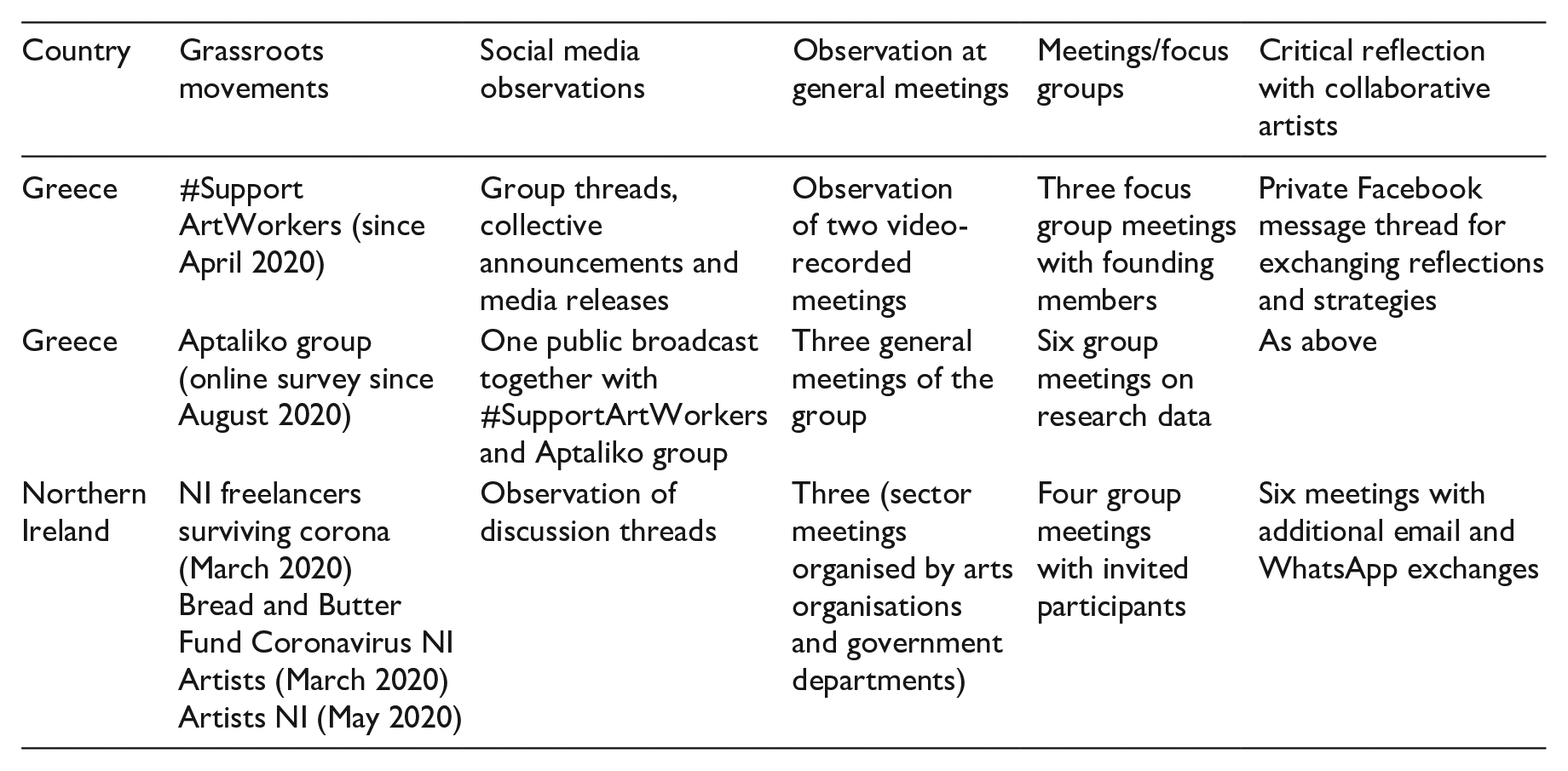
Our methodology was a blend of qualitative ethnographic and exploratory inductive methods, each working within our disciplinary standards but sharing emerging discoveries and adjusting our approach as we progressed the project. We can summarise the different elements that occurred between April 2020 and January 2021 as follows:
Driven by the established inequalities we observed and informed by feminist approaches to our research agenda (as per Hakim et al., 2020), we adopted an inclusive ‘Nothing About Us Without Us’ (NAUWU) approach, 1 structuring the project to engage and pay four freelance artists (two each in Greece and Northern Ireland) as ‘practitioner experts’ and co-researchers. Initially mobilised to campaign for the rights of disabled people, NAUWU has subsequently been taken up by other marginalised groups such as refugees and asylum seekers (Cañas, 2015) to articulate (as we do here) that these approaches offer opportunities for rebuilding knowledge systems such that new discoveries can be made more equitably. Challenges of inclusive research practices concern how to deal with ‘best practice’ norms of research such as ethics approval, academic standards and modes of dissemination, payment and treatment of time. Inclusive research also navigates the boundary between research towards forms of social justice and change and research as advocacy. Nevertheless, as Nind (2017: 280) observes, inclusive research assumes that participants are not just contributors to, or beneficiaries of, knowledge but its generators.
Drawing on established voices in academia that call for the strengthening of collaborative research beyond the ‘impact’ buzzword agenda (Askins, 2009; Pain et al., 2011), we position ourselves as co-producers of knowledge and strategy with our collaborators. As Pain et al. (2011) argue, the process of collaborative research with non-academic partners and participants often has significant value and generates impacts in itself: for example, including the sharing of knowledge and skills, capacity building, comprehension and empowerment among participants, and iterative dissemination and impact. (p. 186)
This practice suggests neither that research (and its dissemination) equals activism nor that the two processes are simultaneous or unproblematically hierarchical. Rather, we wish to unsettle the separation between ‘doing research on’ grassroots activism and the – often unfulfilled – hope that our research might feed into their campaigns. As Rachel Pain (2004) writes elsewhere, a significant contribution of participatory research springs from the potential to use ‘legitimacy gained from academic status and ability to engage in “scientific discourse” to actively work against inequality’ (p. 659).
We amplify this further by exploring the significance of our co-researchers being artists. As noted, artists’ absence from creative/cultural economy policies and as active contributors to the cultural ecologies research to date has limited their voice and inadequately utilised their expertise. Furthermore, little is understood in policy development of their spatial relationships with and in their locales through labour that is simultaneously public and personal, paid and unpaid. In our collaboration, our practitioner experts brought forward their own artistic practices and relationships as ways of developing conversations, revealing a more complex picture. To us, this went beyond the ‘lived experience’ often drawn out in participatory research and demonstrated what knowledges artists offer to research and policy discourses from their own creative practices.
Günel et al. (2020) call for a ‘patchwork ethnography’ most closely resembles our process of data gathering once we had entered this collaborative process. They combine ‘ethnographic processes and protocols designed around short-term field visits, using fragmentary yet rigorous data, and other innovations that resist the fixity, holism, and certainty demanded in the publication process’, while ‘fully attending to how changing living and working conditions are profoundly and irrevocably changing knowledge production’ (Günel, Varma, and Watanabe, 2020). As our article title suggests, it also drew from the innate strengths within performing arts where improvisation, although outwardly appearing loose and ungoverned, operates within a range of conventions (Ramshaw and Stapleton, 2017) and enables individual participants to bring forward new ideas and ‘lead’ the research at different moments.
Our initial plan was to combine social media and meeting observations of grassroots activist movements with focus groups in each context before co-authoring a policy statement. However, at initial planning, the artists in Greece wanted the researcher to contribute actively to discussions and present back to groups; while in Northern Ireland, the artists asked to have meetings rather than focus groups. In addition, in Northern Ireland, the artists contributed to outline questions proposed by the researcher, selecting alternate themes of inquiry and pursuing additional meetings with individuals they felt were not adequately represented (d/Deaf, disabled and minority ethnic arts freelancers, freelancers based outside Belfast).
We garnered knowledge from participants recruited by our practitioner experts. We shared our social media observations of the online groups listed above in critical reflection with our co-researchers, who themselves were evolving responses to the experiences of other participants. Recognising our collaborators as co-researchers and experts in their own lives (as per NAUWU) and practices, our initial process was dismantled in favour of their choices. We stepped back in leading our research direction. This broadened and altered its focus, introducing deeper dimensions of care and reflexivity. In this effort, we drew on established practices in anthropology and postcolonial studies, which highlight that different people conceive the nature and the agendas of research projects differently, whether due to indigenous backgrounds, intellectual histories or other socialising forces (Harrison, 1991; Tuhiwai Smith, 2012). In Northern Ireland, this rescinding of control happened by the practitioner experts re-shaping the temporary systems at play to introduce a wider urban and rural multi-artform community of freelance practitioners beyond the research focus of Belfast and the performing arts. In Athens, our conversations with #SupportArtWorkers documented and fed into the first mass mobilisation of performing artists after more than a decade of economic crisis and austerity. The imperative of rescinding control over the research agenda was more than a mere strategy to break perceived barriers between ‘researcher’ and ‘subject’ at odds with the cultural ecology we studied. The intention here was also to link together and enhance flow between the two parallel processes of ‘researching’ those artworlds and engineering change within them, with the opportunity for researchers and practitioners to dialectically co-shape both processes.
We articulate our transdisciplinary collaborative approach as improvisational and inclusive, adapting to fit the context as we progressed. Freelancers/artists held multiple roles as co-researchers, participants and beneficiaries. We argue that this methodological philosophy is more ethically in tune with proposals for new cultural ecologies (as per Chapain and Sagot-Duvauroux, 2018), especially towards inclusive visions of cultural regeneration and creative flourishing at grassroots level. The changing conditions for the artists we encountered, the relationships they formed and the coping strategies they deployed were highly fluid over time. These circumstances resisted traditional arches of hypothesis – data collection – results, requiring instead a more improvisational approach, such that new directions were revealed throughout. In this way, our reporting of findings here and conclusion of the ‘funded project’ represents a stage and not the closure of a finite methodological framework. Indeed, the artists and their networks’ activities remain ongoing, and our relationship to the participants continues as invested and mutually transformative. In line with Røyseng and Stavrum (2019) and Nind (2017), our relational approach to this work has recognised how our own position (and rescinding of it) influenced the process and findings.
In addition, it allowed us to reimagine how we could share power in the research and dialogic relationship, producing allyship and resisting ‘academic parasitism’ to derive ‘impact’ (Belfiore, 2015; Hadley, 2020; Nind et al., 2017; Stone and Priestley, 1996).
Selection of ‘practitioner expert’ artists
Our project began with the recruitment of two freelance artists in each context. Our approach to partner/participant selection identified individuals demonstrating leadership in informal and spontaneous online networks and campaigns. Wider participant engagement was informed by their expert knowledge of their field. All of these ‘practitioner’ experts had some formal training in performing arts; however, we understand their knowledge as derived from their work as practitioners and as significant mobilisers and campaigners. While we might articulate them as ‘leaders’, this is a title that they dispute, representing borrowed terminologies of business or public policies from which they perceive themselves to be excluded.
In Northern Ireland (NI), where formal state subsidy of some arts activities through an arms-length body existed pre-COVID-19, the most visible and vocal ‘leaders’ recruited as our practitioner experts emerged as a theatremaker and a playwright. They, with others, were the co-founders of three initiatives: the Facebook Group ‘NI Freelancers Surviving Corona’, the ‘Bread and Butter Fund’ and a website/network ‘Artists NI’. In Greece, by contrast, there was little to no state subsidy for the arts pre-COVID-19 and the informal economy as a result was more dominant among performing artists. There, we worked with musicians primarily from folk and jazz freelance scenes, and stage actors who led the grassroots collective #SupportArtWorkers.
Belfast, Northern Ireland and Athens, Greece as cultural ecologies
We selected the contexts for this research – Belfast (Northern Ireland) and Athens (Greece) – based on our previous immersion in artistic networks in these locales (both as researchers and practitioners). This ensured rapport, trust and ethical confidence in engaging in crisis research. The similarities and differences between these two contexts also provided a fertile context for comparison from a perspective of cultural ecologies.
One (Greece) is an independent nation; the other a ‘sub-nation’ (Northern Ireland as devolved administration within the United Kingdom). They possess common features as peripheral ‘small nations’ within Europe and spanning boundaries of wider regional demarcations (Northern Ireland as peripheralised within the United Kingdom and as a contested EU (European Union)/UK boundary area post-BREXIT; Greece sitting on boundaries of Western and Eastern Europe). Both have experienced intense austerity policies in the past decade. Turbulent and often violent political histories in Northern Ireland and Greece had shaped their economic and political contexts. The resulting political regimes had to some extent marginalised concerns of cultural production, its audiences and markets, within wider national debates and policies, exacerbating the austerity conditions and precarity of cultural work. Both to different extents have been sites of the bifurcation of policy distinguishing creative industries (cultural tourism, creative tech, film and TV) from both grassroots and socially driven cultural forms and artforms such as theatre, dance and visual arts.
Small nations offer particular advantages to the scrutiny of cultural economies, enabling inter-relationships between policy, practice and community to be more clearly visible (Durrer and Magan, 2017; Newbigin, 2014). While the two urban areas were both ‘capital’ cities, they differed in scale (Belfast: 750,000 in Northern Ireland, 1.8 million population; Athens: 4 million in Greece, 11 million population). Athens was the seat of national government, thereby possessing significant proximity to power, whereas Belfast, although the seat of the Northern Ireland Assembly, was on a separate island to the national UK parliament. Nevertheless, each city acted as the principal urban site for viable cultural work, drawing from the largely rural and small-scale urbanisations of the rest of the nation. In both nations, governments had turned to cultural and creative regeneration strategies as a means of recovery pre-COVID-19.
Data on Northern Ireland’s creative industries suggest it comprised 3100 business generating £1008 million and employing 25,000 people (Northern Ireland Statistics Research and Agency (NISRA), 2019). This, however, is acknowledged as lacking the more holistic creative/cultural economy perspective including non-commercial and amateur cultural and arts activity and a significant freelance informal economy. While separate state bodies and government units exist for development and financing of creative industries, digital and screen media, the ‘arts’, museums and heritage, there is little joined-up thinking, substantial over-administration and no accountable statutory provision. Levels of investment are lower than other UK regions and mired in instrumentalism, exacerbated by relatively immature and volatile political structures. While population survey statistics show a very high level of cultural consumption, these figures do not show the complexity of how culture is interpreted. The ethno-political conflict since the 1960s has been in part conducted through everyday cultural traditions and practices of identity: language, music appreciation, use of separate public spaces and symbolic display (flags, murals, etc.; Durrer and Magan, 2017). Political attention to culture has privileged economic regeneration as ‘normalising’ society post-conflict (through creative cities, creative enterprise and cultural tourism initiatives) and bipartisan (Nationalist:Unionist) cultural identity disputes (Ramsey, 2013; Ramsey and Waterhouse-Bradley, 2018). Although the region has promoted itself through notable success stories (Titanic tourism, Game of Thrones, Van Morrison, Seamus Heaney), these established and commercialised ‘products’ eclipse concerns of local precarity and sustainability within the cultural ecology (Ramsey et al., 2019) and also the contested spaces (of geography, identity and culture) of post-conflict society.
Greece’s cultural economy, by contrast, is more heavily dominated by its substantial cultural heritage and associated tourism and a substantial informal economy across all aspects of society, with many citizens having little engagement with official state systems and supports. The most authoritative research, carried out in 2014 during the Greek financial crisis, reported that the cultural industries include 46,370 businesses, employing 110,688 people, and contributing 2.1 billion euro to the Greek economy (Regional Development Institute, Greece (RDI), 2017). However, these data miss the large amount of undocumented and untaxed activity, especially related to night-time entertainment that operates as the key industry for professional musicians. Amplified post-austerity, state policy has largely monopolised significant heritage sites and directly supported major cultural centres, thereby also increasing their dominance in the cultural landscape (Palmer, 2018). Less attention (and subvention) has been provided to smaller scale local and contemporary creative enterprise or again to concerns of cultural workers. Latterly, the dominance of heritage and ‘sun-seeking’ tourism has been recognised as somewhat outdated, and new policies aimed at pump-priming creative industries (again focused on creative tech and enterprise) have been attempted (Lazaretou, 2014). Accordingly, arts freelancers’ relationship to the state and policy pre-COVID-19 was principally fuelled by activism with almost no expectation of subvention.
Lockdown in both contexts began in March 2020 with varying levels of severity. Social gatherings including weddings, conferences and private events were banned; all public venues closed. In addition, bars, film sets, recording studios, schools and private tuition, and youth/community activity were closed or suspended. The portfolio nature of performing artists’ work meant that this interrupted not one but all aspects of their livelihoods and work. While some hospitality sites reopened during summer 2020, restrictions on live performance generally continue and this uncertainty dominated the lives of all our participants. Governmental responses were varied and evolved over time. Northern Ireland was the first region in the United Kingdom to introduce emergency funding for arts freelancers in the form of micro-support project grants (Wright, 2020). These required that some production (often online) was needed to demonstrate ‘public benefit’. Support for the self-employed from the UK government was slow, arriving weeks after employee furlough schemes and paid retrospectively; at least 30 to 40 per cent of freelance arts workers were excluded or ineligible from all UK government supports by dint of their mixed employment (Freelancers Make Theatre Work, 2020; Musicians’ Union, 2020). Despite multiple campaigns and extensions, by March 2021, the exclusions remained unchanged at UK government level. While other pan-arts emergency funding (national and devolved governments) was released intermittently between April and December 2020, many calls operated with short notice periods, were often delayed by bureaucracy and were overwhelmed by demand. In Greece, two rounds of allowances for freelancers were made available between March and October 2020, with additional small instalments in the months following. Nevertheless, the majority of performing artists (as high as 70% of them, according to #SupportArtWorkers activists) were excluded as a result of state definitions of ‘sustained’ labour and the frequency of undocumented work within those scenes.
The freelancers we focus on here have, in both nations, been largely invisible in pre-pandemic policy and generally excluded from COVID-19 policy measures. In both locations (and across Europe), culture is seen as a driver of social and economic recovery and particularly urban/regional recovery (Montalto et al., 2020); yet, little attention has been given to the lasting effects of these shifts in how and where cultural experiences were created and shared. We illustrate then, in our findings, how our approach suggested new and useful knowledge to such futures.
Mobilisation and self-organisation in uncertainty
Through our co-researchers, we gained insight to working practices during COVID-19. These presented counter-narratives or additional insights to dominant rhetorics at the time (from official industry campaigns, trade unions and governments) and suggested high levels of self-organising.
On 27 April 2020, a few weeks into the COVID-19 lockdown, a small collective of Greek performing artists started a Facebook group titled ‘Support Art Workers’. As Valeria, an actor and one of the founding members told us in an interview, ‘we weren’t expecting it, but within hours the whole thing exploded! #SupportArtWorkers started trending on social media and every hour we had thousands of new members’ (interview extract from 17 July 2020, translated by I. Tsioulakis). Starting as an online exchange and support network, the group soon expanded into different types of activism, including street protests, written manifestos, public performance interventions, podcasts, visual artwork and more (see, further, Tsioulakis, in press). Also in the summer of 2020, a small group of Greek musicians powered by the non-profit organisation Aptaliko conducted an online survey to document the emergent circumstances of COVID-19 for freelance musicians. Exceeding expectations, the survey received thousands of responses and led to a large-scale project of analysing and visualising data (Aptaliko Non-Profit Organisation, 2021).
A grassroots network, NI Freelancers Surviving Corona, appeared on Facebook in Northern Ireland on 16 March 2020, the same day that a similar group of artists set up an emergency GoFundMe campaign (Bread and Butter Fund Coronavirus NI Artists). These movements predate the official UK/NI lockdown but reflect the lived experience of cancelled contracts and loss of work due to official ‘discouragement’ to attend live events before mandated closures. Such losses hit during a usually quiet period of early Spring, affecting seasonal uplifts in March. The Facebook group (which grew rapidly to around 2000 members) and GoFundMe campaign were responding to financial and emotional shock and intended ‘to share information and support’. Political mobilisation followed in May 2020, instigated through a series of posts to the group and an open call for a Zoom meeting among freelancers. In May 2020, the network and website Artists NI was established.
In every instance, we observed individuals undertaking the labour of cancelling and rescheduling work, the work of ‘unproducing’. Some had paid work to ‘pivot’ online, often with little additional financial or technical support. They were actively retraining and adjusting their practice, usually entirely without external assistance and from domestic settings. Despite our focus being collaborative artforms (performing arts), they often worked in isolation in their homes and many carried multiple other personal caring responsibilities. DIY (Do It Yourself) acts of cultural production were mobilised both online and later in person as a desire to connect people, setting up virtual ‘creative coffee breaks’, broadcasting free live performances and watch parties, running free online workshops, socially distanced walks and outdoor creative gatherings. Most undertook the labour of seeking emergency arts grants or social welfare support, writing funding applications and claims, many for the first time.
This organising, mobilising, auto-producing was unpaid labour shrouded within a rhetoric that ‘business was closed’ as the principal public faces of their industry – venues – promoted campaigns around empty seats and closed doors. This amplified freelancers’ invisibility and exclusion from policymaking, within local and national governmental decision-making bodies, and disconnected their identity from their traditional ‘places of work’. Furthermore, it was a counter-narrative to the largest trade union movements who have previously disregarded the voices and predicaments of freelance/precarious performing workers (as identified in our own and others’ prior research – Banks and Hesmondhalgh, 2009; Comunian and England, 2020; Tsioulakis, in press).
Mutual and radical care as response to ‘invisibility’
Through the improvisational strategies we adopted, we found that these self-organising ecologies were demonstrating more complex and equitable systems of care than ‘official’ systems. We see this as a direct response to freelancers’ invisibility and exclusion. While these informal networks always existed, their function and reach were amplified digitally and emotionally leading to increasing levels of mutual care, supporting younger, more vulnerable or excluded practitioners. As Pavlos, an actor/musician and founding member of #SupportArtWorkers in Greece, told us, ‘our movement emerged because there was no provision. [. . .] So, there was a need to act outside of those norms, and this was what we fulfilled at that moment’ (interview extract from 17 July 2020, translated by I. Tsioulakis). However, the ways in which these initiatives manifested were not uniform across the different regions. In Greece, the #SupportArtWorkers campaign early on set a strategy premised on visibility, disruption and a forceful reclaiming of the agenda. The campaign transformed within a month into a movement of thousands, with numerous public interventions, both physical (demonstrations at the Greek parliament, public meetings and performance events) and virtual (through closed and public meetings). Their strongly worded open letters to the Greek Minister of Culture, as well as their political interventions against police brutality and in favour of the right to protest, are a testament to this strategy. Since November 2020, #SupportArtWorkers have initiated online public discussions with artists internationally, under the theme of ‘radical voices/radical ideas’. Through our project, our Northern Irish co-researchers were brought into public online conversations with the Greek collective, illustrating ways in which not only cultural production but also activism within creative labour can be deterritorialised through digital technologies.
By contrast, the Northern Irish groups resisted both formal self-organising and open public campaigning. As one of the Northern Irish practitioner experts said ‘I don’t want to set up another organisation and committee’. This strategy may seem counter-intuitive but was informed by multiple factors. Significant voices in these Northern Irish meetings self-identified as working-class or ‘benefits-class’ and believed pleading an ‘exceptional case’ for arts freelancers was inappropriate. In addition, many expressed little patience for ‘complaint without attempt at solution’ (contribution at meeting). They had experience of other lobbies being ‘hijacked’ by organisations or loud individuals and wanted a balance between their personal input or leadership and personal resistance to being made ‘spokesperson’. The common theme for all was mobilisation because of the failures of cultural institutions and networks, governments, public bodies and trade unions to adequately engage and respond to their concerns. A further common theme was a sense of ‘last straw’: that these failures were replications of previous patterns of being ignored and invisible.
In addition, we observed that the groups in both contexts often felt detached from or antagonistic towards more formal networks and trade unions. As 2020 advanced, we saw frustration in Northern Ireland that unions and campaigns largely focused on English policy rather than devolved UK nations’ policy divergences. Variations in lockdown between UK nations and corresponding continued closures were often omitted in national media reporting, and performing arts was frequently omitted in published guidance by the different devolved governments. Individual artists/practitioners reflected that becoming organised and vocal were things they had not expected to do themselves, previously leaving it to others who were better at ‘politicking’, organising or public speaking. Examples of ‘expert advocates’ included theatre associations and trade unions (UK Theatre and Equity), and spokespeople for the National Campaign for the Arts (Ireland). Younger practitioners in Northern Ireland expressed feeling ignorant of government language and policymaking processes at national or local level, unable to recognise themselves in how their sector was described. In Greece, the #SupportArtWorkers collective sought to create working groups, decentralising and delegating the labour, but in doing so found itself in complex antagonisms (if not explicitly in conflict) with formal trade unions. In both contexts, we observed tensions in relationships with official or funded institutions such as companies and venues. Some freelancers expressed sympathy and saw a shared struggle. Others, notably where government support had privileged employees, expressed anger at the lack of effort or mobilisation from salaried workers.
Particularly in Greece, where the Actors’ Union (ΣΕΗ) and the Musicians’ Union (ΠΜΣ) were long established as the forefront of freelancers’ labour activism, the emergence of #SupportArtWorkers and other online-powered collectives during COVID-19 on one hand fed the engagement of previously unaffiliated artists with trade unions while, on the other, it complicated the relationship between recognised bargaining bodies and grassroots mobilisation.
We identify the informal networks, shaped by freelancers through social media and voluntary campaigns, as a move from sites of anger to sites of radical care (echoing Chatzidakis et al., 2020). Of course, issues of ‘care’ have always been central to the labour of performing artists. Performers offer ‘affective labour’ (Hardt, 1999; Hesmondhalgh and Baker, 2011: 159–186) by inducing emotions and affect among their audiences and they engage in ‘emotional labour’ (Hochschild, 1983; Hofman, 2015) by manipulating and externalising their own emotional states, on and off stage. Simultaneously, they curate their bodies and appearance as forms of ‘aesthetic labour’ (Witz et al., 2003) and they forge and cultivate networks and friendships in what Shannon Garland (2019) calls ‘phatic labour’ (cf. Tsioulakis, forthcoming). However, this care-work under COVID-19 expanded to activities beyond typical ‘artistic’ work. Often, our co-researchers revealed these as counter-responses to the exclusion amplified from the pre-COVID status quo. Detachment from governmental policy, either because of perceived failure in provision or historic working practices in which public funding/policy is absent, has produced alternate systems of professional networking and production. These parallel systems display fluid practices and attention to inclusivity that is shaping this labour (professional, voluntary and emotional) as an invisible cultural ecology in itself. Many had become involved in wider forms of care (making masks, helping with voluntary food banks, etc.) and regularly contributed for free to online entertainment as (in their view) part of working for social good (as per Serafini and Novosel, 2020). We also observed that the act of care was not always voluntary, with many (particularly women) supporting children, older relatives and partners suddenly in need of extra support.
While recognising all forms of care, we concentrate particularly on the mutual systems of support for other arts freelancers in the absence of care from state, unions and often cultural organisations. Through our observation of social media groups, we saw numerous examples of older or more experienced practitioners explaining emergency support schemes, passing on tips or helplines to other practitioners. In both locales, multiple threads sought help and crowdsourced solutions to accessing emergency social welfare, resolving problems with official documents, interpreting government announcements to their own circumstances. While many individuals knew each other, these spaces facilitated discussion between strangers, with individuals openly discussing personal and financial crises and others offering advice and empathy. These sites which moved between the virtual and ‘meatspace’ (term from Northern Irish meeting) were also spaces for arts freelancers to ‘sound off’, to co-organise protests, petitions and awareness-raising, and share survey information.
Vulnerability of expertise and imagination
As we moved away from our documentary and impact-driven approach, our collaborative research revealed more complex insights to freelancers’ vulnerability to political apathy and the potential loss of expertise from both future research and cultural recovery policies. Two years on from the COVID-19 outbreak in Western Europe, and with coherent governmental responses to the freelance labour and live events crises still lacking in Northern Ireland and Greece, we see lost opportunities for this fluid, adaptive expertise to be involved in the re-futuring of creative economies and civic society. Although we as researchers were able to ‘feed in to’ aspects of policy, our artist partners had little engagement with cultural recovery planning. Formal Taskforces in the United Kingdom have predominantly engaged with ‘leaders’ representing institutions or businesses, missing the opportunity to draw on freelancers’ lived knowledge (repeating the closed networks of influence identified by Comunian and Conor, 2017; FitzGibbon, 2019a; Nisbett and Walmsley, 2016). More generally, we can see that this persistent failure to include artists in formal policy discourses is influenced by differing levels of hostility on the part of political parties as well as an embedded apathy to understand artists’ circumstances and the nature of cultural work and ecologies. In Northern Ireland where an arms-length public arts body exists, some of this failure appears borne of a distracting tension between the public body and its lead department. The practitioners’ responses in both contexts alternated between deliberate provocation of politicians, public complaint and satirising through social media, and the staging of public appeals for support. In this process, these new collectives refused to be legitimised by public officials and politicians whom they no longer believe care.
We speculate that, as this situation persists, freelance practitioners/artists are increasingly struggling to imagine their future work and lives. This is a missed opportunity and voice in cultural ecologies research as well as an urgent policy priority. As previously noted, this absence is connected to exclusion and precarity. In Greece, less than 30 per cent of working performing artists qualified for the limited state support for freelancers (according to ‘Support Art Workers’ initiative and Panhellenic Musicians’ Union). This exclusion is because much of this work falls in the cracks between definitions of ‘sustained’ work by the Greek Ministry of Labour or exists as completely undeclared labour. Moreover, we hear about the agendas that are involved in the construction of a census of performing artists by the Ministry of Culture, and the grassroots resistance that it faces. In Northern Ireland, where additional emergency funding was either delayed in distribution or released in a slow dripfeed of short notice micro-granting, we observed initial energy to mobilise falling away due to hardship, frustration and loss of hope. Although the Northern Ireland Assembly spoke of cultural recovery planning, a formal Taskforce was not established until Spring 2021 and its report only appeared in November 2021 (Department for Communities, 2021).
Beyond the ability to subsist (a major concern in these groups), we speculate how significant the absence of this expertise and imagination will be to the so-called ‘new normal’. As discussions of re-localised and sustainable enterprise and social rebuilding grow in policy and research discourses, we question how arts freelancers’ unique knowledges will be harnessed and what will continue to be overlooked in this future. In particular, we note the significance of their fluid and disassociated networks of care and their adaptive strategies that transcended public, private and digital spaces throughout lockdowns and reopening. As we turn to our final and core finding, we argue that there is a moral imperative for future academic collaborations to involve these groups as critical stakeholders.
The collaborative researcher:practitioner relationship
Working closely with these different groups has allowed us to form bilateral beneficial relationships, managing to (a) understand the different ecologies within which they operate (formal, informal and both); (b) gain an empirical view of how state support has alleviated some precarity but also reproduced exclusions and inequalities invisible from a top-down perspective; (c) trace their relationship with – and in some instances opposition to – more formal collectives such as the Panhellenic Federation of Performance and Sound, the Panhellenic Musicians’ Union, Equity and organisation-led campaigns and networks; and (d) discuss and feed into their claims and demands vis-à-vis the Greek Government and the Northern Ireland Assembly.
The significance of the findings lies in their collaborative production. We believe the usefulness, depth and range of our insights have been achieved with more equitable transdisciplinary practices and utilising both lived experience and core practice knowledges of our co-researchers. We have come to understand how our presence has influenced the groups’ behaviours and the inclusive approach we adopted has enabled us to be allies to their campaigns. In as much as we have drawn on their expertise, we have brought ours. We articulate particular examples: being critical friends in discussions within Northern Ireland and bringing knowledge from other groups, bringing international perspectives to #SupportArtWorkers and contributing analysis expertise to the survey conducted by Aptaliko. Responding to requests from our collaborators, we have also enriched their cross-national understanding of the circumstances of cultural work and linked activists from both contexts together. This supported an exchange of strategies as well as reflection on how their different contexts shaped different responses. In addition, our status as academics at times added ‘gravitas’ to group statements or put key concerns into other realms through talks, presentations, securing press coverage, meeting and advising public officials and government departments. While resisting ‘saviour complex’, we have mined our academic privilege to amplify the plight of precarious arts freelancers, at the same time questioning how our own conceptualisation and discourse differs to theirs. Documenting these exchanges informs a scholarly understanding of emergent post-COVID-19 cultural ecologies, and how they form in isolation or dialogue.
As we continuously shift between documenting and feeding into these debates, our key finding is methodological: that the research within and surrounding cultural ecologies must accept an absence of finite results, embracing the evolutionary nature of the urgencies and context of creative practice, and recognising the ethical purposes of academic involvement. Moreover, we are testing techniques of collaboration and reflecting on their effectiveness. In this process, we are finding out that not only the production of answers and data, but the design of the questions is better left in the hands of artists, freelancers, workers and their grassroots collectives.
Conclusion
This research collaboration was mobilised as both a documentary and impact response to COVID-19. However, the pressing needs of freelance artists and the long-term consequences coming over the horizon show that documentation might be necessary but it is insufficient. Hence, we seek here to address exclusion and significant injustice through our role as academics. Our collaborative engagement with ‘practitioner experts’ has opened up new thinking in the challenges and opportunities in shaping new practices and economies. The approach has also enabled us to contribute to, and reflect on, our own capacity as researchers to shape and influence practice, policy and research. Through them, we observed lateral human connections that transcended the boundaries of social group, artistic discipline and the geography of their locales. In addition, their improvised and DIY creation of cultural experience and spaces that moved between the virtual and physical has value to policies of creative and cultural regeneration. Their informal networks act as human points of inclusion, care and representation, but these rich alternative ecologies are thus far overlooked in post-COVID recovery in these cities and regions. Future study should both look more closely and involve them more in order to reconceptualise what ‘resilience’ and ‘sustainability’ might look like in post-COVID-19 regions and cities.
We are also concerned about what will be lost if such expertise is not protected. Informal networks formed new invisible adaptive and fluid cultural ecologies and processes of care under COVID-19 that resisted economic imperatives and blurred distinctions of public and private realms and causes, activism and expression. These processes act as a direct counter to what Chatzidakis et al. (2020) point to as a ‘carewashing’, in this case the creative economy policies surrounding the crisis. The practitioners’ creative practices offered improvisation and adaptiveness in practice and research whose insights could be better harnessed in new cultural economies. Yet, they are also extremely fragile and increasingly vulnerable. Our concerns in the face of alternating hostility and apathy within policy and political discourses are that this potential richness will be lost along with the status of these artists as workers and thus citizens and contributors within their locales. We propose that future research must centralise the voice and informal processes of arts freelancers for it to be grounded in both reality and potential.
We resist a definite conclusion and argue that future cultural ecology research must adopt ongoing, equitable and collaborative practices to realise their value and to recognise both their interdependency with practice and their privilege, particularly in relation to freelance creative labour. We propose that inclusive approaches within disability studies, feminist methodologies and decolonisation research offer opportunities and wider applications to the development of both research and policy in cultural ecologies at a regional and city level. Finally, we suggest there are moral ethical drivers that should compel academic researchers to adapt their practices to the fluidity of lived experience and make the invisible visible.
Footnotes
Acknowledgements
The authors acknowledge the contribution of scholars Roberta Comunian, Tamsyn Dent and Daniel Ashton in commenting on a working paper version of this article through the Creative and Cultural Ecologies Research Network.
Declaration of conflicting interests
The author(s) declared no potential conflicts of interest with respect to the research, authorship, and/or publication of this article.
Funding
The author(s) disclosed receipt of the following financial support for the research, authorship, and/or publication of this article: This work was supported by the Economic and Social Research Council.
