




Abstract
Urban and regional research has focused on opportunity entrepreneurship and how cities can promote growth through the ‘right’ type of entrepreneurship. This neglects the increasing risk of precarious self-employment reflected in the compositional change of self-employment towards self-employment with no employees (‘solo self-employment’). This article tests whether precarious self-employment is more prevalent in urban areas, in parallel to more entrepreneurial forms as shown in previous research. Based on the European Working Conditions Survey 2015 and including 30 countries, it proposes a multidimensional empirical framework of precariousness of self-employment. Findings show significant variations in the prevalence of precarious self-employment in urban versus non-urban areas across geographical regions. Some individual characteristics (gender) and job-related characteristics (industry and working at home) are related with an increased risk of precariousness in urban areas. Policies therefore need to go beyond regulatory and legal frameworks and target local conditions of self-employment.
Keywords
Introduction
A striking trend that has been observed in almost all advanced economies is a significant change in the composition of self-employment. The share of the self-employed who work on their own account and do not have employees (‘solo self-employed’ workers) has increased whereas the share of self-employed workers with employees has decreased (Boeri et al., 2020). Solo self-employment has been coined as ‘new’ self-employment and framed in the sociological literature as precarious nonstandard employment (Buschoff Schulze and Schmidt, 2009; Kalleberg, 2011). There is also some evidence that self-employment has become more urban due to its rise in the modern service sector (Magrini, 2019). This spatial shift has largely remained unrecognised within the literature on ‘new’ self-employment.
Empirical evidence shows that solo self-employment has emerged as a distinctive new form of self-employment that differs from both paid employment and self-employment with employees in terms of working conditions and experiences (Boeri et al., 2020; Buschoff Schulze and Schmidt, 2009). However, within the group of the solo self-employed, working conditions and experiences also vary substantially (Bögenhold, 2019) as solo self-employment is prevalent in traditional sectors (e.g. construction and skilled trades), professions (e.g. health practitioners), personal services (e.g. hairdressers), and increasingly in low-skilled sectors due to the rise in delivery and driving services (Deliveroo, Uber, Just Eat, etc.). This heterogeneity coincides with a complexity of precarity that has remained underresearched (Holloway and Pimlott-Wilson, 2021; Murgia et al., 2020; Wall, 2015).
Regional and urban studies has highlighted the importance of spatial context for self-employment (Faggio and Silva, 2014; Haapanen and Tervo, 2009). Existing studies have investigated whether self-employment is more entrepreneurial in urban areas than rural areas (Faggio and Silva, 2014; Tervo, 2008) and identified the factors that influence self-employment and entrepreneurship in urban areas (Glaeser, 2007; Glaeser and Kerr, 2009). However, this literature has focused on entrepreneurial and innovative forms of self-employment resonating the focus in much contemporary urban and regional research on economic growth and innovation. Since precarious forms of self-employment have been related to ‘new’ industries that are more prevalent in urban areas such as the creative sector (Murgia et al., 2020), the prominent view on entrepreneurial forms of self-employment in urban areas may disguise that urban areas may be more likely to produce precarious forms of self-employment in parallel to more entrepreneurial forms. Hence, the objective of this article is to provide, for the first time, empirical insights into precarious self-employment in urban areas. It specifically explores (1) whether precarious forms of self-employment are more likely to exist in urban areas than non-urban areas, and (2) whether certain types of precarious self-employment are more prevalent in urban areas than non-urban areas.
Using the European Working Conditions Survey 2015, we develop a multidimensional approach to understanding spatial aspects of precarious self-employment. In line with the most recent evidence on ‘new’ self-employment, we define multiple risk types of solo self-employment as precarious (Murgia et al., 2020). This approach recognises the contemporary heterogeneity of self-employment linked with varying risks of precariousness even among the solo self-employed (Gevaert et al., 2021). This also allows us to investigate significant differences between different types of precariousness from which more precise policy conclusions can be drawn.
Since there is no existing research, to the best of our knowledge, that has explored the risk of precarious self-employment in urban areas, we hope that much can be learnt from our empirical study. First, we use different literatures to derive types of self-employment according to their risk of precariousness. This provides a robust empirical basis for future research to advance knowledge of precarious self-employment. Second, previous research in urban and regional studies that has been critical of the dominant discourse casting urban areas as innovation machines (Florida et al., 2017), yet has still been concerned with the geographical variation of innovation or the absence of innovation in some urban locations and has not focused on precariousness in urban areas (e.g. Fitjar and Rodriguez-Pose, 2020; Shearmur, 2012). This study will add a critical perspective on urban employment conditions and labour markets to urban and regional studies by moving beyond the focus on innovation and entrepreneurship. This is important conceptually and has also implications for policy, especially in European labour markets, where the solo self-employed have become a relevant ‘reserve’ workforce, as argued by Boeri et al. (2020), with consequences for wages but also for how to measure and understand labour markets. Third, this study also adds to the literature on precarious nonstandard work in the social sciences a spatial perspective highlighting the importance of local conditions for precariousness above and beyond regulatory and legal contexts.
In the rest of this article, we first discuss different types of precarious self-employment identified in the extant literature which will form the basis of our analytical framework. We will then discuss the urban economic literature to argue why urban locations may be relevant for understanding precarious self-employment and which features of urban labour markets may reduce or increase the risk of precarious self-employment in urban locations. From this review of literature, hypotheses would be derived that are then explored empirically.
Literature
Defining precarious self-employment
The precariousness of self-employment has been associated with low income, job insecurity, and a lack of social benefits and labour rights (ILO and OECD, 2020; Kalleberg, 2011; Schulze Buschoff and Schmidt, 2009). The solo self-employed have been specifically related to inadequate incomes and benefits and low job certainty and hence with precariousness (Vosko and Zukewich, 2006). In terms of income, however, De Vries et al. (2020), for example, found that in the Netherlands only a small proportion of the solo self-employed can be classified as precarious when the standard national poverty threshold is taken as a comparator. Rather than low income of the solo self-employed per se, it is the risk of job insecurity, unemployment or loss of financial and other resources that is often described as precarious self-employment (Dekker, 2010; ILO and OECD, 2020) and which forms the reference point for this study. Defining precariousness through the risk of job and financial insecurity is different from some studies that have focused on precarious working conditions of the self-employed. These studies have often described precarious self-employment, contrary to this study, through working long hours and working at unusual times (Bergvall-Kåreborn and Howcroft, 2013).
Characteristics of solo self-employment that have been associated with the risk of job and financial insecurity in previous research, which we refer to as precariousness of self-employment in this study, include (1) the number of clients, (2) the motivation of becoming self-employed, and (3) low working hours. These definitions and concepts of the precariousness of self-employment will now be discussed in turn.
When the self-employed usually have only one client they are in a de facto employment relationship but without the security and benefits of being an employee such as paid sickness and holiday leave. Therefore, this type of self-employment is ‘at the boundary between self-employment and dependent employment’ and exposes the self-employed to financial risk as they are economically dependent on one ‘employer’ (Schulze Buschoff and Schmidt, 2009: 147). This type of self-employment is referred to as ‘dependent’ self-employment. With the emphasis on the financially vulnerable status of the self-employed, it is often defined as being self-employed with no employees and having only one customer (Böheim and Mühlberger, 2009; Eichhorst et al., 2013). Some studies also consider whether the solo self-employed feel they have autonomy over their business (Bozzon and Murgia, 2022; Williams and Horodnic, 2018) or limit dependent self-employment to working as solo self-employed for a previous employer (Román et al., 2011).
Dependent self-employment has a longer history in traditional labour-intensive industries such as agriculture, transport and construction (Thörnquist, 2015) and has increased previously during recessions (Román et al., 2011). In some countries, self-employed work that is dependent on the demand of one client has been specifically investigated as a form of precarious self-employment in the construction industry, notably in the United Kingdom and Italy (Williams and Horodnic, 2018).
However, contemporary dependent solo self-employment is in itself a diverse phenomenon (Eichhorst et al., 2013). Across Europe, dependent self-employment was most prevalent in traditional sectors (agriculture, forestry and fishing) but also in arts, entertainment, recreation and other service activities (Williams and Horodnic, 2018). In addition, the rise of the ‘gig economy’ and ‘on-demand’ business models such as Uber and Deliveroo have created new forms of dependent self-employment enabled by mobile technology (Zwick, 2018).
Dependent self-employment is often discussed in the extant literature in conjunction with ‘necessity’ self-employment – when self-employment is taken up because of a lack of alternative employment. For example, Böheim and Mühlberger (2009) using data for Great Britain, identify dependent self-employment as a specific form of necessity-motivated entrepreneurship. Necessity self-employment has been defined in the entrepreneurship literature as a distinct form of entrepreneurship that is less likely to be linked with economic growth (Acs, 2006). Empirically, necessity self-employment or being ‘pushed’ into self-employed has been related to the risk of unemployment (Binder and Coad, 2013). Both dependent and necessity self-employment have been regarded as ‘involuntary’ self-employment highlighting that the self-employed have no choice in the labour market (Kautonen et al., 2010).
Compared to employees and the self-employed with employees, Boeri et al. (2020) found that a distinguishing characteristic of the solo self-employed in the United Kingdom, the United States and Italy is to want to work more hours. Working insufficient hours is a form of underemployment. Solo self-employment in their study was further associated with transitioning in and out of unemployment and low earnings. Gevaert et al. (2021) using data from the European Working Conditions Survey 2015 also related insecure self-employment with being solo self-employed, having only one client, working low number of hours and necessity-driven motivations of self-employment. Insecure self-employment contrasted in their study with ‘stable’ solo self-employment that is associated with a preference for being self-employed, a moderate number of hours worked and having more than one client highlighting the varying risk of precariousness among the solo self-employed.
Studies on the geography of underemployment suggest that urban economies but also remote rural areas produce underemployment as shown for the United Kingdom (Lindsay et al., 2020) and Greece in the aftermath of the global financial crisis (2007–2009; Gialis et al., 2018). Gialis et al. (2018) estimate that, in 2012, half of all part-time employment in Greece including in metropolitan areas was involuntary (i.e. underemployment). In both of these studies, underemployment is highest in accommodation and food services and other services including entertainment, which are sectors where self-employment is also high further suggesting a link between precarious self-employment and underemployment.
Low working hours and low earnings in self-employment have been associated in related entrepreneurship research with working at home especially among the female self-employed (Thompson et al., 2009). Mason et al. (2011) found that so-called home-based businesses, in which case, the self-employed do not have commercial premises but use their homes as a place for their work or as a base, are across regions in the United Kingdom not only more often run part-time but the self-employed are also more likely to have other income sources than those from their businesses (e.g. other employment, pensions). The authors describe this as ‘a portfolio of income-generating activities’ (Mason et al., 2011: 630). However, rather than positively viewed as a personal portfolio, this might indicate insufficient working hours and therefore precariousness.
Entrepreneurial self-employment and urban location
Spatial entrepreneurship research has highlighted the importance of contextual (external) factors such as location for self-employment and entrepreneurship in addition to dispositional factors such as personal traits. A particular focus in this research has been on differences in entrepreneurship and business start-ups between urban and rural areas.
Some research supports the view that self-employment and business start-ups are more likely to be entrepreneurial (opportunity-driven as opposed to necessity-driven and/or growth-oriented) in urban areas than in rural areas (Bosma and Sternberg, 2014; Faggio and Silva, 2014). Similarly, Tervo (2008) relates self-employment in rural areas with a lack of employment opportunities more than in urban areas. This is despite self-employment being traditionally more prevalent in rural areas. Bosma and Sternberg (2014: 1027) infer from this to a ‘premium’ for opportunity entrepreneurship (as opposed to necessity entrepreneurship) in urban areas.
An ‘urban premium’ for entrepreneurial types of self-employment could first relate to benefits from agglomeration economies related to the spatial proximity to input suppliers and customers (Glaeser and Kerr, 2009). Cities also provide better and more infrastructures and services relevant for businesses including financial services that facilitate business start-ups and business growth (Eliasson and Westlund, 2013).
A second explanation for more entrepreneurial – and less precarious – self-employment in urban areas relates to networks and knowledge spillovers. New entrepreneurs and those who want to start a business are reliant on networks (Stam, 2007) and the creation of social capital (Nijkamp, 2003). Network opportunities are enhanced in cities through both dense professional networks and informal networks. A specialised local industry structure can specifically provide formal networks and access to potential clients, suppliers, collaborators and specialised services (Eliasson and Westlund, 2013). Diversity in terms of industry structure and people may promote informal learning processes such as ‘learning by doing’ (Glaeser and Kerr, 2009) across industries and thus enable the self-employed to establish their business. The spatial proximity to a large number of other self-employed individuals in urban areas could stimulate ideas for an own business and hence more opportunity-driven business start-ups (Andersson and Larsson, 2014).
A third explanation discussed in existing research is a ‘culture’ of entrepreneurship such as attitudes towards entrepreneurship and self-employment. Positive entrepreneurial attitudes were found to be higher in metropolitan areas than non-metropolitan areas, for example, with a traditional manufacturing industry structure (Westlund et al., 2014).
Urban location and less entrepreneurial, precarious self-employment
Other studies, however, found no difference in the motivation to become self-employed between urban and rural areas (Eliasson and Westlund, 2013) and across regions (Dawson et al., 2014). This contradicts the view that opportunity-driven self-employment is more urban. Haapanen and Tervo (2009) further argue that if urban areas provide a better opportunity structure for more economically successful self-employment than rural areas, one would also expect higher exit rates from self-employment in rural areas. However, the authors found self-employment exit rates to be higher in urban areas than rural areas.
Modern service industries associated with higher levels of self-employment due to low-capital requirements such as professional and financial services are concentrated in cities (Glaeser, 2007). However, some knowledge-intensive sectors provide little choice between paid employment and self-employment and may therefore ‘push’ some people into self-employment. Production is organised around projects in a wide range of professional and cultural services (Sydow et al., 2004). Consequently, in sectors such as media, short-term employment, freelance work and high turnover of staff have become the norm (Morris et al., 2016). Because of the high mobility between employers and projects, dense networks (social capital) are important for finding freelance work (Farrell and Morris, 2017), which is facilitated by urban labour markets.
Knowledge-intensive sectors dominated by project and temporary work organisation have increasingly been associated with precarious work. Particularly in the cultural industries, precarity has been related to experiences of extended periods without work and earnings (even before COVID-19) and the need to accept low remunerations to secure future ‘gigs’ (Umney and Kretsos, 2014). The high dependence on informal social contacts especially in the creative sector has developed into what Huws et al. (2018) termed a ‘fluid’ labour market in which people not only move between different employment states and jobs but also increasingly between offline and online work.
Furthermore, urban areas and large cities, in particular, are places of rising occupational polarisation (Goos and Manning, 2007) and social inequality (Lee et al., 2016). Unemployment is higher in urban areas (Houston, 2020; Lindsay et al., 2020), which is consistent with greater necessity-driven self-employment, which may push people into precarious forms of self-employment. ‘Gig’ work in driving and delivering services (e.g. Uber and Deliveroo) is one modern driver of low-skilled and low-paid solo self-employment (Taylor et al., 2017). These platforms rely on a large pool of low-skilled labour which is supported in urban labour markets by large proportions of vulnerable populations, particularly young people and ethnic minorities that often face a lack of employment options (Blackburn and Ram, 2006).
Summary of literature and hypotheses
In summary, we can define two contradictory presumptions on the prevalence of precarious self-employment in urban locations. On one hand, urban economic research highlights the greater opportunities of business start-ups, entrepreneurs and smaller firms in larger cities due to the benefits of proximity to suppliers, people, infrastructure and output markets. Some studies suggest that due to this urban economic ‘advantage’, necessity-driven self-employment is rather rural than urban. Furthermore, one might also expect that agglomeration benefits can reduce the risk of the self-employed not having sufficient hours to work (i.e. to be underemployed) or to be economically dependent on only one client due to proximity to a large number of customers and dense networks. On this basis, we derive the hypothesis that the risk of precarious self-employment more generally is lower in urban areas (‘opportunity hypothesis’).
On the other hand, precarious self-employment is driven by economic restructuring and the re-organisation of production and paralleled by increasing occupational polarisation and concentration of vulnerable groups in urban areas. Involuntary self-employment – both in the form of necessity and economically dependent self-employment – and solo self-employment with insufficient working hours are therefore likely to be features of urban labour markets. Contrary to the opportunity hypothesis, some research suggests that the motivation to become self-employed does not vary by urban versus rural locations. Therefore, it can be hypothesised that the risk of necessity self-employment is not significantly reduced in urban areas (‘necessity hypothesis’). Dependent self-employment is prevalent in industries that are concentrated in both urban and rural areas. Within the service sector, however, economically dependent self-employment may be more prevalent in urban locations (‘economically dependent self-employment hypothesis’). Underemployment, more generally, appears to be dominant in lower skilled sectors located in both urban and rural areas so that no variation between urban and non-urban locations among the self-employed is expected (‘underemployment hypothesis’).
Data and methods
This study analyses data from the Sixth European Working Conditions Survey (EWCS 2015). Using multi-stage stratified random sampling, the EWCS 2015 interviewed workers across occupations, industries and countries and collected comparable data on a wide range of work-related topics. To be eligible, respondents had to be 15 years old or above (or 16 years in some countries) and work for payment for at least 1 hour in the week preceding the interview (Eurofound, 2015).
Sample and measures
We include the 28 European Union Member States (EU 28) plus Norway and Switzerland in this study. Participants were asked whether they were working as an employee or as self-employed in their main job. From this question, we derive our sample of 5904 individuals who answered that they are self-employed. The survey asked for a regular second job but not by employment status, so our study does not include second job self-employment.
The self-employed were asked whether they have employees working for them allowing solo self-employment to be identified. The self-employed were further asked a series of questions about their work on which basis three types of precarious self-employment can be defined. This makes the EWCS unique for our purposes. However, because the dataset is cross-sectional, we can investigate statistical associations but not causal relations.
Necessity self-employment
The self-employed were asked whether they became self-employed as it was their personal preference or did not have a better alternative for work. The respondents could choose from the following three responses: ‘mainly through own personal preference’, ‘no other alternative for work’ and ‘a combination of both’. We define as precariously self-employed those who do not have employees and answered that they had no other alternative for work.
Using self-employment motivation as a measure of necessity (vs opportunity) is a commonly used method, although there may be a risk of recall error (Dawson et al., 2014). It may also be that those who became self-employed due to a lack of alternative employment may do financially well later on. However, necessity self-employment is linked in the literature with insecure and vulnerable solo self-employment (Gevaert et al., 2021). In our sample, the gap in the average income of those defined as necessity self-employed to the solo self-employed who do not classify as precarious on either of our three precariousness measures is large and statistically significant. 1
Economically dependent self-employment
In line with previous research, we define as dependent self-employment the risk of being economically dependent (Eichhorst et al., 2013; Schulze Buschoff and Schmidt, 2009). This is operationalised in our study, following Böheim and Mühlberger (2009), as the self-employed with no employees who answered ‘no’ to the question ‘regarding your business, do you generally have more than one client or customer?’ 2
Underemployed self-employment
Respondents were asked how many hours they usually work per week in their main paid job and how many hours per week they would prefer to work. We define as precariously underemployed those who are self-employed with no employees, work less than 35 hours per week and want to work more hours. We use 35 hours per week as a threshold for ‘full-time work’ following previous research that used the EWCS (Smith et al., 2013).
We conducted correlation and reliability analyses of the three measures of precariousness. The mean of inter-item correlation equals 0.16, and the overall Cronbach’s alpha is 0.36. The pairwise correlations are also significant, but the Pearson Correlation Coefficients are below 0.2. Since the three measures are only weakly correlated in our data, we use each measure as an independent outcome variable.
Urban versus non-urban areas
The EWCS 2015 adopts the Eurostat DEGURBA indicator to classify the level of urbanisation of an area according to whether it is densely, intermediately or thinly populated (Eurofound, 2015). Among the 5904 self-employed respondents, about 35 per cent lived in urban areas.
There is no matching information available in the survey data on the location of the respondent’s workplace. In order to address the issue that some solo self-employed may travel for work from rural areas into urban areas in order to circumvent low demand, which would significantly affect our results, we derive a control variable that measures whether the self-employed have either a long commute (90 minutes both ways combined 3 ) or work mobile with no fixed work location (e.g. van drivers).
In our sample of the self-employed in Europe, 28 per cent are solo self-employed due to a lack of opportunities and are therefore classified as being necessity self-employed, 17 per cent are solo self-employed and usually have only one client, which we consider as being economically dependent self-employed. Another 9 per cent work insufficient hours as solo self-employed and are classified as underemployed. A sample description is displayed in the Appendix 1.
Analytical framework
We use logistic regression models with the three types of precariousness as dependent variables and our urban/non-urban variable as an independent variable to explore associations of precarious self-employment with an urban location. We include a control variable for long commutes or mobile work to correct for the limitation of the survey data that only respondents’ residential location but not their workplace location is captured. To further test unique characteristics of precarious self-employment in urban areas, we add interaction terms between our urban/non-urban variable and other co-variates. Due to brevity, we only report significant interactions.
As individual characteristics included are gender, respondents’ age in three categories to examine specifically older and younger people, educational level, and migrant status as ‘migration background’ measuring whether the respondents or their parents were born outside the country, they were interviewed.
We include as co-variates job characteristics as follows: grouped industry sectors, occupational skills and whether respondents use information and communication technologies (ICTs; computers, laptops, smartphones etc.) never or almost never at work compared to using ICTs more often to always. Instead of the control variable of a long commute or mobile work with no fixed location, we include working at home as a binary variable measuring whether people work ‘daily or several times a week or a month’ at home compared to working at home less often or never.
We further group the 30 countries included in our analysis into geographical regions to be included as co-variate in our models. For this purpose, we follow the classification by Holman (2013) that identifies European countries according to patterns of job quality. Our geographical regions variable includes five European regions: continental Europe, social democratic (Scandinavian) countries, liberal countries (the United Kingdom and Ireland), transition countries and Southern Europe. The full classification is displayed in the Appendix 1.
Empirical findings
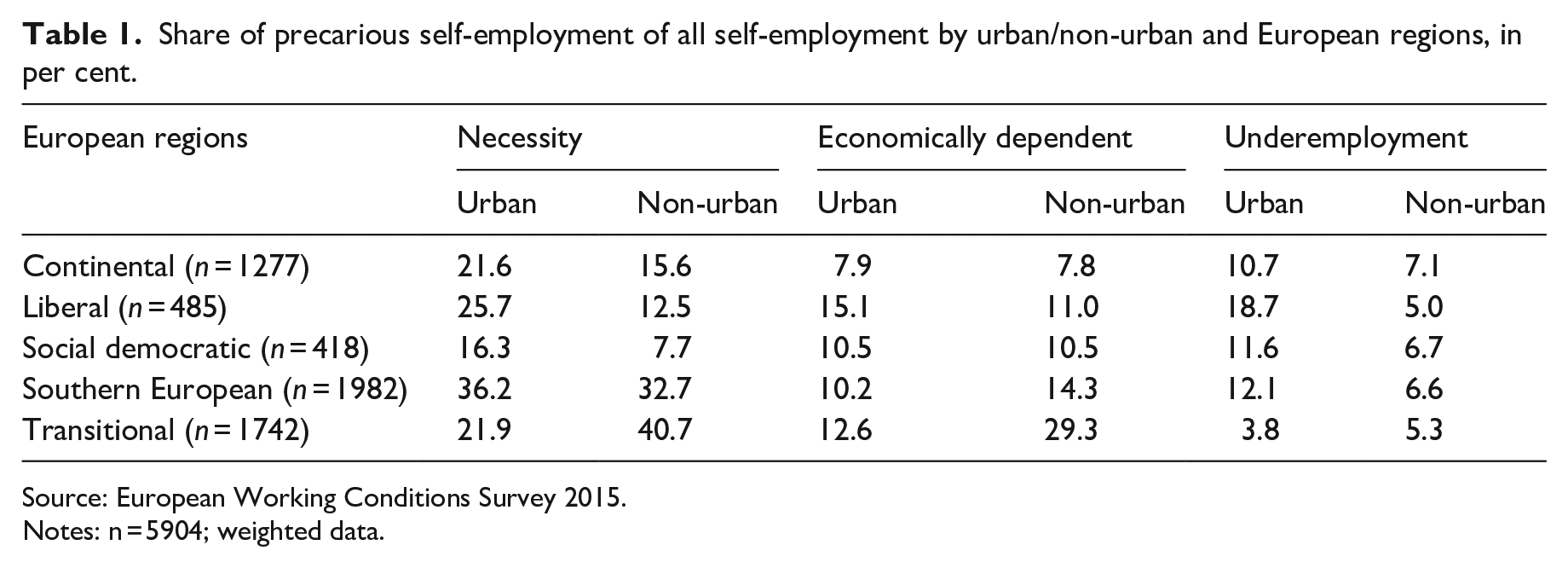
Descriptive findings do not show a clear urban/non-urban pattern for either type of precarious self-employment (Table 1). Both necessity and underemployed self-employment are higher in continental, liberal and social democratic countries in urban than non-urban areas. In transitional countries, all types of precarious self-employment are lower in urban than non-urban areas. Underemployment is here substantially lower than in urban areas in other European regions. In Southern Europe, the share of precariousness is only substantially different between urban and non-urban areas in relation to underemployment.
Share of precarious self-employment of all self-employment by urban/non-urban and European regions, in per cent.
Source: European Working Conditions Survey 2015.
Notes: n = 5904; weighted data.
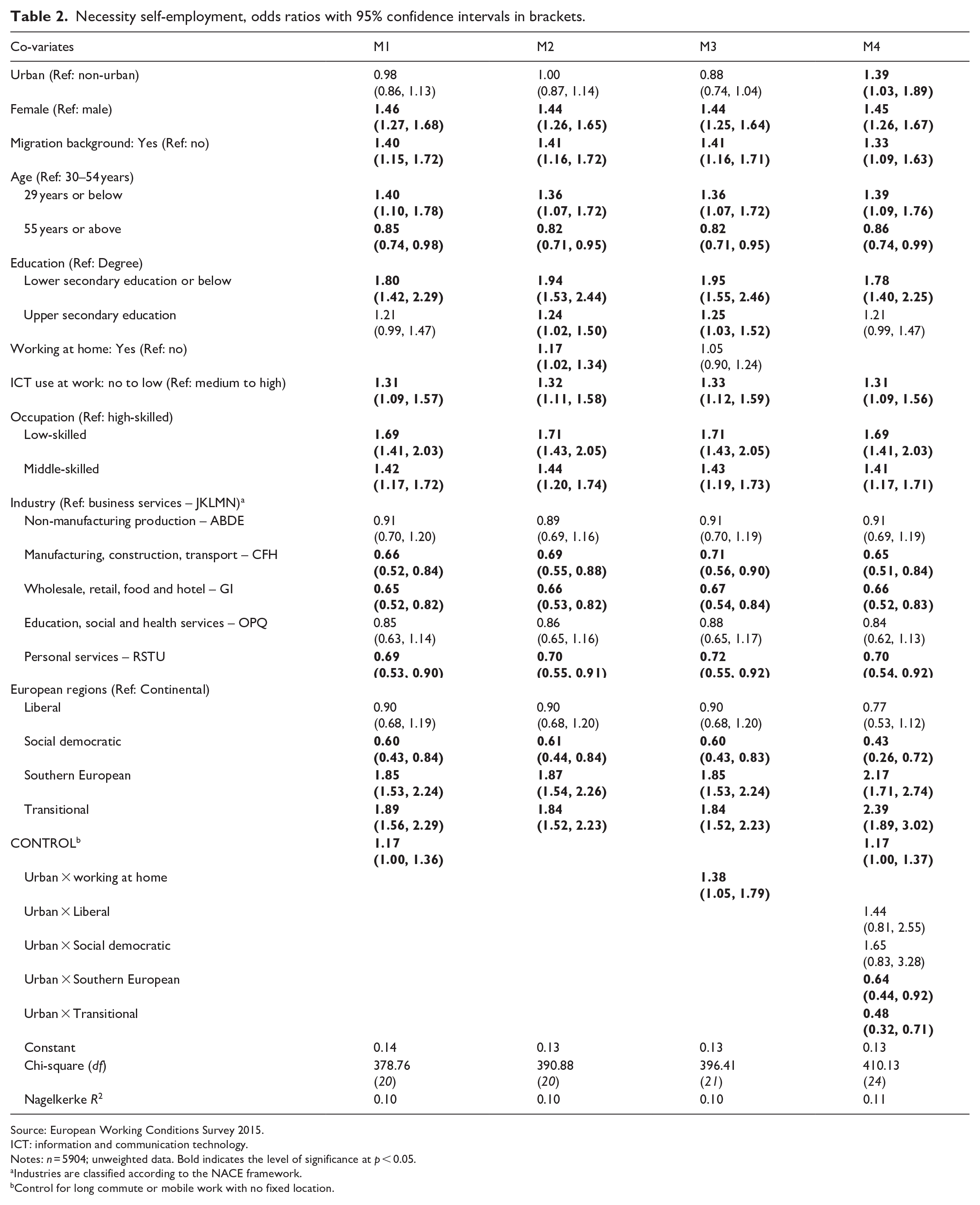
Necessity self-employment, odds ratios with 95% confidence intervals in brackets.
Source: European Working Conditions Survey 2015.
ICT: information and communication technology.
Notes: n = 5904; unweighted data. Bold indicates the level of significance at p < 0.05.
Industries are classified according to the NACE framework.
Control for long commute or mobile work with no fixed location.
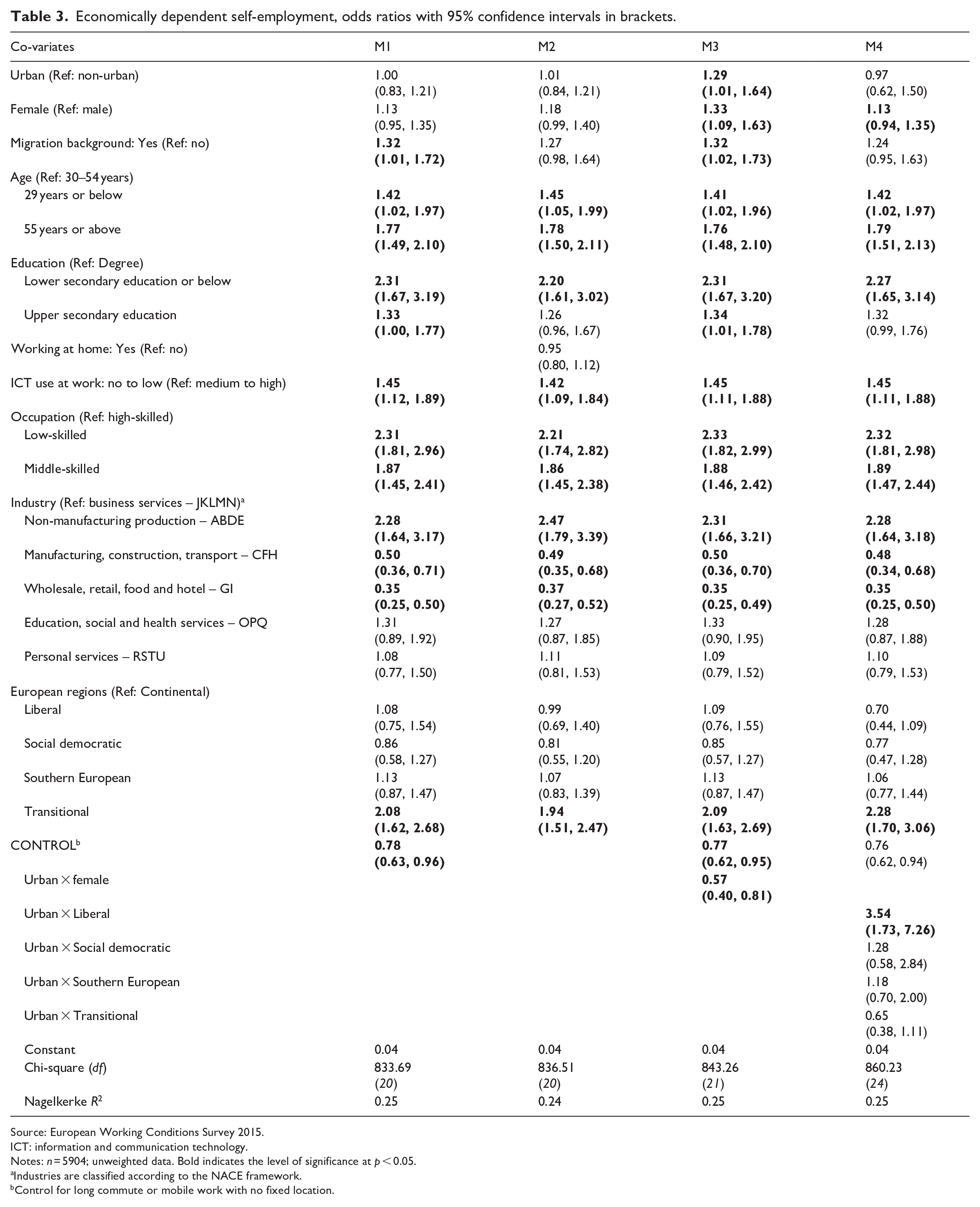
Economically dependent self-employment, odds ratios with 95% confidence intervals in brackets.
Source: European Working Conditions Survey 2015.
ICT: information and communication technology.
Notes: n = 5904; unweighted data. Bold indicates the level of significance at p < 0.05.
Industries are classified according to the NACE framework.
Control for long commute or mobile work with no fixed location.
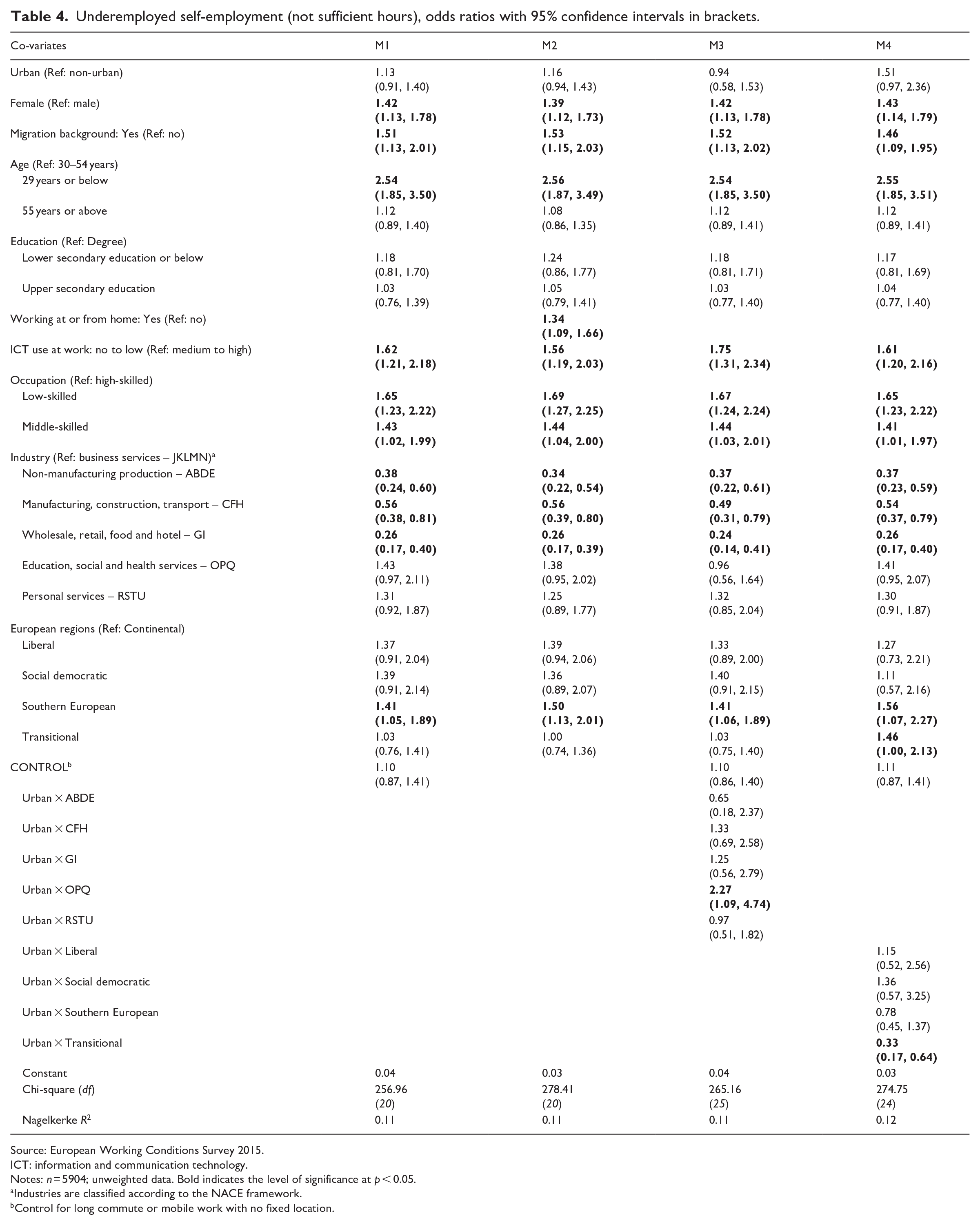
Underemployed self-employment (not sufficient hours), odds ratios with 95% confidence intervals in brackets.
Source: European Working Conditions Survey 2015.
ICT: information and communication technology.
Notes: n = 5904; unweighted data. Bold indicates the level of significance at p < 0.05.
Industries are classified according to the NACE framework.
Control for long commute or mobile work with no fixed location.
The multivariate findings in Tables 2–4 show that an urban location is not associated with a significantly higher or lower risk of precarious self-employment compared to a non-urban location, after individual and job-related controls as well as a control for long commutes or mobile work with no fixed location (Model 1 in Tables 2–4). All forms of precarious self-employment are associated with young workers and individuals with migration background which will be linked with some higher shares of precarious forms of self-employment in urban areas in the descriptive results (Table 1). Furthermore, precarious self-employment is associated with low-skilled occupations and work involving no or low level of ICT use. Despite this, more traditional sectors generally are less associated with the risk of being precariously self-employed compared to the modern (business) service sector. We also find an increased risk of necessity and underemployed self-employment among women and those working at home. Despite common features, the three types of precarious self-employment are associated with some distinct characteristics in terms of individual and job characteristics confirming the relatively low correlation between these types of precariousness in our sample.
The analyses of interaction effects (Models 3 and 4 in Tables 2–4), however, reveal significant risks of precariousness of the self-employed in urban areas. The first type of self-employed precariousness that is more likely to be urban than non-urban is necessity-driven self-employment of those working at home (Table 2, Model 3). The literature has highlighted work-life balance issues of running a business from home especially among women. Other motivations include the absence of the need to have premises or the intention to keep fixed costs low (Mason et al., 2011). Why in urban areas working at home as solo self-employed is associated with a lack of alternative employment might be related to more vulnerable groups (young or older people, ethnic minorities and women) performing this type of work across a range of industry sectors (Williams and Horodnic, 2015).
The second type of precariousness specific to urban areas is economically dependent self-employment of men (Table 3, Model 3). Since we controlled for industry sectors, this is unlikely to show that men more than women work in labour-intensive industries such as construction. Therefore, it may show that men in urban areas more often than women become self-employed out of previous paid employment (Román et al., 2011), which is facilitated by the density of employers in urban areas.
The third type of precarious self-employment related to an urban location is industry-specific. We find that solo self-employment that does not allow for sufficient hours of work (Table 4) is positively associated with education, social work and health services in urban areas. This includes, for example, self-employed tutors, music teachers or health practitioners, and aligns, therefore, with recent research that has highlighted precariousness among solo self-employed tutors (Holloway and Pimlott-Wilson, 2021) and nurses (Wall, 2015).
We further find significant variations in all three types of precarious self-employment by geographical regions. Southern European and transitional countries have an increased risk of necessity self-employment compared to continental countries (Table 2, Models 1 and 2). However, this risk is significantly lower in urban locations – above and beyond industrial composition and ICT use at work. Moreover, the risk of being underemployed as solo self-employed worker is significantly decreased in transitional countries in urban areas compared to non-urban areas (Table 4, Model 4). Hence, we observe that urban areas are most likely to lower the risk of precarious self-employment relative to non-urban areas in transitional countries.
In stark contrast, economically dependent self-employment is more prevalent in urban areas in liberal countries (Table 3, Model 4). Williams and Horodnic (2018) identified a high level of dependent self-employment in the United Kingdom and Italy (but not Ireland). Existing studies also connected dependent self-employment in these two countries with the construction sector. It seems likely that the urban nature of economically dependent self-employment in liberal countries is related to complex factors of regulation and industry and most likely also to immigration since liberal countries have seen substantial immigration from Eastern Europe in the 2000s.
Robustness checks
We conducted two robustness checks of our results. First, following Román et al. (2011), we used in the multivariate models an index of country-level employment protection instead of geographical regions. Data used come from the Organisation for Economic Co-operation and Development (OECD) index on the strictness of employment protection in relation to temporary contracts referring to the year 2015 to match our EWCS survey data. 4 We derived three groups of countries with low-, medium- and high-employment protection. The multivariate findings do not change our urban/non-urban results.
As a second robustness check, we ran multi-level models with countries as random effects for all our models, excluding geographical regions as co-variates. These checks also confirm our urban/non-urban results in the main effects and interaction effects models. Findings of these robustness checks are shown in Supplemental materials.
Discussion and conclusion
In this study, we examined precarious self-employment across Europe as a multidimensional concept of risk of job and financial insecurity defined as solo self-employment that is either necessity-motivated, economically dependent on one client or does not provide sufficient hours of work. Based on urban economic literature that has emphasised opportunities for entrepreneurship in urban areas, we derived the hypothesis that urban areas may be able to reduce the risk of being precariously self-employed due to externalities of urban locations for entrepreneurs and small businesses related to the proximity to clients, suppliers and dense networks. However, we do not find a universal ‘urban effect’ in the risk of being precariously self-employed. Findings also do not support the opposing hypotheses that there is no geographical variation of the motivation to become self-employed, including necessity self-employment and underemployment among the self-employed by urban and non-urban locations. Instead, we find significant spatial variations in the associations between precarious self-employment and an urban versus non-urban location across geographical regions (and employment protection systems). Specifically, we find a reduced risk of precarious self-employment in urban areas in transition countries, both in relation to necessity and underemployment. Urban areas in Southern Europe also show a reduced risk of necessity self-employment in multivariate analysis but on aggregate, they have the highest share of necessity across all geographical regions.
Necessity-motivated or ‘survivalist’ entrepreneurship in transition economies has also attracted attention in entrepreneurship research (Chepurenko and Sauka, 2017). Our findings confirm the increased risk of necessity self-employment in transition countries and add to this literature that cities in transition economies, however, do better than non-urban areas in reducing both necessity and underemployed solo self-employment relative to other European regions. Literature on transition entrepreneurship has highlighted both institutional and behavioural reasons (e.g. attitudes towards entrepreneurship) for barriers to opportunity (innovative/growth) entrepreneurship in former socialist countries (Szerb and Trumbull, 2016). We also controlled our findings for regulatory contexts of self-employment related to national-level employment protection. Therefore, our findings are likely to reflect behavioural aspects of entrepreneurship, specifically the greater opportunities for networking and the more entrepreneurial attitudes in cities. This is an important social capital that cities need to nurture (Westlund et al., 2014).
In our study, economically dependent solo self-employment is associated with traditional sectors that are more prevalent in rural areas. We cannot find evidence of an increased risk of economically dependent self-employment in the service sector as expected from studies that highlighted the increasing heterogeneity of economically dependent self-employment (Eichhorst et al., 2013). In contrast to our opportunity hypothesis, however, we find that urban areas in liberal countries produce the highest level of economically dependent self-employment in Europe. Although in liberal countries, in quantitative terms, the share of economically dependent self-employment in urban areas is not substantially higher than in non-urban areas, the multivariate results highlight the differences to other European regions which have higher or approximately equal shares of economically dependent self-employment in non-urban areas compared to urban areas. Importantly, the risk of financial insecurity due to being solo self-employed with usually only one client is in liberal countries significantly increased in urban areas despite the human capital and industrial structure which usually favour cities economically.
Findings of this study further reveal specific features of precarious self-employment in urban areas related to individual characteristics (gender) and job-related characteristics (education, social work and health sector; working at home). Therefore, we could better than previous research define characteristics of the ‘reserve’ workforce in urban labour markets linked to the rise in solo self-employment (Boeri et al., 2020). These identified characteristics of precarious self-employment in urban areas further help to develop approaches to self-employment in cities that recognise the increasing polarisation of self-employment (entrepreneurial vs precarious).
In summary, these contrasting outcomes of risk and mitigation through urban areas underline the importance of local conditions of precarious self-employment – in addition to local conditions of opportunity self-employment and entrepreneurship highlighted in urban and regional studies (Faggio and Silva, 2014). Existing research on the precariousness of ‘new’ self-employment has emphasised regulation and legal frameworks (Buschoff Schulze and Schmidt, 2009; Eichhorst et al., 2013). Our study highlights commonalities across European regions and employment systems that require a mix of national and location-oriented policies. Our findings suggest that beyond sector approaches and a greater emphasis on working at home and gender-specific differences in the risk of job and financial insecurity, urban areas need to focus on skills and ICT-based work for reducing the risk of precarious self-employment. Occupational skills and ICT-based work are both consistently associated with a lower risk of precariousness across all types of precarious self-employment employed in this study. Although we were unable to identify low-skilled and mobile forms of ‘gig working’ on digital platforms in our data, our study underlines the importance of higher skilled work for lowering the risk of precariousness in self-employment in urban Europe.
Supplemental Material
sj-docx-1-eur-10.1177_09697764221095756 – Supplemental material for Precarious self-employment in urban Europe
Supplemental material, sj-docx-1-eur-10.1177_09697764221095756 for Precarious self-employment in urban Europe by Darja Reuschke and Mary Zhang in European Urban and Regional Studies
Footnotes
Appendix
Distribution of the sample by urban versus non-urban, column percentages for each variable.
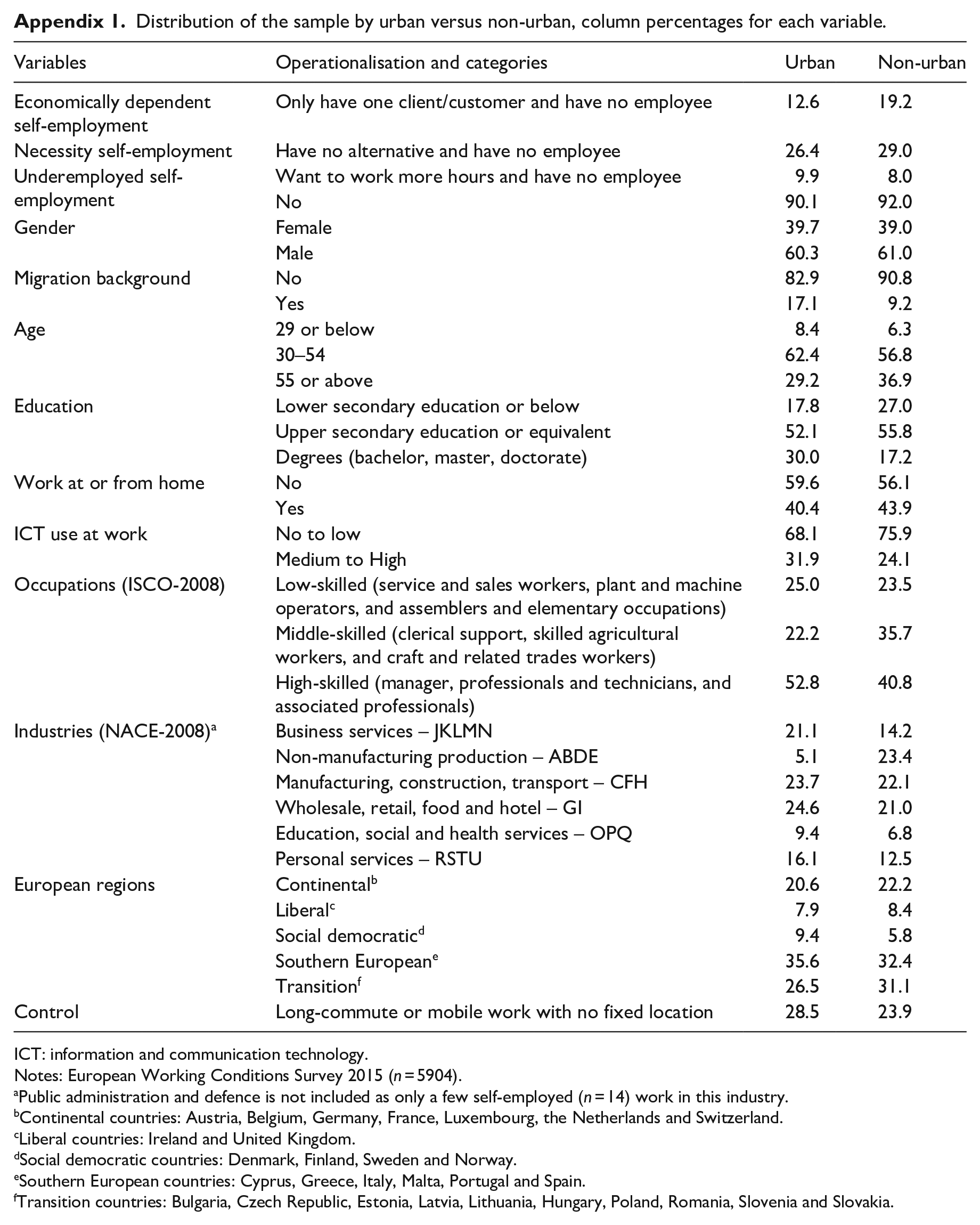
| Variables | Operationalisation and categories | Urban | Non-urban |
|---|---|---|---|
| Economically dependent self-employment | Only have one client/customer and have no employee | 12.6 | 19.2 |
| Necessity self-employment | Have no alternative and have no employee | 26.4 | 29.0 |
| Underemployed self-employment | Want to work more hours and have no employee | 9.9 | 8.0 |
| No | 90.1 | 92.0 | |
| Gender | Female | 39.7 | 39.0 |
| Male | 60.3 | 61.0 | |
| Migration background | No | 82.9 | 90.8 |
| Yes | 17.1 | 9.2 | |
| Age | 29 or below | 8.4 | 6.3 |
| 30–54 | 62.4 | 56.8 | |
| 55 or above | 29.2 | 36.9 | |
| Education | Lower secondary education or below | 17.8 | 27.0 |
| Upper secondary education or equivalent | 52.1 | 55.8 | |
| Degrees (bachelor, master, doctorate) | 30.0 | 17.2 | |
| Work at or from home | No | 59.6 | 56.1 |
| Yes | 40.4 | 43.9 | |
| ICT use at work | No to low | 68.1 | 75.9 |
| Medium to High | 31.9 | 24.1 | |
| Occupations (ISCO-2008) | Low-skilled (service and sales workers, plant and machine operators, and assemblers and elementary occupations) | 25.0 | 23.5 |
| Middle-skilled (clerical support, skilled agricultural workers, and craft and related trades workers) | 22.2 | 35.7 | |
| High-skilled (manager, professionals and technicians, and associated professionals) | 52.8 | 40.8 | |
| Industries (NACE-2008) a | Business services – JKLMN | 21.1 | 14.2 |
| Non-manufacturing production – ABDE | 5.1 | 23.4 | |
| Manufacturing, construction, transport – CFH | 23.7 | 22.1 | |
| Wholesale, retail, food and hotel – GI | 24.6 | 21.0 | |
| Education, social and health services – OPQ | 9.4 | 6.8 | |
| Personal services – RSTU | 16.1 | 12.5 | |
| European regions | Continental b | 20.6 | 22.2 |
| Liberal c | 7.9 | 8.4 | |
| Social democratic d | 9.4 | 5.8 | |
| Southern European e | 35.6 | 32.4 | |
| Transition f | 26.5 | 31.1 | |
| Control | Long-commute or mobile work with no fixed location | 28.5 | 23.9 |
ICT: information and communication technology.
Notes: European Working Conditions Survey 2015 (n = 5904).
Public administration and defence is not included as only a few self-employed (n = 14) work in this industry.
Continental countries: Austria, Belgium, Germany, France, Luxembourg, the Netherlands and Switzerland.
Liberal countries: Ireland and United Kingdom.
Social democratic countries: Denmark, Finland, Sweden and Norway.
Southern European countries: Cyprus, Greece, Italy, Malta, Portugal and Spain.
Transition countries: Bulgaria, Czech Republic, Estonia, Latvia, Lithuania, Hungary, Poland, Romania, Slovenia and Slovakia.
Acknowledgements

Declaration of conflicting interests
The author(s) declared no potential conflicts of interest with respect to the research, authorship and/or publication of this article.
Funding
The author(s) disclosed receipt of the following financial support for the research, authorship and/or publication of this article: Darja Reuschke’s time on this study was funded by the European Research Council, the Starting Grant WORKANDHOME (ERC- 2014-STG 639403).
Supplemental material
Supplemental material for this article is available online.
1.
The mean income per month of the necessity self-employed is €955 compared to €1781 among the solo self-employed who are not precarious on either of our three measures.
2.
3.
A commute of 90 minutes (both way combined) is a threshold derived from the distribution of our data. It equals the 95 percentile of all self-employment commutes.
References
Supplementary Material
Please find the following supplemental material available below.
For Open Access articles published under a Creative Commons License, all supplemental material carries the same license as the article it is associated with.
For non-Open Access articles published, all supplemental material carries a non-exclusive license, and permission requests for re-use of supplemental material or any part of supplemental material shall be sent directly to the copyright owner as specified in the copyright notice associated with the article.
