




Abstract
Although research on smart cities increasingly acknowledges the involvement of civil society actors, most studies fall short when it comes to clarifying the specific modalities of civil society involvement. By probing into the smart city ecology that has developed around the Amsterdam Smart City-Foundation, we explore not only the extent to which the civil society is part of a smart city ecology but also what role civil society actors hold within this ecology. This article draws on data gathered and analyzed through quantitative and qualitative methods. The qualitative analysis focuses on analyzing the institutional dynamics that shape civil society involvement in Amsterdam’s smart city ecology. The quantitative data are used to unravel the relational dynamics by quantifying collaborative patterns between different types of organizations in Amsterdam’s smart city ecology. Our findings reveal that powerful institutional dynamics, manifested through normative pressures, favor the involvement of socially oriented civil society actors. At the same time, however, relational dynamics that shape the collaborative patterns in the projects of the ecology rather exclude the socially oriented civil society at the benefit of an economically oriented civil society. In other words, while the entire ecology rhetorically adheres to an ethos of pervasive civil society involvement, politically, socially, and civically oriented civil society actors lack inter-organizational collaboration—even in the supposedly inclusive context of Amsterdam.
Keywords
Introduction
Initially, smart city research primarily revolved around the crucial role of global information technology corporations like Cisco, IBM, and Siemens. Only large technology corporations, it seemed, possessed the necessary resources—capital, technology, and experience—to conceive and implement comprehensive local smart city strategies that prepare urban services and infrastructures for a digital future (e.g. Townsend, 2013; Viitanen and Kingston, 2014). More recently, however, research has nurtured doubt about whether the alleged “vendor-driven model” (Barns, 2016: 555) corresponds with the empirical realities of “the actually existing smart city” (Shelton et al., 2015). An increasing number of scholars highlight the complexity of actor constellations in smart city development (Arnkil et al., 2010; Mora et al., 2019b; Mulder, 2015; van Winden and van den Buuse, 2017). In these complex actor constellations, civil society organizations (CSOs) appear to constitute important and legitimate stakeholders when it comes to implementing digital technology to improve urban services and infrastructures. Ideals of “people-centered” “smart cities 2.0” (Crowley et al., 2016; Trencher, 2019) even allude to a new participatory era of smart cities succeeding the vendor-driven model. However, comprehensive empirical analyses that inquire into the position of the civil society within the smart city strategizing and implementation processes are still scarce. Existing works either probe into specific aspects, such as vested interests of “professional citizen” groups (Farías and Widmer, 2018) and learning benefits of citizens in participatory projects (van Waart et al., 2016), or is rather skeptical when it comes to the actual involvement of citizens (Cardullo and Kitchin, 2019; Shelton and Lodato, 2019). Shelton and Lodato (2019), for instance, see a crucial mismatch between a “discursive centrality of the general citizen” and actual citizen involvement in the actor constellations developing smart cities.
We locate this article within this diverse body of work on actor constellations in smart cities, framing these constellations as smart city ecologies. With this notion, we draw on and extend previous work on “project ecologies” (Grabher and Ibert, 2011). Smart city ecologies consist of different types of actors that participate in projects connected through an overarching smart city strategy. Conceptually, the smart city ecology comprises institutional (field-type) dynamics such as normative pressures (DiMaggio and Powell, 1983; Powell and DiMaggio, 2012) through which different actors elaborate and subscribe to a common strategic agenda—without necessarily engaging in actual relational interactions. Smart city ecologies, however, are also driven by relational (network-type) dynamics that are enacted precisely through such concrete interactions in specific projects.
Starting from the idea of smart city ecologies as a conceptual premise, the article focuses on one key aspect within these ecologies: the involvement of civil society actors. Our argument builds on critical positions concerning a people- or citizen-centered smart city (e.g. Cardullo and Kitchin, 2019; Shelton and Lodato, 2019; Vanolo, 2016). We maintain that there is in fact a mismatch in smart city ecologies.
We develop this argument in two steps. First, we distinguish different types of CSOs. Analyses of smart city development by Cardullo and Kitchin (2019) as well as by Cowley et al. (2018) elucidate that the motives and forms of civil society involvement are diverse and reflect the heterogeneity of CSOs. Drawing on different modes of “publicness” conceptualized by Cowley et al. (2018), we distinguish between two groups of actors that make up the civil society: professional CSOs that we refer to as economic civil society, and the more socially, civically, and politically orientated parts of the civil society that we frame as social civil society.
Second, we employ this distinction to empirically probe into the Amsterdam smart city ecology, which we regard as a “most likely” critical case (Flyvbjerg, 2006: 231; also Gerring, 2006: 115). By analyzing an environment that is usually regarded as more likely to involve (social) CSOs than other places, this case selection strategy allows us to generalize the limitations of (social) CSO involvement in smart city development. The Amsterdam smart city ecology in our view represents such a most-likely critical case study. Numerous scholars and practitioners describe Amsterdam as particularly prone to engage with CSOs in smart city development and producing technology in a particularly participatory manner (de Falco et al., 2019; Mancebo, 2020; Mora and Bolici, 2017; Zygiaris, 2013; Bunders and Varró, 2019; Zandbergen and Uitermark, 2020). Amsterdam’s smart city strategy places a strong focus on creating a “quadruple-helix” ecology in which corporations, governments, universities, and citizens collaborate (Mancebo, 2020; Mora et al., 2019b). More recently, though, scholars examining individual smart city project activities in Amsterdam have pointed to the limitations that CSOs face when attempting to participate in the ecology's projects (Mancebo, 2020; Zandbergen, 2020). Our research complements such analyses by focusing the Amsterdam’s smart city ecology rather than on individual projects.
Our study of the Amsterdam smart city ecology reveals that, on the one hand, strong institutional (field-type) dynamics, mostly manifested through normative pressures, favor social civil society involvement in smart city development (de Falco et al., 2019; Mancebo, 2020; Mora and Bolici, 2017). On the other hand, relational (network-type) dynamics that shape actual collaborations both in the governance structures of the ecology and at the project level rather exclude social civic society at the benefit of economic civil society.
Building on these findings, this article contributes conceptually to the literature on the role of CSOs in smart city development. Rather than starting from normative postulates (e.g. Hollands, 2008) and conceptions like the “people-centered smart city” (Saunders and Baeck, 2015), we particularly intend to advance an analytical conception of how CSOs are involved. We also contribute to the literature on actor constellations in smart city development more broadly. Besides corroborating the general critique of the private-public pattern inherent in the “vendor-driven model” (Barns, 2016: 555), we also offer a more comprehensive understanding of collaborative structures in smart cities that reaches beyond stylized conceptions such as “triple-helix” (Leydesdorff and Deakin, 2011) or “quadruple-helix” (Mora et al., 2019b). Moreover, in methodological terms, the article offers a systematic categorization of collaboration patterns in the Amsterdam smart city ecology by retrieving and purposefully deploying data from the online digital registry of the Amsterdam Smart City (ASC)-Foundation. 1 As this registry, which also functions as a platform, comprises all projects and participating stakeholders in the entire ecology, and offers a valuable data source for the proposed analytical strategy.
This article consists of the following sections. Following this introduction section, a literature review conceptually frames our approach to the smart city ecology and the involved CSOs. Then, we set out our research design, including the selected data sources and methods. This is followed by a presentation of the findings regarding the institutional and relational dynamics shaping the ecology. Finally, we discuss the results and their implications for theory building and further research.
Theoretical framework: smart city ecologies and types of CSOs
Smart city ecologies: a conjunction of institutional and relational dynamics
The development of smart cities unfolds in projects that embrace different types of actors (e.g. Coletta et al., 2019; Raven et al., 2019; Vanolo, 2016; Viitanen and Kingston, 2014). Such inter-organizational constellations often implicate “extra-territorial networks of key actors” (Shelton et al., 2015: 16), for example, those global technology corporations that are emblematic for the “vendor-driven model” (Barns, 2016: 555). However, smart city development usually does not materialize as a juxtaposition of isolated temporary networks of local and non-local players but is embedded in a wider local context of other projects and other players. We refer to the conjunction of smart city projects and this wider local context as smart city ecology, building on extant work on institutional and relational dynamics that shape smart city development.
Inquiring into the institutional context that influences smart city development, Raven et al. (2019: 260), for instance, emphasize the role of “place-specific institutional arrangements” that affect both who is involved and what agendas the involved organizations pursue in smart city development. Institutional arrangements engender the “regulatory,” “normative,” and “cognitive” (Scott, 2013) dynamics that frame smart city developments. Furthermore, institutional dynamics generate differences across cities by locally “inflecting” (Valdez et al., 2018: 3357) the global standard “visions of data-driven smart cities” (Shelton et al., 2015: 17) that circulate in “extra-territorial networks” (Shelton et al., 2015: 16). According to this literature, place-specific institutional arrangements lie at the heart of place-specific actor constellations and agendas in which smart cities actually materialize (Farías and Widmer, 2018; Viitanen and Kingston, 2014; Wiig, 2016).
In the literature on the underlying relational dynamics shaping the smart city ecology, the inter-organizational make-up of smart city development is usually framed as “innovation system” (Leydesdorff and Deakin, 2011) or “innovation ecosystem” (Claudel, 2018; Snow et al., 2016). These systems mobilize various types of actors and facilitate the transfer of knowledge and ideas and the pooling of resources. Respective authors tend to equate actor constellations in smart city innovation systems with a “triple helix” pattern of “university-industry-government-relations” (Leydesdorff and Etzkowitz, 2003: 57), plus the civil society as a fourth organizational type in the helix structure (Arnkil et al., 2010; Mora et al., 2019b; Vallance et al., 2020; van Winden and van den Buuse, 2017). Smart city developments thus build on networks of different groups of actors to allow for the implementation of digital innovation and the digitalization of urban (infrastructure) systems.
Our conceptualization of a smart city ecology both combines and specifies institution-based and network-based approaches to understanding the inter-organizational constellation developing smart cities. We hold, thus, that the inter-organizational make-up of smart cities comprises both institutional dynamics (i.e. joint normative, cognitive, and regulatory frames) and relational dynamics (i.e. patterns of cooperation). The institutional dynamics are conveyed through a (strategic) context in which “existing initiatives are corralled into the semblance of an overarching, coordinated, strategic and branded narrative” (Coletta et al., 2019: 350). The relational dynamics, in contrast, are observable in concrete cooperation arrangements in actually existing smart city projects. For this purpose, we draw on and adapt the notion of “project ecology” (Grabher and Ibert, 2011) that conceptualizes the intricate interplay between (permanent) relational and institutional contexts and (temporary) projects. While a project ecology typically unfolds around one project, the smart city ecology embraces various projects joined together in a common (institutional) strategic agenda. The joint commitment to the common strategic agenda is the source of institutional (field-type) dynamics, while the cooperation on projects enacts relational (“network-type”) dynamics.
It remains unclear how both dynamics interact. Institutionalist literature on organizational fields suggests a primacy of institutional or field dynamics since normative pressures favor aligning to a joint agenda (DiMaggio and Powell, 1983). Research focused on network analysis elucidates that both dynamics tend to unfold concurrently, or even reinforce each other mutually (Hollway et al., 2017; Kenis and Knoke, 2002).
CSOs: social or economic orientation
While the inclusion of CSOs in smart city research and political practice has turned into a widespread imperative, the actual conceptualization of civil society involvement is a non-trivial challenge. Since CSOs constitute a diffuse and diverse sphere whose activity cannot be narrowed down to mean only collective action (Leydesdorff and Etzkowitz, 2003: 57), we find that framing the role of civil society in smart city ecologies requires a concise systematization of the type CSOs that engage in smart city development.
With the CSOs’ diverging role in smart city development in mind, we sort the CSOs that participate in smart city development into two sub-types: social civil society organizations and economic civil society organizations. This conceptualization of two types of CSOs is based on and condenses Cowley et al.’s (2018) framework of four “modalities of publicness” that are relevant in smart city contexts. We find that Cowley et al.’s (2018: 72) framework exemplifies the divide between a more “civic and political” idea of the smart city and a more “service-user and entrepreneurial” idea of the smart city. For the following analysis of the Amsterdam smart city ecology we, therefore, propose a classification of two different types of organizations that participate in smart city development as civil society. These types also exemplify different understandings of a smart city and the role of CSOs within it.
Social CSOs consist of political and civic non-state and non-corporate organizations. Social CSOs notably include political advocacy and non-profit community-service organizations.
Economic CSOs consist of economically oriented non-state and non-corporate organizations. This includes industry associations and representations, as well as chambers of commerce and consumer cooperatives.
Each type of CSO reveals a particular focus of a smart city ecology and of a particular mode of civil society involvement. Social CSOs are mainly aimed at affording the democratic legitimation of smart city development and at assuring the public goods-character and the “public value” of digitalized urban services and infrastructures (i.e. their “net benefit” in terms of “important civic and democratic principles”; Castelnovo et al., 2016: 735). When involving social CSOs as representatives of a wider citizenry, smart city development draws on what Cowley et al. (2018: 72) call civic and political publicness. By engaging with social CSOs, smart city projects frequently support activities toward participatory planning (Clark, 2020: 164) and foster (data-based) transparency in decision- and claim-making (Dalton, 2019).
Economic CSOs, in contrast, exemplify the “service-user and entrepreneurial” dimension of the smart city. In a sense, economic CSOs provide added (economic) value to the development of digitalized urban infrastructures in two ways. For one, they facilitate the mobilization of users as co-creators of innovation (Baccarne et al., 2014: 162; Carayannis and Rakhmatullin, 2014). Users are supposed to provide three forms of knowledge that cannot be mobilized in the professional realm of the “triple helix” (Mora et al., 2019b): (1) everyday knowledge that helps to test novel technologies; (2) problem knowledge that is instrumental for detecting novel areas of application; and (3) solution knowledge through which citizens might even co-produce actual problem-solving tools. For another, economically oriented CSOs themselves provide specific assets (e.g. access to sources of funding or specific knowledge) that contribute to the economic utility and viability of smart city development.
Research design: a “most-likely” case study based on mixed-methods
We draw on a mixed-methods approach, which offers “two sorts of advantages compared to mono-methods: confirmation and complementarity” (Spillman, 2014: 197). The qualitative analysis focuses on the institutional dynamics, such as the regulatory, cognitive, and normative dynamics that shape CSO involvement in Amsterdam’s smart city ecology. The quantitative data are used to unravel the relational dynamics by quantifying project-level collaboration between different types of organizations that form Amsterdam’s smart city ecology. Both methods were carried out independently in parallel data collection and analysis processes.
Qualitative sources and methods
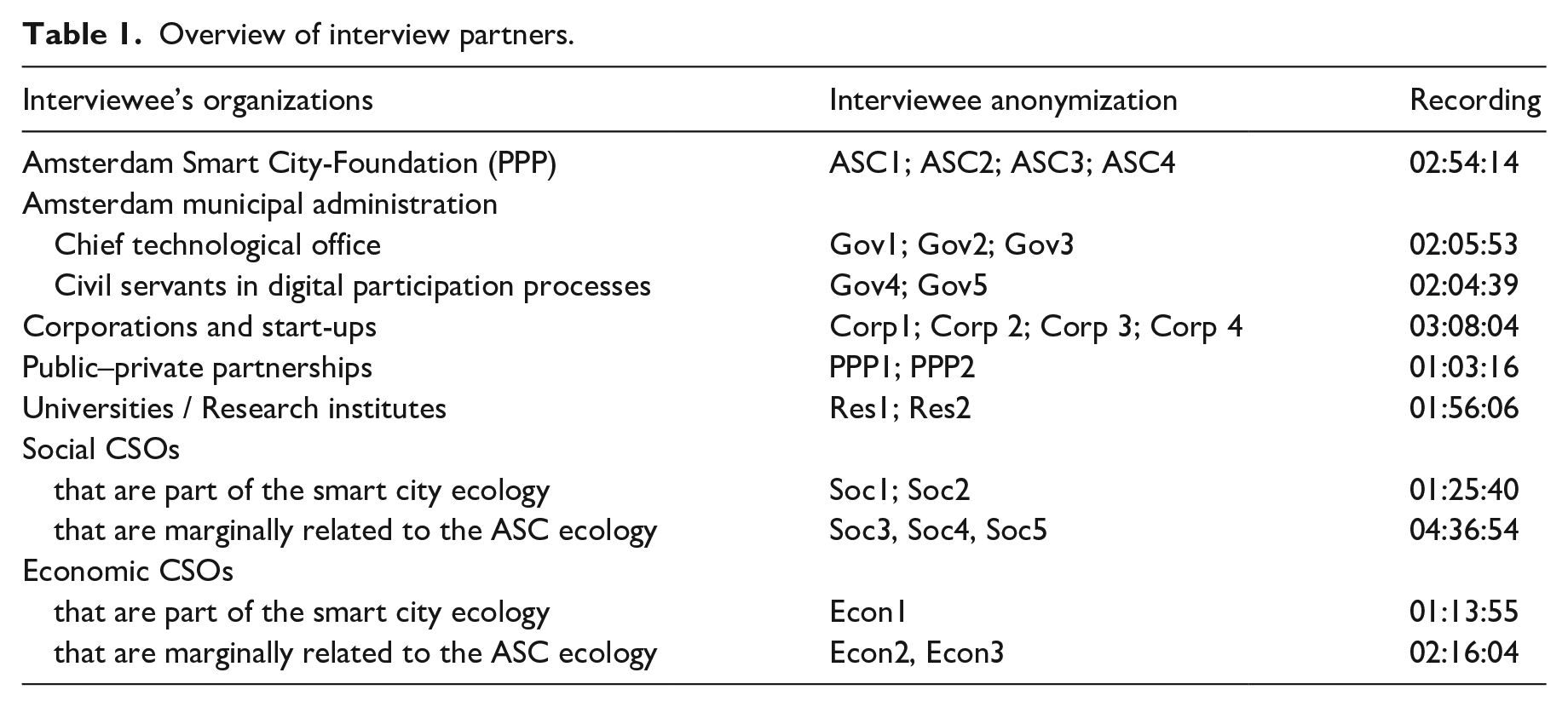
The qualitative analysis is based on document analysis and semi-structured interviews. The document analysis draws on digital documents from the website of the ASC-Foundation and the websites of members of the ASC-Foundation. We searched the websites for English and Dutch keywords, such as “smart city” and “slimme stad,” and added search results to a document database. The interview material consists of 24 interviews with 25 interview partners that were conducted between June 2018 and December 2020. We selected interview partners based on whether they were part of at least one of the three following groups. First, we interviewed key organizations from Amsterdam’s smart city ecology, notably the ASC-Foundation to understand the normative, cognitive, and regulatory dynamics structuring the smart city ecology and CSO involvement within it. Second, we interviewed a variety of organizations engaged in the smart city ecology to understand how they responded to the dynamics structuring the smart city ecology by collaborating (or not) with CSOs. At this stage, the interview partner selection strategy aims to reflect the diversity of organizational types participating in Amsterdam’s smart city ecology. Third, we interviewed social and economic CSOs that focus on similar issues as the ASC-Foundation but are not part of the Amsterdam smart city ecology. This latter group of interviews mainly elucidated the perceived barriers for CSO involvement in the ecology.
Each interview took between 30 and 120 minutes (on average 57 minutes), leading to a total of 22 hours and 45 minutes of recorded material. The document database and the transcribed recordings were coded in MaxQDA. Whenever the empirical material concerned the involvement of CSOs in the smart city ecology, we coded for (1) the institutional and relational dynamics at hand and (2) for the type of CSOs (i.e. outlined social or economic) that the material referred to. In addition, we also coded statements made by CSOs regarding their perception of their role in the ecology.
Quantitative sources and methods
The quantitative analysis relies on a database of all project activities listed on an online registry managed by the ASC-Foundation. 2 The online registry supports the goal of the ASC-Foundation to become an intermediary that connects innovation-oriented actors in Amsterdam. The projects and organizations composing the database are vastly diverse in terms of thematic focus, size, and stakeholder constellations (see Mello Rose, 2021; Putra and van der Knaap, 2018; Sengers et al., 2018). While imperfect, we hold that the project registry of the online platform 3 is an accurate and extensive representation of the smart city activities taking place in Amsterdam.
Our quantitative analysis was carried out in the following steps (see Table 2 for more detail). In a first step, the database was cleaned. 4 In a second step, we categorized all 759 organizations that are part of the ecology into organizational types. In a third step, we created an overview of the involvement of different types of organizations in Amsterdam’s smart city ecology based on descriptive statistics. In a fourth step, we assessed to what extent the dominant types of organizations of the ecology (i.e. government organizations and corporations) avoid engaging with social and economic CSOs. For this, we carried out cross-tabulations and calculated chi-square-values that assess whether there is a statistical avoidance of collaborating with either type of CSO.
Findings I: institutional dynamics of civil society involvement
Smart city development in Amsterdam began in 2008 with a public–private partnership (PPP) between the municipal administration, the grid operator Alliander, and KPN, a telecom company (Mora and Bolici, 2017). In the following year, the ASC-foundation was established to assure a greater corporate involvement in smart city development (Raven et al., 2019: 265). The ASC-Foundation is financed and supported by a 3-year-renewable membership of key organizations and public administrations of the Amsterdam Metropolitan Region. The periodic membership renewals allowed the ASC-Foundation to move from being PPP-based to following a business-led (Noori et al., 2020) quadruple-helix concept (ASC4) (Arnkil et al., 2010; Carayannis and Campbell, 2009). As prescribed by this concept, the ASC-foundation now involves organizations from the research sector (Amsterdam University of Applied Sciences and the Amsterdam Institute for Advanced Metropolitan Solutions) and various social and economic CSOs. The social CSOs—NEMO Kennislink; Pakhuis de Zwijger; the Waag Society—are all organizations that focus on providing education to a wider public by organizing events, workshops, and in the case of Waag Society, also by hosting a “smart citizens lab” (Nesti, 2020). The economic CSOs include Metabolic, a social enterprise, and BTG, the Dutch industry association for ICT and telecommunications.
With a permanent secretariat, the ASC-Foundation is a “trusted third party” (van Winden et al., 2016: 13) and an “innovation intermediary” (Claudel, 2018; also in Raven et al., 2019). In this role, the ASC-Foundation has reduced its direct involvement in smart city projects. Instead, the ASC-Foundation influences the institutional dynamics of the Amsterdam smart city ecology in two main ways. First, the ASC-Foundation manages an online platform on which Amsterdam’s smart city activities are registered (Mello Rose, 2021; Nesti, 2020; Putra and van der Knaap, 2018; Raven et al., 2019; Sancino and Hudson, 2020; ASC2). Through this registry of smart city projects, the ASC-Foundation aims to support the creation of inter-organizational project partnerships (ASC2; ASC4). This online platform puts organizations and persons who are aligned with the foundation’s strategic goals on CSO involvement in contact with each other (ASC2; ASC4) and, hence, leverages cognitive dynamics in institutionalizing CSO involvement.
Second, in a “steering committee” member organizations of the ASC-Foundation collectively define the strategic goals of Amsterdam’s smart city development. Even if formally dependent on the Amsterdam Economic Board—an economic CSO similar to a chamber of commerce—the ASC-Foundation is collaboratively governed by its members in a “steering committee” (ASC1; ASC2). All ASC-Foundation members have the same formal status in this steering committee. Interviewees and researchers, however, describe the Amsterdam Economic Board, the public utility company Alliander, and the municipality of Amsterdam as being more influential than other members of the ASC-Foundation (ASC 1; ASC 2; Corp1) (Claudel, 2018; Nesti, 2020; Raven et al., 2019). These three most influential member organizations frequently highlight the importance of civil society involvement as both normative and practical necessities. For example, an employee of the Amsterdam Economic Board (2020), who has been seconded to the ASC-Foundation, claims that the “Amsterdam Smart City [. . .] developed a way to mobilize this power of society [and] bring these companies, public institutions and residents to shape the cities of the future.” In a similar vein, Alliander maintains that the company’s Virtual Power Plant project has won awards, “because it puts citizens at the heart of ICT innovation, enabling them to improve their own quality of life through technology” (Alliander, 2018, own translation). The municipality of Amsterdam asserts that in Amsterdam’s smart city ecology “collaboration between the municipality, knowledge institutions, the market and residents is unique” because it fosters a “learning environment (. . .) in which new initiatives can be developed, applied and improved.” (Gemeente Amsterdam et al., 2018).
In this sense, the move of the ASC-Foundation away from a PPP-model toward pursuing a quadruple-helix approach (Mora et al., 2019a) was accompanied by the emergence of a normative framing that civil society involvement is a highly useful, if not essential, part of smart city development. Other members of the ASC-Foundation, including corporations and knowledge institutions, align to such a norm-driven institutionalization of CSO involvement. Arcadis (2021), an engineering company, argues on its website that “smart cities are about people, not technology.” Eurofiber (n.d.), a digital infrastructure supplier, calls to “involve residents in the development of the smart city [. . .] by being open to their concerns and handling their viewpoints carefully” (p. 8; own translation).
Moreover, the narrative of a participatory approach to smart city development is leveraged as a key source of differentiation and legitimation by the ASC-Foundation. A report on the activities of 2019 of the Amsterdam Economic Board (2019) quotes the program director of the ASC-Foundation stating that “for more than 10 years, Amsterdam Smart City has distinguished itself by putting people first, [. . .] and connecting governments, the business community, knowledge, and social institutions, citizens and start-ups” (own translation). One corporate interviewee explained that their membership in the ASC-Foundation was justified internally by the fact that the it provides “access to the civil servants of the municipality and, together with the Waag Society and Pakhuis de Zwijger, [. . .], helps to get a deep understanding of the wishes of the citizens” (Corp2).
However, while CSO involvement is institutionalized through normative and cognitive dynamics, corporate interaction with citizens and CSOs within the ASC-Foundation mostly takes place indirectly. More precisely, specific knowledge-focused social CSOs, economic CSOs, universities, and hybrid organizations (i.e. formalized PPPs), are tasked with involving citizens and social CSOs in general (Nesti, 2020; Raven et al., 2019) (ASC1; ASC2; Corp2; Res1). Multiple interviewees criticized that this practice also leads to the exclusive participation of elites endowed with significant cultural capital (Res1; Econ1; Econ3) (see also Zandbergen and Uitermark, 2020). An interviewee from the ASC-Foundation counters that the ASC-Foundation’s task is not to “reach all citizens [as] that is more a task for the government than for us as a foundation” (ASC2). A member of a social CSO working on the digitalization of urban areas criticizes the ASC-Foundation for being “focused on the decision-makers, scientists and innovative entrepreneurs [and that] it’s not for the people of Amsterdam” (Soc3). Despite a strong “people-centered” rhetoric, hence, it seems that the institutional dynamics of Amsterdam’s smart city ecology rather lead to bypassing or merely indirectly engaging with social civil society actors.
Findings II: relational dynamics of civil society involvement in the smart city ecology
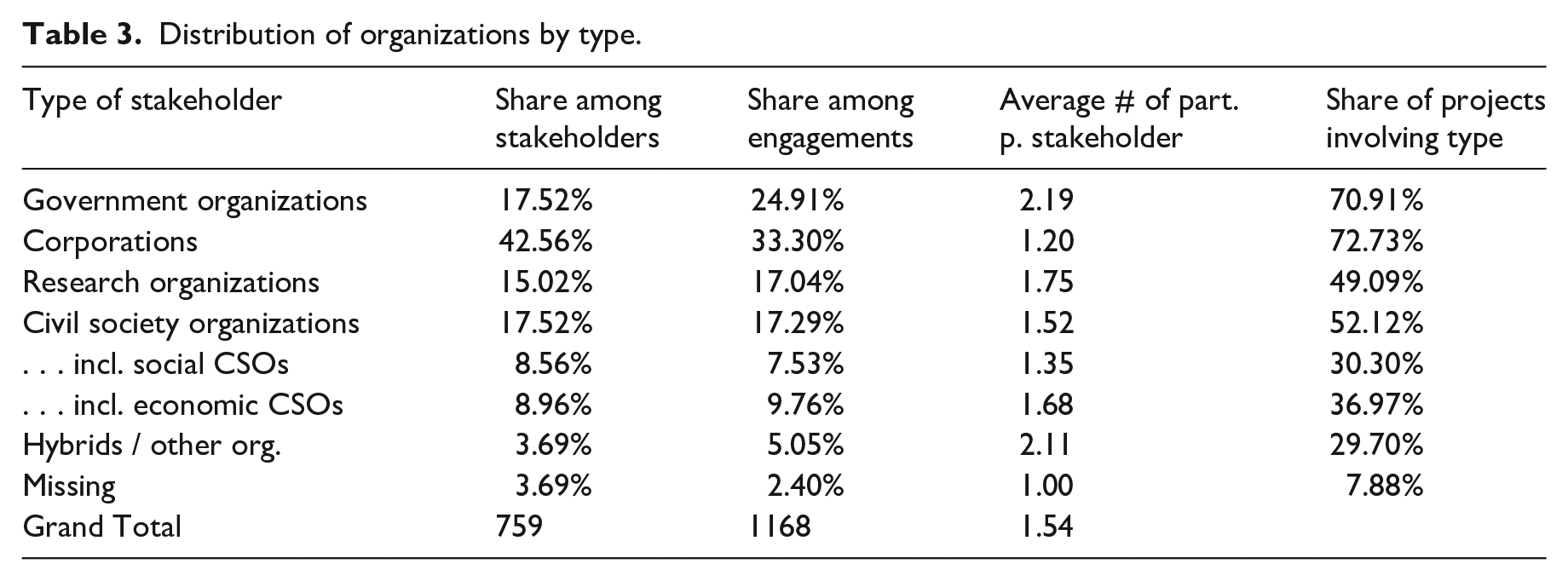
The first step of our quantitative analysis of civil society involvement in the projects of the ecology (Table 1) confirms past results that Amsterdam’s smart city ecology involves multiple types of organizations, including CSOs (Mora and Bolici, 2017; Mora et al., 2019b). Corporations make up the largest group of organizational types involved in Amsterdam’s smart city ecology (42.6%). In all, 17.5 percent of all organizations in the ecology are governmental organizations, while 15 percent of the ASC ecology’s organizations are research-related organizations. CSOs, including economic and social sub-categories, account for 17.5 percent of all organizations of the ecology of which a slight minority of 8.6 percent are social CSOs and a majority of 9 percent economic CSOs.
Overview of interview partners.
While on average corporations participate mostly in a single project only, governmental organizations are typically involved in more than two projects (see Table 3). As some types of organizations typically participate in more projects than others, we focus on project participations rather than on the count of organizations present in the ecology. With this consideration, we find that corporations are significantly less dominant. When accounting for the repeated involvement in the ecology by some organizations, social and economic CSOs, respectively, make up 7.5 and 9.8 percent of all of the ecology’s stakeholders. Taken together, economic and social CSOs account for a similar share of organizations and project participations as universities. While CSOs therefore clearly participate in the ecology, a majority of the ecology’s CSOs and CSO-related project participations are linked to the involvement of economic CSOs. Civil society at large (including both sub-types) is involved in about half of all of the ecology’s projects (52.1%), while government organizations and corporations are part of more than two-thirds of all projects (70.9% and 72.7% respectively). When analyzed separately, however, social and economic CSOs are each part of only about a third of all projects (30.3% for social and 37% for economic CSOs, respectively). In Amsterdam’s smart city ecology, 86 projects engage at least one type of civil society stakeholder. Social CSOs participate in 50 projects, while 61 projects involve economic CSOs; 25 projects include both.
Overview of the steps of the quantitative analysis.
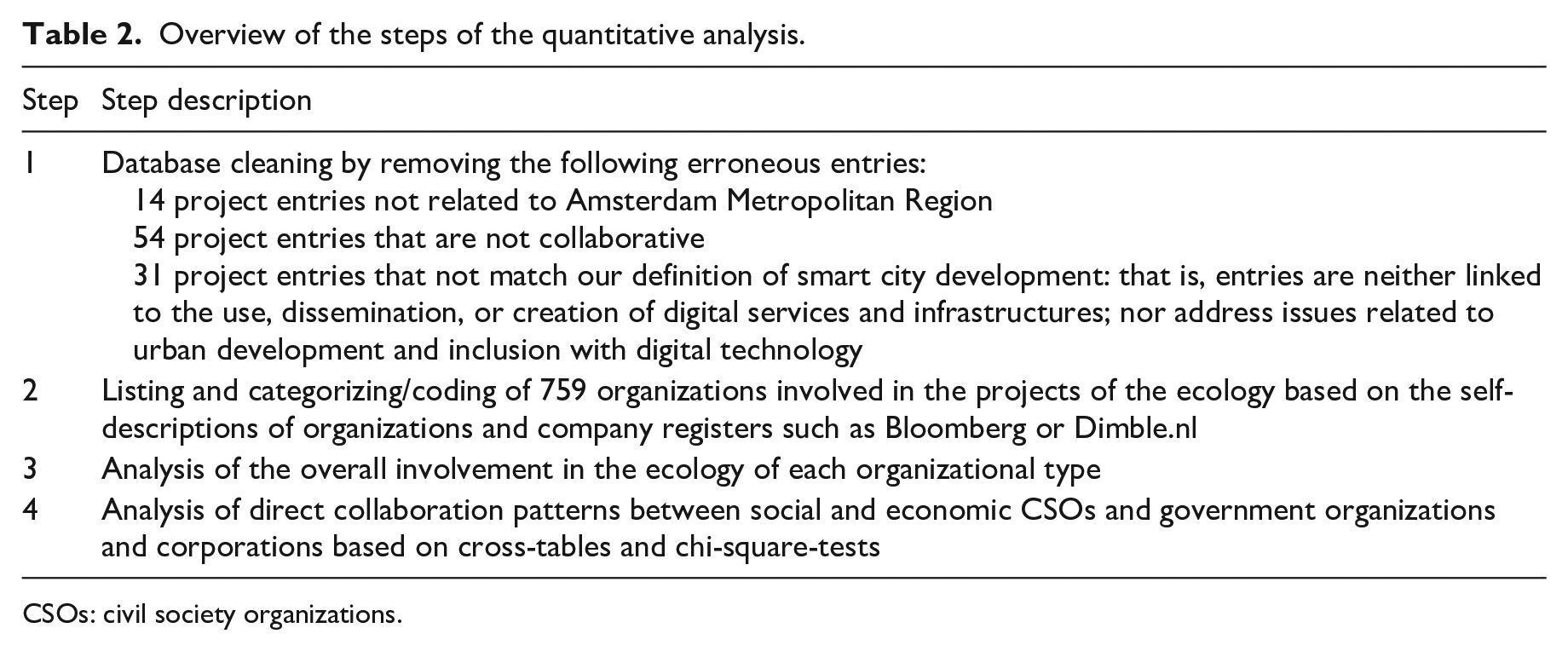
CSOs: civil society organizations.
Distribution of organizations by type.
To understand to which extent CSOs are not only part of Amsterdam’s smart city ecology, but actually participate in projects in which government organizations and corporations innovate, we cross-tabulated variables that display the involvement of each organizational type (Table 4). We find that despite the institutionalized norms of (social) civil society involvement, direct collaboration with CSOs in the projects of the smart city ecology is related to whether the CSO is economically or socially oriented. In Amsterdam’s smart city projects, a government or corporate presence in a given project typically reduces the likelihood of involving a social CSO. While government involvement only slightly (and not statistically significantly) reduces the odds of social CSOs participating in a project, corporate participation in a project significantly reduces the odds of social CSOs being involved in the same project by half (odds ratio (OR) = .545; p < .1). At the same time, government and/or corporate involvement slightly (though not statistically significantly) increases the odds of economic CSOs being involved in the same project roughly by a factor of 1.6 (see Table 2).
Project-level collaboration of governments and corporations with CSOs.
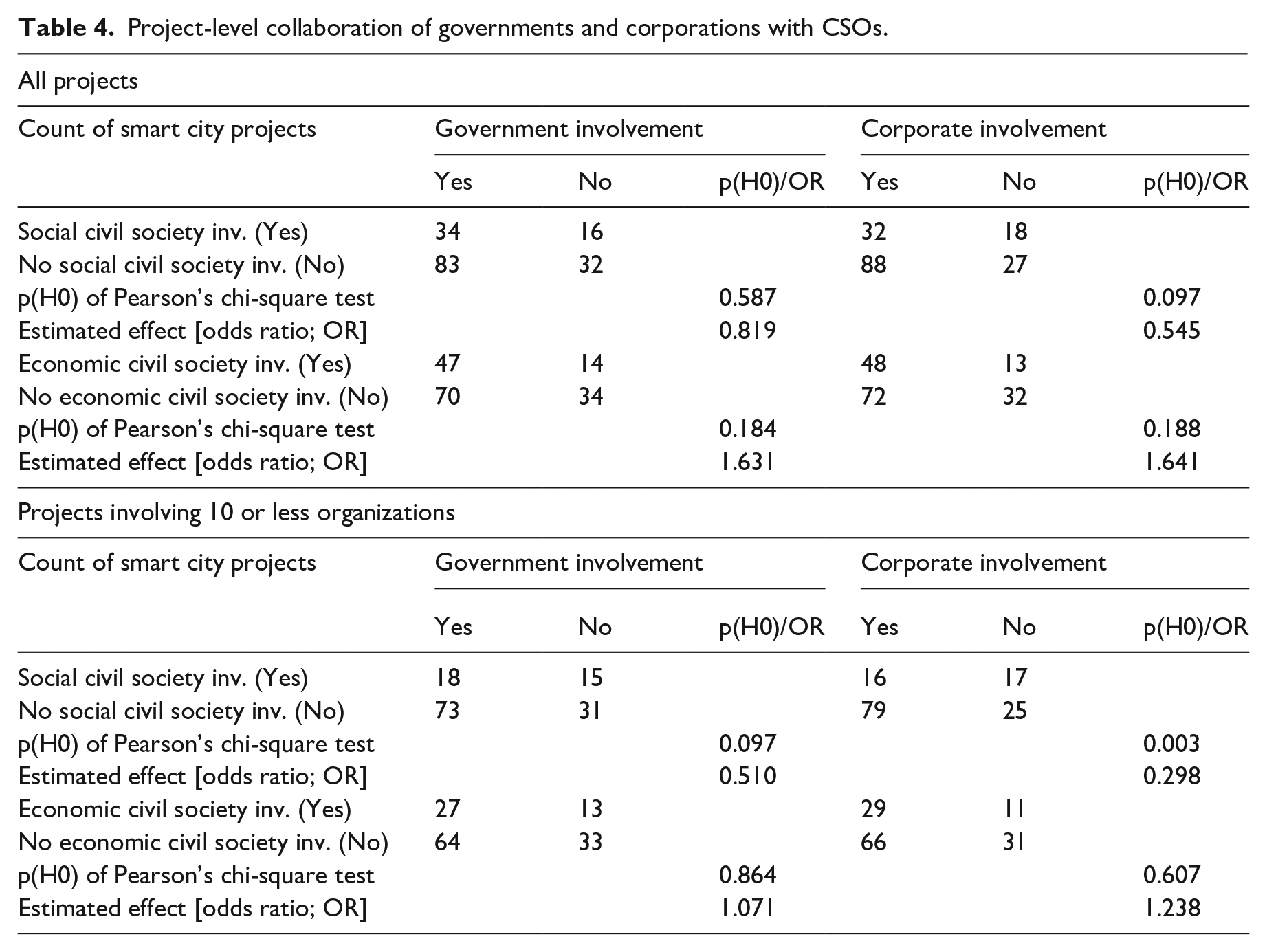
Naturally, the likelihood of involving any type of organization increases when a project is larger and involves more organizations (i.e. in large project partnerships). In this sense, we find that once more than 10 organizations 5 are involved, analyzing collaboration patterns becomes futile, as government organizations and corporations are part of almost all large projects partnerships (respectively 26 and 25 of 28 large projects). The near-ubiquitous presence of government organizations and corporations in large project partnerships, which typically involve more than four different types of organizations, means that this subset of the ecology provides little information regarding collaboration patterns. In excluding 28 large outliers and focusing on smaller, possibly more selective project partnerships, we find that the involvement of government organizations and corporations leads to even stronger decreases in social CSO involvement (Table 2). In this subset of projects, a government and corporate project involvement significantly (p < .1 and p < .01) reduce the odds of a social CSO participating by a factor of .51 and .298 respectively. For economic CSOs, we did not observe such a reduction of the likelihood of participation in projects whenever other types of organizations were also involved.
Discussion and conclusion: unexpected selectivities
A starting point of our analysis of civil society involvement in smart city development was an analytical distinction between different sub-types of civil society: social civil society and economic civil society. This distinction echoes different ideas of the smart city as either a “civic and political” or a “service-user and entrepreneurial” project (Cowley et al., 2018). Social CSOs are understood to provide legitimacy to “smart” developments in the public realm. This ideal is based on the expectation that smart city development can enable citizen empowerment (Clark, 2020: 164). In contrast, economic CSOs mostly contribute to the technological innovation for digitalized urban infrastructure systems, by representing the users of these systems and affording a more voiceful and active role for these users.
Our evidence suggests that this differentiation of two types of CSOs has been useful and provides discriminating results. Employing this distinction, we find that both when it comes to governance and strategic decision-making, and concerning project-level implementation, civil society involvement in smart city development predominantly translates into participation of economic CSOs. Social CSOs are, if at all, mostly involved indirectly. While the rhetoric of civil society involvement is pervasive and citizen participation has a distinct tradition in the city, economic CSOs play a key role in mediating between a variety of organizational types—governments, corporations, and social civil society. The representatives of the social civil society are less (directly) involved at the governance level. At the level of actual project collaborations, we find an even clearer overrepresentation of the economic civil society and an underrepresentation of the social civil society whenever government organizations or corporations are involved. That is, the “classic” civic and political segment of the civil society does not participate in projects involving corporations and governments to an extent that would reflect its presence in the overall ecology. These findings expand on Shelton and Lodato’s conclusion, that a “discursive centrality of the general citizen” does not correspond with actual citizen involvement in strategizing processes (Shelton and Lodato, 2019). Not only is the “general citizen,” as Shelton and Lodato call it, only indirectly involved in strategy development; social CSOs, it seems, are even actively avoided by corporations and by government organizations when it comes to concrete collaborations at the project level.
What can we conclude from this evidence? Our results might provide a starting point for further lines of inquiry in two different areas. The first area relates to the key empirical point that the article makes: There is a lower importance of the “civic and political” as compared with the “service-user and entrepreneurial” idea of smart cities. This insight, on the one hand, affirms the critical assessments of the people-centered smart city, culminating in Cowley et al.’s (2018) argument that in actual implementations of smart city development the civic and political aspect of urban futures is downplayed. On the other hand, the results also point to a more comprehensive understanding of smart city development as being a civic and political and a service-user and entrepreneurial project. Smart cities comprise both the governance of public goods and the advancement of corporate technology projects. Smart cities, then, generate new hybrid governance arrangements (Brandtner et al., 2017) in which civil society players apparently are involved both as co-creating users and as political activists. This result resonates with research on a generally changing role of users in today’s society and economy, from passive recipients to more voiceful and (partially) collectively organized actors (e.g. Grabher and Ibert, 2018). Users, in fact, seem to gain also political weight compared with the “classic” civil society. It might thus be worthwhile to dig deeper into the double role that citizen-users play in smart city development.
The second area concerns the conceptual premises of this article and the interaction between field dynamics and network dynamics in the smart city ecology. On the one hand, the legitimacy of Amsterdam’s smart city strategy originates from cognitive dynamics (i.e. as the recognition as part of the ecology that is based on a shared understanding of smart city development as collaborative endeavor) and normative dynamics (i.e. that citizens and CSOs are legitimate stakeholders). These dynamics favor a “citizen-centric” smart city development. On the other hand, the actual involvement of “citizen-centric” CSOs does not materialize with regard to both strategic orientation and actual implementation. Our findings, hence, neither corroborate an expected primacy of institutional dynamics (DiMaggio and Powell, 1983) nor are they in line with the assumption that field and network dynamics develop in a parallel or mutually reinforcing fashion (Hollway et al., 2017; Kenis and Knoke, 2002). In our case, the relational dynamics that favor specific cooperation patterns seem to outperform the institutional dynamics generated by the strategic smart city agenda. It seems that normative pressures in the context of strategic programs are not comparable with the homogenizing field dynamics that pertinent research has identified when it comes to the gradual evolution of “classic” organizational fields (DiMaggio and Powell, 1983). Further work is also needed to unravel the dynamics within organizational ecologies that join projects under a common strategic agenda.
Taken together, we have provided an initial step to unravel the complex actor ecologies in which the development and implementation of smart city-related projects occur—in particular with regard to the role of CSOs in such ecologies. While based on just a single case study, our findings might be generalizable to some extent. When even in the “most-likely case” of Amsterdam the involvement of CSOs is largely restricted to those organizations that underpin a service-user and entrepreneurial idea of smart cities, this tendency should hold all the more for places that exhibit a less participatory governance tradition.
Footnotes
Declaration of conflicting interests
The author(s) declared no potential conflicts of interest with respect to the research, authorship, and/or publication of this article.
Funding
The author(s) disclosed receipt of the following financial support for the research, authorship, and/or publication of this article: This work was supported by the German Research Foundation (Deutsche Forschungsgemeinschaft - DFG): grant number GR1913/14-1.

3.
We use the term platform here in a generic sense, that is, in the sense of a database that is fed by a decentralized registration process and structured by a centrally provided template. The role of the platform for our research is therefore not conceptual; the ASC-platform serves simply as a (useful and robust) data source. The ASC-platform is briefly further described in section “Findings I: institutional dynamics of civil society involvement.” However, we refer to existing literature on this platform for further details on the platform’s operations and the therein listed projects (Mello Rose, 2021; Noori et al., 2020; Putra and van der Knaap, 2018; Raven et al., 2019; Sancino and Hudson, 2020).
4.
We find that all relevant projects are listed in the database, even if not all projects in the database conform to our definition of Amsterdam’s smart city ecology leading to the necessity of filtering erroneous entries.
5.
We classify projects with more than 10 involved organizations as large outliers because any project involving at least 10 organizations can involve all five analyzed types of organization twice. We hold that in large project consortia, the significance of involving CSOs is significantly reduced.