




Abstract
In order to answer the question posed by the conference Urban Europe, Precarious Futures? the article examines the relationship between rising precariousness,the need for social-ecological transformation to keep socio-ecological environments manageable for future generations of Europeans and the provision of urban reliance systems as the key pillar of a possible transformation toward life within the planetary boundaries. The article has four goals: First, it establishes a link between the literatures on precarization, three possible political-economic development scenarios, and resulting modes of urban governance. Second, it develops the normative but theoretically and empirically backed claim that a strengthening of the foundational economy appears most suited to produce the necessary reductions in precarious living conditions and environmental destruction required for a socially and ecologically sustainable future. Third, the urban scale is argued to occupy a privileged position as a growing site of human habitation in Europe and for the design and provision of foundational infrastructure and universal basic services. The article links cities to the foundational economy via the concept of the Grounded City. Fourth, research on the provision of universal basic services in the City of Vienna is employed to illustrate that a narrow focus on cities as territorial-administrative containers ignoring their inter-territorial and inter-scalar relations is likely to produce socio-spatial rebound effects that may neutralize the gains of social-ecological investment in cities. Any effective social-ecological transformation thus requires coordination, cooperation, lobbying and political change at all scales of governance. In the European case, it requires the European Union to evolve from an economic to a social-ecological Union and for urban governance regimes across Europe to be altered to take into account the horizontal and intra-scalar relations that co-constitute cities.
Keywords
Introduction
We are rapidly approaching the point of no return at which the global climate will become unstable and the ecological, social, and political-economic consequences unpredictable (O’Neill et al., 2018; Steffen et al., 2015). The finite resources of the planet constitute a hard limit that, given the current state of technology, cannot be transformed into a barrier to be overcome through socio-technical transitions in the current social order (Brand et al., 2021; Hickel and Kallis, 2020; Novy, 2022). The looming environmental crisis reduces the policy space to deal with the current social crisis characterized by rising inequality and the normalization of precarious working and living conditions. At this critical conjuncture, multiple future political-economic trajectories can be identified and envisioned, but few will produce the systemic transformation necessary to maintain “a good life for all” within planetary boundaries (Eckersley, 2021; Gough, 2020; Novy, 2022; Polanyi, 1944). Starting with the premise that we are at a critical conjuncture, this article takes the conference title literally and critically engages with the key terms of the conference, precarious, future, urban, Europe and examines whether and how different dimensions of the precarious are linked to three different, possible future political-economic scenarios (Liberal globalism; Nationalistic capitalism; Foundational economy (Novy, 2022)) that, in turn, prioritize particular levels of analysis (global, state, urban/local) and scalar interdependencies (global-individual; national-individual; local-global). The article will argue that political economies grounded in the foundational economy based on an understanding of an all-humanly shared precariousness offers the most promising vision for a social-ecological transformation of Europe in the long run.
As cities are primary sites for rolling out socio-ecological infrastructure and services and densely populated areas tend to exhibit lower carbon emissions (Gill and Moeller, 2018; Meyer, 2013; Wiedenhofer et al., 2018), cities will play a major role in the required transformation process. However, vertical inter-scalar and horizontal inter-territorial relations (Engelen et al., 2017; Leitner and Sheppard, 2020) will introduce challenges for city governments constrained by administrative boundaries. Policy makers need to think of cities in territorial and relational terms.
The novelty claim of the article is the linking together of disparate strands of literature to make a normative, but theoretically and empirically backed, claim about the most promising political-economic vision for European cities, given the current state of knowledge on the link between socioeconomic activity and environmental destruction: A vision based on grounded (rather than entrepreneurial) cities recognizing our humanly shared precariousness and geared to deliver foundational infrastructure and universal basic services (UBS) that improve the capabilities and functionings of all its citizens while simultaneously reducing carbon emissions through limits on private consumption. Employing selected empirical work on Vienna, the article also argues that more attention needs to be paid by policymakers to inter-territorial and intra-scalar relations that co-constitute cities. In the context of European cities, that entails a conceptualization of cities as entangled in inter-scalar relations and hence, a recognition that “urban” policies are always embedded in regional, national, and European Union (EU)-wide policies.
The article is organized as follows. Section “Precariousness, precarity, and governmental precarization” introduces the key dimensions of the precarious: precariousness, precarity and governmental precarization (Butler, 2004, 2009; Ettlinger, 2007; Lorey, 2007, 2015) Section “Precarious futures?” briefly discusses three possible future political-economic scenarios emerging from the current critical conjuncture (Novy, 2022). Section “From neoliberal to grounded city” pairs these three possible scenarios with ideal-typical forms and functions of cities: entreneurial, entrepreneurial-nationalistic and grounded (Davis, 1992; Engelen et al., 2017; Harvey, 1989). Section “The grounded city and beyond: lessons from Vienna” draws on Vienna as an example to illustrate the limitations of a territorially bounded strategy for a successful social-ecological transformation and the need for incorporating inter-territorial and intra-scalar relations that can neutralize the socio-ecological benefits from investment in central city social-ecological infrastructure (Engelen et al., 2017; Wiedenhofer et al., 2018). Section “Conclusion” concludes the article.
Precariousness, precarity, and governmental precarization
In order to answer if, to what extent, and in what ways Europe’s future is precarious, it is first necessary to define key terms. The literature on precariousness is broadly divided between those that focus on the precariousness of human life (Butler, 2004, 2009; Lorey, 2015) and those that focus on the rise of precarious working conditions in the Global North since the early 1980s (Castel and Dörre, 2009). The “precarity-of-work” literature highlights the restructuring of labor markets in the countries of the Global North as expression of the broader process of neoliberalization, but has been criticized for the generalization of Fordist fulltime and stable work contracts that were, in reality, reserved for relatively small groups of male (usually white, non-foreign) workers in particular industries in countries and cities of the Global North. It ignores or minimizes “the impact of gender, legal or migration status, and place on people’s experience of life and work precarity” (Parfitt and Barnes, 2020: 489; see also Strauss, 2018). Hence, it is important to develop a broader concept of “life precarity” accepting that precariousness may arise from life conditions other than work (Ettlinger, 2007).
Butler (2004, 2009) defines precariousness as common human vulnerability, an endangerment of embodied existence such that individual life depends on others for survival. This primary vulnerability is distributed unevenly among individuals, groups and places. Precarity is the socially, politically and legally induced differential exposure to harm, insecurity, injury, violence and death affecting some populations, social groups, and individuals more than others (Butler, 2009). Understanding precariousness as an ineradicable condition of life “requires an ontological move away from a focus on individualism and the protection of life in and of itself and directs attention to the conditions which maintain life, which either enhance or reduce its precariousness in a particular location at a particular time” (McNeilly, 2016). What conditions, what capabilities are required to guarantee a “livable” life? What kind of economies, societies, and policies do we require to reduce exposure to precariousness, to generate a “livable” live for all? In order to link precariousness and precarity to governing and politics, Lorey (2015) introduces the concept of governmental precarization. The introduction of governmental precarization enables Lorey (2015) to examine how precariousness serves as biopolitical steering technique that operates differently in liberal and neoliberal settings and hence offer different constraints and opportunities for transformational politics. The three dimensions of the precarious do not occur individually, but in historically differently posited relations.
Drawing on Foucault, Lorey (2007) illustrates how rulers and the liberal state acquired legitimization through protection of its subjects and citizens from insecurity posed by unemployment, illness, accident, old age, and social exclusion. At the same time, the state supported economically productive self-government techniques among obedient and cautious citizens, who ensured themselves and precarized others simultaneously. This governmental dynamic involves attempts to control the precariousness shared among all by striating and positioning dangerous “others” as the precarious ones at the “margins.” (Lorey, 2015: 39)
The adherence to naturalized differences of bodies (gender, race, ethnicity), the formation of groups along those differences, and attachment of values of superiority/inferiority to each group produce precarity through the unequal allocation of resources and access to power defined by group membership. Precarity so construed denies commonly shared precariousness that cannot be contained by the drawing of boundaries (Ettlinger, 2007). It works by emphasizing homogeneity within groups and differences between groups where precarious outgroup members are blamed for their status because of lack of effort to self-secure (e.g. culture of poverty), religious and cultural deviation from the norm (e.g. Muslims, Jews, LGBTQIA+), skin color, gender, and so on. The secured majority located at the center of society constitutes the national normality from which the precarious other at the inner and outer peripheries deviate. In Keynesian welfare states, male breadwinners occupied the center of society secured by a generous welfare system. Protection extended to dependent spouses and children. Immunization worked through integration, becoming part of and conforming to dominant group norms.
Castel (2009) interprets the decline of the welfare state as precarization eating its way up from the periphery to the center of society that, in turn, becomes threatened and unsettled, society-at-large destabilized and potentially ungovernable. Castel (2009) assumes that a stable, secure center still exists and that the response to rising precariousness at the margin is the extension of protection from the center to the margins through integration of the precarious other. Lorey (2015) objects and believes that the “viral infection” is constituted in the normalization of precarization throughout society. “There is no longer a center or a middle that could be imagined as a society stable enough to take in those pushed to the margins” (Lorey, 2015: 60). Evidence for that can be found in the arguments on the shrinking middle class (Kochar, 2015) or the increasing difficulty of middle-income groups to make a living (OECD, 2019). Furthermore, since the Great Recession, the numbers of the working poor and those at risk of poverty have risen substantially in Europe. 1
There are a number of implications of this argument. First, the stripping down of social safeguarding systems to the bare minimum is interpreted as a return to precarious working and living conditions experienced by many since the origin of capitalism. In this case, Keynesianism needs to be understood as historical exception rather than the rule but one whose mode of governing did not differ qualitatively from liberal capitalism (Neilson and Rossiter, 2008). Rather than organizing precarity along group membership, [n]eoliberal and post-Fordist governing techniques are entirely different: biopolitical steering techniques govern in this political-economic mode on the basis of competing differences. It is no longer primarily a matter of deviations from a national normality, but rather of regulating a tolerable balance between diverse normalities. (Lorey, 2015: 69–70)
Second, as contingency and unpredictability become dominant, the separation of “abstract anxiety over existential precariousness (anxiety that the body, because it is mortal, cannot be made invulnerable) and concrete fear of politically and economically induced precarization (fear of unemployment or inability to pay rent, health care or education bills even if employed)” can no longer be maintained even among the formerly protected members of society (Lorey, 2015: 88). Through neoliberalization, precarization has been transformed into an instrument of governing that centers on (individual) insecurity rather than (in-group) security. The fear of being exposed to existential vulnerability compels individuals to self-secure against job loss, ill health, or homelessness creating the illusion of individual security and obscuring the fact that precariousness necessitates dependence on and care for others. The “individualization of precariousness” entails that social practices oriented to “living together and to common political action, recede ever more into the background and become ever less imaginable as lived reality” (Lorey, 2015: 90).
Lorey’s (2015) interpretation of the current conjuncture accomplishes two tasks relevant for this article: First, it explains the survival of neoliberalism as long as it is able to secure the majority of people at the bare minimum. Accordingly, the global war on poverty and the support packages during the COVID-19 crisis are not to be interpreted as a return to a generous welfare state but rather as consistent with an effective neoliberal state securing individuals at the minimum to guarantee the survival of the current system without addressing underlying problems (e.g. hyperglobalization, rising inequality, environmental destruction). Second, crises interrupt normal modes of living, being, and working and offer an opportunity for individuals to become aware of shared precariousness. Those that fell through the cracks of the support system during the current crisis (artists, event managers, Uber drivers, or other members of the gig economy) became painfully aware of their shared precariousness previously obscured by apparent security generated through individual effort, self-promotion and betterment, hard work ethnic, and competitive differentiation of offered services from other self-securers. Recognition of shared precariousness and dependence on others opens up possibilities for political organization, highlights and so puts into public focus socio-ecological injustices, and forces politics to engage with them even if the precarious failed so far to translate political momentum into an institutionalized political process of change (Azmanova, 2020; Comunican and Tanghetti, 2020; Fuentenebro, 2020).
The discussion of precariousness, precarity and governmental precarization is tied to the future of Europe and its cities in several ways: first, governments and rulers legitimize their existence through securitization against the risks of life in one way or another (see also Hausknost, 2020). If the exhaustion of environmental resources or inability to raise sufficient revenues incapacitates states to securitize the majority of citizens against precarization, they lose legitimacy. The rise of the populist radical right in the EU may be a sign of that. Second, as precariousness is a property of life, our futures will be precarious. However, alternative modes of governance yield different allocations of precarity. Hence, the future path societies take will determine how many and to what extent people are exposed to various risks of life. Third, the allocation of precarity and the anxiety over precariousness governs our behavior and preferences and in turn, the ability of states to expand social and curtail individual rights (see below). And,as the limitation of individual rights to consume whatever is wanted is a precondition for reducing private consumption and staying within the planetary boundaries, the dominant form of allocating precarity is linked to environmental change (Gough, 2017a, 2017b, 2019).
Precarious futures?
Fundamental uncertainty precludes predictions about the future of European cities (Knight, 1921). Instead, this section introduces three plausible future scenarios of socioeconomic organization, liberal globalism, nationalistic capitalism, and foundational economies, introduced by Novy (2022) as “political trilemma of contemporary social-ecological transformation.” His analysis of the current conjuncture is indebted to Karl Polanyi’s (1944) The Great Transformation where Polanyi interprets the profound social transformations of the 1930s as countermovements to the liberal project of universal capitalism (Slobodian, 2018). These three scenarios should be understood as ideal extremes along a continuum of actually existing, variegated political-economic formations that map onto the discussion of the precarious in the previous section. 2 Novy (2022) develops those three possible political-economic development scenarios and evaluates their strengths and limits for successful social-ecological transformation to stay within the planetary boundaries (Steffen et al., 2015; Steinberger et al., 2020). The three scenarios are briefly summarized and the challenges of their legitimization linked to precarious governmentality (see Table 1).
Predominant modes of the precarious, urban governance, and scalar relations in three scenarios of future political-economic development.
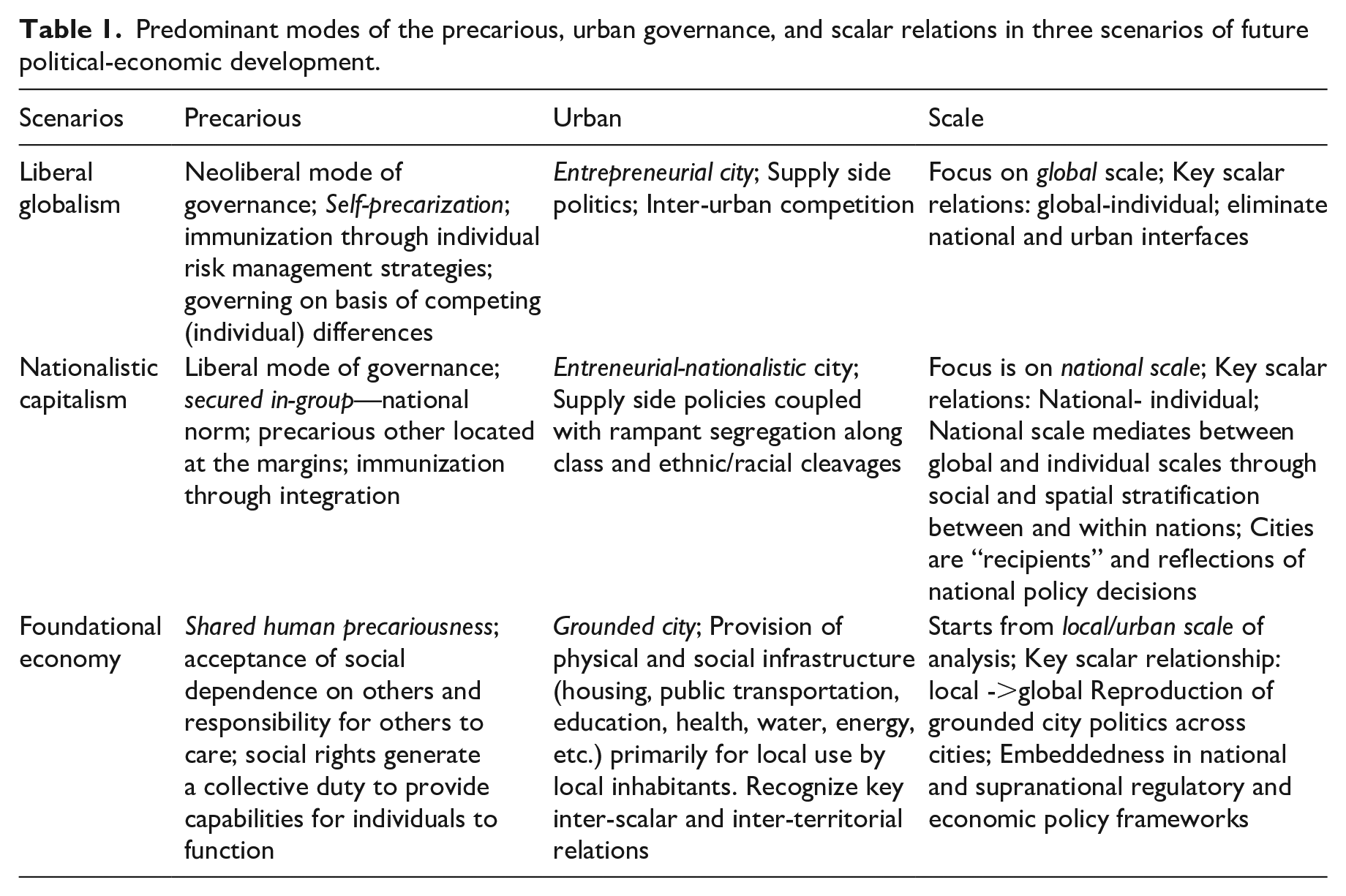
Liberal globalism can be interpreted as the continuation of the status quo. It includes the extension of markets into all spheres of life, the legal insulation of markets from political (mainly state) intervention, the elimination of barriers to the free movement of capital, people and commodities, and the glorification of consumer sovereignty. States are reduced to guarantors of individual rights, to enforcers of legal codes that privilege privatization and capital globally (Pistor, 2019; Slobodian, 2018). In that sense, liberal globalism depends on states to uphold and enforce rules that are increasingly engineered by and in favor of globally mobile, private capital. Responsibility for solving social and/or environmental problems is pushed down to the level of individual consumers who express their preferences through their purchasing behavior in the market. However, consumer choice is constrained by “choice architecture” (Gough, 2017a: 158) and preferences are shaped by corporate power, system lock-in, and a combination of the two (Fuchs et al., 2016). Restricting or prohibiting private consumption of socially and environmentally harmful activities and products is not only rejected by elites but also ordinary citizens (Blühdorn, 2014). It is therefore unlikely that liberal globalism will be able to offer a viable path out of the social-ecological crisis.
Since the Financial Crisis in 2008, there is evidence of stagnating global integration and a tendency toward regionalization of trade patterns (UNCTAD, 2018, 2020a, 2020b). There is also some indication that the hollowing out of the financial and political capacity of states to provide social protection from the negative effects of globalization (Rodrik, 2018) may trigger responses in form of conservative or progressive anti-globalization movements to challenge the status quo. Whether the current world order survives will depend on the ability and willingness of states to guarantee a minimum standard for individual survival of the majority. Even liberal states did intervene with more or less generous support packages during the current crisis. 3 If people are secured at the minimum, neoliberal biopolitical self-governance through precarization, the acceptance of individual self-securement and an understanding of freedom as unrestricted execution of personal preferences (choice), will prevail and a transformation toward a sustainable future seems unlikely in a political-economic formation governed by Liberal Globalist principles.
The current wave of radical right populism across European countries (Agnew and Shin, 2020; Dijkstra et al., 2020; Essletzbichler et al., 2021; Mudde, 2016; Rodriguez-Pose, 2018; Rodrik, 2018), the United States (Essletzbichler et al., 2018; Rodriguez Pose et al., 2020) or Brazil can be interpreted as signs of a reactionary counter-movement to liberal globalism that Novy (2022) labels nationalistic capitalism. While economically liberal, socio-culturally this Populist Radical Right (PRR) has been reactionary and challenging humanitarian values (Inglehart and Norris, 2019). Rather than focusing on individual differences, the PRR stratifies humanity into a superior “West” and the inferior “rest” and so returns to a liberal mode of governmental precarization. The movement also works for a re-establishment of a national norm centered on white masculinity positioned against the precarious others. Rather than addressing the underlying causes of increasing inequality, social marginalization, declining standards of living in the Global North, or planetary destruction, nationalistic capitalism promises to continue with our imperial mode of living (Brand and Wissen, 2018) by restricting access to scarce resources to a relatively small group of consumers in the Global North. In order to re-establish this colonial world-order and defend the prevailing world economic hierarchy, globalization (especially migration, multiculturalism, human rights) and its institutions (WTO, trade and investment treaties, EU, UN, climate treaties, etc.) are contested. While the implementation of such policies in Nazi Germany or the US South drew on “scientific” support for their racist policies from eugenicists like Francis Galton, Karl Pearson, or Ronald Fisher (John Maynard Keynes was head of the British eugenics society from 1937 to 1944), the lack of “scientific theories” legitimizing racism today is countered with a rejection of science (e.g. climate change denial) and facts (e.g. fake news) altogether.
The question is why a strategy based on nationalistic capitalism needs to follow a reactionary instead of a progressive trajectory and why a return to social welfare states under a “Bretton Woods (style) System” is unfeasible. Novy (2022) makes two important observations: (1) the political-economic context of the current conjuncture is closer to the globalized economy prior to World War I than the devastated economies after World War II and (2) the fierce individualism pushed by neoliberalization over the past 40 years resulted in liberal value pluralism at the expense of social freedom and collective agency espoused by left cosmopolitans and right nationalists alike. It legitimizes consumer sovereignty and rejects societal responsibility for a common mode of living and working that is environmentally sustainable and socially inclusive (Gough, 2017b, 2020). Taking these points together would suggest that a more inclusive form of nationalistic capitalism including Keynesianism could bring short-term relief but would not solve the social-ecological crisis because Keynesian policies rely on growth in aggregate demand which, if inclusive and based on private consumption, would exceed our planetary boundaries (Brand et al., 2021; O’Neill et al., 2018; Semieniuk et al., 2021; Steffen et al., 2015). 4 An inclusive strategy without growth would require restrictions on individual consumption (and other forms of “freedom”) unacceptable under liberal regimes of nationalistic capitalism prioritizing individual over social rights. Consequently, even “progressive” forms of nationalistic capitalism would need to restrict access to resources to global elites. These policies would fail to address the ecological crisis as the consumption-based emission shares of the global top 1 percent are as high as the sum of consumption based emissions of the bottom 50 percent (Chancel, 2021; Gough, 2017a) such that exceeding planetary boundaries may be delayed but not avoided. In this sense, neither reactionary nor “progressive” forms of nationalistic capitalism will provide viable strategies for the necessary socio-ecological transformation and are likely to end in fortress states (Urry, 2011), probably scaled up to fortress regions. States would try to secure survival in a constant state of emergency focusing on the adaptation to a hotter and unstable climate and securing supplies of energy, water, and food through military means, if necessary.
Because of the identified shortcomings of liberal globalism and nationalistic capitalism to offer credible solutions to the current social-ecological crisis, Novy (2022) introduces the foundational economy as the third alternative future scenario. The foundational economy is at once an empirical reality that distinguishes those economic zones providing the material and social necessities to sustain human life (i.e. products and services to satisfy satiable human needs) from those that produce for profits to satisfy unlimited wants, and “foundational thinking,” a particular kind of thinking developed by the Foundational Economy Collective in their Manifesto (Bentham et al., 2013) and a series of papers and books. 5 The Foundational Economy Collective (Froud et al., 2018b), following, among others, Polanyi (1944), does not equate economy with market or trading at the margin under conditions of scarcity, but the social organization of production, exchange and consumption of use values required for survival and the good life (freedom) for all. The provision of UBS reduces precariousness for all rather than the selective few. And as they are provided universally, individuals have the ability to “opt out” of attempting to become part of the secured core group (as in the scenario of nationalistic capitalism) or struggle to self-secure (as in the scenario of liberal globalism). For Azmanova (2020), the ability to opt out is critical for overcoming systemic unequal relations of power that impede social-ecological transformation. Furthermore, the social rather than private provision of foundational goods and services reduces consumption, and in turn, our environmental footprint, and has also been shown to have strong redistributive income effects (Calafati et al., 2021b; Dabrowsky et al., 2020; Lechinger and Matzinger, 2020).
The foundational economy is an alternative project with the following characteristics:
The main goal of a foundational economy is long-term social-ecological transformation (Bentham et al., 2013; Calafati et al., 2021b; Froud et al., 2018a, b).
To shape these changes in a cooperative and inclusive way, democracy needs to go beyond market-prone democracy. Socioeconomic democratization is the process of changing the basic functioning of the economy in a democratic way, prioritizing the provisioning of foundational goods and services (for all) and more generally, strengthening the co-responsibility for organizing “human livelihood” (Polanyi, 1977: xxxxix; Novy, 2022). Democracy and freedom need to extend beyond the political into the socioeconomic domain and “effectively strengthen the co-responsibility for organizing ‘human livelihoods’ ‘(Novy, 2022: 10).
It is based on a capabilities 6 based-notion of freedom (Nussbaum, 2011; Sen, 1999). Capabilities need to be provided in a socially and ecologically sustainable way. For Polanyi, sustainable modes of living are those that can be universalized (e.g. private pools are unsustainable, but public pools are possible—both are solutions for individuals to execute their capability to swim/exercise) (Novy, 2022). Some foundational thinkers prefer human needs theory rather than the capability approach to guide decision-making as the capability approach views people’s freedom of choice as its immovable standard (Bärnthaler et al., 2021; Coote, 2020). As these choices vary geographically and culturally they cannot provide the “means for identifying basic functionings or capabilities common to a group of people, let alone to all people” (Gough, 2017a: 41).
The current “choice architecture” (Gough, 2017a: 158) framed as consumer sovereignty to optimize individual wants satisfaction has to be substituted with sustainable and more equitable choice architectures that offer provisioning for the satisfaction of basic needs.
Basic needs are understood as universally shared. All individuals in the world at all times past, present, and future have the basic needs for nutrition, shelter, social participation, health, and physical security (Gough, 2019). These are not feelings but functions that need to be met or cause harm of compromised agency. Different basic needs are not substitutable.
The provision for non-substitutable basic needs and nameless, substitutable commodities to satisfy wants is structured differently. “Markets and charity cannot guarantee the meeting of needs. Only public authority can provide equitable entitlements to need satisfiers” (Gough, 2019: 538). The emphasis on “positive” socioeconomic rights entails a collective obligation to meet the basic needs of people. Traditionally this duty was reserved for citizens, but supporters of the foundational economy reimagine social citizenship, based on plural identities and rights conferred to residents rather than passport holders.
With rights come responsibilities. The focus on socioeconomic rights entails the obligation of individuals to contribute to collective care to promote the capacities for autonomy and self-determination. There is no point to rights if they cannot be exercised.
As discussed above, precariousness and dependence on others for survival is an ineluctable fact of life, sometimes we must rely on others to provide for us and sometimes, we must provide for them. Precariousness is neither avoided through integration of the precarious other into the protected in-group (as in nationalistic capitalism), nor through individual efforts to self-secure (as in liberal globalism), but rather through collective social provisioning based on recognition of shared precariousness and dependence on others for protection (Bayliss and Fine, 2021; Fanning et al., 2020). This protection extends from avoidance of harm to “the promotion of capacities for autonomy and self-determination” (Gough, 2019: 538).
The foundational economy is committed to a reduction of social inequalities through the provision of foundational services for all, funded in part by taxing wealth and conspicuous consumption. This transfer of private wealth/monetary income to universal basic services (rather than a universal income or other monetary transfers) reduces private consumption and, in turn, the ecological footprint. Other than raising taxes on high incomes and wealth, members of the Foundational Economy Collective suggest also different accounting rules for the public sector as the public sector is not in the business of profit rate maximization (Haslam et al., 2017), the establishment and calculation of residual rather than wage income as yardstick for local and regional economic success (Calafati et al., 2021a), or the introduction of social licensing agreements to force corporations to fulfill their social obligations in exchange for the right to use and/or profit from the provision of foundational services (Froud and Williams, 2019).
While basic needs are universal, how they are met is not (Schafran et al., 2020). As the provision of foundational infrastructure and services differs across space, the urban/local level as site of implementation takes center stage. The foundational economy is grounded in a particular place, a city, municipality, or village but entangled with socioeconomic, political, and legal processes at state, supranational, and global scales as well as socio-cultural practices at the social group and/or neighborhood scale.
After summarizing “Foundational Thinking,” how can we measure and evaluate its relevance in practice? Official industry and employment statistics are not collected with the purpose of differentiating between the foundational and non-foundational economies and individual output is the result of a myriad of transactions and resource flows (intermediate inputs, etc.) so that any output in the “foundational” sector will always include inputs from “non-foundational” sectors. Any distinction is therefore always imperfect. Despite these practical difficulties, a number of attempts of estimating the extent of the foundational economy exist. At its core of the foundational economy is the provision of UBS (Gough, 2017a, 2017b, 2019, 2020) in form of material (pipes, cables, roads, buildings, grids, etc.) and providential foundational economy (health care, education, etc.) (Froud et al., 2018b). Froud et al. (2018b) estimate the employment shares of the foundational economy as 36.9 percent in Italy, 41.3 percent in Germany, and 43.8 percent in the United Kingdom. For Austria, a recent study distinguishes between unpaid work (within the household), the everyday economy that includes the foundational economy (public services and infrastructure + essential local provision (e.g. local banking, food)) and non-essential local provision (restaurants, hairdresser, etc.), and export-oriented market economy and rentier economy (Krisch et al., 2020). According to their calculations, 44 percent of jobs are allocated to the foundational economy and 65 percent of jobs to the everyday economy. Mader et al. (2020) 7 estimate that the unpaid household sector contributes the equivalent market value of 30 percent of gross domestic product (GDP) (not yet included in the calculation of the relative sizes of foundational or everyday economies) to the Austrian economy. Whatever the exact delineation, the size of the foundational economy is substantial. Hence, one of the benefits of relying on the foundational economy to drive the necessary socio-ecological transformation is that it does not have to be created from scratch (at least in European countries and cities). On the contrary, it is not surprising that the foundational economy has become of primary interest to private providers who see privatization of publicly provided services as lucrative business opportunity. Conflicts over the right to provide foundational economies and services and the relative increase of power of private sector actors vis-a-vis the state (institutionally enshrined in public procurement and competition laws at the state and EU level) (Plank, 2019) will pose a serious challenge for states to expand the foundational part of the economy. Social licensing agreements may help to dampen private profits and obtain high-quality services, but past evidence casts doubt on this solution (see below).
The foundational economy differs from the market economy because the respective socioeconomic goals differ. In standard economics, efficiency is measured in narrow input-output terms rather than multiple dimensions of value. As efficiency determines profits and high profits are the goal of private enterprises, this makes perfect sense for companies operating in the market and rentier economies (Krisch et al., 2020). As the goal of the foundational economy are not profits but the provision of stable, high-quality, sustainable, resilient, and low-cost supply of necessary use values, simple efficiency measures are inadequate to evaluate the success of foundational infrastructure and service provision. Alternative measures, such as the “social return on investment” (SROI) take into account social, economic and ecological wellbeing. Assessing service efficiency through social value analysis takes into account longer-term and indirect effects, as well as shorter-term, direct ones 8 (Gough, 2019: 539). Planning for the long run, accepting low annual rates of return, cooperation and investment in maintenance, upgrade, and repair trump short-term efficiency, profits, and shareholder value considerations. Because of those conflicting goals, large parts of the foundational economy were and should be in public ownership. Where they have been privatized as part of neoliberal market creation policies, they often succeeded in producing profits and shareholder value, but failed to deliver on quality, repair, and long-term maintenance (Burns et al., 2016; Froud et al., 2018b; Getzner and Krisch, 2018; Plank, 2019). If the private sector is providing foundational infrastructure and services, then it must be strictly regulated and licensed (Froud et al., 2018b; Froud and Williams, 2019; Gough, 2019). While the foundational economy may be the most compatible scenario with social-ecological transformation, financing it without growth is challenging (Eckersley, 2021). More work needs to be done on various possibilities of financing the foundational economy through wealth and land tax, social licensing, progressive value added tax (taking into account carbon emissions), or progressive energy bills (Engelen et al., 2017; Froud et al., 2018b; Gough, 2017b). An even greater challenge to expand the share of the foundational economy are probably the necessary shifts in individual value systems and political decision-making in liberal-democratic states which, by nature, are long-term processes that may be difficult to alter in the short time left to stay within the planet’s ecological limits.
From neoliberal to grounded city
This section discusses the role of cities as well as the key scalar relationships in the three scenarios developed above and argues for the grounded city as “leitmotiv” for future urban development in Europe. As a working definition, cities are defined as relatively densely populated parcels of land, often bounded by administrative borders and co-dependent on ties with their hinterland; cities are best understood as territorial and relational (Massey, 2007). Following Engelen et al. (2017) the hinterland of cities does not only include geographically proximate areas, but is defined by ex-urban flows of resources (water, energy, food, raw materials), people (commuters, migrants), and value (from sales of “urban” products and services, repatriated profits or financial capital in/out-flows). Agglomeration economies (Brakman et al., 2020; Duranton and Puga, 2004), value transfer, and the “accelerator” function of urban real estate markets (Engelen et al. 2017) combine to increase productivity, wages and consumption.
Liberal globalism prioritizes analytically the global and individual scales of analysis. The elimination of the state and urban interfaces is supposed to increase the efficiency of global markets and allow individuals to compete on global job markets and satisfy their wants supplied efficiently by global companies. This is the flat-world topology championed by O’Brian (1992), Ohmae (1995) and Friedman (2005). National and urban economic policies focus on the supply side to provide the conditions for improving the productivity of individual agents (firms, workers, consumers) and so attract globally mobile capital and “creative workers” expected to generate spillovers and trickle-down effects for urban residents (Florida, 2011; Glaeser, 2011). The paradigmatic city model of liberal globalism is thus the entrepreneurial city (Harvey, 1989).
Nationalistic capitalism prioritizes the national level of analysis. In the current conjuncture, this means the move toward authoritarian governments dividing populations along sociocultural and ethnic/racial cleavages to manage and channel discontent toward the “precarious other” rather than addressing the causes of worsening economic conditions for the majority. As nationalistic capitalism does not question neoliberal economic doctrine, the entrepreneurial city model will continue to dominate but coupled with differentiated access to urban infrastructure, jobs, and social services for in- and outgroups. Rising property prices and amenity costs lead to the expulsion of the poor (Sassen, 2014) from city centers, the exclusion of and protection of privileged areas from the poor (Davis, 1992), poor neighborhoods (e.g. banlieues in France, poor inner city neighborhoods in the United States) and their citizens are perceived as danger to the national norm, discourse on these neighborhoods is “securitized” and racialized and those living in those areas are increasingly subject to penalization as they “fail to integrate” (Dikec, 2007, 2013; Wacquant, 2008, 2009). 9 We would also expect the “creation of living space” for in-group member through discrimination in housing markets, eviction from and restriction of access to municipal housing and other social services through the reintroduction of citizenship as access criteria. 10 The result of those policies would be strongly segregated cities along income, citizenship, and race/ethnicity. This ideal-type city could be labeled as entreneurial-nationalistic It is expected to differ from the Keynesian welfare city because of the continued belief in neoliberal economic policies and hence, the pursuit of an entrepreneurial city strategy but, contrary to the entrepreneurial city, divides urban residents along race, religion, culture, and citizenship and restrict access to already reduced levels of UBS to in-group members. Cavaille and Ferwerda (2017) and Essletzbichler and Forcher (2022) examine empirically political tensions between Austrian and foreign passport holders that emerged in relation to the opening of municipal housing to foreign nationals in Vienna and the ensuing electoral success of the radical right Austrian Freedom Party (FPÖ) arguing for exclusionary access for Austrian citizens. Notice that unreflective smart- and eco-city concepts, in line with green growth policies that focus on the livability concerns of wealthy residents, will lead to rising property prices in city centers and the banishment of poorer residents to the (sub-)urban peripheries. These concepts are thus compatible with this as well as the entrepreneurial mode of urban development (Angelo and Wachsmuth, 2020; Keil, 2020).
While the foundational economy is strongly associated with the welfare state, the urban/local scale is seen as starting point for successful socio-ecological transformation for at least three reasons.
First, an increasing number of people live in territorial units labeled as urban. Given recent and predicted population trends for Europe (BBSR, 2016 11 ; European Commission, 2015; Wolff and Wiechmann, 2018), it is expected that, on average, urban and suburban areas grow while rural areas shrink. Shrinkage is particularly high in the rural municipalities of East Germany, Hungary, Romania, the Baltic States, and Albania. In these countries/regions only few (including urban) municipalities beyond the largest metropolitan areas grow. In France and Spain, population growth is strong in cities and along the coasts (Wolff and Wiechmann, 2018). The provision of foundational infrastructure will thus need to consider increasingly the needs of “urban” populations. But because the basic needs of inhabitants vary across EU countries, regions, and between central cities, suburbs, and rural areas and depend on their current conjunctural position (i.e. growth, stagnation, decline), the provisioning of foundational infrastructure needs to be locally specific (Schafran et al., 2020). Building the foundational economy thus starts from the local/urban scale.
Second, high-density settlement patterns have, everything else equal, a smaller carbon footprint per capita. Essential infrastructure and services can be delivered more efficiently, shared and so reduce, in theory, consumption per capita (Meyer, 2013). The urban ecological advantage is not uncontested and strongly dependent on density, socioeconomic characteristics of households (in particular, income and household size), and geographic and historical context (Baiocchi et al., 2015; Gill and Moeller, 2018; Weisz and Steinberger, 2010; Wiedenhofer et al., 2018). For Germany, Gill and Moeller (2018) show that direct Greenhouse Gas Emissions are higher in rural areas, while indirect effects are higher in urban areas (higher urban productivity → higher income → higher consumption levels) and that emissions are highest in suburban areas and commuter belts
Third, and contrary to its conceptualization in new geographical and urban economics (Brakman et al. 2020; Glaeser, 2011), cities are not isolated containers whose faiths depend solely on the productivity of local firms and people. Instead, cities are grounded in at least three ways (Engelen et al., 2017): First, cities are grounded through their co-dependency with their hinterland that supplies inputs and revenue through the sale of “urban” output. The relations with the hinterland thus govern city development. Second, the growth of value extracted from the hinterland is “accelerated” through investment in urban land, resulting in rising urban land rents; capital is sunk in a particular place. Third, the urban economy is “stabilized” through the foundational economy generating about 40 percent of jobs in growing, stagnating, or declining cities. These jobs are tied to a particular place as they satisfy the universal basic needs of the local population. In the medium to long run, cities grow, stagnate, or decline and there is little that they can do independently of their hinterland to avoid that. Instead of city-specific supply side policies to generate (temporary) growth, they should focus on the provision of local “stabilizers,” jobs in the local production, and service sectors that provide (shared) foundational infrastructure and services to local people by local employees (Engelen et al., 2017). Access to and sharing of communal rather than private goods and services also reduces the carbon footprint and is socially inclusive; it reduces precarious conditions for all (Gough, 2017a, 2019, 2020; Novy, 2022).
The arguments above require careful evaluation. While it may well be the case that, everything else equal, central cities use fewer resources per capita, agglomeration economies producing growth and density depend on value transfer from their hinterland. Extracting value from their respective hinterlands and valorizing and accelerating value creation through investment in local real estate means the displacement of workers at the lower end of the income distribution to suburbs and rural communities that, on average, use more resources per capita than central cities (Keil, 2020). The possibilities and limits of urban provisioning of foundational capabilities are illustrated using the example of Vienna next. Despite a number of advantages to build on, modify and expand municipal foundational services, it also illustrates the struggles and conflicts to maintain foundational services in relation to national liberal-conservative economic politics, the decline of the European Social State (Streeck, 2019) and rapid population increase as a result of shifting geohistorical conditions.
The grounded city and beyond: lessons from Vienna
This section uses Vienna as an example in order to illustrate that “urban” politics and planning needs to “free” itself from a narrow territorial conceptualization of cities where planning often stops at administrative city borders but is subject to decision-making at other spatial scales as well as changes in the cross-territorial relations often outside the control of the city administration (immigration flows, reduction of monetary inflows and foreign workers due to a health epidemic, etc.). Both, relational and territorial properties of cities are context specific and hence, unique to a city. In order to examine the possibilities and limits of maintaining and developing the foundational economy in the particular context of Vienna, it is useful to start with an analysis of its “spatiotemporalities” (Leitner and Sheppard, 2020). This includes the analysis of the city’s geohistorical trajectory, vertical inter-scalar relations, and horizontal relations. These three dimension need to be understood as analytical starting points of conjunctural urban analysis, but in reality many relevant events and processes are not easily placed in those boxes. The spatially and temporally specific particularities need to be distinguished from and related dialectically with general tendencies shared across places and time and, where relevant, their mutual constitution examined (Leitner and Sheppard, 2020). Examining the evolution of the three dimensions of Vienna’s spatiotemporalities highlights the possibilities and constraints for building, protecting, and adapting the foundational economy. This section does and cannot offer a full geohistorical account of Vienna, but identifies those events and processes of the recent past judged critical for identifying changing inter-scalar and inter-territorial relations and the need to think of city politics, often constrained by administrative boundaries, in relation to its internal structure and its hinterland, and hence, across vertical scales and horizontal linkages.
Based on the OECD metropolitan PPP GDP/capita estimates, Vienna ranks 127th of 707 cities. 12 Despite this rather mediocre performance, Vienna has been ranked as the most livable city for years in a row. “Strong, on-the-ground capabilities are integral to the global operations of most international businesses and are in large part driven by the personal and professional wellbeing of the individuals that companies place in those locations said Ilya Bonic, Senior Partner and President of Mercer’s Career business.” 13 These “on-the-ground capabilities” include health care, education, public services and transportation, housing, natural environment, that is, key elements of the urban foundational economy. The ranking features prominently on the website of the city of Vienna 14 and is used to sell the location to potential investors and “creative workers.” The capabilities underpinning these rankings were not created to improve “competitiveness” but to secure workers and later, middle-class citizens, against precarious conditions of work and living starting with the building and municipal acquisition of the “material foundational economy” (Froud et al., 2018a) in the later half of the 19th century, the development of social housing, recreational and health facilities during the period of “Red Vienna” between 1923 and 1934 (Kadi, 2015; Matznetter, 2002, 2019; Novy et al., 2001) and was further expanded as part of the Keynesian welfare state after WWII (Bärnthaler et al., 2020). As a result, the city of Vienna now owns 220,000 flats, 26.5 percent of all housing units in 2011. 15 Coupled with strict rental regulation for certain segments of the private housing stock, the city was able to offer relatively cheap rented accommodation such that more than 75 percent of the Viennese population now lives in rented accommodation (Kadi and Verlic, 2019; Matznetter, 2019). Most of the foundational infrastructure and services created are still under control of the city government (Plank, 2019), but since the mid-1980s, key historical changes occurred that altered Vienna’s vertical inter-scalar and horizontal relations which, in turn, affected the demand and supply of foundational infrastructure and services while simultaneously reducing the political independence and scope of intervention for municipal government.
The recent geohistorical events and trajectories affecting Vienna’s development trajectory as well as its inter-scalar and horizontal relations were the war in Yugoslavia, the fall of the Iron Curtain, the accession of Austria to the EU in 1995, the accession of Eastern European countries to the EU between 2004 and 2007, the Great Recession of 2008, as well as the arrival of displaced persons and refugees in 2015. Consequently, Vienna moved from the periphery of Western Europe to the geographical Center of the European Union attracting immigrants from Germany, former Yugoslavia, Romania, and Turkey expanding its population from 1.5 million in 1988 to 1.9 million in 2019. The share of foreign citizens increased from 7.6 percent in 1982 to 30.1 percent in 2019. 16 The internationalization of horizontal linkages in terms of commuting and migration flows were supplemented by financial flows to and from former Eastern European countries and an expansion of international tourist flows. The industrial structure of Vienna shifted from domestic-market orientation to international markets that produced jobs in the FIRE, creative industry, and tourism sectors. Rapid population growth coupled with deregulation of the private low rental housing market (Hatz, 2019; Kadi, 2015; Kadi and Verlic, 2019; Matznetter, 2002, 2019; Reinprecht, 2019; Tockner, 2017) and fiscal constraint of the city 17 (Bärnthaler et al., 2020) resulted in rising demand for and lower supply of affordable housing. Although suburbanization processes occurred at least since the 1970s, the recent pressures on Vienna’s housing market resulted in the growth and geographic expansion of Vienna’s commuter belt far beyond the administrative boundaries of the city (European Commission, 2015; Kramar et al., 2019). The relational consequences of the provision, repair, adaptation, improvement, and extension of the urban foundational economy need to be considered in order to avoid ecological rebound effects (e.g. green gentrification pushing poorer households into low-density and poorly accessible districts within and municipalities beyond the city’s boundaries; attraction of higher income groups to city center increases consumption and so the indirect effects on emissions) and negate local improvements of climate change adaptation. Land use regulation, integrated social-ecological mobility, and dwelling concepts and strategies need to be developed in coordination with adjacent municipalities and regions in order to produce choice architectures that are socially-spatially fair and ecologically sustainable. In this sense, the “urban-local” scale needs to expand to the “urban-regional” scale of planning, decision-making, and investment.
The accession to the EU constitutes the key change in Vienna’s inter-scalar positionality as the city is now subject to EU competition rules, procurement laws, and Europe’s neoliberal interpretation and enactment of political economy (Streeck, 2019). With respect to housing, EU law required the municipality to open up the municipal housing market to EU citizens in 1995 and to third-country nationals with permanent residency in 2007 (Cavaille and Ferwerda, 2017). As available municipal housing is allocated according to multiple criteria, 18 rapidly rising prices in the private rental market, deposit requirements in the cooperative housing sector and the fact that many of the newcomers from outside the EU are most in need of accommodation, the vast majority of the newly rented municipal flats goes to third-country nationals (Simons and Tielkes, 2020). The result is ethnic diversification and social residualization of municipal housing areas. Generating feelings of insecurity and fear among old (Austrian) residents (Marquart, 2013; Wodak and Forchtner, 2014) and narrating conflicts between old and new residents along, almost exclusively, ethnic lines, the radical right Freedom Party (FPÖ) is able to compete with the Social Democratic Party (SPÖ) in municipal housing areas (Essletzbichler and Forcher 2022; Reinprecht, 2012; Rosenberger and Permoser, 2012). While racism and intolerance toward minority outgroups cannot be denied, the lack of social policies at the EU level to counter negative political and economic spillovers from the free movement of people poses limits for political acceptance of the local provision of foundational infrastructure and services and in turn, puts into question the political legitimacy of the EU. This is further exacerbated by the implementation of New Public Management (NPM) thinking at the national scale and EU competition and procurement laws that seriously limit the political-economic space for maneuvering by local authorities. In order to be effective and social-ecologically sustainable, governments at national and supranational scales would be required to prioritize the foundational over the market economy as well. Otherwise, political fallout and rebound effects will nullify any change implemented at the local scale.
Bärnthaler et al. (2020) argue that the extent of change in social-ecological infrastructure provision required necessitates not only a scaling up but also scaling down of urban politics to neighborhoods and individuals. First, neighborhoods within cities differ with respect to built infrastructure (low/high density, easy/poor access to public transport, green spaces, housing, etc.), land use, social structure and hence, the demand for foundational infrastructure and services varies across neighborhoods. Second, only if local populations are engaged in the planning, design, and delivery of socio-ecological infrastructure and take ownership of the process, will they agree to the curtailment of individual rights in form of private consumption choices. The grounded city so enables place-building as well as local forms of sense-making and belonging stressing the human-in-common need of care from and for others rather than individualized human capital formation to securitize against perceived precariousness in a topologically flat, competitive world where individual success and self-realization are measured as one’s position in the socioeconomic hierarchy in relation to the individuals above and below.
“Urban” foundational politics, usually confined to administrative borders, need to be coordinated across scales and territorial boundaries. Given its recent geohistorical trajectory, for Vienna that means lobbying in Brussels for the development for a common European Social-Ecological Union that puts the foundational economy and needs (rather than wants) of people at the center of its legitimation claims. Adherence to the Liberal Globalist path is likely to result in increasing nationalistic fragmentation, changes in access rulea to UBS along race, religion, and/or citizenship or possibly, the demise of the EU. Within Vienna, neighborhood particularities need to be recognized, analyzed, and mobilized to enroll local populations in a social contract that empowers local co-creation and instills a sense of ownership of a local social-ecological transition (Bärnthaler et al., 2020). All policies, especially those pertaining to the housing/land use and mobility systems, require collaboration between jurisdictions in order to avoid displacement and rebound effects.
Conclusion
The article argued that the precarization of an increasing number of Europeans coupled with the looming ecological crisis constitutes a critical conjuncture which opens up different future political-economic scenarios, liberal globalism, nationalistic capitalism, and foundational economy (Novy, 2022). While liberal globalism can be interpreted as continuation of the status quo resulting in a further expansion of the “state of insecurity” (Lorey, 2015) where individuals are governed through “self-precarization,” nationalistic capitalism is likely to return to a liberal mode of governmental precarization, where ingroup membership (defined through ethnicity, citizenship, religion, gender, etc.) and adherence to the group norm secures its members against “precarious others.” Foundational economy is based on an understanding of shared human precariousness as ineradicable condition of life that is, at one point or another, dependent on others. This shifts the emphasis on the collective endeavor (right and responsibility) to safeguard life rather than individual responsibility for something that cannot be protected without help from others. The shift from self-securitization to collective provision of care is seen as important because it opens up discussions on value, ethics, needs, wants, individual versus social rights, economics and politics. This is critical because an economy geared toward profits from satisfaction of unlimited wants rather than the collective provision of UBS to fulfill satiable needs is likely to be unable to generate the necessary reductions in greenhouse gas (GHG) emissions fast enough to maintain life within the planetary boundaries (Eckersley, 2021; Gough, 2017; O’Neill et al., 2018; Steffen et al., 2015).
Neither liberal globalism nor nationalistic capitalism are able to suppress individual consumption to reduce GHG levels sufficiently or generate an equitable distribution of resources and surplus because they do not challenge the premises of a growth-based economic system and because their political legitimization is based on a notion of individual freedom as ability to consume. The foundational economy starts from universal basic needs and the social provision of infrastructure and services necessary to produce the capabilities that allow individuals to meet those needs. The economy is built around the satisfaction of those needs rather than life structured around the requirements of the economic system. The foundational economy proposes the expansion of social and curtailment of individual rights, an understanding of shared human precariousness, and a reduction in personal consumption and resource use (in the Global North) and so appears to offer a more credible scenario for social-ecological transformation. All three of the scenarios are plausible and should be interpreted as ideal cases from which countries and cities will deviate. In European countries, elements of each of the three scenarios are observed in reality. Liberal globalism dominates economic policymaking, nationalistic capitalism returns in many European countries but to a different extent and political direction (left/right populism). And finally, the material foundational economy exists in all countries, but with varying importance and size. As Bärnthaler et al. (2021) illustrate, policy decisions may be less about exclusion of one or the other option but about the rebalancing of our material economies and a normative shift in understanding of economies as optimal distribution systems of scare resources to satisfy unlimited individual human wants to an understanding of economies as social provisioning systems to satisfy a limited number of human needs.
The local scale, cities and municipalities, have been identified as local expressions and drivers of the three political-economic scenarios. The article argued that more emphasis should be placed by European cities on the delivery of foundational infrastructure and services for local populations instead of supply side policies to attract internationally mobile capital and “creative” workers. As the structural position of cities, differences in needs across cities, and differences in the existing provision of infrastructure and services vary, the supply of those services requires a locally specific approach, a spatial contract (Schafran et al., 2020), to deliver the foundational economy efficiently and gain support for the measures. However, as the, admittedly brief and incomplete, account of Vienna demonstrated, effective “urban” policies are always required to consider location-specific inter-territorial and inter-scalar relations in order to avoid displacement and rebound effects.
And finally, in light of these scenarios, the article provides the following answers to the question of the conference “Urban Europe, Precarious Futures?” Our futures have to be precarious given the fact that precariousness is an ineluctable fact of life. But, it is a political decision how, as societies, we allocate precarity between individuals and/or groups and will depend on the future political-economic development pathway societies, countries, cities, and the EU embark on. As urban populations tend to grow throughout most of Europe and cities are key sites of delivery and design of national and European policies, cities will have a privileged position in shaping our futures.
Footnotes
Acknowledgements
The author thanks the editor, Mike Raco, Daniel Grabner, and two anonymous referees for excellent comments on an earlier draft of the paper. Any remaining errors are the sole responsibility of the author.
Declaration of conflicting interests
The author(s) declared no potential conflicts of interest with respect to the research, authorship, and/or publication of this article.
Funding
The author(s) received no financial support for the research, authorship, and/or publication of this article.
