



Abstract
The most significant episode in the assetisation of housing (underpinning its financialisation) is often understood to be the economic restructuring that took place during the 1980s – particularly deregulation of the banking sector and credit liberalisation. Research has reported on the housing ‘investor subject’ that emerged during this time, as an integral part of the transition towards financialised economies. This article provides new evidence about the housing consumer subject, and its place in this transition, by drilling into UK housing policy history and its discourses around the consumer relationship with housing. Using archive data from the Parliamentary and National Archives alongside interviews with key informers, we illustrate three cases of housing policy development in which the consumer demand for, and relationship with, housing is discursively reconditioned. We conclude that the housing investor subject was pursued in housing policy reform and its discourses well before the 1980s and the economic reforms commonly identified as the causes of financialisation. In addition, these discourses are found to have been reconditioned in order to align with broader macroeconomic policy concerns of the time. The article therefore provides a rare view of assetisation from within the state apparatus, revealing how housing policy and its discourses around consumption became functionally integrated within wider macroeconomic goals.
Introduction
The assetisation of land and housing has elicited significant attention in recent years (Ducastel and Anseeuw, 2014; Gallent et al., 2019; Ward and Swyngedouw, 2018). Understanding this form of assetisation is important because it is fundamental to the character of contemporary financialised capitalism (Langley, 2021) and of national economies. For example, the preference among banks for lending secured against property, and the associated perverse incentives are well known (Ryan Collins, 2019; Ryan-Collins et al., 2012; Stephens, 2007). This process is supported by consumer demand for home ownership (Jorda et al., 2016; Rolnik, 2013) and by a consumer relationship with housing in which homes provide asset-based welfare (Adkins et al., 2019) through house-price Keynesianism (Crouch, 2009).
The research project on which this article draws aimed to better understand the progressive assetisation of housing in the United Kingdom. Following the theory of a relationship between consumer housing choice and national political and economic restructuring (Castles, 1998; Kemeny, 1981, 2005; Schwartz and Seabrooke, 2008), we sought evidence about the nature of this relationship: how this restructuring and actual market operation affect one another. Opening the ‘black box’ of markets requires apprehending the ‘assemblage of material and technological elements in combination with human activity’ (Fields, 2017) that makes them up. From the various elements involved in the assetisation of housing, this article drills into housing policy discourse around the consumer relationship with housing. While the work of the state is only a part of the human activity that makes up the financialisation of housing, it is nevertheless a significant aspect and one of the most overlooked (Christophers, 2017).
The article provides new evidence about the consumer relationship with housing, showing how policy discourses around housing tenure and consumer subjectivities have been reconditioned around housing as an asset, to support new directions in macroeconomic policy throughout the 20th and 21st centuries. We reach two significant conclusions. First, the assetisation of housing – the foundation of its financialisation – was pursued through housing policy reform well before the 1980s, supported through shifting policy discourses around the consumer subject. Second, and more importantly, this trend was related to the macroeconomic concerns of government, rather than concerns about housing policy itself. The history related here shows how housing policy and its discourses have become functionally integrated with wider macroeconomic goals such as to control inflation, and the pursuit of new forms of economic growth. The central implication is that housing policy should be understood as a macroeconomic resource before being considered an element of social policy.
The article has the following structure. The ‘Review of existing evidence’ outlines the research on which this article draws, theorising a link between contemporary capitalism and the housing choices of individual consumers. The ‘Data and analysis’ section elaborates the methodology, drawing on archive and interview data on housing policy development and discourse throughout the 20th and 21st centuries. ‘Findings’ presents findings relating to three cases of housing policy development – each linked to broader macroeconomic strategising of government – and the discursive conditioning of the consumer relationship with housing associated with these shifts in policy. Each case highlights how housing policy has been designed not according to the social function of housing, but according to much broader macroeconomic concerns. The first reveals how housing policy has been designed to support productive activity and national economic growth. The second illustrates a change in macroeconomic thinking which led the 1951–1955 government to strengthen the function of housing as an asset for individual consumers. The third looks at more recent shifts from individual to institutional investment into the housing system. In each case, the consumer demand for, and relationship with, housing is discursively reconditioned to align with the broader macroeconomic policy concerns of the time.
Review of existing evidence
What is the assetisation of housing?
Housing systems are fundamental to national economies, leading macroeconomists to study the various ways they affect the dynamics of aggregate economic activity. House prices can affect consumer spending (and therefore GDP) through the collateral channel, by improving access to additional credit for homeowners (Muellbauer, 2007, 2018). Falling house prices can cause credit availability to contract, even more than rising prices can lead it to expand (Hendry and Muellbauer, 2018). House-price appreciation can also affect gross domestic product (GDP) through the wealth effect, encouraging households to save less and spend more (Kaplan et al., 2016; Mian et al., 2013). Other channels include the liquidity channel, by which house prices can affect the ease of sales and thereby also affect mortgage lenders’ attitudes to lending; as well as the cash-flow, redistribution and income channels (Hedlund et al., 2017). Monetary policy levers like interest rates can be used to manipulate the various ways that housing functions as an asset through these channels, but such levers affect households differently depending on their type of mortgage (e.g. variable or fixed) or degree of leverage, hence the interest in housing among macroeconomic scholars (Bahaj et al., 2018; Burrows, 2016; Calza et al., 2009; Cloyne et al., 2016; Fair, 2016; Geiger et al., 2016). There is debate about which levers, targets and variables should be considered by macroeconomic policymakers (Hendry and Muellbauer, 2018). It has been argued, for instance, that falling residential sales (leading to falling employment in construction, finance and real estate, as well as in the production of consumer durables) might be the most accurate predictor of economic recession, putting the emphasis on housing consumption and housing starts (rather than house prices per se) for macroeconomic wellbeing (Leamer, 2007, 2015).
Scholars studying social and geographical outcomes (rather than macroeconomic outcomes) have focused instead on asking how different regimes of accumulation or modes of capitalism impact the housing system (Lowe, 2011; Lowe et al., 2011; Ronald and Dewilde, 2017; Schwartz and Seabrooke, 2008). Where the macroeconomic literature seeks to understand the relationship dynamics between housing and the macroeconomy, these scholars have emphasised the history of this relationship; not simply the role that housing plays as an asset, but its assetisation. ‘Assetisation’ is usually associated with ‘financialisation’, being understood as ‘the path to housing financialisation’ (Wu et al., 2020) or one of the processes underpinning it (Birch, 2017; Ward and Swyngedouw, 2018). For scholars of housing, urban and regional studies, analysis has focused on understanding the driving forces of these phenomena (Jorda et al., 2016; Pappa, 2016); the actors, infrastructures and practices implicated (Aalbers, 2016; Botzem and Dobusch, 2017; Bradley, 2021; Ducastel and Anseeuw, 2014; Fields, 2017; Ouma, 2015; Savini and Aalbers, 2015) and their nature and variegated impacts in different localities (Aalbers, 2009; Ward and Swyngedouw, 2018).
Financialisation is a form of economic restructuring that can be identified across entire economies, in which profit is created increasingly through financial channels, rather than through trade or commodity production (Krippner, 2005). It is also used to describe the condition of specific markets which have become financialised; those in which value is created and managed not according to the inherent materialities of the market concerned – in this case, the consumer market for houses – but according to the credit that can be secured on the expectation of steadily increasing economic rent (Bradley, 2021; Gunnoe, 2014). This requires the reshaping of certain elements within value chains (whether these be physical or organisational elements) so they can function as financial artefacts or investment opportunities (Birch, 2017; Ducastel and Anseeuw, 2014). The commodities on offer – in this case housing – are still produced or for sale, but at the same time, their markets are fundamentally organised around their status as an asset (rather than as a commodity).
How and why has housing been assetised?
Analytic interest in the financialisation of economic and social life (and the assets at its foundation) preceded the global financial crisis (GFC; Krippner, 2005; Langley, 2006) but the GFC-focused housing, urban and regional studies on these phenomena (Aalbers, 2009, 2016; Botzem and Dobusch, 2017; Fields, 2017; Guironnet et al. 2016). Literature often pinpoints the 1970s and 1980s as decades of critical change (Birch, 2017; Christophers, 2017; Krippner, 2005; Rolnik, 2013). There is a tendency to frame the late 1970s and 1980s as the most significant turning point in the history of the UK housing system, as capitalist economies moved from a Keynesian post-war consensus (during the late 1940s to the 1970s) to a post-Fordist regime, in response ‘to the 1970s oil shock and global recession’ (Waterhout et al., 2013: 143, see also Crouch, 2009). The significance of the 1980s is well documented as a period that brought forth the economic and banking disruptions that have been identified as the ‘common causes’ of financialisation (Gallent et al., 2017). These disruptions included the deregulation of the banking sector and credit liberalisation (Gallent et al., 2017; Ryan-Collins et al., 2012), drawing more diverse financial institutions into mortgage lending, advancing access to international capital markets for housing finance (Balmaceda et al., 2014) and breaking the link between savings deposits and mortgage lending (Wainwright, 2009). This also led to the proliferation of new financial tools such as mortgage-backed securities (Gotham, 2016) and more predatory mortgage lending practices (Rolnik, 2013).
There have also been ‘place-specific triggers’ which in the United Kingdom are understood to include active encouragements towards home ownership and the denigration of renting as an inferior tenure (Gallent et al., 2017: 2211). International research has emphasised the centrality of home ownership and private property to financialisation (Belotti and Arbaci, 2021), backed by ‘the political force of homeownership ideology’ (Rolnik, 2013) and ‘myths concerning the superiority of home-ownership over other forms of tenure’ (Kemeny, 1981: 11). Jorda et al (2016) provide evidence of UK financialisation being driven by ‘the great mortgaging’ and correlated closely with a rising share of mortgage loans in banks’ total lending portfolios during the 20th century. These authors show that high levels of home ownership, far from being a fundamental trait of advanced economies, have been a significant historical prerequisite for financialised housing markets. Scholars of ‘asset-based welfare’ point towards a political, ideological and discursive shift towards homes as assets (Castles, 1998; Doling and Ronald, 2010; Kemeny, 1980, 2005; Lennartz, 2017; Lowe, 2011; Lowe et al., 2011; Ronald and Dewilde, 2017; Schwartz and Seabrooke, 2008). This literature shows that individuals’ housing demand, choice and consumption are fundamental to economic restructuring and the process of financialisation, as households start to ‘use their homes as ATM machines’ (Fernandez and Aalbers, 2017). An important outcome is ‘a new relationship with housing’ expressed through new patterns of consumption, ‘from domestic buyers moving their capital into bricks and mortar . . . to overseas buyers “parking” money in key investment destinations’ (Gallent et al., 2017).
The consumer relationship with housing and its significance for state restructuring is also foregrounded by scholars concerned with the ‘everyday financial subjectivities’ of housing consumers, particularly the ‘modern investor subject’ engaged in contemporary mortgage networks (Langley, 2006; Watson, 2010). Watson (2010: 414) discusses the construction of investor subjects throughout the 1990s and 2000s, as New Labour’s attempts to establish house-price Keynesianism produced an ‘asset-holding society’. By reflecting on the moralising tone of government documents during the 2000s, he shows that policy and political discourse are significant to the construction of consumer subjectivities, and hence assetisation. Discourses around home ownership are an important part of this, as ‘[r]esponsible home-owners are distinguished [. . .] from their Other: those irresponsible and irrational individuals who spend “dead money” on rent and fail to get “a foot on the property ladder”’ (Langley, 2006).
The state and the assetisation of housing
The main focus of research on assetisation has been on private actors (Christophers, 2017). While the state is considered an important actor in the recent trend towards treating land and housing as an asset (Aalbers, 2016; Christophers, 2013), its role remains under researched (Christophers, 2017; Feng et al., 2021). The state’s role has been conceptualised as providing the necessary conditions and licences for the practices that are required in order to financialise markets, including policing property rights (Harvey, 1982). Its role is often traced back to the deregulation of mortgage markets since the 1980s (Ashton et al., 2016; Feng et al., 2021) or more recent financial policies (Aalbers, 2019; Guironnet et al., 2016). Even if the state has simply facilitated other actors (rather than acting as an agent of financialisation itself, see Aalbers, 2019; Harvey, 1982; Weber, 2010), the processes underpinning financialisation involve state institutions (Gotham, 2016; Rolnik, 2013; Wainwright, 2009: 1059), for example, emphasises the centrality of housing policy reform for financialisation, particularly concerning home ownership and private property. The government promotion of home ownership, often presented as being rooted in the 1970s (Wijburg, 2019), is viewed as crucial in this respect. Active work is required from within the state apparatus to set the right conditions for the assetisation of housing, asset-based welfare, privatised Keynesianism or house-price Keynesianism. The rationalisations behind these processes are rarely uncovered however, and the view from the state apparatus remains obscure. This article illuminates this view in the case of the United Kingdom, drilling into policy discourses around housing consumption at crucial points in housing policy history, and revealing how these shifted to support new directions in macroeconomic strategy.
Data and analysis
Discourse-oriented analysis, such as the archive method used here, provides a supplementary mode of data to practice-oriented and political economy analysis (Fields, 2017). It is not used to evidence the precise causal policy mechanisms by which the state has advanced the assetisation of housing. Policy reform is discussed, but our focus is on the discourses deployed in order to meet these ‘institutional and organisational objectives’ (Fairclough, 2001: 231). The theory is that discourses have an operational force that impacts on social action; they are productive or, in Foucauldian terms, a discourse can be seen as an agent of power (Carabine, 2001: 268). Power in this context operates through norms of behaviour which are threaded through society, conveyed through discourses which offer messages about what is normal and what is not, normalising certain perspectives and behaviours above others (Carabine, 2001: 277). It is beyond the scope of this article to analyse the ways these discourses might come to affect housing market operation; the task here is to identify the shifting discourses around housing consumption, from the view of the state, in relation to housing policy reform across the 20th and 21st centuries. By analysing the way the housing consumer is spoken about in national housing policy discourse, as well as how this has changed in relation to specific policy reforms, this article traces the relationship between the work of the state, and the discourses surrounding housing consumption that are created in the process.
Selection of a corpus of data involved reviewing all relevant housing policy documents (Bills, and Acts of Parliament, published Command Papers, ‘housing summaries’ or ‘housing returns’ data sets). In order to review how discourses changed in advance of, and in the run-up to, the 1970s and 1980s reforms most commonly identified as significant for the assetisation of housing, 1900 was chosen as the earliest date for data collection. Analysis was subsequently focussed on strategic documents (mostly White and Green Papers) rather than Bills or Acts, since these have discursive and rhetorical depth, indicating the direction of policy reform and government rationalisations, but are not constrained by the practicalities of actual implementation. As Aalbers (2004, quoting Priemus 2000) has observed, policy ‘rhetoric’ (such as that used in publicly available White Papers) can be distinct from the actual drivers behind policy design. In order to place discourses in the proper context of government strategising, analysis was extended to archive records of the policy development process leading up to publication. These data were used to uncover the constraints and opportunities felt within government that informed subsequent policy reform and discourse.
The Parliamentary Archives are particularly useful for sourcing personal documents collated by Members of Parliament around the publication of strategic documents, including press clippings and letters from lobbies, constituents or other interested parties. The National Archives store multiple files on any particular policy process. These contain policy development records drawn up during the development of strategic documents: memos, notes and letters between members of Cabinet, ministers and departmental civil servants, as well as informal notes which give a better ‘feel’ for the more informal side of policy development. It should be noted that not all the policy proposals referenced here preceded actual implementation. The iterative nature of policy design, with all its cul-de-sacs and negotiations between different departments, individuals and interest groups, may not always result in new regulatory frameworks, but gives us an important insight into the opportunities and constraints felt within government, what goals were sought with and through the housing system, and what discourses were involved in this process. In addition, we are not concerned with assessing the agency of the state for directly affecting the assetisation of housing. As Krippner (2005) observes, forces like globalisation and financialisation reduce the power of the state to define economic and social policy. Here, the state is understood as a conduit or indicator (rather than definitive originator) of social change. This is an important distinction because the task at hand is not to identify the ultimate cause behind the assetisation of housing, but to interrogate the discourses involved and how this work has been done.
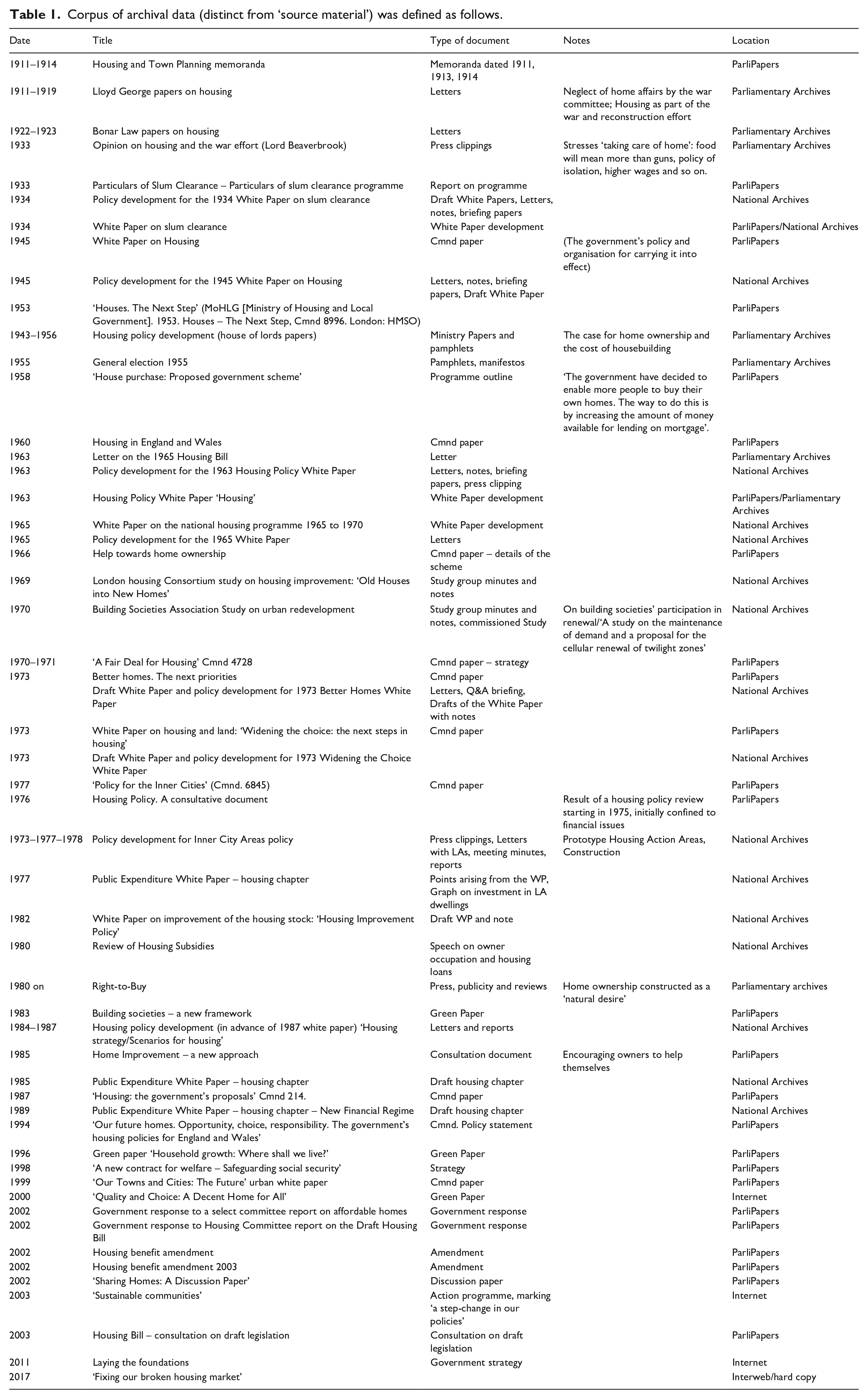
The starting points for data collection are given in Table 1. These relate to national housing policy and belong to the government department responsible for housing. Reading through these documents, links were traced to interactions with other government departments; these were particularly with the prime ministers’ Office, the Treasury and Cabinet. Christophers (2017) describes how in the United Kingdom, the state and its processes are highly centralised, with the prime minister’s office being atypically significant for directing ministerial departments and other arms of the state. This was found here, with policy relevant to housing often being developed between the prime minister’s office and the Treasury.
Analysis applied Braun and Clark’s (2006) framework for qualitative thematic analysis, since this shows how discourses and thematic patterns work across a broad population of interlocutors or respondents. This framework offers a practical guide for identifying discursive themes and relationships between themes. Analysis resulted in distinguishing the ultimate strategic goal of policy development from the organisational mechanisms deployed in support of these goals – the pathways for action chosen, the taxes abolished, subsidy levels raised – and the way the consumer relationship with housing was framed discursively therein. In this article, policy ‘strategy’ (the strategic goals of housing policy design) is thematically distinguished from these policy ‘devices’. However, since data points coalesce around specific time periods in the long run of housing policy history, the results of analysis are not presented thematically but rather according to time sequence, for the sake of clarity.
One fundamental limitation of using public records offices to source documentary data is the ‘20-year rule’, which means that documents are available only after 20 years, and that there is a fundamental inconsistency between historical and contemporary data. We therefore conducted interviews with key informers to gain an insight into more recent housing policy development, and to supplement the discursive data from published white papers (see Table 2). Interview data were also analysed thematically according to the same framework as archive data.
Findings
The productive function of housing
The first decades of 20th-century housing policy were characterised by political pressure for government intervention, with widespread slum conditions of increasing public concern (Gallent and Tewdwr-Jones, 2007). With the provision of housing largely coordinated by private builders, it was ‘moral obligation’ that forced the hand of government towards subsidised housebuilding from 1911 onwards (Saunders, 1990: 26). Another strategic concern expressed in the policy of subsidised housebuilding, particularly during and after the First World War, was the function that housing might play in ‘rebalancing’ the national economy, serving as a device to generate an efficient distribution of workers returning from serving in the war. In August 1914, the Local Government Board wrote that finance made available to local authorities for housebuilding ‘shall be utilised for the joint purposes of providing and improving housing accommodation for the working classes, and of preventing or mitigating unemployment in the building trades’.
1
This frames housing policy as a mechanism for tackling two distinct but equally important goals: providing accommodation, and mitigating unemployment. A third goal was geographical: When the War is over, soldiers who previously worked as agricultural labourers will be making up their mind whether they will return to the land or seek occupation elsewhere . . . One of the factors which has driven men from the land in the past has been the lack of houses, and unless this is remedied no other steps to render country life attractive can succeed.
2
Housebuilding is framed here as a policy device to help meet the strategic goal of attracting workers to different locations across the country. But the success of this device rested on a particular consumer relationship with housing, in which workers could be ‘attracted’ by the housing offer. This framing of housing consumption is illustrated in a 1917 memorandum of the Reconstruction Committee, which illustrates how ‘attractive’ housing was to play a part in national economic strategy, drawing the agricultural labourer towards productive work in the country: As counter-attractions to the magnetism of the town, we must for the most part look to pleasures, to forms of happiness, and to sources of income which are denied the dweller in most of our big industrial centres. Of these a detailed discussion would be out of place here, but in his housing we can, to a great extent, give the returning soldier most of the very same advantages he had in the town, and several in addition which he could not get in the town. He can have more, not less accommodation, because the cost of the site represented so infinitesimal a sum in the weekly rent. He can have a proper water supply; he can have good sanitary arrangements; he can have a range in the scullery, so that his living room need not be unbearably hot – unless he prefers to live in the scullery’ and, above all, he can have ample ground for garden, pig, and poultry [. . .] Security of tenure, the ability to remain in the same house and make it the family home, this, perhaps the chief desire the agricultural worker [. . .] there will be less tendency for farmers to change their hands; for in itself the knowledge of the soil and of the behaviour of the land in different weather, etc., which the labourer acquired from long experience of the same far, is an asset of great value; and no good farmer will want to change his men unnecessarily. Of course, even the agricultural cottager may have to move; and when he does he must be given full compensation for his garden. But, broadly speaking, the farm labourer’s cottage is his home, and should remain so till his garden and his allotment no longer suffice, and he moves to a small holding of the larger kind; when he may leave the old home to his son.
3
Corpus of archival data (distinct from ‘source material’) was defined as follows.
Full list of interviewees.

The attractions of housing to the agricultural labourer are framed here in terms of pleasantness, comfort, pleasures and ‘forms of happiness’; as an object of policy, housing is understood in relation to the consumer’s ‘preferences’ with regard to his ‘home’, and to security of tenure. It is the labourer, rather than the house, which is expressed as an ‘asset’. Housing services are exchanged for workers’ ‘knowledge of the soil and of the behaviour of the land’, incentivising them to remain in one location so that farmers do not need to ‘change men unnecessarily’. While housing may have functioned as an asset for a relatively small number of individual owners at this time, within national housing policy the function of housing for consumers was framed as the housing services it offered – put to the service of a policy strategy for effective agricultural production and economic balance.
This productive function of housebuilding was drawn on throughout the interwar years. The Conservative government that came to power in 1935 announced their success with a housing programme that was the ‘Key to British recovery’, as an interview with Lord Beaverbrook (owner of the Evening Standard and later Minister of State, of Supply and of War Production in Churchill’s Cabinet) illustrates, Things are going well in this country. The Government is strong and the country is recovering. What is the reason? Housebuilding. Just that. The burst of activity in the housebuilding industry lies at the back of the whole of this welcome wave of recovery. No form of expenditure spreads its effects so quickly through every branch of industry as housebuilding. None touches the whole economic structure in the same way. It is not only a question of a boom in the brick business or cement. There are also electric appliances of every kind, electric wire (with a reaction on the copper market), paint, timber, wallpaper, nails, slates, and so forth. Then when you put the roof on and get the new tenants in, there is furniture to be got. Don’t imagine they bring in old furniture. They do not. And the further out of town you build these houses the better it is. For then the tenants must buy a motor-car if they do not have one already. It is my belief that you would do well in America too, if you embarked on a big housing programme instead of squandering your money in other and less fruitful directions
4
The use of housebuilding for this end puts housing policy squarely in the realm of the ‘post-war consensus’ (Dutton, 1991; Kavanagh and Morris, 1994). In British history, this is used to describe the consensus between both Labour and Conservative governments throughout the 1940s and 1950s on maintenance of the welfare state, the mixed economy and other Keynesian demand-side measures in order to ensure full employment (Rollings, 1996). The use of housing as a productive element of budgetary policy was interrupted by the Second World War. But after the war, this strategic goal supposedly forged a political consensus on the merits of budgetary policy (including direct public investment into housing) as a macroeconomic resource.
By 1945, with housing policy tangled in the fallout of war, policymakers stated that ‘The first objective of the Government is to use for housing all the productive resources of the nation that can be spared and so to provide the largest number of houses in the shortest possible time’.
5
Subsidies were required to encourage building at scale, but intended to be temporary, to achieve a strategy of ‘reduce[d] building costs, as quickly as possible’.
6
But building costs did not fall, and subsidy remained an essential part of their upkeep into the 1950s.
7
In 1947, the government commissioned a report on the subject.
8
This framed the rising cost of housebuilding, relative to the beneficial effects for the national economy, as out of balance. The appointed Committee of Enquiry felt that this warranted a revision in public spending on housebuilding: A large part of the cost today is being borne by subsidies . . . [which] will increase cumulatively by about £3.3 million per annum for so long as subsidies remain at the 1947 level. While we agree that housing must have high priority among the claims on the available national resources, we consider that in any review of the housing programme the financial implications must be borne prominently in mind
9
The support that public housebuilding could give to national economic growth was seen as limited relative to its rising costs, which were viewed as unsustainable. Nevertheless, both Labour and the Conservatives supported a continued subsidised housebuilding programme, providing evidence of a post-war consensus. This was propagated by a discourse on housing conditions as the main feature of individuals’ relationship with their housing, emphasising the particular needs of married couples and families, and framing ‘better housing’ as the most important outcome of housing policy.
10
As might be expected of post-war housing policy, the repair of damaged and slum housing is addressed, but housebuilding is given priority, underpinned by ‘betterment’: The present demand for housing [. . .] has not in fact the same relentless pressure behind it [as the demand which arose at the end of the last war] [and] must come from a rise in the standard of living which would probably have to take the form not merely of compulsory slum clearance [. . .] but an active desire on the part of people who already have a reasonable house to get something better
11
Great concern is expressed about the number of newly married couples, and giving them access to ‘separate dwellings’. 12 Discourse on consumers takes a different tone to that around the ‘attractiveness’ of labourers’ cottages in the interwar years; nevertheless, it still centres on the physical condition of housing services as the priority of the housing consumer subject; there is barely a mention of tenure and none of home ownership as investment. The division of tasks between public and private enterprise goes undetailed; the task is simply to unleash the building of houses.
After the Conservatives gained power in 1951 this seemed to continue, with a 3-year building plan drawn up to accelerate housebuilding to 300,000 annually by 1954. These figures were intended to be objectives rather than limits: There will be no arbitrary limitation by an arbitrary programme of 175,000 or 200,000 or any other figure of houses a year. There is no restriction; No rigid ceiling; No artificial limit. And the quicker you build, the more there will be to build.
13
In proposing the scheme to cabinet, Minister of Housing and Local Government, Harold Macmillan, promised that ‘If I can do better, I will’. 14
The monetary function of housing
The strategic goal of housing policy during this period has been a topic of debate. In the context of rising costs, an expensive public housebuilding programme was pursued. Holmans’ (1987) reading of the commitment to subsidised housing emphases the context of rising interest rates, used to restrain inflation, and meaning local authorities faced higher payments on the loans that financed their housebuilding. According to Holmans, the goal of subsidy increase was to offset this effect and protect local authority funding. The expansion of public housebuilding by the 1951–1955 Conservative government is here posited as one of the most noteworthy episodes in British housing history: ‘This action deserves more attention than it has generally received . . . How and why the decision to protect the finances of housing in this way was taken in 1952 has attracted little comment’ (Holmans 1987: 152).
Evans (1992) argues instead that the strategic goal was withdrawal of housing subsidy. In the short term, this relied on increasing subsidies to stimulate housebuilding in a high-cost vacuum, ‘until it became possible to free the house-building market’ (Chancellor Rab Butler quoted in Evans 1992: 94). An election promise of 300,000 homes a year ‘sat awkwardly’ next to commitments to reduce public spending but was in fact vital to its success (Evans 1992: 91). Reductions would eventually be achieved in the longer term, by raising public and private rents and by pursuing owner occupation: ‘sponsoring home ownership by making renting less affordable was a part of a party-political strategy which viewed a property owning democracy as the future bastion of Conservative votes’ (Evans 1992: 93).
If the subsidy increase of 1952 has been overlooked, it is likely because of the U-turn that followed: a shift in the mid 1950s took subsidies entirely away from general and towards ‘special’ needs. 15 The Chancellor reported that a major adaptation in the direction of housing policy was ‘inevitable’; 16 by 1954, the government were engaged in ‘Operation Round-up’, 17 which by 1955 involved complete withdrawal of general needs subsidy. 18 The same government that had doubled down on the post-war commitment to socially financed housing promptly kick-started its residualisation (Forrest and Murie, 1983). Alongside this U-turn, our analysis has identified a significant shift in policy discourse surrounding the consumer relationship with housing, outlined below.
Significant changes in 1953
Contrary to Holmans’ and Evans’ readings of housing policy strategy, records suggest that initially, the 1952 commitment to subsidised housebuilding was sought for the same reason such schemes had been pursued in previous decades: in order to support the building industry, employment levels and the economy at large. These faced risks due to a shortage of steel, meaning that housebuilding once again provided a useful productive resource in support to the national economy. The 3-year housebuilding programme was justified in these terms: It would be fatal if fear of unemployment caused a slowing up of work or an unwillingness to recruit apprentices. On the other hand, we have a great chance of pressing forward with those forms of building which do not require any large quantity of steel . . . These are housebuilding, conversions of houses into flats, house-repairing and general repairing.
19
Once again, this supports the thesis on the post-war consensus, in which both Labour and Conservative governments saw public investment – in this case through housing – as a resource to ease unemployment and for reflation of the economy.
The conventional reading of this post-war consensus is that investment of public budgets for full employment was pursued throughout the 1940s, 1950s and 1960s. This sees a ‘collectivist macroeconomic hegemony’ existing until the 1970s, when politicians started to question the state in public life (Muller, 1996). This is supported by housing studies literature that points towards neoliberalisation – the ‘reflex reliance on markets to determine the allocation of resources’ (Berry, 2014) – as the dawn of public housing residualisation and the most significant turning point in 20th-century housing policy.
But Rollings (1996) presents us with a very different reading of the post-war consensus, in which it ceased after the 1951 election. Socially coordinated investment, flowing through the exchequer and the public sector borrowing requirement (PSBR) started to be understood as having inflationary tendencies. With its capacity to undermine confidence in Sterling and the Sterling-Dollar exchange rate, inflation could make the pound weak in relation to other currencies and weaken Britain’s international trading position. It was during the early 1950s that the Cabinet began to follow this theory, and to prioritise exchange rates by avoiding inflation (Rollings, 1996). By this logic, avoiding inflation would require that social investment into the productive economy be replaced with private investment. While public investment clearly continued after 1951, Rollings (1996) has argued that this marks the date from which budgetary policy would be pursued only after international considerations were borne in mind. It represents a shift in macroeconomic thinking that redressed the strategic goals of the various government ministries.
For the 1951–1955 government, reducing public budgets was necessary to serve the requirements of international competition. Within housing policy, this could be deployed through cuts in subsidies, not only by retracting the general needs housebuilding programme but also through the expansion of private ownership. By reducing the need for public investment, individual consumer investment into housing was framed as a means of achieving the same benefits for the economy, but one that was more attuned to an increasingly globalised world. Private housing consumption was a means of economic reflation that avoided the risk of inflation, raised living costs and devaluation. The privately owned house therefore served a very specific function within macroeconomic organisation, transferring the cost of investment into the economy (through housing) from the public to the homeowner.
But in the field of housing policy, this macroeconomic shift required a reconfiguration of the housing consumer subject as an investor subject. The first discursive utterance on this topic identified in this research came from the Building Societies Association (BSA) which in 1948 emphasised the cost of public housebuilding and made ‘The Case for Home Ownership’ along these lines: The man who buys a house [. . .] offers a threefold relief to the State and the local authority. In the first place, the community is relieved of any obligation to provide a house for him and thus both the State and the local authority are saved the considerable sums [. . .] Finally, the capital cost of the house is provided as a result of voluntary private saving by investors in building societies and the capital which would otherwise have had to be provided by the Government becomes available for other purposes
20
In addition, the BSA framed the act of housing consumption as ‘gradually acquiring a substantial investment and a security on which he could readily borrow’. 21 This presents a discursive shift in the consumer relationship with housing, emphasising the function that housing could play for individuals as a means towards savings and investment, and the function this could serve in turn for reducing state housing expenditure. This new framing of the consumer relationship with housing was deployed as a device through which it might be aligned with the wider goals of macroeconomic restructuring.
Analysis of policy development in the early 1950s reveals that the discursive device of housing as a personal asset was deployed within legislative, fiscal and policy proposals that aimed to incentivise private investment into the economy, through house purchase. Policy development for the 1953 housing White Paper noted that ‘the owner-occupier costs the Exchequer nothing, and on every new house privately owned the Exchequer saves a subsidy of £770’.
22
In that same year, work started on a ‘house purchase scheme’, to be agreed with the BSA, to lubricate mortgage lending: The main obstacle today to an extension of home ownership is not the rate of interest, nor the need to put down a deposit, but the difficulty of getting a loan on mortgage because the demand on building societies exceeds their available resources. The simple and effective remedy is [. . .] making Government money available to increase the flow of mortgages for house purchase.
23
This strategy was supported by discourses around home ownership as investment, as illustrated in a 1954 press conference: There is hardly a better form of saving for the whole family than by investing in the home which the whole family uses. The Minister believes that there is little doubt that many more families will buy homes of their own if the financial side is made easier
24
Published in 1956, the scheme was controversial largely because the interest rate at which building societies could borrow from government was lower than that for other social investments, such as for transport, fuel, power, schools, roads, health services or mortgages for home ownership funded by local authority finance.
25
A justification for limiting the subsidy to building societies was sought. Suggestions ranged from ‘political grounds’
26
to administrative practicability.
27
By 1958, the decision was defended on the basis that building societies provided a service that was ‘country-wide in its extent and uniform in its application’, but this was only half of the problem: I do not know how convincing you will find [this]. But you will observe that it does not answer the criticism that the Government are proposing to give higher priority to house purchase than to other forms of social investment – simply because there is no answer to this criticism . . . [the charge is] that the Government are giving priority to the purchase of houses . . . over other forms of social investment promoted by local authorities and over productive investment promoted by the nationalised industries . . . To concede this point would be to imperil the whole of the Government’s interest-rate policy; and the Committee have therefore [recommended] that the Government will be prepared to defend discrimination in favour of the building societies as a deliberate act of social policy and to resist, regardless of the circumstances, pressure by the local authorities and the nationalised industries for a corresponding concession.
28
(emphasis added)
This excerpt illustrates the way that private investment into the housing system (through mortgage lending to owner-occupiers) was prioritised as part of national economic (interest-rate) policy, and was therefore given preferential subsidy to other social policy areas. While defended as a social (rather than economic) policy, the device of incentivising ownership was de facto an element of macroeconomic strategy. While policy lag meant that the tax treatment of home ownership was not revised until 1963, ‘New thinking’ was requested from civil servants to encourage individuals to invest in housing by strengthening the investment benefits accruing to owners. 29 Proposals in 1958 included reduced transaction taxes; abolition of Schedule ‘A’ tax on owner-occupiers; 30 ‘pressure and/or incentives for local authorities to sell council houses [. . . and . . .] the offer of 100 per cent mortgages’. 31 By strengthening the attractions of housing-based equity to consumers, policymakers aimed to shift tenure preferences to align with the logic of monetary (rather than budgetary) policy.
The assetisation of housing: from individual to institutional investment
While resting on the demand for mortgage credit, the 2008 financial crash was a crisis of macroeconomic organisation. Its threats, like plummeting spending on goods, services and other business investments in the real, productive economy, were macroeconomic. The response was also macroeconomic, with the Bank of England lowering interest rates to reduce the cost of borrowing and encourage circulation of investment. With interest rates so low (reduced to 0.5% in 2009) maintaining this strategy required further unconventional monetary policy. Quantitative easing (QE) was intended to give banks greater liquidity to encourage further lending (House of Commons, 2016), a financialised solution to stimulating real economic growth. In August 2016, the Bank of England’s Monetary Policy Committee voted to extend QE by £25 billion to £140 billion, cut the benchmark interest rate to 0.25% and introduce the Term Funding Scheme (TFS; House of Commons, 2016). Its aim was similar to previous initiatives; it would ensure that banks passed lower interest rates to end users, with up to £100 billion ‘newly printed money’ providing cheap loans to commercial banks linked to the amount they lent to firms and households (House of Commons, 2016).
This strategy, based on the vehicle of debt, was geared towards macroeconomic (rather than housing) goals but created the context for a post-crisis rush in effective demand for home ownership. The status that housing had achieved as an asset relative to other investments during previous decades meant that boosts to investment in general ushered large amounts of capital into housing specifically. QE and TFS drew demand away from bonds and equities and meant that physical assets would offer better returns, all contributing to the status of housing as an asset and the declining affordability of house purchase. The low-interest rate environment made large mortgages increasingly affordable and accelerated price inflation (Hedlund et al., 2017). According to our interviewees, this was something acknowledged by policymakers at the time, but seen as unavoidable (I8).
Thus, while alleviated credit constraints had implications for housing affordability, it was also seen as central to the strategy for economic recovery: a rush to assets and rising house prices were bound up in the engine of growth selected by government. Any housing policy geared towards greater access or affordability would need to sit within this strategy. One such device, sitting happily in a low-interest rate, high-debt environment, was increasing the supply of housing in order to put downwards pressure on house prices. From 2010 onwards, the issue of raising housing supply came to dominate housing policy design: It became even harder for people to actually buy homes and then one of the ways to reduce or control that, other than, you know, increase in interest rates, is to try and increase the supply of housing. Not necessarily causing prices to fall because that would have the same issue in terms of government policies, rates and all that stuff. But to make it grow at a steady pace. (I8)
This illustrates a shift in housing policy – from emphasising tenure (and particularly the investment benefits associated with ownership), to emphasising supply – a shift that was determined by the broader macroeconomic strategy of government. Increased housing supply was pursued across all tenures. In London, the Greater London Authority’s response was to create more land availability and density through the planning system: ‘pushing back garden development, town centre regeneration, demolishing council estates, . . . getting as much density as possible onto those sites, [getting] local authorities in areas surrounding London to take on higher housing targets’ (I10). As a policy device, densification has characterised UK housing and planning reform since (MHCLG, 2020); one way to address affordability without also undermining the status of housing as an asset.
Another housing policy device that could be used to raise supply of housing without bolstering or undermining house prices was the institutional provision of rental property. This had the potential to bring in the scale of investment required for large-scale housebuilding in urban centres, given rising land values: ‘build to rent is bringing investment to get more stuff built; what other ways can you get stuff built, when people can’t pay?’ (I8). Under pressure to increase access to dwellings without damaging a precarious national economy, institutional investment into housing would become the object of an explicit government strategy. Government commissioned a review to investigate whether the rented sector could offer potential investment opportunities of interest to large-scale institutional investors, and to consider the potential for attracting such investment into new homes for private rent (Montague, 2012). This model for investing into the housing economy forms a significant element of the 2017 housing policy White Paper, which develops devices to reduce the constraints of the build to rent delivery model, and to shift incentives from individual to institutional landlords (DCLG, 2017).
Once again, this shift in housing policy has required a reconditioning of the consumer demand for housing. Support for the function of housing as an asset for individuals shifted to include support for housing as an asset for institutions and corporate bodies. As well as incentives for institutions themselves, this has required reframing the benefits of renting to individual consumers of housing. Montague (2012), for example, advocated a ‘renting plus’ model that would compensate for the loss of ownership with other attractive features particular to renting, and specialist services like concierges, laundry, repairs, delivery and grocery services. The market-level adaptation to this shift has involved the production of institutional, amenity-heavy, and communal models of rent as an aspirational tenure. By contrast, small private landlords started to be framed unfavourably in housing policy discourse. One of their few mentions in the White Paper characterises them as predatory: [. . .] high demand and low supply is creating opportunities for exploitation and abuse: unreasonable letting agents’ fees, unfair terms in leases, landlords letting out dangerous, overcrowded properties. In short, it’s becoming harder to rent a safe, secure property. (p. 10)
The white paper is notable because it lacks discursive distinction between home ownership and renting. Just as, in the early 1950s, housing policy shifted its focus from supply and the condition of housing to the balance of tenure, 2017 marked a juncture at which the balance of tenure receded. This represented a discursive shift away from the asset function of housing for individuals and households. The consumer relationship with housing was reframed as ‘the most basic of human needs’ (p. 9); no encouragements were made to buy over renting, nor any investment-related benefits to housing mentioned. However, this shift does not undermine, but continues to reinforce the salience of housing as an asset for corporate entities. It marks another juncture at which policy discourse around housing tenure and the housing consumer subject has been reconditioned to support new directions in macroeconomic policy. Individual consumers (and their relationship with housing, or demand for certain tenures) contribute monthly rental payments towards the continued assetisation of housing.
Conclusion
Through analysis of housing policy discourse around the consumer subject and relationship with housing, this article shows how this has been reconditioned to support new directions in macroeconomic strategy throughout the 20th and 21st centuries. One conclusion is that the assetisation of housing in the United Kingdom was pursued through housing policy reform well before the 1980s, supported through shifting policy discourses around the consumer subject.
Research has shown that financialised economic activity rose sharply in the 1980s (Krippner, 2005) and has reported on the ‘investor subject’ that is part of this transition (Watson, 2010), emerging since expansion of the mortgage market (Langley, 2006). This literature and the concept of financialisation have tended to overshadow other factors in the 20th-century housebuilding boom. We have found that in the United Kingdom, discourses on the investor subject emerged years before, and were related to the macroeconomic concerns of government, rather than the concerns of housing policy itself. By drawing on new archive data and tracing housing policy strategy and discourses over a longer period than is usually considered, this article shows that the prospect for housing consumers to build equity through home ownership was deployed as part of macroeconomic strategy from the 1950s onwards. This challenges a tendency to frame housing policy as moving from a Keynesian post-war consensus (during the late 1940s to the 1970s) to a post-Fordist regime, as a reaction ‘to the 1970s oil shock and global recession’ (Waterhout et al., 2013: 143, see also Crouch, 2009). While it may be true that ‘Homes until the liberalisation of the banks in the 1980s were just that, places where people lived’ (Lowe, 2011: 204), the housing system had already been placed on its trajectory towards assetisation decades before; more a case of policy accretion than a radical shift towards a neoliberal paradigm.
In addition, we have shown that assetisation of housing is not supported solely by the high levels of private home ownership that emerged in the mid-20th century (Jorda et al., 2016; Rolnik, 2013) but could also be buttressed by rental tenures (Fields, 2017, 2018; Belotti and Arbaci, 2021) and an aspirational renter subject. Assetisation is therefore not limited by any particular consumer relationship with housing, or by a system of accumulation grounded in house-price Keynesianism and asset-based welfare provision. Rather, assetisation in the housing system is a flexible process (Wijburg, 2019), centred simply around private investment into housing. This indicates the significance of assetisation beyond the indebtedness of individual households (Langley, 2021) and has implications for the housing investment landscapes we see around us today. As house prices rise above the level that incomes can carry them, some predict a shift away from neoliberal policymaking and its assetisation of housing: ‘the market will need to be re-embedded in society at some point’ (Fernandez and Aalbers, 2017: 155). But this position is undermined if assetisation depends less on housing as an asset for individual consumers, and more on an indiscriminate drive for private investment into the housing system to support macroeconomic goals.
The central implication of these findings is that housing policy should be understood within housing, urban and regional studies as a macroeconomic resource before it is an element of social policy. The priorities of the Treasury regarding Britain’s strategic economic and global position have, thus far, provided the organising principles according to which housing policy and discourse are aligned before housing-based goals have been pursued. Housing policy and its discourses about the consumer subject have become functionally integrated within wider macroeconomic goals. Any intervention intending to strengthen the social function of housing, achieve greater supply or greater affordability, needs to acknowledge the historical scale of this entanglement and of its associated interests.
Footnotes
Declaration of conflicting interests
The author(s) declared no potential conflicts of interest with respect to the research, authorship and/or publication of this article.
Funding
The author(s) received no financial support for the research, authorship and/or publication of this article.
