



Abstract
The emergence of collaborative approaches in innovation policy and regional governance has increased expectations for universities to engage in strategy making and assume broader roles and responsibilities. Nonetheless, complexities inherent to the policy process, regional context and universities’ own institutional and organisational capacity are often ignored or under-explained when framing universities’ roles. Although these roles are frequently introduced, they have been superficially conceptualised in the literature. This study develops a deeper theoretical and empirical understanding of universities’ contributions in the different stages of regional innovation strategy processes. Through a comparative case study of four European universities, it explores the variation of these roles by policy stage and university actors involved in the strategies. Findings suggest universities have expanded to perform new planning-related roles (e.g. consultation, mediation) and that diverse factors (e.g. the regional context, such as urban versus peripheral) determine their participation in regional strategies. However, strategic coordination within universities and with regional bodies is needed for the optimisation of their engagement in the regional governance process.
Introduction
While formerly universities were mostly responsible for knowledge dissemination and production through the academic missions of teaching and research, now they are progressively assuming a more engaged regional stance through a “third mission” of external, societal engagement (Etzkowitz and Leydesdorff, 2000; Gunasekara, 2006). This has translated into a growing number of bi-directional and network links with regional actors. University–industry collaboration has figured prominently in studies approaching universities’ regional engagement, resulting in a skewed perception of universities’ regional roles (Pugh et al., 2016). Indeed, with governance models and policy frameworks emphasising increased stakeholder participation and a knowledge-based approach to decision-making (Ansell and Gash, 2007), university–regional government collaboration has become salient and universities are increasingly important in the design of regional strategy processes. A recent and paradigmatic example is the EU’s Cohesion Policy Smart Specialisation framework and subsequent strategies (RIS3), which have formulated a mechanism for collective stakeholder engagement in the Entrepreneurial Discovery Process (EDP) and highlighted universities’ privileged position in those processes (Elena-Perez et al., 2017; Foray et al., 2012).
The increasing expectations placed upon universities, not only regarding knowledge dissemination, production and commercialisation, but also regional governance and strategy design, demonstrate a need for more comprehensive assessments and understanding of universities’ roles. Limiting universities’ regional roles to university–industry interactions and entrepreneurial or economic impact (Fonseca, 2019a; Pugh et al., 2016) works against the potential of universities to perform developmental roles and contribute knowledge as well as experience to regional development processes and strategies (Marques et al., 2019). There is still a lack of clarification on the exact roles universities are performing, and a tendency to conflate and homogenise these roles across institutions, contexts and timeframes (Flanagan et al., 2010; Uyarra, 2010), particularly in university–regional government relations. This is a complex dynamic and engagement arena, influenced by multiple aspects: the regional setting and administrative structure, political mandates, power asymmetries and, on the other hand, universities’ regional/international orientation, research and engagement interests and capabilities, and the general predisposition of their agents towards external/regional engagement (Aranguren and Magro, 2020; Brown, 2016; Goddard and Puukka, 2008; Thune et al., 2016). Since the policy cycle is also characteristically given to variations in actor involvement, commitment and scope (Birkland, 2010), this topic demands further exploration in the literature.
This study will, thus, develop deeper theoretical and empirical understandings of universities’ contributions and effective roles in the different stages of regional innovation strategy processes. Through a comparative case study of four European universities in different regional contexts – Aalborg University (AAU), University of Aveiro (UA), Autonomous University of Barcelona (UAB) and University of Twente (UT) – it explores what roles universities play in regional innovation strategies and to what extent these vary depending on policy stage and university actors involved. The background section approaches the literature on collaborative regional governance, emerging expectations of universities’ roles, specifically in regional innovation strategies, and draws on this to provide a conceptual model of analysis. This is followed by the methodology section, and finally by our findings, discussion and conclusion. Findings suggest universities have expanded on mere knowledge transfer to perform more planning-related roles (e.g. consultation, mediation), with high dependence on regional context. In more peripheral regions the university tends to emerge as a predominant actor compensating for what can be an institutionally thin innovation system (Amin and Thrift, 1995; Fonseca et al., 2021), which can allow for closer engagement throughout the policy stream. There is, however, an increased necessity for strategic coordination and alignment within universities for an optimisation of their engagement with governmental institutions and potential new stakeholders in the regional governance process. By understanding the determinants influencing universities’ capacity and predisposition, regional stakeholders can draw from universities’ planning and governance potential, and thus clearly delineate their desired contributions to regional policy/strategy processes.
Background
There has been a tendency in the last decades to call upon a set of diverse stakeholders to participate in regional innovation and development strategies, and policies (Brandstetter et al., 2006; Dąbrowski et al., 2014; Purkarthofer, 2019). This aligns with the idea of bottom-up, collaborative regional governance, in which networks of state and non-state actors contribute to regional transformation processes (Ansell and Gash, 2007; Willi et al., 2018). Governance habitually comprises the definition and implementation of regional strategies that define a shared regional vision, and the activities that must be undertaken to get there (Valdaliso and Wilson, 2015). Within the idea of collaboratively creating regional futures, governance transcends the state’s traditional spaces to rely on various other actors. This has been picked up in different areas, such as the innovation policy literature. Kuhlmann (2001) argues that innovation policies are created in “multi-actor innovation policy arenas” in which different player networks negotiate the priorities of their innovation systems.
The expectation that a group of actors can define the drivers of regional innovation and collaboratively implement strategies towards new regional futures is increasingly found in diverse policies. A recent and prominent example of these collective, bottom-up governance processes and respective strategies (Aranguren et al., 2019) is the EU’s Smart Specialisation framework, as an ex-ante conditionality for accessing European Regional and Development Funds in all European regions. It has introduced EDPs, a collective prospecting process in which regional stakeholders progressively identify and define regional strengths, priorities and trends and collaborate towards strategic development.
Emerging expectations and variations in universities’ roles
Next to the state, the private sector and civil society, universities have become major stakeholders in these multi-partner governance processes (Benneworth, 2018; Edwards et al., 2014; Silva et al., 2016). Indeed, universities contribute to regional governance through different activities/processes (Table 1) and have increasingly been ascribed a more developmental – and less entrepreneurial and market-centred – role (Gunasekara, 2006). Growing evidence points to universities being a trigger for development (Fonseca, 2019a; Goddard et al., 2013), even in territorial disfavoured contexts. For instance, Goddard et al. (2013) found that universities are important players in three main areas of these regional strategies: (a) they participate in EDPs by generating knowledge and engaging with regional partners; (b) they give academic support to government officials in defining the strategies; and (c) they use their international connections and knowledge to connect the regional to the international scale.
Universities in multi-partner governance processes.

Several underexplored dynamics of universities’ roles – particularly governance-related roles – in regional contexts have thus been introduced or re-emphasised with the introduction of RIS3 (Vallance et al., 2017). However, universities’ predisposition and activities in engagement and collaboration are influenced by various factors, with regional development expectations placed upon them perhaps greatly exaggerated (Bonaccorsi, 2016; Brown, 2016). In their study on universities’ contribution to RIS3, Elena-Perez, Arregui Pabollet, and Marinelli (2017) found that universities’ engagement largely depends on a diverse set of regional configurations and instruments that originate different dynamics. Similarly, internal institutional characteristics – such as universities’ disciplinary focus, interface bodies, academic communities, individual agency and leadership potential (Fonseca et al., 2021; Nieth, 2019; Raagmaa and Keerberg, 2017; Thune et al., 2016) – can greatly influence the type of regional roles they assume. Therefore, different types of universities inserted in distinct regional contexts inevitably undertake heterogeneous roles and engagement activities in the regional strategy process.
Boucher et al. (2003) have considered both external and internal determinants in universities’ roles, furthering this argument. Among those stipulated, the type of region, the characteristics of the higher education system, the number, scale and age of universities in the region, universities’ strategic orientation and their embeddedness in a regional strategy significantly shape the type of engagement a university delves in and, consequently, the regional roles it undertakes. A single university located in a peripheral region, for example, will have a greater alignment with regional needs, and be better positioned to participate in networks and shape the institutional environment (Boucher et al., 2003).
Towards a more comprehensive analysis of universities’ roles – Building a conceptual model
The literature on universities’ roles has emphasised the combination and intersection of several models of engagement, which can give rise to “contradictions or conflicts of policy rationales and objectives” (Uyarra, 2010: 1229). With studies pending towards private sector links and the more economic aspect of universities’ regional engagement, this may lead to a skewed perception in the identification and conceptualisation of university roles, limiting awareness of universities’ regional impact (Marques et al., 2019). Concomitantly, while universities are increasingly expected to participate in regional strategies, they are not homogenous institutions that can be predicted to contribute evenly. What regional roles universities are able to play depends heavily on their organisational priorities that, in turn, are determined by aspects such as funding mechanisms and other incentives (e.g. national/international rankings, research assessment exercises, excellence frameworks, etc.) (Bonaccorsi, 2016; Goddard and Puukka, 2008; Rose et al., 2013). The different roles may also not be prioritised nor adopted at the institutional level, but by individual actors or communities within the university (Perkmann et al., 2013; Thune et al., 2016).
Universities are “loosely coupled” institutions with complex and fragmented internal structures (Goddard and Vallance, 2014). Even though managerial and administrative levels seek organisational alignment, directives often dissipate in their transmission to the lower levels of the institution (Fonseca et al., 2021). Benefitting from a high autonomy, faculties, departments, research units, interface offices, technical staff and individual researchers can diverge in their priorities and approaches to tasks (Thune et al., 2016). Without disregarding this institutional and organisational complexity, we will focus on three main levels within universities: (a) managerial (executive management); (b) intermediary (i.e. nexus offices administering knowledge transfer and collaborative activities); and that of (c) academics (individuals as well as research teams). This can provide a granular analysis of the overall activities and roles universities perform in their engagement in regional strategies.
Finally, despite expectations associated with the multiple university roles identified in the literature (e.g. service-provider, connector, animator), there is still a lack of definition of what exactly they entail in practice and a tendency to conflate and homogenise them across universities, contexts and timeframes (Flanagan et al., 2010; Uyarra, 2010). It is widely underemphasised in the literature that in different contexts, different areas of action (e.g. policy, industry or community engagement) and stages (project design versus implementation), universities perform differentiated roles. For instance, in the case of their participation in regional strategies, depending on the phases of the strategy process, that is, design, implementation and evaluation, universities can be called upon to contribute in specific forms, and themselves can assume varying levels of responsibility. There are inevitable variations in stakeholder engagement in the governance process (Birkland, 2010), determined by self-interest and different procedural necessities. We will therefore also utilise a policy stages analysis (see, e.g. Tantivess and Walt, 2008) for deepened understanding of universities’ varied governance roles. For example, in the policy formulation stage, the exploration and assessment of options is prioritised, so actors with expert, solution-oriented knowledge tend to be recognised here. The implementation stage is given to more fragmentation and deficiencies, exacerbated by the fact that implementation actors are not often involved in the formulation stage. Finally, the evaluation stage is considered an important – often under-researched – part of the policy cycle, involving different stakeholders (Teirlinck et al., 2012). Sustaining a consistent level of interest, commitment and collaboration throughout these various stages is inherently a difficult task.
Innovation and regional development policy are characterised by complexities related to contextuality, and the granular character of multi-level governance of strategies (Blažek and Csank, 2015). Thus, the need to understand differences in universities’ roles and explore under which circumstance certain roles are prioritised and by who needs to be made explicit. This paper aims to introduce more detail to this underexplored topic by applying the conceptual model outlined (Figure 1) and considering the dimensions of university actors and their role in different policy stages. The following research questions are posed.
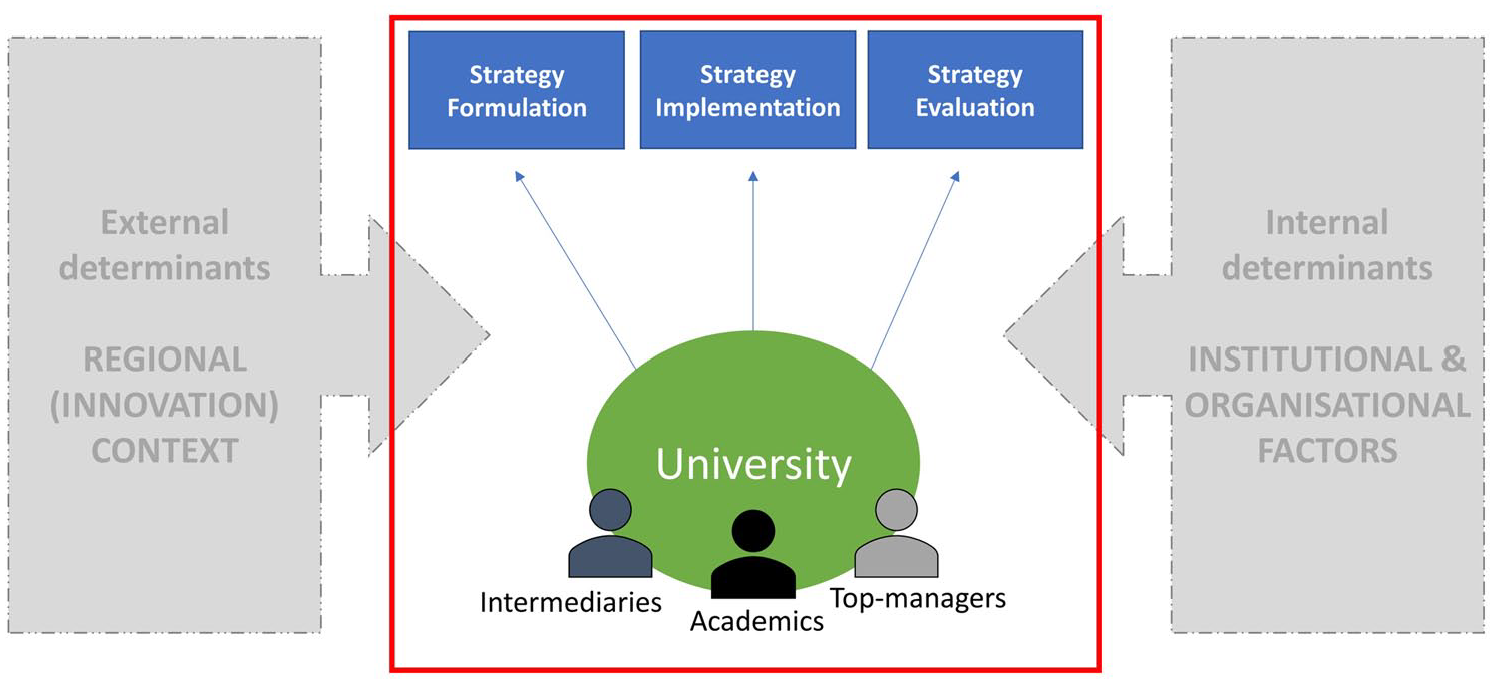
Universities’ participation in the policy process. Authors’ own design.
1) Why and how do universities engage in regional strategy processes and how is this affected by regional and institutional contexts?
2) What differentiated roles do universities play in each stage of the regional innovation policy process?
3) To what extent are universities moving from traditional roles to more governance/planning-related roles?
Methodology
In seeking to understand the character of universities’ participation in regional strategies, a social phenomenon, this study is inherently exploratory and qualitative in nature (Bryman, 2012). Through a comparative case-study approach, a better understanding of contextual and institutional factors is achieved. It enables theory-building by facilitating the drawing of patterns and conclusions across cases (Bryman, 2012: 73), therefore supporting replicability and contributing towards enhancing knowledge in the field. Case selection applied the following criteria.
a) Case studies should be universities who have engaged in regional strategy processes in the past 4 years.
b) Cases should be in different EU countries, possessing national, regional and institutional heterogeneity. Variety in economic development and innovation are welcomed to provide a counterpoint to the comparison.
This paper thus draws on four case studies of universities across different national and regional contexts: AAU (Denmark), UAB (Spain), UA (Portugal) and UT (The Netherlands). As per criterion (b), three are in peripheral regions in their national context, while one (UAB) was chosen to provide a counterpoint to the analysis, being located in a regional development nexus in Spain. In institutional terms, these are public universities that have been shaped by the economic and policy context of their region. Despite their varied backgrounds, these universities possess broadly comparable characteristics. All are relatively young and entrepreneurial universities created in the last 60 years, and are actively playing a leading role in their respective regions, namely in regional governance matters. This leading role is explored in other literatures, such as Fonseca et al. (2021). It presents itself as a wilful institutional positioning towards responding to regional needs and collaborating with regional partners. On a policy level, as per criterion (a), all four universities demonstrate an interest in extended engagement activities with their regions, particularly in regional development strategies and policymaking, and have adopted organisational models to enable this interaction.
The authors have considered pragmatism in the case selection as well, with two of the universities being their home institutions. The other two universities were chosen according to the criteria and investigated during research secondments of 3–4 months.
Data collection was undertaken as part of the two authors’ PhD projects, and took the form of document analysis and semi-structured interviews. In total, these amounted to 120 interviews across the four case studies (Table 2). Initial access to a small group of key individuals was given through project partners and stakeholders within and outside the university; subsequently, a snowball approach was applied to access additional interview partners. Closure was reached when no new interview partners were recommended, and/or topics were examined from all possible perspectives. The recorded interviews lasted between 60 and 90 minutes and were transcribed and translated into English (when necessary). Interviews in Aveiro and Twente were partly conducted jointly, while interviews in Aalborg and Catalonia were conducted by one of the two researchers. Interviews included actors who were involved in the strategy formulation, implementation and evaluation process that came from strategic/management levels as well as project/executive levels (Table 2). Qualitative analysis was conducted to draw relevant themes from the interviews, and quotes serve to highlight these and provide an actor-relevant perspective. In addition, regional strategies, action plans, cooperation agreements and university documents were analysed.
Interview Partners.

Key aspects of the role of universities in regional development strategies
Table 3 provides an overview of each of the chosen universities by their strategic foci, formal organisational engagement support structure and their regional setting. The following section below outlines each universities’ engagement history, the different institutional actors involved in regional strategies and the roles assumed in the different policy phases.
Comparison of Case Study Universities and their Respective Regions.

Aalborg University
AAU was established to stimulate regional development and has since been working very closely with regional partners, such as the public sector and industry, becoming an important driving force in industrial renewal. Collaboration and a strong link to regional partners has been facilitated through a support structure – AAU Innovation – that manages clusters, knowledge exchange activities, networking, etc. Regarding AAU’s participation in regional strategies, 1 it assumes a relevant role in the regional Vækstforum, 2 a body created with regional development objectives combining representatives from government, industry and educational institutes. The regional strategy is formulated by the region with input from the Vækstforum members. Subsequently, these members evaluate, recommend and decide on the distribution of funding according to priorities defined in the strategy. In addition, the AAU Innovation Director participates in the Vækstforum’s preparation committee and therein also evaluates and decides on funded projects. A university leader described AAU in the Vækstforum as the actor that introduces research-based ideas and a “broader, less political and trustworthy perspective”, thereby nominating it a counterbalance to the “political” municipalities.
Aside from formal engagement through AAU top-managers, academics were consulted in strategy formulation. This only happened when relevant connections between individuals (in the region and the university) were pre-existing. In those cases, the region relied on AAU’s knowledge in focal areas, such as energy and sustainability. A project manager involved in the strategy formulation highlighted: “I think we need each other. But at least [the region] needs [AAU] a lot, because we need them to address regional questions and [. . .] take the responsibility of being the biggest knowledge provider”. AAU plays an important role in the strategy’s implementation as it is a major beneficiary of funding and materialises different projects.
University of Aveiro
Since its foundation, UA has formed a close connection with regional industry and public bodies at the local, sub-regional and regional levels, being considered a privileged partner and stakeholder. Despite being located in a less-developed peripheral region, UA has managed to leverage collaboration with businesses as well as local and regional government, and is often considered as Aveiro region’s “twelfth municipality”. At the institutional level, this engagement rhetoric has been enacted by different institutions, such as the technology transfer office UATEC and other interface structures (e.g. Creative Science Park), as well as through several appointed management positions, such as the Rector for University-Society Relations and the Pro-rector for Regional Development. It is through the two latter top-managers, in conjunction with UA’s Rector, that formal partnerships occur, namely in matters of regional innovation strategy. In turn, project management is conducted by UATEC, research units and academics. Multi-level policy engagement is emphasised, from local (municipalities), to sub-regional (intermunicipal community) to regional (Centro region, RIS3 level).
The Intermunicipal Community of Aveiro Region (CIRA), tasked with designing territorial development strategies, invited UA as a partner. Interviewees considered UA’s engagement as prominent in the formulation phases. The Pro-Rector for Regional Development position was expressly created, and a team – composed of technical staff and academics – was assigned to conduct regional analyses, participative forums and support collaboration with CIRA’s municipalities. Policymakers and other external stakeholders appreciated UA’s coordination and pedagogic approach, seeing it as providing “clearer guidance” on policy requirements, and keeping the involved stakeholders “working within the framework”.
Nonetheless, interviewees highlighted UA’s diluted engagement and leadership in the implementation stages, where UATEC and academics’ project management was more periodic. A lack of internal coordination and strategic engagement was referred to, as “each department just [tried] to deal and [do] its own work”, independent of (un)existent overarching orientations. Interviewees agreed on the need to align institutional discourse with operational involvement, often dependent on efficiently managing incentives for academics.
Autonomous University of Barcelona
UAB was created in a time when pro-democratic demonstrations and political turmoil, and massification of higher education, required the development of flexibility and autonomy in higher education institutions (HEIs) to respond to emerging societal challenges (Manrique and Nguyen, 2017). UAB’s location outside the city did not hinder linkages with Barcelona but benefitted the relationship with its surrounding region. Given Catalonia’s innovative character, UAB has developed an entrepreneurial approach and regional societal engagement support structure (UAB, 2019), namely through its Research Park and various research and innovation (R&I) organisations. It has created a territorial network of influence, coordinated by its top management, of which the main “third mission” support nexus is the Vice-management for Research.
In the policy sphere, this vice-management is UAB’s most direct channel of engagement, while the Catalan Association of Public Universities (ACUP) is an indirect one. Its participation within the smart specialisation strategy of Catalonia (RIS3CAT) was done through these channels, although it was highly variable across the policy process. According to an interviewee, while “there was a lot of interest by the government to have universities join the project”, the complexity of Catalonia’s innovation system led the regional authority (Generalitat) to limit stakeholder participation in the formulation stages. Instead, the Generalitat opted for a survey-based public consultation and an expert council. Interviewees considered joint sessions as more informative than consultative, and widely agreed that “universities weren’t given much voice in the beginning of the process”.
Universities were more active only through RIS3CAT implementation instruments. These include the RIS3CAT Communities, designed to facilitate collaboration across sectorial stakeholders, and Projects for Territorial Specialisation and Competitiveness, promoting territorially based collaboration and managed by local government. According to interviewees, UAB’s involvement was not just motivated by access to European Regional Development Funds, but a visible attempt to “generate spaces of collaboration” 3 and develop local innovative assets. Interviewees also saw UAB as providing both scientific and operational knowledge, by managing fund requirements and mapping “future actions”.
Evaluation-wise, there was no institutional-level engagement – although an individual UAB academic co-generated assessments with the Generalitat. University representatives emphasised that the RIS3CAT process lacked transparency and progress communication, providing few opportunities for UAB’s consistent engagement.
University of Twente
UT is one of three HEIs situated in the peripheral region of Twente. It was established with the aim of renewing the region’s industrial landscape. Today, UT is involved in many regional projects and an important partner in networks. With a peripheral regional ecosystem lacking big economic players and company leadership, UT has been described as a coordinator and moderator. A high-level university manager claimed that “it’s the university that sets the [regional] agenda and the industry that follows”, explaining that UT takes on a “heavy responsibility” for the region’s future. Different engagement activities are assumed at various institutional levels. The department for Strategy and Policy, under the Executive Board, has responsibilities in the preparation of strategic meetings with regional authorities. The intermediary organisation Novel-T often serves as a knowledge and technology transfer office.
In practice, UT is involved in the design and implementation of the regional strategy, with no responsibilities in its evaluation. The president of UT’s executive board represents the university’s interests in the Twente Board (TB), a strategic economic board consisting of members of industry, public governance (province and region) and different education institutes. The TB consults on the design of the regional innovation strategy, influencing policy design and selection of prioritisation areas. University actors and regional stakeholders described UT’s role in this process as vital, giving direction in potential regional economic opportunities, connecting with international partners and becoming a “source of inventions”. Aside from the formal role of the president of the executive board in the TB, academics are involved in so-called “innovation tables” that discuss specific prioritisation areas and can orient municipalities and industry. A project manager from the regional governance body explained that these academics are very relevant in the process, as they “disseminate their research efforts into practice” through the projects.
Understanding university engagement in the regional development policy process
Consistencies and variances were identified in relation to universities’ tasks and responsibilities in the several stages of their respective strategy processes. This section comparatively highlights the roles universities assumed, in function of the analytical model (Figure 1).
Universities in strategy design
All strategies analysed included universities’ participation but, comparatively, their involvement in the design phase was heterogeneous. In the cases of AAU, UT and UA, the universities’ participation was done mostly through key top-management figures. In the first two, these acted as institutional representatives in the regional bodies developing the strategies, conveying their university’s strategic orientation. UA was specifically invited as a partner in the territorial development strategy process, which enabled it to have a stronger involvement at several levels, with top managers leading initial contact and major discussions, and academics and technicians leading trend assessment and coordinating participative forums.
These three universities were emphasised as crucial actors in their region’s strategy processes, particularly in the formulation stage, where they distinguished themselves among other actors by their proactive stance and knowledge of regional potential (often in direct relation to university strengths). The most prominent university roles identified in the cases of AAU, UT and UA were those of “leader”, providing direction and guidance in an often complex and bureaucratic process; “facilitator”, leveraging its networking capacity and facilitating (knowledge) exchange between partners; “moderator”, attracting and engaging stakeholders to the strategy process; and “mobiliser”, creating or providing the conditions to effectively materialise collective regional objectives. All three universities influenced and provided guidance on regional priority-setting and performed not just as knowledge providers but also pedagogical and steering roles that enabled learning dynamics and institutional-building – especially in UA’s case – and promoted the universities as regional leaders.
Interestingly, the cases in which universities had a stronger participation in strategy design were in regions where these universities were either the sole university (UA) or the most prominent (AAU and UT). All were peripheral regions, with Aveiro also being categorised as less-developed. Given these universities’ heightened role in the design processes, and in the definition and impact on regional development trajectories overall, it is relevant to emphasise that these contexts partly enabled the strengthening of a productive relationship. Nonetheless, higher expectations are also placed upon universities in these regions for institutional and operational steering. This can either pose the risk of straining university capacity or exaggerating their governance performance in relative terms.
In the case of UAB, its context of creation was more political than territorially based, meaning that such direct interaction with local, county and regional government was difficult to establish. The abundance of regional actors, namely the presence of several universities, inevitably generated competitive dynamics and limited more consistent university–regional government interaction during RIS3CAT’s design phase and overall policy process. This has been changing in recent years with UAB’s greater approximation to the more local and county levels, where while still not the only university, it benefits from proximity and institutional ties. Nonetheless, in RIS3CAT’s design phase, while universities were considered relevant, their indirect representation through ACUP has made it impossible to identify any role aside from “consultative”.
Universities in strategy implementation
Universities’ roles in strategy implementation were found to be complex and multi-faceted in our cases, albeit lacking a strategic approach. The complexity is partly due to the variety of university stakeholders involved in different capacities. University leadership was often involved in strategy implementation through their engagement in policy platforms, such as the TB (UT) and the Growth Forum (AAU). In these platforms, top management was part of a group of regional stakeholders that acted as project/funding evaluators, recommending projects to be implemented and funded according to strategic priorities. In Aveiro and Twente, a similar role was taken on by academics who participated in roundtables along specific thematic lines, providing research-based and internationally linked knowledge that other regional stakeholders did not possess. This perspective distinguished the university as a knowledgeable and relatively neutral evaluator.
Concomitantly, individual academics and research groups were identified as fund recipients and project partners (sometimes even leaders) in the implementation of instruments/projects, together with other regional stakeholders. Overall, these roles were very much dependent on individual motivation, the need for funding of individual researchers or departments and the availability of potential (regional and international) contacts and project collaborators. Additional actors, such as UATEC or UAB’s and UT’s Science Park, were periodically involved at this stage by participating in – and, to a certain degree, coordinating – projects. Observably, further effort seems required to align the two levels of leadership and operational involvement. While researchers became involved in strategy projects and provided scientific and operational knowledge as well as connections, no strategic approach to project participation – aligned with the regional strategy – can be identified.
Universities in strategy monitoring/evaluation
There has been little to no sign of processes of evaluation of the strategies and their results, which might be due to the fact that most of the strategies are still ongoing processes. However, in Twente and Aveiro, where analysis focused on two strategies, no official or comprehensible evaluation was done between the two. Only RIS3CAT includes evaluation/monitoring mechanisms for furthering the strategy’s impact. As in other phases, the Generalitat has chosen to develop its monitoring more closely with a selected expert – a UAB academic. This has been emphasised as an individual, not an institutional participation.
Given the emphasis of universities’ knowledge provision role in other stages, their input to evaluation could be valuable for improved effectiveness. Their lack of participation is, therefore, surprising. Nonetheless, this could relate more generally to monitoring being a lesser preoccupation for government authorities, with them more inclined to use the start of a new period and the design phase as a form of evaluation (where the universities do play a role). This is also in line with the findings from Teirlinck et al. (2012: 374) in that “the planning of evaluation in the policy cycle remains ad hoc or exceptional, and the take-up of evaluation results is sub-optimal”. Government authorities could favour the strategy’s sustainability by cementing evidence-based assessments in monitoring and evaluation.
Actors involved in engagement and strategy processes
Having discussed the various university roles at different strategy stages, we identify profound disparities between the distinct institutional actors that engage in the strategy process. On the one hand, university top management is often tied to regional partners through engagement contracts or specific roles in regional platforms. Accordingly, universities play a formal – even representative – role, in which top management shows commitment to the region and creates consensus among stakeholders. Often, this commitment is not broken down internally. While top management engages in these platforms, involvement in the strategy process does not easily trickle down to the faculty level or individual academics (see also Goddard et al., 2016). Only at UA have top managers officially included professors and technicians to become part of the strategy design process, while at the AAU, UAB and UT, top management coordinated first contact points between academics or heads of research units and external partners involved in strategy implementation.
Conversely, academics mainly participated in the strategy process autonomously, with most activities conducted independently from top-management direction. Applying for projects within the regional strategy or giving feedback on strategic lines, for example, are dependent on intrinsic motivation primarily related to funding attainment, the wish for knowledge application, long-standing commitment to external stakeholders or the desire to build new connections. Most cases analysed show that, overall, individual engagement was unrelated to top-management behaviour or top-down stimulus.
Intermediary bodies, liaisons between external stakeholders and university staff, participated in crucial stages of the strategy processes. ACUP in Catalonia represented UAB and other universities in the region in the RIS3CAT design stage. In other instances, technology transfer offices like UATEC (UA), innovation and entrepreneurship organisations like AAU Innovation and Novel-T (UT) as well as research parks like PRUAB (UAB) provided a more specialised perspective on regional innovation and some even coordinated academics for an effective involvement in the implementation stages. Nonetheless, they appear underutilised, as they could serve as a missing bridge between strategic orientation and operationalisation, or between external actors and the expertise of the academic community. These intermediary bodies could be involved more strongly in strategic design and in incorporating different actors in the strategies, instead of mostly remaining as fund recipients. Their involvement, highly defined by top management and restricted by organisational resources, could thus be further optimised.
Discussion and conclusions
This paper explored the roles universities have assumed in regional governance processes, particularly how different circumstances have impacted on how universities participated in the design, implementation and evaluation of regional innovation strategies. When considering the circumstances under which universities participate in these strategies, the types of regions and the context of creation of the universities influenced their degree of involvement and the roles they assumed. Similarly, the nature of their regional orientation and their predominance as universities in the region shaped the opportunities and extent of their governance roles. While this reproduces some findings of the previous literature (Boucher et al., 2003; Elena-Perez et al., 2017; Gunasekara, 2006), its significance is herein emphasised as it considers the particular context of university–regional government relationships, and the more granular multi-level and stage-sensitive linking of this collaboration.
Why do universities engage in regional strategy processes and how is this affected by regional and institutional contexts?
Universities’ engagement was prompted by a set of diverse factors: institutional and individual volition, expectations by regional authorities and certain regional and institutional orientations and path-dependencies. Those universities located in more peripheral areas (AAU, UA, UT) – often one of very few universities in those regions – tended to engage more directly with regional authorities and partners. In this analysis, this can also relate to the context of the universities’ creation, strongly linked to regional needs and expectations, and the consequent development of their institutional strategy in close dialectic with the region, and regional government. UAB stands out here as the only non-peripheral university whose institutional orientation towards social innovation and network governance seems to have influenced its engagement in regional strategies more than the geographical context per se.
What differentiated roles do universities play in each stage of the regional innovation policy process?
Through a more granular analysis, the variation of university roles throughout the policy process was confirmed, as well as the fact that diverse university layers/agents interact at different times, scales and levels within the regional governance system. In line with Goldstein and Glaser (2012), top management was most often involved in strategy design in a formal representation of universities’ interests in regional boards/platforms. This involvement thus improved steering and governance capacity (Goldstein and Glaser, 2012) and cemented the universities’ leadership in the region. On the other hand, academics were asked to design/implement projects and thereby translate the strategic priorities into reality while applying their expert knowledge. Since the implementation phase is characteristically more fragmented and less constant in regional government engagement, it enables individual agency and autonomy in these academics, not always aligned with top-management directives or government authority expectations. This presents an interesting dichotomy between formal and informal modes of interaction. While agreements and other more formal, representative, periodical and political types of interactions are managed between the top tiers of regional institutions, at lower organisational levels there is a tendency for more informal contacts to be established by individual agents. These informal connections between engaged agents then give rise to more continuous forms of interaction that were considered crucial in ensuring the unlocking of impasses during the strategy process and resulted in wider and often unexpected benefits (e.g. institutional capacity-building, network expansion, consensus building and pedagogy). Besides the implications regarding universities’ governance roles, this reflects two other points in the literature: the importance of interpersonal skills and commitment of involved actors to enable, sustain and favour the governance process (independent of the stage of involvement) (Goldstein and Glaser, 2012); and the exercise of agency and leadership through key actors or “champions” at multiple levels (Gunasekara, 2006).
Despite variation in the cases analysed, the identification of the universities as “honest brokers” by the government authorities and other stakeholders was a constant at the various policy stages. Most universities analysed have been successful in building their legitimacy in this type of engagement from a proven regional orientation and internal capacity-building, and from consistently being awarded/managing regional funds (Pugh et al., 2016). This manifested in their incorporation - or not - in various capacities depending on the needs of the policy stage:
Formulation: knowledge provision, stakeholder mobilisation, network coordination and facilitation, forum moderation, priority-setting and assessment, institutional leadership, guidance in planning and strategy design.
Implementation: stakeholder mobilisation, network coordination, facilitation and institutional leadership, proposal writing and evaluation, project management and planning.
Evaluation: non-existent institutional-level engagement.
Nonetheless, one must acknowledge that although considered a relatively neutral stakeholder, in their involvement in shaping regional strategies and subsequent funding priorities, universities carry their own interests associated with funding attainment and promotion of research assets. In regions where they emerge as key partners in the process, they are in a unique position to exert policy capture (Brown, 2016). However, their contribution to evidence-based policy and their mobilising role may justify their active inclusion in the strategy process.
To what extent are universities moving from traditional roles to more governance/planning-related roles?
The university roles highlighted above point to an expansion of university engagement roles from a more entrepreneurially-focused knowledge transfer with industry to one encompassing more developmental (Gunasekara, 2006) and supportive roles to wider regional governance. Most of the universities herein analysed have performed several roles in the strategy design process previously thought of as the jurisdiction of government authorities (e.g. network mobilisation, forum moderation, strategy design and priority-setting). Particularly those prominent regional universities in peripheral regions (UA, AAU, UT) have sought to meet the high expectations placed upon them by the regional government. This aligns with the findings of Aranguren et al. (2019) in that “regionally influential universities and higher education institutions [can] fill the void of regional government capabilities” (p. 8). It also appears as a compensation for a characteristically institutionally thin regional innovation system (Tödtling and Trippl, 2005). It is thus suggested that these universities, in these types of contexts, could thus have a greater tendency towards playing planning-related roles, and seem to be cementing this (e.g. UA with its Pro-Rector for Regional Development, and UT with its office for Strategy & Policy).
Universities’ governance potential is therefore present, if not already widely materialised in these cases. However, it is not perfected. While these institutions shape regional governance capacity through their engagement, this is still inconsistent, dependent on actor commitment and, arguably, an indirect consequence of their knowledge provision role. It is also important to posit if universities’ encroachment in governance is, indeed, desirable. As highlighted by Aranguren and Magro (2020), there are challenges, such as the policy implementation gap and tension related to the lack of consensus about policy goals, which might complicate the contribution to regional policies and question whether universities should take on these new roles. Their involvement, and especially their predominance in the process in peripheral and less-developed regions, can exert policy capture (Brown, 2016). Moreover, they are compensating for certain government deficiencies that, consequently, may never fully be developed. Recognising the benefits of their engagement should therefore be accompanied by a critical reflection of the region’s overall dependence upon them.
Although the findings presented are limited to four case studies, they point towards an increased necessity for coordinated engagement and alignment between universities and governmental institutions, as well as wider stakeholders in the regional governance process. The entrepreneurial character of the universities studied herein, and the overall context of their creation, assumes their openness towards regional engagement. Nonetheless, their engagement in strategies and regional governance was not only a more recent extension of their activities, but one that lacked exploration. Each university dealt differently with this engagement, which suggests a need for more granularity in the analysis of these roles and practices.
In terms of policy recommendations, different aspects must be considered. Firstly, regional partners need to know how to work together – without being restrained by their institutional differences (Nieth, 2019) – so that the regional strategy processes are effectively about regional development and not (just) about different stakeholders learning to cooperate while “[breaking] down silos between various administrative bodies and improve multi-level governance” (European Commission, 2017: 5). Finally, expectations towards the contribution of universities to regional governance processes are often not aligned with universities’ capabilities. In some of the cases, they have been expected to take up a heavy mantel in the governance process. While some may embrace this, generalisations should not be made of universities’ capacities to engage in this arena. Uyarra (2010) highlights that more attention must be given to universities’ complexity and diversity, and that we cannot assume these are highly flexible or integrated actors. This also applies to the regional strategy and policy process, especially considering that universities have become important stakeholders therein.
The regional setting, as well as the different stages of the strategy process, pose varied challenges, constitute opportunities and call for varied approaches to stakeholder engagement. In their work on territorial strategies, Valdaliso and Wilson (2015) point out that the rapid emergence of territorial strategies in the last decades has accelerated their creation and implementation before a conceptual and empirical understanding about them was established. Our findings confirm this, as it seems universities’ roles have been developed “on the go” – with apparent flexibility, but also vagueness regarding their contribution. Nevertheless, universities’ involvement was, regardless of variance, viewed as a vital guidance to these strategy processes, providing crucial knowledge and resources throughout. The strategies’ success would be in question without, at least, their partial input in any of the policy stages. Their undertaking of more strategic and influential roles imparts beneficial outcomes. Given the temporal limitation of focusing on particular policy framework periods, future research can explore effective socio-political and economic impacts of universities’ engagement in the strategy processes. We believe that through our case-study analysis, we offer policymakers an insight into how universities can take on strategic roles and how these can be explored depending on regional contexts, and thereby contribute to the conceptual and empirical understanding of universities’ roles in regional innovation and development strategies.
Footnotes
Acknowledgements
The authors wish to express their gratitude to Prof. Paul Benneworth, Prof. Joan Lluís Capelleras Segura and anonymous reviewers for their constructive feedback. A preliminary version of this paper was presented at the EU-SPRI 2019 Conference (Rome, June 2019) and the 26th APDR Congress (Aveiro, July 2019), also leading to helpful comments for its improvement.
The authors wish it to be known that, in their opinion, both authors should be regarded as joint first authors
Declaration of conflicting interests
The authors declared no potential conflicts of interest with respect to the research, authorship, and/or publication of this article.
Funding
The authors disclosed receipt of the following financial support for the research, authorship and/or publication of this article: This work was supported by the EU’s Horizon 2020 Research and Innovation programme under MSCA-ITN Grant agreement No. 722295.
