




Abstract
The age of migration finds its physical manifestation in the immigrant neighbourhoods of European cities. These ‘ethnic enclaves’ have received much attention from the public, as well as policy makers. Conventional wisdom holds that policies are required to confront such concentrations. Several European countries have implemented measures to achieve a spatial balance – be it through settlement bans or allocation quotas – in the name of fostering immigrants’ integration.
However, the scholarly verdict on the relationship between segregation and integration is still pending. This article aims to contribute a novel approach, namely discourse analysis of immigrants’ Facebook groups. To this end, it first establishes the level of segregation in six cities (three in Germany and three in England) using data held by municipal archives. Second, it scrutinises 119 Facebook groups of Pakistanis and Turks in these cities, with a total of 2665 posts. This exploratory analysis suggests that desegregation might be causative for downwards assimilation and transnationalism, whereas ethnic enclaves might provide the basis for a pluralist mode of integration. Therefore, it argues for a re-evaluation of the suitability of dispersal policies for shaping the transformation of ever more European cities into multi-ethnic metropolises.
Introduction
‘It is desirable, and in larger societies even indispensable, that guests are allocated to their seats using place cards’, wrote Henriette Davidis, Germany’s most famous etiquette author in 1845. ‘In doing so, one has to ensure that family members are dispersed around the table, so they can provide their guests’ catering and entertainment in the most efficient manner’ (Davidis, 1845: 240, own translation). Davidis’ predilection for predetermining the physical whereabouts of hosts and guests can still be discerned in German immigration policy. However, in contrast to Davidis’ firm conviction that guests and hosts should be spread out evenly, the scholarly verdict on the relationship between segregation and the integration of immigrants is still pending. In light of accelerating immigration to Europe and the concomitant transformation of ever more European cities into multi-ethnic metropolises, this article aims to contribute to the investigation of the segregation-integration nexus.
The novelty of this contribution consists in the method it explores, namely a comparative discourse analysis of immigrants’ social media groups. This approach will make it possible to ‘listen into’ the conversations taking place among immigrants in cities with varying levels of segregation. The differences discerned will provide cues for assessing different modes of integration.
To this end, the article starts by presenting current patterns of urban segregation in Europe. This serves as the basis for the selection of case study cities, with Frankfurt, Munich and Berlin on the lower end of the European segregation spectrum, opposite to London, Birmingham and Bradford. Second, the article examines the integration regimes underlying the differences in segregation. After a research design section, social media discourse analysis will be applied to Turkish and Pakistani Facebook groups in the sample cities. As this ‘online fieldwork’ explores a novel methodology, the findings are tentative. Nevertheless, through encoding of the Facebook posts along thematic lines that map onto hypotheses drawn from the integration regime literature the following preliminary conclusion emerges: Desegregation might be causative for downwards assimilation (i.e. assimilation into poorer segments of the host society) and transnationalism, whereas ethnic enclaves provide the basis for a pluralist mode of integration. This suggests to limit Henriette Davidis’ dispersal policies to dinner parties, and to critically re-evaluate their suitability as immigrant integration tools.
Ethnic segregation in Europe
Ethnic segregation is alternately conceptualised as spatial separation (Van Kempen and Özüekren, 1998: 1632), deviation from a uniform dispersal (Johnston et al., 1986: 100) or relative overrepresentation (Veldboer et al., 2002: 42). No matter which definition scholars chose in studying the phenomenon in Europe, many have perceived it to be on the rise (c.f. European Commission, 2021). This has triggered a debate about a new reality of ethno-racial divisions in metropolitan Europe, which increasingly resembles the urban patterns of highly segregated North American cities (Hanlon et al., 2006: 15; Pattillo and Robinson, 2016: 341; Van Kempen and Murie, 2009: 377; Wacquant 2014: 1689).
Such accounts misconceive Europe as a homogeneous unity. In fact, levels of ethnic segregation vary greatly throughout the continent (Anderson, 2019: 2; Musterd, 2020: 5). To illustrate this, scholars frequently juxtapose Great Britain and Germany as lying on opposite poles of the uniformity-segregation continuum (Brady and Burton, 2016: 381; Mateos, 2008: 33; Pastore and Ponzo, 2016: 8).
However, as the Organisation for Economic Co-operation and Development (OECD) decries, longitudinal data are missing (2018: 76). Thus, we cannot rule out that British and German cities are – despite the different status quos – united in a common trend towards American-style segregation. The lack of data might be due to the relatively recent transformation of European countries into multi-ethnic societies. German municipalities only started to account for more than the few largest immigration groups in the 1980s, and the British census only introduced categories other than the Commonwealth countries in the 1990s. Therefore, any attempt to quantify the supposed increase of segregation remains sketchy.
This article has pieced together the available data for the ethnic groups considered to be among the most segregated, namely Pakistanis and Turks (Alba and Froner, 2015: 86). The data have then been used to compute the most common measure of segregation, the index of dissimilarity (ID):

With i denominating the land units within a city, xi denominating the minority population within a unit, X denominating the minority population in the entire city, ai denominating the rest of the population within a unit, and A denominating the rest of the population in the entire city, it calculates the percentage of a population category that would have to move to reach an equal distribution (Winship, 1977: 717). The results are presented in Figure 1.
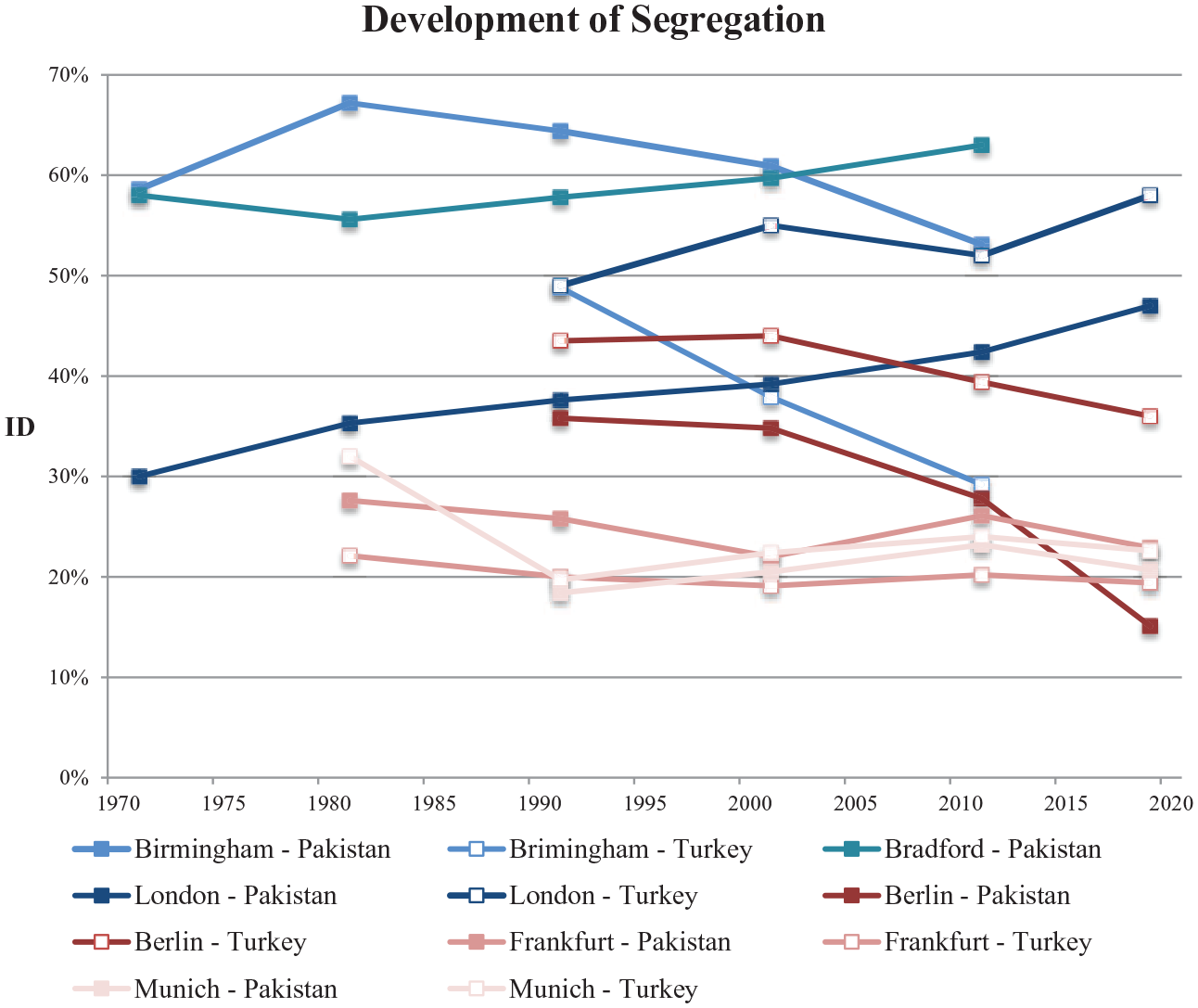
Segregation has increased in some British cities, and stagnated or decreased in German cities.
Figure 1 shows that general statements about two opposing modes of segregation in Britain and Germany tend to be overly simplistic. First, there are intra-country differences between the cities; second, there are intra-city differences between the ethnic groups.
Despite these nuances, with British indices of dissimilarity reaching up to 67 per cent, the general notion of Britain being more segregated than Germany can be confirmed. Furthermore, both systems can also be differentiated with regard to dissimilarity developments. Whereas the transatlantic convergence theory of European and American cities becoming more alike seems to apply to Bradford and London, where levels of segregation have risen more than 10 percentage points in the last three decades, they remained equal in Munich and Frankfurt and decreased in Berlin. Therefore, instead of convergence, it might be more appropriate to speak of intra-European divergence.
How can these differences be explained? The United Kingdom has more starkly cutback housing market intervention than other European countries. By providing social housing, governments have the capacity to alter the link between socio-economic disparities and segregation (Van Kempen and Murie, 2009: 388). However, since the 1980s, the United Kingdom has re-commodified large parts of its social rented sector under the ‘Right to Buy’ scheme. In contrast, Germany has the lowest proportion of owner-occupation in Europe (Kemp and Kofner, 2010: 379). Consequently, global economic pressures impact more directly on the British than on the German urban fabric. In this regard, the different levels of segregation are the result of different housing regimes, which in turn, reflect broader welfare state differences rooted in Britain’s liberal, and Germany’s conservative-corporatist approach (Esping-Andersen, 1990: 221–223).
Distinct immigrant housing policies compound the effects of these general policy differences. Programmes designed to increase ethnic mixing do exist in the United Kingdom. However, they are confined to widening housing choices for minorities (Harrison et al., 2005: 70–71). Germany, in contrast, is described as having Europe’s most ‘fierce’ desegregation policies (Musterd, 2005: 340). In the past, these largely consisted of negative allocation mechanisms through quota systems. Until 1975, German cities with a foreign population over 12 per cent had the right to ban further settlement (Drever, 2004: 1425). On an intra-city level, such settlement bans were still applied in the late 1990s. In Berlin, Frankfurt and Munich, the threshold of foreigners permitted in each district varied around 20 per cent (Bolt, 2009: 399; Yamamoto, 1993: 146). Today, these have been replaced by positive allocation mechanisms. This means that city authorities assign migrants to social housing in districts where they are not overrepresented. Due to the significant size of the regulated housing sector and the overrepresentation of ethnic minorities within it, this method is considered effective in achieving a social mix (Bolt et al., 2010: 131). Consequently, the different levels of segregation in Britain and Germany are influenced by different political attitudes towards immigrant neighbourhoods. These attitudes, in turn, stem from different conceptualisations of how immigrant integration works.
Integration theory and research design
The decision to pursue dispersal policies forms part of a broader pattern of regulations, which ‘regime theory’ clusters into national integration regimes (Brubaker, 1992: 21; Soysal, 1994: 32). The three modes of integration distinguished by this school of thought – assimilation, pluralism and transnationalism – form the pillars of the subsequent research. To make each of these three amorphous areas more approachable, they are subdivided into sociocultural, economic and political integration. This results in nine fields of analysis, whose corresponding hypotheses are illustrated in Figure 2.
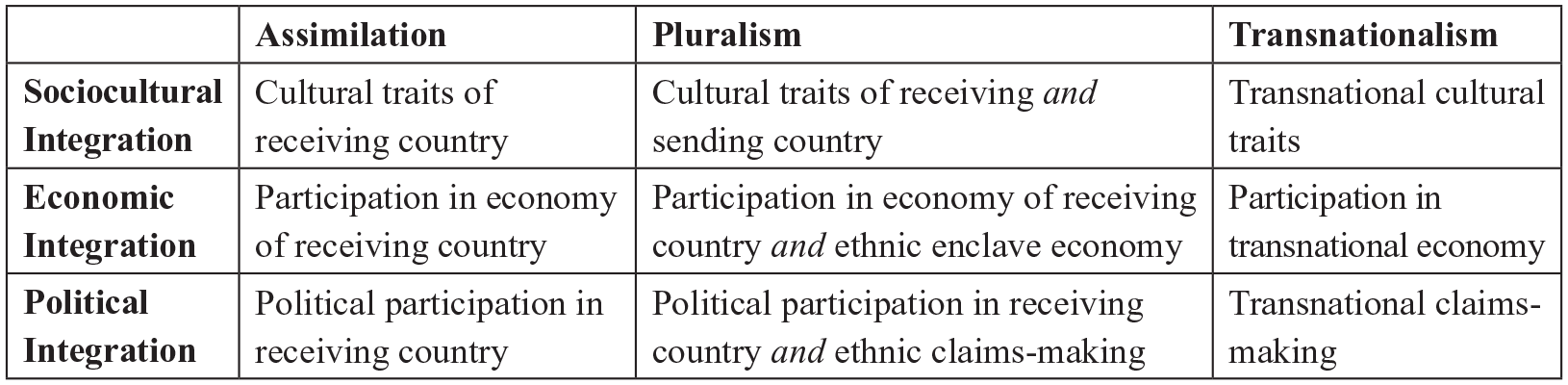
Nine hypotheses tested in the subsequent analysis: Do we see assimilationist, pluralist or transnational modes of integration within the sociocultural, economic and political realm?
Germany’s integration regime is said to derive its main tenets from the theory of assimilation (Phillips, 2010: 201). In this line of thinking, immigrants reach resource parity with autochthonous groups if they immerse themselves in this national unity, by renouncing their ethnic traits (Kostakopoulou, 2010: 945). The spatial manifestation of this school of thought is geographical dispersal, with ethnic enclaves regarded as impediments to entering mainstream society. So if this ‘German’ logic holds, we would find that as a result of immigrants’ relatively even distribution, they will assimilate by adopting German cultural traits, and by participating in the national economy and in the political processes of their receiving country.
Great Britain’s integration regime, in contrast, is frequently cited as an example for pluralism (Kivisto, 2003: 21). This concept originated from the social movements of the 1960s. The concomitant explosion of ‘lifestyle enclaves’ (Bellah et al., 1985: 73–74) and ‘individualisation’ (Beck, 1992: 127) undermined the prior notion of a homogeneous majority population. This development had its repercussions in the social sciences, with newly emerging theories conceptualising society no longer as a unity, but as consisting of interdependent ‘fields’ (Bourdieu, 1989: 1–5) or ‘systems’ (Luhmann, 1997: 60–61). These engage actors only in certain respects, never in their totality. For integration studies, this means that it is possible for immigrants to be part of various systems simultaneously (Joppke and Morawska, 2003: 3). Here lies the main difference to assimilationism: the notion of exclusivity is supplanted by compatibility. In other words, immigrants do not need to renounce their ethnic resources, but can add receiving country resources on to them. Geographically, the pluralist attitude translates into space through ethnic enclaves, as the physical expressions of co-existing sub-systems within the national territory (Musterd, 2003: 626). In concrete terms, if the ‘British’ notion of a pluralist integration process holds, immigrants living in ethnic enclaves will be able to acquire British cultural trades, while at the same time, keeping their distinct ethnic cultures. They will participate in the mainstream national economy as well as in segments of the economy in which their own co-nationals are overrepresented. Furthermore, they will engage with national political issues as well as advancing political demands specific to their own ethnic group through ethnic claims-making.
The latest turn in integration studies is the concept of transnationalism. Triggered by the ‘discovery’ of globalisation, scholars began to conceptualise how constant communication through the Internet and cheap travel lessens the degree to which social relationships are attached to national boundaries (Habermas, 2001). As the ‘container’ function of nation states looses significance, the demarcation of social, political and economic space is no longer conterminous. This altered spatiality also shapes the lifeworlds of sedentary populations (c.f. Mau, 2010 for Germany), but it is especially significant for migrants. New information technologies enable them to maintain home country linkages at an unprecedented scale. Therefore, scholars now asked how enduring transnational ties transform the integration process. Hereby, they shifted from seeing them as an impediment (Levitt and Glick Schiller, 2004: 1003), to stressing their compatibility (Barkan, 2006: 11; Erdal and Oeppen, 2013: 867; Kivisto, 2003: 5; Snel et al., 2006: 285). Thus, transnationalism, just like pluralism, rests on the logic of non-exclusive sub-systems. The difference, however, is that transnationalism goes one step further in breaking with the nation-state model. Pluralism still assumes congruence between a territorial state and a national community, even if the community may take the form of a spatially distant diaspora (Soysal, 2000: 10–11). Therefore, a pluralist mode of incorporation conceptualises the ‘adding up’ of two pre-existing national patterns. In contrast, transnationalists maintain that globalisation is undermining modes of belonging premised on territoriality, creating completely new morphological structures (Koopmans and Statham, 2003: 202; Recchi et al., 2019; Tedeschi et al., 2020). Consequently, if the integration process would indeed follow transnational lines, we would find that immigrants develop a transnational culture, earn their income in a transnational economy and articulate transnational political demands.
Which of these nine hypotheses (summarised in Figure 2) can be backed by evidence? When selecting case studies to test such hypothesis, research in international comparative integration generally suffers from the problem that conditions for a ‘most similar systems’ approach are hard to come by. This approach seeks to explain an outcome (here, integration) by the presence or absence of a key explanatory factor (here, ethnic segregation), while holding all other influential factors constant (Landman, 2008: 70). Yet, the differences between Britain’s and Germany’s integration regimes are manifold, making it difficult to disentangle which effects stem from geographical dispersal in particular. However, this can be partially resolved since the sample contains cities of varying degrees of segregation within each national integration regime.
Another blow to most similar systems theory is that differences between ethnic groups are hard to control for. The best way to ensure similarity would be to analyse the same groups in every country. However, given Germany’s and Britain’s unique immigration histories, it is necessary to compare different groups. Germany’s largest minority, Turks, were initially recruited as low-skill workers during the 1950s economic boom. Their share of the total population now comprises 3 per cent (Aydın, 2016: 2). Turks in Britain, in contrast, are a newly emerging, small minority, with a sizable share of high-skilled immigration. Being another Muslim immigration group, Pakistanis’ cultural difference to Western Europe might be comparable to that of the Turks. Pakistanis started arriving in the United Kingdom to fill the post-Second World War labour shortages in the 1950s, and now make up 2 per cent of the British population (Werbner, 2005: 476). Pakistanis in Germany, in contrast, have a smaller, more recent presence, frequently arriving for educational purposes (Haug et al., 2009: 76). Consequently, with Turks in Germany being comparable to Pakistanis in the United Kingdom, and Pakistanis in Germany to Turks in the United Kingdom, this set-up was found to be the best possible approximation of similarity.
It remains to determine which indicators to use to measure integration. Commonly used indicators for sociocultural integration are language acquisition, endorsement of norms and values associated with the receiving society, and identification with the receiving or sending country (Geiss and Gensicke, 2006: 347). Economic integration is traditionally assessed by income, sector of occupation or employment rates (Kasinitz et al., 2004: 5–6). Measures of political integration most frequently mentioned are citizenship acquisition, political representation and direct or indirect political participation (Bijl and Verweij, 2012: 151). This article draws on already established indicators, by selecting source of identification for sociocultural integration, sector of occupation for economic integration and modes of political participation for political integration.
However, it applies social media discourse analysis as a new method of data collection. This is possible, as online posts reveal with which country their issuers identify, to which economic sector the job offers and adverts they share belong, and which political events they inform other users about. To retrieve this information, Facebook was systematically searched for online diaspora groups, using as key terms all possible combinations between city of residence and country of provenance as noun, adjective and demonym (e.g. Turkey, Turkish, Turks), in all relevant languages (English, German, Turkish, Urdu and Punjabi). This uncovered a total of 119 groups. Of these groups, 49 were publicly visible; the remaining 70 had privacy settings that enable only members to see their content. The private groups were accessed by applying for membership. This was successful in all but two cases. Subsequently, the most recent 100 posts (or all available posts if fewer than 100 had been posted) of the three biggest groups in each city were extracted, forming a total sample of 2665 posts. Due to Facebook’s restrictions on automated webscraping, the posts were manually copied and organised in Excel. They were then codified along pre-established themes (with posts in English and German directly processed by the author, and posts in the other relevant languages pre-translated by native speakers). During the entire process, an ethical treatment of the data was assured by following general data protection regulation (GDPR) data protection principles, not storing or publishing any personally identifiable information.
Social media discourse analysis bears the disadvantage of producing potential selectivity effects. First, it might be assumed that the most marginalised migrants could be unable to afford access to social media, thus being underrepresented. However, studies have repeatedly shown that even for precarious migrants digital technology is part of the basic ‘migration infrastructure’ (Merisalo and Jauhiainen, 2021: 184; Nedelcu and Soysüren, 2020: 7). Thus, there is a little reason to expect a significant selectivity bias along economic lines. Second, however, as younger, more Internet-savvy immigrants are more active in online groups, their views might be overrepresented in the sample. This age bias might potentially skew the data towards second- and third-generation immigrants. Furthermore, as identities are contextualised, the version people present of themselves in the context of a Facebook group might not be the same in other settings. However, as these caveats hold for all cities equally, it does not affect the comparability between the case studies.
Apart from these limitations, social media discourse analysis has three advantages over traditional integration measures. First, in being a natively digital method, it trumps the main datasets used to obtain integration indicators (e.g. Labour Force Survey, Citizenship Survey, and the National Indicator Set in the United Kingdom, and Socio-Economic Panel in Germany) by circumventing a social desirability bias of participants. It also makes it possible to apply the same yardstick to multi-country case studies that are not covered by the same national integration survey.
Second, the traditional indicators used to measure economic integration are not fully equipped to do so. Official statistics only capture formalised work (Werbner, 2001: 681). However, scholars have repeatedly shown that the informal sector plays an integral part in the insertion of migrants (Reyneri, 2003: 117; Talani, 2013: 4–5). As social media groups can serve as free marketing platforms, they are especially popular for ‘low-profile’ business activities. Thus, they render parts of the shadow economy visible.
Third, traditional indicators have not kept up with the ‘transnational turn’ in integration studies. The classical datasets do not contain assessment categories for transnational modes of belonging. Research on transnationalism is therefore mostly available on a case study basis, with scholars conducting on-site interviews with particular migrant groups (e.g. Erdal, 2020; Poros, 2001; Portes et al., 2002). However, with the Internet being the main medium through which transnationalism is enacted, it provides a data source for empirically analysing transnational relationships. Nevertheless, online communities largely remain the objects of theorisation, not ‘hands-on’ evaluation (for exceptions, see Brinkerhoff, 2009; NurMuhammad et al., 2016; Oiarzabal, 2012; Park and Gerrits, 2021). Furthermore, to the best of my knowledge, social media analysis has never before been applied to the study of urban segregation.
Analysis
The influence of place on social space
Before asking how urban segregation influences integration, it has to be pondered if such a conversion of physical place into (digital) social space can be assumed at all. After all, spatial distributions could be mere manifestations of social networks, without any autonomous role in the (re)production of these networks (Kearns, 2002: 148; Whitehead, 2002: 66). Georg Simmel is considered the first sociologist to focus on the social effects of urban space itself. For him, cities differ from rural communities as their domination by the money economy leads to impersonal social relations. This is intensified by their spatial density and the concomitant over-stimulation, which further enhances city dwellers’ individualisation (Simmel, 1995 [1903]: 116).
The motif of cities as dissolvers instead of creators of social relations still features in the contemporary literature on ethnic segregation. Scholars like Saunders argue that contemporary international migration is better conceived as rural-to-urban migration within the global trend of urbanisation. Thus, ethnic enclaves are a mode of transplanting the rural logic of personal relations into the impersonal urban sphere (Saunders, 2011: 239). In this view, ethnic enclaves are isles in which place translates into social relations, whereas this is not the case in the wider city.
Other authors, however, stress the relationship-forming capability of neighbourhoods in general. They are faced with the objection that, in modern society where work, leisure and living localities tend to be spatially detached, personal interactions exceed the immediate living environment, rendering neighbourhoods insignificant (Joseph et al., 2007: 369; Kleinhans, 2004: 367). They argue that inhabiting common spaces still increases the likelihood of peoples’ lives getting interwoven (Kostakopoulou, 2010: 956; Pastore and Ponzo, 2016: 179) and that even weak ties generated by everyday encounters on the streets suffice to foster a sense of belonging and ‘public familiarity’ (Blokland, 2019: 101; Blokland and Nast, 2014: 1142). This is especially true for immigrants, as they are less likely to work or form part of associations, and are therefore more dependent on the neighbourhood (Van Eijk, 2010: 238).
This is contrasted by a new wave of denying the importance of place in forming social space, triggered by globalisation theorists. A pioneer in this regard was Heidegger, capturing how the penetration of modern technologies in the industrial age changed how space is organised and experienced. Whereas he conceptualised the constant availability as ‘shrinking of space’ (Heidegger, 1971: 163), others approached the same phenomenon from the angle of ‘distanciation’, that is, the stretching of relations across space (Waters, 2001: 68). Either way, their consensus is that in late-modernity ‘space trumps place’. Hereby, space is understood as a flow, which does not need to overlap with the fixed arena of place (Castells, 1996: 6; Harvey, 1996: 297).
The transnational strand of integration studies has picked up on this concept, by asserting that migrants form communities in space, independent from physical propinquity in their place of settlement (Drever, 2004: 1424; Kennett and Forrest, 2006: 713; Zelinsky, 2001: 215). As a result, preferences, instead of geography, are said to be the key determinants of community boundaries (Van Alstyne and Brynjolfsson, 2005: 852).
The sheer existence of online groups founded upon the premise of place, such as the ones analysed in this article, casts doubt on this assertion. They seem to suggest that, even in the digital arena, people form relationships aimed at or evolving out of physical co-presence. The seemingly unabated importance of proximity lends itself to the hypothesis that cities with higher immigrant concentrations should also have more densely knit immigrant online networks. However, this proves to be a fallacy (see Figure 3).
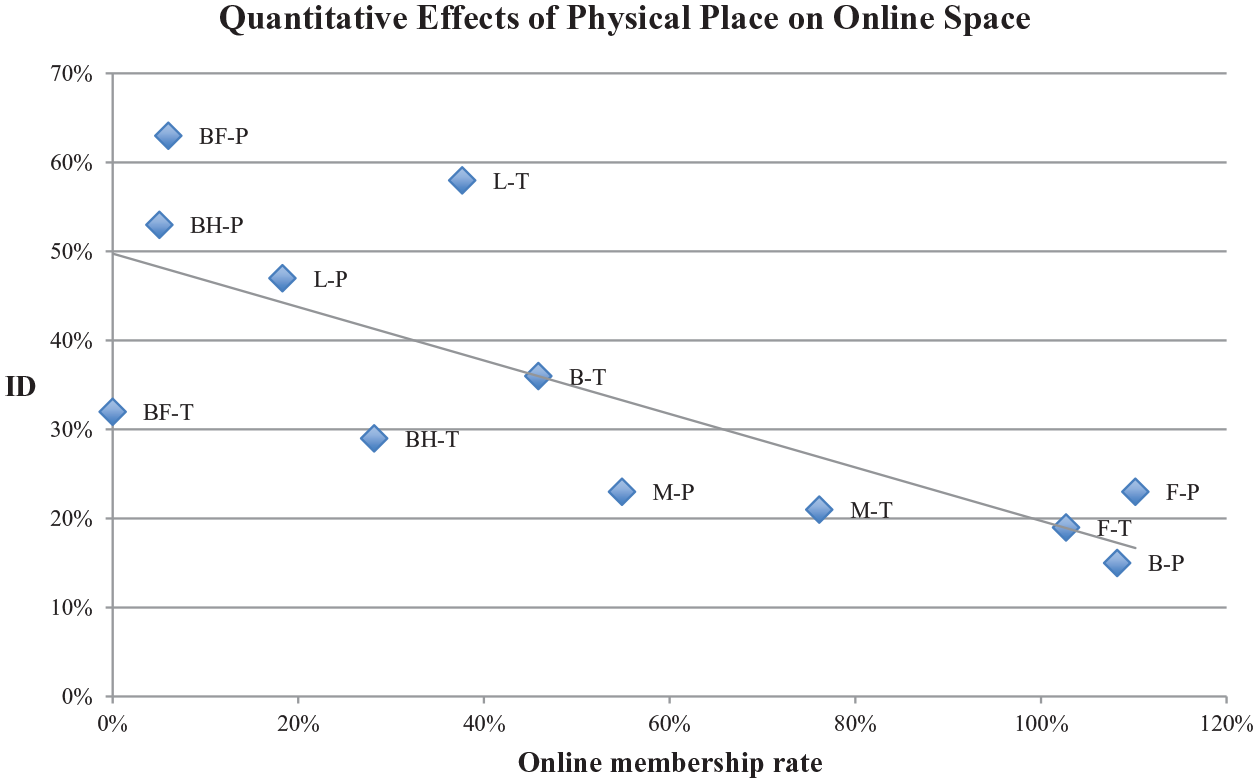
In less segregated cities, a greater share of migrants is organised in Facebook groups.
Figure 3 shows that the exact opposite holds; a higher concentration in physical place is actually associated with a lower concentration in online space. Behind this conclusion lies the calculation of ‘online membership rates’, defined as the quotient between the total population of the respective ethnic minority in each city and the number of memberships in the corresponding online groups. Bradford, for instance, is home to 106,611 Pakistanis, with 6401 memberships in Facebook groups for Pakistanis in Bradford. This equals a membership rate of 6 per cent, making it one of the least densely knit online communities, although it is the most segregated city in the sample. Frankfurt provides a contrary example. With a Turkish population of 26,735 and 27,458 Facebook memberships, it has a membership rate of 103 per cent, despite being among the least segregated cities. That the number of memberships exceeds the number of actual residents can have two reasons. First, one person can be part of multiple groups. Second, people who are not of Turkish descent or Turks not living in Frankfurt can sign up as well. Nevertheless, higher membership rates point towards higher engagement in online communities in more dispersed cities. An interpretation of this might be that online space assumes a compensatory role in places whose physical set-up is less suitable to foster social relations. Thus, has place indeed decreased in significance?
Before writing place off, it is necessary to look beneath the quantitative aspect of membership rates into qualitative differences between the discourses. Members’ contributions can be categorised into two groups of posts. One sort bears no identifiable intention to provoke repercussions outside the online space. Typical examples are posts like ‘Good morning friends, I’m new in this group’. The other sort, on the contrary, aims to translate into ‘real’ action, with examples such as ‘Come join us this Wednesday 11-2pm [. . .] for Naashta and Games!’ and ‘Any plans for cricket today somewhere in Frankfurt?’ The relative frequency of the latter category of posts is shown in Figure 4.
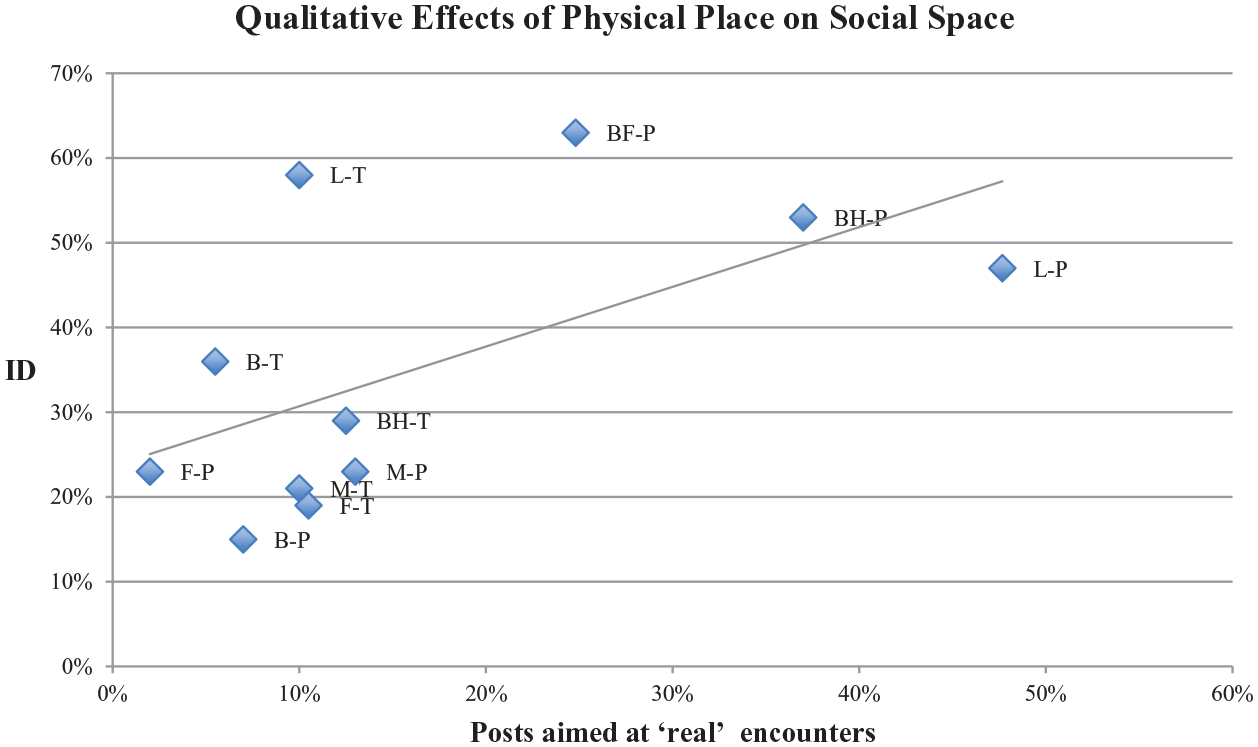
In less segregated cities, a smaller share of posts is related to ‘real’ encounters.
Figure 4 shows a reverse correlation to that of Figure 3. This means that immigrants in more dispersed cities might interact more on online platforms, but these interactions are less connected to ‘real’ encounters. For example, in Munich, only 2 per cent of posts from Turks suggest activities that involve face-to-face contact, compared to almost half of the posts from Pakistanis in London. This suggests that online space is not a full substitute for physical place, as relationships formed online remain of a different quality. Place might have lost its monopoly power, but it still seems to be an important catalyst for forming social relations. As Castells (2000: 443) states, ‘places do not disappear’, they constitute the ‘nodes and hubs’ of space.
Sociocultural integration
Assimilation
Given the evidence that immigrants’ physical emplacement in the city still shapes their social networks, it will now be analysed how these networks impact on their sociocultural integration. The most prominent theme in the literature dealing with sociocultural effects of urban segregation is the formation of a ‘culture of poverty’ (e.g. Halli et al., 2000; Kazemipur and Halli, 2000; Massey and Denton, 1993; Quillian, 2012; Sampson, 2012; Wilson, 1996). The geographical concentration of poverty, and its accompaniments such as drug abuse, crime and violence, are said to create a counter-culture in which norms and behavioural patterns increasingly differ from the mainstream culture (Massey, 2016: 376; Peterson and Krivo, 2012: 13). Based on their study of ‘the Negro family’ (Moynihan, 1965) and ‘the Puerto Rican family’ (Lewis, 1966), the founders of the ‘culture of poverty’ thesis maintained that a culture shaped by sustained poverty becomes self-perpetuating, even once the ‘structural’ reasons for poverty have changed. These lines of argumentation have become discredited for their tendency to ‘blame the victim’. However, a new generation of ‘culture of poverty’ scholars (e.g. Bell et al., 2015: 1; Small et al., 2010: 13) now seeks to develop more sensitive ways to link culture and pockets of poverty.
However, ethnic enclaves cannot be equated with poor neighbourhoods. To do so would be to conflate ethnicity with class. As Max Weber (1978 [1922]) holds, both are ‘modalities of social closure’ (p. 383). But whereas the first rests on the logic of horizontal stratification, the latter produces vertical stratification (Schunck, 2014: 48). Often, both intersect and therefore produce similar urban segregation patterns (Arbaci, 2007: 404), but this is not necessarily the case. On the contrary, if people are held together by ethnic solidarity, those who have climbed up the class ladder might be more likely to stay in the same neighbourhood. Thus, ethnicity can actually prevent pockets of poverty that would emerge if class were the only factor in residential sorting (Cutler and Glaeser, 1997: 828).
Therefore, it is not a ‘culture of poverty’ but ethnic culture that should be analysed as the underlying shaper of norms, values and behaviours. An opinion is that ethnic traits are preserved within ethnic enclaves due to a lack of cultural exchange with the ‘outside’ (Martínez, 2014: 9; Van Kempen and Murie, 2009: 388). This might be too simplistic without considering also the other side of the coin; ethnic identity might be reproduced on the ‘inside’, as relative isolation from other groups melts down intra-group divisions, strengthening the desire to express a shared identity. Some authors have argued that this can lead to cultural ‘fossilisation’, that is, the adherence to cultural markers, such as hijabs or burkas, which have supposedly become a thing of the past in the country of origin (Saunders, 2011: 32; Van Kempen and Özüekren 1998: 1634). The notion of backwardness implied in the term ‘fossilisation’ might be unwarranted as the observation that tradition is ‘invented’ in the present (Hobsbawm, 1983: 1) seems especially accurate here, considering the recent renegotiation of veiling cultures in many Muslim communities (Abraham, 2017: 252; Almila, 2017: 15). But regardless whether specific cultural traits are relicts from the past or modern innovations, the overarching concept is that ethnic enclaves are ‘collective identity machines’ (Wacquant, 2005: 11).
A commonly used indicator for the preservation of ethnicity is the degree of identification with the sending or receiving society. Identification can be understood as the process of constructing a social identity in relation to an environment (Snel et al., 2006: 290). In line with the literature on the performativity of language (Butler, 1995: 197; Gal, 1995: 169), posts containing positive information about either the sending or receiving country can thus be seen as acts of identity construction. Examples for the creation of an ethnic identity are posts like ‘Official ISPR Pak Army Video – I personally feel immensely proud of our armed forces – Pakistan Zindabad!’ and ‘How lucky is everyone who can call himself a Turk’ (own translation). The thesis of the cultural ‘identity machine’ would lead us to believe that the more segregated immigrants live, the greater the share of posts like these. As Figure 5 (blue line) shows, this is actually the case. For instance, Pakistanis in Bradford praise aspects of their home country in 17 per cent of their contributions, whereas their compatriots in Berlin do so in only 6 per cent of cases. Assimilationists might see this as an indication that in less segregated cities there is less ethnic identification to stand in the way of cultural assimilation.
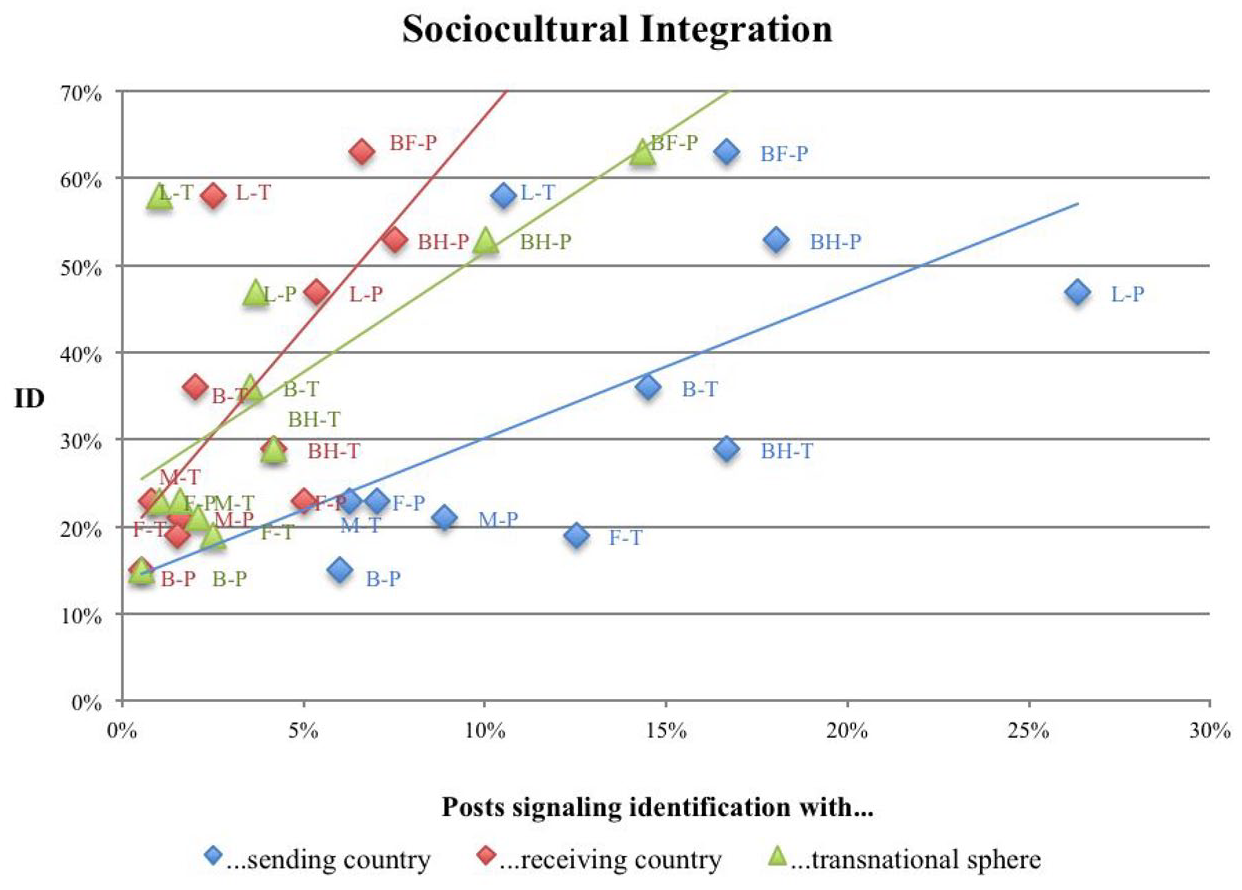
In more segregated cities, a greater share of posts signals identification with the sending country. However, the same holds for identification with the receiving country as well as the transnational sphere.
Pluralism
The pluralist view holds that ethnic enclaves do not constitute barriers to the adoption of cultural traits associated with the receiving country. The underlying reasoning is that a vibrant ethnic community provides a psychological buffer against alienation (Drever, 2004: 1423), and a sense of security and self-worth, that endows migrants with the necessary confidence to venture into the host society (Pattillo and Robinson, 2016: 350; Sánchez-Jankowski, 2008: 177). Pluralists base these claims on the observation of places like Chinatown (Zhou, 1992), Cuban enclaves (Portes and Stepick, 1993) and Korean ‘Kimchee Towns’ (De Vos and Chung, 1981). These remained as elective ethnic concentrations while a gradual erosion of social and mental boundaries lead to higher rates of cultural adaption, socialising and intermarrying with the host population. Thus, instead of ‘fossilisation’, pluralists evoke the imagery of a ‘springboard’ to symbolise the role of ethnic enclaves as facilitators of cultural integration (Wacquant, 2005: 10).
If the ‘springboard’ thesis holds, immigrants in cities with higher indices of dissimilarity should be more engaged with the host culture, and therefore incorporate it more in their social identity construction. This would be reflected in posts displaying positive connotations with the receiving environment, such as ‘Name these places . . . I want to know how much you know about beautiful Bradford’ or ‘Congratulations to all of us for being in London’ (own translation). As Figure 5 (red line) shows, this is the case. With up to 7 per cent of posts in Birmingham and Bradford praising the country or city of residence, while German cities fluctuate around 1 per cent to 2 per cent. How can the parallel trends of increases in ethnic identification as well as in host country identification be reconciled? An interpretation is that they are not mutually exclusive, and can thus be incorporated simultaneously within a collective identity. With resource simultaneity being one of the central tenets of pluralism, this points towards a pluralist mode of integration in more segregated cities. In contrast, there is no sign of increased identificational assimilation in cities with lower indices of dissimilarity, discarding the assimilationist reasoning behind dispersal policies in the realm of sociocultural integration.
Transnationalism
The prior approach of first looking at ethnic identification and subsequently at receiving country identification adhered to the traditional juxtaposition of country of origin and country of residence. A transnational identity, however, transcends this duality. By continuously crossing cultural boundaries, transmigrants form hybrid identities (De Fina and Perrino, 2013: 509; Mavrommatis, 2014: 1968).
With indefiniteness and constant renegotiation as part of the concept of transnational identities, it is hard to pin down. However, with regard to Pakistani groups, the contours of a transnational collective identity become perceivable through the self-labelling as ‘apna’. ‘Apna’ translates loosely from Punjabi as ‘one of our own’ and refers to Asian groups in Western contexts (Sanghera and Thapar-Björkert, 2008: 556). Judging from the usage of the term in the social media posts, it is frequently applied to consolidate the conservative parts of the ethnic culture with Western youth culture into a new cultural amalgam. Examples for this are ‘It’s party time right up till I go to hajj’ (Hajj is the annual pilgrimage to Mecca) and ‘Why do some apne always ask the same ol questions i.e what do ju prefer lover marriage or arranged?’ The latter post is accompanied with a picture of the ‘apne’ asking themselves this question: Pakistani girls wearing stereotypically Western clothing and make-up. Thus, it expresses how Pakistani youths manoeuvre between traditional concepts (‘arranged marriage’) and ‘Westerness’, negotiating their own, hybrid positions. Within the transnational construct of ‘apna’, national references do not disappear. However, national identity is not portrayed as fixed or territorially bound, but as dynamic and defined in terms of behaviour, as exemplified by this post: ‘There’s always those odd apne in the community that act more British than the British lol’.
‘Apna’ has no equivalent in the Turkish online community, and comparable hybridisation of Turkish and German culture is only discernible in 1 per cent to 3 per cent of posts (see Figure 5, green line). The higher rate of up to 15 per cent in Bradford gives reason to belief that ethnic enclaves provide fertile ground for transnational identity formation. Thus, Wacquant’s (2005: 11) terminology of enclaves as ‘identity machines’ might be appropriate, albeit not in the narrow sense of fuelling only ethnic identity, but also pluralist and transnational identity formation.
Economic integration
Assimilation
Socialisation theory is the main assimilationist concept that sees ethnic enclaves as impediments to the integration of immigrants into the labour market. It is inspired by the concept of social capital. It holds that social capital, in the form of personal relationships, can translate into economic capital (Bourdieu, 1986: 241); for instance, through the presence of role models or information about job opportunities. Putnam (2000: 22–24) introduced the distinction between two kinds of social capital – bonding capital, which refers to the ties within a community, and bridging capital, which refers to ties between communities. A third variation is linking social capital, which denominates links with individuals at higher socio-economic positions (Pieterse, 2003: 45). As all three rest on the differentiation between in-group and out-group, they found a natural field of application in immigration studies. These studies usually measure immigrants’ assimilation by the presence, strength and quality of their ties to the domestic group, that is, by their bridging social capital (Cox and Orman, 2010: 2). Ethnic enclaves are seen as a reason for a lack of between-group ties, and therefore as impeding the formation of bridging social capital. This, in turn, deprives immigrants of the contacts that would facilitate the crossing over into the host country’s labour market (Cutler and Glaeser, 1997: 827; Van Eijk, 2010: 59).
If the socialisation theory holds, immigrants in cities with higher levels of segregation should be less integrated in the domestic labour market. This would result in fewer posts containing employment opportunities or marketing activities related to the receiving country’s labour market. As Figure 6 (blue line) shows, with nearly a quarter of posts from Turks in Frankfurt – compared to around 8 per cent in Bradford and Birmingham – a tendency towards more labour market assimilation in more dispersed cities could be inferred.
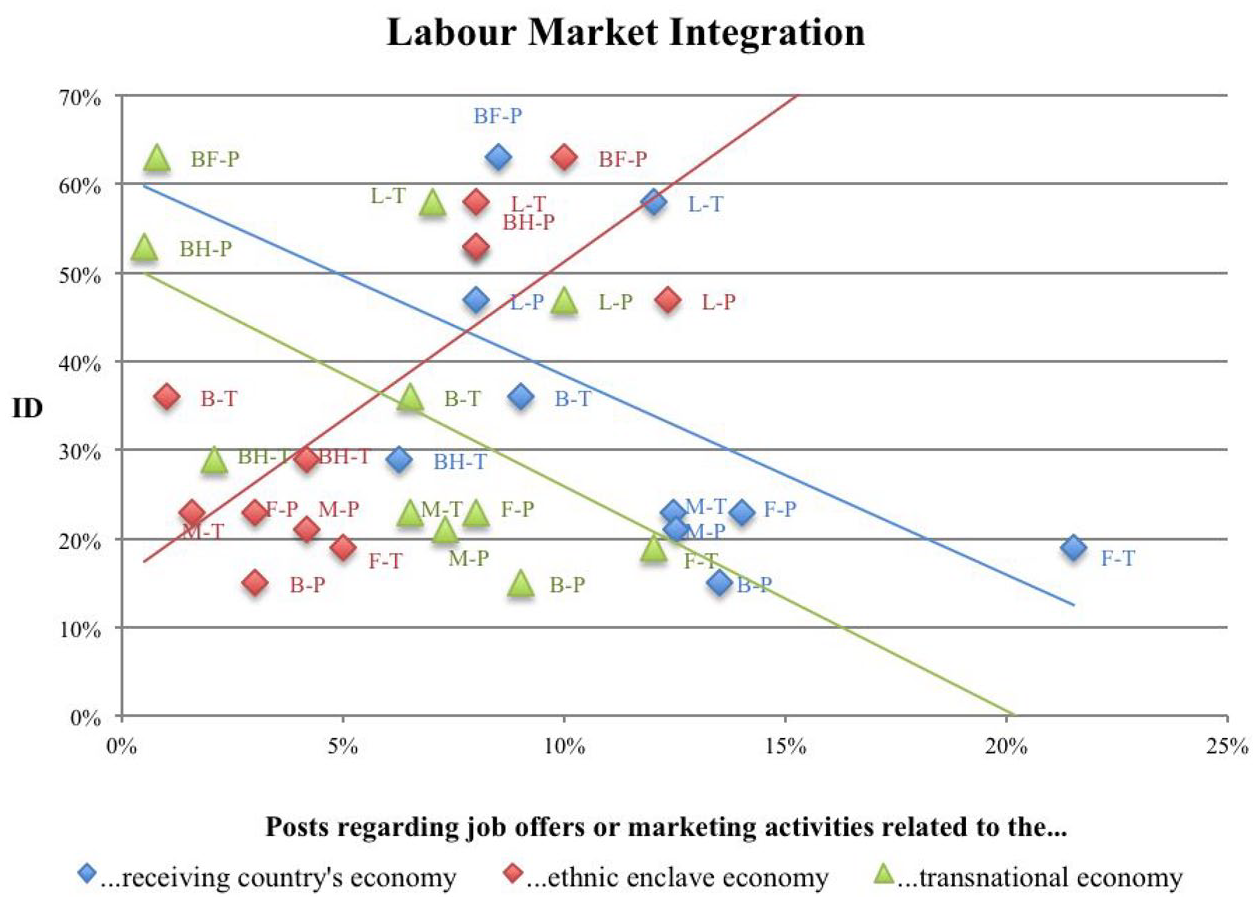
In more segregated cities, a greater share of posts relates to an ethnic enclave economy. In less segregated cities, a greater share of posts signals engagement with the receiving country’s economy as well as the transnational economy.
However, treating the labour market as homogeneous conceals more than it uncovers. To get a more accurate picture, it is helpful to combine segmented assimilation theory (Portes and Zhou, 1993: 82) with dual labour market theory. Dual labour market theory differentiates between a primary sector, consisting of high-skilled, stable jobs and a secondary sector, with low-skilled, less protected jobs (Piore, 1979: 35–36). Incorporation of migrants into the former can be considered upwards assimilation, whereas the latter might constitute a mode of downwards assimilation. This distinction can also be made in the social media analysis. Posts like ‘Amazon is looking for a software development manager for one of its teams in Munich. If you know someone with the right set of skills and desired experience, please let me know. I can forward their CV’ are related to the primary sector, while ‘This hotel in Berlin is looking for many people for its room cleaning service’ (own translation) points towards secondary sector employment. Distinguishing between primary and secondary sector reveals that underneath the negative correlation between index of dissimilarity and domestic labour market posts are two opposing trends: more secondary labour market posts in less segregated cities (e.g. 12 per cent for Pakistanis in Munich and 20 per cent for Turks in Frankfurt, compared to 3 per cent and 1 per cent for Pakistanis in Bradford and Birmingham, respectively) and slightly more primary labour market posts in more segregated cities (e.g. for Pakistanis, only 1 per cent in Munich and 2 per cent in Frankfurt, compared to 7 per cent in Birmingham and 5 per cent in Bradford). This suggests that increased labour market assimilation in German cities can be mainly explained by increased downwards assimilation into the secondary labour market.
However, the role of dispersal policies in triggering these results has to be interpreted with caution, as they might be predetermined by the countries’ immigration regimes. Germany is said to attract more unskilled migrants (Cohen and Razin, 2008: 3), which are more likely to end up in the secondary labour market, regardless of whether they live in concentrated or dispersed areas.
More conclusive might be the slight increase in primary sector posts in more segregated communities, as it challenges the socialisation thesis. The theory rests on the same mix-up of class and ethnicity that has already been criticised earlier. Especially in the United Kingdom, fairly wealthy and poor Pakistanis live next to each other (Musterd, 2005: 339), and the Facebook groups create the impression that economically established immigrants reach out to newcomers with primary sector job offers. Thus, the bonding social capital between in-group members might also fulfil the function that socialisation theory only ascribes to bridging social capital with the autochthonous group. The same is true for linking social capital: ‘Friends in higher places’ (Pieterse, 2003: 31) might not only be found outside but also within the ethnic group.
Pluralism
The main pluralist concept of economic integration is ethnic enclave economy theory. It describes an alternative to economic assimilation provided by the enclave economy, in which ethnicity is an advantage. Spatial clustering is a prerequisite for its formation, as a critical mass of co-ethnics is required as a customer base for the goods traded within it, such as traditional foods or ethnic clothing (Drever, 2004: 1434).
Some authors describe the enclave economy as a substitute for secondary labour market employment (e.g. Constant and Massey, 2005; Demireva and Zwysen, 2021; Lusis and Bauder, 2010; Sanders and Nee, 1987; Schrover et al., 2007). In this view, the competitive edge of ethnic entrepreneurs lies in the presence of underemployed co-ethnics, resulting in labour costs that are more aligned with standards in the home country than in the country of residence (Light and Rosenstein, 1995: 15–16).
Others portray employment in the enclave not as precarious, but as lucrative. They describe how those employed within an enclave fared better than their compatriots in the domestic economy; for instance, because educational qualifications from the home country were better remunerated (Werbner, 2001: 674). This is illustrated by examples of enclaves with huge economic significance, such as Asian business in Manchester (Werbner, 2001: 680) or Bradford (Saunders, 2011: 246). For these authors, the success of ethnic entrepreneurship derives from solidarity and enforceable trust, which, for instance, facilitates mutual credit (Light et al., 1993: 36). Furthermore, it provides a stepping-stone to expand to a non-immigrant clientele (Pécoud 2004: 19), and to use the proceeds to finance the second generation’s educational advancement (Portes et al., 2002: 294).
Ethnic entrepreneurship is reflected in the Facebook groups through posts like ‘Today’s original Agha Noor collection. All sizes S M L Xl available. More order & information contact & what’s app no 03217547042’. As expected, Figure 6 (red line) shows a clear correlation between posts like these and the degree of concentration of ethnic groups. Thus, a pluralist mode of economic integration is more feasible for immigrants in British cities. The lack of ethnic entrepreneurship in German cities, however, is not only due to the absence of large enough concentrations, but also the legal hurdles for non-citizens to set-up businesses (Kogan, 2004: 440). Therefore, dispersal policies are just an additional barrier within the German integration regime that hamper the formation of ethnic economies.
Transnationalism
In a globalised world, the transnational economy can provide an alternative route for economic adaption. In contrast to the ethnic enclave economy, it is not located within the receiving country, but binds the receiving and sending country together through cross-border networks (Poros, 2001: 243). Apart from international travel, the Internet is a key enabler for migrant entrepreneurs to conduct transnational business (Andreotti and Solano, 2019: 449). Some authors portray transnational entrepreneurship as an accelerator for integration, with transnational entrepreneurs earning more than ethnic enclave entrepreneurs and co-ethnics in the domestic labour market (Portes et al., 2002: 286).
However, their narrow focus on entrepreneurs should be extended to also account for the integrational effects on those immigrants who are involved in the transnational economy as customers or employees. Posts like ‘technology has made it easy to learn the Quran through Internet all over the world, we teach online’ are examples for new types of services catering to the diaspora. Posts promoting online-based jobs (e.g. ‘Work in Turkey while being abroad – wondering how that’s possible?’ (own translation)) are part of an evolving transnational labour market. Transnational economy posts are more widespread in cities with low-ethnic concentrations (see Figure 6, green line). As posts related to enclave economy activities show the exact opposite correlation (see Figure 6, red line), this might suggest that the transnational economy provides a compensation for the absence of a local ethnic economy.
Political integration
Assimilation
Definitions of political integration can be clustered into two categories. The first focuses on political structures, such as Browning et al.’s (1986) definition as ‘the responsiveness of the political system to the interests of inclusion’ (p. 576). The second focuses on the agency of migrants themselves. Here, integration is defined as the level of immigrants’ political participation, be it direct through voting or indirect by drawing upon other sources of influence (Jones-Correa, 2005: 75; Tillie, 2004: 532).
Arguments against ethnic concentrations based on the former, structurally oriented approach, argue that immigrants’ low voter turnout might create areas of ‘organisational desertification’ (Van Kempen and Özüekren, 1998: 1633; Wacquant, 1998: 25) that are overlooked by politicians. Scholars concerned with the latter, agency-focused aspects contemplate how immigrants’ living environments might shape their political activity. Living among natives might foster assimilationist political participation. This is defined as engaging with politics like the average native-born, that is, mainly through direct electoral participation and by addressing claims to established political institutions (Nielsen, 2014: 157).
Assimilationist political participation is expressed in posts like ‘Sign the Petition UK Parliament: Prohibit the purchase of Acid to those without a licence’ and ‘Which candidates & party are you voting for tomorrow apneyoh? [. . .] Don’t just make a choice apneyoh, make an informed one’. Contrary to what assimilation theory would lead us to expect, posts like these occur more frequently in more segregated cities (see Figure 7, blue line).
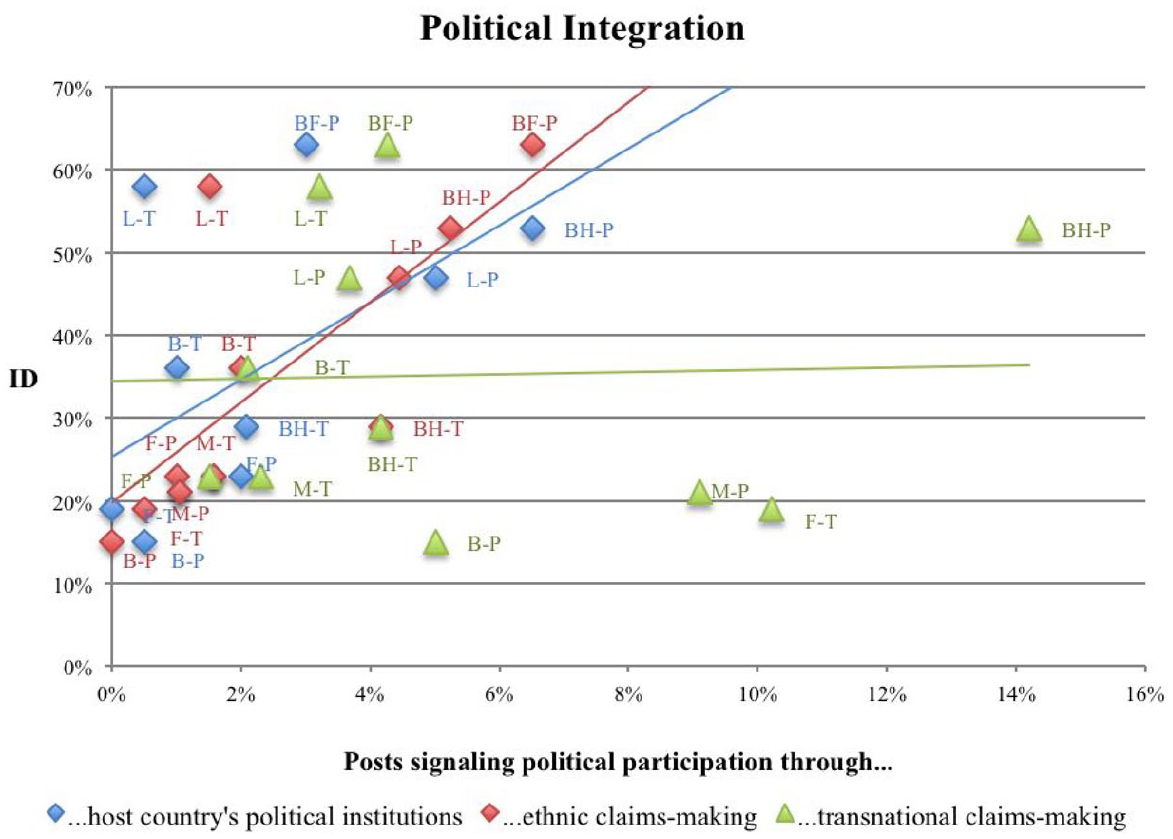
In more segregated cities, a greater share of posts signals assimilationist as well as pluralist political participation, while transnational political participation is relatively high independent of the level of segregation.
The relative frequency of posts by Pakistanis signalling interest in British national politics suggests that living in dispersed neighbourhoods is no prerequisite for political assimilation. When interpreting the low engagement rates among German immigrant groups, however, it has to be taken into account that – unlike in the United Kingdom, where Commonwealth citizens are allowed to vote and be elected (Bauböck, 2005: 685) – this is not the case for most immigrants in Germany. As only those with German citizenship are enfranchised and the naturalisation law is described as one of the most restrictive (Diehl and Blohm, 2003: 134), only 0.5 million of the 3.7 million Turks in Germany form part of the electorate (Green, 2003: 225). Thus, for many immigrants, full political assimilation is a structural impossibility.
Pluralism
Pluralist considerations about the advantages of ethnic enclaves for the structural aspects of political integration reverse the argument of ‘organisational desertification’. In constituency-based electoral systems, concentrations of minorities are seen as pools of electoral power, into which politicians want to tap by tailoring policy proposals to minorities’ needs (Koopmans and Statham, 2003: 213; Roberto and Rodríguez-Pose, 2017: 3).
Authors focused on the agency aspects of political integration stress the role of ethnic enclaves as enablers of collective action. A clearly defined area is considered to facilitate mobilisation by fostering a shared repertoire of images and meanings through which a collective destiny can be conceived (Kivisto 2003: 14; Wacquant, 2008: 245). Therefore, in contrast to political assimilation, pluralist participation is associated with group-based political pursuits and indirect participation through demonstrations or other forms of unconventional politics (Hochschild and Mollenkopf, 2009: 30).
Pluralist participation surfaces in posts like ‘Join the protest. [. . .] We are the voice of Britain’s Immigrant community and continue to be so. Aim: to bring to light the predicaments faced by immigrants, especially those [. . .] thousands who have been forgotten by the system’. In line with the theory of enclaves as political catalysts, such calls for ethnic claims-making are issued more frequently in segregated cities (see Figure 7, red line).
Are German immigrants deprived of the possibility for collective action due to their geographical dispersal? Critical scholars’ assessment of de-concentration as a means of preventing proletarian unification suggests so (Goetz, 2003: 201; Imbroscio, 2004: 111; Wacquant, 2008: 245). This is in line with Saunders’ observation that immigrant enclaves became the objects of policy intervention for the first time in history in the wake of the French Revolution. Historical arrest records revealed that the storming of the Bastille was an uprising of rural-to-urban migrants, the core residents of Paris’ immigrant quarters (Saunders, 2011: 153). This pattern runs through many revolutions, all the way up to the Arab Spring in 2011 (Saunders, 2011: 326), which leads Saunders (2011) to call immigrant enclaves a ‘political force capable of changing nations’ (p. 131).
One might choose to see the race riots taking place in cities and towns in Northern England in 2001 in a similar light. It is no coincidence that they occurred in the most segregated cities, such as Bradford (Robinson, 2007: 164; Simpson, 2004: 661). But to what extent is this still a ‘confrontational’ mode of political integration (Østergaard-Nielsen, 2003: 23), or a sign of political disintegration?
Transnationalism
The structure of transnational politics spans across the country of origin and settlement, fusing domestic and international political terrains. The addressees of transnational claims can be manifold: home country politicians, who become involved to strengthen the position of nationals abroad, host country politicians, to achieve improvements in the sending country (Østergaard-Nielsen, 2003: 21), or non-governmental actors, to advance more universalistic projects (Soysal, 2000: 1).
In terms of agency, transnational political participation traditionally took indirect forms. Now, it can increasingly also be enacted through direct election, as more and more governments grant their diaspora voting rights (Bauböck, 2005: 683). This is seen as part of a great transformation of the membership boundaries that circumscribe democratic citizenship, triggered by international migration (Brubaker, 2010: 61; Itzigsohn, 2000: 1126).
There are two opposing theories concerning the impact of receiving countries’ integration regimes on migrants’ transnational political involvement. One argues that exclusive political systems will drive migrants into transnationalism (Abadan-Unat, 1997: 229; Koopmans and Statham, 2003: 231). Germany often serves as an example for this, which would lead us to expect many posts like the following: ‘Germany says “There is no democracy in Turkey, no human rights.” So where are our rights here? They are forgotten. We demand that our state puts pressure on Germany!’ (own translation). The other finds that pluralist integration regimes foster transnationalism, as they give minority groups the space to institutionalise ethnic organisations (Faist, 2000: 211; Kaya, 1998: 23). This would be reflected in more transnational claims-making posts from Pakistanis in England, such as ‘Stop Drone Attacks in Pakistan – Join our Protest!’. Figure 7 (green line) indicates that both theories are not mutually exclusive. Online groups in most sample cities contain an equal and – compared with the assimilationist and pluralist posts – high amount of transnational political posts.
When comparing the transnational political behaviour of Turks and Pakistanis, it should be borne in mind that both countries exclude expatriates with dual citizenships from voting, which affects only 13 per cent of Turks in Germany, but over two-third of Pakistanis in the United Kingdom (Erdal, 2016: 5). This might lead to comparably fewer posts of Pakistanis regarding direct transnational political participation. Nevertheless, Pakistanis still display high levels of indirect transnational involvement. This might debunk assimilationist theories that hold that engagement of migrants in their homeland politics disappears as they become more politically integrated in their new country (Østergaard-Nielsen, 2003: 15). Rather, it confirms a pluralist conception of simultaneous integration in the political systems of sending and receiving countries.
The future of urban dispersal policies
Should dispersal policies persist? The evidence presented earlier suggests ‘no’. This answer has to be attenuated given the above-mentioned limited representativeness of Facebook posts. Nevertheless, within this limitation, the analysis suggests that desegregation fails to induce assimilation, while simultaneously hampering pluralist modes of integration. Furthermore, the increased possibility to resort to transnationalism signals that dispersal policies, as a lever to shape integration trajectories, might become obsolete anyway. Another caveat, however, is that owing to the method of analysing immigrants’ online discourse, all observations were based on their effects on immigrants themselves. But in line with the concept of integration as a ‘two-way road’ (Barkan, 2006: 10), their impact on the autochthonous population should also be taken into the equation.
With regard to sociocultural integration, ethnic enclaves might influence the behaviour of natives, as places provide frames for categorising others. Immigrant places are frequently constructed as loci of deprivation and the underclass (Werbner, 2001: 672), and in the case of Muslim immigration even as breeding grounds for radicalisation (Nielsen and Otterbeck, 2016: 189; Varady, 2020: 1326). This converts them into stigmatised neighbourhoods, which symbolically degrade those who live in them (Bourdieu, 1999: 129). Wacquant (2008) draws an analogy between territorial infamy and other stigmata, such as race and religion, as it provides a similar basis for stereotyping and discrimination (p. 238). Thus, living in an immigrant neighbourhood might become a reason for sociocultural exclusion due to ‘post-code racism’ (Musterd and Ostendorf, 2008: 184).
The prevalence of this phenomenon cannot directly be gauged from the Facebook groups. However, taking posts that voice a feeling of discrimination as a proxy (e.g. ‘These thugs can’t decide if we’re taking all their jobs or taking all their benefits . . . I mean really!’) confirms that discrimination might be more widespread in cities with higher levels of segregation. Perceived discrimination was expressed in none of the posts from Pakistanis in Frankfurt and Berlin, only in 1 per cent of posts from Pakistanis and Turks in Munich, but in 6 per cent of the posts from Turks in Birmingham and 7 per cent from Pakistanis in Bradford. Thus, the autochthonous reaction to ethnic enclaves might put roadblocks on the way to integration.
Concerning economic and political integration, ethnic enclaves might foster nativist attitudes, as the distribution of economic and political resources is perceived as a zero-sum game. If a pluralist mode of integration really increases immigrants’ share of these resources, it might thus trigger anti-immigration backlashes. Brexit might be interpreted as a case in point (Bhambra, 2017: 91; Calhoun, 2017: 59). In Germany, a comparable desire to curb immigration has so far not reached the political mainstream. This might be due to the exclusionary or downwards assimilationist effect of the German integration regime, which keeps allocation conflicts in check, thus increasing Germany’s ‘intake capacity’.
From this point of view, dispersal policies act as an integration tool by indirectly impinging on the autochthonous group. However, there are two objections to be made. First, in a regime depending on downwards assimilation, migrants are integrated as cheap labour, resembling the much-criticised dogma underpinning the German ‘guest worker’ schemes of the 1960s and 1970s (Ciupijus, 2010: 10; Jurgens, 2010: 345). Integration in the sense of equal access to sociocultural, economic and political resources cannot be achieved in this manner.
Second, dispersal policies leave the pathological reasons for the emergence of ethnic enclaves unchanged. Socio-economic polarisation in cities would not be reduced, only more evenly distributed. Discrimination might lose a projection screen, but not its root cause. Therefore, many scholars doubt that increased dispersal would translate into more social ties between immigrants and natives (Bolt, 2009: 400; Van Eijk, 2010: 231). To conclude, tackling ethnic enclaves is fighting the symptoms, and, if the above analysis holds, even a remedy of the current world order.
Will dispersal policies persist nonetheless? Most likely, yes. Immigration regime theory is currently observing a process of Europeanisation in the integration domain (Joppke, 2007: 245; Musterd, 2005: 340). Not least due to increasing fear of Islamic radicalisation, once pluralist nations abandon their creed in favour of a collective rejuvenation of assimilationist policies (Abbas, 2005: 156; Johnston et al., 2006: 974). Great Britain is a paradigmatic example (Schmitter Heisler, 2007: 99). This shift is also reflected in its housing policy, with its long-standing commitment to increasing minority choice being watered down by desegregationist overtones (Phillips, 2010: 213; Ratcliffe, 2004: 59). Similar trends can be seen in France’s mixing policies in the banlieues (Carpenter, 2018: 29; Machline et al., 2020: 36) and Denmark’s ‘No ghettos in 2030’-plan (Silver and Danielowski, 2019: 26), which includes restricting the mobility of specific communities, and even tearing down their housing (Walks, 2020: 403–404). Therefore, dispersal policies are set to become an integral part of urban governance throughout metropolitan Europe.
Conclusion
The segregation-integration nexus is still unresolved. Social media discourse analysis provides an accessible source to explore it further. Future research could test if the same findings hold for other ethnic groups and other cities. The present article opted to compare British and Germany cities, thus taking advantage of social media analysis’ ability to provide comparable datasets across different countries. The cross-national comparative approach was essential for analysing cities with varying levels of segregation against the backdrop of different national integration regimes.
In these case study cities, higher levels of segregation do not seem to impede integration. On the contrary, in the realm of sociocultural integration, lower indices of dissimilarity do not lead to assimilation, but higher indices of dissimilarity foster pluralist as well as transnational identificational integration. With regard to economic integration, lower indices of dissimilarity are associated with downwards assimilation and transnational business activities, while higher indices of dissimilarity entail upwards assimilation and pluralist integration into the ethnic enclave economy. Concerning political integration, lower indices of dissimilarity fail to bring about political assimilation, whereas higher indices of dissimilarity lead to assimilationist as well as pluralist political participation. Transnational political engagement is a mode of political integration prevailing throughout all levels of segregation.
These findings contribute to the on-going theory building on the segregation-integration nexus. First, by presenting empirical evidence in favour of pluralist theories that see segregation and integration as compatible. Second, by working towards a European segregation-integration theory that needs to emancipate itself from the US origins of the field. Not only are levels of segregation in Europe more variegated, the European space is also more permeated by integration policy. The article developed a theoretical framework in which this variation in segregation and policy can be studied in relation with each other, using the power of comparative research to shift our attention to the explanatory relevance of the contextual policy environment.
In line with the policy focus, the article’s findings provided a basis for criticising dispersal policies. The motivation behind them seems to be quite distinct from Henriette Davidis’(1845) predilection for spreading guests around the table so that hosts can ‘provide their guests’ catering and entertainment in the most efficient manner’ (p. 240). Hyperbolically put, they rather keep guests from uniting and taking too much food from the buffet. Even if one does not ascribe malicious intent, their effectiveness remains doubtful. In her novel The Watsons, Jane Austen (2013 [1871]) seems to have grasped this when she described a seating order ‘where [guests] only were formally seated’ and ‘as soon as they were all duly seated placed again [. . .] a very stiff meeting between these near neighbours ensued’ (p. 14). To avoid such ‘stiff meetings’ and their negative effects on integration, allocation quotas should be scrapped, instead letting migrants freely elect their place of settlement. Following Austen rather than Davidis, Europe should meet its multi-ethnic future with the motto ‘free seating’.
Footnotes
Declaration of conflicting interests
The author(s) declared no potential conflicts of interest with respect to the research, authorship, and/or publication of this article.
Funding
The author(s) received no financial support for the research, authorship, and/or publication of this article.
