



Abstract
In this article, we study how the local concentration of ethnic minorities relates to the likelihood of out-migration by natives in Copenhagen, the capital of Denmark. In US studies, a high or increasing proportion of racial or ethnic minorities in inner-city neighborhoods is seen as an important motivation for White middle-class families’ out-migration to racially and ethnically homogeneous suburbs. The relatively egalitarian Scandinavian setting offers a contrasting case, where inner cities are less deprived and where minority groups primarily consist of immigrants and the children of immigrants who have arrived over the past few decades. We use population-wide, longitudinal administrative data covering a 12-year period, and measures of individualized neighborhoods based on exact coordinates for place of residence, to examine whether out-migration is associated with minority concentrations in the Copenhagen area. Our results largely support the presence of a native out-migration mobility pattern, in contrast to much existing literature. We also show that responses to increasing minority concentrations vary across the life course and between natives and children of immigrants.
Introduction
In most diverse societies, residential segregation along racial or ethnic lines is a salient issue. The composition of the local population and the relative concentration of minority and majority groups have been hypothesized to affect individuals’ day-to-day interaction patterns (Moody, 2001), risk of poverty (Massey et al., 1987), children’s school achievements (Jensen and Würtz, 2011), and a host of other social and economic outcomes.
Residential segregation can emerge as a result of several different processes. One contributing factor is when the residential choices of majority and minority groups are motivated in part by preferences regarding neighborhoods’ racial or ethnic composition. In the United States, the hypothesis of “White flight” has long been part of the discussion of continued residential segregation by race. This term was coined to describe the suburbanization of White families, the pattern of migration of relatively affluent Whites from racially mixed inner cities to racially homogeneous suburbs, which has contributed to the emergence of inner-city areas consisting largely of marginalized African Americans (Crowder, 2000; Crowder et al., 2011; Crowder and South, 2008).
In this article, we study whether the local concentrations of ethnic minorities in Copenhagen metropolitan area neighborhoods affect natives’ out-migration patterns. We discuss the literature on White/native out-migration and flight from areas with relatively high minority concentrations. In the empirical part, we analyze how changes in the concentration of minorities relate to natives’ and children of immigrants’ (hereafter: descendants) out-migration. Contrasting descendants with natives can yield useful insights into what mechanisms are at work in producing differences in migration patterns, compared with contrasting natives with immigrants, as descendants are, on average, less socioeconomically deprived than immigrants, and have mostly grown up in the country, meaning that differences in language proficiency, migration experience and so on are minimized. We draw on individual geocoded coordinate data linked to large-scale, population-wide administrative register data on the complete population of the Copenhagen metropolitan area. This allows us to use individuals’ places of residence to form individualized, scalable neighborhoods to define social surroundings.
Denmark has a relatively short history of large-scale international migration, with modern labor migrants arriving first in the 1960s. The immigrant population has grown rapidly since then, and now includes large groups of migrants who are visibly and culturally distinguishable from the majority population. The integration of ethnic minorities in Denmark has been a topic of much research and public debate. While there is evidence of relatively weak socioeconomic assimilation among the first generation of immigrants to Scandinavian countries, and particularly among refugees and immigrants from non–OECD (Organisation for Economic Co-operation and Development) countries (see, for example, Galloway and Aaberge, 2005; Husted et al., 2001; Longva and Raaum, 2003), their descendants seem, to some extent, to have become an economic success story (Hermansen, 2013). To the extent that social ties to the native population mediated through neighborhoods serve as a resource for integration, patterns of native out-migration and increased residential segregation may undermine the further integration of minorities.
The Copenhagen context and its migrant population
The population of the greater Copenhagen area increased from 1.21 to 1.33 million between 1980 and 2019. Over the same period, the share of immigrants and their descendants increased from 6.3 to 22.9 percent of the population, with the share of descendants increasing markedly sharper than the share of immigrants.
The country-of-origin composition of the immigrant-origin population also changed significantly in the period 1980−2019. Table 1 shows the populations of the 20 largest immigrant and descendant groups and the changes in these groups from 1980 to 2019. In Copenhagen in 1980, the share of the immigrant origin population originating from Western countries (defined as the current European Union/European Free Trade Association (EFTA) members, the United States, Canada, Australia, and New Zealand) was approximately 60 percent, and approximately half of these originated from neighboring countries. In 2019, the percentage of residents from Western immigrant origins was lower, and people originating from neighboring Sweden, Germany, and Norway made up only 8 percent of the immigrant-origin population. The diversity of the immigrant-origin population also increased during this period. In 1980, the 20 largest country-of-origin groups made up 82.6 percent of the immigrant-origin population, while in 2019, the corresponding share was just 66.1 percent. The largest groups in the immigrant-origin population of Copenhagen in 2019 were from Turkey (31,340), Pakistan (21,646), Iraq (13,619), Poland (12,469), and Germany (9558).
Population groups and sizes (immigrants and descendants) in the Copenhagen metropolitan area 1980–2019.
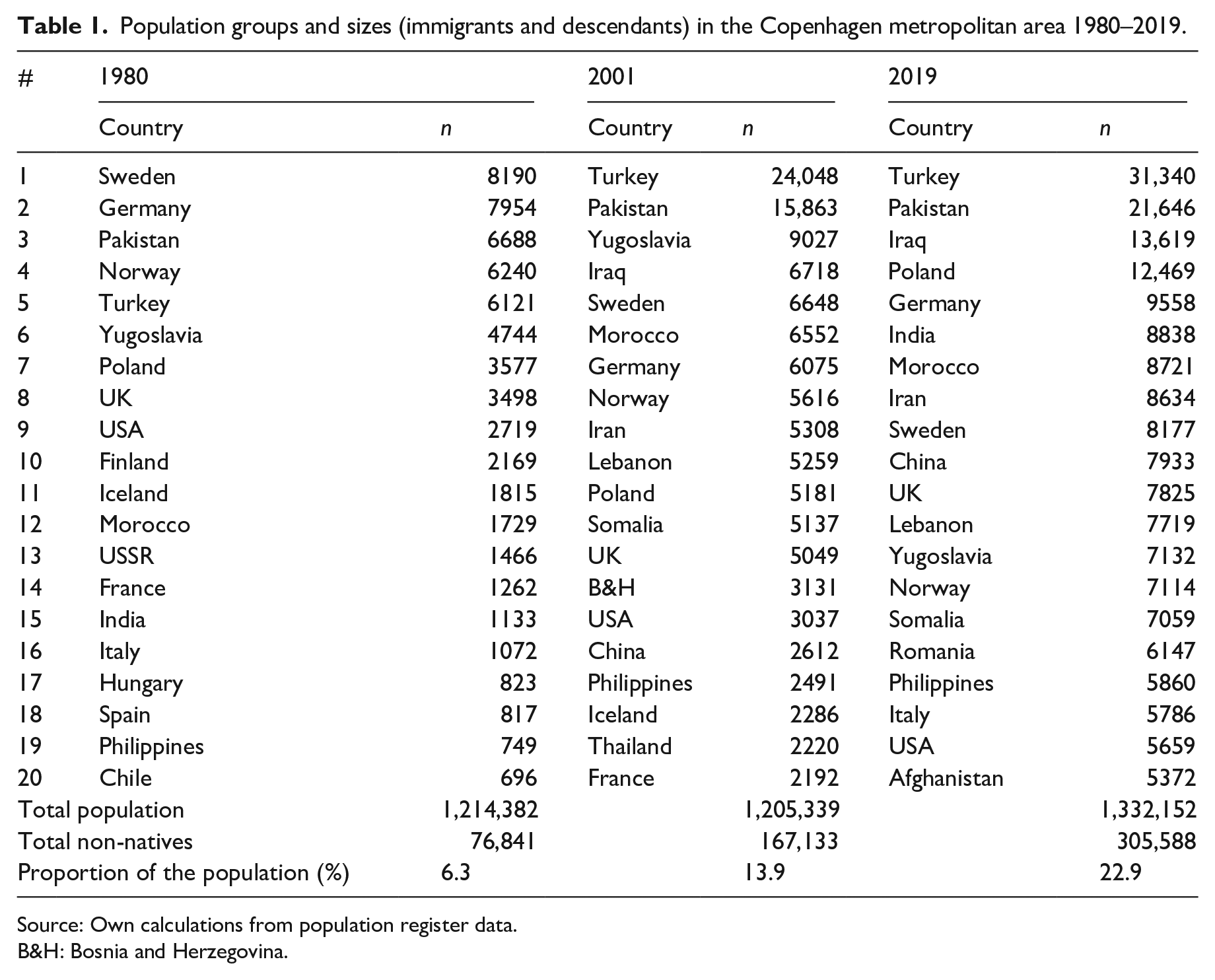
Source: Own calculations from population register data.
B&H: Bosnia and Herzegovina.
The current composition of the immigrant-origin population in the Copenhagen area was shaped by migration flows starting around the second half of the 1960s, when workers from Turkey, Pakistan, former Yugoslavia, and Morocco arrived by way of the workforce-immigration program. During the 1980s and 1990s, the main migration streams originated from various conflict regions (Iran, Iraq, Lebanon, Somalia, and Bosnia and Herzegovina). The 2000s were dominated by flows of asylum seekers from various regions and immigrants from Eastern Europe, who, following the enlargement of the European Union, had access to the Danish labor market. In 2019, people of Polish origin ranked the fourth largest immigrant origin group in the city.
There is a significant level of residential segregation of minorities in Copenhagen, although there is weak downward trend (as measured by the dissimilarity index; cf. Supplementary Table S2). Housing policies and prices, migration inflows, and labor market developments have contributed to the segregation processes and outcomes in Copenhagen. Comparative research on Nordic cities has shown that the housing market has a fundamental role in structuring segregation patterns (Andersen et al., 2016). It is worth noting that Denmark has historically led an extensive policy aimed at providing affordable housing for all residents through means such as tax deductions for mortgage interest and direct subsidies for rental housing, as well as rent regulation (Kristensen, 2002).
Approximately half of the Danish residential units are owner-occupied. However, the proportion of owner-occupied units is far lower in the Copenhagen area, where approximately two in five and one in five residences are owner-occupied in the regions Københavns omegn (surrounding areas) and Byen København (the city of Copenhagen), respectively (Statistics Denmark, n.d). For many immigrants in the urban areas, social housing and dwellings in disadvantaged neighborhoods have been the most easily available housing options (Kristensen, 2002), resulting in political concerns over the concentrations of social problems in such areas (Ministry of Refugees, Immigration and Integration Affairs, 2004). Following the 2001 election, the Ministry of Housing was closed down, and its activities were transferred to several other ministries, as the national government took a less active role in housing policy.
The issue of residential segregation is a major political factor in Denmark. Its salience stems from its link to larger, integration-related issues. In the last decade, the country’s immigration policy has stood out as being markedly stricter than those of neighboring countries. Denmark has also had a more intense public debate about immigration, integration, and segregation (Green-Pedersen & Krogstrup, 2008).
Theoretical perspectives and research on segregation and native out-migration
As mentioned, the concept White flight was coined in the United States to describe a process whereby White middle-class families move from the central cities to suburbs within US metropolitan areas (e.g. Crowder and South, 2008; Massey et al., 1994; South and Crowder, 1997). The main assumption is that White households residing in mixed neighborhoods tend to move out of such neighborhoods because of the high or increasing minority share of the neighborhood population. As predicted by the Schelling (1971) model, such a process may be driven by Whites’ preferences for a certain proportion of own-group members in their neighborhoods. This argument is supported by comprehensive literature showing that own-group preferences exist among both majority and minority populations, although several studies have found that some minority populations tend to prefer integrated or mixed neighborhoods (Clark, 2002; Clark and Coulter, 2015; Emerson et al., 2001; Krysan et al., 2009; van Ham and Feijten, 2008). Furthermore, studies building on, expanding, and modifying the Schelling model have shown that such preferences are capable of explaining persisting patterns of segregation through selective moving behavior (see, for instance, Aldén et al., 2015; Clark and Fossett, 2008; Fossett, 2006), although the model has also received criticism (Bruch and Mare, 2006). Other studies suggest that stereotypes, prejudice, and negative attitudes toward other races, ethnicities, and immigrants are the causes of out-migration (Farley et al., 1994, 1997; Krysan, 2002; Wilson and Taub, 2006), rather than mundane preferences.
However, a number of factors other than the racial or ethnic composition of neighborhoods may also produce similar patterns. For instance, immigrants may settle in areas where the resident natives are generally more mobile (Crowder et al., 2011). According to the socioeconomic context thesis, the conditions of the neighborhood are more important predictors of out-migration than ethnicity or race per se. An increase in the concentration of minority groups in an area may be associated with, or even generated by, a worsening of the socioeconomic conditions in that area. For instance, deterioration in the quality of education, poorer employment prospects, and an increase in crime may affect the neighborhood composition through several mechanisms (Betts and Fairlie, 2001; Crowder et al., 2011; Rathelot and Safi, 2014), including shifts in housing prices allowing relatively poor minority groups to settle. This transformation of neighborhoods, in turn, may become a push factor for migration decisions. However, as Goodwin-White (2018) has shown, the impact of a neighborhood may be conditional on the characteristics of the movers and the stayers, and people who may benefit from moving are more likely to do so. In a similar vein, the racial proxy hypothesis suggests that an influx of minorities in a neighborhood is a signal of socioeconomic deprivation, and that this is what motivates the moving behavior of the majority population, rather than the minority concentration in itself (Clark and Coulter, 2015). The housing competition model, however, suggests that an influx of minorities can increase housing prices and the cost of renting, which can stimulate majority group members of lower socioeconomic status to leave the neighborhood (Crowder et al., 2011; Ley and Tutchener, 2001). A different argument is provided by the labor market competition hypothesis, which suggests that an influx and an increasing concentration of immigrant minorities increases competition in the local labor market. A potential response to this pressure is for the population groups already in place to migrate out of the area (Borjas, 2006; Frey, 1995, 1996; Filer, 1992). Moreover, micro-level characteristics (individual and household) are important intervening factors in the relationship between out-migration and the local concentration of minorities. For example, there may be differences in the probabilities of out-migration by age, sex, marital status, number of children, and household income (Crowder, 2000; Sabater and Finney, 2014). The notion that high ethnic minority concentrations are somehow problematic, or are perceived as problematic by movers, should be accompanied by an important caveat; ethnic segregation may, in some instances, yield benefits to newly arrived immigrants. Ethnic enclaves may provide social networks, support, and employment opportunities, as well as a cultural and linguistic community for ethnic minorities (Edin et al., 2003; French, 2014; Musterd and van Gent, 2012; Wilson and Portes, 1980).
Regardless of the exact mechanisms that may produce these moving patterns, several studies have shown robust patterns of White or native flight, even after control for numerous relevant individual- and neighborhood-level characteristics (see, for instance, Andersen, 2017; Bolt et al., 2008; Crowder et al., 2011, 2012). The bulk of the literature on White or native flight stems from the United States. US studies usually employ racial categorizations, such as Black, White, and Hispanic, and some have shown that the phenomenon of flight is not solely related to the White population. Similar patterns can be observed among the African American or Black population in the United States (Crowder et al., 2012; Pais et al., 2009; South and Crowder, 1997; South & Crowder 1998; Woldoff, 2011). For example, Crowder et al. (2012) indicated that the probability of out-migration is significantly associated with the racial composition of the origin neighborhood, both for Whites and Blacks, controlling for other socioeconomic characteristics of the individual and the neighborhood. Pais et al. (2009) document a type of out-migration they call “minority flight” in cases where the probability of out-migration increases for minorities (e.g. Latinos) in White-dominated neighborhoods because of, for example, real or perceived discrimination. Several studies show that the flight thesis can be extended beyond racial segregation and applied to the mobility of the native and immigrant-origin population in the United States. For instance, Crowder et al. (2011) observed intensified out-migration among natives (Whites and Blacks) when the share of immigrants increased in a neighborhood. Similarly, in studying migration patterns related to the labor market, Borjas (2006) found that native out-migration increases with immigration-induced increases in the supply of labor. Hall and Crowder (2014) observed that the association between the out-migration of natives (Whites and Blacks) and the concentration of immigrants is significantly more pronounced in the developing gateways of migration than in the developed ones.
Above and beyond the current composition of neighborhoods, Bråmå (2006) suggests that the rate of the change in composition may be important for out-migration. Moreover, Crowder et al. (2011) suggest that immigrant concentration in the surrounding areas likely also has an effect on out-migration, by constraining the opportunities of finding nearby neighborhoods with more ethnically homogeneous populations.
Out-migration, flight, and avoidance in Europe
Concerns about the integration of immigrants from non-Western countries and their concentration in relatively disadvantaged urban areas have generated increasing interest in residential segregation among social scientists in Europe. However, in European settings, and particularly in the Nordic countries, segregation is often conceptualized and studied as the separation of the native or ethnic majority population from the immigrant or other ethnic minority populations, rather than the separation of different racial groups. The relatively short history of large-scale immigration makes the comparison with White flight in the United States difficult, given the long US history of racial oppression and discrimination, particularly of the African American population. Another important difference is the existence of more extensive welfare states, which may attenuate socioeconomic neighborhood deprivation. Notably, the inner cities are generally less deprived in European countries than in the United States, and even less so in Scandinavia. Thus, the notion of White flight, as discussed in the American literature, may be less relevant. Despite these differences, however, it is reasonable to assume that some of the mechanisms that produce White flight in the American context may work similarly to produce native flight in Denmark and other European contexts. Particularly, one might expect the dynamics of in-group/out-group preferences to translate into preferences for the ethnic majority/minority compositions of neighborhoods, thus producing patterns of native flight from neighborhoods with high and growing proportions of minorities. However, studies of White flight or native flight in European contexts have so far shown mixed results.
Based on a study of four large cities in the Netherlands, Bolt et al. (2008) provided evidence that Dutch and Western immigrants had a higher probability than non-Western migrants to move out of neighborhoods with high concentrations of immigrants. Dutch natives also tended to migrate to areas with lower proportions of minorities. Van Ham and Feijten (2008) also showed that increases in the immigrant population were associated with Dutch natives’ desire to leave their neighborhoods. However, Zwiers et al. (2018) found the mobility patterns of the native Dutch population to drive increased residential mixing, not segregation.
A study by Clark and Coulter (2015) found neighborhood deprivation, changes in the neighborhood ethnic composition, and changes in housing tenure distribution in Britain to be associated with preferences for moving, and that feeling similar to others and having a sense of belonging in a neighborhood were associated with a lower desire to move. However, they found individual characteristics to matter more than neighborhood characteristics. In France, Rathelot and Safi (2014) showed that the probability of out-migration from Parisian neighborhoods with a high share of immigrants was higher for natives, but this association became small and insignificant once all fixed characteristics of the geographic area were introduced into the regression models. Similarly, Simpson and Finney (2009), using census data, did not find evidence of a native flight pattern in Britain. They suggest that out-migration can be explained by aspirations to improve living conditions, which are shared by all ethnic groups. Bråmå (2006, 2008) provided evidence to reject the hypothesis that the flight of Swedes caused further ethnic segregation and immigrant concentration in Swedish cites, and argued that the main cause of increasing segregation is the avoidance-like behavior of natives; natives avoid moving into areas with high proportions of minorities, rather than move out of them. Andersson (2013) confirmed that Stockholm residents tend to avoid multi-ethnic neighborhoods. However, other studies have found evidence of native out-migration as a response to high concentrations of minorities in the urban areas of Sweden (Aldén et al., 2015), Norway (Wessel and Nordvik, 2019), and France (McAvay, 2018a). Kauppinen and van Ham (2019) also found the intraregional residential mobility patterns of natives to contribute to increased ethnic segregation in the Helsinki region of Finland.
In an anthology edited by Lloyd, Shuttleworth, and Wong (2014), several authors shed additional light on residential mobility processes and how these may contribute to residential segregation. For instance, Shuttleworth et al. (2014) showed that among the Protestants and Catholics in Northern Ireland, selective moves corresponded with patterns of out-migration and flight from neighborhoods with high shares of out-group members. However, this did not translate into increasing segregation, because, in addition to the effects of births and deaths, most moves were across short distances between similar neighborhoods, and relatively few lived in neighborhoods dominated by their out-group. Van Ham and Manley (2014) showed that the social housing market policies in England affect residential sorting between minority and majority groups in a manner consistent with the notion of selective moves, leading minority groups to move into deprived neighborhoods. In a related vein, but returning to the US context, Hwang (2014) showed how the housing market in St. Louis and Cincinnati contributes to racial segregation.
In the case of Denmark, the literature focusing on native out-migration is scant. Immigrant-origin minorities in Denmark often live in less attractive areas with more social problems. The city of Copenhagen has seen an increase in spatial segregation in housing and education (Møller and Larsen, 2015). Moreover, in the period 2000−2008, non-Western immigrants in Copenhagen did not improve their neighborhood status, whereas the native group did, according to a study of the spatial integration of immigrants in Nordic cities (Wessel et al., 2016). In a study of young home leavers of Danish, Somali, and Turkish origins, Nielsen (2016) found that all minority groups had a higher likelihood of moving to neighborhoods with high minority concentrations. There was only a weak tendency among minority home leavers to move to neighborhoods with lower minority concentrations, suggesting that the intergenerational assimilation processes that may generate upward residential mobility are slow. This pattern of limited residential assimilation (or minority retention) among children of immigrants is also echoed in studies from other European countries (Hermansen et al., 2021; McAvay, 2018b; Zuccotti, 2019). Andersen (2017) conducted a study of residential mobility in Denmark in 1985−2008, using data on non-Western immigrants aged 15 years or above and a sample of Danes from administrative registers. Based on information on 9000 neighborhoods (approximately 600 inhabitants each), he used a logistic regression model of out-migration with control characteristics (individual, household, and neighborhood). The study provided some evidence of native flight in Denmark, as the probability of out-migration increased with the share of immigrants; however, native avoidance seemed more important than flight in producing the spatial segregation patterns.
With regard to the housing market, it is well established that ethnic minorities face several disadvantages that may affect moving patterns and reduce their out-mobility (including income and wealth discrepancies, tenure type, and housing and credit market discrimination), and that neighborhood differences in tenure composition and affordability of housing are major factors contributing to residential segregation. For instance, comparing four Nordic capital cities, Andersen et al. (2016) have documented a strong link between residential segregation and housing tenure, while Kauppinen et al. (2015) found differences in entry into homeownership between natives and immigrants that could not be explained by employment status and income in three Nordic capital region (though wealth was not included in their models). However, while the characteristics of the local housing tenure composition, homeownership, accumulated wealth, and several related characteristics are relevant to understanding the moving decisions of minority and majority groups, we cannot include these factors in our analyses, for reasons explained below.
Finally, having children likely increases one’s responsiveness to local conditions that otherwise would not be given much weight, such as children’s school environments and environments for language learning (Nielsen and Andersen, 2019). Such factors could increase the sensitivity to the local population composition for natives with children, but likely not the childless natives (Wessel and Nordvik, 2019). In Denmark, school attendance is primarily decided by geographical attendance boundaries, which makes residential relocation a potentially important strategy for parents who want to avoid enrolling their child in the local school. However, these boundaries are not absolute. In Copenhagen, parents may apply for their child to attend a different school than their nearest school; an application that is approved if the school has extra capacity (City of Copenhagen, n.d). A recent study from Denmark (Bjerre-Nielsen and Gandil, 2020) has shown that many parents respond to the socioeconomic and ethnic composition of their local school, and the redrawing of attendance boundaries, either by relocating or by enrolling their child in a private or a different public school. Similar studies from Norway (Rogne et al., 2021) and Finland (Kauppinen et al., 2020) have also shown that schools are an important factor in parents’ moving decisions.
Our contribution, hypotheses, and expectations
This article contributes to the literature in several ways. First, we offer a longitudinal view of native out-migration, where we relate neighborhood characteristics and changes in these characteristics to the likelihood of an individual’s out-migration. We use individualized scalable neighborhoods based on high-quality register data, with detailed geographical coordinates on all residents of the Copenhagen metropolitan area. This allows us to circumvent the problem of aggregation, an important part of the modifiable areal unit problem (MAUP, see Nielsen and Hennerdal, 2017). Second, we address several different aspects of the dynamics of residential segregation, including the importance of the extralocal neighborhood composition and majority/minority group differences in moving patterns. Third, we not only study out-migration for the whole population, but also analyze whether sensitivity to the local neighborhood composition and to changes in this composition is different for individuals with and without children, and assess the robustness of our estimates to different specifications of the minority group.
Based on the brief overview of the literature reviewed above, we set out several hypotheses on how native out-migration choices are associated with the ethnic composition and the changes in the ethnic composition of the neighborhood. First, we set out to test the out-migration hypothesis:
H1. The likelihood of out-migration is higher when the share of minorities is higher, and it increases when the share of minorities increases.
Second, we also put forward the stronger out-migration hypothesis, which posits that the out-migration response to the local concentration of minorities varies with one's own immigrant background. If natives have a stronger response than descendants of immigrants, it may suggest that the mechanisms increasing native out-migration are related to minority status and social or cultural factors, and that estimates do not simply reflect higher residential turnover in neighborhoods with higher minority concentrations:
H2. The probability of moving out of neighborhoods with high concentrations of minorities is markedly higher among natives than among descendants of immigrants.
We also want to examine the hypothesis that the concentration of minorities in the extralocal area, the larger area beyond the immediate neighborhood, is negatively associated with out-migration decisions in the native population. According to Crowder et al. (2011), an increase in the extralocal concentration of minorities may lead to a reduction in the probability of the majority group moving out. The reason for this is that for structural reasons (e.g. commuting patterns and family ties), most migrations take place over rather short distances, and an increase in the concentration of minorities in the extralocal area limits the migration options for individuals whose tolerance for minority groups is low. Thus, our third hypothesis, the extralocal opportunities hypothesis, states the following:
H3. A higher concentration of minorities in the extralocal area is negatively associated with native out-migration.
Finally, since we expect parents to be more sensitive to their local neighborhood and school context than non-parents, we study whether having children moderates individuals’ sensitivity to local conditions. Our fourth hypothesis is thus:
H4. The response to the concentration of minorities and changes in the concentration of minorities is weaker among childless natives than among native parents.
Data and methods
For our empirical analysis, we use data from the administrative population registers of Denmark, administered by Statistics Denmark (summarized in Table 2). Our data consist of individual and neighborhood characteristics for the urban area of Copenhagen in 2007, 2011, and 2014. In addition, we use data from 2003 to calculate changes in neighborhood characteristics in the period from 2003 to 2007. The urban agglomeration area in and around Copenhagen is defined as two NUTS-3 areas: Byen København and Københavns omegn, which, in total, consist of 17 municipalities: København, Frederiksberg, Dragør, Tårnby, Albertslund, Ballerup, Brøndby, Gentofte, Gladsaxe, Glostrup, Herlev, Hvidovre, Høje-Taastrup, Ishøj, Lyngby-Taarbæk, Rødovre, and Vallensbæk. In 2014, this area had 1.26 million inhabitants and had grown by approximately 106,000 since 2007. Our data include all individuals who were registered as residents in these areas in any of these calendar years. Included in the data are individual-level characteristics for all these individuals (cf. “An individualized approach to neighborhoods” section) and, importantly, the geographical coordinates of the individual’s place of residence. The individual-level data were then complemented with the characteristics of each individual’s neighborhood.
Descriptive statistics of analysis variables.
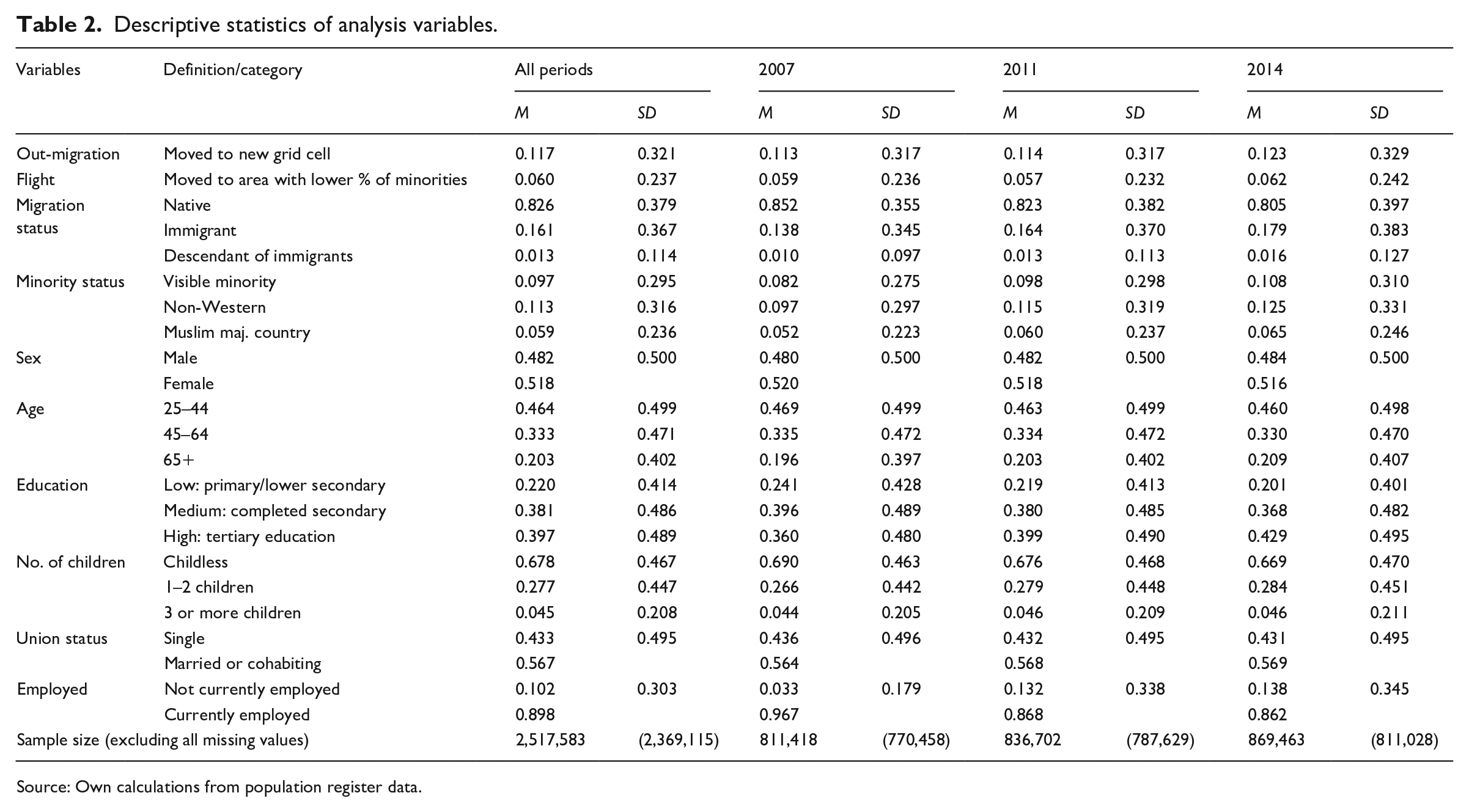
Source: Own calculations from population register data.
This data set was compiled for the purpose of providing statistics and analyses to the now-completed, comparative research project ResSegr. The main strength of the data set lies in the high-quality, detailed neighborhood variables that were calculated for each individual, its size, and its longitudinal nature (summarized in Table 3). The most important limitations are that it does not cover every calendar year, and that the set of variables is limited and fixed. Notably, although factors such as wealth and homeownership are central to moving decisions and housing opportunities, we are unable to incorporate these in our analyses.
Descriptive statistics of neighborhood variables.
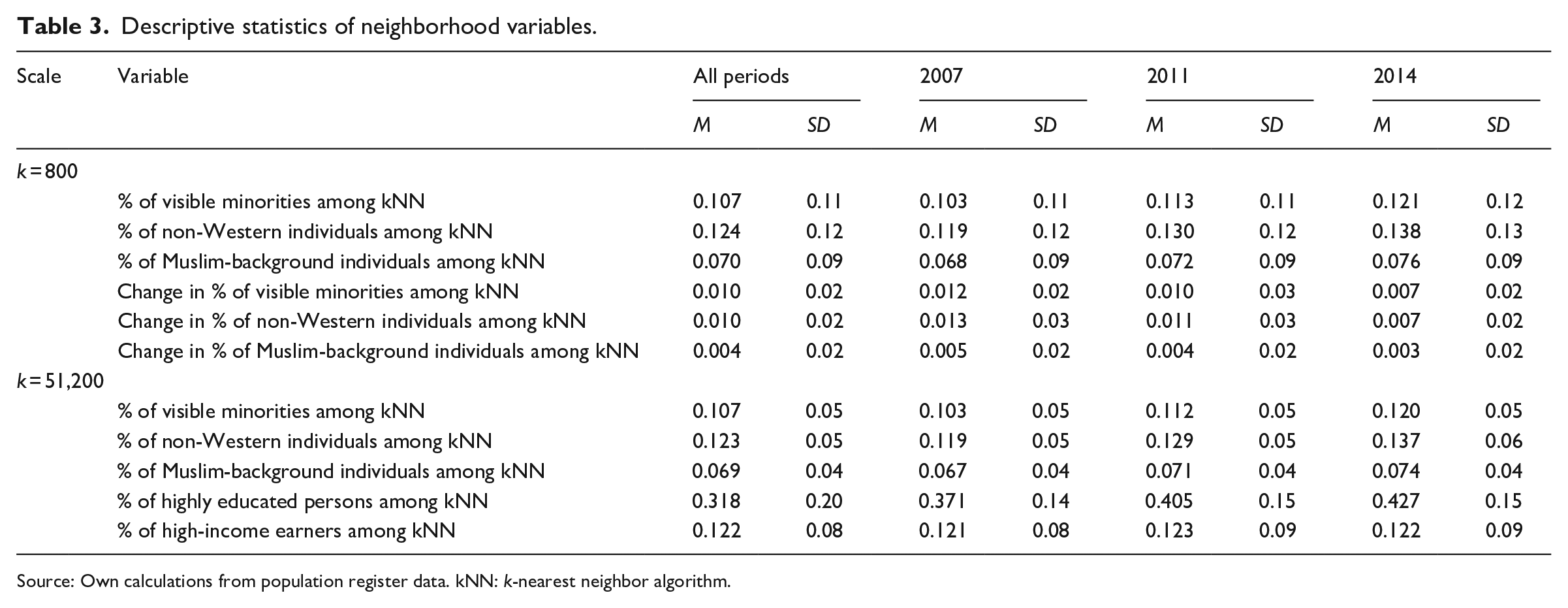
Source: Own calculations from population register data. kNN: k-nearest neighbor algorithm.
Individual-level variables
This main dependent variable is an indicator of whether an individual changed place of residence during a calendar year. We measure this change by comparing the grid cells indicating where an individual lived at the beginning (1 January) and at the end of the year t (31 December). If the codes of the two grid cells are different, we code this as an out-migration event. Individuals who died or emigrated during a year, or have missing addresses, are excluded from the analysis.
Mobility and segregation patterns are highly structured along demographic and socioeconomic dimensions. Minority populations may, for example, be younger and more male-dominated than majority populations. To avoid confusing the effects of the environment with the effects of individual characteristics, we include six individual-level control variables in order to improve the comparability of individuals with different origins living in different neighborhoods. Age is represented by a set of dummy variables indicating three broad age groups; 25–44, 45–64, and 65 and above. Sex is a dummy variable indicating if a person is a male. Marital status indicates whether an individual does not live in a registered form of partnership. Number of children is defined as a categorical variable with levels childless, 1–2, and 3+ children. We do not have any information about the age of these children in our data. Educational attainment is defined as a categorical variable with the levels primary or lower secondary (low), higher secondary (medium), and tertiary (high). The variable Employed is a dummy variable indicating whether the person is currently employed. Finally, we include dummy variables for year to capture any secular trends in mobility.
In this article, we primarily wish to investigate whether native residents in the Copenhagen area move out of neighborhoods with high (and increasing) concentrations of minorities. We contrast natives to descendants of immigrants, using the standard definitions made by Statistics Denmark. There, a native is a person of Danish origin with at least one parent who is a Danish citizen and was born in Denmark. This definition does not involve the focal individual’s place of birth. The group is thus heterogeneous as, for example, the children of mixed-origin couples (one Dane and one non-Dane) will still be counted as natives. A descendant is a person born in Denmark, neither of whose parents is a Danish citizen and born in Denmark. If there is no available information on either of the parents and the person in question is born in Denmark and a foreign citizen, the person is also defined as a descendant. Thus, if at least one parent with descendant status was naturalized, then a child is treated as a native. 1 An immigrant is a person who is born abroad and does not fall into either of the former categories.
An individualized approach to neighborhoods
A key challenge to all research on neighborhoods and aspects of their composition is how to define the size and delineation of neighborhoods (Damm & Schultz-Nielsen, 2008). Most of the research on segregation and mobility patterns use some kind of prior definition of neighborhoods, usually city districts or census tracts that typically are defined by historical borders, roads, or natural obstacles (such as rivers dividing cities), or for other practical, administrative, or political purposes. Such neighborhood definitions mean that the borders may be somewhat arbitrarily defined, however, and they may be at odds with the actual, spatial patterns of social interactions. Local neighborhoods do not necessarily stop at administrative borders, and segregation patterns may not follow the structure of the administrative units.
Individualized scalable neighborhoods, however, are neighborhoods defined by the individual’s location, where each individual’s neighborhood is defined as their k-nearest neighbors (Östh et al., 2014, 2015). The basic premise of the individualized approach is to calculate statistics over these k individuals (or households). Thus, in this approach, the neighborhood is defined around individuals rather than based on the borders of the administrative unit in which the individual resides. Our data on place of residence measure location down to a 100 × 100 m grid. The algorithm expands the area around the individual until k individuals are included in the neighborhood. Most individuals have their k = 800 nearest neighbors within the first three “rings” of grid cells, that is, within a radius of 300 m from their own location. (cf. Supplementary Table S7). Individual-level data on these neighbors were then used to calculate neighborhood characteristics and descriptive statistics of minority status, income and education at the neighborhood level. For this, we used the specialized software EquiPop, developed by population geographer John Östh (2013).
Definitions of neighborhood variables
Some neighborhood variables have straightforward definitions, while others require a deeper explanation. We tap into the socioeconomic characteristics of the neighborhoods by including the neighborhood’s educational level, measured by the share of individuals aged 25–64 years who have completed tertiary education, and neighborhood affluence, measured by the share of people aged 25–64 years who have a level of taxable income in the highest decile of the national income distribution. Turning to the local concentration of minorities, we measure this using three variables: the local concentration of minorities (see below), change in the local concentration of minorities, and, following Crowder et al. (2011), the concentration of minorities in the extralocal neighborhood. The local concentration of minorities is measured as the share of minority individuals in the focal individual’s egocentric neighborhood consisting of k = 800 individuals. The change in the local concentration of minorities is measured as the change in this concentration between the years under consideration (2007 vs 2003, 2011 vs 2007, 2014 vs 2011). The concentration of minorities in the extralocal neighborhood is measured as the share of minorities among the 51,200 nearest neighbors.
To create the variables measuring the ethnic composition of the individualized neighborhood, we need to define the minority group. Defining the minority group based on register data is not trivial and involves some difficult choices. We do not know which characteristics of minorities are most salient, and we have limited data on potentially relevant traits. On one hand, visual or phenotypical traits, such as skin color, may be important, as individuals with traits visibly different from the majority population may be subject to prejudice, discrimination, racialization, avoidance, and so on from the majority population. On the other hand, recent media debates and evident prejudice and hostility toward Muslims suggest that Muslim minorities may be particularly subject to negative stereotypes. In addition, research on ethnic segregation in Europe commonly focuses on the divisions between people from Western and non-Western origins (however defined), in part due to some notion of cultural proximity, and in part due to the different reasons for migration that have historically been important for different country-of-origin groups. Notably, refugees, asylum seekers, and their families mostly originate from non-Western countries, while immigrants from Western countries more commonly arrive as labor migrants, particularly after the EU expansion in 2004, or as students. Other options include grouping all immigrants and descendants, regardless of the country of origin, or distinguishing between European and non-European backgrounds. Danish register data contain information on immigration background and country of origin, but not on other potentially salient traits, such as skin color, race, ethnicity, and religious affiliation. Thus, groupings based on such characteristics have to be proxied by the country of origin. In this article, we categorize individuals as belonging to a minority group if they originate (i.e. are immigrants or descendants of immigrants) from countries outside of Europe (excluding Turkey), North America, and Oceania. We also experiment with two other groupings: one based on a naïve Western versus non-Western dichotomy and one based on the majority religion in the origin country. The results from analyses with these two definitions are very similar to our main results (cf. Supplementary Table S5).
Model specifications
We estimate several logistic regression models for the individual decision to leave one’s neighborhood during a year. The right-hand side of Model 1 includes the concentration of minorities, change in this concentration from the previous period, and a control for the concentration of minorities in the extralocal area. Then, we add controls for other characteristics of the neighborhood (Model 2). Finally, we include individual-level controls (Model 3). This set of models is estimated on the full population of natives and descendants (i.e. all non-immigrants), and then separately for natives and descendants. We also include supplementary analyses (Supplementary Tables S5.1–S5.2), in which we explore to what extent our results are dependent on the definition of the minority group.
In much of the previous theory and literature, the terms flight and out-migration are often used interchangeably, but these are two related but separate phenomena. While out-migration is a move to any area, a flight-type move really is a move to an area with a lower concentration of minorities. To make claims about flight in this narrower sense, one cannot rely on regression modeling like we do in this article. One may think that one could define the outcome to be a move to a neighborhood with a lower concentration of minorities. However, that involves a methodological problem: regression to the mean. When moving, people who live in neighborhoods with very high concentrations of minorities will usually move to neighborhoods with lower such concentrations—even if the moves are completely random. The opposite is true for people living in neighborhoods with low concentrations. The reason is that, closer to the top (bottom) of the distribution, there are fewer neighborhoods one could move to that have a higher (lower) concentration. Thus, if one studies native flight as a move to a low-concentration neighborhood, one would, almost by definition, find that a higher concentration in the local neighborhood is strongly positively associated with native flight. Using such a definition of the outcome would upwardly bias our estimates.
Results
A randomly chosen resident has between 10 and 16 percent chance of moving between the time points of our measurements in 2003, 2007, 2011, and 2014. Natives have the lowest likelihood of out-migration, while immigrants and descendants have somewhat higher likelihoods (cf. Supplementary Table S8).
The link between ethnic composition and out-mobility
Table 4 reports the results from our set of models of out-migration estimated on the full population: natives and descendants of immigrants. We first focus on the results for the full population, listed under the “Full” panel of Table 4, and the final model 3 that includes all controls. The findings suggest that the likelihood of moving out of a neighborhood is higher if the share of minorities in the neighborhood is higher. A one standard deviation higher share of minorities is associated with approximately a two-and-a-half-fold increase in the odds of out-migration (b = 0.912, odds ratio (OR) = 2.49) when controlling for individual and neighborhood characteristics. We examined the possibility of threshold effects, but except for the very end of the distribution (which concerns quite few individuals), there were no important thresholds in the absolute out-migration probability (cf. Supplementary Table S6). It is also clear that an increase over time in the share of minorities in the neighborhood population is positively associated with out-migration when other characteristics are controlled for (including the level of the minority concentration). An increase in the proportion of minorities of one standard deviation is associated with an approximately 31 percent higher odds of out-migration (b = 0.271, OR = 1.31).
Main results for neighborhood composition from three models across three population definitions.
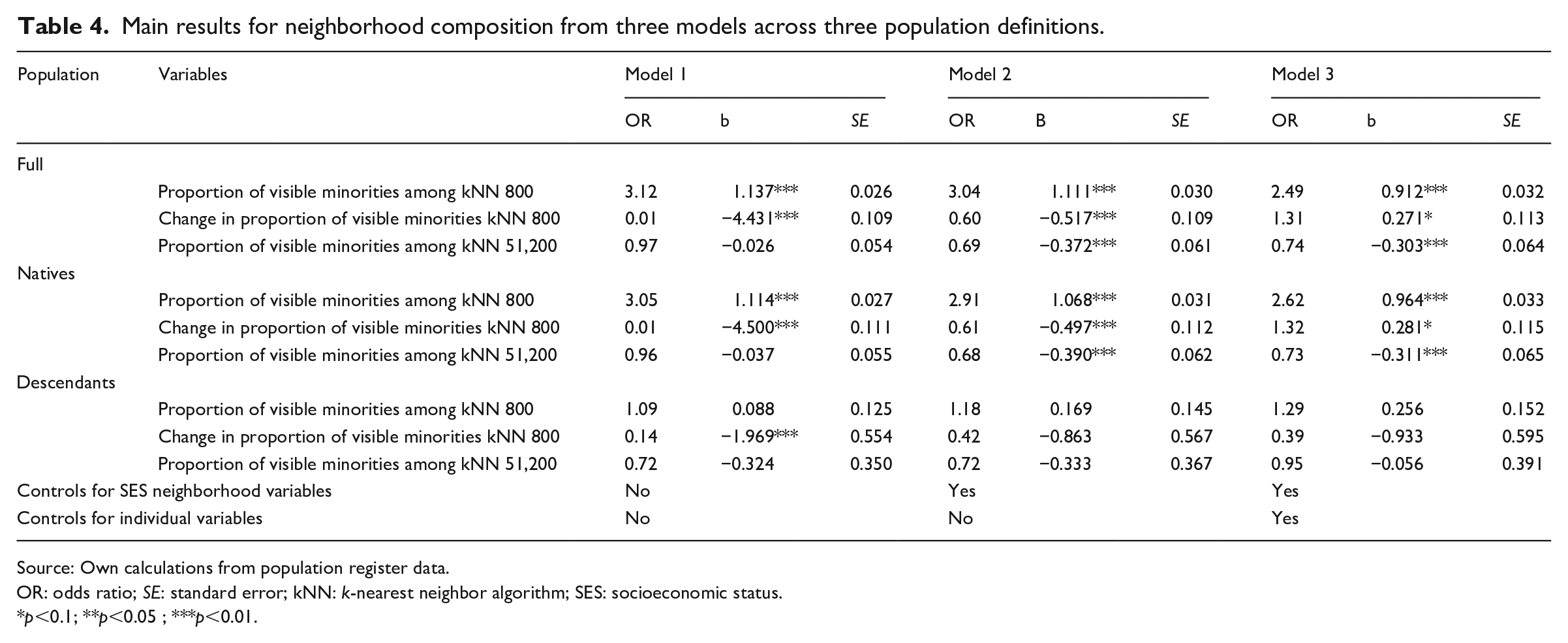
Source: Own calculations from population register data.
OR: odds ratio; SE: standard error; kNN: k-nearest neighbor algorithm; SES: socioeconomic status.
p<0.1; **p<0.05 ; ***p<0.01.
In our next step, we split up this population of individuals born in Denmark into natives and descendants. These sub-analyses reveal that the phenomenon of out-migration related to minority concentration is only observed in the native group. As follows from the separate Natives and Descendants panels in Table 4, the coefficients in the models for the native population are similar in size to those in the models for the total population. In our sample of descendants, the coefficients for the proportion of minorities are smaller and non-significant, while the coefficients for change in the proportion of minorities are negative and non-significant. Only various individual and neighborhood-level control variables (cf. Supplementary Tables S3.1–3.3) are statistically significantly associated with a descendant’s likelihood of out-migration. This supports our second hypothesis that posited a weaker relationship between local population characteristics and out-migration among the descendants of immigrants.
The concentration of minorities in the extralocal (k = 51,200) area is negatively and statistically significantly associated with out-migration. This association is, however, somewhat weaker than the association with the proportion of minorities in the local neighborhood, and insignificant for descendants. This supports the extralocal opportunities hypothesis, which posited that when the concentration of minorities in the extralocal area is relatively high, the likelihood of out-migration is lower.
The importance of parenthood
Our fourth hypothesis stated that the response to changes in the local concentration of minorities is weaker among childless natives than among native parents. Wessel and Nordvik (2019) suggested that parents may be more sensitive to the local concentration of minorities than non-parents, for instance, because of concerns over the potential adverse effects of their children attending schools or residing in neighborhoods with high minority concentrations (Nielsen & Andersen, 2019). In other words, it is likely that individuals’ responses to such concentrations vary with individuals’ life course stages.
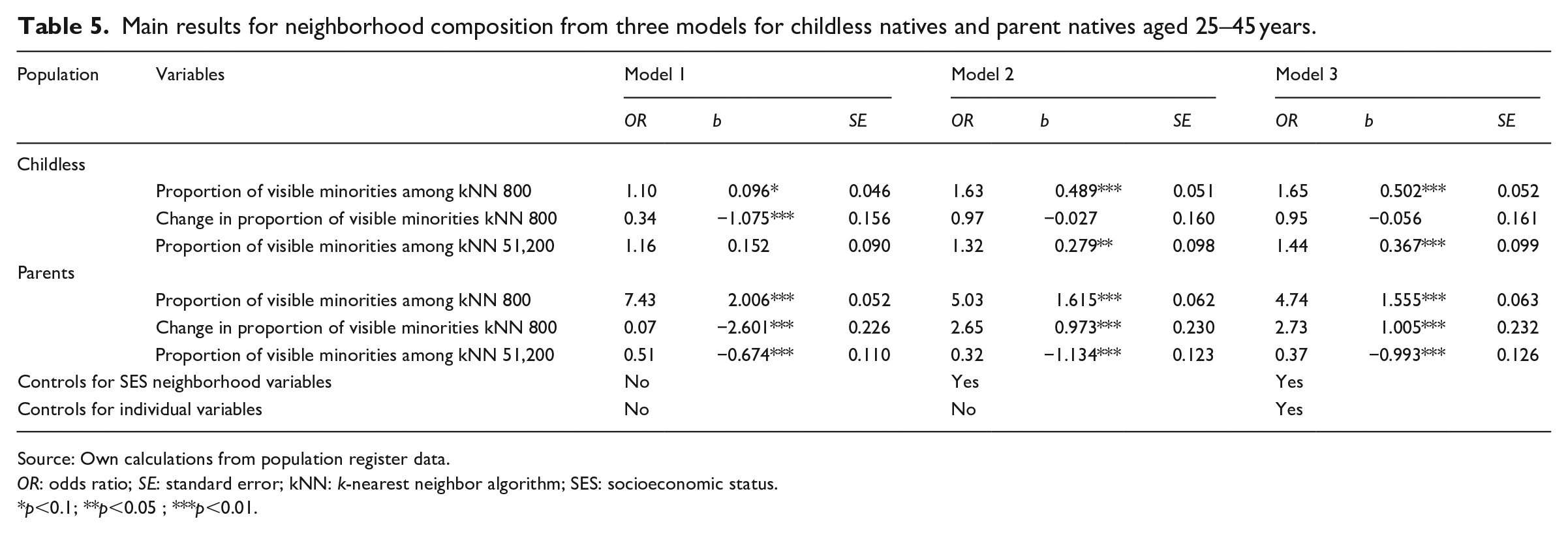
To assess this hypothesis, we ran an analysis using native individuals aged 25–45 years, who represent those most likely to be living with children of (pre) school age. This subsample was divided into two groups: parents and non-parents. We then estimated our main model specifications on these subsamples. The main results from these estimations are given in Table 5 (with complete results in Supplementary Tables S4.1 and S4.2). The results from our estimations largely confirm that parents do appear to be more sensitive to the population composition of their neighborhoods, and to changes in this composition, than non-parents. Consider our fullest model specification (Model 3 in Table 5) and the coefficients for the local concentration of minorities and the change in this concentration. For childless individuals, the coefficient for the local concentration of minorities is about one-third of the corresponding number for individuals who are parents (1.65 vs 4.74), and the difference is statistically significant. The higher sensitivity of parents becomes even clearer when we compare the corresponding coefficients for the change in the concentration of minorities. The coefficient for childless individuals is near zero and non-significant, while the coefficient for parents is positive, rather strong (OR = 2.73) and statistically significant.
Main results for neighborhood composition from three models for childless natives and parent natives aged 25–45 years.
Source: Own calculations from population register data.
OR: odds ratio; SE: standard error; kNN: k-nearest neighbor algorithm; SES: socioeconomic status.
p<0.1; **p<0.05 ; ***p<0.01.
These results thus support Wessel and Nordvik’s (2019) suggestion that individuals with children have a higher sensitivity to characteristics of the local environment and changes in such characteristics. We do not know exactly what produces these associations, however, and there are some important possible explanations, even when we have controlled for some aspects of the socioeconomic composition of the neighborhood. For example, the possibility remains that characteristics of housing stock are correlated with the concentration of minorities. Neighborhoods with high minority concentrations are often characterized by a high density of apartment buildings. Individuals with children living in such areas most probably also have a higher and perhaps even increasing housing demand (Gambaro et al., 2017) and may be forced to look elsewhere to be able to find larger dwellings. In addition, as discussed above, the perceived quality and student compositions of local schools may be important for parents’ moving patterns.
Robustness check: Does the definition of minority groups matter?
As discussed above, the definition of the minority group that we use in our main analysis is somewhat arbitrarily chosen and delineated. We therefore find it pertinent to ask whether the results are highly sensitive to the definition of the minority group. It is conceivable that our results would look different had we used another grouping of individuals. We therefore tested the sensitivity of our results to the choice of grouping by re-estimating the same models, while defining the minority group as individuals originating from non-Western countries, and from predominantly Muslim countries, respectively (Pew Research Center 2011).
We observe the same general pattern for all three definitions of the minority group (as is clear from the Supplementary Table S5). For all these definitions, the coefficient for the association between the local concentration of the minority group and out-migration is estimated at approximately 0.9. Evidently, the choice of grouping does not matter very much in this case.
Discussion and conclusion
We found that the out-migration probabilities in our pooled sample of natives and descendants are higher in neighborhoods with higher proportions of minorities and in neighborhoods with increasing shares of minorities, and lower in areas with higher proportions of minorities in the extralocal neighborhoods. We further found that this pattern is stronger among natives, but weaker, partly reversed, and non-significant among descendants of immigrants. In other words, we found evidence of moving patterns that correspond with native out-migration in Copenhagen. Our results also suggest patterns of minority retention or slow spatial assimilation.
Why do natives leave neighborhoods where the share of minorities in the population is high or increasing? In other words, what mechanisms may lead to higher out-migration among natives? As mentioned above, one possibility is that people leave such areas because they prefer to live in proximity to their own group. Individuals’ preferences for neighborhood compositions may be more or less diversity-oriented, and they may prefer to live in relatively ethnically homogeneous areas. Earlier, we reviewed several competing hypotheses on native out-migration in response to increasing local minority concentration. Can these theories be put to use in our case, or are we left with ethnic homophily preferences as the main explanation? The socioeconomic context hypothesis and the labor market competition hypothesis do not seem highly relevant, as we attempted to control for such factors at both the neighborhood and individual levels. The housing competition hypothesis is obviously related to socioeconomic status, but involves factors we cannot control well for. The racial proxy hypothesis, the idea that people see an increasing minority population as an early signal of neighborhood decline, cannot be ruled out by our analysis. This hypothesis nevertheless involves a belief about minorities that borders on preferences for ethnic homophily. Thus, with some reservation about the roles of housing competition and anticipated neighborhood decline, we still must consider the preference-based explanation plausible. The contrast between natives' and descendants' migration behaviors is noteworthy in this regard. It is likely that descendants' preferences are different from natives’ preferences. It seems plausible that the response to increases in minority concentration is driven by minority retention, or a desire to live in neighborhoods with co-ethnics, family, or a sizable minority population, but we cannot rule out alternative explanations, such as socioeconomic disadvantages and more limited opportunities in the housing market for minorities.
In 2002, the European Social Survey asked respondents about their preferences for neighborhood ethnic composition. The opinion held by Danes was striking: 37 percent stated that they preferred to live in an ethnically homogeneous area. This is a markedly more negative attitude to neighborhood diversity than the views held, on average, by the Norwegian (23%), Swedish (20%), and Finnish populations (31%). However, when we restrict the sample to those living in the metropolitan area, including the capital city, the levels are somewhat lower. Danes in the Copenhagen area were less skeptical of neighborhood diversity, but still more than a quarter (27%) expressed negative opinions about residing in a diverse neighborhood, markedly higher than the populations of the Oslo and Stockholm metropolitan areas.
Another related explanation is that some parents may hold preferences for schools with a low concentration of ethnic minority pupils (Nielsen and Andersen, 2019), such that native parents of young children move selectively to avoid schools with high minority concentrations. Wessel and Nordvik (2019) suggested that this may be the case in Norway, and other recent studies support this notion (Bjerre-Nielsen and Gandil, 2020; Kauppinen et al., 2020; Rogne et al., 2021). Our analysis of parents and non-parents also clearly supports such an argument. However, we cannot rule out alternative explanations, such as the possibility that the tendency of natives to out-migrate that we observe is primarily driven by neighborhood characteristics other than their ethnic composition, or by selection processes. In other words, this study does not provide direct evidence that natives are motivated to move by a preference for ethnically homogeneous neighborhoods. A number of other factors besides ethnic composition may affect the propensity to move out of neighborhoods with high and/or increasing proportions of minorities. Regardless of the exact mechanism producing native out-migration, however, this study has documented that natives do tend to move out of neighborhoods with high and increasing minority concentrations in the Copenhagen area. Moreover, this process likely contributes to maintain ethnic segregation in the urban area. In this regard, our results are consistent with some recent studies in other countries, for example, Aldén et al. (2015), Wessel and Nordvik (2019), and McAvay (2018a), who found patterns of native out-migration in Sweden, Norway, and France, respectively.
Nevertheless, our study also has several limitations worth noting. First, our sample is endogenously conditioned. The individuals living in neighborhoods with high concentrations of minorities are the individuals who have not already moved out. This may bias our estimates downward if the natives remaining in such neighborhood are selected on tolerance or other relevant traits that lower their out-mobility. Second, the set of control variables we include is by no means comprehensive, and other factors (at the neighborhood or individual level, including characteristics of the local housing market or wealth) may drive our results. In particular, data on individuals’ duration of residence, their housing tenure, and the housing market are highly relevant for our study, but we were not able to include such factors in our data and analysis.
Third, we only analyze a limited number of years. Undoubtedly, our conclusions could have been stronger if we had been able to use more fine-grained panel data. Fourth, we do not have information about individuals’ preferences, and thus, cannot directly test whether our results chiefly reflect neighborhood preferences. Fifth, we acknowledge the fact that our analyses are sensitive to issues related to comparing the logistic regression coefficients across models (Mood, 2010) and that the explained variance in most models is modest. Finally, most of the theoretical discussions in this article, and in much of the literature on residential segregation, assume that individuals interact with their neighbors or somehow care about who resides in their neighborhood. This may be a strong assumption with limited validity. If neighborhoods are not an important locus of interaction, this would undercut several theoretical contributions to segregation research, but it would not invalidate our conclusions. However, we do believe that this may be a valuable research topic, as several theories about neighborhood effects implicitly or explicitly assume that neighbors interact and affect each other, and that neighborhood differences are not primarily driven by selection.
These limitations notwithstanding, this study has contributed to the literature on segregation and mobility in several ways. We have used high-quality register data and the novel technique of individualized, scalable neighborhoods to model out-migration in Copenhagen. Our results speak to several salient issues in the extant literature: ethnicity likely influences migration processes in urban areas, because our results differ sharply between natives and descendants. Our analyses also highlight the role of children as a potentially important aspect of people’s motivations for moving. It remains unclear why, during the period we studied, Copenhagen experienced both native out-migration and declining overall segregation. Malmberg and Clark (2019) showed that there is income sorting across neighborhoods with different ethnic compositions and suggested that this income sorting in combination with higher housing costs may counteract or limit ethnic segregation. Future research will hopefully take up this question.
To researchers and governments who are struggling with issues related to the integration of minorities, the evidence presented here may serve as a useful reminder that individuals respond to their environments in ways that sometimes are in conflict with the political goals and the targets of social planners. If neighborhood diversity is a political goal, and there may be good reasons to pursue such a goal, one must take into account the potential feedback mechanisms of individuals moving away from areas with large and increasing shares of minorities.
Supplemental Material
sj-xlsx-1-eur-10.1177_09697764211039183 – Supplemental material for Ethnic segregation and native out-migration in Copenhagen
Supplemental material, sj-xlsx-1-eur-10.1177_09697764211039183 for Ethnic segregation and native out-migration in Copenhagen by Marcin Stonawski, Adrian Farner Rogne, Henning Christiansen, Henrik Bang and Torkild Hovde Lyngstad in European Urban and Regional Studies
Footnotes
Declaration of conflicting interests
The author(s) declared no potential conflicts of interest with respect to the research, authorship, and/or publication of this article.
Funding
The author(s) disclosed receipt of the following financial support for the research, authorship, and/or publication of this article: The authors acknowledge funding from the Research Council of Norway grant #241357 and grant #236793, and the subsidy funds of Cracow University of Economics.
