




Abstract
City-regions have become a core unit of analysis for spatial economy, providing an explicit link between bounded administrative units and more networked spaces of production. Too often, however, such analysis is focused on the core of the city-region, applying presumptions of gravity-based agglomeration. This paper examines these networked spaces of production from the city-region periphery, using a firm-based approach as critical determinants of spatial economy via their key interactions. Focused on the Greater Birmingham city-region, UK, the paper explores the integration of city-regional geography with firm-based networked economy. In doing so, it applies a set of networks of practice, focused on firms’ factored, transactional, and transitional dependencies. Using these networks of practice, it critically analyses the spaces of production formed through firm-based interactions, and their concomitance with city-regional designations. It makes two key contributions. First, it enhances the call for greater understanding of the relationship between core and periphery in the context of city-regions. Second, it argues that network-based approaches, which form spatial economy around firm interactions over administrative configurations, offer useful insight into understanding firm–place relationships which more conventional place-based approaches cannot.
Introduction
Recent academic and policy debates have focused overtly on the economies of cities and their capability and role in forming spaces of production (Glaeser, 2013; Storper, 2013). Cities are here posited as economic locus through their concentration–agglomeration potential (Bettencourt et al., 2007; Hall, 2003) providing advantages in terms of both enduring adaptability and network capital (Katz and Bradley, 2013; Storper, 2013) and scale sensitivity for the effective governance of enduring social and economic challenges (Barber, 2013).
Favouring of city-first models has further re-shaped methods of sub-national economic governance (Harrison and Heley, 2015; Martin and Sunley, 2011). At its most extreme, this has seen a redrawn map of regional geographies with administrative units adapted through the privileging of city-regions (Harrison, 2010) and constituent areas reframed to conform with such dynamics (Salder, 2020; Waite and Morgan, 2019). More broadly, integration of city-regionalism as a mode of practice represents both a continued experimentation in policy responses (Moisio and Jonas, 2018) and an enduring dependence on tested approaches via forms of policy mobility (Fricke, 2020).
One of the key questions in the shift toward city-regionalism is that of representation (Jonas and Moisio, 2018). City-regions have been posited as addressing complex questions of not only changing relationships of production but of those between production and space. Three aspects are critical here: the role and integration of place, the representation of different sectors and industrial structures, and the shift toward more networked modes of production. Greater focus on city-based externalities in driving growth has led to questions in relation to both the negative effects of such externalities (Dijkstra et al., 2013) and their capacity to address enduring structural challenges in secondary centres, peripheral places, and the broader hinterland (Rodríguez-Pose, 2018; Varna et al., 2020). This issue is further emphasised in the sectoral preferences and limitations of city-regional models (Meijers and Burger, 2015). Against ongoing spatial fragmentation caused by global mobility and technological advancement, network-based models of production have emerged extending relations beyond the purely place-based and reconfiguring concepts of spaces in production (Goodwin, 2013; Grillitsch and Nilsson, 2017; Jessop et al., 2008; Jonas, 2012).
Responding to these challenges requires greater understanding of the distinctive ways spatial economy is created through networks of actors and their related processes. Conventionally associated with state-based demarcations, integrating network-based approaches through the application of city-regions allows greater emphasis on networked forms of interaction. Equal consideration is needed of more diverse and dispersed production patterns devised around the interaction of actors such as firms, as opposed to gravity-based explanations (Goodwin, 2013; Jonas, 2012). The space in which firms function, however, does not occur on a blank slate; distinct boundaries remain in embedded historic–geographic relationships and associations at sub-firm, firm, and extra-firm levels (Johnson and Hoopes, 2003; Marques, 2019).
This paper contributes toward developing a stronger understanding of city-regional dynamics and the limitations of such models in interpreting spatial economy. It progresses this through focusing on three critical aspects of peripheries, networks, and firms. Whilst critical components in discussion on spatial economy, such components are often secondary considerations framed around a priori or singular designations of space (Agnew, 2013). This paper extends this debate, considering spatial relations and their formation through the networked interactions of peripheries, using firms as critical actors in the production of space. Here two key concepts are applied: the relational or networked economy and its interpretation as a spatially dynamic phenomenon, and embeddedness, interpreted as the pivotal relationships and dependencies of firms. The context is the Greater Birmingham city-region, UK, with specific focus on its peripheral localities. This case study is insightful for two reasons. First is its spatial reconfiguration in the move toward city-regionalism, integrating a wider periphery whilst separating the former West Midlands conurbation, specifically the governance arrangements linking Birmingham with the neighbouring Black Country. Second is its enduring dependence upon more traditional forms of industry, historically embedded in a city-led production system since fragmented via contemporary market forces. Through the key dependencies of constituent firms, the paper examines the evolving articulation of critical firm relationships, how these link city-region peripheries into wider spaces of production, and the key factors contributing to their formation and continuity.
Commencing with a discussion on the construction of the spatial economy, the relationship between city-regions and their peripheries, and the role played by firms in such definition, the paper then sets out its methodological approach. It progresses to consider firm spatial relationships using three key networks of practice: factored, transactional, and transitional. It concludes by discussing the emerging spatial articulation of these networks and their implications relating to concepts of spatial economy in peripheral places. It contributes through enhancing understandings of the integration of city-regional peripheries in city-regions, and the role of more network- or firm-based analysis in understanding and determining place-based systems.
City-region peripheries, firm embeddedness, and the networked turn
How we define and articulate spatial economy has gained increased interest from academics and policy practitioners recently. Consistently, spatial economy has been aligned with state-based administrative units. Such units have, however, seen ongoing reform in pursuit of optimum scalar fixes to emerging economic challenges (Bennett, 1997; Jones, 2001; Soja, 2015), most recently adopting the city-regional model as a conduit between spaces of governance and those of production (Martin and Sunley, 2011; Waite and Morgan, 2019).
Preference toward city-regional models is rooted in presumptions of a concomitance between the concentration–agglomeration advantages of cities and the networked tendencies of contemporary production. At the same time, these network-based tendencies have illustrated a level of dynamism and plurality in spatial economy (Agnew, 2013; Jones, 2009). As a result, new spaces of production have emerged, determined through fragmented production patterns (Dicken, 2007; Gereffi et al., 2005), adaptive practices (Bailey and De Propris, 2014; Vanchan et al., 2018), and dispersed regulatory arrangements (Clark, 2014; Plank and Staritz, 2015).
City-regional networks have become prominently positioned as a response to the networked turn. Whilst the economic influence of cities has been championed by high-profile debates (Bennett et al., 1999; Glaeser, 2013; Storper, 2013), changes to the institutional infrastructure of regional governance has similarly cemented preference for city-led approaches (Harrison and Heley, 2015; Martin and Sunley, 2011; Waite and Morgan, 2019). Alongside this has emerged a growing school of literature outlining the limitations of the city-region as an a priori model of spatial economy. Focus upon the city element of the city-region has come at the expense of both broader understandings of city-regional dynamics (Fricke, 2020; McCann and Ortega-Argiles, 2015) and more focused analysis of peripheral or outlying spaces (Harrison and Heley, 2015; Salder and Bryson, 2019). Presumptions of the network-based capabilities of cities have similarly situated broader dependencies on aggregated notions of resource inputs without due analysis of critical determinants in the shape of firms (Plank and Staritz, 2015). This paper addresses the gap in existing analysis, focusing on the network-based dependencies and embeddedness of firms situated in a city-region periphery. To do so, it here explores the role and conceptualisation of peripheries within the city-regional debate and alongside this the classification of firm-based embeddedness.
Peripheries in a networked economy
The relationship between city-region core and periphery has tended to be explained through either the application of centrifugal gravity-based concentration–agglomeration effects (Bettencourt et al., 2007; Dijkstra et al., 2013) or use of related centripetal concepts such as borrowed size (Alonso, 1973; Meijers and Burger, 2015; Phelps et al., 2001). The nature of the peripheral parts of the city-region, however, represent more complex production systems with esoteric development pathways. Such pathways break with conventional agglomeration rules. For Camagni et al. (2015), the bifurcation of trajectories and segmentation of economies outside core cities stimulates cooperation networks within wider spaces of production. For Salder and Bryson (2019), the interaction of fragmenting production systems with integrated spatial attachments requires the development of novel systems and practices to accommodate rather than bypass sub-optimal environments.
One key aspect of such esoteric production systems is the economic structure of the periphery. Partly a historic phenomenon, this is distinctive from that of the core with a greater representation of more traditional industries occurring (Hamdouch et al., 2017), either through ‘agglomeration shadow’ as new activities converge within larger centres (Burger et al., 2015) or ongoing processes of industrial dispersal (Carr and Yan, 2012; Tallon, 2013). Lifecycle variations at firm and industry level therefore make for a broad set of contexts accommodated unevenly by the presumed agglomeration benefits of major urban areas (Bailey and De Propris, 2014; Lema et al., 2013).
Distance from these externalities, Grillitsch and Nilsson (2017) argue, can be beneficial to firms in preventing path dependency or negative spillovers occurring through spatially bound, knowledge-based networks. Here, agency and interactions essential for performance in a peripheral location are critical factors. The adoption of network-based approaches allow actors to counteract presumed negative location effects; some studies identify little difference between innovation performance amongst firms in core or periphery locations (Brodzicki and Golejewska, 2019; Roper, 2001). Instead, performance in peripheries relies upon development of more iterative and adaptive relationships, founded upon organisational and institutional forms of access and proximity beyond those purely geographic (Marek et al., 2016).
The foundations of network-based dependencies and interactions within city-region peripheries are therefore distinctly different to those found within the city itself. Networks here occur across significant distances rather than being spatially bound (Balland et al., 2015; Gui et al., 2018). To understand the nature of these networks and their formation within city-region peripheries, it is essential to understand their foundations. To do so, the concept of embedding provides a useful perspective, as does its application through a critical determinant of spatial economy: the firm.
Networks as firm embeddedness
In determining spatial economy, the interaction of firms is often overlooked in favour of state spatial or neo-regionalist framings. The application of firm-based interactions in examining spaces of production has, however, become an important element of urban and regional analysis, considering both intra- and inter-regional or metropolitan networks (Pain and Hall, 2006; Taylor et al., 2020; Zhang et al., 2020). Such an approach has similarly been accommodated in regional reconfigurations, with greater prominence placed on functioning economic areas and firm interactions (Harrison, 2012; Salder, 2020). Even when firm-based networked approaches are adopted, these tend toward analysing interactions within specific geographic spaces or scales over the place- and proximity-based dependencies of constituent firms (Plank and Staritz, 2015). In an economy increasingly defined by networks, firm-based interactions play a significant role in understanding spatial economic relations.
Critical for these relations is the concept of embeddedness. Firms do not simply occur in space; they are formed and embedded through a concatenation of social and economic conditions. Embeddedness relates to the processes through which firms are established and embedded in specific locations, involving a complex range of factors which interweave spaces of economic governance and economic production (Shearmur, 2011). Growing dependence on extra-regional inputs has redefined embeddedness as multi-scalar (Frigant and Zumpe, 2017; Hess, 2004), occurring through differing processes involving globally dispersed labour, production, and knowledge networks (Oinas et al., 2018). As a result, embeddedness has become more nuanced and scaled, incorporating personal, firm, and industry levels (Johnson and Hoopes, 2003; Koster and Pellenbarg, 2019; Marques, 2019; Salder and Bryson, 2019).
Embeddedness can be identified in three distinct forms. First is a set of physical and structural inputs aiding access to markets, incorporating communications, site availability, labour supply, and environmental quality. These represent a set of sunk interests for firms and their key decision-makers related to firm-based or state/industry investment. Whilst conventional forms of such inputs are integral, locational dependence shaped by firm-led plant commitments (Conroy et al., 2017) and public infrastructure investment (Pereira and Andraz, 2013), this static nature is complemented by dynamic considerations involving distinct localised resources of human capital (Hamdouch et al., 2017; Vanchan et al., 2018) and a form of emotional embeddedness reflecting the influence of non-business logics on business decision-making (Biniari, 2017; Salder and Bryson, 2019).
Second is a set of forward and backward linkages creating distinct spaces of production through transactional relationships. Whilst historically associated with localised production systems and supply chains, such relationships have fragmented through a mix of cost-based demands, increased international mobility, vertical disintegration, and entrepreneurial adaptation (Chen, 2005; Gereffi et al., 2005; Knoben and Oerlemans, 2008; Scott, 1986). As a result, production systems and their forward and backward linkages have become more dispersed, shifting from spatially bound relations to distinctive and individualistic iterations such as industrial archipelagos (Veltz, 2000), trans-local spaces (Sassen, 2004), and variegated networks (Indraprahasta and Derudder, 2019). Such tendencies display their own set of adaptations with notable sectoral variations; this includes counteracting such fragmentation through reshoring to form time-sensitive clusters or address issues of quality management (Vanchan et al., 2018).
Finally, there is knowledge transfer and assimilation developed through the maintenance, management, and integration of internal capabilities and external resources as part of a process of adaptation (Hervas-Oliver et al., 2018; Mackinnon et al., 2004; Salder et al., 2020). Critical here is not so much the direct tangible structural or transactional relations. Instead, the creation, accessing, assimilation, and proximity of data is relative to specific industrial-level specialisms and ideologies; for Balland et al. (2015) proximity here becomes an aspatial concept of varying non-geographic forms, whilst Mallinson (2019) argues firm-led innovation is more closely aligned with value-based proximity. Proximity to knowledge, and thus the capability to utilise this, occurs through specialised technical inputs embedded in internal or external networks (Asheim et al., 2011), in forms of temporal clustering (Growe, 2019; Torre, 2008), and methods of strategic acquisition (Grigoriou and Rothaermel, 2017; Huggins and Kitagawa, 2012).
Whilst the formalisation of such embeddedness relates to socio-spatial context, situating this embeddedness within conventional demarcations of space and articulations of scale does not fully address a firm’s complex set of relationships or forms of adaptation. Instead, embeddedness can be interpreted through three specific networks of practice: a factored network defined through physical and structural inputs occurring at firm, state or industry level; a transactional network constituting direct forward and backward trade linkages; and a transitional network, involving knowledge transfer and assimilation via broader industrial relations and specialism acquisition. Such practice sees embedding a dynamic process in which these networks interact and respond to similar dynamism in both local and extra-local inputs and environment (Figure 1).
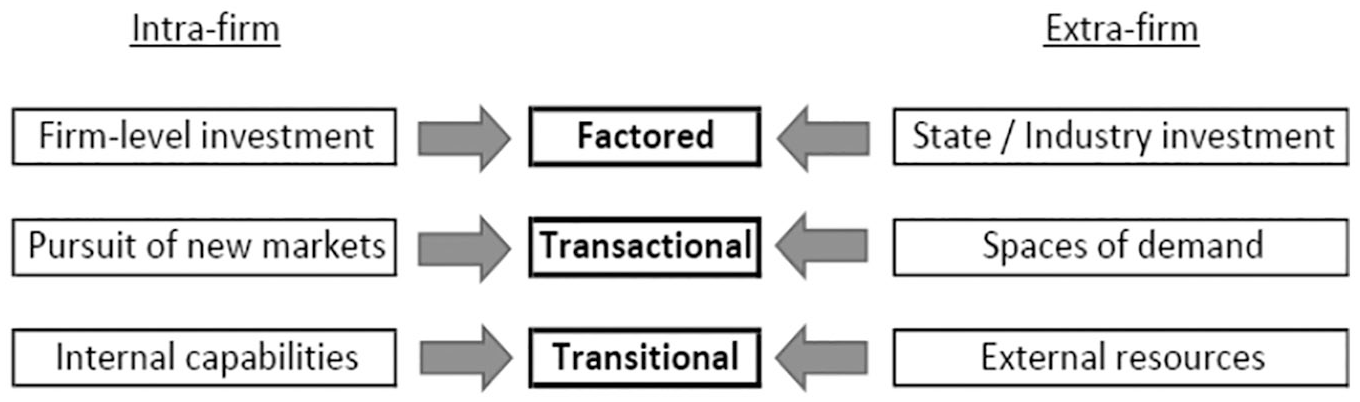
Firm-based networks of practice: factored–transactional–transitional model.
Increasing shifts toward networked modes of production have seen the promotion of a city-regional model as an appropriate response to balancing bounded processes of state spatial governance with dispersed forms of economic production. The capacity of such approaches to represent both the diverse forms of city-regional dynamics and the esoteric networks of production found in more peripheral parts of the city-region remain open to question. The relationship between city-regional economy and its periphery thus requires further examination, emphasising the embedding practices of firms and conceptualised through separate, but interweaving, factored, transactional, and transitional networks of practice. This paper uses these networks of practice to explore spatial economy in city-region peripheries as a firm-led phenomenon. In doing so it makes two specific contributions: first constructing spatial economy from a periphery-first approach, and second exploring the resultant networks through places and industries regionally peripheral to the agglomeration benefits of a city-region.
Methodology
The analysis in this paper is founded on interviews with actors from 48 firms. It is framed in the context of the Greater Birmingham city-region, UK (Map 1), formed following a major restructuring event in state governance arrangements. This section outlines the approach taken in the analysis.
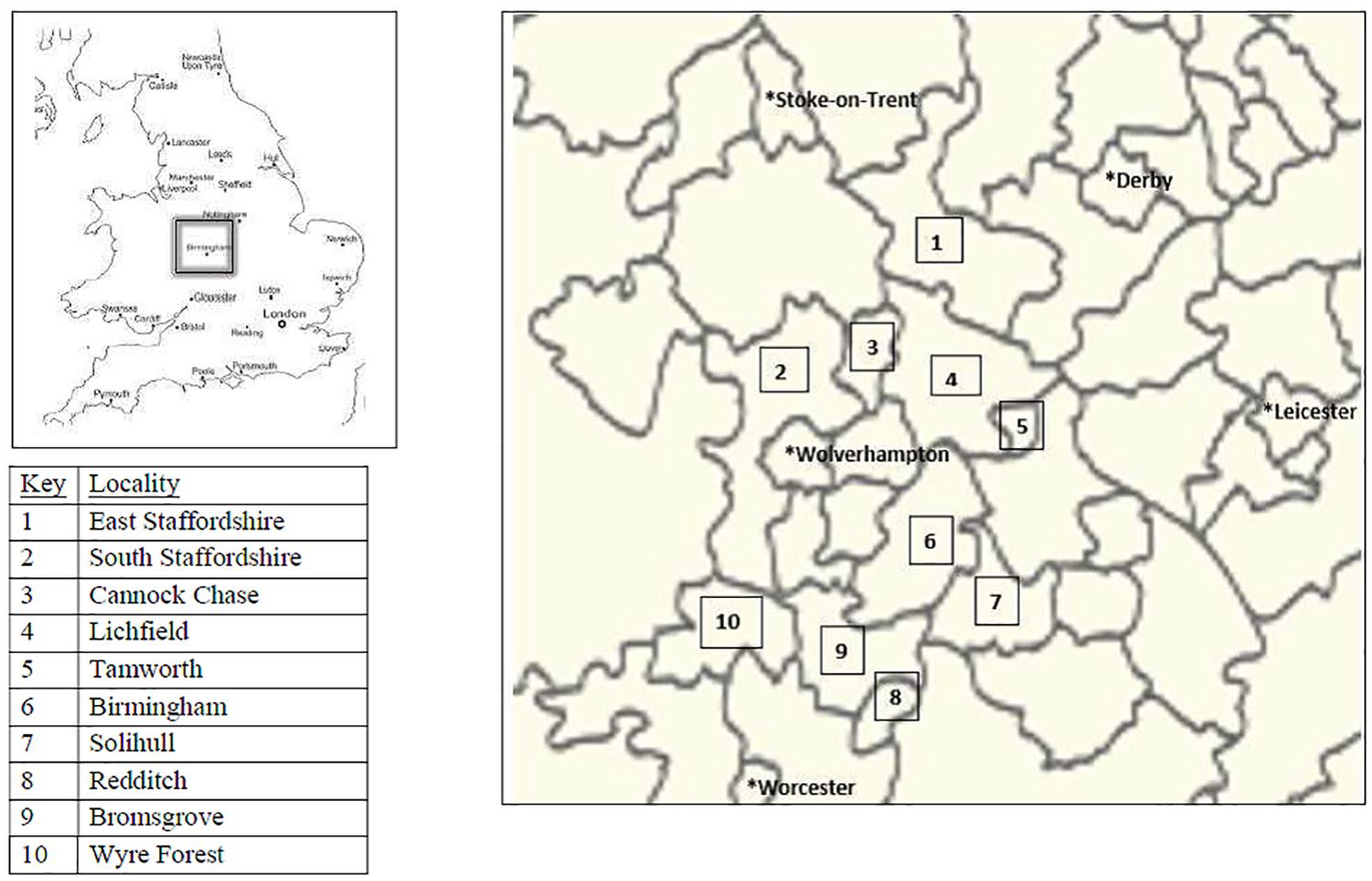
Southern Staffordshire/Greater Birmingham and Solihull study area.
Networked practice in economic production is changing how we understand spatial economy. This paper proposes firms function and are spatially embedded via three distinct factored, transactional, and transitional networks of practice. To implement the analysis, the paper employs indicators linking firms’ practice with these conceptual networks. For the factored network, location rationale is used – specifically conditions and factors underpinning firm operations. For the transactional, it uses the location of immediate customers and suppliers. For the transitional, customer/supplier/competitor interaction and dialogue is used alongside engagement with intermediary organisations.
Applying this framework follows Markusen’s (1994) approach to examining regions through firms, which maps spatial economy using the location of customers, suppliers, competitors, and intermediaries. Two specific adaptations were made. First, Markusen’s work defines relationships as simply within or outside the region. This study extends the analysis using a broader set of geographic scales of local–regional–national–international. Secondly, Markusen rigidly uses an a priori definition of the region. Following this approach as a starting point, this was adapted to deconstruct firm-level networks from sub-national units rather than presuming singularity, forming a circular approach moving from region to industry and firm, then extrapolating to define industrial network and space (Figure 2).
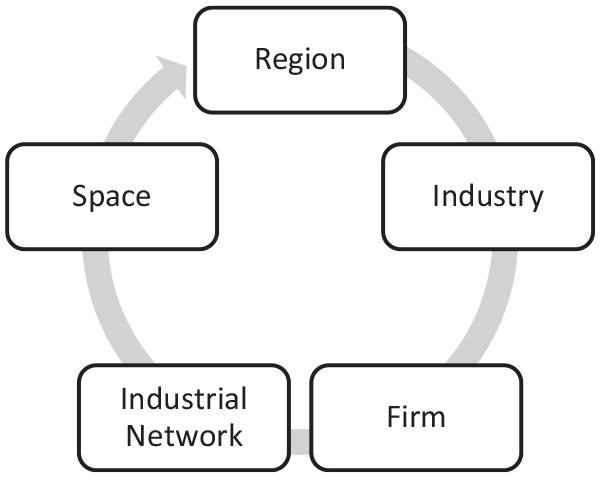
Examining spatial economy – adapted approach.
The firms interviewed were determined by spatial and structural contexts. The research was conducted within the Greater Birmingham city-region (GB), and, specifically, the peripheral localities of Cannock Chase (CC), East Staffordshire (ES), Lichfield (L), South Staffordshire (SS), and Tamworth (T) – collectively referred to as Southern Staffordshire (SSt). Here, two factors were integral. First, SSt was in 2010 absorbed into a city-region geography through revised state spatial policy founded on core-periphery orthodoxy, underwritten by labour flows and a presumption of firm networks grounded in historic, culturally embedded linkages (see Taylor and Wood, 1973). Second, alongside its spatial repositioning, places such as SSt became more central to national policy objectives of structural rebalancing focusing on manufacturing and more traditional industries; this is particularly pertinent in the case of SSt, where industrial decline is less pronounced than at regional or national levels (Bryson and Taylor, 2006). The fragmentation of production patterns in modern manufacturing were here disregarded; instead presumptions of the gravity effect were applied founded on industrial heritage in GB and the West Midlands over contemporary models of sectoral development. The SSt localities and the networks of their constituent firms thus provide a distinctive context in which to explore the dependence of peripheries on city-regional dynamics, the extent of these dependencies for more traditional forms of industry considering contemporary networks and ongoing processes of economic adaptation, and the tensions created in the area through contradicting iterations of spatial and structural policy.
Firms were selected from key sectors defined using a location quotient (LQ) applied to Standard Industrial Classification 2-digit level, where an LQ equal to or greater than 1.5 was identified (Mack and Jacobson, 1996). Three sectors were identified; Manufacturing, Wholesale, and Construction. Firms were identified using business databases from local authorities, Bureau Van Dijk FAME, and Birmingham Chamber of Commerce. In total, 171 firms were contacted; 52 declined participation and 71 did not respond. Data was collected through structured telephone interviews with senior personnel from the 48 participating firms. The questionnaire focused on firms’ interaction with markets and the state, with three distinct sections: firm factors, focused on identifying location and attachment; trade relations and networks, focused on market locations and industry dialogue; and public sector engagement, focused on engagement with state and quasi-state institutions. Each interview was recorded and transcribed, with two exceptions where subjects were unwilling to be recorded; here, manual documentation was used. All subjects were anonymised employing an alpha-numeric code relating to location (i.e. CC#1).
Firms’ spatial interactions: Factored, transactional, and transitional networks
The nature of spatial economy, and its formation through relationships between firms and administrative units, is evolving. The increased use and dependence of networks in processes of formation have shifted the dynamics of interaction from place-based to firm-based forms of embeddedness. Such tendencies have notable implications for spatial interactions amongst firms in more resource limited locations, in this case city-region peripheries. This section applies the model of factored, transactional, and transitional networks to examine firm-based spaces of economic production and their relationship to city-regional spaces of economic governance.
Factored networks: Firm location and embedding
In an economy where production systems are increasingly fragmented, the foundations of attachment between firm and locality has become more esoteric. Progressing beyond proximity to core marketplaces, here prosaic factors of service and amenity interact with traded and untraded interdependencies. One key aspect of this relationship is the integration of local endowments with shifting patterns of demand, and therefore its role in methods of firm embedding through physical infrastructure, technical aptitude, or more ephemeral interactions. Examining how these endowments emerge within firms, this section focuses on location and embeddedness.
Firms’ trading and production location here tend toward orthodox explanations (see Conroy et al., 2017; Pereira and Andraz, 2013). Key endowments, however, occur irregularly across the sample, representing both orthodox and more arbitrary influences. Of primary importance is site availability, followed by personal proximity, transport infrastructure (road, rail and air), consolidation or expansion opportunities, cost, and pre-established local presence (Table 1).
Principal factors in initial location.
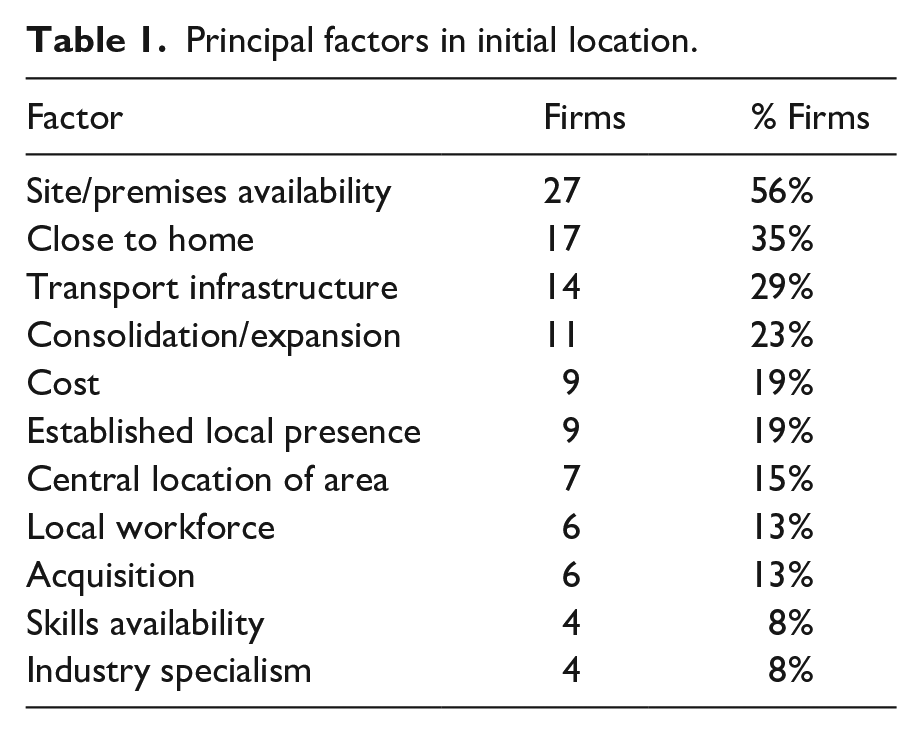
Amongst these endowments, utility is integral. Site availability offers options which attract firms in key sectors – undeveloped land providing choice in terms of prestige position or clustering opportunities. Alongside this run more prosaic cost and availability considerations reinforced by embedded personal and industry-based perceptions of what is either available or comparable, both locally and more widely. Site potential is here bound to historically rooted resource embedded in three distinct places: firm, sector, and state provision. Proximity here is integral, allowing for the convenience of senior management and retention of key employees, linking productivity gains with knowledge inputs. The availability of key employees relates to a wider place-based legacy of sectoral investment embedding specific forms of workforce aptitude (Hamdouch et al., 2017; Vanchan et al., 2018). Finally, industrial dispersal or brownfield-led regeneration policies encourage the consolidation of specific forms of production activity, (re)located through successive policies which encourage a move from core to periphery settings (Carr and Yan, 2012; Tallon, 2013).
Location endowments, however, are not a static proposition – they evolve in line with ongoing transitions in the location of markets. These endowments evolve as firms embed, underpinned through ongoing adaptation and interaction involving a local workforce, sunk costs, transport infrastructure, geographical location, and production/operation costs (Table 2). Certain endowments are historically embedded through state and firm-led investments – workforce skills being a location-specific sectoral legacy locking-in firms through reliance on ‘a big concentration of specialists’ (ES#1) the firm would find ‘very difficult to replicate’ (ES#2) despite ‘skillsets. . .not anything like as widely available as we would like’ (T#2). The benefits of centrality and infrastructure enable proximity for firm engagement with and distribution to key clients. Such physical networks are embedded in an alignment of geographical position and communication links, with little need for integration into any externality-based local production system; as one subject stated, their location choice had ‘nothing to do with the place, it’s to do with. . .transport links’ (C#11). Local embedding factors in this instance facilitated access to broader dependencies, without which firms would cease functioning locally rather than cease functioning.
Principle factors in retaining firms’ location.
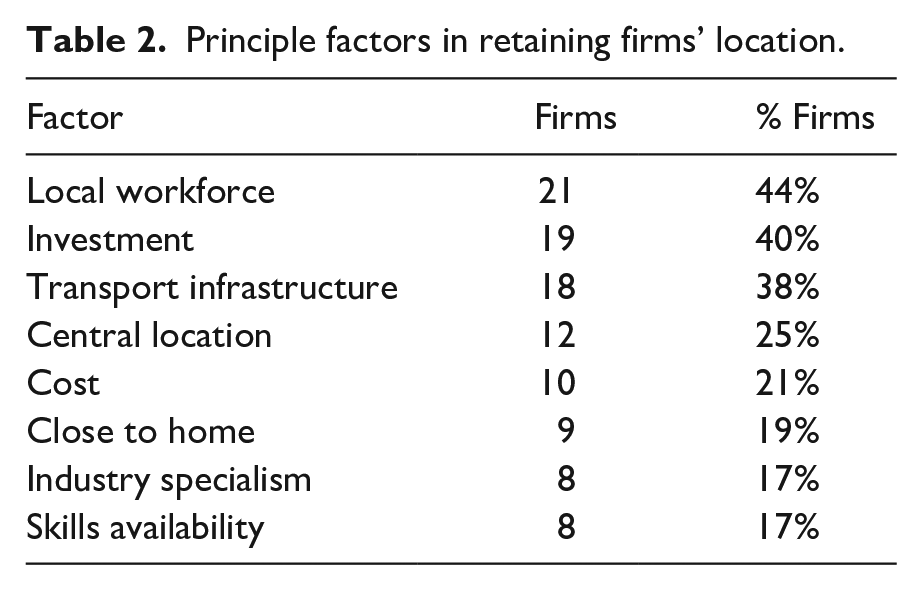
In the location and embedding of firms, factored networks are thus dynamic and in ongoing transition. Through this dynamism, firms gain some flexibility to develop appropriate strategic responses linked to broader infrastructural investment. Additionally, a pluralism here indicates interdependent relationships: 77% cited at least two principal location factors and 81% two or more embedding factors. Transition between location and embedding showed some natural genesis, such as sunk costs as an outcome of site investment. Alongside this, however, runs a flexibility enabling firms to respond to shifting spatial patterns and production practices of their industry. Flexibility of and specialism in workforce endowments allow for the maintaining of competitive advantage in a fragmenting market, where ‘a significant part of our business relies on expertise and we have a lot of experience and expertise within our business. . .it would be really difficult to replace that and we would be putting the business at risk’ (L#14). Infrastructural investment similarly allows for access advantages embedding firms, where ‘it is from a logistics perspective the best place for us. . .somewhere in the Midlands gives us the shortest delivery time to all our customers’ (L#4). Factors such as industrial aptitude, embedded via a production heritage, or infrastructure, providing market accessibility, therefore offer a key intersection. Whilst this access occurs locally, its regulation and requisite investment networks local interests and decisions with regional, national, and supra-national institutions, informing the strategic development of communications and support infrastructure. Specific localised embedding factors are therefore limited, instead embedded relationally within a set of extra-local dependencies. Some are wholly absent. Such is the case for proximity to markets in the shape of customers and suppliers.
Trade exchanges: Transaction-based networks
Orthodox models of spatial economy have been contested through increasingly fragmented production practices (Dicken, 2007; Gereffi et al., 2005). To examine the changing nature of this transactional network, this section considers the location and distribution of firms’ direct forward and backward linkages.
Customer distribution suggests dependency occurs principally beyond local and regional demarcations. Only 15% (7) of subjects identified regional customers – those within either the GB city-region or outside this within the West Midlands – with none holding specifically locally based customers. For those serving a regional client base, rather than a spatially confined production system, this occurred as part of a wider national or international field – 68% (32) exporting to Europe, the Americas, and Asia.
Although often trading beyond the local and regional, the extent of these networks were neither singular nor absolute. Against an orthodox axis of regional–national–international, several firms were operating on each axis simultaneously. This presented fluid spatial articulations in customer distribution, from the constantly iterative, where ‘My business is peaks and troughs. . .I got back from Copenhagen Saturday morning. I’m in America in November. [It’s] based really all over Europe, that includes the UK, and America’ (L#1) to more consistent distribution: ‘[It’s] 35% from the UK, the rest exports. . .all over the world. We tend to, of the 65% we export, we probably send 80% to our sister company [in Belgium]’ (C#10). Firms were, however, positioned within specific confines around markets and market spaces. As changing patterns of customer distribution reshaped market networks and segments, three distinct groupings were identified: extensive spaces, where firms serve an industry representing broad but even levels of spatial distribution; nodal spaces, where customers are widely but unevenly dispersed; and public sector markets, accommodating extensive and nodal forms focused on providing to UK state institutions.
Extensive spaces represent 30% (14) of the sample, tending toward goods mass-produced although often for specialist markets. Market penetration is thus broad but principally UK-focused, where for some, ‘every single postcode in the UK has a customer in it’ (C#11). Within these firms, distribution rather than production process was a primary consideration, with benefits emerging from a centralised point for distribution into this extensive space. Whilst location factored in proximity to the head office of certain key customers, this proximity was recognised as a convenience rather than of strategic importance as here product sets were principally for commodity retail markets and thus widely distributed: ‘At the moment the head office of our customers tend to be located around the Midlands which is a help [although] from a logistics point of view we do supply to the whole of the UK’ (T#11).
Nodal spaces represent 52% (25) of the sample and principally cover exporting, partly a response to declining domestic demand for core products:
In terms of. . .output our biggest base is commercial vehicle customers and none of them are in the UK. Which might sound a bit strange but it’s historic. . .none of those companies exist in the UK anymore. (L#14) Much of our work traditionally would have been with the kilns in Stoke-on-Trent, but with the decline of this industry we’re looking. . .at a worldwide market. (C#9)
Nodal firms therefore look to Europe, Asia, or America rather than to domestic markets; this manifests as node-based firm-to-firm networks with small sets of customers broadly dispersed across different countries and shaped by evolving forms of industrial specialism. Referring to these markets as international is not wholly appropriate. Rather, these are internationally dispersed, serving a form of demand highly localised but non-contiguous – insofar as it occurs in a small number of geographically distant locations – as opposed to widely dispersed as is the case of the extensive spaces.
Public sector markets represent 17% (8) of the sample. These customers are UK focused and UK spread. They occur in both extensive and nodal forms. Extensive markets here represent general products or services often centrally commissioned for a broad state service provision: ‘We supply our systems into acute hospitals generally. But our customers are. . .building consortia, PFI consortia and so on. Now once you recognise who is the customer base there, it’s across the country’ (SS#4). Nodal markets are more locally commissioned through sub-national government and localised government agencies: ‘The market. . .local authorities try to keep their transportation costs to a minimum and that’s why we have [opened] a number of sites through the UK [to compete] on different local authority contracts’ (SS#6). Initial market entry occurs via local interactions, followed by expansion driving growth strategies or markets evolving with changing processes of public sector commissioning: ‘Mainly it’s through. . .having a relationship with the service managers we’ve built up over the years’ but ‘we’re in an age of technology now. . .and the [Government] contracts you know, you have to go through their tendering process on the computer’ (L#6).
Suppliers are similarly broadly distributed. Local or regionally situated suppliers are identified for 40% (18) of firms. Only three of these, however, relied singularly on this group of suppliers. Almost 90% use national or international suppliers primarily – dependence greater on Europe than provision within the region. Where regional dependence occurs, it tends toward importers – ‘our suppliers are based locally. . .which is a slight misnomer as. . .the retailer may be close by [but] it’s probably made in Germany’ (T#2) – or dual-sourcing strategies: ‘We’ve got one [supplier] in Leicestershire. . .others are kind of Midlands. We have new suppliers . . .Finland. . .Turkey. They’re of increasing importance to us’ (ES#5).
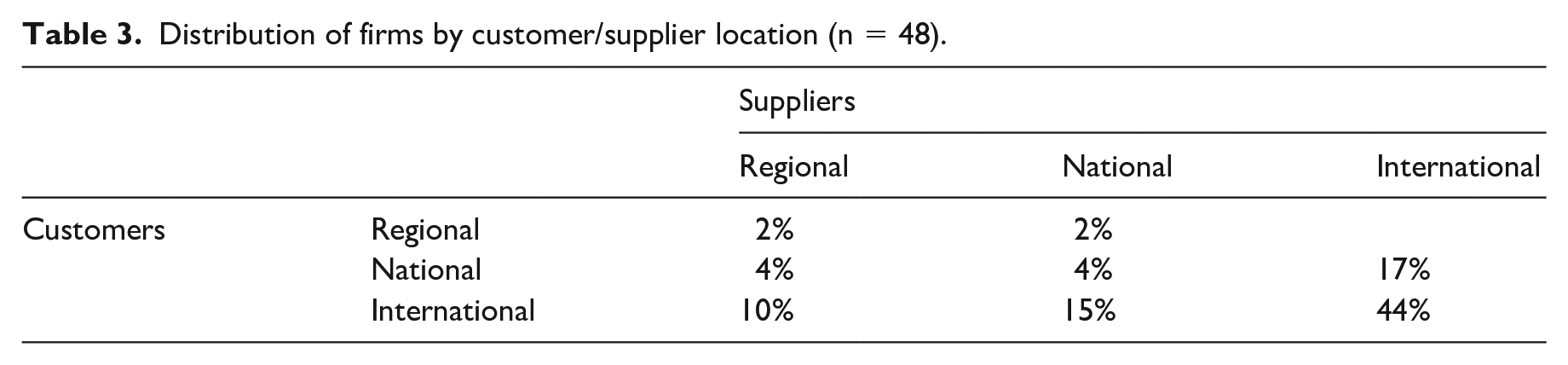
The dispersal here of direct forward and backward linkages occurs principally as a response to and strategy for mitigating the hollowing out of local and regional product demand. Reform in the UK’s state spatial units proposes a more cohesive city-regional model. The changing transactional networks of firms, however, bypass such integration and dependence. Over 80% of firms saw customer–supplier concentrations focused at the national–international axis (Table 3). The use of such terms in defining the spaces of transactional networks is misleading, with the distribution of linkages displaying two iterations: extensive forms or nodal forms. In either form, these iterations are highly distinctive and individualistic on a firm-by-firm basis (Camagni et al., 2015; Salder and Bryson, 2019), manifesting outside sub-national articulations and established political–economic hierarchical interpretations (Dicken, 2007; Gereffi et al., 2005). Thus, transactional networks evolve with and through the spatial fragmentation of production rather than any conventional model based around core-periphery forms of spatial organisation. Determined partially by forward–backward transactional relationships, critical in shaping the geography of transactional networks are knowledge inputs involving actors beyond the transactional.
Distribution of firms by customer/supplier location (n = 48).
Transitional networks: Peer dialogue and industry regulation
Beyond their direct forward and backward exchang-es, firms are embedded in relationships acquiring and applying essential intelligence for developing products and responding to evolving market demands. They are thus in an ongoing state of transition. Such inputs rely on wide spatial networks determined by distinctive firm-level relations (MacKinnon et al., 2004; Salder et al., 2020) and related forms of industrial dialogue (Balland et al., 2015; Growe, 2019; Mallinson, 2019; Torre, 2008).
Transactional networks present a firm-based picture of spatial economy nationally and internationally dispersed. These commercial exchanges are enhanced through knowledge-based dialogues designed to monitor industry developments. Building and maintaining such dialogues uses direct and remote practices representing different modes of proximity (Balland et al., 2015). Within this, three distinct sets can be identified: organisation-based practice, with knowledge attained through direct communication with organisations; investment-based practice, where knowledge is acquired; and industry-based practice, with knowledge disseminated via cross-industry and multi-actor mediums (Table 4).
Firms’ practices in transitional networks: customers and suppliers.
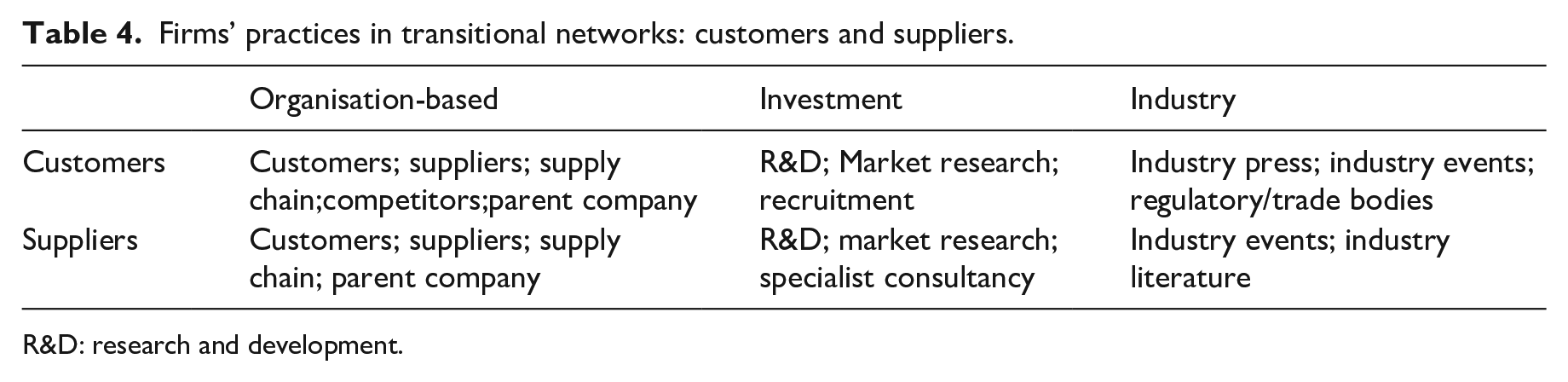
R&D: research and development.
Organisation-based practice builds intimate knowledge using pre-transaction dialogue with established and embedded customers/suppliers, and enhances this interaction with competitors, parent companies, and extended production chains. Framed within established and evolving geographies of industrial transaction over formal spatial units, maintaining such interactions applies remote and ephemeral dialogues focused on virtual mediums or temporary nodes such as trade events (Growe, 2019; Torre, 2008). Alongside this, investment-based practices see firms acquire new knowledge via research and development (R&D), commissioning, and recruitment strategies (Grigoriou and Rothaermel, 2017; Huggins and Kitagawa, 2012), extending inputs in pursuit of ‘new products or materials, otherwise. . .our customers are driving us all the time’ (C#6) or recruiting expertise through consultancy or personnel, allowing firms to be ‘involved in the design process of our supplier’s products’ (C#4) or take ownership of their niche: ‘It’s not a “their” industry, it’s an “our” industry. We are at the leading edge’ (L#5). Industry-based practices are more prosaic, based on less intimate and looser connections maintained through third parties, such as industry press and events.
Alongside customer and supplier inputs, also integral are competitors and intermediaries. Competitors replicate customer/supplier tendencies, dispersed at national–international scales but partially integrated via collaboration and inter-firm trading or referral: ‘If. . .a job comes to us that isn’t our cup of tea we will point it to [our competitors] and vice versa’ (C#6); ‘Collaboration has become more important’ (SS#1); ‘On big schemes you’ll. . .find two or three contractors’ (S#6). These collaborations occurred principally with competitors based outside the region.
Representation organisations similarly enhance firms’ resource, providing a consolidated voice and extending dialogue between firms (Clark, 2014; Plank and Staritz, 2015). The remit of intermediaries is rarely aligned with sub-national demarcations. Whilst spatial intermediaries such as Chambers of Commerce are used, they are principally access points for extra-regional relationships through export documentation and intelligence on state support schemes, thus providing a localised input capable of supporting transitional networks in extending further outside the local. Alongside these run industry-focused trade associations, offering intelligence and lobbying around policy areas of health and safety and environmental regulation, and engaging with national and supra-national governments, whilst also playing a role in evolving products through regulation intelligence and process support.
Transitional networks occur in increasingly aspatial forms through interaction with an iterative set of customers, suppliers, competitors, and intermediaries. Spatial interactions are seen to manifest beyond regional demarcations; their dependency on dispersed production patterns and inputs being both a legacy and a cause of ongoing industrial fragmentation. In the limited instances of interaction occurring through localised relationships, the local is here integral through its role as an access point to extra-regional interactions.
New networks of firm integration: On functional and temporal dispersal
Spatial economy has been conventionally associated with political demarcation, occurring through clearly defined and regulated state spaces. State spatial reform has, however, adopted the principle of the city-region and its presumed network-based benefits as a means of integrating the spatially bound tendencies of political governance with more network-based and fragmented territories of production. Within this approach, limited attention has been paid previously to both peripheral parts of the city-region, with presumption of their integration occurring via centrifugal (Bettencourt et al., 2007; Dijkstra et al., 2013) or centripetal forces (Alonso, 1973; Meijers and Burger, 2015; Phelps et al., 2001), and to firms as determinants of spatial economy via their own esoteric networks (Plank and Staritz, 2015). This analysis addresses such a gap through considering the interactions of firms located in the city-region periphery as critical actors in the formation of spatial economy.
Peripheral places may bypass the presumed production benefits of city-based systems in favour of relations more specifically tailored to fit their distinctive needs and production practices (Camagni et al., 2015; Salder and Bryson, 2019). This analysis unpicks these relations through application of a model conceptualising place-based firm embeddedness as dependent on three specific networks of practice: factored, transactional, and transitional networks. Through application of these networks, it argues the form of spatial economy within city-region peripheries occurs separately from that created via city-regional externalities and shows a strong tendency for bypassing localised and regional dependencies in favour of more dispersed networks of practice (Marek et al., 2016). Here, three findings are of particular interest.
First, the interaction between peripheries and core within the city-region has tended to be interpreted via a particular form of network created through both gravitational and agglomeration forces related to urban concentration. Such networks are not singularly an urban phenomenon. Externalities present within cities may play an important role for certain activities, but their flexibility is limited (Dijkstra et al., 2013) and the ability to accommodate the evolving, fragmented networks of firms based in city-region peripheries is undermined by such firms’ adaptation processes (Grillitsch and Nilsson, 2017; Salder and Bryson, 2019). Periphery-based networks are thus more highly dispersed entities than those presumed via city-first approaches; they are also counterintuitively more place-based entities, formed through the material interactions and dependencies of local endowments and extra-local forces as opposed to more abstract application of city-based agglomeration (Hamdouch et al., 2017; Vanchan et al., 2018).
Second, the place-based aspect of these networks of practice reconfigures the dynamic between network and space. Rather than framing networks within a clear demarcation conforming to administrative boundary and city-region dynamics, the network becomes both the object and process through which spatial economy – determined through firm-based practice – is defined. Such a network–space dynamic provides sensitivity to the ephemeral and temporal nature of firm-based interaction (Growe, 2019; Torre, 2008) whilst accommodating evolving notions of proximity (Balland et al., 2015) and its manifestation in more fragmented or variegated forms (Indraprahasta and Derudder, 2019; Sassen, 2004; Veltz, 2000).
Finally, application of these networks of practice also allows for a more dynamic reading of spatial economy, one capable of incorporating adaptive or evolutionary dimensions through which temporal shifts in place, in firm, and in market can be accommodated. Here, the relationship between established local endowments and extra-local forces reframes not only networked spaces – with proximity based on capability or value more integral than geographic (Balland et al., 2015; Mallinson, 2019) – but also the endowments key to the firms’ ongoing practice and further adaptation. Thus, localised expertise (Hamdouch et al., 2017; Vanchan et al., 2018) is integrated with methods of strategic acquisition (Grigoriou and Rothaermel, 2017; Huggins and Kitagawa, 2012) and emotionally embedded, non-business logics (Biniari, 2017; Salder and Bryson, 2019). This temporal dimension shows signs of progressing through four waves of reformed embeddedness (Figure 3).
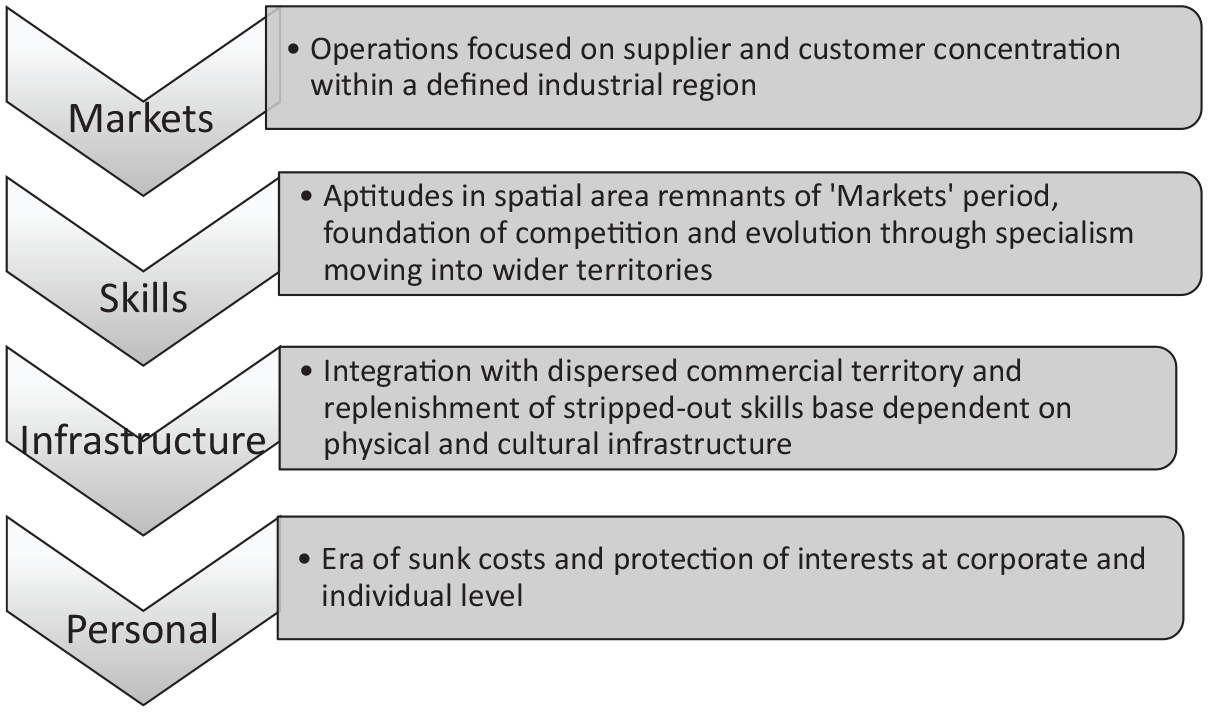
Temporal waves of firm activity: erosion of embedding factors.
With almost absolute erosion of markets as a foundation for spatial economy, here localised iterations become rooted in other industrial factors. These factors show similar signs of erosion. High quality skills key to local functions and fundamental in structural resilience erode as the workforce ages with no replacement pool forthcoming. To compensate, acquisition of skills from external sources becomes more integral (Grigoriou and Rothaermel, 2017; Huggins and Kitagawa, 2012), for which cultural and environmental infrastructure becomes as critical as more orthodox forms (Koster and Pellenbarg, 2019). Such conditions yield more personal forms of integration, with interests translating as the protection and continuation of emotional embeddedness through firm-based sunk costs and the collective interests of principal personnel (Biniari, 2017; Salder and Bryson, 2019).
The relationship between firm-based networks and politically formed spatial economy has increasingly been explained through the application of city-regional models. Such an explanation, however, fails to accommodate either the evolutionary nature of firm relationships or the distinctive conditions and practices occurring within the city-region, in particular its peripheral locations. This paper proposes the application of a set of networks of practice based on the key functional requirements of firms to more effectively interpret both spatial relations at a localised level and the extent to which city-regional dynamics represent localised structure; the factored–transactional–transitional model. This model presents spatial economy as highly fragmented, and positions peripheries as at least partially outside the efficacy of city-regional demarcations. Whilst prominent at the city-regional level, the networked economy of firms in city-region peripheries identifies a similar phenomenon across broader orthodox distinctions of political economy. In place, these networked spaces occur as both ephemeral (Growe, 2019; Torre, 2008) and nodal, trans-local, or variegated relationships (Indraprahasta and Derudder, 2019; Sassen, 2004; Veltz, 2000) existing in perpetual flux driven by distinctive historic–cultural dynamics between individual firms, localised endowments, and changes in a wider market environment.
Conclusion
This paper examines the networked economy of firms in city-region peripheries. Focusing upon key sectors within the peripheral Southern Staffordshire area of the Greater Birmingham city-region, it explores key dependencies and interactions within firms, their spatial articulation, and the related integration with city-regional forms of spatial economy. It argues the integration of both peripheries and their constituent firms, rather than singular and embedded within presumptions of the network potential of cities, occurs through multiple layered interactions at individual firm level. These interactions create highly individualistic, esoteric, and geographically fragmented spaces.
Conceptualising spaces of production as occurring through a set of networks of practice, these networks occur in three forms: factored, defined through tangible resource allocation; transactional, constituting direct trade inputs; and transitional, involving knowledge sharing and adoption. Within these networks of practice, the relationship between peripheral spaces and the city-region core are found to be limited. Whilst evidence of a historic relationship is present, either in industrial agglomeration tendencies (Bettencourt et al., 2007; Hall, 2003) or borrowed size occurring through infrastructural investment (Alonso, 1973; Meijers and Burger, 2015; Phelps et al., 2001), this relationship is subject to ongoing erosion. In its place, firms in these peripheries develop esoteric adaptation practices (Grillitsch and Nilsson, 2017; Salder and Bryson, 2019), rooted in varying forms of proximity (Balland et al., 2015) creating spaces of production at once ephemeral, nodal, trans-local, and variegated (Growe, 2019; Indraprahasta and Derudder, 2019; Sassen, 2004; Torre, 2008; Veltz, 2000).
Three findings are key in this analysis. First is an illustration of the limitations of a development model rooted in city-based externalities. The influence and efficacy of cities has been integral to growth in certain spaces; the capability of this model to fully represent the extent of its spaces and their diverse interests is, however, open to debate. Second is the contribution the networks of practice model can make as both object and process in interpreting spatial economy. Prior analysis has sought to use firms in understanding spaces. Often, this is conducted within a priori units and thus seeks to interpret spatial economy as opposed to determining it via networks and interactions. Finally, is the dynamic reading this analysis offers of firm-based dependencies, place-based networks, and the relationships occurring between local endowment and extra-local forces. It thus both contributes to calls for new forms of analysis on city-region and core-periphery dynamics and offers a novel approach to understanding and interpreting firm–place relationships more broadly.
These findings are particularly relevant for policy considering ongoing interest in city-regional approaches to economic development and calls for devolution. Standardised or singular approaches to defining spatial economy lack the level of sophistication required to effectively interpret the breadth of firm embedding within conventional forms of sub-national political economy. City-based and city-regional models offer only partial solutions here, interpreting the esoteric nature of their peripheries without due consideration of constituent firms and their networks. Application of the networks of practice model provides a more critical approach to examining the nature and extent of firm-based interactions in relation to city-region and wider state spatial demarcations. Such relationships will display varying spatial and temporal dynamics dependent on space and sector, for which the networks of practice model could be applied.
Footnotes
Acknowledgements
The author would like to thank the editors and two anonymous reviewers for their excellent guidance, alongside Professor John Bryson for comments on an earlier iteration of this article. This work is based on findings from research supported by the Southern Staffordshire Partnership.
Declaration of conflicting interests
The author(s) declared no potential conflicts of interest with respect to the research, authorship, and/or publication of this article.
Funding
The author(s) disclosed receipt of the following financial support for the research, authorship, and/or publication of this article: This work was supported by the Economic and Social Research Council (Grant No. 1650742).
