




Abstract
In this paper, we analyse long-term changes in the regional distribution and migration flows of university graduates in Finland and Sweden. This study is based on detailed longitudinal population register data, including information on high school grades and parental background. We find a distinct pattern of skill divergence across regions in both countries over the last 3 decades. The uneven distribution of human capital has been reinforced by the mobility patterns of university graduates, for whom regional sorting by high school grades and parental background is evident. Our findings indicate that traditional measures of human capital concentration most likely underscore actual regional differences in productive skills.
Keywords
Introduction
Urbanisation and the increased concentration of human capital in larger and more densely populated regional labour markets have been occurring for many years and are evident in most countries (Iammarino et al., 2019; OECD, 2018). A number of recent studies have documented the cumulative nature of skill agglomeration and its geographical consequences for economic development and various other socioeconomic outcomes in different regions. For example, Moretti (2012) concludes that the level of education in the workforce has been the main predictor of the long-term economic success of regions in the US. Skill-biased technological change and globalisation have altered the relative productivity among categories of workers, generally favouring highly skilled workers and human capital-intensive regions. 1
In this paper, we analyse the geographical distribution of skills and the human capital content of migration flows among regions using detailed Finnish and Swedish longitudinal population register data. In addition to the commonly used indicator of human capital measured by the level of educational attainment, we utilise information on the individual’s high school grades. We also use measures of parents’ socioeconomic status as complementary indicators associated with ability and the socioeconomic outcomes of their children.
The geographical concentration of economic activities is generally considered to be favourable for economic growth through different mechanisms, giving rise to agglomeration economies (Duranton and Puga, 2004; Marshall, 1890). Agglomeration economies are reflected in higher productivity of labour and an urban wage premium (UWP) in larger labour markets. Recent research shows that empirical identification of a UWP requires careful consideration of residential self-selection, i.e. labour with relatively high productivity self-selects into metropolitan areas and other larger or more densely populated labour markets (e.g. Andersson et al., 2014; Combes et al., 2008; Korpi and Clark, 2019).
This study is exploratory in nature. We make no attempt to identify the causal effects of human capital on productivity or to quantify the magnitude of residential selection bias on estimates of agglomeration benefits. Instead, we contribute by presenting new empirical evidence on the systematic self-selection of highly skilled individuals into agglomeration economies through migration flows upwards and downwards in the regional (size) hierarchy. We use nationwide register data covering 30 years of yearly observations of all individuals of working age in Finland and Sweden. Linked employer-employee data contain information on the locations of workplaces and places of residence. We use functional regional labour markets as regional entities instead of administrative geographical jurisdictions. Family identifiers allow for observations of parents’ socioeconomic status, which together with information on high school grades, provide information on heterogeneity in family background and ability among university graduates.
Finland and Sweden share important economic and institutional characteristics. They are open market economies that are strongly dependent on international trade. Both countries are welfare states with relatively large public sectors and extensive social security systems. Both countries are within the EU inner market. The technological level of production is high, the workforce is well-educated, and per capita income is high in both economies. Other common features are the high degree of urbanisation and population concentration in capitals and larger cities. The same applies to time trends in the production structure from industry to services, increased shares of highly educated persons in the workforce and internal migration flows favouring relatively large cities and more densely populated geographical labour markets. Our comparative approach is facilitated by access to comparable population data.
To preview some of our results, we find, for both countries, a positive and robust correlation across regions between the initial share of workers with a university degree and the change in this share during the last 3 decades. Local labour markets with high initial shares have systematically experienced a larger increase in the share of university graduates. We further find that the migration behaviour of individuals with a university degree reinforces the pattern of skill divergence across regions. Large (populous and dense) local labour markets receive considerable net in-migration flows of young university graduates, the most migration-prone population, while small local labour markets experience large net out-migration flows. However, larger regions are not only net attractors of young university graduates in quantitative terms, but we also find a distinct migration pattern in qualitative terms. The data reveal that the share of migrants moving upwards in the regional hierarchy, i.e. from smaller to larger local labour markets, increases consistently with school grades. Migration upwards in the regional hierarchy is also found to be associated with strong family backgrounds of migrants in terms of parents’ education and earnings.
The next section provides a brief overview of previous research on agglomeration, the UWP and the geographical sorting of human capital through migration. Data and measurement are then presented. The fourth section provides a description of the geographical distribution of university graduates and the evolution of skill divergence over time. The fifth section focuses on the role of migration for the redistribution of human capital across regions and heterogeneity in migration flows by an individual’s school grades and parental background. The paper ends with a summary and discussion.
Agglomeration, productivity and residential self-selection
The positive association between human capital and growth is documented in numerous studies using aggregate data for regions and countries (see, e.g. Barro and Sala-i-Martin, 1999; Östbye and Westerlund, 2007, on Swedish and Norwegian data; Karhunen, 2008, on Finnish data; and Crespo Cuaresma et al., 2018, on European data). Hanushek et al. (2017) use measures of average cognitive ability and educational attainment across states in the US as indicators of knowledge capital. They find a roughly equal contribution by educational attainment and cognitive skills to the total estimate of 20%–30% of the interstate variation in per capita GDP.
The present study relates more closely to the research on agglomeration economies and the systematic sorting of skills through migration. Several plausible mechanisms may explain the causal effects of agglomeration on productivity. These mechanisms may be classified into three categories: sharing, matching and learning (Duranton and Puga, 2004).
Agglomeration economies can generally be attributed to the broad categories of factors of production: capital, labour and technology. The primary concern in this study lies with the agglomeration of human capital, i.e. not only with the quantities of labour but also quality in terms of productive skills/ability. Such skills may signal higher productivity in a static meaning but also learning and communication/interaction capabilities. The geographical concentration of labour in quantitative terms, i.e. at any given level of skill, may increase productivity because of firms’ opportunities to exploit labour pooling or increased job search and job-matching efficiency (e.g. Gobillon et al., 2007; Wasmer and Zenou, 2002). Thus, agglomeration can improve the utilisation of skills in the labour market.
An individual’s abilities can also interact with agglomeration in various ways. Larger local labour markets offer a larger variety of skills among job searchers and a larger variety in firms’ demands for skills (e.g. Abel and Deitz, 2015; Wheeler, 2001). The productivity gains of higher job-finding rates and better quality matches may increase with ability through higher search efficiency and via a better ability to process information when evaluating alternative job offers.
Individuals benefit from agglomerations not only because of direct effects on employment and wage levels but also because of dynamic effects through human capital accumulation and higher wage growth through matching and learning mechanisms. This reasoning is consistent with observations of higher returns on human capital in larger cities, especially for the highly educated (e.g. Glaeser and Resseger, 2010). Self-selection into more high-skilled jobs may contribute to higher returns. Both low-skilled and high-skilled job searchers benefit from being matched with highly skilled co-workers, but the beneficial effect can be stronger for highly skilled workers (Venables, 2011). New technologies are usually implemented in urban environments first. Complementarity between ability and technology (Acemoglu, 1999; Caselli, 1999) may increase the comparative advantage of highly skilled workers to locate in urban labour markets. In all, these mechanisms imply a wage premium of agglomeration (UWP).
Recent empirical studies have challenged earlier findings of a large UWP. Ciccone and Hall (1996) found that a doubling of the geographical density of employed workers in states in the US was associated with 5%–6% higher wages. Recent studies with better data and control for residential selectivity indicate smaller estimates of the UWP, approximately 2%–4% (Andersson et al., 2014; Combes et al., 2008; De la Roca and Puga, 2017; Mion and Naticchioni, 2009; Pekkarinen, 2002).
Combes et al. (2008) find that 40%–50% of aggregate regional wage differentials in France are accounted for by the regional sorting of labour on observed and unobserved skills. Mion and Naticchioni (2009) report similar results for Italy. Using Swedish data, Andersson et al. (2014) conclude that the spatial sorting of labour is the main explanation of higher earnings in dense labour markets. 2 Pekkarinen (2002) finds for the Finnish metal industry that real hourly wages are 2.4% higher in urban areas than in rural areas after controlling for several individual, job and firm characteristics.
Studies on internal migration show that moves over longer distances/between functional labour markets are mostly undertaken by young people and that the propensity to migrate increases with educational attainment (Böckerman and Haapanen, 2013; Greenwood, 1997; Machin et al., 2012). Research also shows that the spatial sorting of skills through migration is evident in most developed countries (Winters, 2011, on US data; Faggian and McCann, 2009, on data from Great Britain; Venhorst et al., 2010, on data from the Netherlands; Haapanen and Tervo, 2012, on Finnish data; and Henning, 2020, and Tano et al., 2018, on Swedish data). 3
In sum, previous research provides several theoretical mechanisms and solid empirical support for the positive static and dynamic effects of the regional concentration of human capital on income and the systematic sorting of highly educated individuals into agglomerations. Our study unveils considerable heterogeneity in ability within this group of migrants that differs systematically between upward and downward migration flows.
Data and measurement
We use data on the entire populations of Finland and Sweden. The data originate from various registers administered by Statistics Finland and Statistics Sweden. By matching the unique personal identifiers of individuals across censuses/registers, the panel data sets provide a variety of reliable, register-based information regarding residents, including their educational qualifications and locations of residence and workplace. Annual data are available from 1986/7 (Sweden/Finland) to 2015. Due to data protection issues, the Finnish and Swedish registers are used in different research environments. The regional classifications available to us are from 2014 for Finland and from 2015 for Sweden.
Next, we briefly describe the regional classifications and key variables that we use in the empirical analyses. The analyses focus on the working-age population between 17 and 64 years of age. Additional sample restrictions are described below. 4
Regional classifications
To measure the allocation of human capital, we utilise local labour market areas (LMAs) that are defined by observed commuting flows between municipalities. LMAs (travel-to-work areas) are formed by joining a central municipality and a surrounding municipality (or municipalities) from which at least 10% (7.5%) of the labour force commute to the central municipality, as defined by Statistics Finland (Statistics Sweden). Thus, LMAs are functional labour markets in which most people tend to both live and work.
In Finland, there were 320 municipalities in 2014. Of them, 236 municipalities form 42 travel-to-work areas. The remaining 84 municipalities that lie outside travel-to-work areas are self-contained LMAs, each forming a separate area in this study. Thus, our analysis uses information on 126 Finnish local labour markets. Correspondingly, in 2015, 290 Swedish municipalities were aggregated into 69 LMAs (46 of which are LMAs containing two or more municipalities and 23 of which are self-contained municipalities forming their own travel-to-work area).
In some analyses, we further aggregate the local LMAs into three larger regions based on the population size of the LMA (Figure 1): i) large regions (Helsinki in Finland, and Stockholm, Göteborg and Malmö in Sweden), ii) medium-sized regions, defined as LMAs with a minimum total population of 100,000 inhabitants, and iii) small regions, defined as LMAs with a population size of less than 100,000 inhabitants.
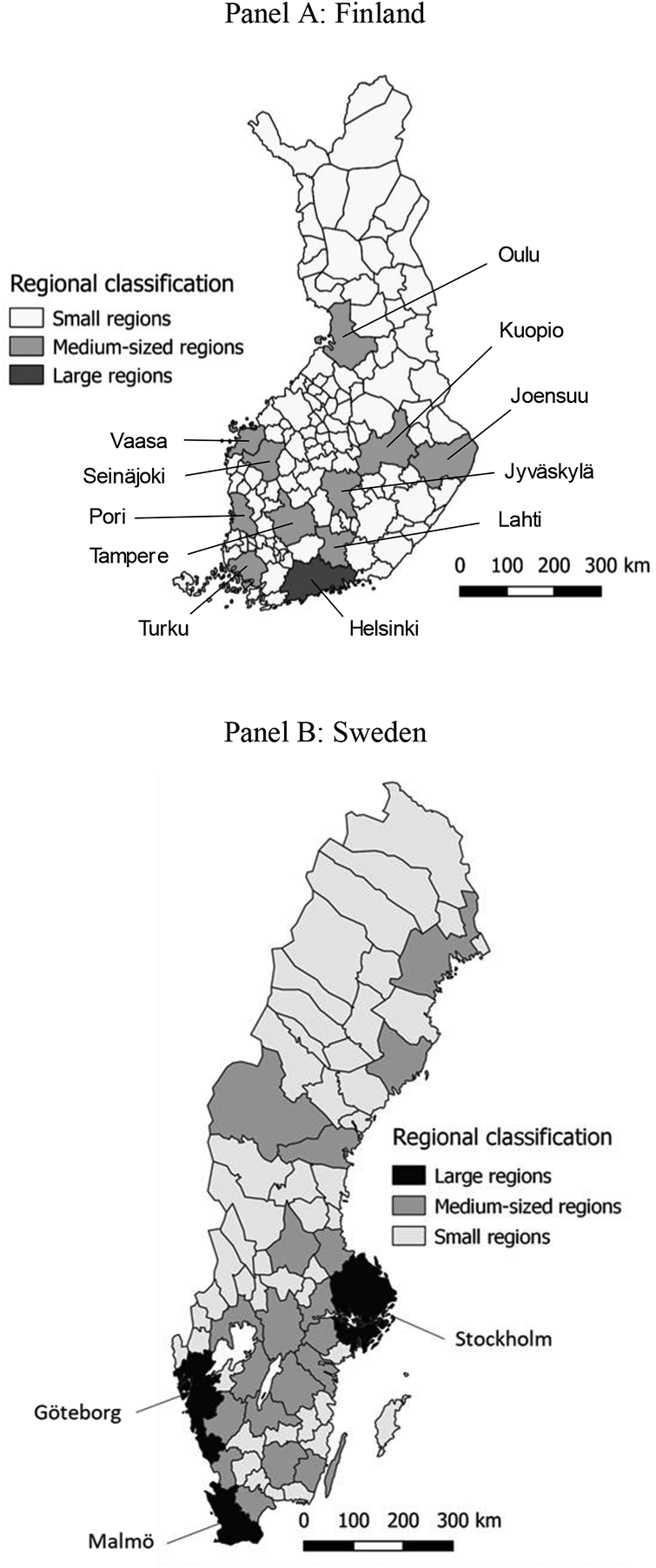
Regional classification of local labour markets into small, medium-sized and large regions.
There are 10 medium-sized regions and 115 small regions in Finland, and 19 medium-sized local labour markets and 47 small regions in Sweden. The medium-sized regions are typically regional administrative centres and contain universities/polytechnics located outside metropolitan regions. With a few exceptions, the small regions do not include regional administrative centres. A supplementary online appendix (Tables A1–A2) provides the names of the medium-sized regions and their population size.
Human capital and parental background
The concept of human capital is multidimensional, including factors such as cognitive and non-cognitive skills, and health. The various dimensions may be interrelated and come from nature and/or nurture. To quantify the level of human capital in the LMAs, we use information on an individual’s educational attainment and high school grades. Measures of parents’ socioeconomic position are used as complementary indicators of individuals’ ability to compete in the labour and housing market.
The core of the analysis pertains to recent graduates, i.e. individuals with an educational attainment corresponding to a short or long university degree. Long university education refers to bachelor’s and master’s degrees from polytechnics and universities with a programme length of at least 3 years of tertiary-level education. Below, the term “university education” refers to polytechnic and university degrees. Short university education is defined as 1 or 2 years of tertiary-level education. In the Finnish context, short university degrees refer mainly to former vocational college degrees that have been replaced by polytechnic bachelor’s degrees (since the mid-1990s).
Educational attainment is arguably a relevant indicator of productive skills with documented statistical power in quantitative research, such as studies on regional growth, earnings and internal migration. However, there is substantial heterogeneity in ability within crude categories of educational attainment. For example, among students with a bachelor’s or master’s degree, variation in academic performance can be anything between excellence and substantial difficulties in meeting minimum requirements for graduation. As indirect measures of this heterogeneity, we add two partially interrelated indicators: individual high school grades and parental background.
School grades are not perfect measures of ability, but a portion of the variation in ability within categories of educational attainment is most likely reflected by school grades. Intelligence is shown to correlate with school grades but is far from the only factor, as the ability to organise studies, motivation, time management and social competence are important factors. Both cognitive and non-cognitive skills may contribute to variance in school grades (e.g. Roth et al., 2015; Spinath et al., 2006).
Parental background correlates with children’s socioeconomic outcomes through genetic and environmental factors. Strenze (2007) reviews and analyses previous research on intelligence as a predictor of socioeconomic outcomes. Intelligence is found to be a powerful predictor but not overwhelmingly better than parents’ socioeconomic status or school grades. 5
We use parental education and earnings as indicators of socioeconomic status. The nature and nurture mechanisms explaining the predictive power of parental background are complex. In addition to the parents’ role in children’s academic achievement, socioeconomic status may also have a direct impact on occupational choices and residential selectivity, such as through preferences, social networks and wealth (e.g. Corak and Piraino, 2011; Hochstenbach, 2018).
In terms of migration and selective location choice for young people, parental socioeconomic status and associated social networks can be important factors in a tight residential market in urban areas. Finding an affordable permanent contract/dwelling in high-growth agglomerations without parental backing can be extremely difficult for young people. Job searchers with little or no parental backup may find it optimal to search for jobs and accept job offers in labour markets outside high-cost agglomerations, e.g. outside Stockholm, in the Swedish context. This trend is in line with the residential-cost explanation of increased skill concentration in urban areas. Generally, increased productivity in agglomerations affects land rents, and only agents with sufficiently high productivity will be able to locate themselves in agglomerations (e.g. Behrens et al., 2014). Inelastic housing supply would reinforce this selection mechanism, see also Berry and Glaeser (2005).
Location and migration
Location is defined by using information on the locations of workplaces or residences. The location of the workplace is used when we discuss the regional distribution of workers, whereas the location of the residence is used to illustrate migration rates across regions. We examine migration rates across local labour markets and migration between the three types of labour markets (large, medium-sized and small regions) as defined above.
We consider migration among recent graduates and working-age populations. For recent graduates, migration is defined using information on the location of the residence at age 17 relative to the location of the residence 5 years after graduation. For the whole working-age population, migration is defined as a change in the location of residence between two consecutive years (e.g. the last date of 2014 vs. 2015).
Geographical distribution of university graduates and skill divergence
During the period of study, there has been a strong increase in the supply of university education, and at the same time, geographical decentralisation in both countries. In Finland, the share of the 25 to 64-year-old population having at least 3 years of university education increased from 10% in 1987 to 28% in 2015, whereas the share having only primary schooling fell from 46% to 17%. The corresponding changes are similar in Sweden: the share having at least 3 years of university education increased from 10% in 1986 to 26% in 2015, whereas the share having only primary schooling fell from 38% to 12%.
In the beginning of the study period, nearly all universities were located in large or medium-sized regions in Finland, and approximately 90% of university degrees were awarded in these regions. Since the polytechnics were created in Finland in the 1990s, more university campuses have been established in the small regions (approximately 10% of the small regions in 2015). At the end of the study period, the share of polytechnic and university degrees awarded in small regions has increased to 16%. The share of degrees in medium-sized regions has remained unchanged at approximately 53% during the study period.
In Sweden, higher education is very concentrated towards larger regions. With only a few and very minor exceptions, all universities and university colleges are located in large or medium-sized regions. During the study period, there has, however, been a shift in terms of the number of enrolled students and awarded degrees between the two types of regions in Sweden. In the beginning of the period, 73% of all university degrees (3 years or longer) were awarded at universities located in large regions and 27% at universities and university colleges located in medium-sized regions. By the end of the period, the share for medium-sized regions had increased to approximately 45%.
Changes in the proportion of highly educated workers
Figure 2 demonstrates regional differences in the growth of the proportions of highly educated workers relative to the baseline proportions in the LMAs (mid 1980s vs. mid 2010s). Calculations are based on observations of workers in their prime age (aged 25–54) and the location of their workplace. Although the proportion increased during the observation period in all LMAs in Finland and Sweden, the increase has been more substantial in some LMAs than in others. In particular, there has been a clear tendency towards regional divergence in the proportions of university-educated workers over time. The increase in the proportions has been larger in LMAs that already had a high share at baseline, as shown by the positive relationship between the baseline proportion in 1986/7 and changes in the proportion from 1986/7 until 2015.
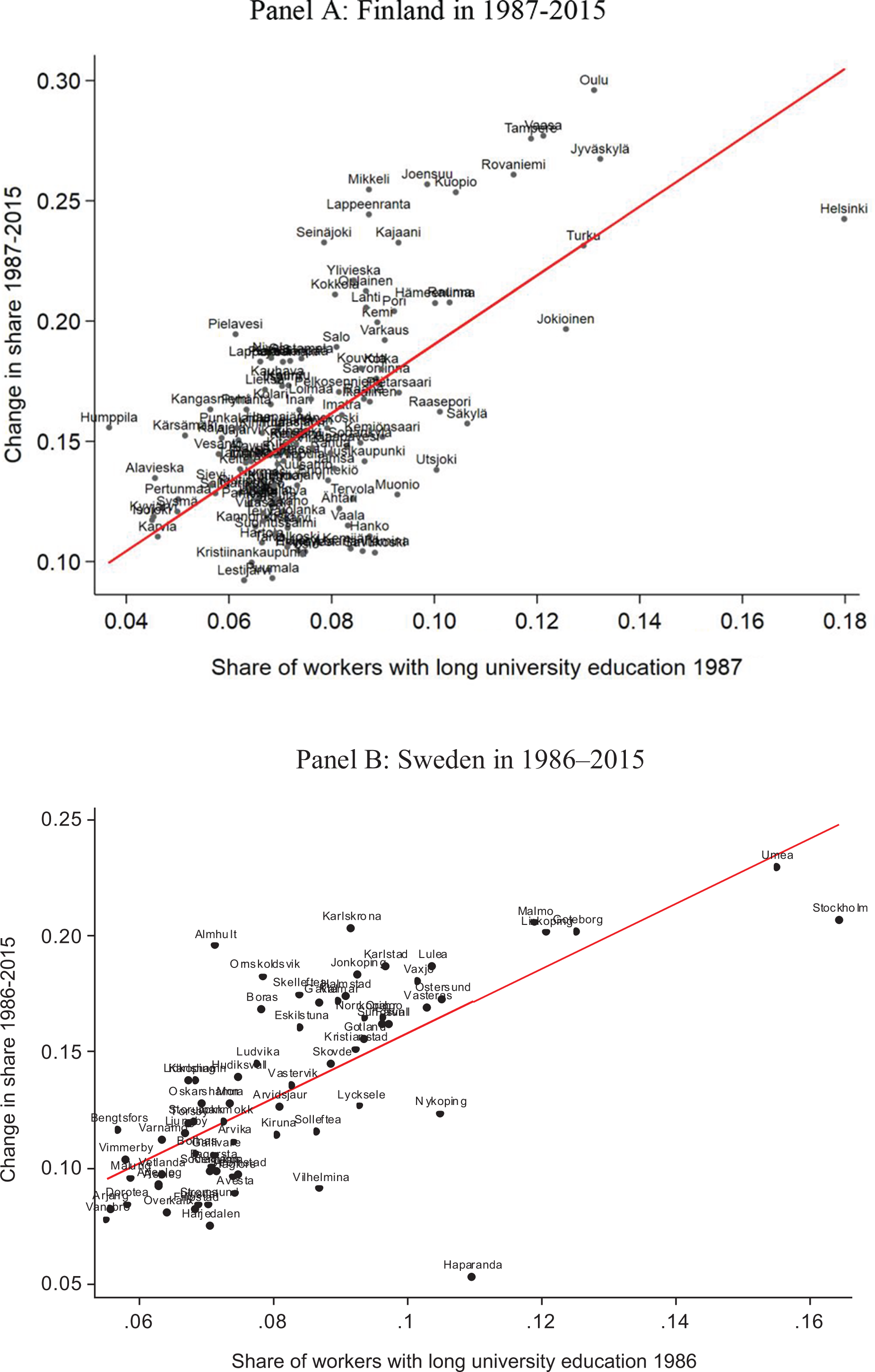
Initial proportion of workers with long university education and change in the proportion of workers with long university education.
Comparison between the countries indicates that the positive relationship is slightly stronger in Sweden (where the correlation coefficient is 0.71) than in Finland (0.65). One possible explanation for the weaker relationship seen in Finland could be the recent expansion of polytechnic education in Finland, which substantially increased the level of education across the country. Also note that, unlike in Sweden, the increase in the proportion of university-educated workers in Finland has been smaller in the metropolitan area of Helsinki than in many medium-sized LMAs (such as Oulu, Tampere and Vaasa). In Sweden, the three metropolitan regions of Stockholm, Göteborg and Malmö, and many of the university-dominated medium-sized LMAs, have experienced substantial increases in the proportion of university-educated workers.
Figure 2 also shows a linear prediction from a simple bivariate (OLS) regression model that is estimated for the two countries. For Finland, the estimated slope of the linear regression is 1.43 (p < 0.001), which means that a 1% increase in the initial share of university-educated workers is associated with a 1.43% increase in the share over a 30-year period. For Sweden, the corresponding positive relationship is similar (1.39; p < 0.001). 6
Table 1 presents OLS estimates of the relationship between the change in the share of workers with a university degree and the initial share of university-educated workers across local labour markets for six sub-periods. The table indicates divergence in all periods. The results for Finland (Panel A) and Sweden (Panel B) show that the higher the initial share of workers with university education, the higher the growth in the share of university-educated workers. The difference between the relatively weak indications of divergence for 1990–1995 compared with the high estimate for 1995–2000 for Sweden, and for 2000–2005 for Finland, is striking. To some extent, this is presumably a reflection of the deep recession during the former period (in both countries), followed by a macroeconomic recovery with increased labour demand and higher mobility in the latter periods. The magnitude of divergence also seems to be lower during the last decade up to 2015.
Changes in the share of workers with long university education across local labour markets: 5-year intervals from 1986/7 to 2015.
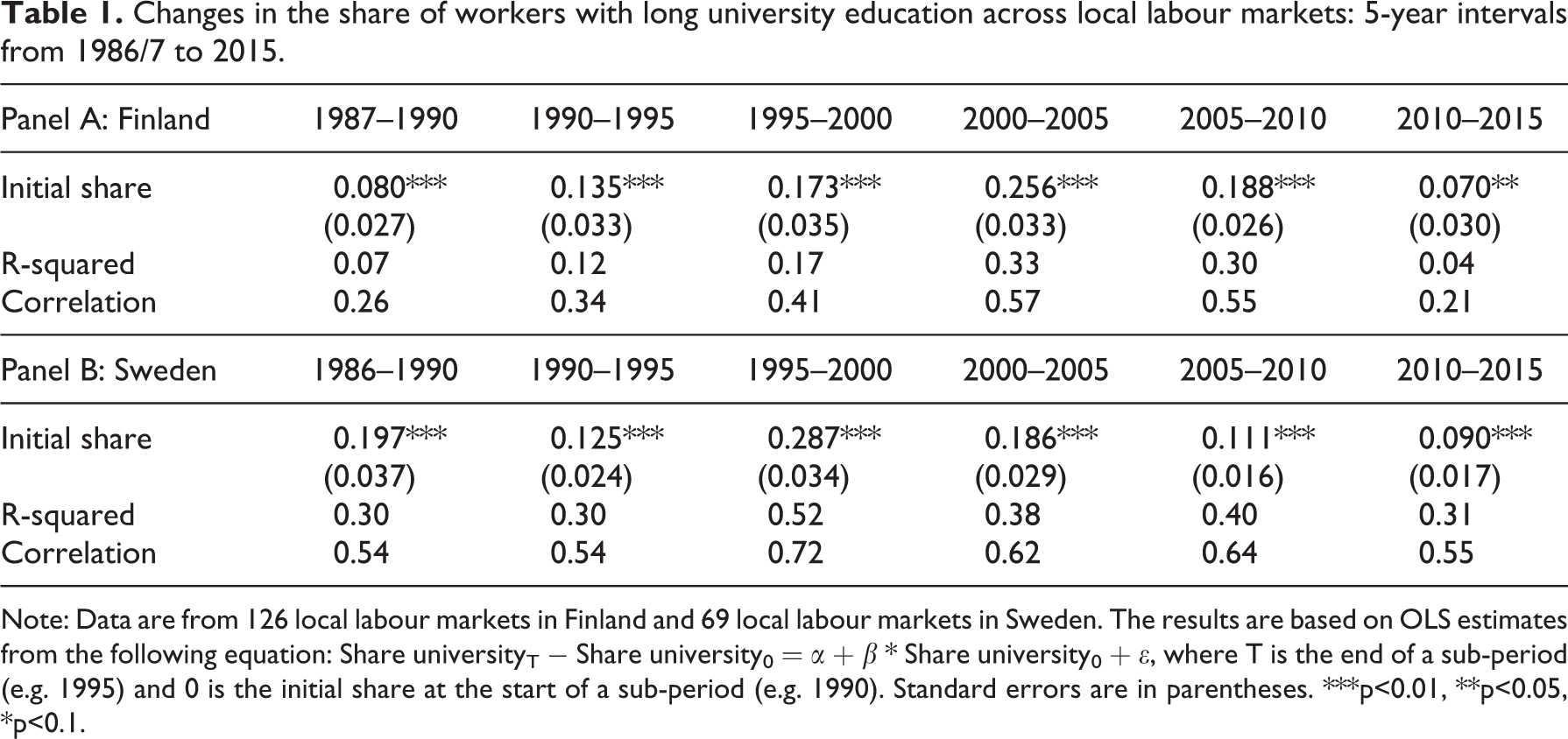
Note: Data are from 126 local labour markets in Finland and 69 local labour markets in Sweden. The results are based on OLS estimates from the following equation: Share universityT − Share university0 = α + β * Share university0 + ∊, where T is the end of a sub-period (e.g. 1995) and 0 is the initial share at the start of a sub-period (e.g. 1990). Standard errors are in parentheses. ***p<0.01, **p<0.05, *p<0.1.
In summary, the level of human capital measured by educational attainment increased substantially in both countries during the 1986/7–2015 period. The growth in the share of workers with long university education was positive in all local labour markets. However, the overall pattern is higher human capital growth rates in larger regions with an initial high share of highly educated workers. The tendency for long-run spatial concentration and regional divergence in human capital is also evident and consistent with estimates of medium-run changes. However, the rate of divergence seems to have tapered off somewhat during later periods of observation (2005–2015) in Sweden first and around 5 years later in Finland.
Migration and regional sorting of skills
In this section, we examine migration of human capital and show that the tendency for increased spatial concentration of skills in Finland and Sweden seems to be stronger than indicated above. We begin with basic facts concerning migration by age and educational attainment. We then focus in greater detail on the migration pattern among recent university graduates. We consider not only the human capital content of migration flows in quantitative terms but also qualitative aspects related to migrants’ abilities.
Migration by age and education
Interregional migration rates across local labour markets by age and educational level by and large follow a pattern that is consistent with human capital theory (see Figure A1 in online appendix). The propensity to migrate peaks at a young age and decreases to a much lower level in middle age and older age. Migration rates also generally increase with educational level, particularly at high-mobility ages up to 30–35 years of age. Interestingly, in both Finland and Sweden, migration rates at 35–45 years of age are highest for individuals with low educational levels, possibly reflecting that those with low educational attainment are forced to search for employment and educational opportunities outside their LMA at older ages.
Regional patterns of change in populations of university graduates and the contribution of migration
Migration rates between local labour markets in Finland and Sweden are particularly high among young and highly educated individuals. To analyse migration for this group, we created data sets for Finland and Sweden that cover all individuals who have graduated from at least 3 years of tertiary education during the period of 2001–2010 (at 32 years of age or younger). Migration was observed by comparing place of residence prior to tertiary education with post-education location.
Changes in the regional stocks of the highly educated by size of regional labour markets are presented in Table 2. Panel A at the top of the table shows figures for Finland, and Panel B at the bottom shows figures for Sweden. Column (1) presents the number of university graduates originating from the three types of regions (labelled “starters”). Here, region of origin is determined according to the location of residence at age 17, prior to university education. Columns (2) and (3) show gross in-migration and out-migration flows following graduation by comparing graduates’ place of origin with their place of residence 5 years after graduation. Column (4) reports net-migration flows, and column (5) presents the location of graduates at the end of the follow-up period (“finishers”). 7 In column (6), we report population changes relative to the number of starters.
Components of change in the number of university graduates by type of region, 2001–2010.
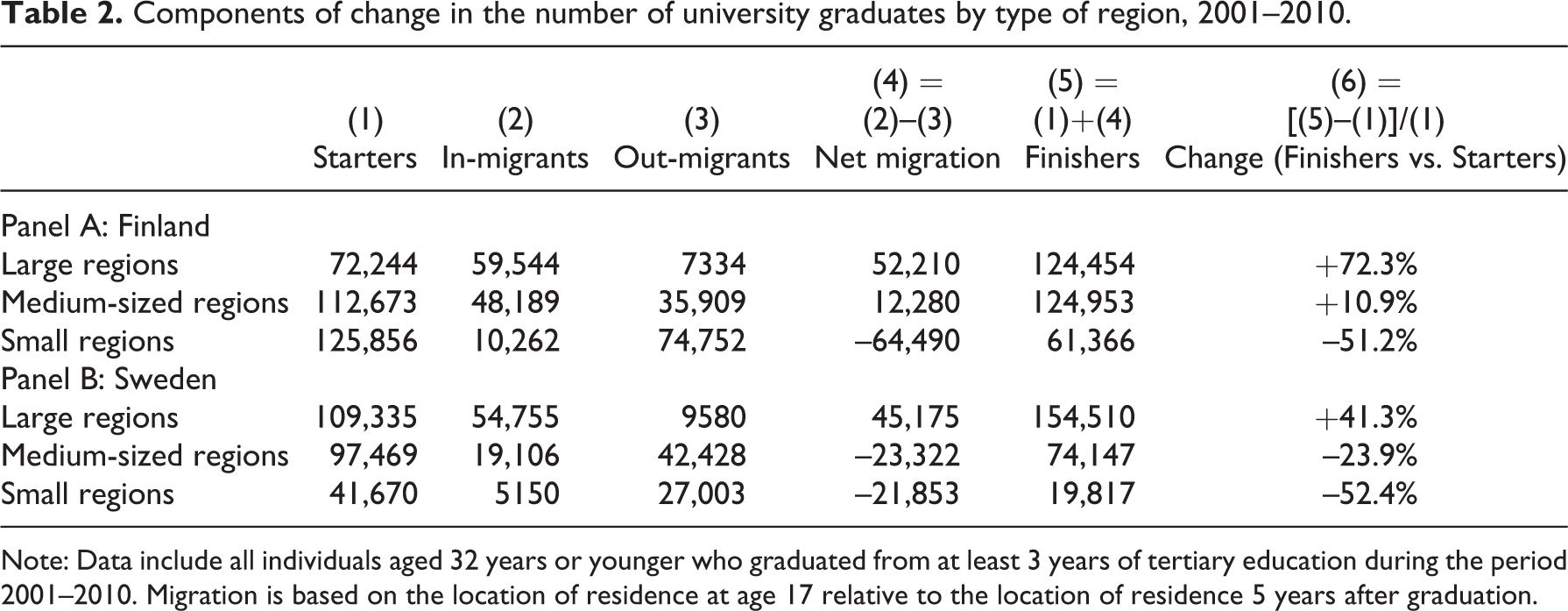
Note: Data include all individuals aged 32 years or younger who graduated from at least 3 years of tertiary education during the period 2001–2010. Migration is based on the location of residence at age 17 relative to the location of residence 5 years after graduation.
The impact of interregional migration is striking. In both countries, in-migration to metropolitan areas by university graduates has been large (in absolute and relative terms). Because their out-migration from metropolitan regions has been small, these regions have managed to increase their population of university graduates substantially, by 72% in Finland and 41% in Sweden.
In-migration to medium-sized regions has been much greater in Finland than in Sweden, but out-migration has been similar in both countries. Because of large in-migration, net migration to medium-sized regions in Finland has been positive (+11% relative to starters), whereas the corresponding figure is negative for Sweden (–24%).
In both countries, small regions are unable to attract university graduates. In Finland, many future university graduates originate from these regions, but relatively few decide to reside there after graduation. In Sweden, the net migration of university graduates from small regions is substantially smaller in absolute numbers than in Finland but similar in relative terms (approximately –52% in both countries). Substantially more university graduates originally (at age 17) hail from small regions in Finland than in Sweden, where far more graduates come from large metropolitan regions.
In summary, the above analysis shows a considerable quantitative redistribution of recent university graduates over time from smaller labour markets towards larger labour markets in both countries. This finding is in line with those of previous studies on migration among university graduates (see, e.g. Faggian and McCann, 2009; Faggian et al., 2007a, 2007b; Haapanen and Tervo, 2012; Venhorst et al., 2011).
We now turn to the qualitative dimension of migration flows among university graduates. We use school grades and parental background as indicators of ability and other productive skills. The two proxies are not perfect measures, but they are shown to be attributes that are positively associated with income and more favourable socioeconomic outcomes in general (e.g. Björklund et al., 2017; Strenze, 2007). They are correlated with each other but not perfectly so. Two alternative measures of parental background are used: education and earnings. In addition to the influence on children’s ability, parental background may affect migration through an individuals’ position in the housing market, a potentially critical aspect for migration into high-cost areas (Coulter, 2017; Öst, 2011).
Figures 3 and 4 present the shares of university graduates moving upward in the regional hierarchy distributed on either upper secondary school (i.e. high school) grades 8 or parents’ level of education. The analysis is based on all individuals 32 years or younger who graduated from at least 3 years of university education during the period 2001–2010. In total, 310,773 graduates were in Finland, and 248,474 graduates were in Sweden. As before, migration is observed by comparing place of residence prior to tertiary education with post-education location. The analysis refers to LMAs aggregated into the aforementioned three size categories: small, medium-sized and large regions. For each origin-destination combination, the share of migrants from region of size category i to region of size category j (mij ) is calculated as mij = (migrants from region i to region j)/(stayers in region i + migrants from region i to j). With this specification, the focus is on whether individuals moving from the LMAs in the small regions to LMAs in the large regions differ in our ability-related attributes compared with stayers in the LMAs of the small regions.
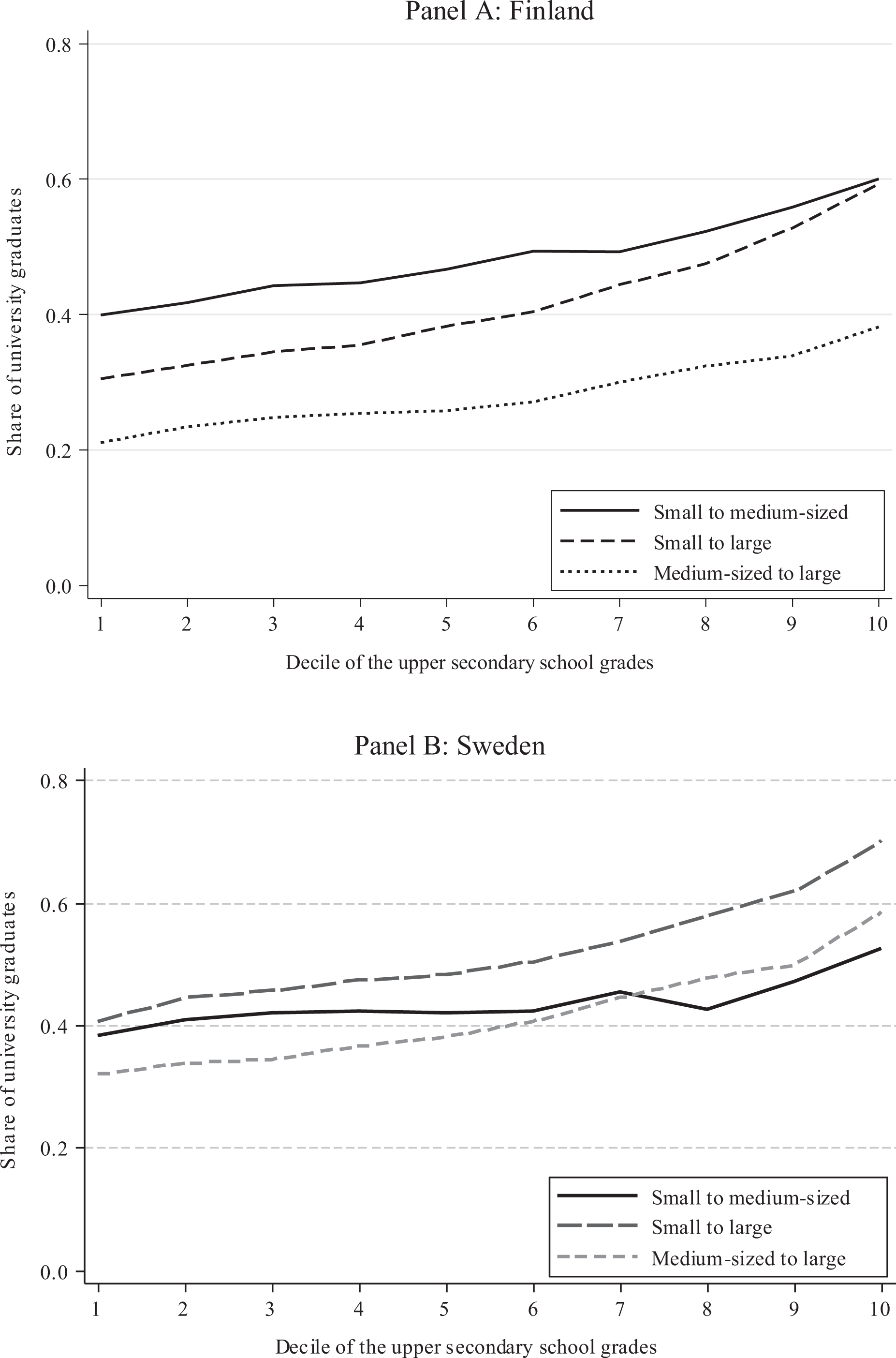
Share of university graduates moving upward in the regional hierarchy, distributed into deciles of upper secondary school grades, 2001–2010.
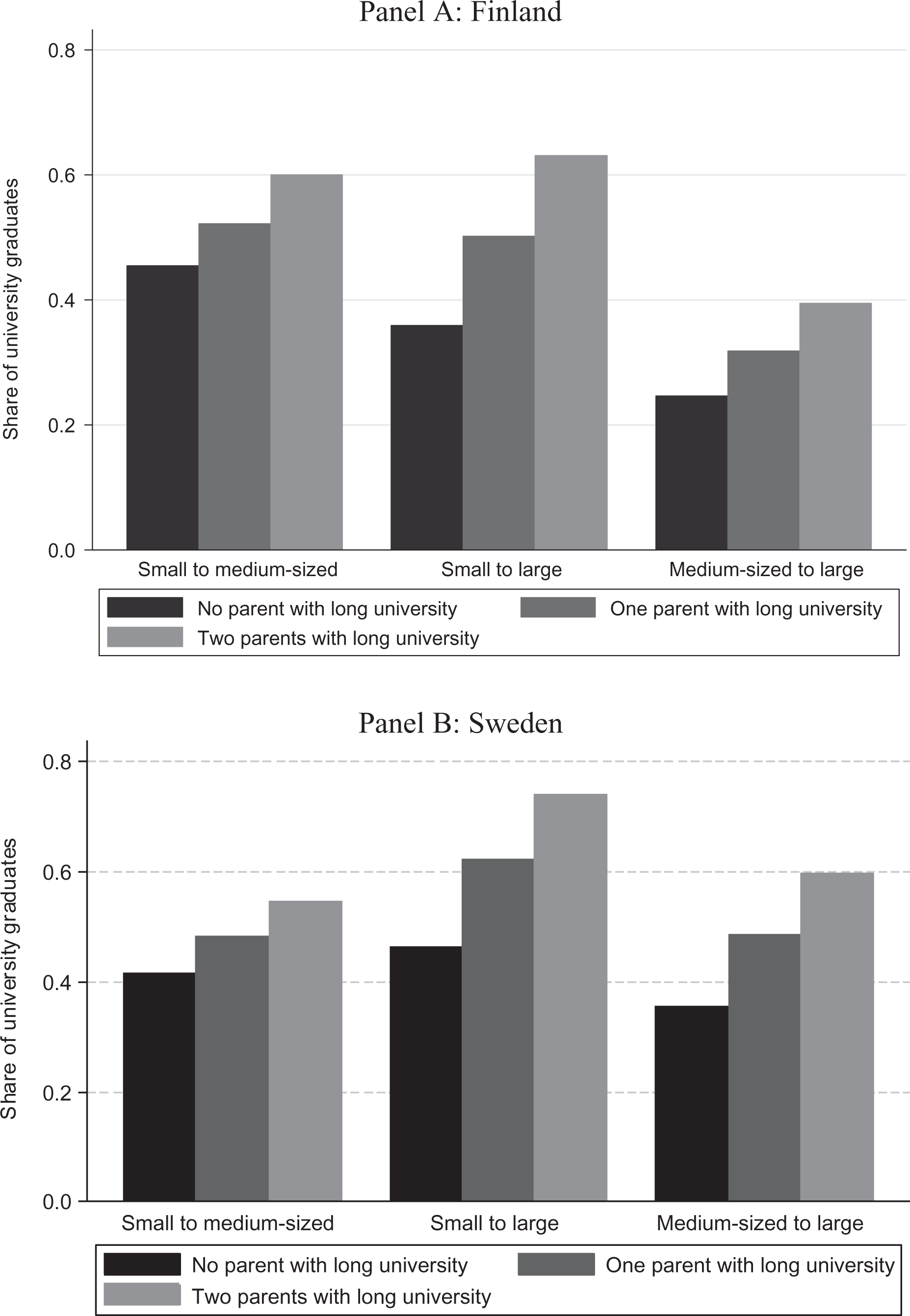
Share of university graduates moving upward in the regional hierarchy distributed by parents’ education.
Assuming that upper secondary school grades are positively correlated with productive skills, Figure 3 indicates that the regional sorting on educational attainment shown in Figure A1 (in online appendix) represents an understatement of the actual regional sorting of skills. There is an almost monotonic increase in the share of university graduates moving upwards in the regional hierarchy from the first to the tenth decile of the upper secondary grade distribution. Moreover, this association is especially evident at the top of the grade distribution and for migration from small to large regions. Among university graduates in the top decile of the grade distribution, the share of graduates from small regions moving to large regions is approximately 60% and 70% in Finland and Sweden, respectively. The corresponding figures for graduates at the lower end of the grade distribution are approximately 30% and 40%.
The share of university graduates moving in the reverse direction (Figure A2 in online appendix), i.e. downward in the regional system, indicates a negative sorting on school grades for migration from large to small regions. Migration from medium-sized to small regions in Sweden and from large to medium-sized regions in Finland show an opposite pattern. In these cases, the share of movers is larger for individuals with high grades than for those with low grades. However, the difference in the magnitude of migration flows between Figure 3 and Figure A2 (in online appendix) (regarding the scales on the vertical axis) indicates the large dominance of migration flows among university graduates upwards in the regional hierarchy over migration flows directed downwards towards smaller regions.
Turning to the parental background of university graduates and migration flows from smaller to larger regions, our results indicate positive sorting on parents’ education into larger regions (Figure 4). 9 The share of university graduates in each upward migration flow increases with parents’ level of education. This association seems to be strongest for migration into large regions. In Finland, the share of graduates moving from small to large regions is 36% among graduates without a university-educated parent, compared with 63% for graduates with two highly educated parents. The corresponding figures in Sweden are 46% and 74%, respectively.
As for migration flows downward in the regional system, Figure A3 (in online appendix) indicates falling shares of university graduates by parents’ education for moves from large to small regions and from large to medium-sized regions in both countries. The pattern for migration from medium-sized to small regions differs by country, but again, the size of these downward migration flows is small compared with the size of the upward migration flows.
In sum, we have shown that the gross migration exchange of university graduates constitutes a large proportion of net changes in regional stocks of human capital. We have also shown that within the group of university-educated migrants, there is substantial sorting on school grades and parental background. Migration upwards in the regional system is associated with higher school grades and more favourable parental backgrounds in terms of education and earnings. Downward migration in the regional hierarchy is less important for the relocation of skills.
Summary and discussion
In this paper, we analyse the geographical distribution of skills and the human capital content of migration flows between functional local labour markets in Finland and Sweden. We use a purely descriptive approach to show the broad picture of recent location patterns and long-term changes over time. Highly informative population register data sets, which are comparable between the two countries, provide new information that unveils systematic heterogeneity in migration flows by the size of labour markets.
Our findings show a consistent pattern of skill divergence across functional regional labour markets during the last 3 decades and striking similarities between Finland and Sweden. We find a robust positive correlation across Finnish and Swedish regions between the initial share of workers with a university degree and the change over time in this share. Local labour markets with high initial shares have consistently experienced a larger increase in the share of university-educated workers. 10 Furthermore, the migration behaviour of recent university graduates reinforces the pattern of skill divergence across regions. The largest and most population-dense regions receive large net in-migration flows of young university graduates, while smaller regions experience large net out-migration flows. This finding represents a quantitatively significant aspect of the re-allocation of human capital because of the combination of high education and high migration rates.
Not only are larger regions net attractors of young university graduates quantitatively, but migration patterns are also distinct in qualitative terms. Our results show that the share of university-educated migrants moving upwards in the regional hierarchy increases with ability. The higher students’ grades are in high school, the higher the share of university graduates who move from smaller to larger regions. We also show that migration upwards in the regional hierarchy is positively related to socioeconomic status in terms of parents’ education or earnings. Thus, our findings imply that the observed regional concentration of highly educated individuals measured in terms of educational attainment most likely underestimates the true concentration of productive abilities.
The descriptive statistics presented in this study provide support for careful identification of the causal effects of agglomeration on earnings and labour productivity and other socioeconomic outcomes. Information on educational attainment is clearly relevant but most likely not sufficient to control for heterogeneity in human capital and residential self-selection. In some situations, data on people’s labour market history may reveal unmeasured ability, which allows us to address residential selectivity by investigating changes in earnings that occur before and after migration. However, a large share of migration between local labour markets pertains to young people with high education with either no or very limited labour market experience before migration. The lack of pre-migration earnings or labour market histories makes it much harder to correct for residential self-selection. Direct measurement or relevant proxies of productive skills, such as school grades and parents’ socioeconomic status should, therefore, be of great interest in the measurement of human capital stocks and the skill composition of migration flows.
The implications of our findings for economic growth depend on the extent to which education and skills can be utilised in regional labour markets. Returns to education and skills have remained substantial in Finland and Sweden (Woessmann, 2016), despite the substantial expansion of higher education in both countries. This finding suggests that the demand for the highly educated has been sufficient to meet the increasing supply of the highly educated. 11 Naturally, high returns to schooling do not exclude the possibility that some individuals over- or under-invest in education. Those individuals whose skills are under-utilised (e.g. their skill level is higher than required by the jobs) are likely to suffer a significant wage penalty (Green et al., 2002). Further research should be undertaken to investigate how migration protects highly skilled workers from under-utilisation of their skills.
In many countries, growing income inequalities and the increased spatial concentration of human capital have occurred alongside changes in the political arena. Iammarino et al. (2019) argue that regional economic divergence has become a threat to economic progress and a source of social and political instability in Europe. Disparities in regional socioeconomic conditions are now a major political issue in many countries. However, what sorts of interventions are most likely to be effective? This question is clearly difficult to answer. Kline and Moretti (2014), Austin et al. (2018) and Iammarino et al. (2019) discuss various aspects of place-based (or place-sensitive) development policies. Place-based policies target specific geographic areas for some type of treatment. One conclusion from these studies is that place-based policies must be tailored to the targeted regions’ specific comparative advantages and challenges. One-size-fits-all policies will not work. Another important conclusion is that place-based policies most likely involve difficult equity-efficiency trade-offs. Increasing the efficiency of resource allocation may lead to greater divergence in economic development across regions.
The equity-efficiency trade-off is partially due to agglomeration economies and UWPs. The positive relationship between the size of regions and workers’ productivity/earnings is well-documented in the economic literature. Agglomeration of skills into larger regions arises because many university-educated workers themselves choose to locate in such areas. Presumably, this pattern reflects their utility gains from location decisions, and previous research has shown that the UWP is especially large for highly educated workers. However, the observed skill divergence across regions is challenging. The fact that many small and medium-sized regions experience a net loss of university-educated workers makes it more difficult for those regions to attract innovative firms. This challenge reduces the supply of attractive jobs in these locations, which in turn makes it more difficult to keep and attract highly skilled people.
Policies aiming to substantially reverse the observed patterns of location choice among highly educated individuals may be overwhelmingly costly. Improved integration between smaller and larger labour markets can be a more efficient strategy. Constraints in the housing market and the transport infrastructure are potentially important explanations for why firms in metropolitan regions find it difficult to fill vacancies. Recent findings from the US indicate that the economic benefits of increased housing supply in metropolitan areas can be fairly large (Hsieh and Moretti, 2019). Investments in transport infrastructure and public transportation that both facilitate efficient mobility within metropolitan areas and stimulate integration between larger and smaller local labour markets may increase labour supply and reduce spatial mismatch. This investment may further enable small and medium-sized regions to tap into the agglomeration advantages of larger local labour markets and offer some relief for the tight housing and labour markets in metropolitan areas. Investments in education can reduce skill mismatch and promote employment. However, investments in higher education can also accelerate the flow of workers to larger regions because most jobs (and the greatest economic returns) for the highly educated are located in larger, densely populated areas.
Supplemental material
Supplemental Material, MigrFinSwe-2020-3-17-supplement - Regional concentration of university graduates: The role of high school grades and parental background
Supplemental Material, MigrFinSwe-2020-3-17-supplement for Regional concentration of university graduates: The role of high school grades and parental background by Kent Eliasson, Mika Haapanen and Olle Westerlund in European Urban and Regional Studies
Footnotes
Acknowledgements
The authors would like to thank two anonymous reviewers and participants at the labour economics seminar at the Department of Economics, Umeå University, for their helpful comments.
Declaration of conflicting interests
The author(s) declare no potential conflicts of interest with respect to the research, authorship, and/or publication of this article.
Funding
The author(s) disclosed receipt of the following financial support for the research, authorship, and/or publication of this article: This study is supported by Academy of Finland SRC projects “Beyond MALPE coordination: Integrative envisioning” (No. 303552), “Work, Inequality and Public Policy” (No. 314208) and Yrjö Jahnsson Foundation (No. 6621).

Supplemental material
A supplemental appendix is available for this article online.
Notes
References
Supplementary Material
Please find the following supplemental material available below.
For Open Access articles published under a Creative Commons License, all supplemental material carries the same license as the article it is associated with.
For non-Open Access articles published, all supplemental material carries a non-exclusive license, and permission requests for re-use of supplemental material or any part of supplemental material shall be sent directly to the copyright owner as specified in the copyright notice associated with the article.
