




Abstract
There is a growing academic and policy interest in the notion of using cities as ‘living laboratories’ to develop and test responses to the social, environmental and economic challenges present in contemporary urbanism. These living laboratories are often assumed to function through ‘quadruple helix’ relations between varied actors from the public, private, university and community sectors. However, empirical research that explores the real-world functioning of these arrangements is comparatively limited. This paper will help address this gap through the case of Newcastle City Futures (NCF) – a university-anchored platform for collaborative urban foresight research, public engagement and innovation. In particular, the paper will concentrate on a two-year period when NCF focused on the facilitation of innovation demonstrator projects guided by the vision of Newcastle upon Tyne developing a postindustrial future as a ‘test-bed city’. Detailed empirical accounts of the development of two demonstrator projects are used to illustrate and analyse processes of cross-sectoral collaboration and engaging the public in co-design. These are used to support the conceptual argument that the presence of the quadruple helix as a form of local innovation system should not be taken as given. Instead, the collaborative relationships required for transformational interventions in the future of cities need to be actively constructed by diverse actors and supported by intermediary vehicles such as NCF.
Introduction
A concern with the future of cities in the 21st century entails addressing demographic, environmental and socio-economic challenges that are corollaries of an increasingly urbanised world (Nijkamp and Kourtit, 2013). The limitations of current corporate-driven, technology-centred ‘smart city’ interventions in these respects mean that a need for more sustainable and socially inclusive solutions is apparent (Dixon, 2018; Trivellato, 2017). One area of exploration into this problem is around the contribution of universities to cities. This interest extends not just to the growth of knowledge-intensive economic activities, but also to ensuring this is part of a more holistic pattern of urban development (Goddard and Vallance, 2013; Harris and Holley, 2016). As many universities are themselves located in urban areas, this strand of research has dovetailed with the notion of using the city itself as a ‘living laboratory’ – that is, as a site for experimentation, learning and enacting change in the local environment (Bulkeley et al., 2019; Karvonen and Van Heur, 2014; König and Evans, 2013). In this scenario, new scientific knowledge is seen to be the product of a mode of practice that is transdisciplinary, socially reflexive and generated by heterogeneous actors in contexts of practical application beyond the academy (Gibbons et al., 1994; Nowotny et al., 2001).
These perspectives belong to a broader family of cross-disciplinary approaches that have rethought innovation as an open process requiring universities to collaborate with varied partners (Van Geenhuizen, 2018). A popular framework used to analyse these relations over the past 20 years has been the ‘triple helix’ (TH) model of industry, government and academia (Leydesdorff and Etzkowitz, 1996). More recently, attempts have been made to expand this into a ‘quadruple helix’ (QH) model by adding a fourth sphere that more explicitly recognises the co-production role of the public or other civil society actors (Carayannis and Campbell, 2009). The emphasis this carries on citizens as active beneficiaries of societal innovations clearly resonates with the living laboratory notion (Arnkil et al., 2010; Cossetta and Palumbo, 2014). For instance, members of the European Union’s (EU’s) Open Innovation Strategy and Policy Group have advanced the QH model as being central to a new innovation paradigm (Open Innovation 2.0) based on cross-organisational collaboration, user/citizen co-created shared value and the cultivation of innovation ecosystems (such as Living Labs) (Curley and Salmelin, 2013). However, the empirical evidence that supports the real-world presence of fully functioning urban living laboratory and QH arrangements (either separately or in conjuncture) does not currently match the theoretical claims and policy rhetoric around these phenomena. There is therefore a need for in-depth, multifaceted academic studies of cases where these concepts have been put into practice in specific settings and, crucially, the considerable challenges that are inevitably part of their formation and operation as vehicles for urban innovation in varied local contexts (Bulkeley et al., 2019).
This paper will help close this gap in the literature through a study of Newcastle City Futures (NCF), a university-led initiative in the English city of Newcastle upon Tyne. Since its inception in 2014, NCF has developed into a collaborative platform for cross-sectoral demonstrator projects that are helping to substantiate a future vision of Newcastle – a former industrial city with enduring socio-economic challenges – as an urban innovation test-bed (Vallance et al., 2019). In NCF’s most recent configuration – as an Urban Living Partnership (ULP) pilot project funded by the UK academic research councils and national innovation agency – it drew on relationships established with a range of stakeholders, as well as academic capabilities across two universities, to help broker a portfolio of these demonstrator projects. This paper is focused on the process of facilitation and early implementation of these projects as a lens through which to study processes of multi-partner collaboration and public engagement in the context of urban innovation. The empirical sections draw on research material collected during the tracking of the projects to help analyse the underlying dynamics involved and reflect on wider lessons that can be derived from these experiences.
NCF adopted a series of principles to guide project facilitation activities that, reflecting the cross-sectoral composition of the project consortia, were based on the QH model of innovation through interaction between public, private, university and community or social actors. Accordingly, the paper will contribute to the emerging understanding of this framework. In particular, it argues that the presence of the QH as a form of local innovation system is not given, but needs to be to be actively constructed by diverse actors and supported by intermediary vehicles. The NCF case also helps to extend existing conceptualisations of possible QH arrangements by providing an example of a local configuration of these sectors that is anchored around the civic engagement activities of intermediary actors from universities.
The paper has six further sections. Firstly, a literature review outlines the QH model and related concepts that underpin the NCF approach to multi-sector collaboration. Secondly, a background section gives an overview of the NCF initiative in the context of North East England. Thirdly, a methodology describes the research techniques used to track and reflect on the progress of the demonstrator projects. Fourthly, the opening empirical section discusses the NCF approach to project facilitation and barriers encountered in general. Fifthly, two detailed case studies of specific demonstrator projects in the domains of housing (Future Homes) and public transport systems (Metro Futures) explore the key QH processes of building cross-sector consortia and engaging the public in co-design. Finally, the conclusion summarises the main findings and contribution of the paper.
Conceptual framework: Quadruple helix innovation systems
The QH framework is an iteration of the more established TH theory of innovation through interaction between different institutional spheres (Etzkowitz and Leydesdorff, 2000; Leydesdorff and Etzkowitz, 1996). This packaged academic thinking about the non-linear and systemic nature of innovation into an easily understood and internationally applicable conceptual and policy model of network relations between industry, government and university partners (Benneworth et al., 2015). In the QH, this is extended by adding a fourth sphere of the public and civil society to the more conventionally recognised innovation actors of the TH (Arnkil et al., 2010; Carayannis and Campbell, 2009).
This reflects a wider tendency in contemporary studies to explicitly recognise the role of end-users – whether individuals, communities or organisations – as integral to processes of product and service innovation (e.g. Grabher et al., 2008; Von Hippel, 2005). For Carayannis and Campbell (2012, 2014), leading proponents of the QH model, this represents a more ‘democratic’ approach to innovation. It also more easily allows for the outcomes of these interactions across institutional boundaries to be conceived as forms of social rather than just technological or business innovation (Klein et al., 2013; Lehtola and Ståhle, 2014). Although some commentators have questioned the analytical validity of extrapolating from the TH concept in this manner (e.g. Leydesdorff, 2012), the basic idea of the QH clearly has some utility as a heuristic framework for the study of broader forms of societal innovation (e.g. Gouvea et al., 2013; Lindberg et al., 2014), and comparable processes of, for instance, participatory urban governance and planning (e.g. Chatterton et al., 2018) or formation of a regional smart specialisation strategy (Aranguren et al., 2019). This reflects the growing value of collaboration beyond individual organisations in response to the uncertainty generated by highly complex societal ‘grand challenges’ at both global and local scales (Ferraro et al., 2015).
Within this basic framework, however, it should not be assumed that each part of the QH has an equal level of influence in shaping innovation dynamics. In a useful contribution, Arnkil et al. (2010) map four different versions of a QH model based on a review of good practice cases. These range from a limited modification of established patterns of organisational collaboration to acknowledge the input of customer feedback (TH + users); through configurations of the QH dominated by, respectively, firms and public sector organisations (firm-centred living lab and public-sector-centred living lab); to a model that is genuinely oriented around the needs of the public (citizen-centred QH). This highlights that the category of ‘users’ (that here defines the fourth helix) can take different forms relative to other actors and in different partnership dynamics – from just a source of information on consumption behaviours, through having some agency as co-designers with firms or public sector organisations, to themselves being the key drivers of social innovation processes as engaged citizens.
Absent from Arnkil et al.’s taxonomy is a version of the QH in which universities are positioned as the core partners. This omission perhaps reflects an implicit acknowledgement of the limitations of approaches to economic development that equate innovation with a process driven by the kinds of scientific research carried out in universities (Power and Malmberg, 2008). However, the TH literature has been characterised by a strong emphasis on the role of the university, and in particular, the emergence of ‘entrepreneurial universities’ (archetypically US institutions, such as MIT and Stanford) as a key event in the development of late-20th century innovation systems (Etzkowitz et al., 2000). In theory, therefore, the potential for universities – particularly those that have adopted a strong place- and/or citizen-focused civic engagement mission – to act as the locus of a QH system remains salient (Goddard et al., 2016). This will, however, require universities to develop new institutional mechanisms and/or collaborative practices to meaningfully engage with the public as part of this model (Miller et al., 2018). A feature of the TH theory is that the interaction of different institutional spheres will produce hybrid organisational forms, such as university and government technology transfer offices or academic spin-off firms (Ranga and Etzkowitz, 2013). This type of intermediary actor, which can operate between sectors to bridge gaps in practice and encourage collaboration, has also been proposed as a key component of QH arrangements (MacGregor et al., 2010). It follows that the interaction with non-professional communities as part of a QH should give rise to different types of partnership mechanism that are more characteristic of a civic (rather than entrepreneurial) university strategy (Goddard and Vallance, 2013). Further research is, however, needed to understand what form these new structures may take and how they can help integrate public engagement concerns into broader innovation processes.
The QH is not an inherently spatial concept, and there is therefore scope for it to be operationalised at various geographical scales. Like the TH before it, however, the instrumentalisation of the framework within the context of regional policy has arguably given it traction at the sub-national level (McAdam and Debackere, 2018). Carayannis et al. (2018), for instance, have sought to elaborate on the basic model through association with local/regional development concepts such as clusters, smart specialisation strategies and regional innovation systems. The cultivation of urban living laboratories, often based on a QH partnership template, has also been promoted within EU networks as a means to build stronger local innovation systems (e.g. Curley and Salmelin, 2013; Robles et al., 2015). However, its popularity as a policy buzzword has led to the urban living lab label being applied in a conceptually inconsistent way (Steen and Van Bueren, 2017). Specifically, it has been attached to smart city projects in which citizens are little more than passive sources of data to be harvested by municipal authorities or private companies (Naafs, 2018). By contrast, definitions informed by open innovation or QH perspectives tend to emphasise the civic function of urban living labs as user-oriented environments for co-creation/co-production between various actors, including the public (Arnkil et al., 2010; Robles et al., 2015).
The growing prevalence of the QH as an academic and policy model also belies the challenges that most cities or regions will experience in effectively bringing together this combination of actors (particularly those representing the public or civil society) to engage in collaborative innovation processes. As mentioned above, the QH concept can be traced back, via the TH, to systems of innovation approaches (see Edquist, 1997). These include an explicit sub-national focus through the development of the regional innovation systems concept to capture the importance of geographic proximity and shared institutional settings between interacting agents (Asheim et al., 2011; Cooke et al., 1997). However, Metcalfe et al. (2012) question the underlying assumptions of these approaches by suggesting that innovation systems – whether national, regional or sectoral – should not be seen as pre-given objects of analysis, but only exist when sets of systemic connections between actors and other components are formed to solve particular innovation problems. For the range of potential innovation actors within a given territory – who collectively are often assumed to unproblematically constitute a national or regional innovation system – they propose the alternative term of innovation ecologies. In earlier work, we have argued that this is an especially useful distinction in relation to understanding the QH (Vallance, 2016). It shifts attention from the mere presence of a local ecology of actors from each of these sectors to the ongoing processes through which they construct a system of QH relations around shared problems or goals. In particular, the ways in which the non-traditional innovation actors of citizen-users are embedded in these emerging systems of relations is a key question that QH frameworks should address.
This argument highlights a need for empirical studies that can elucidate these processes in all their inherent complexity, including the role played by intermediary actors. This paper will respond to this research gap through a study of urban innovation demonstrator projects supported by the NCF collaborative platform. In these cases, the aim of the demonstrator project in question represents the problem or goal around which a QH consortium was encouraged to form. A related aim of these demonstrator projects was to involve residents of Newcastle in the co-design of the solutions to these problems. NCF therefore also offers an opportunity to examine this citizen engagement aspect of the QH framework. Before this, the next section will outline the background to this wider initiative.
Background: The Newcastle City Futures/Urban Living Partnership programme
This section will introduce the empirical part of this paper by outlining the NCF programme. The focus is on activities during a two-year period (from August 2016 to July 2018) when NCF was funded by the UK academic research councils and national innovation agency as one of five ULP pilot projects (covering Newcastle upon Tyne and the neighbouring local authority of Gateshead). Amongst these five ULPs, the Newcastle/Gateshead pilot was notable in following directly on from an earlier project. During 2014 and 2015 a research team from Newcastle University had undertaken the first local sub-project under a national Foresight Programme on the Future of Cities. NCF 2065 consisted of engagement activities including a temporary exhibition on the city’s urban heritage and future, gathering of baseline evidence, stakeholder workshops to identify priority themes and scenario building for 50 years in the future (Tewdwr-Jones et al., 2015).
Newcastle is the largest city in a region (North East England) that, in the wake of widespread deindustrialisation during the final decades of the 20th century, continues to face considerable economic and social development challenges (Hudson, 2005). The 2065 report responded to this priority issue by outlining, as one of its future scenarios, a vision of Newcastle developing an economic niche as a science and engineering-based ‘test-bed’ city for new technologies (Tewdwr-Jones et al., 2015). This projection reflected the current-day importance of the two universities in the city (Newcastle and Northumbria) as anchor institutions1 (Goddard and Vallance, 2013) and an already emerging set of living laboratory initiatives (Powells and Blake, 2016).
Arising from the 2065 foresight project, a semi-formalised committee – the City Futures Develop-ment Group (CFDG) – was established in 2015 on the instigation of Newcastle City Council. This group had a brief to promote a long-term vision for the city and support a programme of development activities drawing on academic research capabilities (from both Newcastle and Northumbria universities) and the resources of other local partner organisations (including Gateshead Council). A further barrier to development in North East England is the weak and fragmented nature of local and regional government within the highly centralised UK governance system (Lemprière and Lowndes, 2019). Although the CFDG is a partnership with no executive power, it has provided a vehicle for the councils, universities and other stakeholders to continue engaging in shared, forward-thinking discussions about the future of the city-region during a period in which the local authorities, in particular, have been constrained by central government austerity measures (Vallance et al., 2019).
Building on these earlier activities, the ULP pilot project had two distinct but interrelated sets of objectives:
i) to diagnose the complex and interdependent challenges within the urban region;
ii) to work collaboratively to co-design and implement initiatives and solutions in order to contribute to the life and development of the area.
For its ‘diagnostic’ side, the NCF ULP project was able to update activities from the 2065 foresight project by employing novel foresight methods related to, for instance, urban systems mapping, data visualisation and digital engagement (Tewdwr-Jones and Goddard, 2014; Wilson and Tewdwr-Jones, 2019). The consultation activities as part of the 2065 project, and subsequent establishment of the CFDG, also provided a foundation for the ‘collaborative co-design’ side of the ULP by beginning to cultivate a network of interested organisations and individuals. This means that, although the ULP project was hosted by Newcastle University, it commenced in summer 2016 with a group of core partners that included local authorities, regional transport bodies, public utility providers, large global technology and engineering companies, regional companies and business associations and local community and voluntary organisations. The interdisciplinary project also brought together a range of academic actors with different perspectives on the development challenges facing contemporary cities. As well as a core team based in Newcastle University (consisting of director, project manager, policy liaison and researcher), the ULP had 10 co-investigators across Newcastle and Northumbria universities from disciplines including planning, geography, architecture, engineering, human–computer interaction, digital humanities and social gerontology.
These connections, both inside and outside the academy, allowed the ULP to quickly assume the function of a collaborative platform for the facilitation of cross-sectoral demonstrator projects focused on the co-design and testing of innovative solutions to future challenges and opportunities within the city-region. The next section will explain the research into this process that forms the basis for the following empirical sections.
Methodology
The following sections are based on research that took place in parallel to the ULP for its full two-year duration. This research aimed to track the development of unfolding demonstrator projects and help reflect on the overall NCF model. It was conducted by a researcher who was a member of the core NCF team, but had no direct responsibilities for project facilitation. The resulting ‘insider–outsider’ position (Dwyer and Buckle, 2009) enabled this researcher to balance, on the one hand, a beneficial level of access to and understanding of relevant activities and participants with, on the other hand, a degree of detachment that allowed a sufficiently neutral and (where necessary) critical perspective to be taken on the collaborative processes under study.
The discussion and case studies below draw on three main forms of qualitative material collected by this researcher. Firstly, notes from meetings, workshops and other events relating to the projects focused on (including Future Homes and Metro Futures), and the ULP more generally (e.g. project ‘mash-ups’, CFDG meetings, team progress reviews). Secondly, correspondence and/or documents relating to the projects (e.g. meeting minutes, design briefs, reports, funding applications). Thirdly, 16 semi-structured interviews (with a total of 19 respondents) carried out at various stages with ULP partners from different sectors. The interviewees included five individuals directly involved in the Future Homes project and five directly involved in the Metro Futures project, along with others who had some knowledge of these activities.
This material allowed in-depth exploration of the origins and evolution of these projects, the relationships between partners within the consortium and the ways in which engagement and/or the co-design methods employed represented an innovative approach. The data collected across these different sources was coded together by project (as well as by other relevant themes) and ordered chronologically. This made it possible to reconstruct the progression of these projects whilst incorporating points of reflection from interviews carried out at different times. The ensuing accounts therefore identify and analyse the dynamics that shaped how each project unfolded and the challenges encountered. In doing so they address the central concerns of this paper with the complex processes through which QH coalitions are formed and mobilised to support the co-design of experimental interventions in the future development of cities. Before the in-depth exploration of these cases, the opening empirical section provides a broader discussion of NCF demonstrator project facilitation activity based on notes and documentary material collected throughout the ULP.
Urban Living Partnership demonstrator projects overview
A protocol drawn up by the CFDG, in advance of the ULP, defined demonstrator projects as those that emerge from a. . .
. . .collaborative process to illustrate or explain, as a theory or product, an idea or innovation that warrants testing or application by exemplification or practical application. A demonstrator project can be an object for further research, policy development, and/or physical or virtual delivery.
For the ULP, the NCF core team adopted an additional set of guiding criteria that demonstrator projects were encouraged to conform to in their conception and realisation. These included the following:
they would be taken forward collaboratively through the formation of a consortium of partners from different organisations or groups, so that (if possible) all four elements of the QH would be represented;
they would deploy novel methods relating to public engagement, digital technologies and/or visualisation to co-produce new knowledge and co-design innovative solutions to the challenge at hand;
they would be based in Newcastle and/or Gateshead, but where necessary could encompass a wider geography (e.g. the Tyne and Wear metropolitan region).
During the ULP, new demonstrator projects would regularly be presented at CFDG meetings for discussion and endorsement by group members. This step ensured that the projects would be consistent with one or more of a set of broad themes – for example, ageing, sustainability, digital, health and wellbeing, culture, young people – used by the CFDG and influenced by priorities for the future city identified through the earlier 2065 project (Tewdwr-Jones et al., 2015). These themes were aligned with the strategic goals of the CFDG’s parent organisations (the two universities, Newcastle and Gateshead councils and Local Enterprise Partnership). However, the identification of potential demonstrator projects was driven more by a bottom-up approach of responding to opportunities to, for instance, embed the testing of innovative ideas into unfolding urban development initiatives; generate novel collaborative solutions to specific challenges facing partner organisations; or help extend existing academic research interests or student projects into activities with social or economic impact within the city-region. Consequently, many of the projects cut across multiple thematic areas, reflecting the complex nature of societal challenges and related development opportunities in contemporary cities.
Over the course of the ULP, the NCF team were involved in the discussion and/or facilitation of upwards of 50 demonstrator project ideas, in doing so considerably growing the range of organisations with which it engaged beyond the initially named core partners (see Oliver, 2018). A selection of these projects involving consortiums are described in Table 1. The core NCF team would often have a role in helping to formulate the project focus and assemble the consortium. For example, early on in the ULP it hosted a ‘mash-up’ event involving a range of partners from which several prospective projects and consortia emerged, which in some cases (for instance, ‘Future High Street’ in Table 1) were subsequently taken forward. The NCF team would also in some cases steer the project through early meetings, before withdrawing when the consortium became self-sustaining and allowing leadership responsibilities to be assumed by an ‘academic champion’ (sometimes one of the ULP co-investigators) and/or other members of the group.
Examples of Newcastle City Futures demonstrator projects and consortium partners.
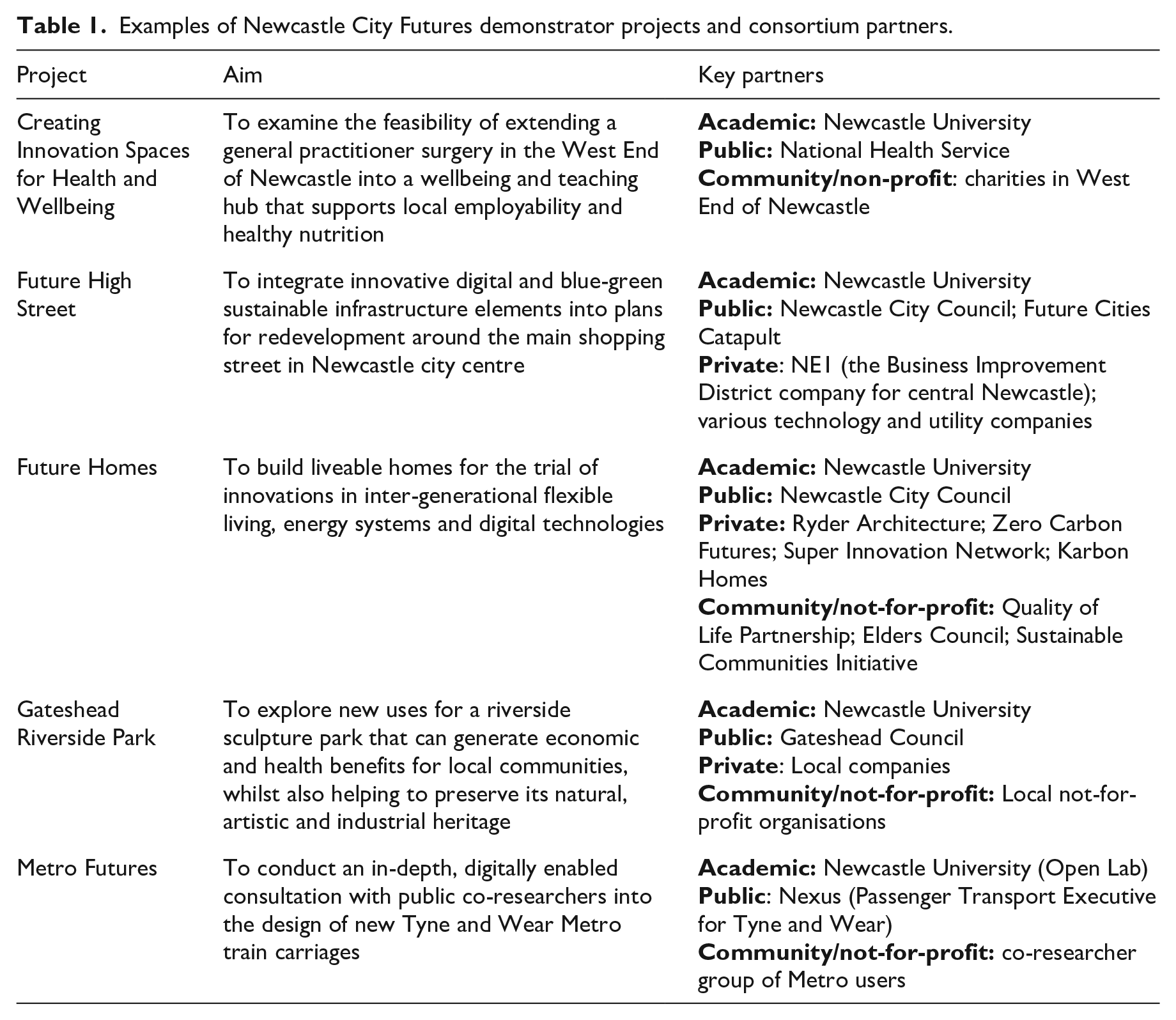
The two projects featured as case studies below (Future Homes and Metro Futures) both had a clear and compelling basis for collaboration that meant that the NCF core team took a supporting rather than leading role (see below). On other projects, however, the core team had to be more active in trying to sustain a QH consortium and guide it towards an appropriate objective. This reflected the often-fragile nature of the partnerships involved and a range of practical issues that delayed the progress of demonstrator projects. For instance, some well-advanced project ideas were not ultimately taken forward due to the unwillingness of stakeholders in control of key regional assets to commit to more ambitious, and potentially risky, plans for opportunities at hand. This was, in part, due to organisational cultures in the public sector that are not conducive to disruptive innovations (see Makkonen et al., 2018). In other instances, the cross-thematic nature of NCF projects also proved to be a challenge for large public sector organisations with siloed structures. As part of the demonstrator project development process, the consortia were encouraged to apply for external funding to enable their idea to reach ‘proof of concept’ stage. In one case, a promising cross-sector consortium stalled because a suitable funding opportunity could not be identified that suited the project’s mix of sustainability, health and wellbeing and cultural elements. More prosaically, several projects were hindered by the limited availability of key individuals, reflecting NCF’s status as a voluntary partnership.
The following section examines two cases of demonstrator project development in more depth. These projects were not without challenges, but were amongst those in the portfolio that advanced furthest during the timespan covered here (up to July 2018) and both are linked to substantial ongoing developments in the city and region. They also represent valuable opportunities to examine the dual processes of multi-partner collaboration and innovative public engagement and co-design that are central to understanding the workings of the QH model in this context. The wider implications of the cases for these debates will be discussed in the concluding section.
Case studies
Building cross-sector consortia: Future Homes
The objective of the Future Homes project is to build houses in Newcastle that can be used to experiment with innovations in design, materials, digital technologies and energy systems. A related aim is to capture the wider learning from this exercise that can inform solutions to the challenges of future housing provision. The project lead is a Professor of Planning in Newcastle University, and Co-Investigator on the ULP project, with longstanding research interests in older people’s housing (Gilroy, 2008). This work has involved collaboration across a number of previous projects with the director of a third-sector organisation that coordinates a City Council-backed initiative to make Newcastle an ‘age-friendly city’. Future Homes grew out of a shared interest in extending the practical dimensions of this work and finding new ways to raise awareness of alternative housing options for older people [Interview 4, 11 November 2016]. An extra source of impetus to the project was given by the vision of Newcastle as a test-bed city promoted through the NCF 2065 project, and the early Future Homes concept received support when presented at a CFDG meeting in late 2015 [Interview 1, 15 October 2016].
From these origins, a wider cross-sectoral group formed to take the project forward – including interested people from voluntary organisations (relating to older people and community energy), a Newcastle-based architectural practice, a regional registered-housing provider and Newcastle University. This group met regularly from early 2016, and as the project progressed into more targeted planning and delivery stages, it assumed an overall steering role. Members of this consortium were existing contacts of the project lead, but a member of the CFDG had joined following the late 2015 meeting to provide expertise in low carbon technologies [Interview 5, 23 November 2016]. Later in 2017, the NCF team helped recruit a specialist in digital onto the group [Interview 15, 24 November 2017]. Those members interviewed for this study (covering different sectors), indicated that the very diverse nature of this group was a novel experience for them and helped constitute different ways of working. Its composition in terms of people with varied backgrounds and expertise means the continual exchange and negotiation of community, economic development and technical perspectives was a central dynamic driving the early development of the project. One member from the voluntary sector described this relationship: It’s really interesting to see a group of people around the table who are passionate about doing something in this place that will really make a difference. And I feel in the group, there’s a lot of respect for the different contributions that people can make. . . . The kind of expertise, and experience, and knowledge that we bring is valued by the people around the table. And that’s hugely important.
During the first year in which this group met, discussions were focused on project objectives and funding possibilities. These was in part channelled into an ultimately unsuccessful application to Innovate UK, the national innovation agency, for a grant to support public and business engagement activities around the design of the homes. However, more significantly, at the end of that year substantial funding was secured from the national housing agency (Homes England) for a build of four pilot housing units originally scheduled for 2018 and a further 48 units over the next two years. The plan was for the initial four demonstrator units to be placed on a plot of land made available by Newcastle City Council adjacent to the site of a major brownfield redevelopment (Newcastle Helix), and the 48 units to be on this site itself as part of a larger residential quarter. This meant that Future Homes would be closely linked into the ongoing development of Newcastle Helix, which is the largest regeneration project in the city and of particular strategic importance to its three investing partners – Newcastle City Council, Newcastle University and the UK-based multinational finance company Legal & General. Later in 2017, Legal & General became directly involved in the project when they supplied an extra stream of funding to support its planned research and engagement activities.
Having this funding in place allowed the project to progress into the design stage led by Ryder Architecture (a partner in the consortium). Along the lines of a QH model, this followed a collaborative approach organised around a programme of engagement with various stakeholders and community groups. A dedicated co-design team with members of Ryder, experts in housing, environment and innovation, and representatives of the prospective tenants, worked together over the course of four workshops between June and September 2017 to refine the project brief and outline a set of core objectives for the homes. Reflecting the origins of the project, parallel engagement workshops were held with older people groups in the city and community health professionals with experience of in-home care. The initial focus on older people had however, through discussions within the steering group, evolved into a broader concern with intergenerational living and the creation of housing that could be adapted to changing resident needs through the life-course [Interview 15, 24 November 2017]. This was reflected in a series of public and community engagement activities connected to the project that were aimed at encouraging a wider conversation about housing within the city. For instance, these became part of the programme for the Great Exhibition of the North hosted by Newcastle and Gateshead during summer 2018.
These engagement activities were seen by the project partners as vital to ensure that the design and construction of the houses would be appropriate to user requirements and not just driven by new technological possibilities. The consortium sought to avoid prescribing in advance what the technologies in the homes would be, to allow opportunity for experimentation and testing with different potential innovations [Interview 1, 15 October 2016]. In addition to public engagement, there were therefore also plans for ongoing private sector input into the planning and design of the homes. This, for instance, included proposals for ‘innovation challenges’ set by the consortium and aimed at digital technology firms in the region [Interview 15, 24 November 2017].
The major challenge as the project moved towards the construction stage was in effectively bringing these different engagement strands together and delivering against attendant time, cost and other practical constraints. An example of these challenges was encountered in early 2018 when serious structural issues underneath the proposed site for the initial four pilot houses forced the consortium to abandon this stage of the project. Instead, the demonstrator concepts will now be tested as part of the larger development of permanent housing units on Newcastle Helix (with 48 planned as of July 2018).
Future Homes is the NCF project that most clearly exemplified the protocol outlined in the previous section, particularly regarding the workings of a QH consortium. Amongst members of the steering group interviewed, the early progress of the project was to a large degree attributed to the serendipity involved in assembling the breadth of experienced individuals from different sectors who were willing and able to invest the time to take the initial concept forward [Interview 1, 15 October 2016; Interview 4, 23 November 2016; Interview 13, 8 September 2017].
The ongoing commitment of this group has been evidenced by the partners collectively forming a Community Interest Company (the Future Homes Alliance) to function as the holder of any intellectual property derived from the development. This was with a view that the Future Homes model could be exported to places other than Newcastle. As illustrated by the formation of this social enterprise, Future Homes is also notable within the NCF project portfolio for having advanced into areas not envisioned in the demonstrator protocol. This meant that Future Homes – with its multiple engagement, design and delivery strands across different ‘Task and Finish Groups’ – expanded to (like NCF itself) draw on a much wider ecology of cross-sector partners and experts from local universities.
Engaging the public in co-design: Metro Futures
The Tyne and Wear Metro (covering a wider city-region than just Newcastle and Gateshead) is, outside the London Underground, the largest public transport network of its type in the UK. This system is managed by Nexus, the Passenger Transport Executive for Tyne and Wear. At the time of the research, Nexus was an agency of the North East Combined Authority (NECA) that covered seven local authorities in the region.2 As part of a long-term strategic programme of investment in the Metro, Nexus planned to replace the ageing fleet of trains (Metrocars) that have been in operation since the system began running in 1980. Before applying to the UK Government to fund this essential renewal process, Nexus wanted to undertake consultation with the public on the preferred design for the new carriages [Interview 2, 25 October 2016].
Nexus has a relationship with NCF going back to their 2014 participation in the original 2065 project, which involved a public event on the future of the Metro. From a provisional conversation about the possible use of digital technologies as part of the consultation on new Metrocars, NCF introduced Nexus to Open Lab – a multidisciplinary human–computer interaction research group in Newcastle University with particular expertise in participatory and experience-centred design [Interview 2, 25 October 2016]. Within the University, Open Lab had close links with NCF through its leadership of a programme (Digital Civics) that is concerned with using citizen-driven design to develop ‘relational’ rather than ‘transactional’ models of local public service delivery (Olivier and Wright, 2015). In this vein, Open Lab had already been working on digitally enabled methods of public engagement as part of a research project focused on older people’s experience of mobility within cities (MyPlace). They agreed to adopt the Nexus collaboration as a final case study in this wider project and the opportunity to test the tools and methods it had fostered [Interview 3, 26 October 2016].
For Nexus, this would run in parallel to two other strands of research: a more extensive questionnaire-based public consultation by themselves, and market research delivered by a specialist agency (Transport Focus). Relative to these, this ‘Metro Futures’ project – organised around a sequence of intensive workshops with a group of ‘co-researchers’ – was a less conventional approach to public consultation that would not necessarily conform to standard targets concerning, for instance, representative sampling [Interview 3, 26 October 2016]. However, as these requirements were to be fulfilled by the other parts of the consultation, and Open Lab would fund this complementary strand themselves under the MyPlace project, Nexus could enter the process with more open expectations of its outcomes [Interview 2, 25 October 2016].
As a NCF demonstrator project, Metro Futures differs from examples like Future Homes in being founded on a bi-lateral partnership between a public sector body and academic research/design group, rather than the full QH consortium. However, the nature of the project necessarily meant that public users of the Metro, and (possibly later on) the private sector contractors responsible for manufacturing the new trains, would also be engaged at different stages in a less tightly configured, but still collaborative innovation process.
At the core of the programme of public engagement facilitated by Open Lab were four workshops held in consecutive weeks during November 2016 in locations across Tyne and Wear. The participants in these workshops were the same group of around 20 volunteer co-researchers recruited (with support from Nexus) by Open Lab. In keeping with Open Lab’s interest in participatory and citizen-led design, the starting point for these workshops was the co-researchers’ experiences of Metro journeys [Interview 3, 26 October 2016]. These were captured in the form of short videos and photographs – where appropriate using mobile phone apps and other digital tools developed by Open Lab (see Bowen et al., 2020) – and then shared and discussed in subsequent workshops as an exercise in collective sensemaking [Interview 11, 29 June 2017]. The group of co-researchers was diverse, with a range of ages and, for instance, visually impaired and hard-of-hearing members. A key objective of this engagement process, therefore, was to encourage participants to move beyond their individual perspective and consider how fellow passengers use the Metro – or indeed, how they may themselves use the Metro differently in the future as their personal circumstances change over the projected 30–40-year lifespan of the new trains [Interview 2, 26 October 2016]. As explained by a member of Open Lab: People will always reflect from the perspective of their own experience. But then actually you always share a [Metro] carriage with a lot of other people who have very different experiences. And [Nexus] wanted to get at that.
The co-researcher workshops resulted in a range of ideas and priorities for the internal design of the carriages. To open this engagement up to more people, this material was made available on the project website for the public to vote and comment on. In parallel to the four workshops, Open Lab also held a number of ‘pop-up labs’ – drop-in sessions in public places where passersby could contribute their own experiences, and respond to co-researcher issues and ideas (Bowen et al., 2020).
The consolidated results from these engagement activities were reported to Nexus in 2017 and fed into the business case submission to the Department of Transport. An end-of-project interview with representatives of Nexus indicated that the design ideas from the Open Lab work largely reinforced preferences from the other two strands of the consultation. However, the novelty of the material from Open Lab’s more intensive approach was still highly valued for the richness it added to the findings [Interview 12, 1 September 2017]. In particular, Nexus recognised that, where conventional consultation methods such as focus groups often necessarily reach an aggregate consensus position, the collective exploration of passenger experiences by Open Lab helped preserve different perspectives while revealing the areas of design around which most people would be flexible: The benefit of the Open Lab process was that it challenged people to think about other passengers. . . . Because then you discover how people change their views, and then you really discover priorities. . . . In the Open Lab process, we learnt where passengers were prepared to compromise. . . . And a compromise is invaluable to us in terms of going forward with a design.
In November 2017, NECA was successful in securing a commitment of £337 million from the national government to fund the new generation of Metrocars. As an additional output of the project, a short film summarising the engagement process was produced by Open Lab and presented to the co-researchers at a June 2018 event hosted by NCF and Nexus. The continuing relationship between Open Lab and the co-researcher group was therefore another positive outcome of the project [Interview 11, 29 June 2017]. For Nexus, this also created the possibility of further engagement as they moved into the procurement stage of producing a design specification and contracting private sector suppliers to manufacture the Metrocars [Interview 12, 1 September 2017].
Discussion and conclusion
This paper has used the case of NCF to help address a shortage of empirical studies of the real-world manifestation of living laboratory and QH concepts in the context of urban test-bed innovation. In doing so, it contributes to a growing concern of urban and regional development scholars with ways in which innovation can be harnessed to address social, environmental and economic challenges as an alternative to corporate-driven, technologically deterministic smart city narratives. NCF represents a potential university-anchored QH model for achieving these more holistic and participatory interventions in the future development of cities. By combining dispersed academic, municipal, community and business resources, it also provides an in-depth illustration of the workings of urban living laboratories that take the form of what Bulkeley et al. (2019) refer to as a civic-based platform.
The preceding empirical section provided two detailed examples of the unfolding development of NCF demonstrator projects aimed at novel responses to challenges and opportunities in the urban innovation domains of future housing and public transport (Metro) systems. These case studies illustrated key features of the QH framework that support processes of interactive knowledge co-production and systemic innovation (Carayannis and Campbell, 2012). They have particularly affirmed the value of insights generated by the sharing of situated expertise across organisational or disciplinary boundaries. In both examples the lines of this collaboration have realised the basic model of an inclusive QH set of relations between (as well as within) public, private, academic and community or voluntary sectors. The non-linear patterns of interaction through which these arrangements have been (re)produced have, however, varied – between a regularly convened group (Future Homes) and a more loosely configured series of encounters (Metro Futures) – suggesting that the relational dynamics underpinning the QH can take different forms.
A related feature of the QH model is that the perspectives of individual citizens and communities, as well as those in a professional capacity, are recognised. Accordingly, NCF demonstrator projects have utilised innovative methods and tools to engage various stakeholders, including members of the public, in the co-design and testing of demonstrator concepts. The participatory nature of this element in the two featured projects, perhaps even more than the novelty of the design ideas arising, added value to the innovation process by ensuring the outcomes were meaningfully shaped by prospective users. For Future Homes this was achieved through ongoing dialogues between group members representing the community sector and professionals with expertise in different fields. For Metro Futures this was achieved by documenting the diverse experiences and needs of different passengers in a way that allowed common ground to be identified. Both projects also incorporated pubic engagement activities that aimed at reaching a larger sample of local residents. In these ways, the demonstrator projects provide clear examples of what Arnkil et al. (2010) would classify as a QH model in which users have a greater level of agency as citizens collaborating with other partners, rather than as just consumers of product or service innovations. In both cases, however, this contribution was again structured by the relational dynamics of the terms on which the members of the public participated in the demonstrator projects. This shows that the opportunity and scope for users to exercise their agency within these innovation processes will be mediated by partners from other segments of the QH.
As we argued in the literature review section (following Metcalfe et al., 2012), the presence of local innovation systems along QH lines should not be taken as given. Instead, they need to be actively and continually constructed through network building that engages a wider range of stakeholders. The NCF vehicle has acted as a platform to enable this in two main ways. Firstly, by cultivating a wider ecology of interested individuals, groups and organisations within the region (and beyond) who can be brought together in different combinations as consortium partners for individual projects.3 This extended network of relations has been built up over time (since the original 2065 project) through various engagement and ‘mash-up’ events that have helped raise awareness and consolidate the community forming around NCF. The origins of, for instance, the Metro Futures and Future High Street projects can be traced to these brokerage activities.
Secondly, by performing early facilitation and steering of project consortia. In terms of the QH model, NCF can be understood in these instances to have moved out of its home academic quadrant and into a position in the middle of cross-sectoral collaboration. This demonstrates the importance of actors that can play a boundary-spanning intermediary role in enabling effective QH relationships (MacGregor et al., 2010). The ability of NCF to occupy this space was, according to a number of interviewees, aided by its perceived neutrality in relation to authorities such as Newcastle City Council (Vallance et al., 2019). Having developed from bottom-up engagement and foresight research activities, this autonomy also extended to NCF’s relationship with the management of its host institution (Newcastle University).
In addition to the activities of its core team, an important feature of the NCF model during the ULP was its role as an interface connecting to academics from varied disciplinary perspectives. Accordingly, other members of Newcastle and Northumbria universities assumed the main facilitating roles on specific projects – such as the lead for Future Homes and researchers/designers from Open Lab for Metro Futures. This supports the argument that universities can become the central intermediary actors around which a QH arrangement may form (c.f. Arnkil et al., 2010), but this may result from relatively decentralised civic engagement activities rather than a top-down corporate strategy. What is important, however, is that individual academics or teams who are personally motivated to perform this kind of extra engagement role in the wider region are granted the time and incentive to do so within their universities (see Kroll et al., 2016).
This is especially important in the territorial context of North East England, where low private sector capabilities in knowledge-intensive sectors mean that universities are disproportionately prominent within the regional innovation ecology. In addition, the oversized role traditionally played by the public sector in the region has, over the past decade, been diminished by national government austerity measures. Most notably, this has affected the strategic and delivery capacity of local authorities, creating an institutional vacuum that NCF found itself working to help fill (Vallance et al., 2019). These place-contingent factors suggest that varying levels of power respectively exercised by economic, government or other institutional actors within any city or region will affect how QH arrangements are configured locally. The NCF case, therefore, shows the value of this kind of future-oriented facilitation vehicle within urban and regional development, but with the caveat that the current situation in Newcastle and the North East has enhanced its impact. If the model outlined in this paper, which has evolved over a number of years, is to be reproduced in other places, it will need to be adapted to local contexts.
Footnotes
Acknowledgements
We would like to thank the editor and two anonymous reviewers for their constructive comments that helped improve the paper considerably. Rose Gilroy and Simon Bowen also gave valuable feedback on earlier versions of the paper. Any remaining errors are our own.
Declaration of Conflicting Interests
The author(s) declared no potential conflicts of interest with respect to the research, authorship, and/or publication of this article.
Funding
The author(s) disclosed receipt of the following financial support for the research, authorship and/or publication of this article: This work was supported by Research Councils UK and Innovate UK (grant number EP/P00203X/1).
