




Abstract
Throughout the 20th century, urban gardening in central and northern Europe as well as in North America has received a great deal of academic attention. However, the recent proliferation of urban gardening in other geographies, such as southern Europe in the aftermath of the economic crisis of 2007–2008, remains underexplored. The economic crisis put on hold urban developments in many southern European cities, leaving idle plots of land waiting to be urbanized. The crisis also triggered radical political demands, such as those of the Indignados, as well as fuelling narratives revolving around social entrepreneurship and social innovation. Barcelona emerges as a laboratory of urban gardening initiatives in vacant lots mobilizing either radical urban demands or embedding new post-crisis rhetoric around social entrepreneurship. Through a combination of qualitative methods, including participant observation, a literature review, semi-structured interviews, informal conversations and field diaries, we present a characterization and evolution of the three most prominent urban gardening initiatives in the city of Barcelona (including 54 gardens at the end of 2016): the Network of Municipal Gardens (municipally led gardens for retired people); the Network of Communitarian Gardens (social movements); and the Empty Plots Plan (social entrepreneurial urban gardening). Subsequently, we discuss the different meanings of gardening in crisis/post-crisis Barcelona as well as the urban politics that each initiative articulates. Our results show that urban gardens within the city are an expression of different and non-exclusive meanings that explicitly or implicitly, in a context of crisis and post-crisis, mobilize notions of political gardening.
Keywords
Introduction
Urban gardening, or the activity to grow food within the perimeter of the city, can be traced back to the emergence of cities (Keshavarz and Bell, 2016). Throughout the 20th century, urban gardening in central and northern Europe as well as in North America has received a great deal of academic attention (Bell et al., 2016; Guitart et al., 2012). However, the proliferation of urban gardening in crisis and post-crisis geographies, such as Southern Europe, remains underexplored. In those settings new urban governance configurations as well as new forms of urban contestation have followed the severe economic crisis of 2007–2008 and have been etched into the urban fabric through the proliferation of urban gardening initiatives. In this article, we explore such phenomena through the case of Barcelona, which has observed an outstanding boom of urban gardens embodying post-crisis urban governance reconfiguration as well as the ensuing new forms of urban contestation.
This paper has a twofold objective. Firstly, to present an original, up-to-date state, characterization and evolution of the three most prominent urban gardening initiatives in the city of Barcelona: Network of Municipal Gardens; Network of Communitarian Gardens; and Empty Plots Plan. All those initiatives take place in public and private brownfields and other urban vacant plots. The second objective of the paper is to discuss the different meanings of gardening in crisis/post-crisis Barcelona as well as the kind of urban politics that the different initiatives articulate. While several scholars have focused on gardeners’ motivations to join urban gardens in different European cities (e.g. Calvet-Mir et al., 2016; Martinho da Silva et al., 2016; Pourias et al., 2016; Ruggeri et al., 2016; Scheromm, 2015), none of them explored other rationalities beyond the individual interests to promote, plan and/or join an urban garden. In this context, our research seeks to comprehensively understand and unveil the meanings and the politics that the new diverse set of gardening initiatives, both formal and informal, expresses. The main contribution of this paper is to show that urban garden initiatives do not follow a simple and unique logic premised on individual gains (e.g. ‘producing my vegetables’) but a combination of individual and collective aspirations. We argue that the intersection of these different and non-exclusive meanings fosters social and urban transformation.
After this introduction, we review the academic literature on urban gardening, with a focus on the re-emergence of this activity in the context of the recent economic crisis (second section). In the third section we present the case study and the methodology used to exhaustively document, in section fourth, urban gardening initiatives in Barcelona, and to explore the different meanings behind them. In the fifth section we discuss the politics of urban gardening in Barcelona, and in the sixth section we briefly present the conclusions of our research.
The re-emergence of urban gardening in the 21st century
Urban gardening dates back to the very beginning of the urban phenomenon (Keshavarz and Bell, 2016). Examples of agriculture in cities can be seen in Egyptian societies, in the Middle Ages, in the planned gardens of the 18th century and in the gardens that were created through the modernization of cities (with the demolition of the old-city walls) during the 19th century (Zaar, 2011). In the 20th century urban gardens have played a significant role, especially during war and post-war periods (Colasanti et al., 2012).
Helphand (2006) uses the notion of the ‘defiant garden’ to characterize urban gardening initiatives during wartime in the harshest environments and situations (e.g. trenches, ghettos or internment camps). Another example is the ‘relief gardens’ that served to ease food access problems in USA during the Great Depression in the 1930s (Drake and Lawson, 2014).
In Europe, there has been a clear institutional recognition of urban gardening, primarily through national and local legislation, and also by promoting vegetable growing within the city at specific historical moments (Moran Alonso, 2011). However, across many urban areas of the Global North, we have observed a rebirth of urban gardening in the past years (Bell et al., 2016; Keshavarz and Bell, 2016). Public administrations, citizens and associations alike have felt the appeal of urban gardening activities; one has only to check the waiting lists in many European cities to join an urban garden (Calvet-Mir et al., 2016; Drilling et al., 2016).
Behind this blossoming, we observe both the continuation of 20th-century allotment gardens (i.e. parcelled plots for family gardening) (Drilling et al., 2016) and, progressively, new forms and approaches to organize collectively such activities (Birky and Strom, 2013; Ioannou et al., 2016). Changing social and political circumstances shape the form, function and culture of actions of urban gardens and their members’ activities (Rosol, 2012). These new forms of urban gardening are a reflection of ongoing changes in urban governance as a response to environmental challenges and to the impacts of the financial crisis or the crisis in democratic representation that plagues Western democracies. Urban gardening has an important role in crisis and post-crisis cities (Baudry, 2012; Kato et al., 2014) and may enhance urban socio-environmental resilience (Camps-Calvet et al., 2015; Colding and Barthel, 2013). Urban gardens are also championed by post-capitalist and social justice urban movements in their alternative imaginaries of social-ecological transformation (Anguelovski, 2013; Camps-Calvet et al., 2015; Tornaghi, 2014), in what could be defined as political gardening (Certomà and Tornaghi, 2015; Kato et al., 2014) or radical urban gardening/horticulture (McClintock, 2014; Mudu and Marini, 2018). These gardens could be circumscribed as infrapolitics of resistance towards certain urban agendas (Baudry, 2012) encapsulating radical imaginaries around anti- and post-capitalist struggles (Gibson-Graham, 2006). Political or radical urban gardens, thus, portray emancipatory and alternatives views about the right to the city and challenge speculative urban development (Eizenberg, 2012). While this could look like a new trend, we have many examples in the past decades, such as ‘guerrilla gardening’ in fiscal crisis-ridden New York since the 1970s, which have evolved into community gardening occupying vacant lots (Baudry, 2012). Notorious and well documented is the case of the struggles mobilizing gardening in the Lower East Side of Manhattan (Schmelzkopf, 1995). In 1976 the Department of Housing Preservation and Development launched an initiative to design and build gardens in vacant lots that were awaiting urban development. However, some of the gardens were abandoned as gardeners complained of the top-down character of the plan resulting in gardeners not feeling an attachment to the gardens (Schmelzkopf, 1995). As a response to this situation, and acknowledging the growing interest of many informal community gardens to establish deals with the local administration to legalize their status (Baudry, 2012) and of the requests of people for leases on abandoned property to develop gardens (Schmelzkopf, 1995), the city launched ‘Operation Green Thumb’. As the New York City Community Garden Coalition (NYCCGC, 2017) argues, this initiative was launched to take control over community gardens and lease them back to gardeners for a symbolic price; the programme also encouraged citizens to develop new gardens under lease in city-owned vacant plots.
Given the malleability and ambiguity of the concept of urban gardening to fit different, and at some points opposed, urban narratives, it is necessary to critically scrutinize more seriously the meanings and politics of gardening (Classens, 2015; Guitart et al., 2012). As Classens (2015) and Lawson (2005), among others, have shown, we urgently need a more nuanced understanding of the drivers behind the development of urban gardening initiatives in the 21st century. We argue that this is a very relevant task to do in understudied geographical settings of the Global North, such as Southern Europe, where the economic crisis starting in 2007–2008 had a harsh and severe impact upon the social fabric of cities. This crisis, particularly in Spanish cities, resulted in four outcomes, the combination of them giving birth to a massive development of urban gardens;
An extensive and unexpected urban political mobilization that occupied squares to protest against political corruption and austerity and to demand ‘real democracy’ (Indignados or 15M movement) (della Porta, 2015; Monterde et al., 2015)
A severe (and uneven) impact upon urban population, with growing poverty rates
A change in the urban landscape, with high number of vacant lots as a result of both private developers and public sector cancelling or postponing development projects
A reconfiguration of urban governance appealing to the responsibility of citizens to overcome the crisis, with public discourses around social entrepreneurship and social innovation (see Moulaert et al., 2007; Pudup,2008; van Dyck, 2012; Weissman, 2015).
While this situation may resemble the one undergone by New York during the fiscal crisis of the 1970s and the ensuing blossoming of community gardens, the historic–geographic trajectory of Southern Europe, and particularly Spain, is rather different and merits further analysis. While there is a detailed academic literature on community gardens in international journals, most of it has focused on gardens in low-income areas of industrial cities of the Global North (Guitart et al., 2012). More recently, efforts have been made to understand the heterogeneous set of gardening initiatives in other geographies, such as Southern Europe, in a context of political and economic crisis (Casadevante and Morán, 2015; Martinho da Silva et al., 2016). In a similar vein, urban gardening has been proposed as a temporary use for vacant urban land (Drake and Lawson, 2014; Németh and Langhorst, 2014). For instance, Delgado (2015), focusing on Portuguese cities, suggests that turning vacant land into agricultural land may help to overcome the effects of the financial crisis. Elsewhere, in Italy, radical urban horticulture initiatives have proliferated in squatted social centres and other abandoned spaces, articulating a strategy to regain social control over urban space and contributing to an alternative and autonomous food production/consumption network (Mudu and Marini, 2018). Among Southern European cities, Barcelona stands as a remarkable example and has attracted the attention of some scholars, focusing either on urban struggles articulated around specific urban gardens (Anguelovski, 2013; Camps-Calvet et al., 2015) or interested in systematizing and calculating the socio-environmental benefits obtained from urban gardens (i.e. ecosystem services) (Camps-Calvet et al., 2016). However, as noted in the introduction, the meanings and the politics of new urban gardening initiatives that the diverse set of gardening initiatives articulate remain fairly unexplored, especially in crisis and post-crisis Southern Europe. We do that through the case of Barcelona.
Case study and methodology
According to most recent data available (Barcelona City Council, 2015a), Barcelona has an average green surface per capita of 17.62 m2. This figure takes into account the Collserola urban forest, which represents the 60% of the city’s green surface. This implies that in the city centre the green space per capita is much lower, down to 1.91 m2 in the most populated city centre district of Barcelona (Eixample). In the light of this figure, Barcelona has a deficit of green infrastructures compared with most European capitals and is much below the recommendations of the United Nations (30 m2) or the European Union (26 m2) (Khalil, 2014). Among the strategies to fight this deficit in green infrastructure, the city council promotes urban gardening.
Barcelona’s city council embraced the concept of Local Agenda 21 as a result of the Earth Summit in Rio de Janeiro in 1992, and adhered to the Aalbörg Charter in 1995, which emphasized the role of cities in sustainable development. After years of work and processes of public participation, the city council concretized its Local Agenda 21 with the strategic document ‘Citizen Commitment for Sustainability 2002–2012’ (Barcelona City Council, 2002). In the lines of action of the first objective (‘Protecting free spaces and biodiversity and expanding urban green’), the document mentioned the need to promote urban gardens.
The updated version of Agenda 21, the ‘Citizen Commitment for Sustainability 2012–2022’ (Barcelona City Council, 2012a), highlights the magnitude of the urban gardens phenomenon as a driver of socio-environmental change at the city level. It sees urban gardens as places to enhance biodiversity and bringing back nature to the city. Beyond renaturalizing the city, Agenda 21 also encourages sharing with other stakeholders the responsibility for planning, managing, using and monitoring public space. For instance, it suggests developing urban gardens in public vacant lots, later epitomized in the Empty Plots Plan (Pla Buits in Catalan).
The use of urban gardens as a tool to renaturalize the city is further discussed in the ‘Barcelona Green Infrastructure and Biodiversity Plan 2020’, which is committed to preserving and enhancing the natural heritage of the city forging a genuine network of green spaces for environmental and social functions (Barcelona City Council, 2013a). More specifically, the plan recognizes the social values of urban gardens, such as the creation of social relationships and environmental education.
More recently, in 2016 the Barcelona City Council presented the ‘Strategy for the Promotion of the 2016–2019 Food Policy’ (Barcelona City Council, 2017) to foster food sovereignty through agroecological practices in the city. This document recognizes the importance of existing urban gardens in the city to achieve such an aim.
We used different methods to accomplish both objectives of the paper. Firstly, to present an up-to-date characterization of urban garden initiatives in public and private brownfields and other urban vacant plots within the city of Barcelona we used participant and non-participant observation (2012–2016) combined with a review of grey literature, including policy papers (e.g. Barcelona City Council 2012a, 2012b, 2013a; Diputació de Barcelona (DIBA), 2015), academic works (e.g. Aragay, 2010; Pomar-León, 2012; Stanchieri and Aricó, 2012; Torras, 2015), newspaper library research, web research and informal conversations and email exchange with persons involved in the three analysed garden initiatives (i.e. Network of Municipal Gardens, Network of Communitarian Gardens and Empty Plots Plan).
To assess the different meanings of gardening encapsulated behind the three initiatives, what gardening provides and what kind of urban politics it articulates (our second objective), we conducted semi-structured interviews in 2014, 2015 and 2016 with stakeholders involved in the three garden initiatives (n = 11). These stakeholders included the following:
Network of Municipal Gardens (n = 3): the city officer responsible for this initiative, one technician of one garden and one gardener;
Network of Communitarian Gardens (n = 3): two of the most involved persons in the network (who also actively participate in two different gardens) and one gardener;
Empty Plots Plan (n = 5): two persons in charge of the initiative from the town council, two persons in charge of two garden projects (who also actively participate in the gardens) and one gardener.
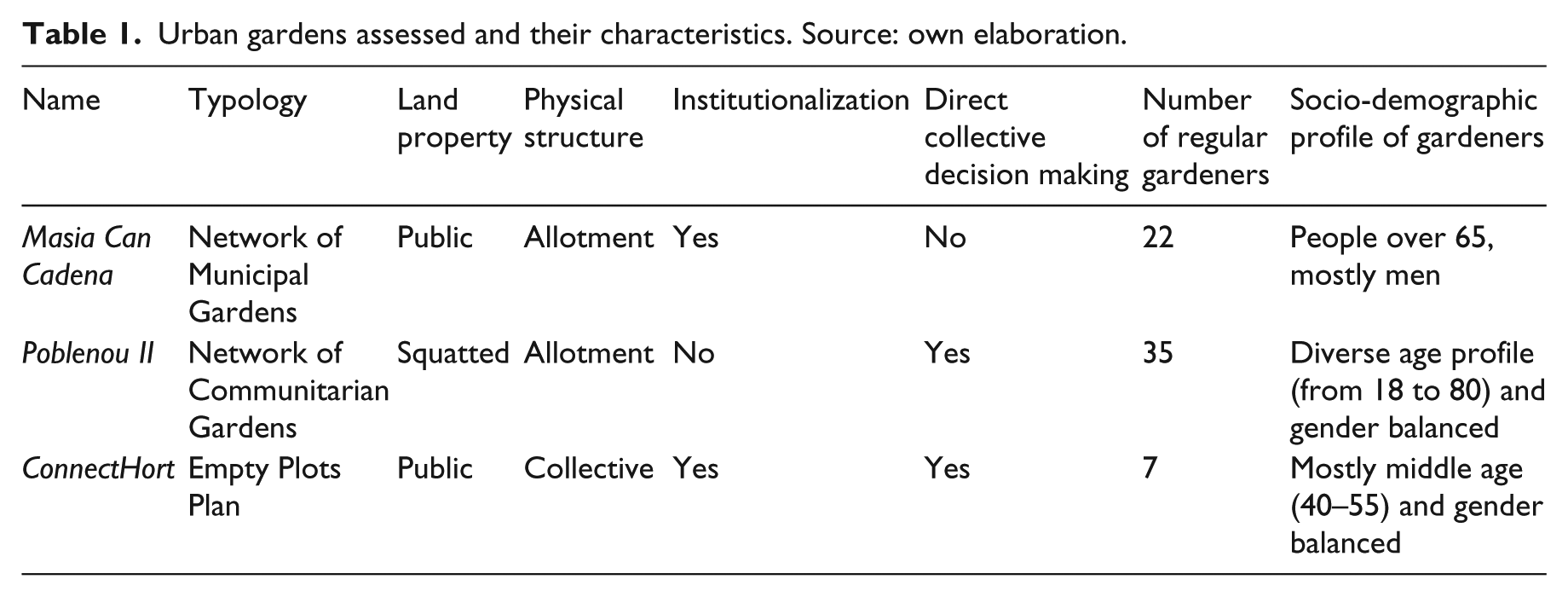
Further, we selected one urban garden of each typology to conduct fieldwork (Table 1). Fieldwork in these three urban gardens spanned from March to June 2014 and included a combination of qualitative methods, including participant observation (e.g. participation in garden events and assemblies) and informal conversations with gardeners. These observations were qualitatively recorded in a field diary in chronological order (Bernard, 2006). To allow maximum comparison regarding urban socio-economic context, the three selected sites were located in the same district: Sant Martí. Sant Martí is situated in Northeast Barcelona by the Mediterranean seaside, counting for 1052.4 ha (around 10% of the city area) and hosting 233,856 inhabitants in 2013 (14.5% of the total city population). The district presented in 2013 the highest unemployment rate (15.8%) among the 10 districts of the city (Barcelona City Council, 2013b). The average disposable household income in the district in 2014 was 16,554 Euros/year, 15% lower than the average figure of Barcelona (Barcelona City Council, 2015b). The district is highly unequal, with some neighbourhoods well above the average income and others among the poorest in the city.
Urban gardens assessed and their characteristics. Source: own elaboration.
We coded data gathered in semi-structured interviews and the field diary by using no predefined categories that emerged from an inductive process (Newing, 2011). The process consisted of collecting data, looking for patterns and establishing categories not previously defined. These categories were ‘food production’, ‘leisure’, ‘social cohesion and integration’, ‘learning and education’ and ‘political activity’. The number of categories we used is lower than in other studies exploring motivations behind urban gardening (cf. Scheromm (2015), 12 categories; Ruggeri et al. (2016), seven categories; Martinho da Silva et al. (2016), eight categories; or Pourias et al. (2016), eight categories). This responds to the fact that some of the categories we use include several categories presented in other studies. On the other hand, we make explicit the category ‘political gardening’, not used in any of the mentioned studies.
All this fieldwork was complemented with our work on urban gardening in Barcelona during the past years and from our participation in the COST Action TU1201 ‘Urban Allotment Gardens in European Cities’ (2012–2016), and our involvement in the Xarxa d’Agricultura Urbana de Barcelona (Network of Urban Agriculture of Barcelona), which was created in 2014 with the objective to make visible all types of gardening initiatives in Barcelona. The first author is actively participating as a scientific expert in this network, granting her a deep understanding of the dynamics of the different initiatives. Moreover, this active enrolment has allowed us to build up an extensive knowledge of urban gardens in Barcelona, which has already produced scientific outcomes regarding ecosystem services provided by those gardens (see Camps-Calvet, 2014; Camps-Calvet et al., 2016) as well as the role of community gardens in enhancing urban resilience (Camps-Calvet et al., 2015).
Results
Urban gardening in Barcelona
Urban gardening has been historically present in Barcelona along the ‘Rec Comtal’, an open channel that has supplied the old city of Barcelona and neighbouring towns with groundwater resources from the Besòs River since the 10th century. While this infrastructure ceased to be a main water supply source in late 19th century (together with the construction of modern urban fabric), it continued to be linked with informal agricultural practices throughout the 20th century. By the mid-20th century, abandoned and cultivated fields alternated in large parts of the city, but fast infrastructural developments caused a decline of gardens in the city (Huertas and Huertas, 2004). Furthermore, many gardens were removed following urban redevelopment plans in the context of the Olympics of 1992 (Roca, 2000). As a result, urban gardens in Barcelona have mostly emerged in the past 20 years and especially since the early 2000s. We identified 54 urban gardens in Barcelona accounting for a total surface of around 10 ha at the end of 2016: this represents 0.35% of the total green surface of the city. While the total number of gardeners fluctuates in some of the initiatives, especially in the Network of Communitarian Gardens, we calculated that approximately there are around 900 regular gardeners. Out of the 54 existing urban gardens in Barcelona, only three were created before the 2000s. In Figure 1 we can observe a slow but relentless growth in the number of urban gardens in the first decades of the 2000s; this growth is led by the city council through the Network of Municipal Gardens. Nonetheless, non-institutionalized gardens began to emerge since 2002 under the Network of Communitarian Gardens. However, it was not until the burst of the global financial crisis in 2008 and especially the ensuing Indignados movement in 2011 that urban garden bottom-up initiatives reached a sustained growth and became a common element of the urban space. As can be observed in Figure 1, this growth was spearheaded by the emergence of more gardens within the Network of Communitarian Gardens and the creation of the Empty Plots Plan by the Barcelona city council (Figure 1).
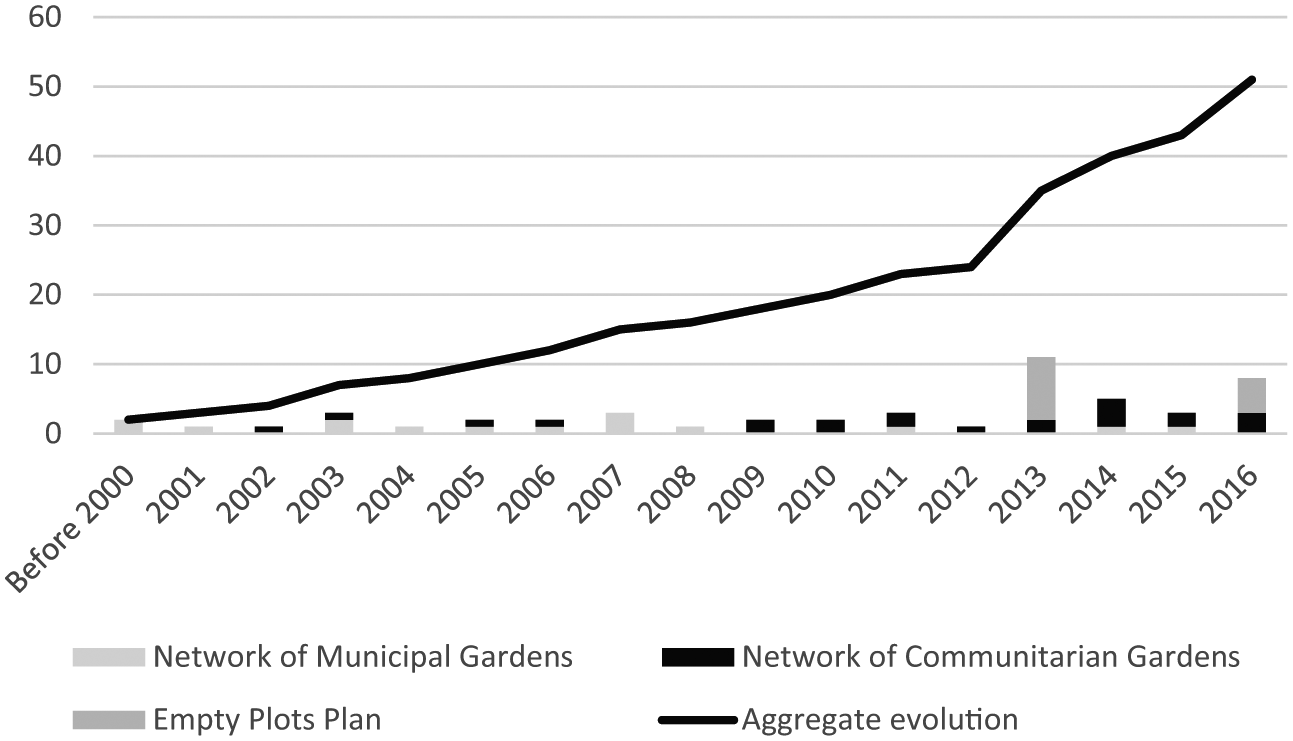
Evolution of urban gardens in Barcelona city. Source: own elaboration.
The Network of Municipal Gardens is an initiative of the city council of Barcelona officially launched in 1997 (although it can be traced back to 1986) to develop organic urban gardens in public land for people over 65, and for people with a risk of social exclusion (i.e. former inmates, mentally disabled people, etc.). In December 2016 there were 15 gardens in this initiative.
On the other hand, the Network of Communitarian Gardens includes most of the ‘informal’ urban gardens occupying vacant plots and established through bottom-up processes by different social movements (e.g. squatter movement) and/or associations (e.g. neighbourhood associations) of the city (although some of them have reached agreements with the landowners). The structure of the network is quite loose, and the number of gardens included fluctuates (as new gardens are included, and some of them cease to exist because of legal problems. Its aim is to become a space of exchange of ideas, resources (including seeds) and knowledge among the gardens while also providing assistance to open up new gardens. As of December of 2016 there were 23 gardens in this initiative.
Last but not least, the municipality launched the Empty Plots Plan in 2013 in the light of the effects of the economic crisis, which halted the construction of planned public urban equipment. It consisted of temporally leasing for free (for three years) municipal vacant plots to not-for-profit associations to carry out activities of social interest (Torras, 2015). According to the initial plan, those empty spaces ‘often concentrate antisocial practices, non-desirable uses and, sometimes, serious situations of social exclusion’ (Barcelona City Council, 2012b: 3, own translation). The underlying rationale was to enhance social innovation and entrepreneurship among Barcelonan civil society while avoiding these ‘non-desirable’ uses of the empty plots. Out of the 14 selected projects in 2013, nine revolved around urban gardening. In 2016 there was a new call that resulted in four new urban gardens, as well as a temporary renewal of the existing ones (from 2013). Also, we have included three more gardens in this typology resulting from a bilateral agreement between the municipality and public and private associations. As of December 2016, 16 gardens were part of the Empty Plots Plan.
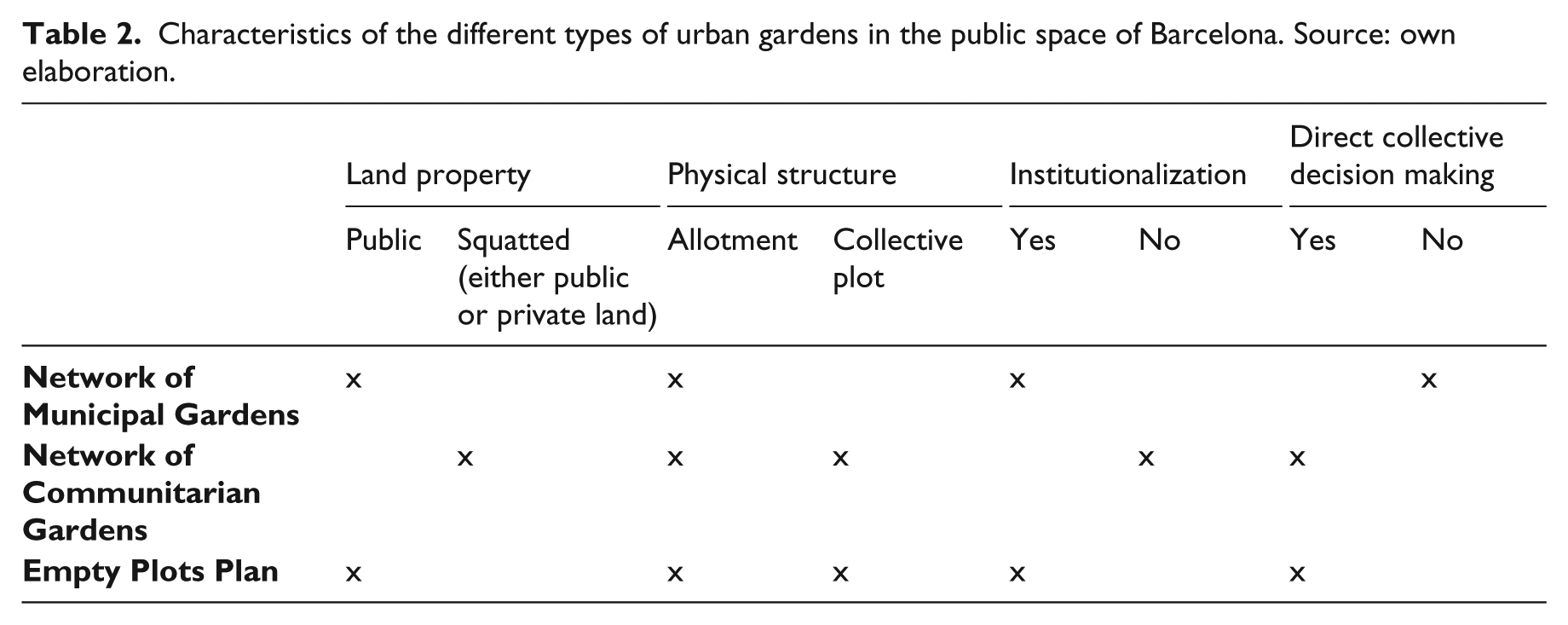
Each of these three initiatives hosts different typologies of urban gardens, with similar features but also with some differences. In Table 2 we present a systematization of them according to four different key dimensions of the urban garden: land property, the physical structure of the garden, the degree of participation of institutions and the presence or absence of dynamics of direct collective decision making within the garden. For instance, all the gardens within the Network of Municipal Gardens share the same characteristics. In contrast, we can find different physical structures in the other two initiatives; there are gardens constituted by parcels while others share the same plot.
Characteristics of the different types of urban gardens in the public space of Barcelona. Source: own elaboration.
Beyond the assessed initiatives, the city has also experienced a resurgence of gardening in public and private infrastructures such as hospitals or schools. For example, in 2015, 282 school gardens of Barcelona were part of the initiative ‘Escoles + Sostenibles’ (More Sustainable Schools) that seeks to promote projects of education, participation and civic implication to build more sustainable schools and cities (Barcelona City Council, 2015c). This trend has also impacted upon private practices at the household level, with many balconies and terraces of Barcelona supporting micro-urban gardens.
Understanding meanings behind the different urban garden initiatives
As noted in the third section, we organized and grouped the diverse meanings encapsulated in the three different initiatives along five general and non-exclusive categories: food production; leisure; social cohesion and integration; learning and education; and political gardening.
In Figure 2 we show how important these categories are in each of the initiatives. The importance is proportional to the centrality that category had in the narratives and practices within each garden initiative (Figure 2). We observed a large difference between the network of municipal gardens and the other two initiatives. We explore these nuances in the next paragraphs.
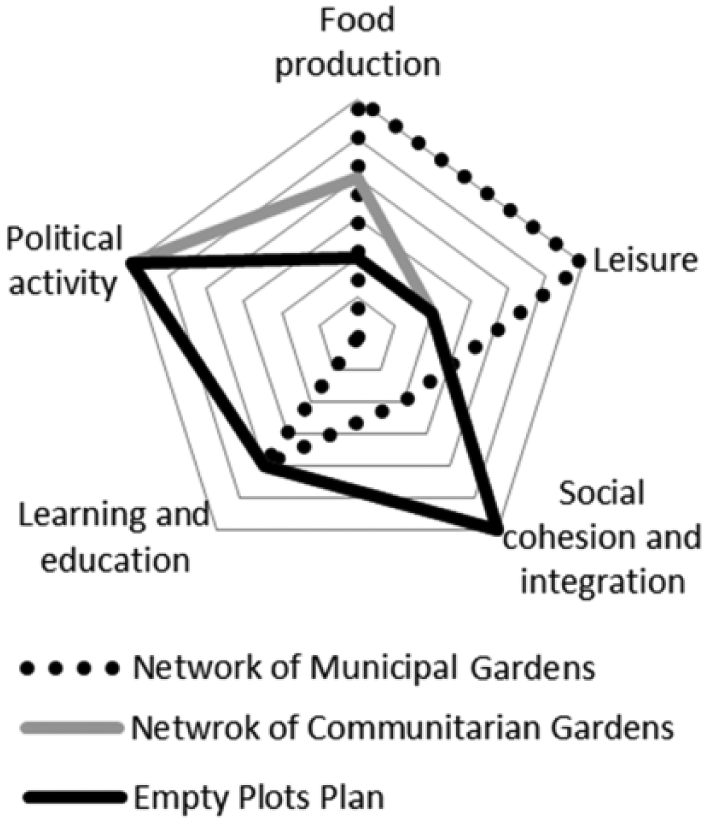
Meanings behind urban gardens initiatives. Source: own elaboration.
Individual leisure and food production for retired people: The Network of Municipal Gardens
According to the municipal documents reviewed, and corroborated by the person in charge of the network, the Network of Municipal Gardens pursues several purposes revolving around leisure, social inclusion, therapeutic benefits, environmental education and city greening. It seeks to be ‘a high social value service provided to the citizens through the development of a green area in each district’ (Person in charge of the initiative). Our onsite fieldwork verifies that most of those objectives are embedded in this initiative, with ‘food production’, ‘leisure’ and ‘learning & education’ as the most important meanings attributed to the garden. A gardener from Masia Can Cadena (i.e. municipal garden) stated, ‘The garden always provides me with something to eat, it is my hobby, if not I would be out there wandering’. In the multiple on-site visits and informal interviews with gardeners, we observed that the produce of those urban gardens bears a symbolic charge that transcends the socially established exchange-value. These self-produced vegetables ‘cannot be bought in any store’ and ‘cannot be priced’, as the gardeners expressed. Furthermore, for all those gardeners out of the labour market, the gardens have a generative role, giving a meaningful sense to gardeners’ free time, fulfilling the person’s need to be productive, although in a symbolic way.
The garden is a space of knowledge co-production and exchange among gardeners; they share garden techniques, knowledge on different types of varieties and plant material, such as seeds or seedlings. It is also conceived as a children’s educational space and a place for intergenerational knowledge exchange. ‘The garden is very important for the schools; we teach the children where the food comes from’, a gardener from Can Cadena recognized. The person in charge of Masia Can Cadena precisely highlighted the important educational function performed by the garden at the neighbourhood level: ‘The neighbourhood is very satisfied with having the garden here, parents are very happy that their children know the origin of the food they consume. The garden is one of the most visited municipal equipment of the neighbourhood’.
Political gardening as the main driving force: Network of communitarian gardens
We found that ‘social cohesion and integration’ and ‘political activity’ were the prominent meanings granted to communitarian gardens. The first meaning was deeply exemplified in the words of a migrant gardener from Chile in Poblenou II (i.e. communitarian garden): ‘As a migrant from Chile the garden gives me a sense of belonging to the neighbourhood that nothing and nobody gave me before. In such a sense the garden community is my family’. The ‘political activity’ meaning encompasses the collective transformation of the community, and if possible, of the global economic system through the act of urban gardening. As one gardener stated: ‘the garden is my political activism… To collect a lettuce, you have to come five, seven, ten times to an assembly, you must discuss, and you must know the neighbours… The garden has a fundamental role to express indignation’. Gardens strive to create spaces of resistance towards neoliberal urbanism and urban speculation and for opening up non-commodified, inclusive spaces: ‘The garden is a place where we can develop initiatives, not just contemplative spaces such as urban parks or consumerist spaces like bars’. In general, they are a form of anti-capitalist struggle and a way to promote food sovereignty: ‘The current food system aligned with the capitalist system is perverse; the garden is a small but significant space where you can fight against this model’.
Social innovation and social entrepreneurship: The urban gardens of the Empty Plots Plan
Based on the words of the two city officers in charge of this initiative, gardens within the Empty Plots Plan foster social entrepreneurship: ‘in contrast to the network of municipal gardeners, this initiative was not a service that the town council gives to the citizen, but one that encourages the social initiative and the self-management of projects’. In other words, it ‘seeks civic involvement and responsibility towards the city’. Among the central meanings granted to the Empty Plots Plan, we found that ‘social cohesion and integration’ explained well the involvement in this initiative: ‘a garden is a perfect socio-urban tool to weave neighbourhood cohesion’, stated a gardener from ConnectHort, an empty plot plan project devoted to urban gardening. On the other hand, ‘political activity’ also fared high as a key meaning of these types of gardens. This meaning was mobilized in several ways. Gardens were imagined as a space of collective empowerment where people use their resources and chances to overcome the sense of powerlessness and lack of influence in political life. As in a ConnectHort gardener’s words ‘we are promoting social initiatives, do things with our resources and ideas, we have the capacities to change our neighbourhood’. This gardener also expressed the necessity of improving and transforming the neighbourhood and the city via creating a network of people and resources in vacant plot: ‘The idea is to bring life to vacant plots’. Building on this argument, the city officer responsible for this initiative stated, in April 2016, that the Empty Plots Plan infused participation into the neighbourhoods, helping the empowerment of people and neighbourhood transformation: ‘The plan has encouraged the participation of people in other activities that are happening in the neighbourhood’.
Discussion: Unearthing the meanings and politics of urban gardening in Barcelona
In this article, we show that in the past few years, urban gardening has observed an intensive re-emergence in the urban fabric of Barcelona. As in many other European cities (Bell et al., 2016; Keshavarz and Bell, 2016), Barcelona is experiencing a resurgence of urban gardening in diverse forms that go beyond the traditional allotment gardens typically found in central and northern Europe. We analysed three of these different urban gardening expressions; the Network of Municipal Gardens was the first initiative that marked the resurgence of gardening in the city, while two other forms followed it (Network of Communitarian Gardens and Empty Plots Plan), showing that urban gardening initiatives do not follow a simple and unique meaning.
The ensuing discussion will revolve around crisis and post-crisis political gardening in Barcelona, which is exemplified, although in different ways and intensity, by the three different initiatives assessed. The Network of Communitarian Gardens is mainly embedded in the long-standing squatter movement in Barcelona that emerged in the city in the mid-1980s. This movement combined a cultural critic to consumer society, promoted self-management and challenged traditional politics (Tudela and Cattaneo, 2016). It has had a prominent role in shaping urban contestation by grassroots since the 1990s, and currently is very heterogeneous, and has permeated into different urban struggles (for instance, the anti-evictions platform, PAH), including urban gardening. The Empty Plots Plan intersects with discourses on social entrepreneurship (van Dyck, 2012) and social innovation (Moulaert et al., 2007). From a planning perspective, both typologies of gardens represent interim uses of the empty urban plots resulting from the impacts of the economic crisis on public and private urban development, slowing or directly halting many projects. Therefore, urban gardens fit as an interim solution to empty land (Delgado, 2015; Drake and Lawson, 2014; Németh and Langhorst, 2014), Barcelona being a prominent example of such initiatives. Despite having a very different foundational rationality, we will also discuss how political gardening may be present unexpectedly in the Network of Municipal Gardens of Barcelona.
As other scholars have argued elsewhere (e.g. Rosol, 2012), changing social and political circumstances both shape and reflect the form function and culture of actions of urban gardens and their members’ activities. What we detected in Barcelona since 2008, but especially since 2011, is the emergence of political gardening (Certomà and Tornaghi, 2015; Kato et al., 2014) or radical urban gardening (McClintock, 2014; Mudu and Marini, 2018). In the light of our context, we understand political gardening as a wide variety of citizen-led practices pursuing social and urban transformation. We also contend that the garden typology is the expression of different motivations that are not isolated from wider societal trends (Calvet-Mir et al., 2016). The economic crisis in Europe, with direct effects in southern European countries, has opened new motivations to engage in urban gardening activities. Eventually, the increasing concerns over urban sustainability and greener and more inclusive cities also influence the reasons to be involved in urban gardening.
The Network of Communitarian Gardens has an explicitly political logic, concerned with broader social and political aspects beyond gardening and food (Kato et al., 2014). It fully expresses a wide and radical notion of political gardening, aiming to use gardening as an immediate tool to subvert structural injustice and neoliberal urban policies through re-appropriation of space for use-value (for example, food production, greenery and leisure, among other activities) rather than exchange-value (Certomà, 2011; Certomà and Tornaghi, 2015; McClintock, 2014; Mudu and Marini, 2018). The blossoming of this type of initiative can be observed since the burst of the financial crisis in 2007–2008 that so severely impacted the urban fabric of Spanish cities, interrupting many public and private developments, and therefore leaving many empty urban plots. Many of these spaces began to be squatted by grassroots, such as activists from the squatter movement or neighbourhood associations, which converted the spaces into urban gardens to denounce austerity urbanism through makeshift urban interventions (Peck, 2012; Tonkiss, 2013). These gardens were conceived as resistance spaces against speculative urban development to reclaim the right to produce urban space not subjected to the dictates of the market (Camps-Calvet et al., 2015). The emergence of the Indignados movement in May 2011 multiplied the number of squatted gardens. The initial and spontaneous burst of collective anger and protest in the squares, including Plaça Catalunya in Barcelona, gave place to more articulated actions at the neighbourhood level. Among them, squatting empty plots to grow vegetables was possibly one of the most visible actions. Many Indignant urban gardens (Horts Indignats), as the activists name them, have been developed since then, especially in neighbourhoods such as Poblenou in the district of Sant Martí. All in all, in a context of post-economic crisis Barcelona urban gardens fare high as a source of collective empowerment promoting emancipatory and alternatives views about the right to the city and challenging speculative urban development (Eizenberg, 2012).
Willingly or not, the municipally led initiative Empty Plots Plan mirrors (or is a result of) to some extent the squatted gardens movement. Even if the municipality managers behind this initiative would not recognize it, there are clear similarities and connections between those initiatives. Firstly, the idle and empty urban plots where those initiatives take place are the product of the economic crisis halting projected public developments, as happened with the squatted gardens (despite the latter also taking place in privately owned plots of land). Secondly, and despite being a municipal initiative, the plan aims to engage citizens in the transformation of the urban space (Barcelona City Council, 2012b; Torras, 2015). It does not do so through the mobilization of radical and anti-capitalist or post-capitalist discourses, but rather through post-crisis rationales revolving around social entrepreneurship, devolution, self-management and social innovation. This plan embodies hegemonic post-crisis values that are portrayed as the seeds to overcome the economic crisis. In that sense, the Empty Plots Plan could be understood as a strategy to ‘domesticate’ both the ‘non-desirable’ uses in empty spaces, and more specifically the uncontrolled and informal gardens that were proliferating across the city (Stanchieri, 2013). Thus, the plan could be interpreted as a top-down initiative that stimulates entrepreneurial civil society through the transfer of the project responsibility to the citizens, fostering the retreat of the local state (Pudup, 2008; van Dyck, 2012). Therefore, the urban gardens within this context can be argued to be tools of disciplining the social fabric and making the projects embody or reproduce entrepreneurial values (McClintock, 2014; Weissman, 2015). Gardeners may unwittingly integrate mainstream post-crisis subjectivities that naturalize the self-responsibility about urban improvement and transformation, hindering more collective political actions (Certomà, 2015).
The radically different rationale of both initiatives is reflected in incompatibilities between urban garden initiatives mainly related to the political ideal of the city that gardeners would like to achieve and the different views on the relation with institutions such as the local government. For example, while communitarian gardens aim to open up non-commodified urban spaces, empty plots gardens, as conceived originally by the City Council (Barcelona City Council, 2012b), are aligned with a discourse around entrepreneurship and social innovation. A ConnectHort gardener explained that it was difficult to establish some cooperation with a squatted garden nearby (Poblenou II) as long as the local government was involved. For example, gardeners from Poblenou II declined to participate in the meetings of the Network of Urban Agriculture of Barcelona, because the city council was also involved. As a gardener of Poblenou II stated: ‘I am completely against any process of institutional intervention in our garden’. Notwithstanding this, since the election of former anti-eviction activist Ada Colau as mayor of Barcelona in 2015 (with the electoral platform Barcelona en Comú) the reluctance by communitarian gardens to establish a dialogue with the city council has decreased and some of them are indeed currently participating in the Network of Urban Agriculture of Barcelona.
However, our results show that it would be a mistake to treat Empty Plots Plan gardens as neoliberal spaces with no potential for a progressive and alternative urban transformation. Alternatively, the plan could offer spaces for social experimentation and revalorization of the land in non-economic terms, beyond rigid urban interventions that push for conventional forms of urban redevelopment (Colomb, 2012). When we contrast institutional objectives with their implementation of specific initiatives, we detect unforeseen outcomes regarding political activity that may resemble those found in the Network of Communitarian Gardens. Our results sustain that urban gardening may take on political characteristics whether intentionally or unintentionally and, in either case, the extent of political engagement evolves according to organizational constraints, interests and other exogenous factors. For example, one of the main interests of ConnectHort promoters was to amplify the network of self-managed spaces with a clear political intention of citizen empowerment. We argue that the political nature of urban gardening must be understood as dynamic rather than static and that it may materialize differently depending on the objectives and practices of the different initiatives (Kato et al., 2014). Through situated everyday practices in these urban initiatives, new (and unexpected) conditions of possibility may arise, transcending their initially “disciplined” rationale (e.g. social entrepreneurship), and thus allowing progressive socio-environmental transformation.
Last but not least, an implicit form of political gardening (Kato et al., 2014) is arguably taking place in the Network of Municipal Gardens of Barcelona. Although political activity is not any of the meanings attributed to this type of garden, the relational dynamics taking shape in them could foster unforeseen knowledge co-production and learning, and groups and community building. Comparable to the results of a study in allotment gardens in Belfast and Dublin (Corcoran and Kettle, 2015), the allotment gardens within the Network of Municipal Gardens of Barcelona may act as a ‘space of potential’, becoming spaces of knowledge co-production and intergenerational knowledge exchange. Likewise, they are places where relations of solidarity, mutuality and trust are being developed, providing the basis for renewed social cohesion.
Conclusions
We observe a proliferation of urban gardens in the city since the middle of 1990s, first under the Network of Municipal Gardens. From the 2000s onwards, and especially the second part of the decade, urban gardens following a different logic and led by social movements and grassroots began to populate the urban fabric. The years between the explosion of the economic crisis of 2007–2008 and the Indignados-15M movement observed an important surge in this type of initiative. In 2013, the Empty Plots Plan found its way into the garden scene. Urban gardens within the city are an expression of different and non-exclusive meanings that, explicitly or implicitly, in a context of crisis and post-crisis, mobilize notions of political gardening, pursuing social and urban transformation.
The case of Barcelona is relevant for an international academic audience as it documents and discusses the articulation of new narratives around urban gradening from Southern Europe, highly affected by the economic crisis that resulted in an important anti-austerity social mobilization. Urban gardening in Barcelona ranges from radical political gardening, that is, occupied urban gardens, to visions articulated around social entrepreneurship and social innovation. While the latter could be observed as a form of disciplining political gardening, it would be a mistake to reduce it to a mere neoliberal strategy to domesticate urban contestation while avoiding the proliferation of more squatted gardens. The latter interpretation would gloss over the context-specific trajectory of urban crisis, and the emerging new forms of contestation in South Europe and more specifically Spain, with the critical importance that the Indignados movement has had in contemporary (urban) struggles against austerity (della Porta, 2015; Monterde et al., 2015). As it is occurring in Barcelona, grassroots and urban associations may use the unexpected avenues of the crisis impinged on the urban fabric (i.e. vacant lots) to initiate processes of socio-environmental transformation towards the collective co-production of urban space and new urbanities. In a nutshell, the case of Barcelona also speaks to critical urban scholars by highlighting that initiatives revolving around mainstream post-crisis entrepreneurial values can lead to unexpected processes of explicit or implicit politicization through garden practices that can inform a progressive urban politics; it is not that distant as it may a priori seem from more radical experiences. As matter of fact, the political shift in 2015, with the substitution of the liberal government (CiU) by a left-wing political platform (Barcelona en Comú), may redirect urban gardening strategies towards a commons-based urban vision.
We argue that urban scholars should contribute to characterize these initiatives and unravel the meanings and values behind them to inform policy makers of the plurality of strategies, meanings and values behind urban gardening avoiding monolithic readings (e.g. urban gardens solely as a leisure activity). In the attempt to make sense of the multiplicity of strategies of political urban gardening occurring in crisis and post-crisis urban settings it is necessary to expand the scope of the empirical research to understudied geographies, such as Southern Europe.
Footnotes
Acknowledgements
We thank the different participants of urban garden initiatives in Barcelona as well as urban garden planners and technicians from the town council of Barcelona that kindly responded to our questions. We would like to thank the editor and two anonymous reviewers for their comments.
Declaration of Conflicting Interests
The author(s) declared no potential conflicts of interest with respect to the research, authorship, and/or publication of this article.
Funding
The author(s) received no financial support for the research, authorship, and/or publication of this article.