




Abstract
This paper proposes a tripartite framework of transportation, transformation and translation to conceptualise the circulation, mutation and impacts of mobile policies as translocal, socio-material networks. Drawing on material from semi-structured interviews, participant observation and documents it considers the value of this framework by examining the mobility of the sustainability agenda of the Winter Olympic Games 2014 in Sochi, Russia. The paper shows how sustainability policies were packaged and mobilised to flow to Russia (transportation), how ineffective governance arrangements, a lack of institutional controls and time pressure altered them (transformation) and how the results fell far short of initial bid commitments (translation). As such, it sheds light onto the multiple immobilities and mutations that come with the attempts to mobilise policies.
Thanks to the Sochi Games, we are raising standards to international levels across the board. … The best practices from all over the world are coming to Sochi, and they will then spread across the entire country, creating a sustainable Games Legacy. (Sochi Organising Committee, 2012: 4) Alexander Zhukov Deputy Prime Minister of the Russian Federation Chairman of the Supervisory Board of the Sochi 2014 Organising Committee
Introduction
In February 2014, the city of Sochi on the Russian Black Sea coast and the northern fringe of the Caucasus Mountains hosted the XXII Olympic Winter Games. Even before the start of the Games, the preparations for this mega-event had already broken records. The event was the most expensive Olympic Games, Summer or Winter, ever: the most recent estimate from February 2013 put the total cost at more than 1.5 trillion roubles, or 51 billion US Dollars. At the start of 2013, it was also the largest construction site in the world with almost 96,000 workers labouring around the clock in a city of barely 400,000 inhabitants.
However, as the epigraph suggests, the Olympic Games in Sochi were also meant to set the bar for sustainability in Russia. When in July 2007 Russia was awarded the right to host the mega-event, the vision for Sochi 2014 stated that the Games would be hosted ‘in a sustainable, inclusive, environmentally responsible manner’ and that ‘all key Olympic infrastructure locations have been selected to ensure maximum sustainability and legacy’ (Bidding Committee Sochi, 2006: 17, 19). Crucially, the bid book promised a comprehensive sustainability management system, sustainable procurement, carbon neutrality, zero waste, extensive environmental impact assessments and multi-stakeholder consultations. The mobilisation of international experience was to play a central role in delivering on these commitments. Organisers modelled the Olympic sustainability agenda on international best practice from previous editions of the event, which they considered to represent the state-of-the-art of sustainability.
Yet, as the preparation for the Olympic Games proceeded apace, it became clear that the actual outcomes from this mobilisation of policies from elsewhere were going to belie the ambitions. The damage to the Mzymta, a major mountain stream in the Sochi area, is a case in point for the transformation and translation of international best practice in the Russian context and the resulting failure to meet essential sustainability goals. Extensive construction, both alongside and right in the bed of the river, led to the wholesale destruction of its ecology and hydrological regimen. The dumping of construction waste and discharge of toxic fluids caused the concentration of arsenic, hydrocarbons and phenol to exceed the critical permissible threshold up to several dozen times, making the water undrinkable for thousands of residents. Felling of trees, mining of gravel for construction from the river bed and straightening of the river altered the runoff regime and resulted in a severe increase in the risk of spring floods, prompting the development of new evacuation plans (North Caucasus Environmental Watch, 2013; Novaja Gazeta, 2011; Ševčenko, 2013). It was only after concerted pressure and repeated visits from the International Olympic Committee (IOC), the United Nations Environment Programme (UNEP) and national and local non-governmental organisations (NGOs), as well as the personal intervention of then Prime Minister Vladimir Putin, that the major companies involved in construction could be talked into signing up to a memorandum of understanding for restoring the Mzymta basin. It is ironic that this restoration is hailed as one of the big milestones of hosting a green Olympics (UNEP, 2011a), when the necessity should never have arisen in the first place under sustainability principles.
What went wrong in the mobilisation of international best practice for Sochi 2014? Where did initial aims start to diverge from realities? For what reasons and with what consequences? This paper constitutes an inquiry into the mobilisation and transformation of sustainability knowledge and policy for the 2014 Winter Olympic Games in Sochi. It traces flows of sustainability expertise and standards to Russia and examines the reasons behind the transformation of the sustainability agenda as well as the overwhelming failure and isolated successes in achieving the goals that the organisers of the Olympic Games in Russia set for themselves. It devotes particular attention to the hitherto underresearched ‘sites of failure, absence and mutation’ of policies (Jacobs, 2012: 419), that is, to the immobilities, or partial and limited mobilities, as well as to the unexpected transformations of policies, and the processes behind them.
As a central contribution, the paper proposes a framework to think about mobile policies and expertise around the three interlinked notions of transportation, transformation and translation. Transportation looks into the processes of rendering sustainability expertise and policies mobile and making them move to Russia in the first place. Transformation examines what factors altered and constrained the implementation of sustainability expertise and policies in Russia. Translation, finally, evaluates the effects sustainability expertise and policies have had on the ground in Sochi and to what extent these lived up to the self-declared goals of the organising committee. With this agenda, the paper contributes to two important discussions. Firstly, it contributes to debates on how to conceptualise the global travelling of policies and expertise and their transformation and adaptation in specific localities (e.g. McCann, 2011; Oanca, 2015; Peck, 2011; for the case of sustainability see Blok, 2012; Bulkeley, 2006; Temenos and McCann, 2012). Secondly, it considers the potential, preconditions and problems for mega-events such as the Olympic Games to deliver on the wide-ranging, often over-ambitious commitments to sustainability that are becoming increasingly common among organisers (Gaffney, 2013; Hayes and Horne, 2011; Horton and Zakus, 2010; Karamichas, 2013; Pentifallo and VanWynsberghe, 2012).
Transportation–transformation–translation: towards a conceptual framework for mobile policies
The interest in the global circulation of policies has experienced a surge in disciplines such as political science, sociology, anthropology, planning and human geography in recent years. Although there has been research on policy diffusion since at least the 1960s (e.g. Walker, 1969), authors have argued that both the tempo and the scope of policy circulation have accelerated in recent years with ever faster policy cycles and growing demand for out-of-the-box, tried-and-tested solutions that are seemingly straightforward to implement across all sectors (McCann, 2011; Peck, 2011). Within political science, the rational choice model held sway for a long time in the conceptualisation of mobile policies (Dolowitz and Marsh, 1996; Mossberger and Wolman, 2003). Actors were seen as evaluating and selecting policy alternatives in the presence of near-perfect information according to their instrumental value for a particular situation. As evidence continued to suggest the inappropriateness of rational choice assumptions for many real world policy diffusion processes, epistemic approaches began to diversify. Dobbin et al. (2007), for example, proposed four causal mechanisms – emulation, learning, competition, coercion – to explain the diffusion of policy models and Dolowitz and Marsh (2000) also stressed the importance of non-voluntarist policy transfer.
The more recent interest in the mobilities of policies across a number of disciplines, such as human geography, urban planning or anthropology, seeks to differentiate itself from the approaches found in political science. With the choice of the term ‘mobilities’ it does not propose a unidirectional A-to-B notion of transfer but acknowledges the often unpredictable and unruly flows of policies, frequently to unexpected places through unexpected routes (Healey, 2012; McCann and Ward, 2012b). Following a social constructivist paradigm, the policy mobilities approach is more interested in the wider social, cultural and economic embeddedness of travelling policies (Peck, 2011: 789) – in what McCann and Ward (2012b: 329–330) call situations. As such, it seeks to contextualise the travelling, adaptation and adoption of policies, problematising the politics of knowledge as well as the mutations policies undergo when moving from one situation to another. Cities and places have their intrinsic logics, Eigenlogik as Löw calls it (2012), which engender peculiar stocks of knowledge and forms of expression. Policies thus do not travel easily and mutation and failure are always part of the picture.
The policy mobilities approach tends to stay close to the embodied practices that establish relations between once distant policy sites and between once unrelated agents, tracing the movements of experts, practitioners, politicians and academics, as well as plans, budgets, videos, white papers, slide decks and so on (e.g. Healey and Upton, 2010; Larner and Laurie, 2010; McCann and Ward, 2011; Peck and Theodore, 2010; Peyroux et al., 2012). Theoretical inspirations frequently originate in scholarship on neoliberalism and governmentality. Mobile policies and policy convergence are then considered as correlates of the worldwide rollout of neoliberalism (e.g. Peck and Theodore, 2001; Theodore and Peck, 2011; Trubina, forthcoming) or as attempts at regulating and governing individual behaviour through the invocation of tried-and-tested global expertise, technologies and best practice (Bulkeley, 2006; McCann, 2008).
The growing interest in mobile policies notwithstanding, authors have diagnosed a lack of conceptual work (Dolowitz and Marsh, 2000: 5) and theoretical inchoateness (Peck, 2011: 774) for both the political science and the transdisciplinary policy mobilities approach. Responding to this need for more conceptual groundwork, this paper proposes a framework for conceptualising and researching mobile policies. It suggests viewing mobile policies as translocal, socio-material networks that are shaped by an iterative, three-step cycle of transportation, transformation and translation (Figure 1). In conceptualising these three terms the paper seeks inspiration from theoretical work in the social studies of science and actor-network theory, which are concerned with the construction, travelling and impacts of knowledge and thus are of particular relevance for thinking about the constitution and effects of mobile policies (e.g. Latour, 1987; Law, 1991). The shared prefix ‘trans-’ points to the fluid, change-related connotations of each of the terms, with transportation referring to the change of places in mobile policies, transformation to a change of content and translation to a change in outcomes. I shall explain each of the three terms and their conceptual implications in turn.
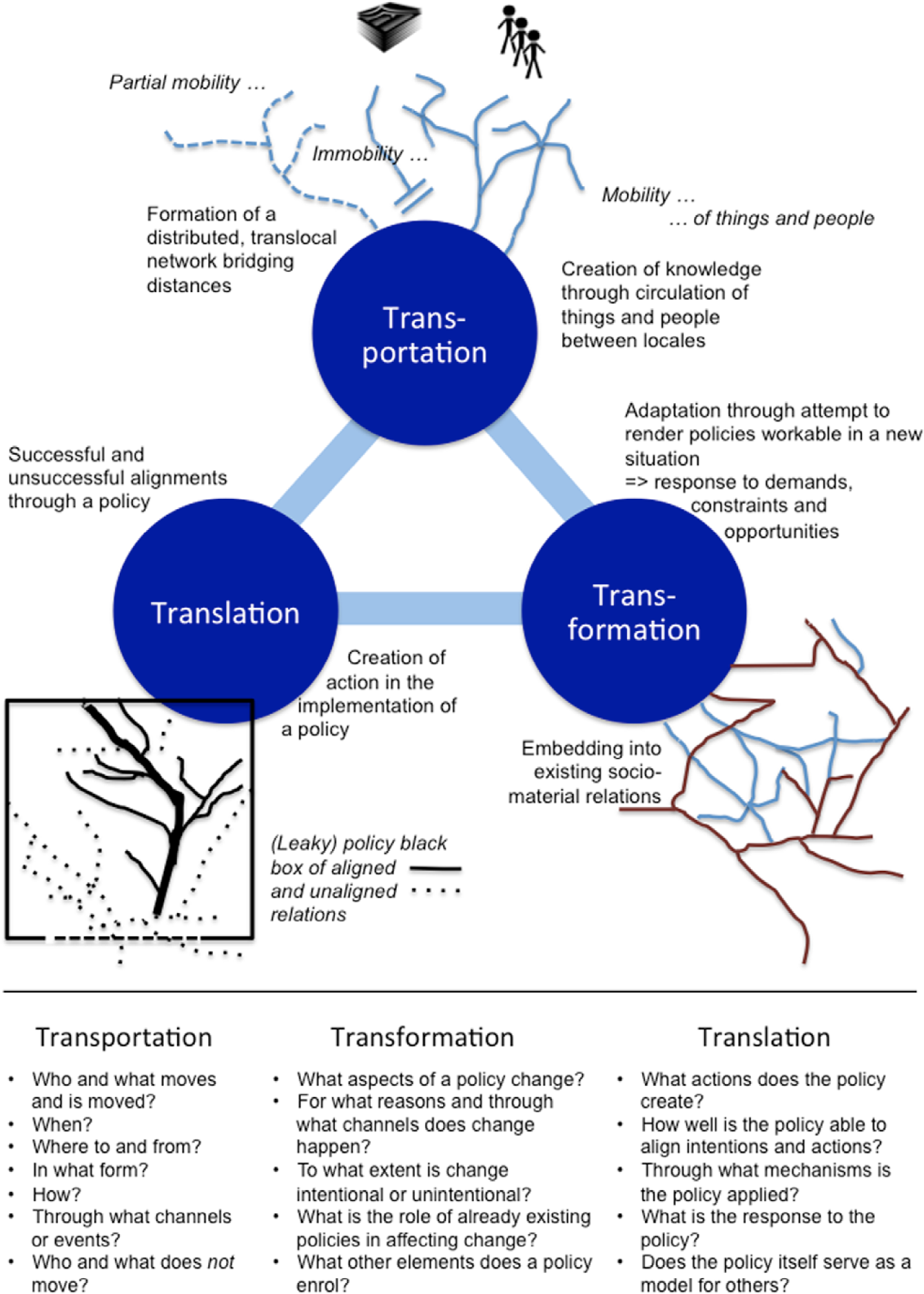
A conceptual framework for studying mobile policies as socio-material, translocal networks: transportation–transformation–translation.
Transportation is the crucial precondition for a policy to come into existence in a new locale. The term does not want to suggest that a policy is moved from A to B as a closed-off, pre-existing object. Rather, transportation points to the necessity of mobilising diverse elements of humans and non-humans from different places to establish relations and assemble a translocal network of knowledge to then form a policy – a proposed or adopted principle or course of action. Picking up on this translocal aspect, Latour (1987: 220, emphasis in the original) asserts that knowledge means ‘to be familiar with things, people and events, which are distant’ (cf. Law and Hetherington, 2000: 47). In order to acquire such familiarity, these elements need to be mobilised and brought together in one place. This mobilisation does not occur out of thin air. Similar to Dobbin et al. (2007), it can, for example, be a response to external requirements, an attempt to enhance competitiveness, a result of seeing a policy in other places and so on. This also means that there is never a pure, unadulterated policy. Policies always have time–spatial origins, although these might get lost as policy elements are transported and embedded into new contexts. The questions of who and what moves or is moved, when, where to and from, in what form and through what channels are crucial for better understanding the preconditions, modes and directions of transportation and its influence on what becomes knowable and what, by contrast, remains shrouded in ignorance. For where there is transportation, there is also immobility: certain people and things stay put, they escape the attempt to move them or move only partially, and this fixity changes what one can become familiar with and bring together in one place.
Transformation is inseparable from transportation. In fact, Latour (1996: 110, emphasis in the original) goes so far as to claim that ‘there is no transportation without transformation’: as knowledge is embedded into new socio-material relations it changes its content and form – sometimes more, sometimes less, seldom not at all. Transformation is also where knowledge morphs into policy as it is attempted to be rendered workable and put into political practice. Transformation can have multiple causes: it could be the result of the demands and interests of new agents that need to be brought on board; of the interaction with already existing policies; of a different interpretation of documents such as guidelines and standards; of the encounter with a different institutional setting, different organisational parameters or different legislation; of a translation between languages. As such, the transformation phase is of particular interest, since it departs from the assumption of isomorphism, prevalent in much of the policy transfer literature (Peck, 2011: 775), and devotes more attention to the mutation of policies. Latour (2005: 39) speaks of so-called mediators, travelling people or things that make knowledge mobile but at the same time distort and modify the meaning or the elements they are supposed to carry. It is this process of mediation that produces new, unexpected turns and directions in policies.
The third and final component is translation, that is, the creation of action, which can be similar to or different from original intentions, and the alignments around it that a policy is able to achieve. The original semantic meaning of ‘translatum’ as the past participle of the Latin ‘transferre’ is instructive here: it refers to ‘that which has been carried across’ and thus to the outcomes of transfer. Translation, if successful, creates ‘convergences and homologies by relating things that were previously different’ (Callon, 1980: 211). It produces a cohesive, organised whole, or what Latour (1987: 131) calls a ‘black box’. Policies are intended to align the state of things on the ground with their programmatic intent, but vary in their success to do so. A focus on translation examines how a translocal network is turned ‘from a heterogeneous set of bits and pieces each with its own inclinations, into something that passes as an … actor’ (Law, 1992: 386) – or where, more often than not, it fails to achieve this. As a part of this, it can also look at the response to the implementation of policies from diverse sides, such as the general public, civil society or state and business organisations, whether supportive, critical or neutral. Translation is not the end point of a linear process: translated policies can be transported again, snapped up in other locations and the cycle of transportation, transformation and translation starts anew. In fact, as the link between ‘transformation’ to ‘transportation’ in Figure 1 shows, it is conceivable for a policy that has never been put into practice to be taken elsewhere.
The transportation–transformation–translation framework differs in crucial respects from existing approaches to conceptualise mobile policies. For political science, Marsh and Sharman (2009: 282) note that scholars in international relations ‘have generally bracketed-off the question of effectiveness’, which this framework explicitly addresses with the aspect of translation, thus focusing on both processes and outcomes of mobile policies. It also avoids privileging either structural explanations, such as competitive pressure, or agential ones, such as the influence of experts and gurus, for the transfer and diffusion of policies (cf. Marsh and Sharman, 2009: 275). Instead, it takes an agnostic view in which the explanation of mobilities emerges through the description of processes establishing new relations and severing old ones. This is in line with the actor-network theoretical approach, which disavows the structure/agency duality but rather sees the social as a circulating entity (Latour, 1999: 17). As such, this framework does not seek to generalise about causes and processes for policy mobilities and transnational policy adaptations, but rather shows a sensitivity to individual cases and circumstances that has sometimes been found lacking in the political science literature (Benson and Jordan, 2011: 375; Marsh and Sharman, 2009: 273). In particular, it demonstrates a greater openness towards whom or what qualifies as a valid agent to be considered in research: besides numerous non-state actors, agents can also be material things that shape or redirect mobile policies in new directions.
For the fledgling transdisciplinary policy mobilities approach, on the other hand, the transportation–transformation–translation framework offers a more systematic way of both conceptualising and also researching mobile policies, as well as the attendant immobilities and mutations. The actor-network, consisting of a heterogeneous, distributed mix of human and non-human elements, is well-suited to describing policies as translocal, fleeting, becoming associations of heterogeneous parts rather than as uniform, pre-existing wholes (cf. the use of ‘assemblage’ in McCann and Ward, 2012a; McFarlane, 2011). In its close association of circulation with transformation, the framework gives due account to the central aspect of the mutation of policies in the course of transfer. As such, the framework allows accounting for the multiple partial or limited mobilities, immobilities and the mutations of policies that are rather the rule than the exception. In short, the transportation–transformation–translation framework helps thinking through where, when and why policies move, in what forms and through what mechanisms, how policies change, and what effects they have once it is attempted to implement them. The remainder of the paper sets out to demonstrate this conceptual value added empirically for the case of the mobilisation of sustainability policies for the Winter Olympic Games in Sochi 2014.
Sustainability mobilities and the Olympic Games
In recent years, scholars have found increasing evidence of the diffusion and convergence of environmental and sustainability policies across national borders. This is particularly true within the European Union, where environmental policy convergence at the national level was mostly due to harmonisation between member states (Liefferink and Jordan, 2005), but also among industrialised states more generally (Holzinger et al., 2008). At the sub-national level, authors have examined transnational networks for sustainability policy learning and adoption between cities and municipalities (e.g. Betsill and Bulkeley, 2004; Blok, 2012; Bulkeley, 2006). As one of the key results, authors observed that, despite intentions to the contrary, best practices remained sticky and did not travel and take root elsewhere easily through these networks, thus limiting the potential for profound policy change. Instead, the circulation of knowledge often rather contributed to a discursive reframing through which new understandings of policy problems arose (Betsill and Bulkeley, 2004).
The Olympic Games are a particularly interesting case for examining the circulation of sustainability knowledge and policies, for they involve organising essentially the same event with the same requirements in a different location every two years, thus encouraging the re-use and diffusion of knowledge from previous events (Pentifallo and VanWynsberghe, 2012). Mega-events can thus ‘act as powerful agents of technology transfer and technical norm diffusion, with a wide mimetic potential in both geographic and public policy sector terms’ (Hayes and Horne, 2011: 750). Organising ‘Green Games’, at least by name, has become de rigueur for host cities. It was primarily the host cities that pushed the development of the environment and sustainability agenda in the Olympic Games. The first concrete measures and policy proposals for incorporating environmental concerns in the Olympic Games originated primarily with the organisers of the Lillehammer Games, for example (Cantelon and Letters, 2000). It was the Olympic Games 2000 in Sydney that for the first time proposed a comprehensive environmental programme, setting environmental guidelines for hosting the event even before being selected as a host in 1993. It was Vancouver 2010, the predecessor of Sochi 2014, that made the move from a focus on the environment to a wider concern with sustainability, followed by London with the 2012 Summer Games. Despite significant shortcomings in delivering on their commitments, these two host cities have generally been regarded as raising the bar for expectations in the area of Olympic sustainability (Holden et al., 2008; Horton and Zakus, 2010; Karamichas, 2013, but see the critical accounts of Boykoff, 2011; Hayes and Horne, 2011).
It is important to note that the IOC has rather been a follower than a leader in strengthening sustainability concerns in the organisation of the Olympic Games, often acting in response to organising committees’ initiatives. The IOC issues no hard-and-fast requirement for Games hosts: documents such as the Olympic Agenda 21 or the sustainability guide provide a general framework and point out what organisers can do, but not what they should do. This laissez-faire policy has two important implications. Firstly, the definition of what a ‘sustainable Games’ means is left largely to the respective organisers and, hence, there exists no unified understanding of what actions ‘sustainability’ includes between different editions of the Olympic Games. There can even be divergent, contradictory and changing understandings within the same edition of the Games, as the case of Sochi will show. What is more, the IOC provides guidance on sustainability, but unlike other areas of the preparation for the Olympic Games, it does not exercise strict control. Secondly, lacking definite requirements from the IOC, host cities seek out previous hosts’ experience in designing and implementing sustainability actions. In recent years, the passing on of knowledge between Olympic hosts has thus become a common phenomenon – and so it has for Sochi.
Sustainability and Sochi 2014
Contrary to the ambitious sustainability agenda for Sochi 2014, environmentalism has not been high on the political agenda of the Russian state since at least the start of the 2000s. While environmental protection enjoyed a brief spell of importance with state institutions after the dissolution of the Soviet Union in 1991, and in fact was one of the causes citizen protests rallied around during the period of glasnost in the late 1980s, Vladimir Putin’s inauguration as president in May 2000 ushered in a period of widespread deinstitutionalisation and degradation of environmentalism (Mol, 2009; Oldfield, 2005). However, for the Olympic Games Putin promised an about-turn. He declared that ‘in determining priorities – money or ecology – we choose ecology. If the balance of nature is upset, this could lead to a situation that would be impossible to restore for any money’ (quoted in UNEP, 2008).
The geographical location of the Olympic Games in Sochi and the scope of the construction programme underscored the necessity of taking environmental concerns seriously. Sochi is situated in the foothills of the Caucasus on the Russian Black Sea coast. The snow sports took place in the village of Krasnaja Poljana, situated in the fragile ecosystem of the Western Caucasus Mountains, a United Nations Educational, Scientific, and Cultural Organization (UNESCO) natural world heritage site. All of the venues and most of the infrastructure had to be constructed from scratch, resulting in a total bill of about USD 50 billion and the most extensive construction programme of any Olympic Games (Müller, 2011). What is more, construction of venues occurred right adjacent to the Caucasus Nature Reserve (protected under the strictest international regime according to International Union for the Conservation of Nature and Natural Resources (IUCN) category Ia) and on the territory of Sochi National Park.
In an effort to live up to the promise of hosting Green Olympics, sanctioned by Putin’s public declaration, an extensive programme was put in place. It envisioned wide-ranging changes across six areas termed ‘healthy living’, ‘harmony with nature’, ‘barrier-free [i.e. accessible] world’, ‘economic prosperity’, ‘modern technologies’ and ‘culture and national values’ (the range of envisioned activities detailed is too extensive to report here, but see Sochi Organising Committee, 2012). The Russian government’s intention was to project the momentum beyond Sochi and spread these changes across the whole of Russia, as becomes evident from Alexander Zhukov’s statement cited at the beginning. This goal tied into a general trend in Russian urban and regional development strategies to launch ambitious large-scale projects with the intent of signalling both Russia’s claim to belong to the leading league of states and positioning its cities in the global competition for reputation and investment (Dixon, 2010; Golubchikov, 2010; Trubina, 2015).
The delivery of the sustainability programme for the Olympics was in the hands of the Sochi Organising Committee of the Olympic Games (OCOG), a non-commercial organisation with 1250 members of staff at the beginning of 2013, about 15 to 20 of which worked in the area of sustainability. The Russian government, however, continued to be involved in major decisions, in particular in those that fall outside the decision-making power of the Sochi OCOG. In what is known in Russia as the ‘power vertical’, that is, the hierarchical subordination of authorities to the government and the Presidential Office, politicians at the national level co-determined policies and their implementation (Müller, 2011).
The sustainability agenda for the Sochi 2014 Games is documented in the bid book with which Sochi applied for hosting the event. As an annex to the host city contract that the IOC signs with every Games host, the bid book contains the legally binding commitments of the Sochi OCOG. As such, it is the main document against which the IOC and other stakeholders measure the success of OCOGs to deliver on their claims. For the sustainability agenda, the bid book committed to an extensive range of activities: a comprehensive sustainability management system inside the OCOG, sustainable procurement of inputs, carbon neutrality, zero waste, extensive environmental impact assessments, multi-stakeholder consultations, environmental outreach and preservation and enhancement of natural habitats and land surfaces, among others (Bidding Committee Sochi, 2006: 71–85). As we will see, much of this had been inspired by the previous Winter Games in Vancouver and brought to Sochi through multiple forms of transportation.
Methodological design
Against this background, the remainder of the paper traces the processes of the transportation, transformation and translation of the Olympic sustainability agenda for the 2014 Winter Games in Russia. It draws on material from 51 semi-structured interviews with staff of the IOC, the local organising committees (OCOGs) of the Olympic Games in Vancouver 2010 and Sochi 2014 and with contracted consultants, conducted between 2010 and 2013. Interviews were in English or Russian and interviewees were given the choice between the two where they spoke both languages. Interviewees included both persons in leading, strategic functions – who were more likely to have been involved in the circulation of knowledge – and those with more operational roles, who are often tasked with implementing certain policies. Interviews focused on the sources, content, adaptation and implementation of policies in the area of sustainability. Interviewees were asked to also reflect on challenges, unexpected outcomes and potential divergences from the original plans. In addition, insight into the organisational processes in the Sochi OCOG was gained during a six-week period of participant observation. The manuscript also incorporates documents such as policies and manuals, websites and news coverage to complement the narrative.
The inclusion of material from Vancouver does not happen in the sense of a full comparison, which is outside the scope of the paper. As the immediate predecessor of the Sochi Games, Vancouver served as the main reference point and source for knowledge and policies relating to sustainability. It was there that staff of the Sochi OCOG went for site visits and to collect relevant documents; it was from there that the Sochi OCOG hired consultants that were meant to help improve the delivery of the sustainability agenda. Interviews with members from the Vancouver OCOG thus were helpful for the author to provide a background to the adoption of policies there and their packaging for circulation to Russia. By contrast, London 2012 or Beijing 2008 are not included as comparative cases, because these had much lower significance in the knowledge circuits that Sochi was connected to.
Transportation: how the sustainability agenda came to Russia
When Sochi was awarded the right to host the 2014 Winter Games in 2007, in the first years the organising committee paid little attention to the ambitious promises in the bid book. The huge scope of the construction programme monopolised efforts and resources. The environment function within the OCOG did not become operational until 2009 and then with only a small workforce. The person to head the environment function had come to the OCOG from the state environmental oversight agency (Rosprirodnadzor) and his first task was to familiarise himself with the bid commitments. It turned out that most of the commitments in the bid book, in his words, were ‘science fiction’. Just like many other bid books for sports mega-events (Pentifallo and VanWynsberghe, 2012), it had been prepared to a large degree by foreign experts, who had been hired for this job, because of their previous experience with other bids. As one interviewee emphasised:
International consultants put into the bid book what they knew that the IOC would like and buy, and when we got the Games it was all of a sudden like: whoooa, we have to deliver on all that and we had no idea how to do that. (Interview with staff of Sochi OCOG)
There is thus an understanding that the IOC expects certain things to be in the bid book that characterise an internationally viable sustainability agenda. The consultants who wrote the bid book, however, were not those who had deliver the commitments. The staff in the environment function of the Sochi OCOG, often ecologists, however, had almost no experience with any of the promises made in the bid book. Many of them had a background in environmental conservation and protection and in the interviews they pointed out that programmes to achieve carbon neutrality, zero waste or social equity, or to implement a sustainability management system were novelties in Russia.
For the Sochi OCOG, it was clear from the outset that not all of these objectives could be achieved in the short time given. However, the ambitious claims had been instrumental in showing to the IOC and the world that Sochi was determined to deliver a sustainability programme at the international cutting edge – precisely what the IOC would expect. Although sustainability was not critical to the operations of the Games and a failure to deliver would not have grave impacts, the commitments were legal obligations under the host city contract, after all, and it was also a question of reputation to perform as least as well as Vancouver. Since the commitments had been formulated with the help of foreign expertise, this knowledge from elsewhere was sought to be mobilised again for their delivery.
So people in the environment function of the OCOG sought out the help of their colleagues in other host cities, Vancouver in particular. But how to get the relevant knowledge to Russia if those people were employed elsewhere? One type of knowledge that proved to be rather straightforward to mobilise were environmental standards. Latour (2005: 230) writes about this ability of standards to make things and agencies in different places comparable and commensurable. A standard purports to be a universal form of knowledge that works equally well in any place on earth, whether in Vancouver or in Sochi. Abstracted from local specificities, it is much easier to circulate. Standardisation is thus a way of making knowledge mobile. The term ‘standard’ also carries a certain normative weight, signalling that its implementation is expected, normal and indeed desired. For Latour, standards are all kinds of abstracted, unified knowledge that allow coordination among agents: these can be legal norms sanctioned by standardising bodies, but also mere internal guidelines or directives that detail the implementation of certain programmes. Standards make sustainability efforts and outcomes measurable and comparable across space – and thus legible to a global audience (cf. Higgins and Larner, 2010; Temenos and McCann, 2012).
Standards played a substantial role for mobilising sustainability knowledge to come to Russia and for living up to international expectations in the field of sustainability and orienting the planning for deliverables. For sustainability reporting, the OCOG mobilised the standards of the Global Reporting Initiative (GRI), as well as the Olympic Games Impact (OGI) framework, developed by the IOC, which requires tracking 126 indicators and formed an important basis of Sochi’s sustainability reports. What received particular attention, however, were green building standards – a class of standards that has proved to be particularly mobile worldwide (Faulconbridge, 2013). The British BREEAM, a widespread standard for assessing the sustainability of buildings, which was applied for London 2012, and the North American LEED standard, a similar standard applied in Vancouver 2010, were considered as models to follow. Ten of the newly built competition venues in Sochi were to be certified according to BREEAM standards. It was the IOC who flagged the application of green building standards as accepted international best practice in an induction briefing for environment:
We did a briefing on environment with the organising committee in Sochi very soon after the environment person was on board and we realised during that briefing that the construction had not taken into account any green building codes or any significant environmental elements. So that’s something that we flagged at the end of that briefing. ‘Sochi you’ve got an amazing opportunity, you should be using this to move forward Russia and put together building codes’ (Interview with staff of the IOC administration)
The crucial precondition for making knowledge mobile was that it was documented in written form and systematised. This made it easier for staff from Sochi to bring the knowledge back home:
The Canadians used a lot of written documents … it’s all written, written, written and it’s all very well integrated with operations within the organisation. It is well systematised, structured and written, and provided to the people that had to implement it. (Interview with staff of Sochi OCOG)
This respondent reported that he had come back from a site visit to Vancouver with 20 GB of data on his flash drive that documented the routines and work organisation of the Vancouver OCOG in minute detail. The flipside of this easy transportability, however, soon became obvious: people felt swamped with a large amount of information, in a foreign language and often peppered with technical terms. It was difficult for them to tell what was more and what was less important. Often technical terms had no equivalent in Russian, which made it hard to understand the concept behind them. What was more, documents tended to present the finished product of a long process of negotiations and failures, hiding the contingencies as well as the intermediate steps that had been necessary to arrive at the final version.
Faced with the overwhelming task of making sense of the transported information and finding a way of delivering on standards, people in the OCOG decided that they also had to mobilise people and organisations that were experienced both in implementing and in assuring those standards. The circulation of documents was thus inseparable from the circulation of people to work with them. As a consequence, hiring foreign consultants became increasingly common, although Russia had long prided itself on being able to pull off the organisation of the event on its own. With the express aim of producing ‘a replicable and scalable approach’ to sustainability (statement of a consultant), also to be applied in other locations, these consultants helped to implement the sustainability expectations they had created in the first place. International consultancy firms were hired to audit and control the progress in implementing the sustainability agenda or as interfaces with the global sustainability community. PricewaterhouseCoopers, for example, received the exclusive rights for the reporting of the Sochi OCOG according to the standards of the GRI. The transportation of standards and the enrolment of international consultants thus allowed tapping into sustainability knowledge circuits with the aim of securing global recognition, or at least global intelligibility of the sustainability efforts in Sochi.
Transformation: why and how the sustainability agenda changed
Yet, standards also need to be rendered workable in local interactions and settings. Three major constraining factors necessitated a step-wise modification and scaling back of the sustainability agenda: dysfunctional governance arrangements, a lack of institutional controls and time pressure.
Dysfunctional governance
The governance arrangements, both within the OCOG and with contractors, were not conducive to facilitating the implementation of the sustainability agenda. Firstly, sustainability and environment had been created as two separate departments, which reported to two different Senior Vice-Presidents. Environment was created first, reporting to the Senior Vice-President for ‘Construction and Transport’. Its major founding rationale was to facilitate the environmental impact exercises for the extensive construction programme and thus to focus on only a fraction of the envisioned sustainability programme. The sustainability function was founded much later, only about four years before the Games, and reported to the Senior Vice-President for ‘Planning and Integration’. It was conceived as a function to take care of the initiatives that had a less obviously environmental component, but rather related to the social or economic aspects of sustainability. As a consequence, the holistic approach to achieve a triple bottom line became fragmented and coordination of activities was made more difficult. Communication about sustainability issues, both inside the OCOG and with the public, became haphazard, with the two departments producing separate requirements and separate publications and reports. This resulted in a considerable dissipation of the thrust of sustainability initiatives.
Secondly, the sustainability agenda was missing high-level support from within the OCOG. Whereas Vancouver had a Vice-President in charge of sustainability, who reported directly to the CEO, none of the higher levels of hierarchy in the Sochi OCOG was specifically in charge of sustainability, which made it less of a high-priority issue. In the initial formation stage of the OCOG, sustainability concerns had been pushed to the side in the face of more pressing issues. This meant that in the day-to-day operations, sustainability concerns were often brushed aside, because they were perceived as a distraction from the bread-and-butter business of delivering the Games under high time pressure.
The central role of external contractors for delivering infrastructure turned out to be a further obstacle to implementing the sustainability agenda. The Sochi OCOG did not develop, manage or own the Olympic infrastructure itself, but had an Olympic delivery agency, Olimpstroj, with numerous sub-contractors in charge. This meant that in order to achieve sustainability goals, both contractors and investors had to be first educated about them and then, in the absence of prior knowledge about how to achieve sustainability standards, assisted in implementing them. This multiplied the time and effort required:
Because I don’t produce my [sustainability] products and services, I have to make others’ operations green. When we say something, we have to help them to deliver on this, because otherwise we lose credibility, if we are not the ones who can make people deliver. So it’s not just like we tell them what to do, but we also have to make it happen. … In Russia it’s almost 200% of the work [that was needed in Vancouver]. (Interview with staff of the Sochi OCOG)
Lack of institutional controls
The enforcement of compliance was further aggravated, because of a general absence of institutional controls to safeguard environmental and sustainability concerns in Russia. State agencies neither had the expertise nor the power to enforce sustainability standards. Many of the objects had been planned and sited without due environmental assessment of risks and impacts. Environmental rules and regulations that were nominally in place were flaunted and fines, if imposed at all, were symbolic at best and thus had no directive influence to discourage violations (Odincov, 2010). Even the intervention of UNEP, the official partner and watchdog of the IOC with regard to sport and environmental issues, did not speed up or improve this process. Although the Sochi OCOG had signed a memorandum of understanding with UNEP in 2009, making transparent its environmental commitments and submitting to independent UNEP assessment of progress, repeated UNEP visits did not yield meaningful results. UNEP stopped publishing updates about the situation in Sochi in 2011, when it became clear that results were falling far short of expectations (UNEP, 2011b: 1).
While NGOs had been active in publicising and campaigning against the widespread environmental damage in the wake of construction activities, no constructive relationship could be established that would guarantee that their demands would be heard. NGOs were concerned that their demands were not being taken seriously and their participation abused for greenwashing, while the OCOG complained that NGOs were not interested in greening but rather in obstructing Olympic operations (Roux, 2010). In the face of continuing environmental destruction and mere lip service to environmental commitments, the World Wide Fund for Nature (WWF), Greenpeace and a number of other NGOs decided to boycott further talks with the organisers from 2010, so as not to legitimise greenwashing. With both state and civil society controls weak, the enforcement of compliance with standards and requirements was severely curtailed. Even though standards and policies had been transported to Russia, their application could not be enforced on an institutional basis.
Time pressure
The dysfunctional governance and lack of institutional controls were compounded by high time pressure on implementing sustainability goals from the bid book. With the late foundation of the environment and sustainability functions in the OCOG, it proved impossible to acquire and establish standards, seed them to contractors and construction companies as well as to other departments within the OCOG, have them implemented in the design and in the construction process, and then monitor this implementation within the less than five years before the Games that the environment function had been operational. What exacerbated the situation was the unprecedented scale of the construction programme of over USD 50 billion, with more than 320 facilities constructed and close to 100,000 construction workers on site. The scale of the task led to the self-perception that environment and sustainability were always behind, trying to catch up with the developments on the ground:
Three years before the Games it’s too late to start anything … I’m in the position when I’m six months after where I was expecting to be. (Interview with staff of Sochi OCOG)
Change: scaling back
The combined influence of these three factors resulted in a profound transformation of the sustainability programme. The ambitious scope had to be scaled back and a new emphasis was put on the environmental component, which also had a more immediate equivalent in Russian (ėkologija). As a consequence, many items of the sustainability agenda from Vancouver, although mobilised and moved to Sochi, were not taken up. Others were implemented haphazardly or reduced in scale. One example is the initial commitment to host carbon-neutral Games from the start of the preparation period to the finish of the Games, which was scaled back to offsetting the additional emissions during the Games and not further communicated as a goal starting with the sustainability report for 2009/2010. Another is the promise from the bid book to host zero waste Games, which was downgraded to ‘reducing waste’ after the provision of the necessary infrastructure could not be completed in time (Novaja Gazeta, 2012).
In public communication, however, the OCOG continued to propagate that it was ‘set to host the greenest Games ever’ (PhysOrg, 2013). The concept of sustainability proved to be such a strong attractor on the global level (Mol, 2010) that it could not be dropped from communication with stakeholders and an international audience without losing face. The scaled-down agenda thus kept sailing under the label of ‘sustainability’, but the term started to become fuzzier and fuzzier and be applied to all kinds of changes in the Sochi region, whether sustainable or not, and whether related to the Games or not. The sustainability report lists among the sustainable achievements, for example, a twofold increase of the total load of the energy grid from 440 to 1000 MW through the addition of three new gas-fired power stations, the construction of 367 km of new roads and the fostering of patriotism (Sochi Organising Committee, 2012: 125–126, 148). Attaching the label ‘sustainability’ in such an arbitrary way to a diversity of phenomena undermined the idea of an efficient, viable and equitable use of resources to enable the long-term maintenance of human well-being that lies at the heart of sustainability and led to contradicting communications about what exactly sustainability meant for the Sochi Games. It also resulted in a translation of the sustainability agenda on the ground that diverged fundamentally from what had been envisioned.
Translation: what impact the sustainability agenda has had
Irreversible environmental damage and excessive scoping
Since the siting of buildings and infrastructure took little notice of environmental concerns, the largest construction site in the world caused an extensive environmental footprint with some irreversible damage. Environmental impact assessments and audits were not performed and environmental documentation was not provided for the majority of construction, although mandated by law (Odincov, 2010). Even an interviewee from the Sochi OCOG conceded:
If you talk about the Games, there can be no [positive] legacy. We are dealing with pristine environment: there is some damage from construction that is irreparable. (Interview with staff of the Sochi OCOG)
NGOs and opposition newspapers have drawn attention to the most incisive impacts, which include an almost complete destruction of the ecosystem and the basin of the river Mzymta, as described in the introduction, the discharge of toxic waste into water bodies and the inappropriate disposal of construction waste and excavated soil, the felling of stands of protected forest and the redrawing of the boundaries of protected areas to allow for the building of an access road (North Caucasus Environmental Watch, 2013; Novaja Gazeta, 2011; Ševčenko, 2013). It is even more cause for concern that some of this environmental damage was facilitated through the targeted relaxation of environmental jurisdiction. This applies to the law on protected areas, which was modified to allow for sports mega-events to be held on those territories, and the forest code, which was modified to allow for the cutting of rare species of trees (Müller, 2013; WWF Russia, 2010).
Moreover, scoping decisions have happened with little regard to sustainable long-term use, so that much of the infrastructure is oversized. The transport infrastructure – touted as one of the principal legacies of the Games – is a case in point. The new airport will be able to handle 3800 passengers per hour at peak time, which equals a fivefold increase over current capacities, but serves a stagnating number of tourist arrivals. The capacity of the combined rail/road link to the mountain village of Krasnaja Poljana is 20,000 passengers per hour, which exceeds the number of rooms in the village. These gross excess capacities do not correspond to the long-term needs of the locality and are at risk of becoming underutilised white elephants, as is the case so often with infrastructure for mega-events. Thus, for both siting and scoping, the mobilisation of sustainability knowledge happened too late or not at all to have much effect on front-end decisions and the large impacts associated with them.
Limited public engagement and local benefits
In addition to the irreversible damage and excessive scoping, the preparation for the Games happened with limited public engagement of NGOs or local residents. This was despite the bid book declaration that promised to work ‘closely with public authorities and non-governmental organisations’ (Bidding Committee Sochi, 2006: 65). In a study, almost 80% of the population reported that participation in the planning for the Olympic Games had been low or very low (Müller, 2012). In some instances, the authorities deliberately undermined the purpose of public consultations, either ignoring the meetings, sending people with no power to make decisions or making promises to break them just several days later (WWF, 2010: cf. Makarychev and Yatsyk, 2015).
Local residents benefitted little from the USD 50 billion – more than USD 100,000 per capita! – that were invested in their region. While property prices were pushed up due to the artificial Olympic demand and beachfront plots sold to outside investors, the local population faced extensive hurdles in getting jobs in the construction industry. Firms preferred cheaper labourers from abroad, who were also less likely to complain about exploitation, violation of labour laws and damage to the environment (Mitrochin, 2012). It is not surprising then that a majority of residents stated that they did not receive any benefit from the preparation for the Games (Müller, 2012). Residents reacted strongly to the failure to safeguard environmental protection. In the absence of proper state enforcement of jurisdiction and institutional checks, they started to form groups to protest for a clean environment – ironically targeting the very measures that were supposed to deliver it, such as new power plants (Novaja Gazeta, 2012; Ševčenko, 2013). Statements that the Games in Sochi would contribute to a broad paradigm shift of how the public was included in decision-making processes and could benefit from large-scale state investment did not come true. On the contrary, the event turned out to be an elite-led project in which the public was often enough perceived as a nuisance rather than as a major stakeholder.
Showcasing standards
It is in the area of standards where the sustainability agenda can be considered at least partly successful. Stakeholders involved in construction went to great lengths and costs to implement resource-saving technologies in the most high-profile buildings and have them certified according to British BREEAM standards. These green building standards were introduced retroactively: the bid book did not mention them and the original plans did not foresee them. This late introduction meant incisive changes to the planning and construction process. For the Ice Palace, for example, a photovoltaic power supply, different light bulbs, heat reusage and climate system automation were added, just to mention a few modifications. Translating this experience to the national level, a national standard for green building (ГОСТ Р 54694-2012) was established in March 2013, drawing on the British and North American green building codes.
A number of factors played a crucial role for this adoption of green standards. Firstly, there was early intervention from the IOC, which helped making green standards a top-level priority with the Russian government and made early action possible. With Vladimir Putin coming out in support of green standards, the OCOG could enter negotiations with contractors with a higher degree of authority, knowing that they had the official backing of the Russian President, and did not get caught up in protracted negotiations. Secondly, there were regular consultations that brought on board a wide range of stakeholders. This approach prevented tardiness or outright opposition to this programme from emerging. Thirdly, there were regular implementation reports as well as a widely publicised green building recognition programme, with awards given to contractors that excelled in particular green building categories. This ensured that there was both systematic control, as well as official and international recognition of sustainability efforts, creating incentives to implement the standards. Fourthly and perhaps most importantly, there was the allure of international standards, coming with an ‘imprimatur of excellence, “world-classness”, and track record, wrapped in layers of awards, and glowing write-ups’ (Temenos and McCann, 2012: 1393). If Vancouver and London had had those international standards, it was imperative for Sochi to have them too in order not to be perceived as lagging behind and to allow ‘the Games to be an even greater success than London or Vancouver’ (Sochi 2014, 2010: 9). Standards ensured the recognition of world-classness around the world, making it legible to a global audience.
Yet, there remain questions as to the long-term success of these green building standards. Standards stipulate technical requirements, of which there is no lack in Russia. However, experience shows that the adverse institutional environment, the ineffective nature of environmental regulation and the absence of incentives for resource conservation or public participation in Russia make it difficult for these to be followed through (Crotty and Rodgers, 2012). The mediatised spotlight character of the Olympic Games caters to a global audience with a short attention span. The emphasis on ‘showcasing’ a select few examples of ‘best practice’ ignores that those showcases were constructed with great effort and at great cost for one big event. Whether the application of green building standards in a few high-profile sports venues will indeed ‘spread across the entire country’ (Alexander Zhukov from the epigraph) remains unclear.
Conclusion
This contribution has proposed a framework for conceptualising mobile policies as well as the multiple mutations and immobilities along three steps of transportation–transformation–translation and has explored its value for the case of the mobilisation of sustainability policies during the preparation for the Olympic Games 2014 in Sochi. It has adopted an actor-network theoretical conceptualisation of policies as constituted through a socio-material, translocal network of associations: as policies move, the network changes. As such, the transportation–transformation–translation framework puts the link between mobile policies and transformation centre stage and stresses the role of materials in the production of agency. Making use of this framework helps to structure research on mobile policies in a more systematic fashion and to better understand the nature of their (im-)mobility, adoption, adaptation and impact in three crucial aspects.
Firstly, the framework incorporates processes and outcomes, considering both how and where policies move as well as the impacts they have. It thus brings together two central facets of mobile policies that much of the existing literature has often treated separately, tending to concern itself either with programmes or with practice (cf. Knill, 2005; Marsh and Sharman, 2009). Whereas ‘transportation’ represents the process component, ‘translation’ represents the outcome component. Integrating both facets in one framework recognises that the results and impacts of mobile policies are not independent from their circulation. Indeed, quite the opposite is the case: the paths and forms of mobility co-determine the possibilities of implementation and thus the outcome of policies. In Sochi, it required both standards as a particular form of mobilisation of knowledge, high-level personal intervention and extensive public promotion for green building codes to be mobilised and taken up in venue construction. Policies that did not have comparable global stature and authoritative backing were either not brought to Russia or ended up foundering and not being translated into practice.
Secondly, the framework highlights transformation and multiple immobilities or partial mobilities as an inevitable part of circulation: transformation forms the tight link between transportation and translation. The incorporation of transformation into one framework with transportation and translation helps to analyse where and why policies start to diverge from their initial intentions and fail to achieve what they were originally intended to. Some policies are only partially mobile, circulation can be selective and policies can be taken up in very different shapes and forms. The framework thus moves beyond the focus on presence and the pervasive spread of sameness in existing research on mobile policies to also develop a sense of where and why mobile policies are absent or different from those in other places (Jacobs, 2012: 418–419). In the case of Sochi, some policies, experts and standards were brought to Russia, while others were not or only in parts. A combination of ineffective governance arrangements, a lack of institutional controls and high time pressure then was responsible for the overwhelming failure of the sustainability agenda to live up to its initial promises and a broad modification and scaling back of the original sustainability agenda.
Thirdly, the actor-network theoretical approach allows giving adequate importance to both human and non-human agents in the mobilisation of policies and privileges neither structural nor agential explanations of mobility. In tracing networks, it uncovers the production of agency in specific cases and thus can do better justice to existing pathways, trajectories and contexts that shape mobile policies (cf. McCann and Ward, 2012b: 327; Peck, 2011). Standards as non-human agents played a crucial role for the translation of the sustainability programme in Sochi. As abstracted knowledge in material form, electronic or print, it was comparatively easy to make them circulate from previous Olympic Games to Russia and they secured the global legibility and thus recognition of Sochi’s sustainability efforts. In addition, the label ‘standard’ suggested that their application was de rigueur and a mark of a superior level of quality, which made their implementation appear even more urgent and desirable.
When drawing up the Olympic sustainability agenda, Russia followed international role models and expectations of what elements such a programme should contain. On the upside, the mobilisation of knowledge and policies, paired with the intervention of international organisations and the Russian leadership, enabled the creation and implementation of a national green building standard where none existed before. On the downside, striving to emulate others produced over-ambitious commitments. Although some sustainability policies were mobilised to come to Russia, the subsequent transformation through ineffective governance, an absence of institutional controls, both at the domestic and at the international level, and high time pressure led to irreversible environmental damage, oversized infrastructure and limited public engagement and benefits. This made the sustainability policies fall far short of the organisers’ initial aims and belied the ambitions to harness the Olympics as a vehicle for global norm diffusion and environmental modernisation. The gap between rhetoric and reality is a persistent one when looking at the sustainability commitments of Olympic Games hosts (cf. Gaffney, 2013; Hayes and Horne, 2011). The difference between Sochi and previous hosts, then, is rather one of degrees than one of principle. The grand claim to organise ‘the greenest Games ever’, almost de rigueur for mega-event hosts, rings hollow yet again.
Footnotes
Acknowledgements
Feedback from audiences in Cambridge, Kazan’ and Zurich, Adrian Smith and three diligent referees helped shaped this paper into its current form. Thank you for your time and intellectual inspiration.
Funding
This work was supported by a Swiss National Science Foundation Professorship under grant number PP00P1_144699.