




Abstract
Background
Ethical competence in nursing is essential. However, a theoretical definition of ethical competence in nursing and the critical components of ethical competence appear to be absent, resulting in a lack of convergence on the core content to be taught on ethical competence in nursing education.
Aim and research questions
This study aimed to answer the following questions: What are the essential components of ethical competence in nursing? What is their definition in terms of nursing? What is the theoretical definition of ethical competence in nursing?
Method
Walker and Avant’s concept synthesis.
Results
Ethical competence in nursing consists of 12 essential components, defined and grouped into three main themes: (1) Ethical knowledge and understanding; having knowledge and understanding of the main theories of theoretical and practical ethics and the principal codes of ethics in nursing; (2) Personal ethical qualities; having ethical awareness and ethical self-awareness, ethical sensitivity, ethical perception, and ethical judgement. (3) Ethical ability and courage to perform; capable of moral reasoning, ethical reflection, and ethical decision-making, having moral courage and demonstrating ethical action and behaviour. The theoretical definition is thus: Nurses considered ethically competent have knowledge and understanding of the main ethical principles in nursing and possess personal ethical qualities, that is, ethical self-awareness, ethical awareness, ethical sensitivity, ethical perception, and ethical judgment as well as having the ethical ability and the courage to perform ethically, that is, capable of moral reasoning, ethical reflection, ethical decision-making, having moral courage, they demonstrate ethical action, and ethically responsible conduct.
Conclusions
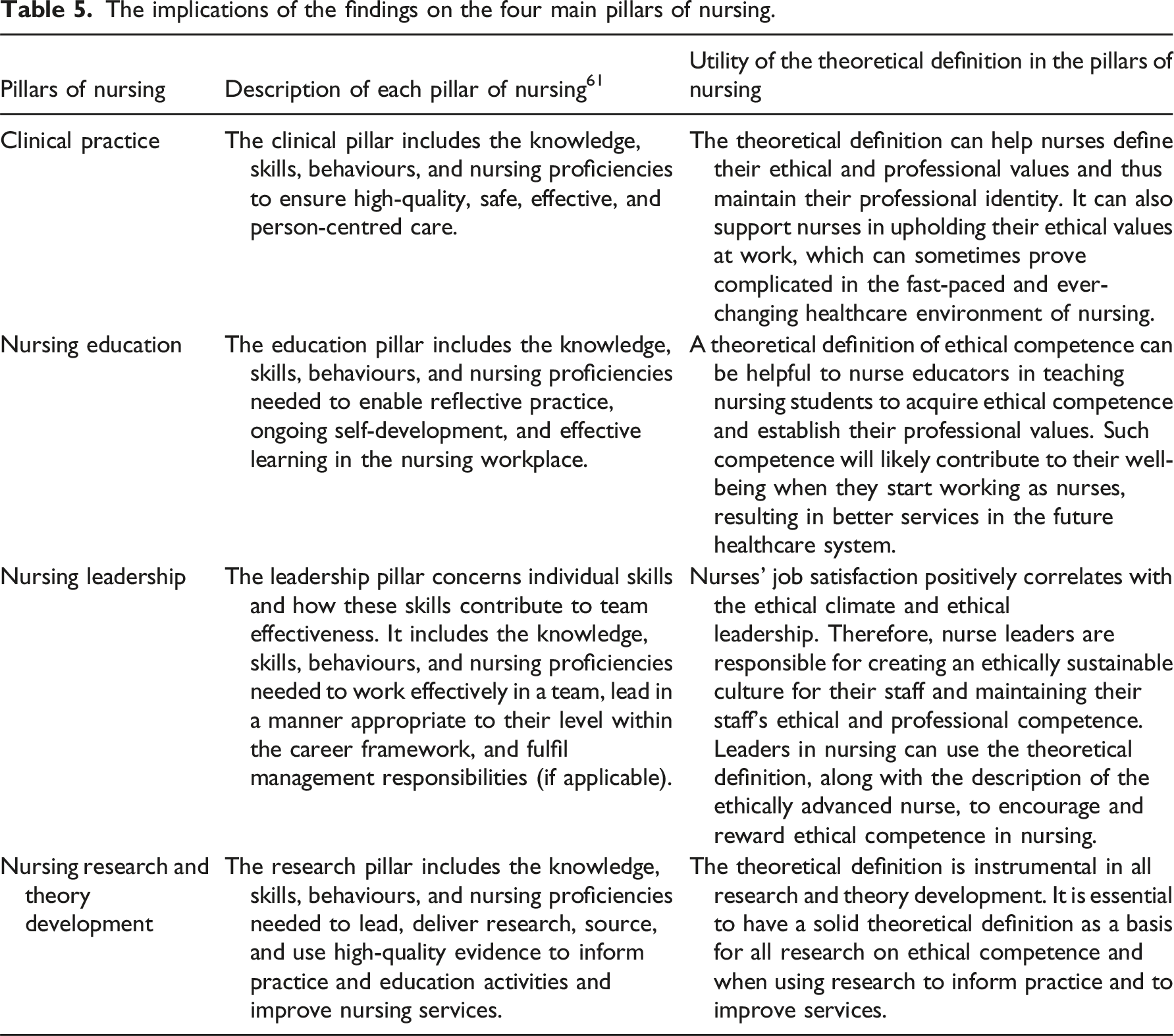
This study is essential to nursing as a discipline and profession. The findings provide a theoretical definition of ethical competence in nursing and the qualities characterising ethically competent nurses, which can be of great value in clinical practice, nursing education, leadership, and nursing research and theory development.
Keywords
Introduction
Ethical competence consists of several components. The three key components are knowing how to be (fr. savoir être), knowing (fr. savoir), and being able (fr. savoir faire).1,2 Ethical competence is critical to providing good nursing care, 3 but a theoretical definition of ethical competence has yet to be found within general healthcare or nursing.
Theoretical definitions deepen our understanding of fundamental concepts. These definitions are called ‘theoretical’ because they aim to develop a ‘theory’ about the nature of the concept in question. Using our current knowledge about a specific concept, we define it based on the best insights available. 4 Professional fields develop frameworks of commonly accepted theoretical definitions to understand these fundamental concepts better. 5
This study aims to develop a theoretical definition of ethical competence within nursing, which could be of value in helping nurses reflect on and improve their practice, 6 for research and theory development and when teaching ethics to nursing students. To present an introduction to the theoretical definition of ethical competence in nursing, we will begin by discussing what ethical competence means within the health sector and then, more importantly, what it means within nursing. We will end the introduction with research on various aspects of ethical competence in nursing, the study’s purpose, and the research questions.
Ethical competence in the health sector
In every discipline, knowledge is required, and the ability to apply that knowledge is assumed. 7 Academic disciplines must set standards for the minimum professional skills required of professionals in the relevant profession so that students have the knowledge, skills, and abilities they need to possess when graduating. 8 Professional skills include, among other things, cognitive skills, such as knowledge and understanding and the ability to use them in practice; functional skills and technical expertise to be able to carry out specific tasks; and ethical skills, which refer to certain personal and professional values of professionals. 8 Professional competence thus involves not only knowing (fr. savoir) or knowing how to do something (fr. savoir faire) but also knowing how to be (fr. savoir être), which refers to the values, attitudes, and intrinsic motivation of the individual.
Ethical competence has long been considered a central aspect of all healthcare services 1 ; however, it has yet to be sufficiently studied in healthcare. 3 The increased activity and financial pressure in the healthcare sector, as well as the development of telemedicine, 2 the evolution of the use of AI in healthcare systems, 9 and other circumstances like the ones caused by the COVID-19 pandemic,10,11 have led to increased demands on staff regarding ethical practices. 12 Unfortunately, a scoping review of healthcare professionals’ ethical competence found that healthcare professionals’ ethical competence was limited. 13
Value sensitivity, or recognising value-related issues when they arise in practice, is a vital competence for health professionals. Interestingly, when value sensitivity was measured, nursing professionals recognized and ascribed importance to principle-related issues more than, for example, professionals from hospital management. 14 A concept analysis of ethical competence in healthcare involved personal character strength, ethical awareness, the ability to evaluate morality or moral judgment skills, and willingness to do what is good and right. 15 The authors consider ethical competence to consist of having ethical knowledge and possessing ethical qualities as a professional, including being skilled in interpersonal relations and that ethical skills will likely result in the best possible solutions for the client and better moral well-being of healthcare professionals at work. 15
There are some definitions of ethical competence within the health sector. In a scoping review of healthcare professionals’ ethical competence, 13 the authors found varying definitions and constructions for ethical competence. They decided, however, not to refer to any sole definition. They point out that one author defined ethical competence in terms of moral competence as ‘the ability or capacity of persons to recognize their feelings when they encounter what is morally right or wrong in particular situations and then to reflect on those feelings to direct their decisions and act in ways which bring about the highest level of benefaction for patient’s best interest’. 16 In another definition, ethical competence was defined in terms of character strength, ethical awareness, moral judgement skills, and willingness to do good. 15 However, this definition is generally about healthcare professionals and not specifically about nursing.
Ethical competence within nursing
Nursing is rooted in a holistic approach that emphasizes nurses’ ethical obligations to protect clients’ rights, respect their autonomy, and maintain the client’s dignity, which requires an understanding of what is morally right and the ability to implement it.17,18 Due to changes in healthcare, nurses are increasingly faced with ethical issues in their clinical practice and, therefore, need specific ethical skills. 18 They are responsible for many people’s well-being and quality of life and must meet high technical and ethical competence standards. 19 If nurses fail to do what they believe is right, they will likely experience moral distress, which can negatively impact the quality of care they provide.18,20 Ethical competence has been seen as ethical knowledge and the ability to read situations ethically and reflect critically on what nurses know, stand for, and do. 21 However, ethical competence in nursing does not appear to have been clearly defined, and a theoretical definition of the concept does not exist. 22 In an integrative review in 2016 on ethical competence, Lechasseur et al. 22 contributed considerably to understanding ethical competence in nursing. They cited the following definition of ethical competence from Gallagher in 2006 which was used at that time, ‘the possession of ethical knowledge next to the ability to “see” what a situation presents (ethical perception); to reflect critically about what nurses know, are, and do (ethical reflection); to bring out the ethical practice (ethical behavior); and to “be” ethical’. 21 They note that this definition emphasizes that ethical competence comprises different dynamically interconnected components. They assert that it is akin to an iterative process, complex and in perpetual development, which can be organized in different steps. Lechasseur et al. also note that ethical competence consists of several essential components, such as ethical reasoning, ethical action, or ethical behaviour. However, they found that these essential components are usually not formally defined. Although they initially sought to define ethical competence, these clues changed the aim of their analysis, in the sense that a specific definition of ethical competence was no longer sought. Instead, they catalogued recurring nursing ethics concepts and noted their connections as a second step. They conclude that ethical sensitivity, ethical knowledge, ethical reflection, ethical decision-making, ethical behaviour, and ethical action are all components of ethical competence and resources to be mobilized. 22 Their identification and linkage allow for an understanding of how ethical competence is developed by nurses and are an essential step towards a theoretical definition of ethical competence in nursing.
Growing interest in ethical competence among nurses
There is a growing interest in ethical competence among nurses because their responsibility for the safety and well-being of vulnerable individuals requires a solid knowledge of, among other things, ethical competence.18,19 Ethical climate is a type of organizational work climate. It is the shared perception of ethically correct behaviour, and how ethical issues are handled in the organization. It is an essential component of the nursing environment and has been the focus of several studies. 23 Research shows that increased job satisfaction among nurses positively correlates with a good ethical climate and ethical leadership in the workplace. 24 Nurse leaders are responsible for creating an ethically sustainable culture with their staff. Through their management, they are responsible for maintaining the core art of caring and the ethical and professional competence of the care staff. 25 However, working conditions in modern nursing are increasingly complex and ethically demanding and tend to challenge nurses’ ability to respond to situations on ethically correct grounds, such as due to rapid developments in knowledge and technology, as well as increasing demands for performance. Such conditions can create a variety of ethical dilemmas and cause anxiety and distress, which can lead to burnout in the long run. 17 Interestingly, a study on ethical climate and nurse competence among newly graduated nurses found strong associations between perceived ethical climate and self-assessed competence, turnover intentions, and job satisfaction. 26 Another study emphasised the value of ethical climate in the moral resilience of head nurses, ultimately enhancing their ethical competence. 27
Knowledge and understanding of the main theories of theoretical and practical ethics, the nurses’ code of ethics and the main ethical principles in nursing can be seen as part of the core components of ethical competence in nursing.8,21,22 An integrative review found that professional ethics in nursing consists of values, duties, rights, and responsibilities regulated by national legislation and international agreements and detailed in professional codes. 28 Nurses must adopt ethical and professional values to develop and maintain a professional identity in the ever-increasing ethical challenges. These values concern human dignity, integrity, and justice and can serve as a benchmark for standards, practices, and evaluation of professional nursing services. 29 Nurses also need moral courage to ensure ethically sound nursing care, 30 because ethical competence is crucial in providing good nursing care. 3
Ethics and ethical competence must be fundamental components of nursing education and be integrated into the nursing student curriculum. 22 Research has shown that ethical decision-making training is likely to positively impact the moral development of nursing students, 31 and health science students have long desired a practical course in ethics that would be useful for them in ethical decision-making in clinical situations. 32 Interestingly, a Finnish study found that nurse educators’ teaching of the codes of ethics was rather extensive, and the teaching focus was mainly on the nurse–patient relationship. 33
Research on various aspects of nurses’ ethical competence
Research on various aspects of ethical competence in nursing has increased, for example, on ethical perception, ethical judgment, and ethical behaviour, as well as on ethical sensitivity, ethical awareness, ethical reasoning, ethical self-awareness, and, finally, on moral courage. Some of these studies will now be introduced.
Ethical perception, ethical judgment, and ethical behaviour
In a study on ethical competence in nursing practice, the definition of ethical competence in nursing consisted of the following three dimensions: ethical perception, ethical judgment, and ethical behaviour. 16 However, ethical perception, judgment, and behaviour are essential not only for nurses but also for nursing students. In a systematic literature review of 15 studies regarding nursing students’ and nursing educators’ experiences of the contribution of ethics education to nursing students’ ethical competence, the authors found that ethics education increases nursing students’ ethical perception and develops their reflective and analytical skills as future nurses. Therefore, every effort should be made to ensure nurses’ ethical competence and encourage nursing educators to continue to create the best ways to teach ethics to nursing students to develop their ethical competence right from the start of their nursing education. 34
Ethical sensitivity, ethical awareness, ethical reasoning, and ethical self-awareness
One of the concepts related to ethical competence is ethical sensitivity. A scoping review of nursing students’ moral sensitivity development found three distinct but related dimensions of ethical sensitivity, including (a) increased ethical awareness, (b) the ability to identify and name ethical issues, and (c) improved ethical reasoning. It was found that ethical self-awareness appears to be more loosely related to the other two dimensions, which raises the question of whether ethical self-awareness can be seen as a prerequisite for the other two. 35
Moral courage
A key concept that has emerged within ethical competence is moral courage, which has garnered attention from Finnish nurses and others, emphasizing that it requires significant bravery to stand up for what is right and to live by one’s moral values. A conceptual analysis of moral courage identifies its primary characteristics as actual presence, moral integrity, responsibility, honesty, commitment, perseverance, personal risk, and advocacy for the patient. The precursors to moral courage are recognized as moral sensitivity, conscience, and experience, while the outcomes include personal and professional growth and empowerment. 36 In a descriptive cross-sectional study involving 482 registered nurses, nurses’ self-assessed moral courage was relatively high, and the participants valued honesty and humanity in their communication with patients. This research focused on nurses’ self-assessed moral courage, utilising the Nurses’ Moral Courage Scale. 30 The authors suggest that the results indicate that the participants had internalised the fundamental values of nursing. In a study on the moral courage of 966 Chinese nurses, three levels of moral courage were analysed: low-level, medium-level, and high-level. Most participants belonged to groups with low or medium levels of moral courage. 37 Interestingly, the results revealed that nurses with high moral courage possessed greater abilities to make ethical decisions than those in the other groups. The authors emphasize the need for guidance and training programs to complement nurses’ moral courage and decision-making. They conclude that raising the moral courage of nurses is likely to result in safer nursing care. 37
Research aims and research questions
In summary, ethical competence in nursing is essential. However, according to an integrated literature review, a consensus on the theoretical definition of ethical competence in nursing appears absent.
22
Moreover, a lack of convergence on core content to be taught on nursing ethics in nursing education to ensure ethical competence has been identified.
38
A theoretical definition of ethical competence could be of value in helping nurses reflect on and improve their practice,
6
for research and theory development, and when teaching ethics to nursing students. Even if different parties are promoting ethics and nursing scholars have already worked on this concept, it is still challenging to identify the essential components of ethical competence.
22
This study aimed to determine the essential components of ethical competence in nursing, define them in terms of nursing, and develop a theoretical definition of ethical competence in nursing. The research questions, therefore, were as follows: • What are the essential components of ethical competence in nursing? • What is their definition in terms of nursing? • What is the theoretical definition of ethical competence in nursing?
Research design
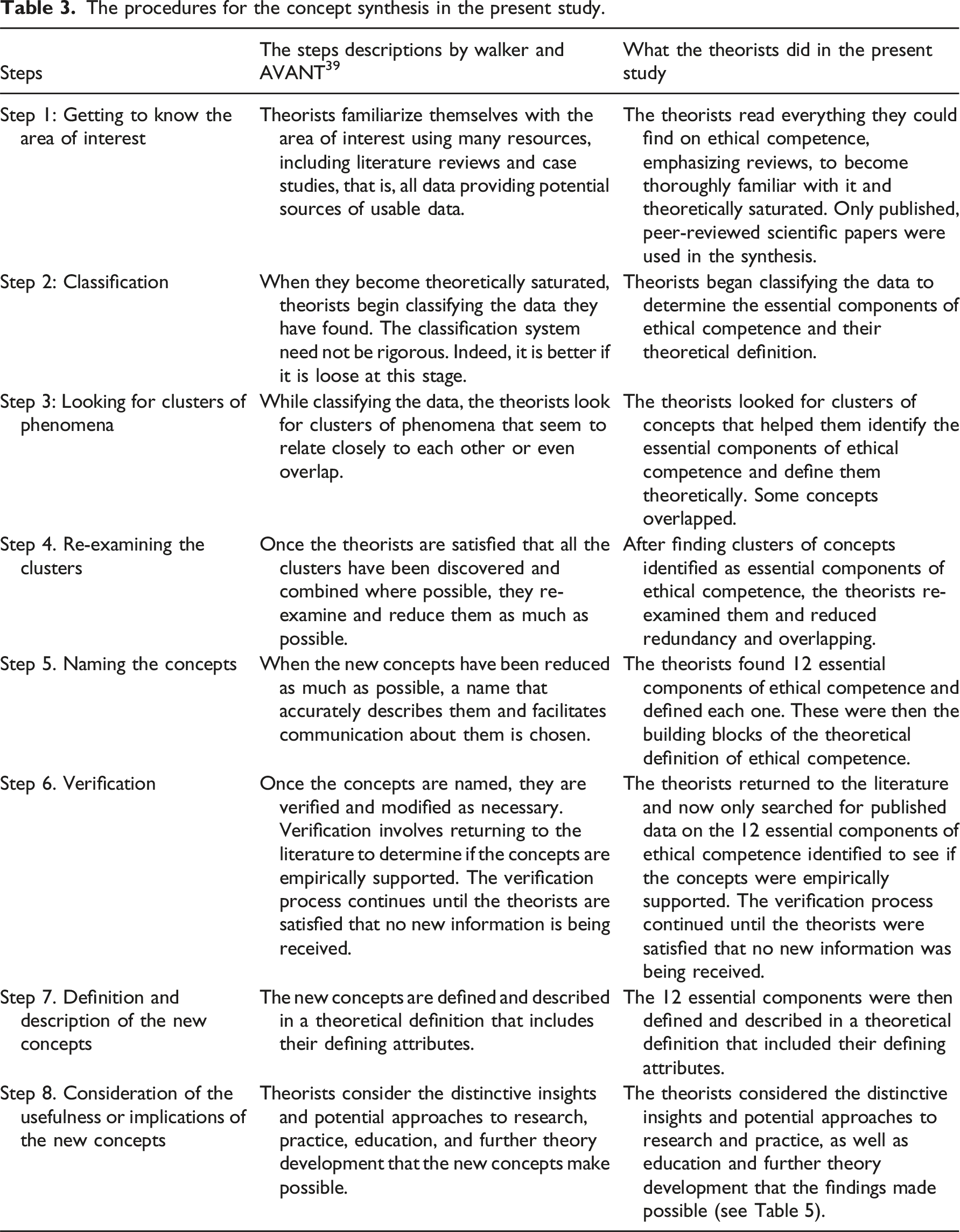
The method used to answer the research questions was concept synthesis, described by Walker and Avant. 39 Concept synthesis provides a mechanism for creating something new from available data. It is one of the knowledge synthesis methods, which means combining separate components to form a coherent whole, focussing on identifying the defining attributes of the concepts. 40 Walker and Avant point out that concept synthesis may be helpful when theorists have clusters of related data but need a way to summarize them. It combines disparate data into something new and gives it a name that makes it possible to communicate clearly about it. 39 The use of concept synthesis, therefore, requires the use of data, and the choice of a synthesis method, qualitative, quantitative, literary, or mixed method, is influenced by the needs of the theorists, the type of literature available on the topic, the state of knowledge in the relevant field, and the quality and completeness of the existing literature. 39 A literary concept synthesis was used since much data on ethical competence is already available, the type of literature is relatively high, for example, many review studies, the state of knowledge is considerable, and the quality and completeness of the existing literature is relatively high. Thorough literature examination is required in literary synthesis to acquire new insights about the phenomena of interest. This examination may yield previously unrecognized concepts for study. Particular to literary synthesis is the idea that literature itself becomes the database. 39 The research work continues until a certain theoretical saturation is reached. The thoroughness of the process in determining which features are most important to the concepts and which are less critical is essential. Concept synthesis culminates in a theoretical definition that includes its defining attributes. 39
Procedure
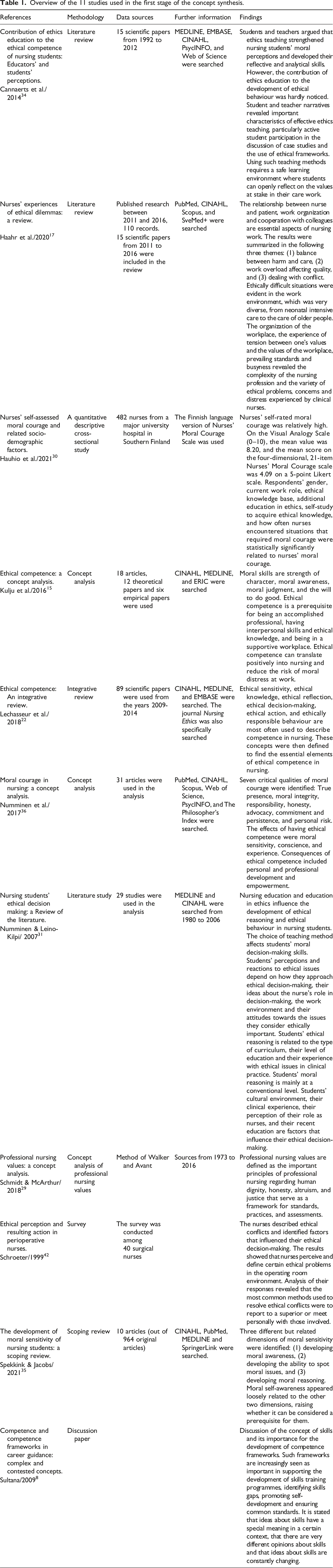
Overview of the 11 studies used in the first stage of the concept synthesis.
Verification
An overview of the 24 studies and peer-reviewed articles that were used in the verification stage of the concept synthesis.

The procedures for the concept synthesis in the present study.
Moral reflection
The theorists considered and respected academic writers’ ethics when reviewing the analysis and contributions of other authors and respected their copyright in all research work for this concept synthesis.
Results
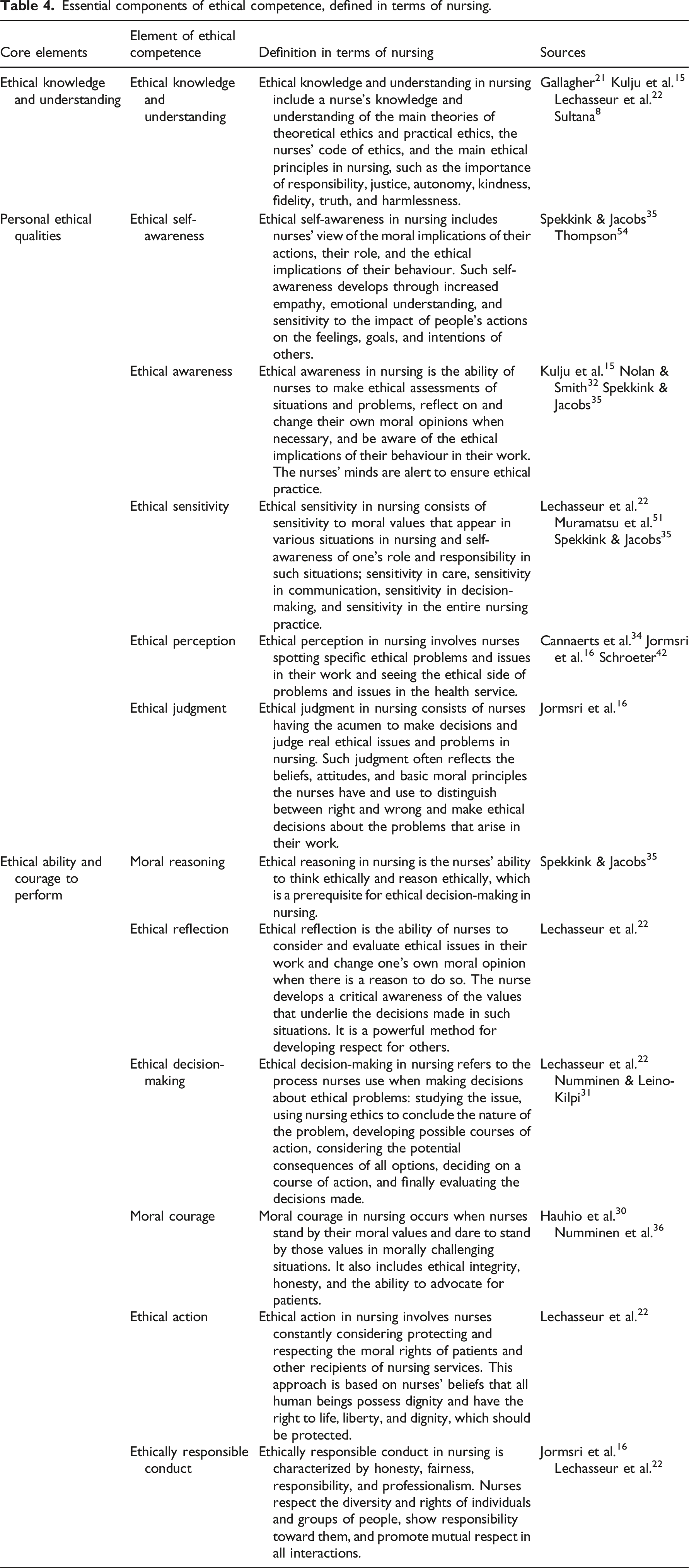
The results of the concept synthesis of ethical competence in nursing are presented in three layers to answer the research questions point by point: (1) Twelve essential components of ethical competence in nursing were identified and defined based on published, peer-reviewed sources. (2) Three core components of ethical competence in nursing were identified based on the twelve sub-components. (3) The theoretical definition of ethical competence in nursing was developed.
Twelve essential components of ethical competence in nursing
Ethical competence in nursing includes nurses’ 1. ethical knowledge and understanding; 2. ethical awareness, 3. ethical self-awareness, 4. ethical sensitivity, 5. ethical perception, 6. ethical judgment, 7. moral reasoning, 8. ethical reflection, 9. ethical decision-making, 10. moral courage, manifested in their work as 11. ethical action, and 12. ethically responsible conduct.
Essential components of ethical competence, defined in terms of nursing.
A theoretical definition of ethical competence in nursing
Nurses considered ethically competent have knowledge and understanding of the main ethical principles in nursing and possess personal ethical qualities, that is, ethical self-awareness, ethical awareness, ethical sensitivity, ethical perception, and ethical judgment as well as having the ethical ability and the courage to perform ethically, that is, capable of moral reasoning, ethical reflection, ethical decision-making, having moral courage, they demonstrate ethical action, and ethically responsible conduct.
Description of ethically competent nurses
Ethically competent nurses have ethical knowledge and understanding; a variety of personal ethical qualities; and the ability and courage to perform ethically. These three main components are described in more detail below.
Have ethical knowledge and understanding
Ethically competent nurses know and understand the leading theories on ethics, practical ethics, the code of ethics for nurses, and the main ethical principles in nursing and realize their importance in their work
Have personal ethical qualities
Ethically competent nurses are aware of their role and the impact of their actions and conduct (ethical self-awareness), can assess situations and problems that arise and ensure that nursing is carried out ethically (ethical awareness), are sensitive to ethical values, show responsibility in complex situations in nursing and nursing practice (ethical sensitivity), and notice ethical problems or issues in their work and healthcare in general (ethical perception). They can make decisions regarding real ethical issues and concerns in nursing that confront them in their work (ethical judgment).
Have the ability and courage to perform ethically
Ethically competent nurses make decisions at work after ethical reflection and justify their choices in an ethical way (moral reasoning), reflect on ethical issues at work, are aware of the ethical values that underlie their own decisions and can change their own ethical opinion when there is reason to (ethical reflection). The nurses are guided by ethics when making decisions about ethical problems at work (ethical decision-making) and have the courage to stand by their ethical values (moral courage). They respect and protect the moral rights of their patients and clients (ethical activity), promote mutual respect and act with honesty, fairness, responsibility, and professionalism as a guide (ethically responsible conduct).
Discussion
One of the aspects of professional competence in each profession is ethical competence, which refers to specific personal and professional values of professionals in the relevant field, 6 and such competencies have long been considered the backbone of health services and in providing good nursing care.1,3,15 The subject of this study was to analyse the essential components of ethical competence in nursing and to present a theoretical definition of the concept. The results describe the essential components of ethical competence in nursing and what characterises ethically competent nurses. Ethically competent nurses possess and understand specific ethical knowledge and ethical principles in nursing and have personal ethical qualities (ethical self-awareness, ethical awareness, ethical sensitivity, ethical perception, and ethical judgement). In addition, ethically competent nurses must have the aptitude and courage to perform ethically (moral reasoning, capable of ethical reflection, ethical decision-making, moral courage, ethical behaviour, and ethically responsible conduct).
Nurses work in an ever-changing and often highly technical environment where they are responsible for the well-being and even the lives of their clients. Ethical issues regularly arise in the work of nurses, where their ethical knowledge and skills are tested as they protect patients' rights and autonomy.16,18 In addition to working in a demanding work environment, nurses and other health professionals must comply with many laws, rules, and guidelines in their work, which often test the moral endurance of nurses. 1 Various things also indicate that nurses' moral distress at work can have an adverse effect on nursing and healthcare18,20 and cause them personal distress.15,17 This information reflects the need for a clear theoretical definition of ethical competence, especially defined in terms of nursing, which was the task of this research. It must not happen that the nursing work is so challenged by the organization and development of the health system that it hinders the professional decision-making of nurses and forces them to compromise the fundamental values of nursing. 17
A code of ethics is the most common form of ethical guidance. 19 A study among nurses from six European countries found that most participants did not understand their code of ethics or did not know its content. 19 A newer study involving a scoping review found that additional research is needed to increase evidence-based knowledge of the impact of codes of ethics.55,56 However, codes of ethics alone are insufficient for ethical competence. Defining ethical competence and developing ways to teach, train, and maintain it is essential, 57 which supports the need for a theoretical definition built on the analysis of the essential components of the concept and the definition of each of the components in terms of nursing.
There have been calls for a better understanding of how nurses and nursing students develop ethical competence and what needs to be considered when designing an ethics course for the profession. 34 Ethical education is not only information or training but also ethical knowledge and competence that require constant reflection and discussion, and must be viewed broadly. 58 It can be concluded that ethical knowledge and competence among nurses could be promoted through intensive, continuous and continuing education in ethics. In such education, the theoretical definition of ethical competence, as defined in terms of nursing in this research, could be helpful.
Considering the importance of ethical competence in nurses’ work, it is remarkable that no theoretical definition of ethical competence in nursing has been found. It is concluded that the theoretical definition of nurses’ ethical competence can benefit nurses and nursing students in their work and contribute to their good moral well-being. Therefore, this study is an essential contribution to nursing as a discipline and a profession.
Future research
Future research could, among other things, focus on investigating ethical competence from various perspectives, such as the perspective of nursing students at different levels of education and the perspective of nursing teachers and nurses in various practice areas. It would also be interesting to investigate whether and how the nurses’ code of ethics in multiple countries is helpful to nurses in their work within the healthcare system, and the relationship between moral courage and the moral well-being of nurses and nursing students in various countries. The Greek term ‘phronesis’, translated as moral sense, moral understanding, or practical wisdom, is also worth studying, as some hope it can help bridge the gap between ethical knowledge and actions.59,60
Strengths and limitations
The research has several strengths, as this is the first theoretical definition of ethical competence in nursing and is vital for nursing. This concept synthesis provides an overview of 12 sub-components that define the concept of ethical competence in nursing, which are grouped into three main components. The 12 sub-components are defined, which can prevent the same term from being used to refer to different phenomena. The first author evaluated all the scientific papers used in the study, which is a theoretical weakness of the study. Other limitations include the quantity and quality of the articles used. Only 11 articles were usable in the first stage of the concept synthesis, so the perspective may be limited. Despite the limitations, the current findings help clarify the essential components of ethical competence in nursing and offers a much-needed theoretical definition of ethical competence in nursing.
Implications of research results
The implications of the findings on the four main pillars of nursing.
Footnotes
Acknowledgements
The authors thankfully acknowledge the invaluable support of the University of Akureyri.
Declaration of Conflicting Interests
The authors declare no potential conflicts of interest with respect to the research, authorship, and/or publication of this article.
Funding
The authors disclose receipt of the following financial support for the research, authorship, and/or publication of this article: Financially supported by the Háskólinn á Akureyri (University of Akureyri).
